
The era of scheduling your day around a 50-gallon tank’s recovery time is over. Power vent water heaters and their tankless successors have fundamentally shifted what home hot water can be: on demand, consistent, and without the physical footprint of traditional storage tanks. For homeowners contending with limited space, efficiency regulations, or a household that burns through hot water before breakfast is done, the move away from a standard atmospheric vent is both a space-saving and performance-driven upgrade.
I’m Min — the co-founder and writer behind Gadgets Feed. This guide is built on weeks of deliberate research: cross-referencing flow rates, energy factors, venting requirements, and warranty structures across dozens of models to isolate the real-world performance differences that actually matter to your home.
Whether you’re replacing a failing tank or building from scratch, selecting the right 50 gallon water heater power vent hinges on understanding venting material, BTU output for your climate, and whether condensing technology fits your existing plumbing. This guide breaks down every critical spec.
How To Choose The Best 50 Gallon Water Heater Power Vent
Selecting the right power vent water heater goes beyond simply matching capacity. The BTU rating dictates how fast the unit can recover, while the venting material (PVC or metal) determines compatibility with your home’s existing exhaust setup. For many, a condensing model with a high UEF can slash operating costs compared to non-condensing alternatives.
Understanding BTU Output and Flow Rate
BTU (British Thermal Unit) is the measure of heat output. A standard 50-gallon tank might fire at 40,000 BTU, while a tankless unit can exceed 180,000 BTU. Higher BTU means faster heat recovery and the ability to deliver hot water to multiple fixtures simultaneously. However, it also requires a larger gas line — check your existing supply and meter capacity before purchasing.
Condensing vs. Non-Condensing Technology
Condensing units capture exhaust heat that would otherwise escape, recycling it to preheat incoming cold water. This pushes UEF ratings above 0.90, often saving homeowners hundreds over the unit’s lifespan. Non-condensing models are simpler and cheaper upfront but lose efficiency, especially in colder climates where incoming water temperatures are lower.
Venting Material and Installation Flexibility
Power vent and condensing tankless units can vent through Schedule 40 PVC pipe horizontally (through a sidewall) rather than requiring a metal chimney. This dramatically reduces installation complexity and cost, making them viable for basements and interior closets. Always verify whether a direct vent kit is included or needs to be purchased separately.
Quick Comparison
On smaller screens, swipe sideways to see the full table.
| Model | Category | Best For | Key Spec | Amazon |
|---|---|---|---|---|
| Rinnai RXP199iN | Premium | Top-Tier Performance | 11.1 GPM, UEF 0.98 | Amazon |
| Rinnai CX199iN | Premium | Whole-Home Demand | 11.1 GPM, 199k BTU | Amazon |
| Rinnai RU199iN | Premium | Continuous Flow | 11 GPM, Circ-Logic | Amazon |
| Rheem RTGH-84DVLN-2 | Premium | Leak Detection Safety | 8.4 GPM, Condensing | Amazon |
| Rinnai RX199iN | Premium | Versatile Venting | 11.1 GPM, Smart Sense | Amazon |
| Noritz NRC71DVNG | Mid-Range | Quiet Operation | 7.1 GPM, Condensing | Amazon |
| Noritz NRC66DVNG | Mid-Range | Small Footprint | 6.6 GPM, PVC Vent | Amazon |
| Rheem RTGH 8.4 GPM | Mid-Range | Balanced Value | 8.4 GPM, 157k BTU | Amazon |
| MIZUDO 199k BTU | Mid-Range | WiFi Smart Control | 10.3 GPM, Sealed Vent | Amazon |
| Westinghouse Smart 180k | Budget-Mid | Smart Home Integration | 7.9 GPM, ±1°F Stability | Amazon |
| APUS 190k BTU | Budget | Outdoor Installation | 8.1 GPM, 190k BTU | Amazon |
| GASLAND Gasmart E | Budget | Entry-Level Savings | 7.6 GPM, UEF 0.8 | Amazon |
| Dometic WH-10GEA | Specialty | RV Replacement | 10 Gallon, 10k BTU | Amazon |
In‑Depth Reviews
1. Rinnai RXP199iN

The RXP199iN is Rinnai’s most advanced residential unit, packing a built-in recirculation pump alongside a condensing design that achieves a UEF of 0.98. The recirculation pump is a standout: it learns your household’s usage patterns and reduces the “cold water sandwich” that plagues standard tankless setups. That means hot water arrives at fixtures far faster, conserving both water and energy.
With 11.1 GPM and 199,000 BTU, this unit handles up to seven fixtures simultaneously without a noticeable pressure drop. Smart-Circ technology provides efficient scheduling, and the versatile Versa Vent system allows indoor or outdoor installation using Schedule 40 PVC. The integrated pump is slightly louder than ideal in economy mode, but the energy savings over a traditional 50-gallon gas tank are immediate.
Installation is DIY-friendly for experienced homeowners but requires proper gas line sizing and PVC vent routing. Rinnai recommends professional installation to protect the warranty, and the included mounting bracket simplifies wall attachment. For families looking to eliminate tank recovery delays and cut utility costs, the RXP199iN is the most complete package available.
Why it’s great
- Built-in recirculation pump with Smart-Circ
- UEF 0.98 condensing efficiency
- Indoor or outdoor installation flexibility
Good to know
- Recirculation pump can be louder than desired
- Professional installation recommended for warranty
- Controlr module sold separately for WiFi
2. Rinnai CX199iN

The CX199iN is a commercial-grade condensing unit that fits seamlessly into residential applications. Its 97% thermal efficiency means that nearly every dollar spent on gas goes directly into heating water, making it one of the most cost-effective options over a 10-year lifespan. Users report noticeable drops in monthly gas bills after replacing older tanks.
This model supports up to 11.1 GPM and includes an optional recirculation conversion kit for faster hot water delivery. The Smart Sense gas control automatically adjusts for natural gas or propane without manual conversion kits. Multiple reviews highlight rapid hot water delivery even to remote bathrooms, and the unit’s quiet operation is a major plus compared to lower-tier tankless heaters.
The CX199iN is slightly taller than standard residential models, so verify your installation space before purchasing. The heat exchanger warranty is robust, and owners appreciate the Bluetooth connectivity via the Rinnai Central App for monitoring and troubleshooting. This is a serious upgrade for homes that demand uninterrupted hot water with minimal wasted energy.
Why it’s great
- 97% thermal efficiency for maximum savings
- Smart Sense auto-fuels natural gas or propane
- Optional recirculation conversion kit
Good to know
- Taller than standard residential units
- Requires professional installation for best results
- No built-in recirculation pump
3. Rinnai RU199iN

The RU199iN is a proven workhorse, with owners reporting reliable performance over five-plus years with consistent temperature delivery and no pressure drop under heavy loads. Its Circ-Logic technology pairs with an external pump to offer on-demand recirculation, reducing hot water wait time across the house without excessive energy waste.
Flow rate reaches 11 GPM, supporting up to seven appliances at once. The Energy Star qualification and uniform energy factor of 0.105 ensure this unit meets modern efficiency standards. Users highlight the space savings: Rinnai tankless heaters free up significant floor area compared to a 50-gallon tank, and the 120V electrical connection simplifies wiring.
Some buyers note that Amazon’s installation service may refuse to install tankless units, so plan for a local plumbing professional. The unit is compatible with Rinnai’s Controlr module for WiFi monitoring, though the module is sold separately. For a family that needs reliable, high-volume hot water without the tank footprint, the RU199iN is a strong choice.
Why it’s great
- Proven long-term reliability (5+ years)
- Circ-Logic for on-demand recirculation
- Energy Star qualified with solid warranty
Good to know
- Amazon installation service may not install tankless
- WiFi module purchased separately
- Slightly longer cold startup delay (10-15s)
4. Rheem Prestige RTGH-84DVLN-2

The Rheem Prestige distinguishes itself with integrated water and gas leak detection that automatically shuts the unit down and displays an error code. This safety feature, combined with condensing technology, makes it a premium pick for homeowners who want proactive protection against catastrophic leaks. The unit weighs 77.9 pounds; its solid build quality contrasts sharply with lower-mass alternatives.
Flow rate is 8.4 GPM with 199,000 BTU, suitable for most large households. Owners report instantaneous heat and quiet operation once installed, though the packaging has drawn criticism — units have arrived with superficial dents. Rheem’s customer service is responsive for error code troubleshooting, but some users experienced prolonged resolution times for complex issues.
This Rheem model is best suited for replacements where the existing gas line and electrical are already in place. The 15-year heat exchanger warranty is among the best in this class, adding long-term value. The combination of leak detection, condensing efficiency, and a well-known brand makes it a compelling, albeit heavier, option.
Why it’s great
- Built-in water and gas leak detection
- 15-year heat exchanger warranty
- Condensing design for high efficiency
Good to know
- Packaging can lead to cosmetic damage in transit
- Heavier than comparable units (77.9 lbs)
- Customer support experiences vary
5. Rinnai RX199iN
The RX199iN is Rinnai’s mid-range ultra-high efficiency model, achieving a UEF of 0.98 while being installable indoors or outdoors with the same Versa Vent system. The Smart Sense gas control automatically detects propane or natural gas, eliminating conversion kit confusion. This makes it an excellent choice for homeowners who want premium efficiency without the added cost of a built-in recirculation pump.
Flow rate reaches 11.1 GPM, handling seven fixtures concurrently. The Quick Flush feature simplifies descaling maintenance, a critical task for tankless longevity. Owners praise the unit’s quiet operation and consistent temperature output, even with simultaneous shower, dishwasher, and laundry usage. The compact footprint (18.5 inches wide, 30.11 inches tall) fits in tight utility spaces.
WiFi control requires the optional Controlr module, which is a separate purchase. Some users note a delay in hot water reaching fixtures more than 25 feet from the unit, which is typical for tankless systems without recirculation. For medium to large families prioritizing efficiency and reliability over built-in extras, the RX199iN is a top-tier value.
Why it’s great
- Ultra-high efficiency UEF 0.98
- Versa Vent for indoor or outdoor install
- Smart Sense auto-fuels any gas type
Good to know
- WiFi module purchased separately
- No built-in recirculation pump
- Requires professional installation for warranty
6. Noritz NRC71DVNG

Noritz has a reputation for tankless reliability, and the NRC71DVNG condensing model keeps that tradition strong. At 7.1 GPM, it is purpose-built for smaller to medium households (3-4 people) who want endless hot water without oversizing. The direct vent capability using standard PVC pipe makes retrofitting into existing mechanical rooms significantly easier than units requiring metal chimney venting.
Owners consistently highlight the unit’s quiet operation — several reviewers noted they can barely hear it running even when installed near living spaces. The compact footprint (17 inches wide, 27 inches tall) is among the smallest for condensing tankless heaters, freeing up valuable wall space. The remote thermostat and 6-foot power cord are included, reducing the number of additional purchases needed.
One caveat: the unit’s maximum temperature is capped at 140°F, which is standard but leaves less room for mixing at the tap. Customer service experiences have been mixed, with some users reporting long hold times. For a well-built, compact, and quiet condensing unit for moderate hot water demand, the Noritz NRC71DVNG is a solid mid-range contender.
Why it’s great
- Very quiet operation in living spaces
- Compact footprint for tight installations
- PVC direct vent simplifies retrofits
Good to know
- Lower flow rate (7.1 GPM) for smaller homes
- Max temperature capped at 140°F
- Customer service wait times can be long
7. Noritz NRC66DVNG
The NRC66DVNG is the smaller sibling in Noritz’s condensing range, offering 6.6 GPM of endless hot water. Its compact dimensions (13.8 inches wide, 23.6 inches tall) make it one of the most space-efficient condensing units on the market, ideal for apartments, small basements, or utility closets. The ability to vent with standard Schedule 40 PVC is a clear advantage over atmospheric vent units that need metal pipe.
Owners report gas savings of 10-20% after replacing conventional tank heaters. The unit delivers consistent digital temperature control and eliminates the “cold sandwich” effect typical of cheaper tankless designs. One experienced user successfully replaced the same 11-year-old Noritz model and praised the straightforward installation process.
Some users note the fan noise is more audible than expected, particularly when the unit is running at full BTU. Additionally, regular descaling and annual cartridge replacement are necessary for maintaining peak efficiency. As a 6.6 GPM unit, it is not ideal for homes with multiple simultaneous high-flow demands. For a focused, efficient solution for smaller households, the NRC66DVNG delivers.
Why it’s great
- Extremely compact size for tight spaces
- Uses standard Schedule 40 PVC venting
- Proven long-term reliability and easy replacement
Good to know
- Fan noise is noticeable at high output
- Requires regular descaling and maintenance
- Not suitable for high simultaneous demand
8. Rheem RTGH Series 8.4 GPM
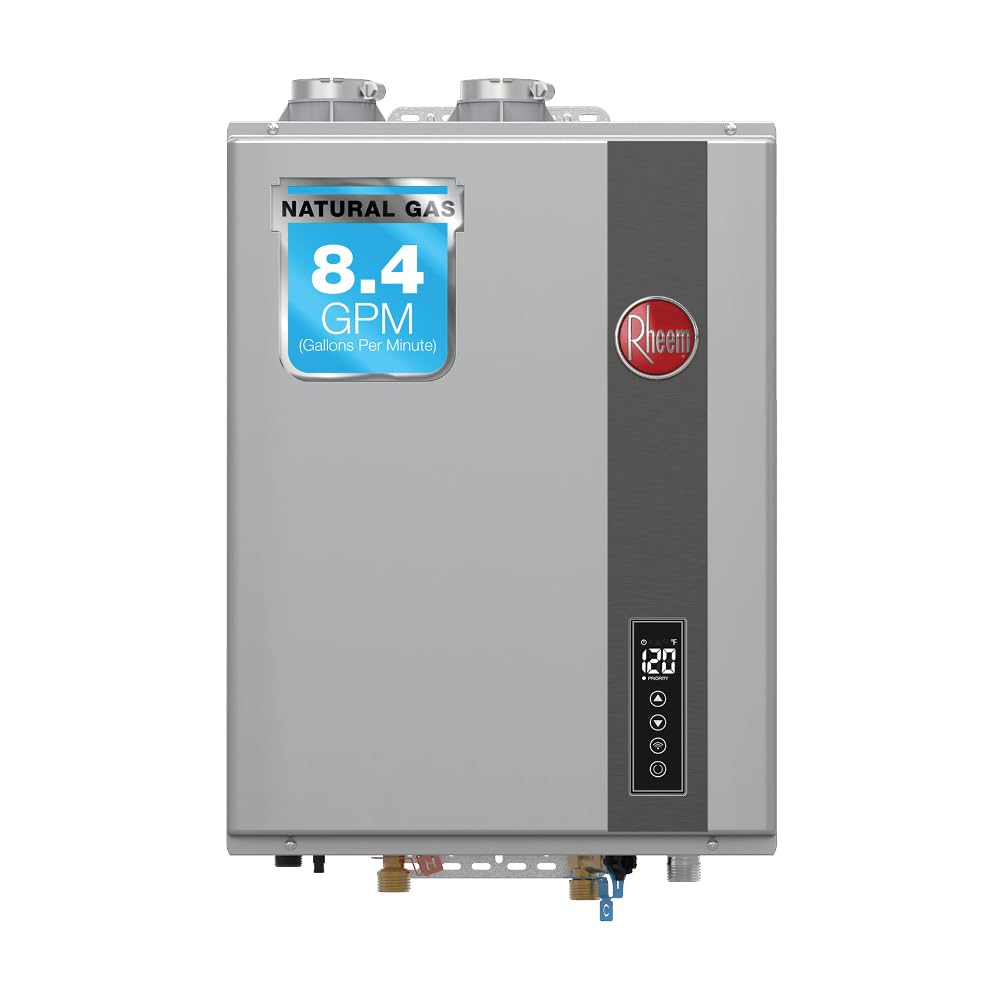
Rheem’s RTGH Series 8.4 GPM unit is a non-condensing tankless water heater that emphasizes simplicity and proven engineering. With 157,000 BTU and a temperature range of 100–140°F, it supports most household demands without the complexity of condensing technology. Users who have had the unit for 5-6 years report consistent performance, including reliable winterization and spring restart cycles.
The warranty structure is strong: 1 year labor, 5 years parts, and a remarkable 15 years on the heat exchanger. Owners note that the 120V electrical installation is straightforward, and the unit’s stainless steel construction resists corrosion. Multiple users observed a measurable drop in their electric bill (up to 75% reported in one review) with only a minimal increase in gas consumption.
Some users experienced a slight water pressure drop when running multiple fixtures simultaneously. The non-condensing design is slightly less efficient than condensing rivals, but it also means fewer internal components to fail. For homeowners who prefer a simpler, serviceable tankless heater from a major brand with excellent warranty support, the RTGH Series is a dependable choice.
Why it’s great
- 15-year heat exchanger warranty
- Proven 5-6 year reliability
- Simpler non-condensing design reduces failure points
Good to know
- Slight pressure drop under heavy simultaneous load
- Non-condensing is less efficient than condensing units
- Installation can be challenging without experience
9. MIZUDO 199,000 BTU
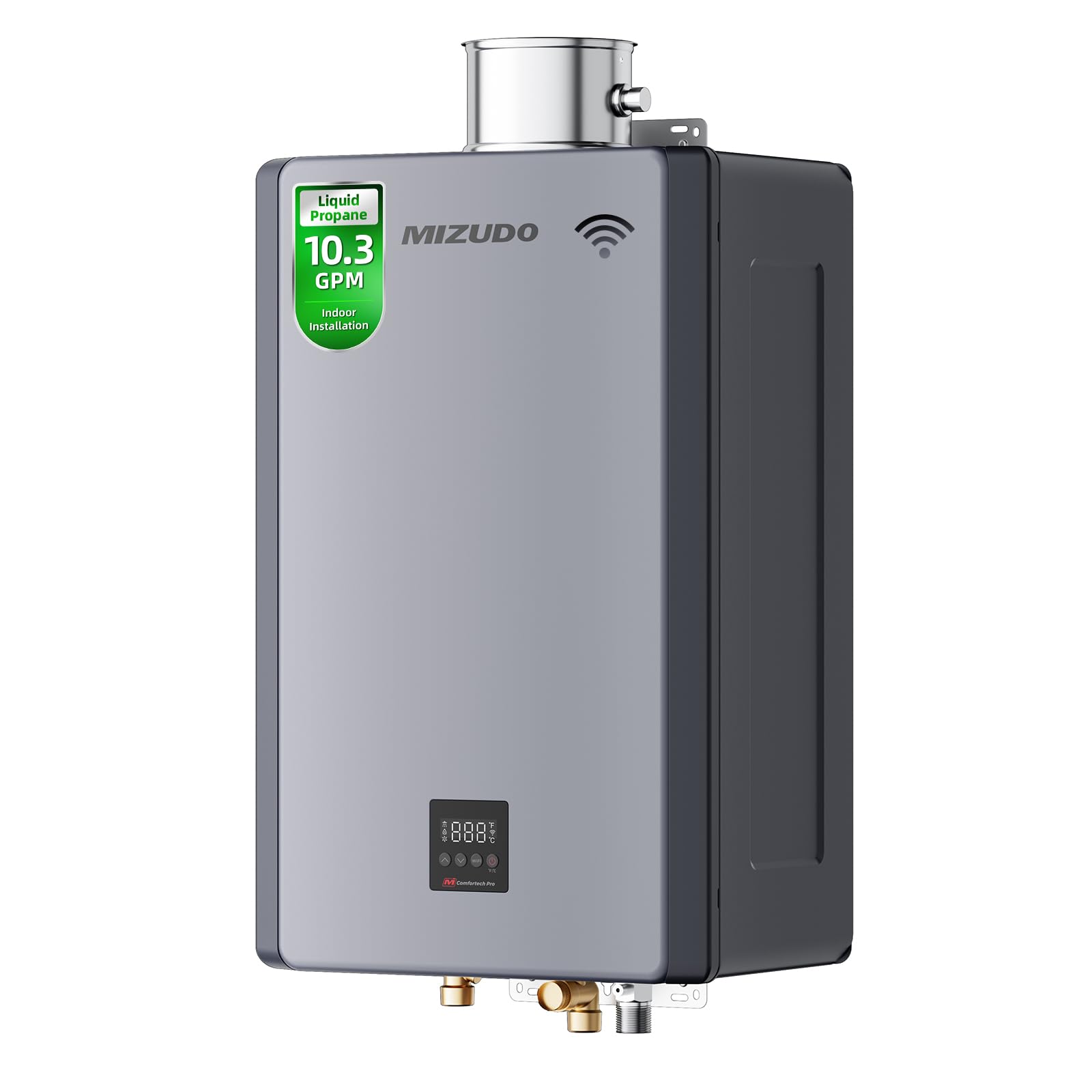
MIZUDO packs aggressive specs at a competitive price point: 199,000 BTU, 10.3 GPM flow rate, and a dedicated WiFi app for remote temperature control and scheduling. The sealed direct vent system draws 100% of combustion air from outside, which preserves indoor air quality and eliminates the need for additional room ventilation — a significant advantage for tightly sealed modern homes.
Users praise the straightforward installation process and the unit’s ability to support large households (5-7 fixtures). The 6-stage gas modulation maintains water temperature within ±1°F stability, effectively eliminating sudden temperature swings. The anti-freeze protection rated to -13°F makes it a viable option for colder climates.
Some users noted that the gas connection fitting requires a 1/2-inch MIP adapter, not included. The warranty (2 years full, 5 years heat exchanger) is shorter than industry leaders. The unit is also heavier than similarly rated alternatives at 55.5 pounds. For tech-forward homeowners who prioritize remote control and sealed combustion, MIZUDO offers strong value with modern features.
Why it’s great
- WiFi app control for remote temp management
- Sealed direct vent preserves indoor air quality
- 10.3 GPM flow for large households
Good to know
- Gas connection may require additional adapter
- Shorter warranty compared to top-tier brands
- Heavier than some competitor units
10. Westinghouse Smart 180,000 BTU
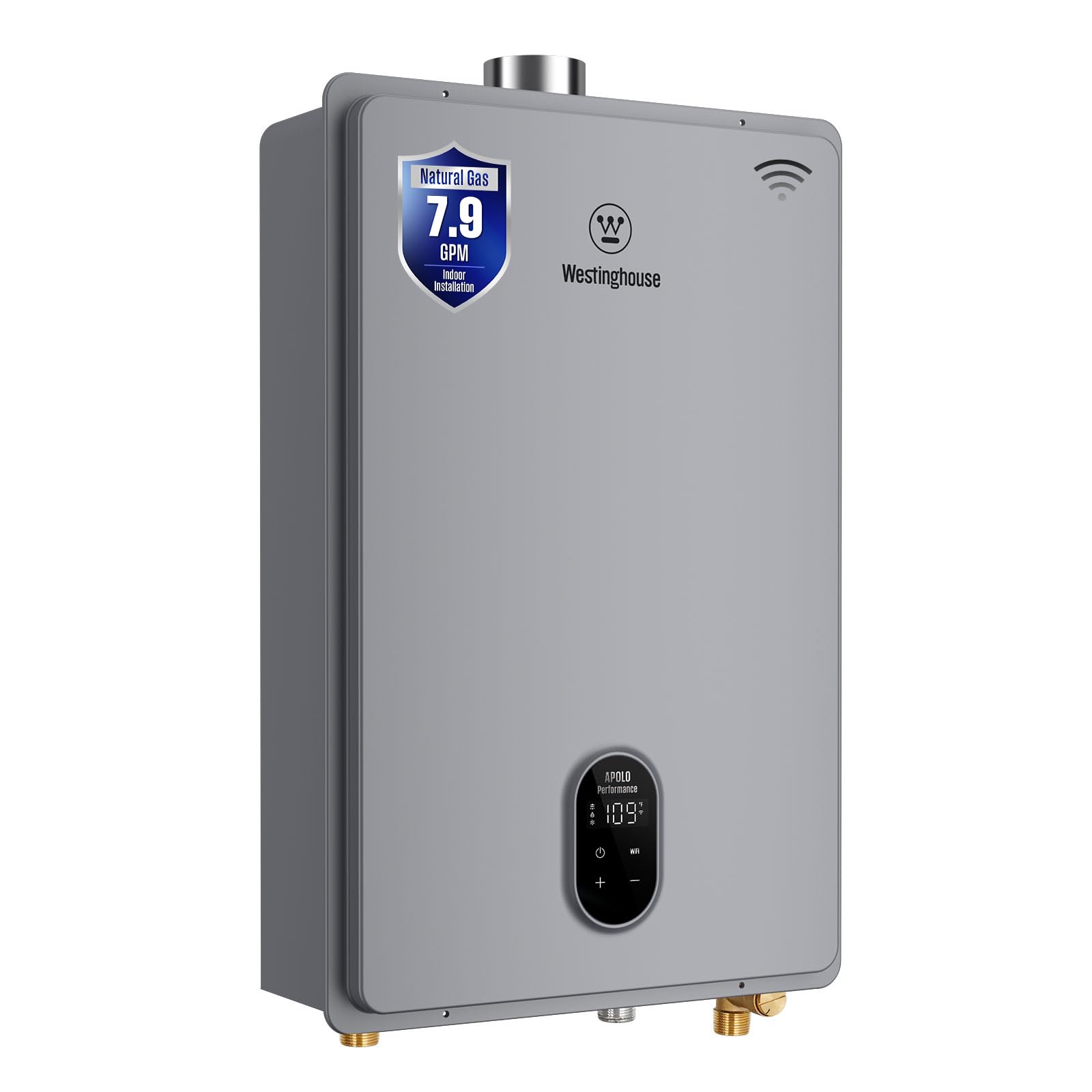
Westinghouse brings its recognizable brand to the tankless market with a 180,000 BTU indoor unit featuring WiFi app control and a sleek LED display. The ±1°F temperature stability, driven by self-modulating gas and water flow technology, is a standout specification in this price tier — it practically eliminates the temperature roller coaster common in entry-level tankless heaters.
With 7.9 GPM, it supports 3-5 fixtures comfortably. The CSA certification and freeze protection provide peace of mind for indoor installations in climates that dip below freezing. Users highlight the easy startup procedure and the wireless remote control that comes included — a nice addition over units that require a separate module for remote adjustments.
Some buyers noted difficulty finding a contractor willing to install a tankless unit they didn’t supply, and there is a brief hot water delay (1-2 minutes) typical of non-recirculating tankless systems. The Westinghouse unit offers a strong combination of smart home integration, reliable performance, and user-friendly features at a mid-range budget point.
Why it’s great
- WiFi app control with included wireless remote
- ±1°F temperature stability eliminates cold bursts
- CSA certified with freeze protection
Good to know
- Typical hot water delay without recirculation
- Finding a contractor for install can be challenging
- Not suitable for extremely high simultaneous demand
11. APUS 190,000 BTU
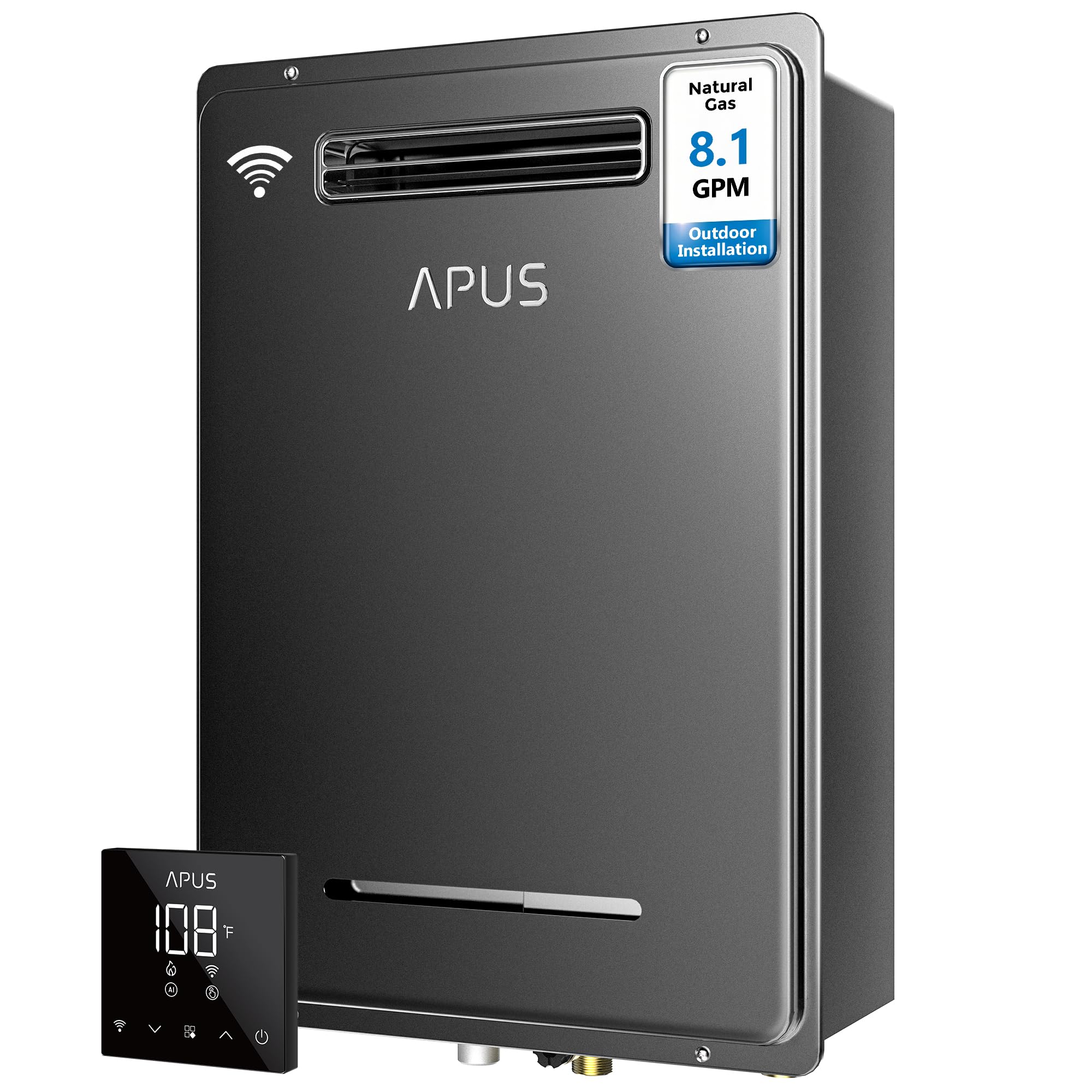
APUS offers a compelling outdoor tankless water heater for homeowners who want to keep the mechanical noise and combustion air entirely outside the living envelope. With 190,000 BTU and 8.1 GPM, it can support three showers and two faucets simultaneously. The 100% oxygen-free copper heat exchanger is 30% more efficient than standard copper, contributing to the claimed 20% energy savings.
The outdoor chassis is built to handle harsh conditions: it features a 10-level wind rating and electric anti-freeze protection, so it won’t shut down in gusty or freezing weather. Ultra-low 0.79 GPM minimum flow means it activates even with weak water pressure, a common issue in older homes or well-water systems. The included Tuya-compatible WiFi controller allows temperature adjustments from 95°F to 149°F.
One catch: the valve body for water connections is sold separately, which adds an unplanned cost and trip to the hardware store. Additionally, outdoor installation requires careful routing of gas and water lines with heat tape and foam insulation in cold climates. For those with an accessible outdoor wall and a desire to free up interior space, the APUS delivers robust performance at a budget-friendly price.
Why it’s great
- Outdoor installation saves interior space
- 100% oxygen-free copper heat exchanger
- 10-level wind resistance and freeze protection
Good to know
- Valve body for water connections sold separately
- Cold climate installation requires additional insulation
- Outdoor mounting may need extra weatherproofing
12. GASLAND Gasmart E
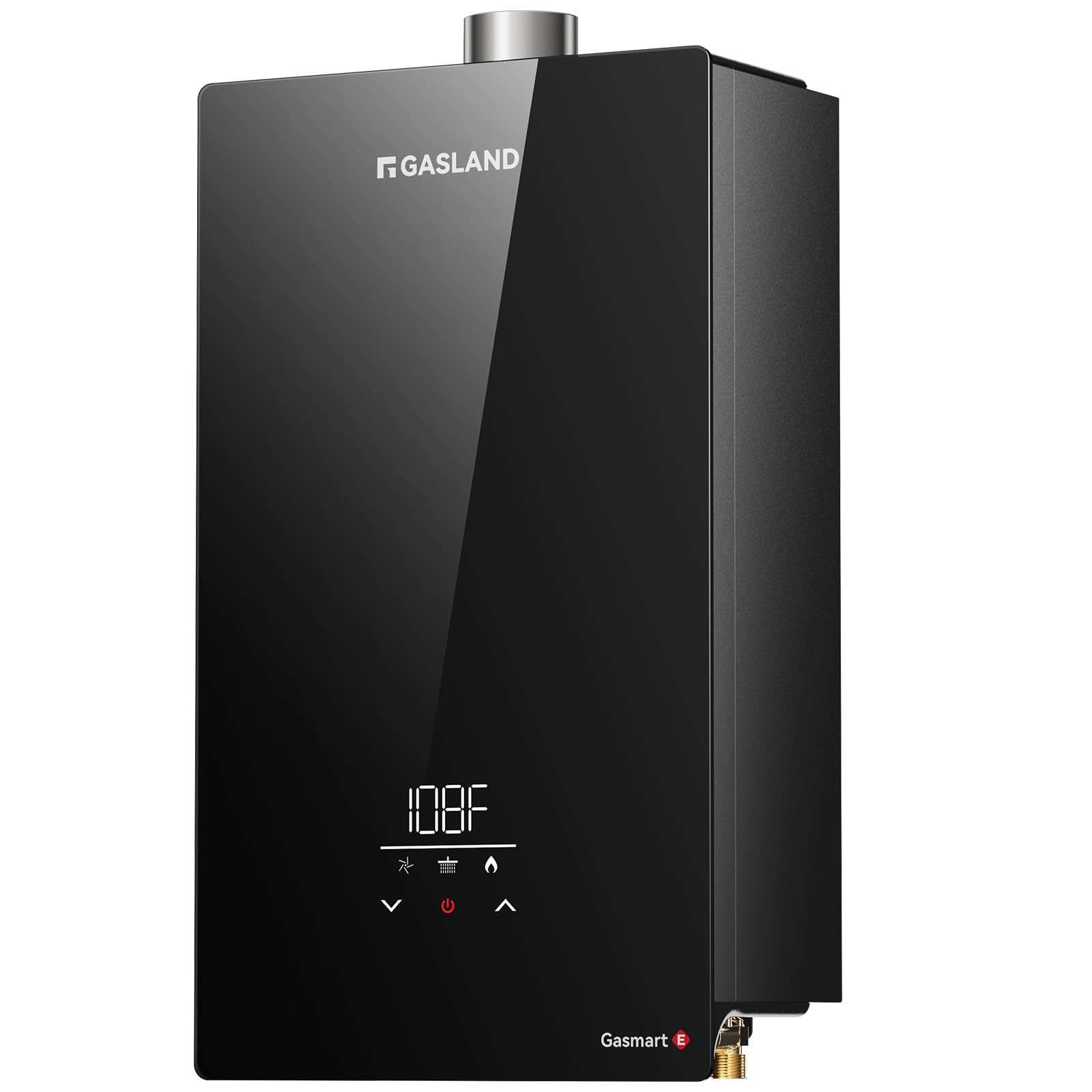
The GASLAND Gasmart E is an indoor natural gas tankless heater designed for homeowners making their first leap from a storage tank. Its UEF of 0.8 is roughly 34% higher than a standard 50-gallon gas tank (UEF 0.6), translating to real savings on utility bills. The 199,000 BTU output supports 7.6 GPM, adequate for 2-3 simultaneous showers.
It is CSA certified and meets high safety standards with multiple protection systems. The compact “suitcase-sized” footprint (14.25 inches wide, 24.69 inches tall) fits neatly into closets or basements. Users note good customer support responsiveness and a straightforward installation process for those with some plumbing experience. The copper heat exchanger is standard but reliable.
There are notable reliability concerns in long-term reviews: one unit failed after only three months, and the return policy does not cover hazardous materials. The inlet and outlet spacing is uneven, requiring careful alignment during installation fan noise may be annoying if placed in a living area. For a budget-conscious buyer, the Gasmart E offers a low barrier to entry, but the reduced build quality and shorter track record pose risks compared to established brands.
Why it’s great
- UEF 0.8 for significant energy savings over tank
- Compact design fits easily into small spaces
- CSA certified with multiple safety features
Good to know
- Reliability concerns with some early failures
- Inlet/outlet spacing can complicate installation
- Not returnable once installed due to hazardous material rules
13. Dometic WH-10GEA

The Dometic WH-10GEA is specifically designed for RV applications, offering a 10-gallon capacity with both gas (10,000 BTU) and 12V electric heating. This dual-fuel approach ensures hot water whether you’re hooked up at a campsite or boondocking off-grid. The lightweight aluminum tank eliminates the need for an anode rod, simplifying maintenance.
The 10-gallon capacity is a 66% increase over standard RV tank sizes (typically 6 gallons), enough for back-to-back showers. The pre-installed winterization bypass kit is a thoughtful addition for cold-weather RV storage. Owners report that the unit serves as a direct fit replacement for older Atwood 10-gallon models with minimal modification.
One downside is poor insulation: owners note the cabinet around the unit can get 15°F warmer due to heat bleed. The gas and electric functions work flawlessly, but the installation requires a dedicated 12V line if the previous unit didn’t use one. For RV owners looking to upgrade their hot water capacity without complex venting, the Dometic WH-10GEA is the correct specialized solution.
Why it’s great
- Dual fuel (gas/electric) for RV flexibility
- 66% larger than standard RV tanks
- Pre-installed winterization bypass kit
Good to know
- Poor insulation causes heat bleed into cabinet
- May need extra 12V line for installation
- Limited to RV/off-grid use — not for whole-home
FAQ
Can a tankless water heater replace a 50-gallon power vent tank?
What is the “cold water sandwich” in tankless water heaters?
How often should I descale a tankless water heater?
Can I install a tankless water heater myself?
Why does my tankless water heater take longer to get hot water to my faucet?
Final Thoughts: The Verdict
For most users, the 50 gallon water heater power vent winner is the Rinnai RXP199iN because it combines a built-in recirculation pump with exceptional condensing efficiency and flexible indoor/outdoor venting. If you want the highest thermal efficiency with commercial-grade build quality, grab the Rinnai CX199iN. And for a compact, quiet unit ideal for smaller homes, nothing beats the Noritz NRC71DVNG.