
A 500 Series chassis isn’t just a metal box — it’s the foundation of a modular recording rig. The right lunchbox powers your preamps, EQs, and compressors with clean voltage and quiet operation, while the wrong one introduces hum, limits headroom, or physically fails mid-session. This guide isolates the spec-level details that separate a pro-capable frame from a budget compromise.
I’m Min — the co-founder and writer behind Gadgets Feed. I’ve spent hundreds of hours cross-referencing power supply ripple specs, backplane trace layouts, and user-reported noise floors across dozens of 500 Series chassis models to separate genuine performance from marketing claims.
Whether you’re outfitting a commercial studio or building a portable production rig, understanding these differences is critical. This guide breaks down the best 500 series chassis on the market for your specific workflow and budget.
How To Choose The Best 500 Series Chassis
Selecting a chassis for your 500 Series modules requires more than counting empty slots. You must evaluate the power supply’s ability to handle high-current modules, the physical build quality for road use or permanent racking, and the backplane configuration that connects to your system. Overlooking these specs can lead to voltage sag, thermal issues, or a chassis that doesn’t fit your rack.
Power Delivery and Slot Current
Each module draws current from the chassis power supply, typically between 120 mA and 250 mA per slot. High-end preamps like the Neve 1073LB can exceed 200 mA. A chassis with a weak or under-rated power supply will suffer from voltage droop when multiple hungry modules are loaded, introducing distortion and noise. Look for a chassis with at least 1.5 A total current on each rail (+16V and -16V) for a six-slot unit, scaling up proportionally with slot count. Linear power supplies are quieter than switching designs, but they run hotter and weigh more — a trade-off worth making for critical tracking applications.
Slot Count and Physical Form Factor
The number of slots directly impacts how you’ll deploy the chassis. A 6-slot lunchbox like the SSL SiX Channel Strip covers a compact tracking rig. An 8-slot or 10-slot chassis offers room for a signal chain (preamp, EQ, compressor) on multiple channels. Beyond slot count, pay attention to the chassis depth and whether it includes a lid for portable use. Road cases with 21″ rackable depth and integrated casters are essential for live or mobile applications, while shallow units fit easier in a standard 19″ rack but may not accommodate deeper modules.
Backplane Configuration and Connectivity
The backplane is the board that routes signal and power between modules and outputs. Most chassis use a passive backplane with individual XLR or TRS connectors per slot at the rear. More advanced chassis include a D-sub (DB25) connector for multi-channel output to a patchbay or interface. Also check for front-panel TRS jacks that bypass the backplane for quick DI or line-level input — a feature on the SSL SiX that’s valuable for mobile engineers. Verify the backplane supports the standard 500 Series pinout (DOA or 51X compatible) if you plan to use non-standard modules.
Quick Comparison
On smaller screens, swipe sideways to see the full table.
| Model | Category | Best For | Key Spec | Amazon |
|---|---|---|---|---|
| Sound Town STR-B8UW | Road Case | Portable 8U rack | 9mm plywood / 21″ depth | Amazon |
| StarTech RACK-24U-20-WALL-OA | Open Frame | Wall-mounted network rack | 200 lbs capacity / 24U | Amazon |
| RackChoice 4U 8-Bay | Server Chassis | Hot-swap storage server | 8x 3.5″ SATA/SAS hot-swap | Amazon |
| SSL SiX Channel 500 | Channel Strip | Studio tracking / mixing | +48V / HPF / Compressor | Amazon |
| RROYJJ 4U 24-Bay | Storage Server | High-density NAS / Plex | 24x SATA/SAS hot-swap | Amazon |
| SilverStone RM52 | 5U Rackmount | High-end PC / workstation | Dual 360mm radiator support | Amazon |
| Neve 1073LB | Mono Preamp | Vocal / instrument tracking | 80dB gain / Marinair transformer | Amazon |
In‑Depth Reviews
1. Sound Town Black Series 8U PA/DJ Rack/Road Case (STRC-B8UW)

The Sound Town STRC-B8UW delivers an all-black anodized hardware aesthetic with 9mm plywood construction and aluminum-reinforced corners. Its 8U rack space and 21-inch rackable depth accommodate most 500 Series chassis and outboard gear. The fully removable front and rear lids provide complete equipment access, which is critical for cabling and module swaps in a live or mobile environment.
Four heavy-duty casters with two foot-brakes and rubber-gripped handles make transport genuinely smooth. User reports confirm the casters arrive bolted inside the case to prevent shipping damage — a thoughtful detail. The twist latches feel secure and have held up over repeated gig cycles, as noted by multiple verified purchasers who use this case for touring microphone racks and wireless systems.
The included rack screws eliminate a common extra purchase, and the blacked-out hardware resists visible scuffs. One user mentioned minor rivet imperfections that didn’t affect structural integrity. For a road-ready enclosure under a premium-tier price point, the build quality and feature set are hard to beat.
Why it’s great
- 9mm plywood with aluminum corners offers genuine tour-grade durability
- Heavy-duty casters with foot brakes simplify transport and setup
- Fully removable lids allow easy access to front and rear panels
Good to know
- At 50.6 pounds, it’s heavy when empty — plan for two-person lifting with gear loaded
- Anodized finish may show wear on high-contact edges over years of touring
2. StarTech.com 2-Post 24U Wall Mount Network Rack (RACK-24U-20-WALL-OA)

StarTech’s 24U open-frame wall-mount rack is built around 2.0mm SPCC cold-rolled steel vertical rails, giving it a 200-pound weight capacity. The adjustable depth range of 12 to 20 inches (30.5 to 50.8 cm) accommodates equipment of varying depths — from shallow patch panels to deeper server chassis. The EIA/ECA-310 compliance ensures compatibility with standard 19-inch rack gear.
Assembly is required, but the ISTA-6 flat-pack packaging and included hardware (M6 cage nuts, screws, and plastic washers) make the build process straightforward. Verified buyers report that the rack feels rock-solid when loaded with four 24-port patch panels and two 48-port switches, with no sagging on the 2-post design. The open frame allows unobstructed airflow, which is essential for cooling dense network gear or audio processing units in a closed environment.
One user noted that the assembly takes longer than expected, but the result is an exceptionally sturdy frame suitable for commercial or home lab use. The 5-year warranty and lifetime technical support reflect StarTech’s confidence in the build. For a wall-mounted solution that needs to hold serious weight without flexing, this design delivers.
Why it’s great
- 200 lbs capacity with cold-rolled steel vertical rails eliminates sag concerns
- Adjustable depth from 12 to 20 inches fits varied equipment depths
- ISTA-6 shipping and 5-year warranty reduce deployment risk
Good to know
- Assembly required — set aside about an hour for a first-time build
- Open-frame design means no side panels for cable hiding or dust protection
3. RackChoice 4U Rackmount Server Chassis 8-Bay Hot-Swappable

The RackChoice 4U chassis packs 8 hot-swappable 3.5-inch SATA/SAS drive bays (2.5-inch compatible) plus one fixed 3.5-inch internal bay into a 26.77-inch deep frame. The backplane uses MiniSAS SFF-8643 connectors, and the package includes two reversed SFF-8643 to 4x SATA 7-pin cables. Motherboard support spans EATX, ATX, MicroATX, and Mini-ITX, giving you wide flexibility for server builds or high-capacity storage servers.
Cooling comes from three pre-installed 120mm PWM ball bearing fans with an additional rear fan option. Users note the stock fans run at 3600 RPM and are loud — described as “like a jet” by one builder — but can be swapped for quieter Noctua units. The sliding rails are included and glide smoothly once installed, though they only provide half extension, limiting front-access serviceability without removal.
The eight full-height expansion slots accommodate graphics cards or RAID controllers easily. One reviewer successfully fitted an oversized GPU with room for power cables. The top-lid design with screws feels sturdy, and the alloy steel construction adds weight but eliminates flex. For a sub-premium-price 4U storage chassis with hot-swap capability, the feature-to-cost ratio is strong.
Why it’s great
- Hot-swap drive bays with MiniSAS backplane enable fast drive replacement without power-down
- EATX motherboard support covers nearly any server board on the market
- Eight full-height expansion slots handle multiple GPUs or RAID/HBA cards
Good to know
- Stock fans are very loud at 3600 RPM — budget for aftermarket replacements
- Included rails only provide half extension, limiting service access while racked
4. Solid State Logic SiX Channel 500 Series SuperAnalogue Channel Strip
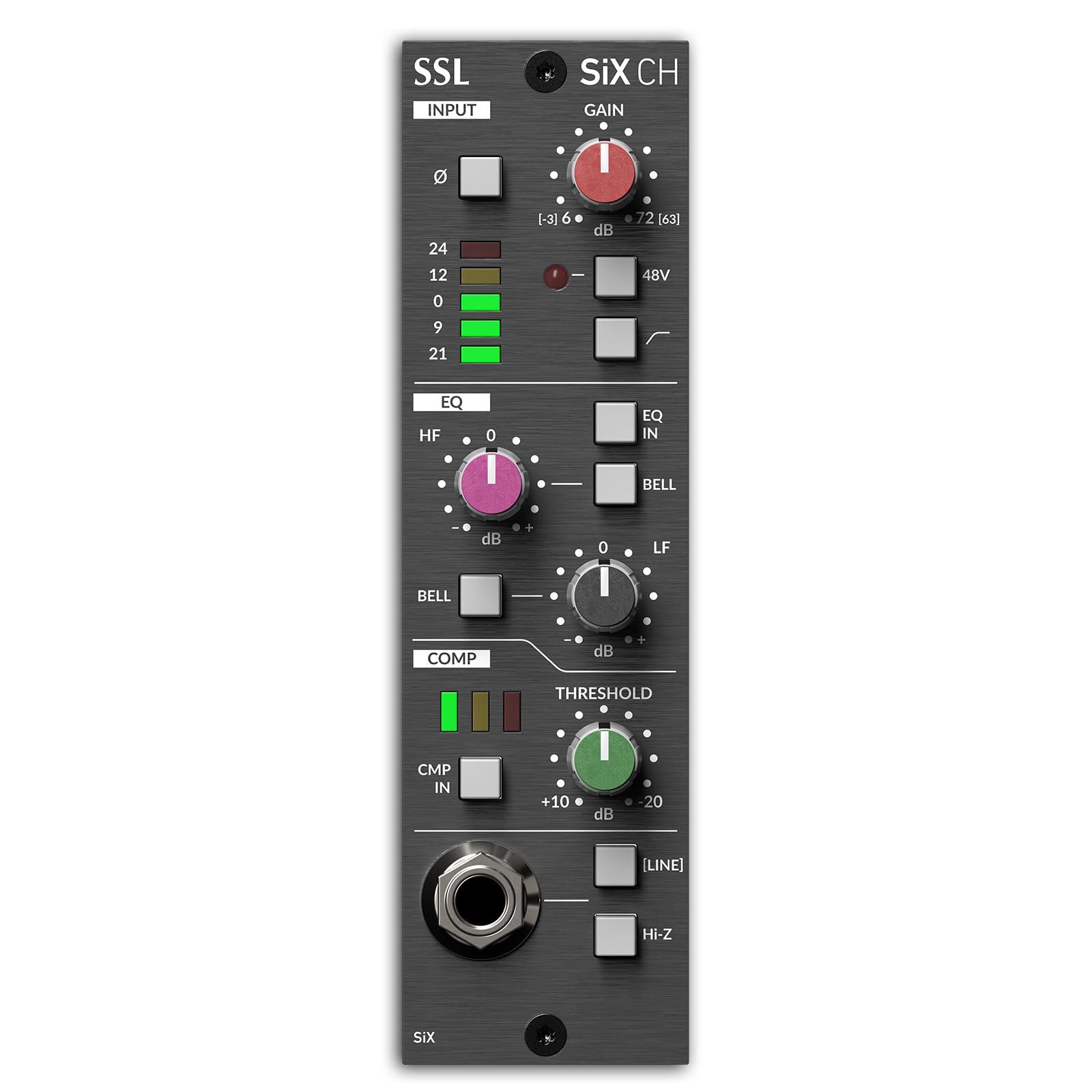
The SSL SiX Channel 500 Series module is a complete channel strip integrating a SuperAnalogue microphone preamp, two-band EQ with switchable shelf/bell on the high band, a variable-threshold single-knob compressor, and a 75 Hz high-pass filter. The +48V phantom power and front-panel TRS line input with a 1 MΩ Hi-Z switch make it equally suited for mic and instrument tracking.
At 11.2 ounces, this is a lightweight module that draws moderate power from the chassis. User reports consistently highlight its punchy sound on drums and overheads, with one engineer noting it pairs exceptionally well with Earthworks microphones. The compressor is described as musical and easy to dial in — a single knob controls threshold, with ratio and attack pre-set for quick operation. The SuperAnalogue circuit delivers 129 dB of dynamic range, keeping noise well below the signal floor even with heavy gain staging.
One critical review noted the lack of a pad switch, which can be an issue with very hot line-level sources. However, for the price point, the SSL SiX provides a cohesive signal path that would cost significantly more in discrete outboard. It’s a strong choice for engineers who want SSL character without the full console investment.
Why it’s great
- SuperAnalogue preamp with 129 dB dynamic range ensures ultra-low noise floor
- Single-knob compressor is intuitive and musical on drums and vocals
- Front-panel Hi-Z input simplifies DI recording without extra gear
Good to know
- No input pad — hot line-level sources may require external attenuation
- EQ curve is voiced, not neutral — best for color rather than transparent correction
5. RROYJJ 4U Rackmount Server Case with 24 Hot-Swappable SATA/SAS Drive Bays

The RROYJJ 4U chassis delivers 24 hot-swappable SATA/SAS drive bays in a 25.59-inch deep, 6.93-inch tall frame. Six internal SFF-8087 Mini SAS backplanes manage the drives, and three 120mm mid-chassis fans plus two 80mm rear fans provide airflow. The 4U rack mount design fits standard 19-inch racks and is suitable for NAS, Plex servers, or backup arrays requiring massive storage density.
User feedback highlights the value proposition: one builder successfully deployed a Micro-ATX board with an i9-13900K, 64GB DDR, and 4x 20TB drives for a Plex server running Unraid. The hot-swap trays are interchangeable and the drive LEDs function correctly — essential for quick drive identification during rebuilds. However, the stock fans are noisy, and several users replaced them with Arctic P12s for quieter operation while maintaining adequate cooling for enterprise drives under 50°C.
The build isn’t without quirks. The fan wall backplane uses a PWM-to-molex conversion, limiting speed control on stock fans. The included standoffs are non-standard sizes, and one user reported that bottom motherboard ports become inaccessible on certain boards. For experienced builders who can work around these issues, the density-to-dollar ratio is excellent. Beginners should budget for aftermarket fans and plan for a careful build.
Why it’s great
- 24 hot-swap bays in a standard 4U form factor provide industry-leading density
- Six SFF-8087 backplanes simplify cabling to a single RAID/HBA card
- Large internal volume accommodates high-TDP CPUs and multiple expansion cards
Good to know
- Stock fans use a proprietary PWM-to-molec conversion — plan to replace them for quiet operation
- Non-standard standoff size and tight clearances require careful motherboard selection
- No manual included — this chassis assumes a builder with prior server experience
6. SilverStone Technology RM52 5U Rackmount Server Chassis

SilverStone’s RM52 distinguishes itself with dual 360mm liquid cooling radiator support in a 5U rackmount frame. This chassis accommodates motherboards from Mini-ITX up to SSI-EEB, making it viable for dual-CPU workstation builds or high-end gaming rigs racked in a studio. The 8.66-inch height provides ample room for large GPU coolers and complex water loops.
Builders report successful installations of RTX 4090 cards alongside a 360mm CPU AIO and a separate 240mm GPU AIO, with good thermal separation. The included front panel USB-C port is a modern convenience for file transfers and peripheral connections. The chassis is prepped for SilverStone’s RMS05-22 sliding rail kit (sold separately), which makes rack installation smooth — one user noted the rails install easily and the case slides in without binding.
Some quality-control issues surfaced: one unit arrived with stripped side panel screws, rendering it unusable out of the box. The included feet are mounted on one side, meaning the chassis sits upside-down if you install them — a minor design oversight. For users committed to water cooling in a rack form factor, the RM52 offers radiator support unmatched by most server chassis. Budget for aftermarket fans if noise is a concern.
Why it’s great
- Dual 360mm radiator support enables serious custom water loops in a rack chassis
- SSI-EEB motherboard compatibility covers dual-socket workstation boards
- Front USB-C port and tool-less rail preparation simplify daily use
Good to know
- Some units have quality issues with stripped side panel screws
- Feet are mounted on the wrong side — plan to leave them off or install upside down
- Sliding rail kit sold separately, adding cost for rack installation
7. Neve 1073LB 500 Series Mono Microphone Preamp

The Neve 1073LB packs the legendary 1073 preamp circuit — including the Marinair transformer and 80dB of gain — into a single-slot 500 Series module. This is the same Class-A design that defined countless classic recordings, now available in a lunchbox format. The audio processing insert feature allows you to patch external gear into the signal path between the preamp and output, expanding routing flexibility.
Users consistently praise the 1073LB for vocal tracking, describing the sound as “a beast” with a rich, harmonically complex character that flatters most voices. On synths and line-level sources, the preamp adds weight and presence, though some users note it can get slightly muddy on Juno-style synthesizers — the optional EQ module would address that. The build quality is typical Neve: robust metal casing, smooth gain pot, and reliable XLR connections.
Customer service issues surfaced around packaging: one unit arrived in the manufacturer’s box with no outer shipping carton, raising concerns about transit protection. The module does not include rack screws — a disappointing omission at this price point. For engineers who want the definitive 1073 sound in a portable format, the 1073LB delivers the transformer mojo that no emulation fully replicates.
Why it’s great
- Authentic Marinair transformer provides the harmonic richness that defines the 1073 sound
- 80dB gain range handles ribbon microphones and quiet sources without an inline booster
- Audio processing insert allows external patching without breaking the signal chain
Good to know
- No rack screws included — you’ll need to supply your own 500 Series mounting hardware
- Some units arrive with inadequate packaging for a premium-priced module
- Single-slot format means you need a chassis with free slots for any complementary EQ module
FAQ
Can I mix modules from different manufacturers in one 500 Series chassis?
What is the difference between a 500 Series lunchbox and a full-size rack chassis?
Do I need a special chassis for 51X modules?
Final Thoughts: The Verdict
For most users, the best 500 series chassis decision comes down to balancing power capacity, portability, and long-term expansion. The Sound Town STRC-B8UW wins for mobile engineers who need a durable road case with deep 21-inch rackable space and integrated casters. If you’re building a permanent studio installation, the SSL SiX Channel Strip offers the best all-in-one signal path with its SuperAnalogue preamp, EQ, and compressor. And for engineers chasing the definitive transformer sound, the Neve 1073LB delivers the 80dB of gain and Marinair character that defines classic recordings — just budget for a power-supply chassis with enough current to feed it.