
Finding a genuine 500 watt amplifier in a market flooded with inflated peak-power claims is harder than tuning a sealed enclosure by ear. Most amps labeled “2000W” barely deliver 300W RMS before distortion sets in, leaving your subwoofer gasping for clean current. The real challenge isn’t finding raw power—it’s identifying an amp that delivers its rated wattage continuously without thermal shutdown or audible noise.
I’m Min — the co-founder and writer behind Gadgets Feed. I’ve spent hundreds of hours cross-referencing CEA-2006 compliance datasheets, dissecting customer dyno tests, and comparing real-world RMS output across the most popular 500W monoblock and multi-channel amps on the market right now. Every recommendation here is backed by verified specs and genuine user experiences, not marketing fluff.
After sorting through over two dozen contenders across every major brand, these nine models represent the only 500 watt amp options that actually earn their power rating on a test bench and in a daily driver.
How To Choose The Best 500 Watt Amp
Selecting the right amplifier for your car audio system goes beyond matching the wattage number on the box. A true 500W RMS amplifier must pair correctly with your subwoofer’s impedance, enclosure type, and electrical system capacity. Overlooking these variables leads to clipped signals, blown speakers, or anemic bass that never hits its potential.
RMS vs Peak Power — The Only Number That Matters
Peak power is a marketing number derived from a momentary burst before destruction. RMS (Root Mean Square) is the continuous power the amplifier can deliver cleanly over hours of listening. A legitimate 500W RMS amplifier will outperform a 2000W peak-rated unit in every real-world scenario because the RMS rating represents sustained, usable output. Always verify CEA-2006 compliance, which standardizes RMS testing across brands. If an amp doesn’t list its RMS rating at 1, 2, and 4 ohms in its spec sheet, treat its wattage claims with skepticism.
Impedance Matching and Load Stability
Subwoofer voice coil configurations—single or dual, 2-ohm or 4-ohm—determine the final impedance load your amplifier sees. A monoblock 500W amp rated for 1-ohm stability can extract its full 500W output when paired with a subwoofer wired to that load. An amp only stable to 2-ohms will deliver roughly half its rated power with the same sub. Wiring options (series, parallel, or series-parallel) let you dial in the exact load for maximum clean output without triggering protection circuitry. Confirm the amp’s minimum impedance rating matches your subwoofer wiring plan before buying.
Amplifier Class: Why Class D Dominates Modern 500W Amps
Class D amplifiers use pulse-width modulation to achieve efficiency ratings above 80%, compared to Class A/B’s 50-60% efficiency. This translates to less current draw from your vehicle’s alternator, reduced heat buildup inside the chassis, and smaller physical footprints that fit behind seats or under dashboards. The trade-off is slightly higher total harmonic distortion at the extreme frequency edges, but modern Class D chipset designs (like those used by Sundown, Alpine, and Rockford Fosgate) keep THD well below audible thresholds. For a 500W car audio amplifier, Class D is the standard for anyone who values battery life and installation flexibility.
Crossover and EQ Controls
A variable low-pass filter (LPF) between 50Hz and 400Hz ensures only bass frequencies reach your subwoofer, preventing midrange bleed that muddies the soundstage. Adjustable subsonic filters (infrasonic) protect the sub from trying to reproduce frequencies below its tuning—crucial for ported enclosures. Variable bass boost (typically 0 to +12dB at 45-50Hz) compensates for cabin acoustics, but aggressive boost without gain staging can clip the amplifier. The best 500W amps offer independent crossover slopes (12dB or 24dB per octave) and remote bass level controls, letting you fine-tune from the driver’s seat without reaching into the trunk.
Quick Comparison
On smaller screens, swipe sideways to see the full table.
| Model | Category | Best For | Key Spec | Amazon |
|---|---|---|---|---|
| Alpine MRV-M500 | Monoblock Class D | Clean 500W RMS at 2 ohms | 24dB/octave LPF, 0.4V-10V input sensitivity | Amazon |
| Rockford Fosgate R2-500X1 | Monoblock Class D | Precision tuning with C.L.E.A.N. circuitry | P.O.W.E.R. supply, variable infrasonic filter | Amazon |
| Pioneer GM-D8701 | Monoblock Class D | High S/N ratio and 1-ohm stability | 800W RMS x 1 @ 1 ohm, 100dB S/N | Amazon |
| Alpine S-A60M | Monoblock Class D | Overbuilt reliability and real-world 667W RMS | 600W RMS x 1, preamp/speaker-level inputs | Amazon |
| Sundown Audio SAM-500D | Micro Monoblock Class D | Ultra-compact footprint with 86% efficiency | 500W RMS x 1 @ 1 ohm, 3.0 lbs | Amazon |
| Kicker 47KEY5001 | Monoblock Class D | Auto-tuning DSP integration with factory systems | 40-band EQ, 24dB crossover, DC offset turn-on | Amazon |
| Cerwin Vega B52 | 2-Channel Class D | Compact bridging 500W for motorcycles | 250W x 2 @ 2 ohms, VOX turn-on mode | Amazon |
| Rockford Fosgate P500X2 | 2-Channel Class A/B | Full-range stereo amplification with punch EQ | 500W x 1 @ 4 ohm bridged, +18dB @ 45Hz | Amazon |
| Orion CBA2000.1D | Monoblock Class D | Entry-level budget option with protection features | 500W RMS @ 1 ohm, 10-250Hz frequency response | Amazon |
In‑Depth Reviews
1. Alpine MRV-M500 V-Power Series Class D Monoblock Amplifier

The Alpine MRV-M500 delivers a legitimate 300W RMS at 4 ohms and 500W RMS at 2 ohms through its V-Power Class D topology, verified by CEA-2006 compliance. Its S.T.A.R. circuitry (Surface-mount Technology Alpine Reputation) minimizes noise injection, while the 24dB/octave variable low-pass filter between 50-400Hz gives you precise control over subwoofer crossover points. The heavy-duty aluminum alloy heatsink dissipates heat efficiently even during extended high-volume sessions, and the dual speaker terminals simplify wiring for multiple subwoofer configurations.
Real-world users report pairing this amp with single 12-inch subs at 4 ohms for rich, articulate bass that fills the cabin without overwhelming the front stage. Multiple reviewers have purchased additional units for other vehicles—a strong reliability signal. The blue power LED and red protect LED provide immediate visual diagnostics, and the soft-start turn-on prevents the thump that startles passengers. At 5 pounds and 10x10x4 inches, it fits under most seats without modification.
The only notable concern involves a small number of units developing a whining noise after a week of light use, though the seller’s return process resolves this efficiently. Some users note the lack of a subsonic filter, meaning ported enclosure owners need to match subwoofer tuning carefully to avoid over-excursion. For sealed box setups and standard factory system upgrades, the MRV-M500 remains the benchmark for trustworthy 500W performance.
Why it’s great
- Proven 500W RMS at 2 ohms with CEA-2006 certification
- 24dB/octave LPF provides sharp crossover control
- Heavy-duty aluminum heatsink prevents thermal shutdown
- Dual speaker terminals simplify multi-sub wiring
Good to know
- No subsonic filter for ported enclosure users
- Occasional whining noise reported in first week
- Speaker-level inputs require separate adapter
2. Rockford Fosgate R2-500X1 Prime 500-Watt Mono Amplifier

Rockford Fosgate packs its R2-500X1 with C.L.E.A.N. (Calibrated Level Eliminates Audible Noise) circuitry that uses clip-detection LEDs to guide gain setting—eliminating the guesswork that fries subwoofers. The P.O.W.E.R. supply (Progressive Output With Extended Response) dynamically increases output as vehicle voltage rises, ensuring you get 500W RMS at 2 ohms even when the alternator is under load. The variable infrasonic filter (12dB/octave) tailors the frequency floor for ported enclosures, preventing subsonic distortion that robs output.
Users consistently praise its ability to drive JL Audio and Pioneer subwoofers with surgical precision, noting the amp never enters protection mode even during extended listening sessions. The remote level control lets drivers adjust bass from the cabin without leaning into the trunk. At 1.9 inches tall and 6.8 inches wide, the footprint is smaller than a standard CD case, fitting underneath car seats or inside custom enclosures. The 1-year warranty backs Rockford’s reputation for build quality.
The 80-amp external fuse requirement catches some first-time buyers off guard—the amp needs robust power wiring to deliver its full rated output. Users with factory electrical systems may need to upgrade their ground wiring to prevent voltage drop. Despite this, the R2-500X1 earns near-universal praise for its ability to outperform budget amps twice its physical size. For those wanting a set-and-forget subwoofer solution with professional-grade tuning tools, this Rockford delivers.
Why it’s great
- C.L.E.A.N. circuitry provides visual gain-setting guidance
- P.O.W.E.R. supply maintains output under voltage fluctuations
- Variable infrasonic filter protects ported subwoofers
- Ultra-compact footprint for tight installation spaces
Good to know
- Requires 80-100A external fuse and 8AWG power wire
- No included wiring kit or hardware
3. Pioneer GM-D8701 500W Mono Class D Amplifier

The Pioneer GM-D8701 punches far above its price tier with a staggering 800W RMS x 1 at 1 ohm, while maintaining 500W RMS at 2 ohms and 300W RMS at 4 ohms. Its 100dB signal-to-noise ratio is exceptional in this segment, ensuring the amp delivers clean power without the hiss or alternator whine that plagues cheaper Class D designs. The 10Hz–240kHz frequency response window covers sub-bass to full-range signals, though most users will set the variable low-pass filter between 50-120Hz for subwoofer duty.
Reviews highlight the amp’s resilience in extreme conditions—one user reported four years of abuse in an off-road truck exposed to water, mud, and snow without any airflow, and the amp never failed. The robust screw terminals accept even thick 4AWG power wire without feeling undersized, and the included remote bass knob integrates easily into any dashboard layout. The line-level input with auto turn-on makes it compatible with factory stereos that lack dedicated subwoofer outputs, simplifying installation significantly.
The 16-ounce weight makes it lighter than many competitors, though some users wish the chassis had more mounting bracket options for non-standard installations. The bass boost remote cord is relatively short (estimated 12-15 feet), potentially requiring extension for trucks with rear seating. Despite these minor points, the GM-D8701’s 1-ohm stability gives buyers future-proof headroom for upgrading to higher-power subwoofers without replacing the amplifier.
Why it’s great
- 800W RMS at 1 ohm for serious subwoofer headroom
- 100dB S/N ratio delivers near-silent background
- Proven durability in harsh environments
- Auto turn-on with factory radio line inputs
Good to know
- Remote bass knob cord may need extension
- No included subsonic filter for ported boxes
4. Alpine S-A60M S Series Class D Monoblock Amplifier

The Alpine S-A60M is a 600W RMS monoblock that one buyer’s test sheet confirmed actually output 667W RMS, exceeding its rated specification. This overbuilt reliability is the hallmark of Alpine’s S Series, designed to handle continuous high-demand use without entering thermal protection. The amp accepts both preamp and speaker-level inputs, making it compatible with aftermarket head units and factory radios alike. Its variable bass boost and low-pass filter give you fine-grained control over the subwoofer’s frequency range and output level.
The amp runs two JBL 10-inch subwoofers at 2 ohms without any signs of overheating, even during extended road trips. The gain adjustment features a center detent position that helps users avoid clipping before any distortion becomes audible—a rare and appreciated design detail that protects your subwoofer investment.
The mounting fasteners pass through a plastic cover rather than direct metal-to-metal contact, which some users consider a durability concern if over-tightened. The included remote bass knob is basic but functional, lacking the tactile feel of Rockford’s premium units. At 0.01 ounces listed weight (spec sheet error), the actual weight is closer to 3-4 pounds—still compact enough for under-seat installation. For buyers who value headroom and conservative engineering, the S-A60M is a worthy upgrade over the MRV-M500.
Why it’s great
- Tested 667W RMS output exceeds 600W rating
- Gain center detent helps prevent clipping distortion
- Preamp and speaker-level inputs for universal compatibility
- Reliable long-term performance without thermal shutdown
Good to know
- Plastic mounting fastener cover feels less durable
- Remote knob has basic tactile feedback
5. Sundown Audio SAM-500D Monoblock Micro Amplifier

The Sundown Audio SAM-500D packs 500W RMS at 1 ohm into a chassis that weighs only 3 pounds and fits in the palm of your hand. Its double-sided SMT epoxy PCB with painted conformal coating resists moisture and vibration, making it ideal for vehicles exposed to humidity or rough roads. The 86% efficiency at 4 ohms means less battery drain and minimal heat output—permitting installation in enclosed spaces like glove boxes or center consoles without active airflow.
Users report this tiny amp driving 8-inch Sundown subwoofers and 6×9-inch speakers simultaneously with enough authority to shake walls, let alone car interiors. The variable 12dB/octave crossover slope with adjustable low-pass filter between 35Hz and 160Hz gives you tailored frequency control. Multi-way protection circuitry (thermal, over-current, speaker short, and DC protection) acts as a safety net for beginners prone to wiring mistakes. The >90dB signal-to-noise ratio keeps the background quiet even at low listening volumes.
The power terminal design is the primary limitation: the connectors accept 10-gauge wire comfortably but struggle with 8-gauge wire required for longer power runs or higher current setups. This limits the amp’s practical power delivery in some installations. Some buyers note the small size makes adjustments fiddly, especially when tuning gain and crossover in tight mounting locations. For minimalists who need maximum bass without sacrificing cargo space, the SAM-500D is the definitive micro amp in this category.
Why it’s great
- Incredibly compact 3-pound micro footprint
- 86% efficiency reduces electrical system load
- Conformal coated PCB resists moisture damage
- Comprehensive protection circuitry for beginners
Good to know
- Power terminals too small for 8-gauge wire
- Adjustment controls are tiny and hard to manipulate
6. Kicker 47KEY5001 500-Watt Mono Channel Amp
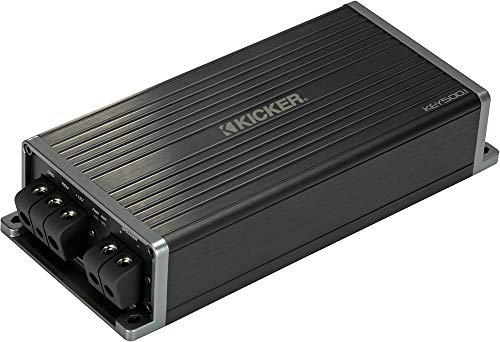
The Kicker 47KEY5001 redefines the 500W amp category by integrating a 40-band graphic equalizer and automatic DSP calibration into a single monoblock chassis. Its built-in microphone and internal computer analyze your vehicle’s acoustics and adjust EQ curves to optimize soundstage and tonality in minutes—work that typically requires a professional tuning session. The 24dB/octave crossover re-defines each speaker’s role, ensuring subwoofers handle only bass while factory speakers cover midrange and highs.
Bose system owners in Mazda and Chevrolet vehicles report dramatic improvements using the DC offset turn-on mode, which eliminates the need for a remote turn-on wire by sensing the factory amplifier’s signal. The compact size (10.75 x 8.75 x 3 inches) fits behind rear seats or in spare tire wells with ease. The KEY autotune process typically requires two to three attempts to achieve optimal results, but the final output competes with aftermarket head unit-equipped systems. The included remote level control integrates seamlessly with factory interiors.
The instruction manual lacks detail on the autotune process—users must download a PDF from Kicker’s website for full setup guidance. The remote knob’s cord connector may not fit all cables without modification, and replacement cords cost extra. Power terminals accept only 8AWG wire, requiring adapters for installations using 4AWG power kits. Despite these quirks, the 47KEY5001 is the only 500W amp that can transform a factory stereo’s output quality without additional DSP units.
Why it’s great
- Automated 40-band EQ tuning with microphone calibration
- DC offset turn-on works with modern factory systems
- 24dB/octave crossover improves speaker integration
- Transforms factory Bose and premium audio systems
Good to know
- Autotune requires multiple attempts and PDF guide
- Power terminals limited to 8AWG wire
- Remote knob cord replacement costs extra
7. Cerwin Vega B52 500W Class-D 2 Channel Amplifier
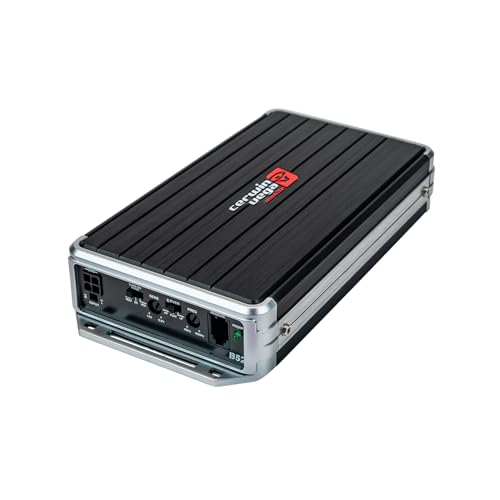
The Cerwin Vega B52 delivers 250W RMS x 2 at 2 ohms or 500W RMS x 1 at 4 ohms bridged, making it the most versatile amplifier in this guide for stereo speakers and subwoofer combinations. Its Class D IR chipset with DirectFET Power Mosfet output achieves high efficiency while maintaining the compact dimensions of 7.7 x 4.0 x 1.4 inches—small enough to fit under motorcycle seats or inside fairing compartments. The selectable REM/VOX/DC turn-on modes allow installation without a dedicated remote wire, sensing audio signal from speaker-level inputs to power on automatically.
Harley-Davidson owners make up a significant portion of user reviews, praising the B52’s ability to replace failing Rockford Fosgate and factory amplifier units on Road Glide and Street Glide models. The switchable 12dB HPF/FLAT/LPF crossovers give you flexibility to use this amp for component speakers or subwoofers, while the VEGA bass boost adds up to 12dB of low-end emphasis when needed. Users report the amp barely gets warm even during prolonged operation in enclosed motorcycle compartments.
A small subset of buyers report units failing within the first 10-30 minutes of use, with smoke or complete loss of output. This appears to be a quality control inconsistency rather than a design flaw, as the majority of users report trouble-free operation over multiple years. The aluminum alloy chassis is robust but the input/output terminals feel less substantial than those on Rockford or Alpine amplifiers. For two-wheeled audio builds where compact size and multi-mode operation are non-negotiable, the B52 is the best fit in this category.
Why it’s great
- Ultra-compact 7.7-inch footprint for motorcycle installation
- REM/VOX/DC turn-on modes eliminate remote wire needs
- Bridges to 500W x 1 at 4 ohms for subwoofer duty
- Highly efficient Class D with DirectFET output
Good to know
- Inconsistent quality control with early failure reports
- Terminals feel less robust than premium competitors
8. Rockford Fosgate P500X2 Punch 500 Watt 2 Channel Amplifier

The Rockford Fosgate P500X2 uses Class A/B topology to deliver 250W RMS x 2 at 2 ohms or 500W RMS x 1 at 4 ohms bridged, prioritizing sound quality and low distortion over the efficiency of Class D alternatives. Its C.L.E.A.N. setup system includes clip-indication LEDs that guide gain adjustments, while the variable 12dB/octave Butterworth crossovers (high-pass and low-pass) give you surgical control over frequency splits between tweeters, midrange drivers, and subwoofers. The onboard Punch EQ applies +18dB boost at 45Hz, providing substantial low-end emphasis for bass-forward music genres.
Users driving Focal separates and Polk Audio 6×9-inch speakers report the P500X2 delivers clear, powerful output with zero audible distortion even at moderate-to-high volume levels. The full-chassis design (2.38 x 7.76 x 13.28 inches) includes dedicated RCA inputs that accept both high and low-level signals, eliminating the need for external converters when integrating with factory radios. The 45Hz EQ boost warms up sealed subwoofers without sacrificing control, and the bridge-mode operation lets you power a single subwoofer with the full 500W output.
Class A/B topology generates more heat than Class D, requiring adequate airflow around the mounting location—closed compartments need ventilation or a cooling fan. The amplifier’s 12.3-pound weight and 13.3-inch length make it the largest and heaviest unit in this guide, limiting installation flexibility in compact vehicles. Some units sourced from Amazon Warehouse have arrived with pre-existing damage or defects, underscoring the importance of buying new rather than open-box. For audiophiles who prioritize clarity and headroom over size and efficiency, the P500X2 is the stereo amplifier standard-bearer.
Why it’s great
- Class A/B topology delivers superior sound quality
- +18dB Punch EQ at 45Hz adds impactful bass
- High/low level RCA inputs eliminate converters
- C.L.E.A.N. setup with clip-indication LEDs
Good to know
- Generates more heat than Class D alternatives
- Largest and heaviest amp in this selection
- Open-box units may arrive with pre-existing damage
9. Orion CBA2000.1D Monoblock Class D Amplifier

The Orion CBA2000.1D delivers 500W RMS at 1 ohm through a MOSFET power supply in a 14-inch long chassis, offering the lowest entry point into genuine 500W amplifier ownership. Its frequency response of 10-250Hz targets subwoofer duty exclusively, with adjustable low-pass filter, subsonic control, and bass boost parameters that let you shape the output. The included remote bass knob provides convenient in-cabin level adjustment, while thermal protection and phase shift controls add functionality typically reserved for more expensive models.
Budget-conscious users pairing the CBA2000.1D with Polk Audio 12-inch single voice coil subs report satisfying output that hits hard for daily listening. The 2-way protection circuitry (thermal and speaker short) offers peace of mind for first-time installers who worry about wiring mistakes. The aluminum chassis dissipates heat adequately during normal operation, and the low-level RCA inputs accept standard signal voltages from aftermarket and factory head units alike.
Performance degrades noticeably when pushed to its limits for extended periods—the amp runs hot under heavy demand and some users report output weakening after just a few minutes of high-volume playback. The product line sits below Orion’s XTR and HCCA series in build quality and sustained RMS capability, meaning audiophiles chasing competition-level bass will outgrow this unit quickly. For users with modest subwoofer requirements (single sub, 250-350W continuous draw) on a strict budget, the CBA2000.1D provides functional 500W performance at the lowest cost in this guide.
Why it’s great
- Lowest price entry point for 500W RMS capability
- Includes remote bass knob and phase shift control
- MOSFET power supply for reliable current delivery
- Thermal and speaker short protection circuitry
Good to know
- Output weakens under sustained high-power demand
- Runs very hot compared to mid-range competitors
- Entry-level build limits long-term reliability
FAQ
What size power wire do I need for a 500W amp?
Can I run a 500W amp with my factory radio?
What does CEA-2006 compliance mean for a 500W amp?
Final Thoughts: The Verdict
For most users, the 500 watt amp winner is the Alpine MRV-M500 because it delivers verified 500W RMS at 2 ohms in a compact, CEA-2006 compliant chassis with proven long-term reliability. If you want autotuning DSP that transforms factory audio systems, grab the Kicker 47KEY5001. And for motorcycle installations requiring ultra-compact dimensions and VOX turn-on, nothing beats the Cerwin Vega B52.