
A flickering grid isn’t a matter of “if” — it’s a matter of “when.” When the lights drop, a 500-watt solar generator becomes the difference between a warm meal and a cold night, between a charged phone and a dead line. You’re not shopping for an accessory; you’re buying a lifeline that converts sunlight into the specific voltage your CPAP, mini-fridge, or laptop demands, all without the noise or fumes of a gas engine.
I’m Min — the co-founder and writer behind Gadgets Feed. I’ve spent countless hours dissecting battery chemistries, inverter waveforms, and real-world charge times across dozens of solar generator kits to cut through the marketing noise and deliver a buying guide that actually helps you decide.
Whatever your use case — from weekend dry camping to keeping a refrigerator running during a hurricane warning — you need the right chemistry and the right panel wattage. We’ve tested the contenders to help you find the best 500 watt solar generator for your specific situation and budget.
How To Choose The Best 500 Watt Solar Generator
Not all “500-watt” generators are created equal. The real-world performance depends on three interlocking specs: the battery capacity in watt-hours (Wh), the inverter’s continuous and surge output, and the solar panel’s real-world efficiency. Picking a winner means understanding how these parts work together for your specific load.
Battery Chemistry Matters More Than Ever
Older models used NMC or lithium-ion cells that degrade after a few hundred cycles. Modern generators use LiFePO4 (lithium iron phosphate) batteries that deliver 3,000 to 4,000 cycles before dropping to 80% capacity. That’s a 10-year lifespan under daily use. If your generator is a tool for emergencies that may sit for months, LiFePO4 holds its charge better and poses less fire risk.
Real Solar Input vs. Advertised Watts
A 100W solar panel rarely delivers 100W. Angle, cloud cover, and your generator’s MPPT controller all affect actual input. Look for a solar generator that comes bundled with a panel that has a high monocrystalline conversion efficiency (23% or better) and a multi-angle kickstand so you can track the sun. A generator with a high MPPT charge limit also allows you to add more panels later for faster recharging.
Port Selection and Output Types
Count your ports. A good 500W generator should have at least two pure sine wave AC outlets, a USB-C PD port with 60W output for modern laptops, and a DC carport. If you plan to charge a CPAP machine or medical device, verify that the inverter is pure sine wave. Modified sine wave inverters can cause buzzing or damage in sensitive electronics.
Quick Comparison
On smaller screens, swipe sideways to see the full table.
| Model | Category | Best For | Key Spec | Amazon |
|---|---|---|---|---|
| GRECELL 500W Kit | Mid-Range | Budget-Conscious Campers | 440Wh / 500W (1000W surge) | Amazon |
| GRECELL EB500 Kit | Mid-Range | Dry Campers & Small Loads | 519Wh / 500W (1000W surge) | Amazon |
| ALLPOWERS SP039 600W | Premium Panel | High-Wattage Solar Input | 600W panel / 44V / 27.5 lbs | Amazon |
| BLUETTI Elite 100 V2 | Premium | Home Backup & Camping | 1024Wh / 1800W (3600W surge) | Amazon |
| DABBSSON 2000L | Premium | Long Runtime, 2200W Loads | 2048Wh / 2200W (3300W surge) | Amazon |
| Anker SOLIX C1000 Kit | Premium | Fast Charging & App Control | 1056Wh / 1800W (2400W surge) | Amazon |
| PECRON F3000LFP | High-Capacity Premium | Whole-Home Backup | 3072Wh / 3600W / 2hr charge | Amazon |
| Jackery HomePower 3000 | Flagship Backup | Outage-Ready Home Backup | 3072Wh / 3600W (7200W surge) | Amazon |
| EF ECOFLOW DELTA 2 Max Kit | Flagship Expandable | Expandable 2kWh to 6kWh | 2048Wh / 2400W (3400W X-Boost) | Amazon |
In‑Depth Reviews
1. GRECELL 500W Portable Power Station with 100W Solar Panel

The GRECELL 500W kit combines a 440Wh power station with a 100W monocrystalline solar panel, delivering a 23.5% conversion efficiency that actually produces measurable power in partial shade. At just 9.9 pounds for the station alone, this is one of the lightest entry-level kits that still offers two 110V pure sine wave AC outlets plus a 60W USB-C PD port for fast laptop charging.
Real-world testing shows the 100W panel averages around 70W in direct overhead sun, which is solid performance for the price bracket. Users report running a 300W heater for about three hours or a 95-quart fridge for over two days. The built-in wireless charging pad is a convenient bonus for topping off phones without fumbling with cables.
Long-term durability has mixed reports — some units developed an A06 error after months of use, though customer service offered replacement units. For the price, the feature set is hard to beat: 10 ports, a foldable 100W panel with a zippered pouch, and a compact square shape that packs easily into car trunks or RV compartments.
Why it’s great
- Extremely compact at 9.9 lbs with a full 440Wh capacity
- Includes wireless charging pad and 60W USB-C PD output
- 100W monocrystalline panel provides solid 70W average in direct sun
Good to know
- Some units reported A06 error after extended use
- Cooling fan becomes noticeable above 100W load
2. GRECELL 500W Portable Power Station 519.48Wh Kit
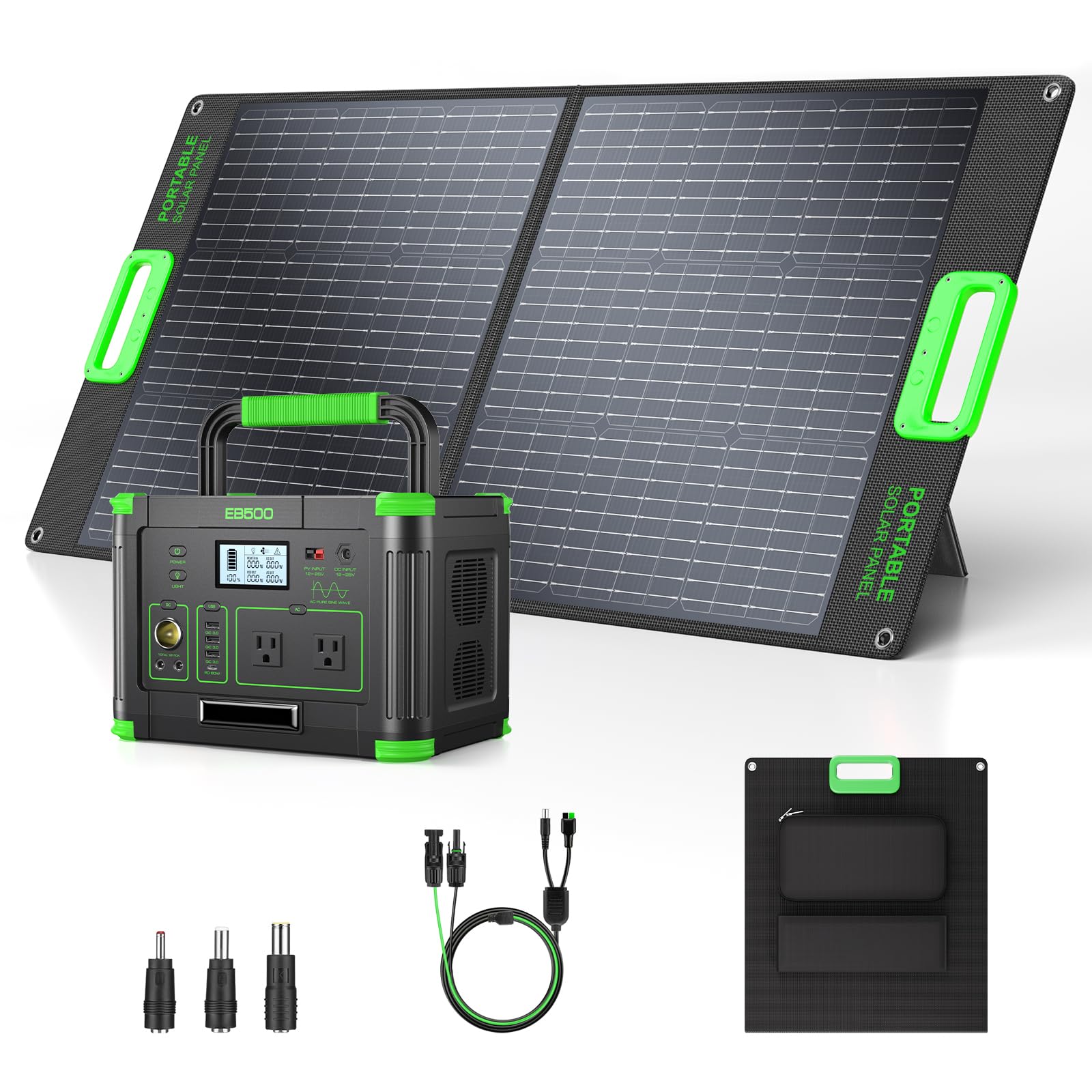
This GRECELL kit edges out its sibling with a larger 519.48Wh capacity while maintaining the same 500W continuous output and 1000W surge. The included 100W monocrystalline solar panel matches the same 23.5% efficiency rating, and the station provides 10 ports including a wireless charger, two QC3.0 USB-A ports, and a 60W USB-C PD output.
For dry campers, this unit holds enough charge to run fans, phones, and a headlamp for five days without solar input. The compact dimensions (11.5 x 7.9 x 7.9 inches) make it easy to stow in a camper cupboard or under a truck seat. Users specifically praise the square form factor that stacks neatly without wasted space.
The built-in Battery Management System (BMS) covers temperature control, overvoltage, overcurrent, and short circuit protection. While the included adapter kit ensures compatibility with most third-party solar panels, the stock 100W panel provides a reliable primary charging source for weekend trips and emergency prep.
Why it’s great
- Larger 519Wh capacity for extended off-grid runtime
- Compact square design fits easily in cupboards and tight spaces
- Comprehensive BMS with multiple protection layers
Good to know
- Solar panel output is position-sensitive; flat placement works best
- Some users note the included adapters can be finicky to connect
3. ALLPOWERS SP039 600W Foldable Solar Panel

The ALLPOWERS SP039 is a 600W foldable solar panel designed to pair with large power stations requiring 44V input. Its 22-24% monocrystalline efficiency means real-world output of 480-524W in optimal conditions — impressive for a portable panel. At 27.5 pounds, it’s lighter than many 400W rigid panels, making it a viable option for RV roof mounting or mobile solar arrays.
When unfolded, the panel measures roughly 6 x 6 feet, providing a massive surface area that captures sunlight even without active tracking. Users report peak outputs of 563W flat on the ground in mid-May, and over 500W regularly with proper angling. The IP67 waterproof rating means you can leave it out during rain without damage.
The foldable design includes a convenient carry handle, though extended use shows some fraying at the fold points after 15+ deployments. Partial shade or cloud cover can cut output by 50%, so positioning is critical. This panel is panel-only — you’ll need a compatible power station with a 44V/13.63A MPPT input to use it effectively.
Why it’s great
- Delivers over 500W in direct sun — rare for a portable foldable panel
- IP67 waterproof design withstands rain and splashes
- Lighter than most 400W rigid panels at 27.5 lbs
Good to know
- Unfolded size is large and awkward to position without support
- Partial shade or clouds can slash output by 50% or more
4. BLUETTI Elite 100 V2 1024Wh Power Station
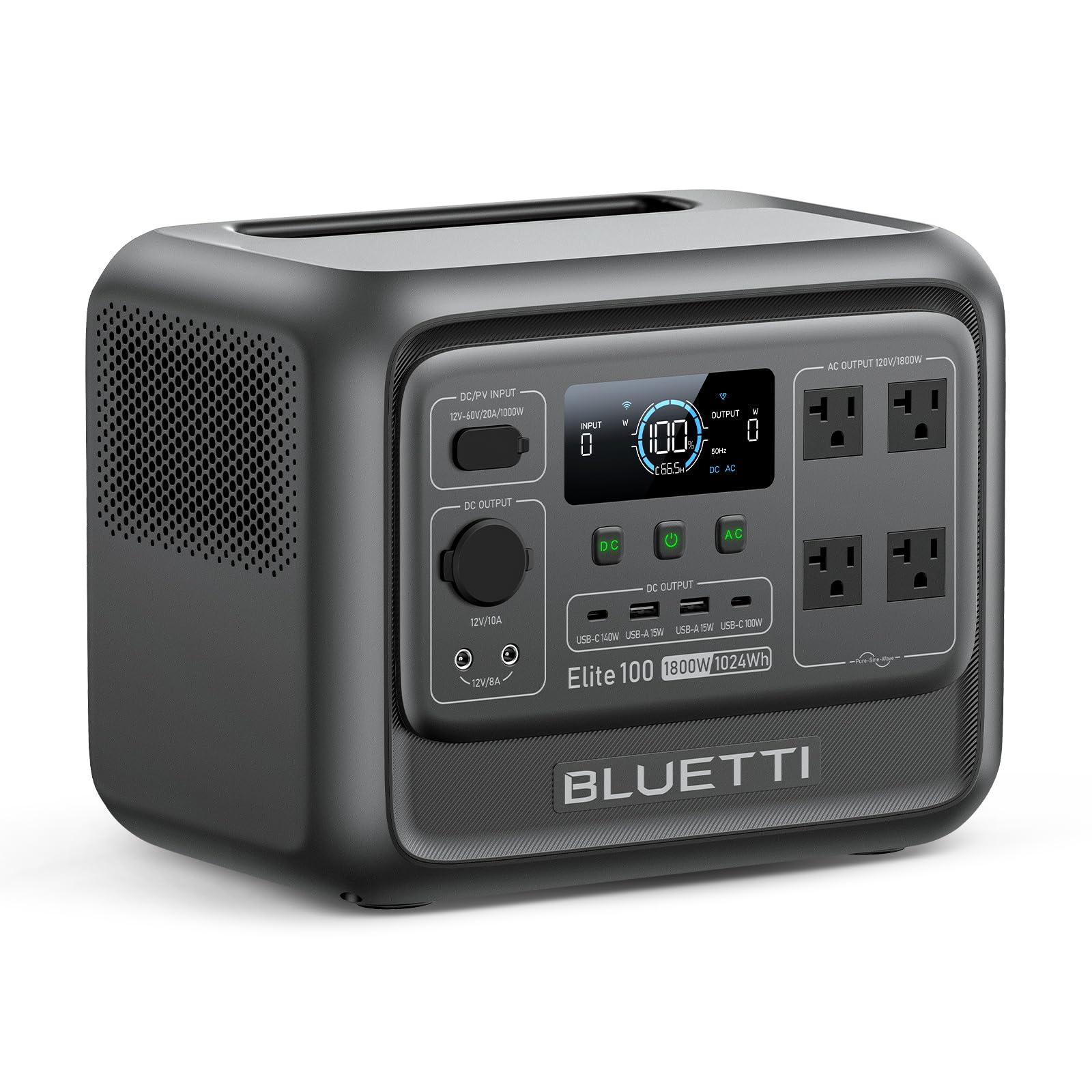
The BLUETTI Elite 100 V2 packs 1024Wh of LiFePO4 capacity into a 25-pound, 17L chassis that’s 35% smaller than previous models. The 1800W inverter (3600W surge) powers 90% of household appliances, and the 10ms UPS switchover keeps Wi-Fi routers and PCs running through brief outages without interruption.
Charging speed is a standout: 1200W TurboBoost AC input fills the battery in about 70 minutes, while up to 1000W solar input makes this one of the fastest solar recharges for a 1kWh station. In silent mode, it runs at just 30dB — quieter than a library — making it ideal for overnight camping or indoor use where noise is a concern.
The smart app supports Wi-Fi and Bluetooth remote monitoring, power management, and OTA firmware updates. The hidden carry handle and compact profile make it easy to grab one-handed, though the missing wireless charger and light compared to BLUETTI’s previous models are notable omissions. With 4,000 cycles to 80% capacity, this unit is built for a decade of regular use.
Why it’s great
- Fast 70-minute AC recharge and 1000W solar input capability
- 35% smaller and 30% lighter than comparable 1kWh units
- 10ms UPS switchover keeps sensitive electronics online
Good to know
- No built-in light or wireless charging pad
- App connection can only be established via Bluetooth, not WiFi remotely
5. DABBSSON 2000L 2048Wh Power Station
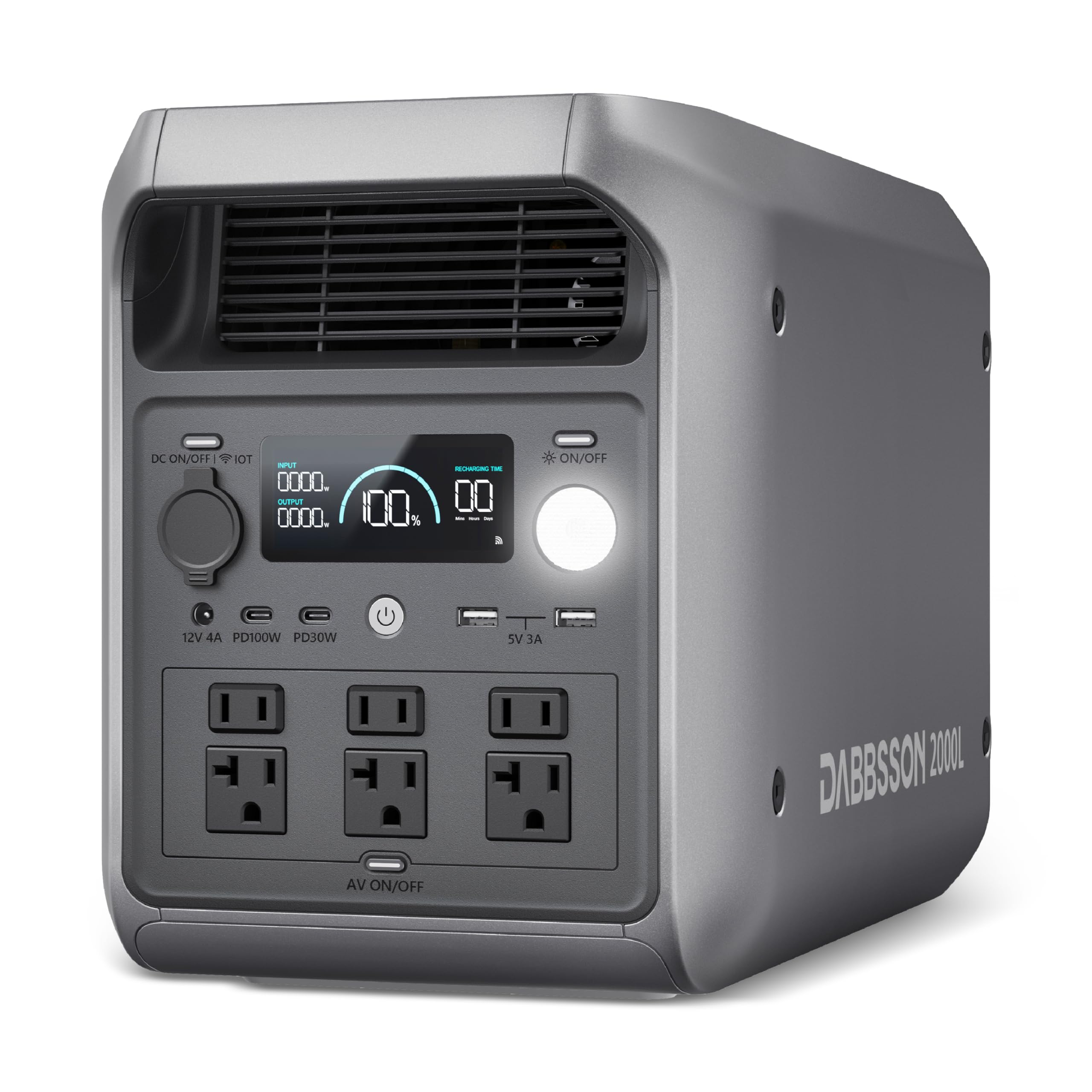
The DABBSSON 2000L leverages semi-solid LiFePO4 cells to deliver 1.3x longer runtime per charge compared to standard LiFePO4 stations of the same 2048Wh capacity. The 2200W continuous output with 3300W Power Boost surges through heavy loads like refrigerators, space heaters, and power tools without tripping.
Charging speed is genuinely impressive for this capacity class: a full recharge in just one hour via 1800W AC input. The 800W MPPT solar input means you can pair it with a substantial solar array for off-grid independence. At 41 pounds, it’s lighter than most 2kWh units, and the compact 11.2 x 18.3 x 8.9-inch footprint stores easily.
The smart app allows remote monitoring via Wi-Fi or Bluetooth, and the UL94-V0 flame-retardant housing adds safety peace of mind. The built-in EPS switchover under 10ms protects connected devices from data loss during grid fluctuations. However, some early units exhibited core software issues that limited max charge/discharge, and support responsiveness has been inconsistent.
Why it’s great
- Semi-solid LiFePO4 cells provide longer runtime than standard LFP
- Full recharge in just one hour via 1800W AC input
- Lightweight for 2kWh class at only 41 lbs
Good to know
- Software issues reported on early production units
- Customer support responsiveness has been inconsistent for some buyers
6. Anker SOLIX C1000 with 200W Solar Panel

The Anker SOLIX C1000 bundle includes a 1056Wh LiFePO4 power station and a 200W solar panel with IP67 waterproof rating. The station’s SurgePad technology delivers 2400W peak output, enough to handle 99% of household appliances. The 200W panel uses a four-position kickstand (30°, 40°, 50°, 80°) to maximize sunlight absorption across different seasons.
Recharging is the fastest in its class: 80% in 43 minutes and full in 58 minutes via AC input with UltraFast mode enabled in the app. The solar panel achieves up to 23% conversion efficiency and has 1.5x higher efficiency than standard models due to its sunlight-trapping surface design. In real-world use, the 200W panel delivers 180W+ in sunny conditions and peaks over 200W under ideal angles.
The 3,000-cycle LiFePO4 battery provides a 10-year lifespan, and the 11 ports cover everything from AC appliances to USB-C laptops. Some users note the solar panel has a strong mildew odor straight out of the box, though newer revisions appear to have resolved this. The C1000 is not weatherproof itself — only the solar panel carries the IP67 rating, so keep the station dry.
Why it’s great
- Ultra-fast recharge: 80% in 43 minutes, full in 58 minutes
- 200W solar panel with four adjustable angles and IP67 rating
- 10-year lifespan with 3,000 battery cycles
Good to know
- Power station is not weatherproof — keep dry
- Solar panel may have strong initial odor on early batches
7. PECRON F3000LFP 3072Wh Power Station
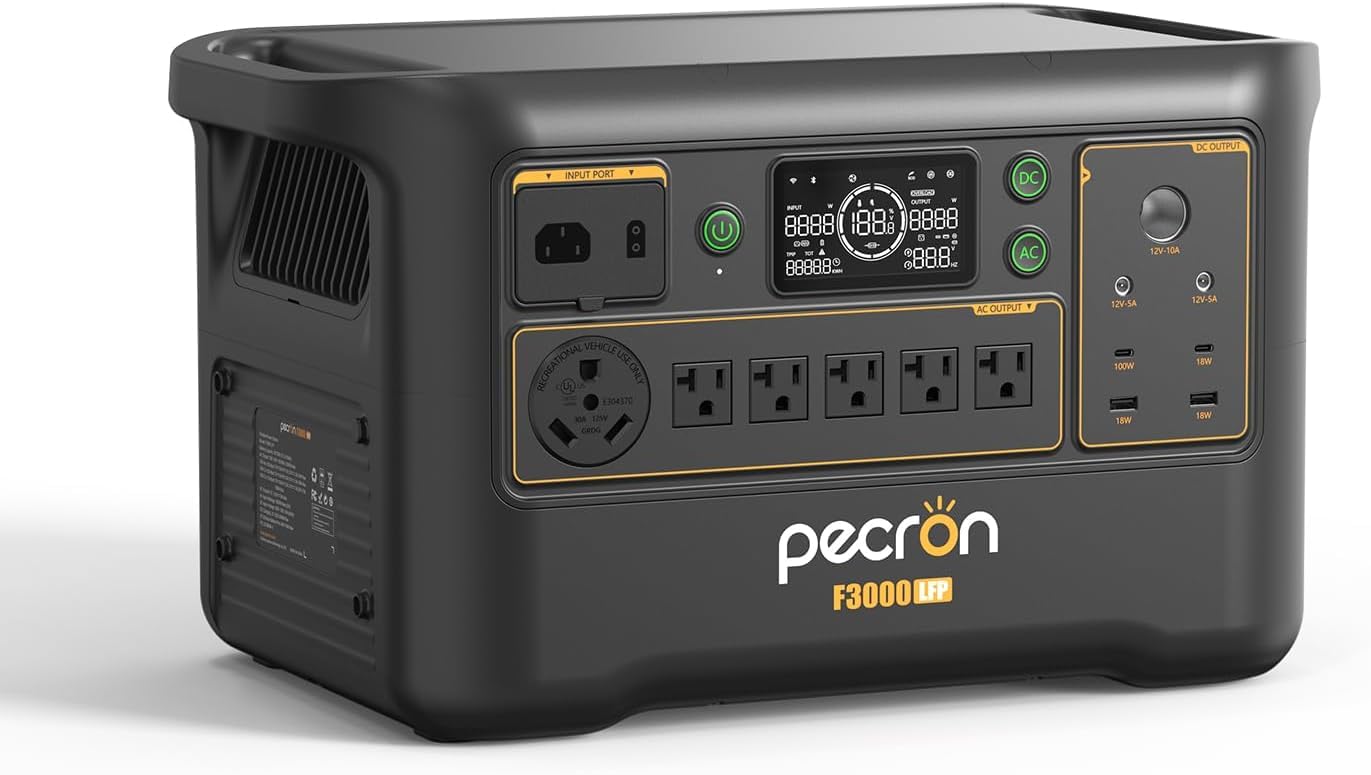
The PECRON F3000LFP brings 3072Wh of LiFePO4 capacity with a 3600W pure sine wave output, capable of running heavy appliances like air conditioners and power tools simultaneously. Its 13 ports include six AC outlets, two 100W USB-C PD ports for fast laptop charging, and a carport for 12V accessories. The expandable architecture allows adding up to 10752Wh via external battery packs.
Charging speed is a major advantage: 0-100% in just two hours via 1800W AC input, which is 30% faster than many competitors in this capacity range. The 1600W solar input (25-120V) accepts high-voltage panels for flexible array configurations. Real-world testing shows a fridge using 31% of the battery over a typical day, while an extended outage could run a freezer and fridge for over 48 hours.
The smart app provides remote monitoring of power draw and charge status, though it requires account login and connects via Bluetooth rather than WiFi. The fan is audible during charging but silent when idle. The 10ms UPS switchover ensures sensitive equipment remains powered during grid blips, though some initial calibration draws of 1500W were noted on first use.
Why it’s great
- Fast 2-hour full recharge via 1800W AC input
- Expandable to massive 10752Wh for extended outages
- High 3600W pure sine wave output handles heavy appliances
Good to know
- At 63.3 lbs, it’s a heavy unit best suited for stationary home backup
- App requires Bluetooth connection and account login
8. Jackery HomePower 3000 3072Wh Station
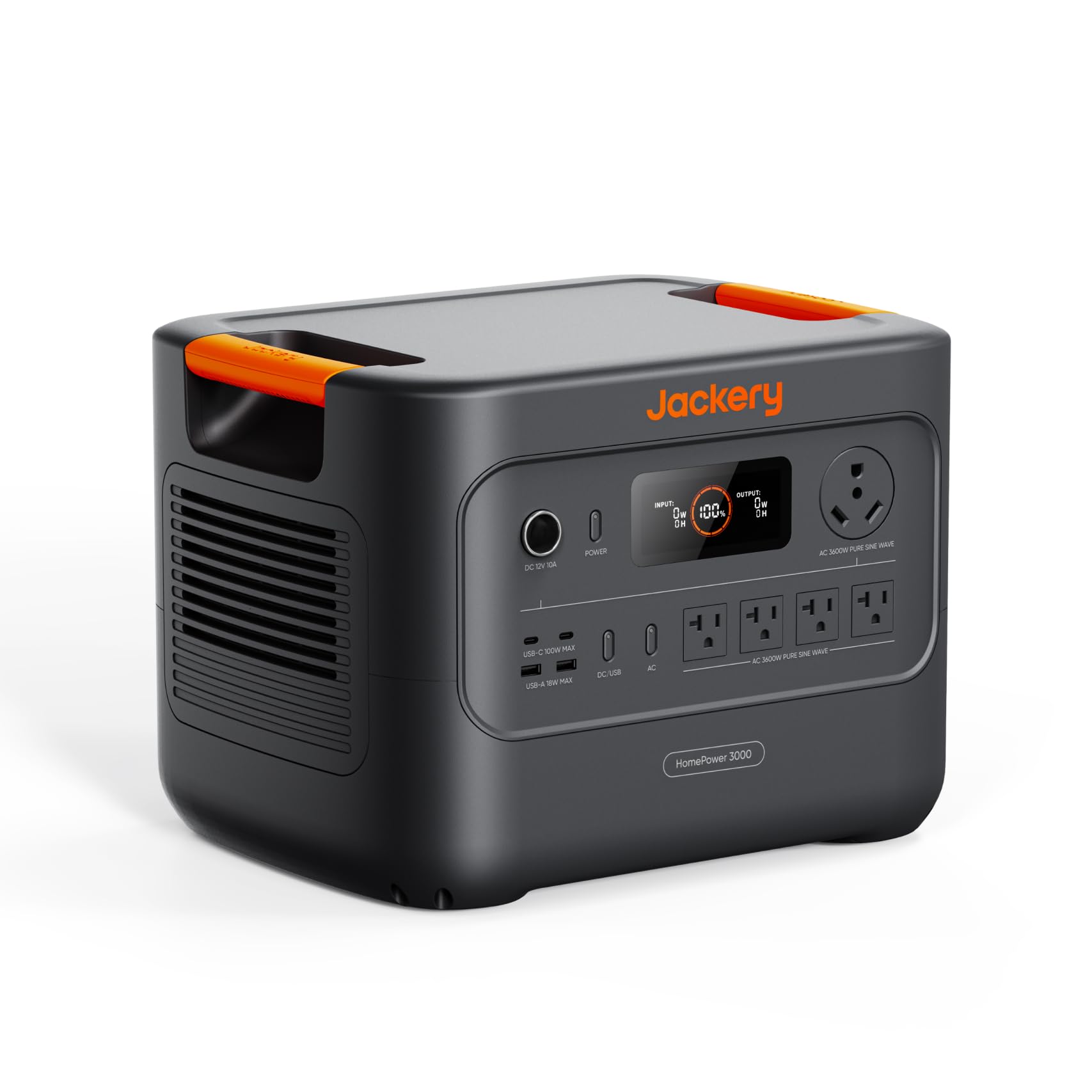
The Jackery HomePower 3000 pairs a 3072Wh LiFePO4 battery with a 3600W inverter capable of a massive 7200W surge — enough to handle motor starts on refrigerators, well pumps, and power tools. Its CTB (cell-to-body) technology makes it 47% smaller and 43% lighter than comparable 3kWh stations, at a still-substantial 59.5 pounds. The integrated TT-30 RV port enables direct plug-and-play power for travel trailers.
Charging versatility is excellent: full recharge in 1.7 hours via hybrid AC+DC input, or 2.2 hours via AC alone. When paired with two 200W SolarSaga panels, solar charging reaches 80% in about 9 hours. The UL-certified ≤20ms UPS switchover keeps security cameras, medical refrigerators, and pet feeders running during grid failures.
ChargeShield 2.0 technology with proprietary AI algorithms optimizes charging speeds and extends battery lifespan. The LiFePO4 cells offer 4,000 cycles to 70% capacity retention. However, the fan is audibly noticeable (around 60 dB) whenever the inverter is under load, making it less suitable for quiet indoor UPS use in bedrooms or offices. Jackery’s warranty policy requires direct-from-Jackery purchases, so Amazon buyers must verify coverage.
Why it’s great
- Massive 7200W surge capacity handles demanding appliances
- 47% smaller and 43% lighter than competing 3kWh stations
- Built-in TT-30 port for direct RV connection
Good to know
- Fan noise around 60 dB under load — not ideal for quiet rooms
- Warranty is only valid if purchased directly from Jackery’s store
9. EF ECOFLOW DELTA 2 Max 2048Wh with 220W Panel
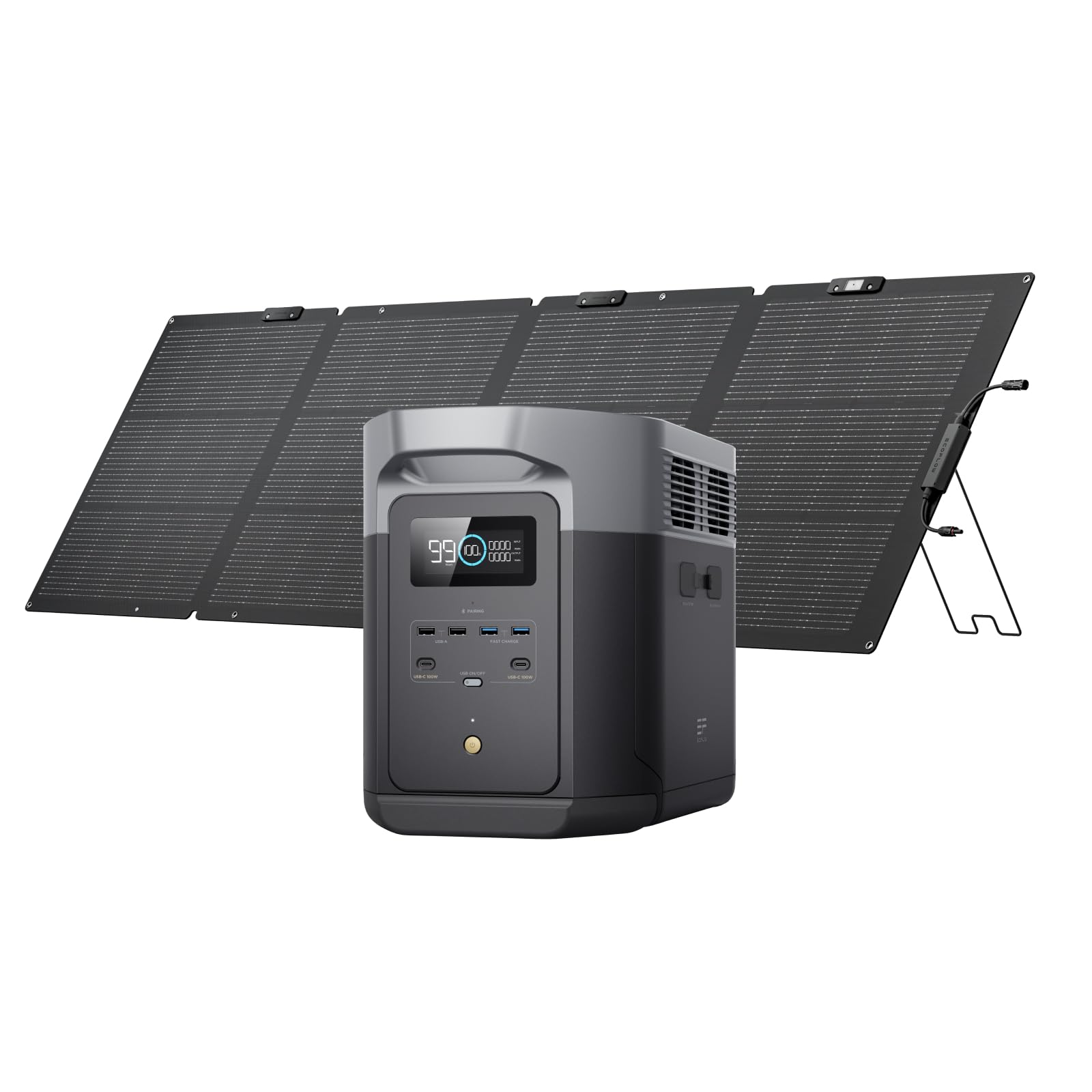
The EF ECOFLOW DELTA 2 Max is the expandable king of the 2kWh class, starting at 2048Wh and scaling to 6kWh with two extra batteries. The 2400W continuous output (3400W with X-Boost mode) handles 99% of household devices, and the 15 outlets offer the most connectivity in this roundup. The 220W solar panel provides a solid charging partner for off-grid recharging.
Charging speeds are impressive: combining 1000W solar input with AC achieves 80% charge in just 43 minutes. The LFP battery chemistry provides 3,000 cycles to 80% capacity — 6x longer than standard lithium-ion packs. At 30 dB, the DELTA 2 Max is genuinely quiet enough for overnight use in a tent or bedroom, and the EcoFlow app allows full remote energy management.
Real-world performance shows the 220W panels outputting 140-160W in full sun and 35-45W in overcast conditions, with a clever dual-surface reflective setup boosting output to over 190W. The unit powers a Starlink Mini and MacBook Pro for eight hours using just 14% battery. At 71 pounds, it’s not a daily carry piece, but the built-in handles and optional carrying strap make it manageable for wheeled transport or short carries.
Why it’s great
- Expandable from 2kWh to 6kWh with plug-and-play extra batteries
- Ultra-fast hybrid charging: 80% in 43 minutes with AC + solar
- Near-silent 30 dB operation suitable for overnight use
Good to know
- At 71 pounds, this is a heavy unit primarily for wheeled transport
- Solar panel output drops significantly in overcast conditions (35-45W)
FAQ
Can a 500W solar generator run a refrigerator?
How long does a 500Wh battery last with a CPAP machine?
Is pure sine wave output necessary for sensitive electronics?
Final Thoughts: The Verdict
For most users, the best 500 watt solar generator winner is the GRECELL 500W kit because it delivers 440Wh of real-world capacity with a 100W solar panel at a price that leaves room for accessories, while staying compact enough for car camping and emergency kits. If you want the fastest recharge and longest battery lifespan, grab the Anker SOLIX C1000. And for whole-home backup that can scale to 6kWh, nothing beats the EF ECOFLOW DELTA 2 Max.