
Our readers keep the lights on and my morning glass full of iced black tea. As an Amazon Associate, I earn from qualifying purchases.
Specs are compiled from manufacturer listings and verified buyer reviews and can change over time — please confirm the key details on the product page before buying.
If you want to run a dryer, a well pump, or a 240-volt central air conditioner when the grid drops, a 5000-watt-class power station does it without gas, fumes, or a pull cord. The trick is getting the honest straight talk on which of these five units actually delivers that output, and where each one quietly holds back. One note before we start: this list uses flexible matching for 5000-watt continuous output or higher, so not every pick is the exact same wattage — the nearest same-type size that serves the same job is included, and we call that out as we go.
I’m Min — the founder and writer behind Gadgets Feed. This guide is built by comparing the manufacturers’ published specifications and the patterns across verified customer reviews, so you get each pick’s real strengths and trade-offs instead of marketing spin.
Backup power is a big-ticket decision, and the marketing language around it is genuinely noisy. To cut through that, here is the practical breakdown of every 5000 watt power station worth putting on your shortlist right now.
Our Picks at a Glance

How To Choose The Best 5000 Watt Power Station
Buying a power station at this wattage is closer to wiring a small sub-panel than picking up a camping battery. You are shopping for a continuous output number, a split-phase voltage, a battery chemistry, and a transfer time — and each one locks in what you can run and for how long.
Continuous watts versus surge watts
A power station has two ratings: the wattage it can hold all day (continuous), and the brief spike it survives when a motor first kicks on (surge). An air conditioner compressor or a well pump draws a large surge for a second or two when it starts. Look for the continuous number first — a station rated for 7200W of rated power has more headroom than one rated for 6000W, and its surge rating tells you what it will tolerate on startup.
Why 120V/240V split-phase matters
Standard household outlets in North America are 120 volts. Big appliances — dryers, water heaters, central air conditioners, EV chargers — run on 240 volts. A station with 120V/240V split-phase output can feed a 240-volt appliance directly. A station limited to 120 volts cannot, no matter how many watt-hours it stores. If you want to run the heavy stuff, this is the single spec to check first.
Battery chemistry and expansion
LiFePO4 (lithium iron phosphate) is the chemistry most of these units use, and it is the one to want — it tolerates daily cycling and holds up over thousands of charge cycles better than older lithium mixes. Expansion matters just as much: a base capacity you can add batteries to grows with your needs, while a sealed unit stays fixed.
Transfer time and how you will recharge
Transfer time is the gap in milliseconds between grid power dying and the station picking up the load. It matters most for desktop computers and network gear. Also plot your recharge path ahead of time — wall outlet, solar panels, or a gas generator — because how fast a station refills decides how many outages it can ride through.
Quick Comparison
| Model | Best For | Continuous Output | Base Capacity | Expansion Ceiling | Amazon |
|---|---|---|---|---|---|
| Anker SOLIX F3800★ Best Overall | Hands-free generator backup | 6,000W | 3,840Wh | Up to 53.8kWh | Amazon |
| EF ECOFLOW DELTA Pro UltraTop Performer | Whole-house UPS protection | 7200W | 6144Wh | Up to 90kWh | Amazon |
| Jackery 5000 Plus | Long multi-day outages | 7200W | 5040Wh | Up to 60kWh | Amazon |
| Anker SOLIX F3800 Plus + Home Power Panel | Hardwired home integration | 6,000W | 3,840Wh | Up to 53.8kWh | Amazon |
| OSCAL PowerMax 6000 | Budget entry to 240V backup | 6000W | 3600Wh | Not stated | Amazon |
In‑Depth Reviews
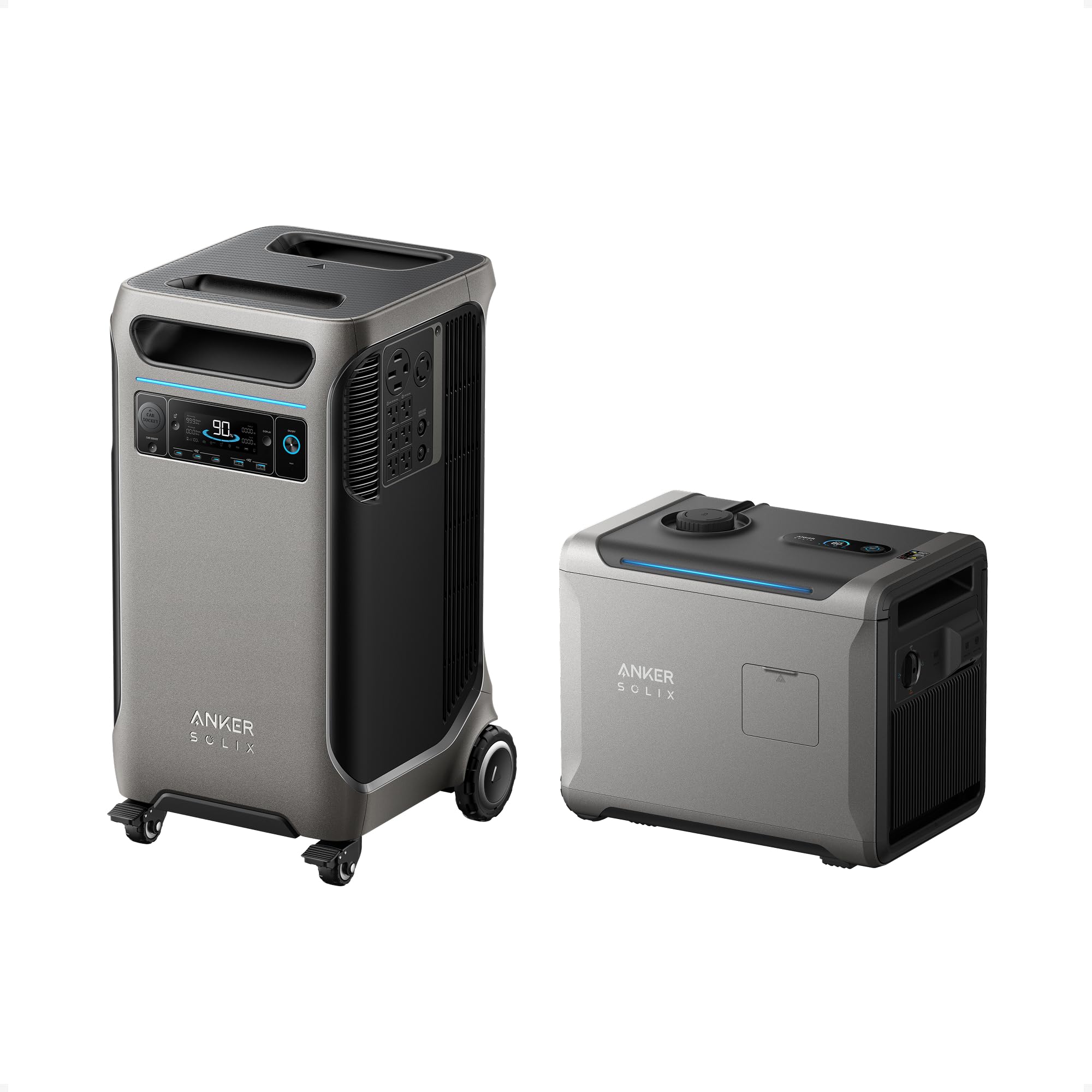
1. Anker SOLIX F3800 Portable Power Station with Smart Generator 5500
Our pick — over 4★ from 300+ verified ratings; the strongest balance of quality and price.
The hands-free workhorse that starts its own generator while you sleep through the storm
What you get here is a 3,840Wh battery paired with 6,000W of AC output — enough amperage to run a dryer, a well pump, or an RV from the NEMA 14-50 and L14-30 ports without extra grounding gear. The real headline is the Smart Generator 5500 in the box: it fires up and shuts down on its own, so the station tops itself off without you standing in the rain pulling a cord.
Buyers report the heavy loads — dryers, well pumps, RV hookups — running without a hitch. Reviews repeat the same pattern: a window AC unit running in a Florida bedroom through cloudy days, a well pump and RV powered without drama, a critical circuit panel handled flawlessly. The F3800 sits at the top of this list because it earns 4.4 stars across 300+ owners and pairs that record with the only auto-start generator setup in the group. Capacity is the other lever: 3.84kWh stretches to 26.9kWh with six battery packs, or up to 53.8kWh with a second F3800 and twelve packs for two weeks of power.
Budget some patience for the solar side. The unit is built for up to 2,400W of solar input, but the honest caveat repeated across feedback is that a single 400W panel tops out well under its rating — as buyers put it, the output plateaus around the 200-watt mark even in full midday sun. Owners also flag a low-temperature charging limit (the battery management system reins in charging below about 50°F) and a firmware quirk that sometimes needs a manual update before AC and solar will charge together. None of it breaks the station; it just means the generator, not the solar, is the recharge path to lean on in winter.
What makes it the pick
- Auto Start-Stop generator tops the battery up unattended, hands-free
- 6,000W continuous with 120V/240V output feeds appliances a standard station cannot touch
- Expandable from 3,840Wh all the way to 53.8kWh with extra packs and a second unit
- App control over Wi-Fi or Bluetooth lets you monitor every power source in one place
Where it asks for care
- At 132.3 pounds this is a two-person lift, not a carry-on
- Solar input rarely hits its 2,400W ceiling in real conditions
- Low-temp charging throttles below about 50°F until the unit warms
The fit: You want a home backup that recharges itself through a long blackout without you babysitting a fuel can or a pull cord.
Pick differently if: You live somewhere the battery spends winter below freezing and you are counting on solar as your main refill.
2. EF ECOFLOW DELTA Pro Ultra 6144Wh Power Station
When the power blinks, this one covers it in 20 milliseconds and keeps the fridge humming
Start with the number that changes the pitch of this whole comparison: 7200W of AC output, against 6,000W on the Anker SOLIX F3800. That is enough to run a 3-ton central air conditioner or a heavy household appliance, and the capacity comparison is just as stark — 6144Wh here versus 3600Wh on the OSCAL PowerMax 6000. That extra stored energy is roughly 40% more before you touch a single accessory battery.
The online UPS behavior is where it separates from the pack. Transfer time is 20 ms, so sensitive gear — a desktop, a router, a medical device — rides through a grid failure without a reboot. From a 6144Wh base you can scale to 15 batteries for 90kWh, which the manufacturer frames as over 30 days of essential power for a standard home. Charging is the quickest in this group too: a single battery refills in about 2 hours, and reviews rank quality and cost-effectiveness above all else — over forty owners put quality first, and many note it costs roughly half a Tesla Powerwall at comparable or higher capacity.
The honest catch lives in the fine print. Several owners mention it will not take a full charge, and some installer feedback notes that EV charging tops out around 6100W rather than the headline 7200W. There is also standby drain to plan around — a handful of percent a day even when the unit sits idle — and the inverter runs warm under load. It arrives in separate packages, so a lone delivery on day one is normal, not a problem. Treat the 7200W figure as a ceiling for appliances and plan your idle losses accordingly, and this is the most capable whole-home unit here.
What the spec sheet earns: 7200W continuous output, 6144Wh scalable to 90kWh, and 20-ms UPS switching combine into the strongest raw capability in the group, backed by UL1973 and UL9540 certification — the only station here that holds both.
What owners live with: Standby drain and the occasional charge hiccup are the real-world grumbles; neither undoes the core performance, but both are worth knowing before you commit to a wall-mounted setup.
Who it is built for: Homeowners wiring a permanent backup that needs to catch a blackout instantly and run the air conditioner, not just the lamps.
When to look past it: If you want a grab-and-go unit for weekend camping, the 70.9-pound split-package design is more install than travel.
3. Jackery Solar Generator 5000 Plus Portable Power Station
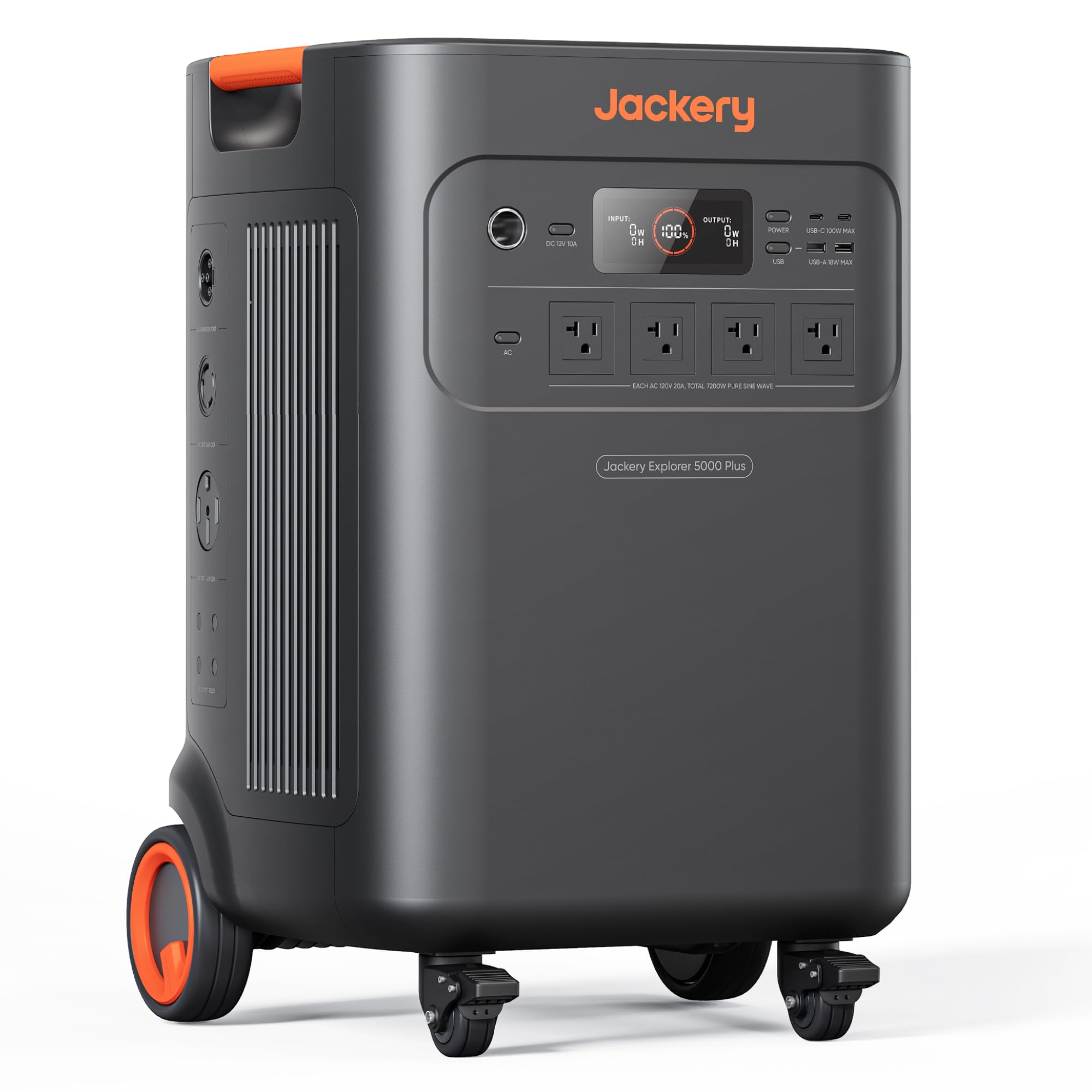
A 5040Wh stack built to keep the lights on for days, not just a single scary night
Where the Anker SOLIX F3800 starts at 3,840Wh, this Jackery opens at 5040Wh — roughly 40% more stored energy from the gate — and its 7200W of rated output edges past the Anker’s 6,000W. It supports both 120V and 240V, so a 5-ton AC or a water heater can run, and the capacity ceilings matter: expandable to 60kWh, which the maker frames as backing a home for up to 13 days. Pair it with the Jackery 60A Smart Transfer Switch and it powers up to 12 circuits at 120V or 6 circuits at 240V.
Owners consistently credit the 7200W output for running major appliances at once. The 7200W output — 14,400W surge — handles major appliances simultaneously, and reviewers repeatedly confirm the 7200W output runs major appliances simultaneously without tripping. One theme to note honestly is battery behavior; some customers note the unit shedding a chunk of its charge each day even when idle, and a few mention reliability that is not always perfect. That is a real fit consideration if you plan to leave it plugged in as a standby UPS rather than cycle it deliberately. Recharge is a strength worth leaning on: up to 4000W of solar input brings it back in about two hours, and ChargeShield 2.0 plus LiFePO₄ cells are rated for up to 11 years of daily use.
The practical read is that this is a long-outage machine, not a leave-it-on-the-wall machine. Plan how you will draw it down across a multi-day event and top it back with solar during the day, and the 5040Wh reserve does the heavy lifting the smaller units cannot.
Why it stands tall
- 5040Wh base capacity expands to 60kWh for multi-day outages
- 7200W rated / 14,400W surge runs big appliances at 120V or 240V
- Up to 4000W solar input recharges in roughly two hours
- LiFePO₄ cells rated for up to 11 years of daily use
Read before buying
- Some owners see notable idle battery drain between uses
- A few report reliability that is not consistently flawless
- The base station ships without the solar panels, which are optional
Reach for it when: You expect outages measured in days and want the reserve to match, with fast solar recharge to refill between events.
Look elsewhere when: You need a set-and-forget wall UPS — the idle drain makes deliberate cycling the smarter routine.
4. Anker SOLIX F3800 Plus Portable Power Station with Home Power Panel
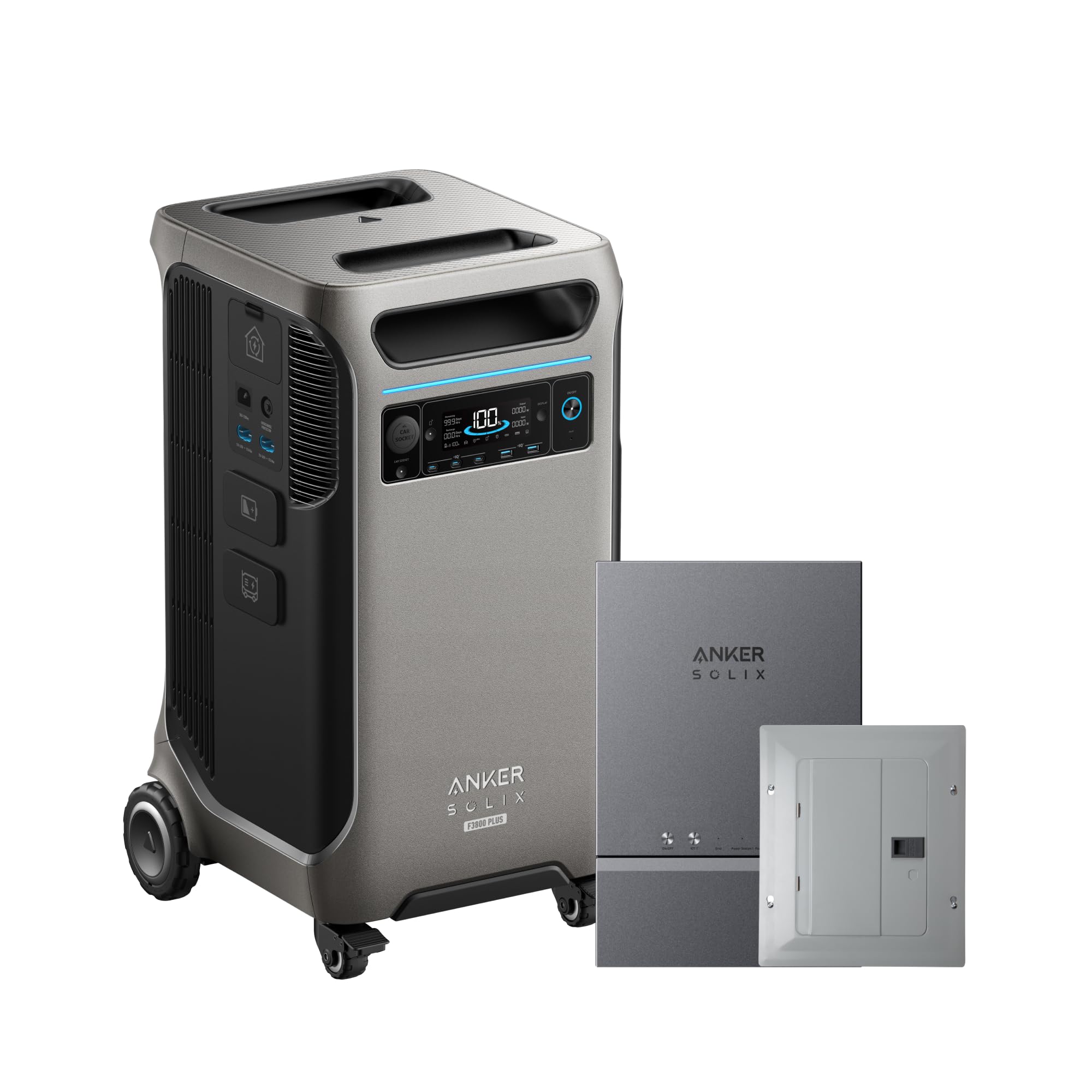
The hardwired blueprint: 6,000W of clean power piped straight into your existing breaker panel
This is the F3800 Plus bundled with the Home Power Panel, and that panel is the whole point. It ties the station into your home’s existing circuitry so backup moves through the wiring you already have. Output runs 6,000W with 120V/240V dual-voltage support — 58% more than comparable portable power stations at the same 3,840Wh capacity, per the maker — and two units can pair for up to 12,000W max AC output. Capacity climbs to 26.9kWh with six batteries or 53.8kWh with twelve for weeks of reserves.
Owners of the F3800 Plus rank build quality first by a wide margin, then raw power and backup capability. The standout detail is quiet: standby power draw is very low, which matters enormously if you leave it wired in as a permanent standby rather than a seasonal camping rig. It recharges in about 63 minutes via solar and generator combined, with 3,200W of solar input and a 240V gas generator feeding a 6,000W bypass. The Anker app handles control and programming, and reviewers rate it well designed for that job.
It also ships as separate packages, and the unit is heavy enough that packaging in transit has occasionally left a scratch or a dent. If you want the full feature set, plan the panel install from the start.
The case it makes: Hardwiring into your breaker panel through the included Home Power Panel, with a 63-minute recharge and a low standby draw that suits a permanent install, makes this the most integrated option in the lineup.
What to check first: Confirm you are installing the panel, because the headline smart features are absent on the standalone unit — a detail worth verifying before ordering.
Best match for: Someone ready to hardwire a station into an existing home panel and wants the panel included to make that happen.
Only look past it if: You want a standalone battery bank without the wiring work — here the integration is the product.
5. OSCAL PowerMax 6000 Solar Generator 3600Wh
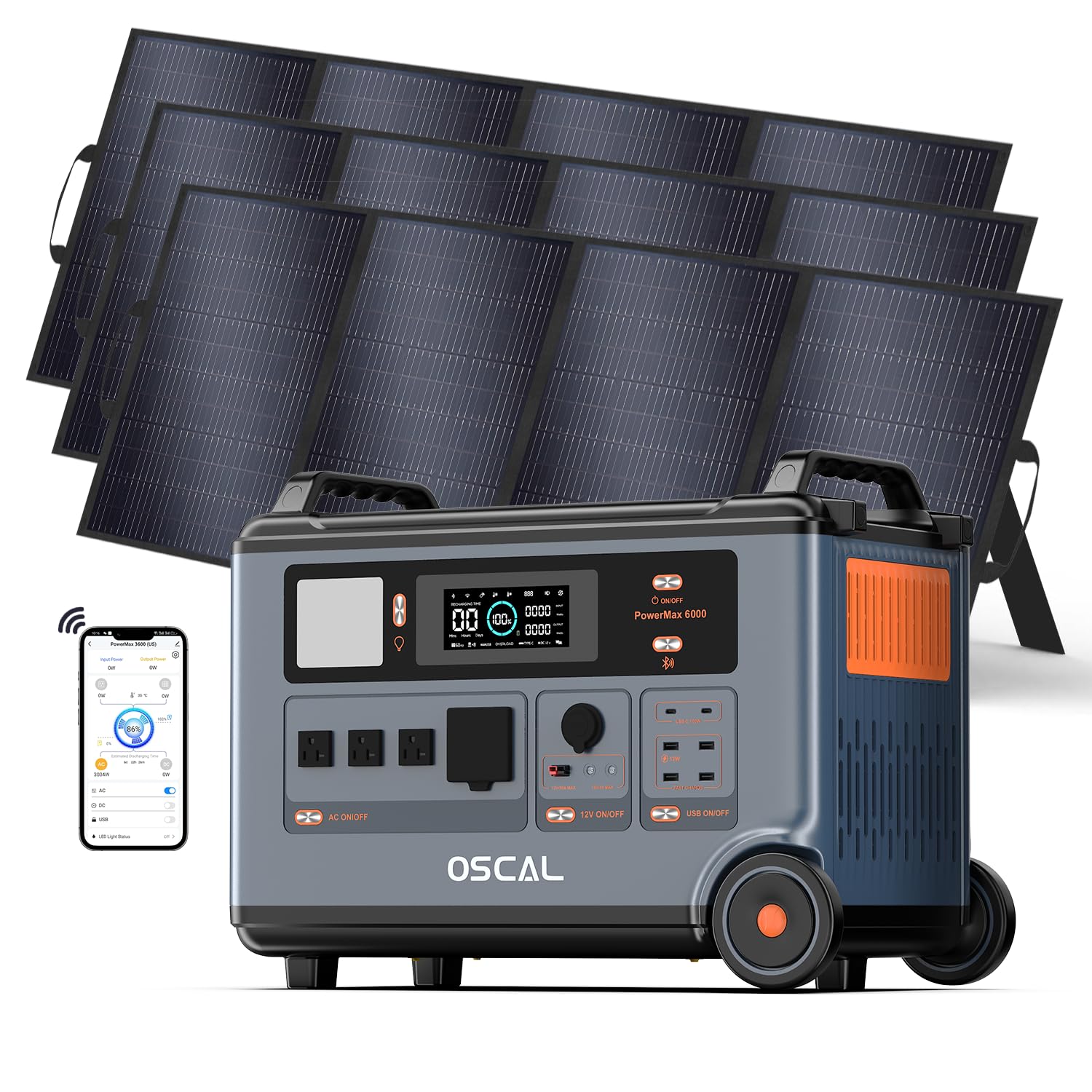
Bundled solar and 240V output at the entry tier — if the cable setup works in your favor
For the buyer who wants 240V capability and solar panels in one order, this OSCAL lands as the entry point to the group. It carries a 3600Wh capacity — matching the EcoFlow DELTA Pro Ultra… except that comparison does not hold, since the EcoFlow opens at 6144Wh. Set the two side by side and the OSCAL stores roughly 40% less energy to begin with. It offers 6000W output with 9000W surge, 120V/240V dual-voltage support, and 14 outlet sources, plus 2200W AC charging that refills from empty to full in about 1.44 hours.
No station in this lineup is expandable here — capacity is fixed at 3600Wh — so your planning horizon is one battery, not a growing stack. The LiFePO₄ battery carries an eight-layer safety BMS and a 3500-cycle rating the maker ties to up to 25 years of service, and switchover to the internal battery runs in 5-8 ms on an outage. Owners praise build quality above all: solid construction, quiet operation, and a clear display. The three included 400W panels let it run fully on solar, which is the appeal for an off-grid cabin or a jobsite far from an outlet.
Then there is the caveat that keeps this a budget-tier pick and not a higher-ranked one. The recurring complaint is connectivity — reviewers point out the unit lacks the cables to link multiple solar panels together, which stalls a full-capacity solar setup. With only the included cable, charging is slow going. Some also ding responsiveness. If your plan is grid charging plus a couple of panels, it does the job; if you are counting on a large solar array from day one, budget for the extra cabling.
Where the value lands
- Three 400W solar panels and 240V output bundled in one purchase
- 2200W AC charging brings it to full in about 1.44 hours
- 6000W continuous with 9000W surge across 14 outlet sources
- 5-8 ms switchover protects gear during an outage
The trade-offs up front
- Missing panel-linking cables stall a full solar setup from the start
- 3600Wh is fixed — no expansion path here
- Capacity trails the larger stations in this group
Choose this if: You want panels, 240V capability, and a fast 2200W plug-in charge without moving to a higher price tier.
Move on if: You plan to wire several solar panels together from the first day and want that cabling sorted for you.
Understanding the Specs
Continuous watts and surge watts
Continuous watts is the power a station delivers hour after hour; surge watts is the brief spike it absorbs when a motor starts. An air conditioner or well pump draws its surge in the first second or two, so a higher surge rating buys startup headroom. Match the continuous number to the appliances you want to run nonstop, and use surge as your safety margin for motors.
Watt-hours (Wh) and expandability
Watt-hours measures how much energy the station stores — it is your runtime. A 3600Wh base runs smaller loads for less time than a 5040Wh or 6144Wh base, and the difference compounds across a multi-day outage. Expandability matters just as much: a station you can add battery packs to grows with your needs, while a sealed unit stays where it started.
FAQ
Can a 5000 watt power station run a whole house?
What is the difference between 120V and 240V output on a power station?
How long will a 5000 watt power station last during an outage?
Is LiFePO4 better than other battery types in a power station?
What does transfer time mean and why does it matter?
Can I charge a power station with solar panels only?
Do these stations come with solar panels included?
Can I run a central air conditioner or dryer on these units?
How much maintenance do these power stations need?
Do I need a home transfer switch to use one of these for backup?
Final Thoughts: The Verdict
For most households, the 5000 watt power station winner is the Anker SOLIX F3800 with Smart Generator 5500, because its auto-start generator turns a multi-day blackout into a hands-free event and its 6,000W / 120V/240V output runs the heavy appliances a generator-free station cannot. It is the crowd favorite here — 4.4 stars across 300+ owners — and the only pick that refills itself through a long outage. If catching the blink in 20 milliseconds and running a 3-ton air conditioner matters most, reach for the EF ECOFLOW DELTA Pro Ultra with its 7200W output and 6144Wh stack. And if days-long outages with fast solar recharge are the concern, the Jackery 5000 Plus brings a 5040Wh base and a 60kWh ceiling to the shortlist.
How We Picked
We do not accept paid placement. Every pick is matched to a real buyer and a real use-case; we do not hands-on test units.
Sources & Methodology
Specifications: manufacturer listings and product documentation. Review insights: verified customer reviews, as of September 2026. Pricing: not shown on this page (it changes often); check the current price via the retailer link.
As an Amazon Associate, Gadgets Feed earns from qualifying purchases. This does not affect which products we feature.