
The RTX 5070 card has landed, and it’s reshaping the mid-to-high-end desktop GPU market with Blackwell architecture and GDDR7 memory. For gamers targeting smooth 1440p or entry-level 4K, the 5070 series offers a clear generational leap over previous 70-class cards, but the choice between a base 5070 and a 5070 Ti involves a meaningful trade-off in VRAM and raw raster performance.
I’m Min — the co-founder and writer behind Gadgets Feed. I’ve spent countless hours analyzing the technical specifications, real-world benchmarks, and user feedback on every 5070 variant currently available to pinpoint exactly which model delivers the best balance of performance, cooling, and price for your specific build.
Whether you’re building a new SFF rig, upgrading from a 20- or 30-series card, or aiming for high-refresh 4K gaming, this guide breaks down the best 5070 Graphics Card options on the market right now to help you make a confident decision.
How To Choose The Best 5070 Graphics Card
The RTX 5070 series spans several distinct models—from the compact dual-fan 5070 to the massive 3.2-slot 5070 Ti. Choosing the right one depends on your resolution target, case size, and willingness to pay for extra VRAM. Here are the key decision points.
VRAM Capacity: 12 GB vs 16 GB
The standard RTX 5070 features 12 GB of GDDR7 on a 192-bit bus, while the RTX 5070 Ti jumps to 16 GB on a 256-bit bus. For pure 1440p gaming with DLSS 4 enabled, 12 GB remains sufficient today. However, if you play modded titles, do 3D rendering, or want to keep the card for 4+ years, the 16 GB models offer meaningful future-proofing and higher memory bandwidth.
Cooling Design and Physical Size
Most 5070 cards draw around 250W, but cooling solutions vary dramatically. Triple-fan designs like the Gigabyte Windforce 3X and Zotac Solid OC run cooler and quieter under load, but require more case clearance. Dual-fan cards like the MSI Shadow 2X OC are shorter and fit smaller cases, though they may hit slightly higher temperatures (75°C under full load). Always measure your case clearance and check whether the card requires a 12VHPWR adapter.
Port Selection and Connectivity
All 5070 cards include DisplayPort 2.1a and HDMI 2.1b outputs, supporting up to 8K resolutions. The 5070 Ti models add a third DP 2.1a port, which is relevant for multi-monitor setups or high-refresh 4K displays. For most single-monitor 1440p gamers, the standard two DP ports are ample.
Quick Comparison
On smaller screens, swipe sideways to see the full table.
| Model | Category | Best For | Key Spec | Amazon |
|---|---|---|---|---|
| MSI RTX 5070 Ventus 2X OC | Mid-Range | Compact 1440p Builds | 12GB GDDR7, 2557 MHz Boost, 236mm Length | Amazon |
| PNY RTX 5070 Epic-X ARGB OC | Mid-Range | Best Value Triple-Fan | 12GB GDDR7, 2685 MHz Boost, 3 Fans | Amazon |
| Gigabyte RTX 5070 Windforce 3X OC | Mid-Range | Quiet Triple-Fan Cooling | 12GB GDDR7, 2542 MHz Core, 3 Fans | Amazon |
| Zotac RTX 5070 Solid OC | Premium | Quiet Gaming & VFX | 12GB GDDR7, 2542 MHz Boost, IceStorm 2.0 | Amazon |
| MSI RTX 5070 Shadow 2X OC | Mid-Range | Small Form Factor | 12GB GDDR7, 2540 MHz Boost, 231mm Length | Amazon |
| Gigabyte RTX 5070 Windforce OC SFF | Mid-Range | SFF-Ready Performance | 12GB GDDR7, 2600 MHz Boost, Compact Size | Amazon |
| MSI RTX 5070 Ti Shadow 3X OC | Premium | 4K & Creative Workloads | 16GB GDDR7, 2497 MHz Boost, 256-bit | Amazon |
| Gigabyte RTX 5070 Ti Gaming OC | Premium | High-FPS 4K Gaming | 16GB GDDR7, 2588 MHz Core, 3 Fans | Amazon |
| ASUS ROG Strix RTX 5070 Ti OC | Premium | Enthusiast OC & Quietest | 16GB GDDR7, 2625 MHz Boost, 3.2-Slot | Amazon |
In‑Depth Reviews
1. MSI RTX 5070 Ti Shadow 3X OC

The MSI RTX 5070 Ti Shadow 3X OC strikes an exceptional balance for gamers who want 4K capability without jumping to the highest price tier. Its 16 GB of GDDR7 on a 256-bit interface delivers noticeably higher memory bandwidth than the base 5070, translating to smoother frame times in 4K and mod-heavy titles. The TORX Fan 5.0 triple-fan setup keeps the card whisper-quiet even during extended rendering sessions, and the nickel-plated copper baseplate ensures heat transfer is efficient across the 2.5-slot cooler.
Out of the box, this card auto-overclocks to around 2800 MHz under load, which is impressive given its 2497 MHz rated boost clock. Users upgrading from an RTX 3060 or A770 report a massive leap in Cyberpunk 2077 and RDR2 at 4K ultra settings, often achieving smooth 60+ FPS without needing aggressive upscaling. The SFF-Ready certification means it fits in enthusiast small-form-factor cases, and the bundled support bracket prevents sag in larger towers.
Creators will appreciate the 16 GB VRAM for video editing and 3D rendering workloads, where the base 5070’s 12 GB would be a bottleneck. The card comes with three DisplayPort 2.1a outputs and one HDMI 2.1b, supporting multi-monitor 4K setups or a single 8K display. While it sits in the premium segment, the Ti variant’s additional VRAM and wider bus make it a smart long-term investment for anyone planning to keep their build for 4+ years.
Why it’s great
- 16 GB GDDR7 with 256-bit bus for 4K future-proofing
- Auto-overclocks to ~2800 MHz, outperforming base spec
- TORX Fan 5.0 triple-fans run quiet even under 100% load
- SFF-Ready certification fits enthusiast small-form-factor builds
Good to know
- Uses GDDR6X memory instead of the faster GDDR7 found on higher-end Ti models
- Initial fan noise reported by some users, resolved after break-in period
- Requires a minimum 750W power supply with 12VHPWR connector
2. ASUS ROG Strix RTX 5070 Ti OC

The ASUS ROG Strix RTX 5070 Ti OC is the most premium 5070-series card available, targeting enthusiasts who demand the lowest possible noise and highest factory overclock. Its 3.2-slot cooler features a massive fin array driven by three scaled-up Axial-tech fans, and the phase-change GPU thermal pad ensures heat dissipation that rivals custom-loop setups. With 1492 AI TOPS, this card is also a powerhouse for AI-assisted creative workflows in Blender, DaVinci Resolve, and Stable Diffusion.
The 2625 MHz boost clock out of the box is the highest among all 5070 Ti models tested, and GPU Tweak III software provides granular control over voltage, memory frequency, and fan curves. The card includes a bundled GPU support stand, an ROG magnet, and a magnetic screwdriver—small touches that reflect its premium positioning. Users replacing an RX 7800 XT or RTX 3070 report significantly lower noise levels and the ability to run Cyberpunk 2077 at 4K path tracing with DLSS 4 without breaking 75°C.
This card is physically massive at 13.1 inches long and 3.6 pounds, so it requires a full-tower or spacious mid-tower case. The 0dB technology stops fans entirely under light gaming loads, making it effectively silent for esports titles. Despite the premium price, the build quality, cooling capacity, and warranty support make it the definitive choice for buyers who prioritize silence and longevity over absolute price-to-performance.
Why it’s great
- Highest factory boost clock at 2625 MHz among 5070 Ti cards
- 3.2-slot Axial-tech fans with phase-change thermal pad for exceptional cooling
- Bundled support stand, magnet, and screwdriver add real value
- 0dB fan mode for silent light gaming
Good to know
- Very large at 13.1 inches—requires a spacious case
- Premium price means it’s best for budget-unconstrained builds
- Heavy 3.6-pound weight needs proper case support
3. Gigabyte RTX 5070 Ti Gaming OC

The Gigabyte RTX 5070 Ti Gaming OC is the sweet spot for gamers who want 16 GB of VRAM and a 256-bit bus but don’t need the absolute highest factory overclock. Its triple-fan Windforce cooler keeps temperatures well under 70°C during prolonged 4K gaming sessions, and the card is noticeably shorter than the ASUS ROG Strix, fitting comfortably in most mid-tower cases. The 2588 MHz core clock provides excellent out-of-box performance, and the GDDR7 memory runs cool even under sustained load.
Users upgrading from an RTX 3070 report a massive jump in 4K capability, with the 16 GB buffer allowing higher texture quality in modded Skyrim and Cyberpunk 2077 without stuttering. The card includes three DisplayPort 2.1a outputs and one HDMI 2.1b, making it ideal for multi-monitor productivity setups or high-refresh 4K gaming on a single display. The reinforced metal backplate reduces PCB sag, and the bundled power cable simplifies installation.
The only real caveat is size—it’s 2.5 slots thick, so it will block adjacent PCIe slots on most motherboards. However, for the price of entry to 16 GB GDDR7, this card offers the best value-to-performance ratio in the 5070 Ti lineup. It’s also fully compatible with DLSS 4 multi-frame generation, providing significant FPS boosts in supported titles without a visual quality penalty.
Why it’s great
- 16 GB GDDR7 on a 256-bit bus for serious 4K future-proofing
- Windforce triple-fan cooler keeps temps under 70°C under load
- Excellent price-to-performance for the Ti tier
- Reinforced backplate prevents sag in larger builds
Good to know
- 2.5-slot design blocks adjacent PCIe ports
- Factory overclock is modest; manual tuning needed for maximum performance
- Requires a 750W power supply; adapter cable included in box
4. PNY RTX 5070 Epic-X ARGB OC
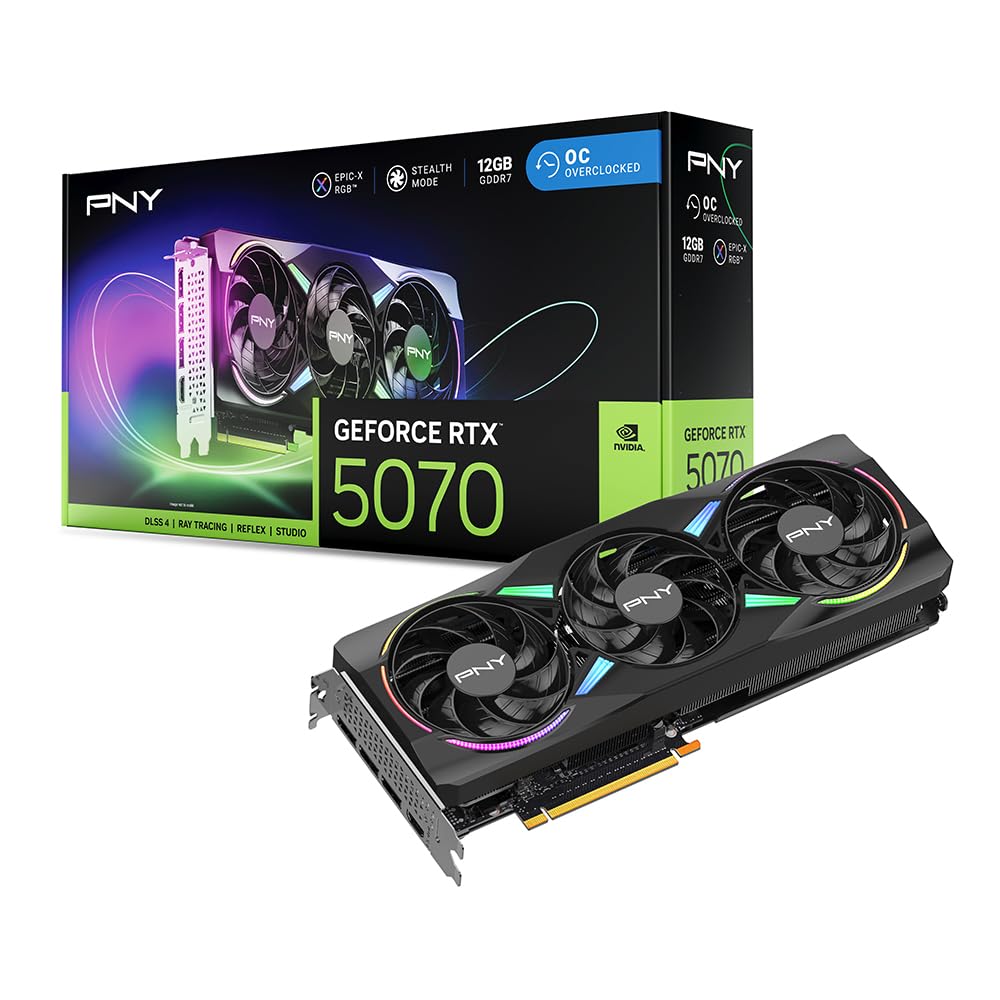
The PNY RTX 5070 Epic-X ARGB OC stands out among base 5070 cards for its aggressive factory overclock of 2685 MHz boost clock and excellent thermal performance. Its triple-fan design keeps the 12 GB GDDR7 memory running cool even under sustained load, and users report case temperatures dropping significantly compared to older 30-series cards. This card is the top performer in the standard 5070 segment, beating the 4070 Super in raw FPS without relying on frame generation.
The 8% factory OC provides meaningful headroom for enthusiasts who want to push further, and the ARGB lighting adds a subtle accent without being overbearing. At just 2.4 slots, it’s relatively compact for a triple-fan design and fits most ATX cases easily. PNY includes a dual 8-pin to 12VHPWR adapter, making it compatible with standard 750W power supplies without a hard-to-find native cable.
Gamers targeting 1440p will find this card hits the sweet spot—DLSS 4 and multi-frame generation push frame rates well past 100 FPS in titles like Battlefield and Call of Duty at max settings. The card also has all 80 ROPS active, unlike some early production units, so buyers get the full Blackwell experience. For anyone seeking the best-performing standard 5070 without jumping to the Ti, this is the card to beat.
Why it’s great
- Highest base-5070 boost clock at 2685 MHz
- Triple-fan cooling runs quiet and lowers case temps
- 8% factory OC with extra manual headroom
- All 80 ROPS active for full Blackwell performance
Good to know
- 12 GB VRAM may limit future 4K texture-heavy titles
- ARGB requires motherboard sync for full customization
- Dual 8-pin adapter included, not native 12VHPWR
5. Zotac RTX 5070 Solid OC

The Zotac RTX 5070 Solid OC is a well-balanced triple-fan card that excels in compact builds thanks to its true 2-slot thickness. Its IceStorm 2.0 cooling system uses three 90mm BladeLink fans with composite heatpipes, keeping load temperatures between 50–69°C in side-mounted installations. This makes it an excellent choice for small-form-factor cases like the Fractal Terra or Cooler Master NR200, where every millimeter of GPU clearance matters.
The card handles high-refresh gaming and creative workloads equally well—users running VFX and CGI report no coil whine and stable performance over six months of use. The bundled GPU support stand is a welcome addition for horizontal mounting, preventing sag in larger towers. With 28 Gbps GDDR7 memory and PCIe 5.0 support, this card is ready for the latest bandwidth-hungry titles without bottlenecking modern CPUs.
The included pre-applied thermal paste is adequate, but enthusiasts may find a few degrees of improvement with aftermarket paste. The Firestorm software, while functional, has a slightly confusing interface for fan curve adjustments. Despite these minor software quibbles, the Zotac Solid OC delivers reliable, quiet performance at a comfortable price point for the 5070 tier.
Why it’s great
- True 2-slot design fits the most compact SFF cases
- IceStorm 2.0 triple-fan keeps temps 50–69°C under load
- No coil whine reported in VFX or gaming workloads
- Bundled GPU support stand prevents sag
Good to know
- Firestorm software interface is unintuitive for fan control
- Fans can be audible at maximum speeds (>2000 RPM)
- Standard thermal paste; room for improvement with aftermarket
6. Gigabyte RTX 5070 Windforce 3X OC

The Gigabyte RTX 5070 Windforce 3X OC delivers excellent value by combining the Windforce cooling system with a solid 2542 MHz core clock at a competitive price point. Its triple 80mm fans operate silently even at 99% utilization, keeping the card cool during extended gaming marathons. Users report smooth 300+ FPS in Cyberpunk 2077 at max graphics with path tracing enabled at 1440p, which is impressive for a standard 5070 card.
The SFF-Ready certification means this card fits comfortably in most modern cases, and its compact 3.94-inch depth leaves room for cable management. The reinforced structure prevents PCB flex, and the metal backplate adds rigidity. While advertised with a 256-bit interface in some listings, the actual memory bus is 192-bit—this is consistent with all base 5070 cards and does not affect real-world performance at 1440p or entry-level 4K.
Gigabyte recommends a minimum 750W power supply, and many users advise using the native PSU cable over the included adapter for optimal signal integrity. The card runs exceptionally cool—idle temperatures hover around 42°C even after upgrading from a power-hungry RTX 3080. For buyers seeking reliable, quiet performance from a trusted brand without paying a premium for flashy features, this is the smartest pick.
Why it’s great
- Silent triple-fan Windforce cooler with excellent thermal performance
- SFF-Ready certification fits tight builds
- Runs Cyberpunk 2077 path tracing at 300+ FPS in 1440p
- Reinforced structure with metal backplate prevents sag
Good to know
- 192-bit memory bus, not 256-bit as sometimes mislabeled
- 750W minimum PSU recommendation; native cable preferred over adapter
- No RGB lighting for those wanting aesthetic customization
7. MSI RTX 5070 Ventus 2X OC

The MSI RTX 5070 Ventus 2X OC is the ultimate compact card for small-form-factor enthusiasts, measuring just 236mm in length. Its dual TORX Fan 5.0 setup with a nickel-plated copper baseplate handles the 250W thermal load admirably, keeping temperatures between 65–72°C under gaming load. Users upgrading from an RTX 3070 report a 45–60% performance uplift at 1440p, with Cyberpunk and Starfield hitting 60+ FPS at ultra settings with DLSS 4 enabled.
The card’s dual-fan design means it’s not the quietest under 100% load, but MSI’s ZERO FROZR technology stops the fans entirely during idle and light gaming, creating a completely silent experience for desktop work. The 2557 MHz boost clock provides solid performance out of the box, and the GDDR7 memory at 28 Gbps ensures fast texture loading in modern titles. Installation is straightforward with the included 12VHPWR to dual 8-pin adapter.
While the Ventus 2X is not designed for heavy overclocking due to its more modest cooler, its small size unlocks compatibility with cases that reject larger triple-fan cards. It’s also a fantastic choice for home server builds—users running Frigate or Home Assistant report low power consumption and cool operation in rack-mounted cases. For anyone prioritizing space efficiency without sacrificing modern features, this is the card to buy.
Why it’s great
- Ultra-compact 236mm length fits the smallest cases
- TORX Fan 5.0 with ZERO FROZR for silent idle operation
- 45–60% performance uplift over RTX 3070 at 1440p
- Low power consumption ideal for home server builds
Good to know
- Dual-fan cooler not meant for aggressive overclocking
- Fans can be audible under sustained full load
- Baseline design without premium aesthetic touches
8. MSI RTX 5070 Shadow 2X OC
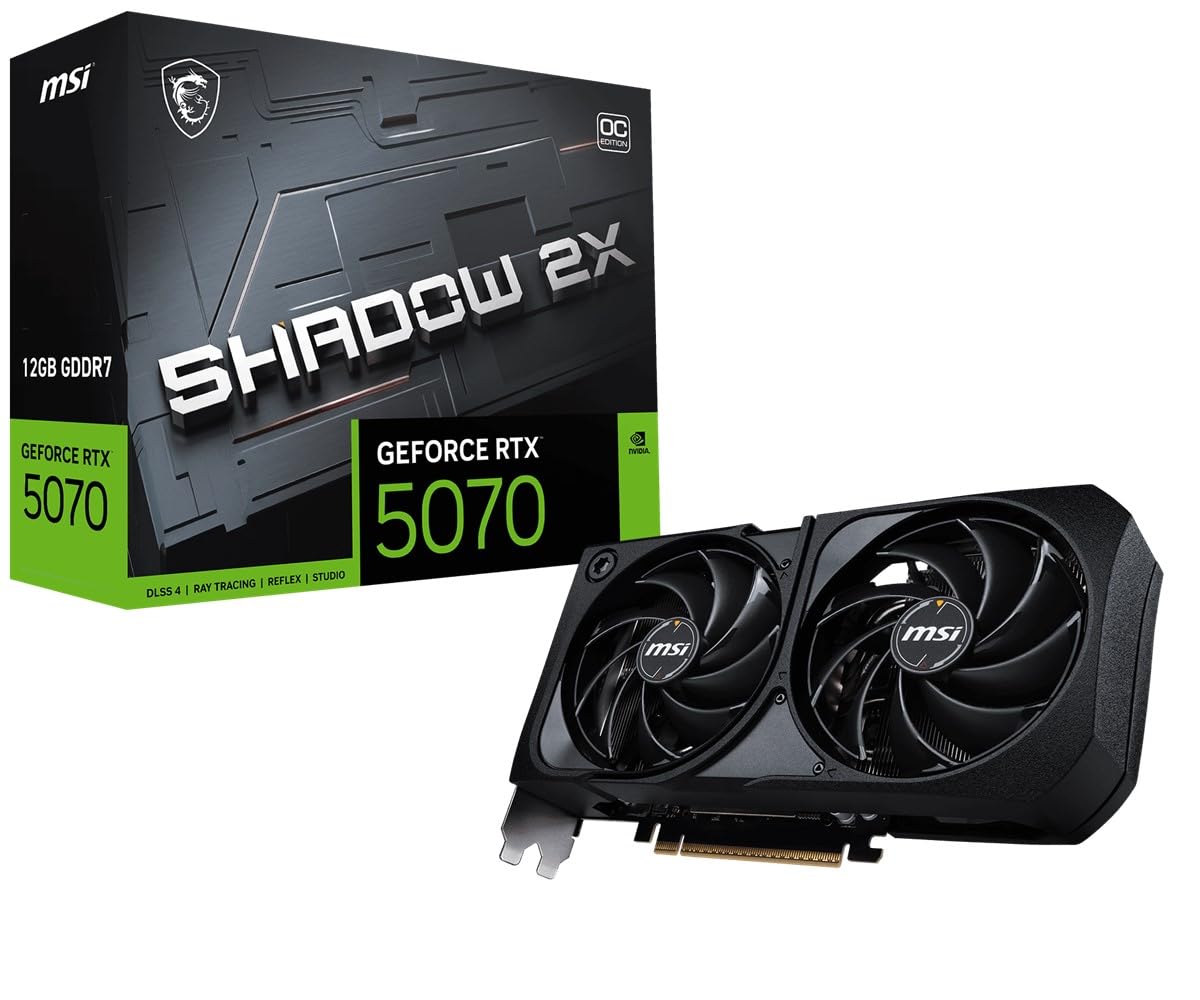
The MSI RTX 5070 Shadow 2X OC is the most affordable way to enter the Blackwell 5070 ecosystem, offering the core 12 GB GDDR7 setup at a lower entry point than most competitors. Its compact 231mm length makes it even shorter than the Ventus 2X, fitting into budget-oriented cases with limited GPU clearance. The dual-fan TORX Fan 5.0 cooler handles 1440p gaming well, with users reporting stable temperatures around 75°C under maximum load in 20°C ambient environments.
Benchmarks show this card scoring 17,000+ points in 3DMark, representing a real improvement over the RTX 3060 Ti with smooth ultra settings and ray tracing in modern titles. The card requires a 12VHPWR 16-pin connector, so ensure your power supply supports this or use the included adapter. Users recommend an undervolt for optimal efficiency, which drops temperatures without sacrificing FPS.
The build quality is solid for its price tier, though the shroud is entirely plastic rather than metal—a trade-off that keeps weight down to 722 grams. The 2.5-slot design is standard, and the card runs silently enough that users switching from older cards notice a significant noise reduction. For budget-conscious builders who want Blackwell’s features like DLSS 4 and ray tracing without spending on premium cooling, this is the logical starting point.
Why it’s great
- Lowest price point for entry to RTX 5070 Blackwell platform
- Ultra-compact 231mm length for budget cases
- Silent operation with 2 fans; 25% smaller than typical triple-fan cards
- 3DMark scores over 17,000 points—real upgrade from RTX 3060 Ti
Good to know
- All-plastic shroud construction
- Runs up to 75°C under load without undervolt
- 12VHPWR connector may require PSU upgrade for older systems
9. Gigabyte RTX 5070 Windforce OC SFF

The Gigabyte RTX 5070 Windforce OC SFF offers a compelling alternative to the MSI Shadow, with a slightly higher boost clock of 2600 MHz and the reliable Windforce triple-fan cooler in a compact form factor. Despite being a triple-fan design, the card fits into SFF cases easily and users report it being noticeably quieter than their previous RTX 2080 Super or RTX 3070 Master cards. The professional, sleek look with no RGB lighting appeals to those building minimalist workstations.
Temperatures stay under 75°C even during maxed-out 1440p gaming at 180 Hz refresh rates, and the card achieves smooth 180 FPS in most titles with a compatible HDR monitor. Users upgrading from an RTX 3080 report significantly lower idle temperatures around 42°C, demonstrating the efficiency of the Blackwell architecture. The card installs easily into standard ATX cases without any clearance issues.
This card shares the same core spec as the other Windforce variant but with the SFF designation emphasizing its physical compactness. The 2600 MHz boost clock is factory-set and requires no overclocking effort to achieve excellent 1440p performance. The only catch is that the memory interface is 192-bit, consistent with all base 5070 cards, but this doesn’t hinder real-world gaming at the target resolution. For buyers wanting triple-fan cooling in a compact, professional package, this is a smart value choice.
Why it’s great
- 2600 MHz factory boost clock—higher than most budget-tier 5070s
- Triple-fan Windforce cooler runs quieter than older-gen cards
- Compact SFF-friendly design with professional aesthetics
- Sustains 180 Hz at 1440p in modern titles
Good to know
- 192-bit memory bus; not the wider bus of Ti models
- No RGB lighting for those wanting customization
- Requires 750W PSU; included adapter should be replaced with native cable
FAQ
Is the RTX 5070 worth upgrading from an RTX 3070 or RTX 2080 Ti?
Does the RTX 5070 support 4K gaming at high refresh rates?
What power supply do I need for the RTX 5070?
Are the 5070 Ti cards worth the extra cost over the base 5070?
Final Thoughts: The Verdict
For most users, the best 5070 graphics card winner is the MSI RTX 5070 Ti Shadow 3X OC because its 16 GB of GDDR7 and 256-bit bus deliver the ideal balance of 4K capability, quiet triple-fan cooling, and reasonable size for the premium segment. If you want the best value in the standard 5070 tier, grab the PNY RTX 5070 Epic-X ARGB OC for its excellent factory overclock and strong gaming performance. And for compact builds where every millimeter counts, nothing beats the MSI RTX 5070 Ventus 2X OC at 236mm without sacrificing Blackwell’s core features.