
Our readers keep the lights on and my morning glass full of iced black tea. As an Amazon Associate, I earn from qualifying purchases.
Specs are compiled from manufacturer listings and verified buyer reviews and can change over time — please confirm the key details on the product page before buying.
A 50-liter pack is the one size that does almost everything — three to five days on a trail, a week of travel with no checked bag, or a bug-out bag that lives by the door. The problem is that “50L” on a listing page tells you nothing about whether the straps will dig into your shoulders at mile eight or whether the zipper will survive a fully stuffed main compartment. Not every pick is the exact number you typed in; the nearest same-type size serves the same purpose, and we tell you the real liter figure on every one.
I’m Min — the founder and writer behind Gadgets Feed. This guide is built by comparing the manufacturers’ published specifications and the patterns across verified customer reviews, so you get each pick’s real strengths and trade-offs instead of marketing spin.
Capacity is only half the story — suspension, fabric weight, and how the main compartment opens decide whether a pack actually carries well. The picks below cover that whole spread, so you can match one to your own trips rather than to a spec sheet with best 50l backpack.
Our Picks at a Glance


How To Choose The Best 50L Backpack
Most people buy a 50L pack on capacity and then discover the real decision was never capacity at all. What you actually feel on day two is the harness — the hip belt, the shoulder straps, and whether the frame passes weight to your hips or leaves it all hanging on your collarbones.
Match the frame to the trip, not to the marketing
An internal frame (a stiff stay or frame sheet hidden inside the pack) is what lets a heavy load ride on your hips instead of your shoulders. Framed packs like the Jueachy, the IX INOXTO, the Mardingtop, and both Osprey picks all put structure between you and the load. A frameless or soft-frame tactical pack still works well if your loads stay moderate or your trips are more urban than alpine.
Read the harness numbers before the liter number
A 50L pack that fits your torso will always carry better than a “better” pack that doesn’t. Look for an adjustable torso range, a padded hip belt that lands on your hip bones rather than your waist, and load-lifter straps that pull the pack toward your back. The IX INOXTO offers a multi-position torso adjustment and S/M/L shoulder strap positions, which is unusually granular at its tier.
Check how the main compartment opens
A top-loading pack is lighter and sheds rain better; a 180° flat-opening pack is dramatically easier to live out of in a hotel room. The LOVEVOOK and the Mardingtop both use full front-zip access, while the Osprey Rook uses the classic top lid plus a zippered sleeping bag compartment at the base.
Don’t overlook the rain cover and the fabric denier
Denier (the thickness rating of the woven fabric) tells you how abrasion-resistant the shell is — 600D is a solid mid-weight, 900D and 1000D are noticeably heavier-duty. Several picks here ship with an integrated or included rain cover, which matters more than most buyers expect once you’re caught out in a downpour with a sleeping bag inside.
Quick Comparison
| Model | Best For | Claimed Capacity | Weight | Fabric / Structure | Amazon |
|---|---|---|---|---|---|
| Falko Tactical 50L★ Best Overall | Everyday tactical carry and travel | 50L | 3.7 lb | Heavy canvas, soft frame | Amazon |
| Osprey Atmos AG LT 50LPremium Pick | Long hauls with heavy loads | 50L | 4 lb | AG mesh suspension, Fit-on-the-Fly hipbelt | Amazon |
| Osprey Rook 50LBest Display | Weekend and overnight backpacking | 50L | 3.6 lb | LightWire frame, AirSpeed backpanel | Amazon |
| LOVEVOOK 50L Travel Backpack | Carry-on travel and short trips | 50L | 2.2 lb | Tear-resistant polyester | Amazon |
| Mardingtop 50L | Multi-day hiking and bug-out duty | 50L | — | 600D Polyester, internal frame | Amazon |
| BARRERA Tactical 50L | Rugged daily and field use | 50L | — | 1000D waterproof nylon | Amazon |
| IX INOXTO 55L | Budget backpacking with hydration included | 55L | 3 lb claimed | Polyester/nylon, elastic steel frame | Amazon |
| Jueachy 50L Internal Frame | Entry-level backpacking and camping | 50L | 4+ lb reported | 600D Oxford, aluminum internal frame | Amazon |
| Large Black Tactical 40L/50L | Disaster prep and expandable travel | 50L, expands to 70L | — | 900D PVC, shoulder harness | Amazon |
In‑Depth Reviews
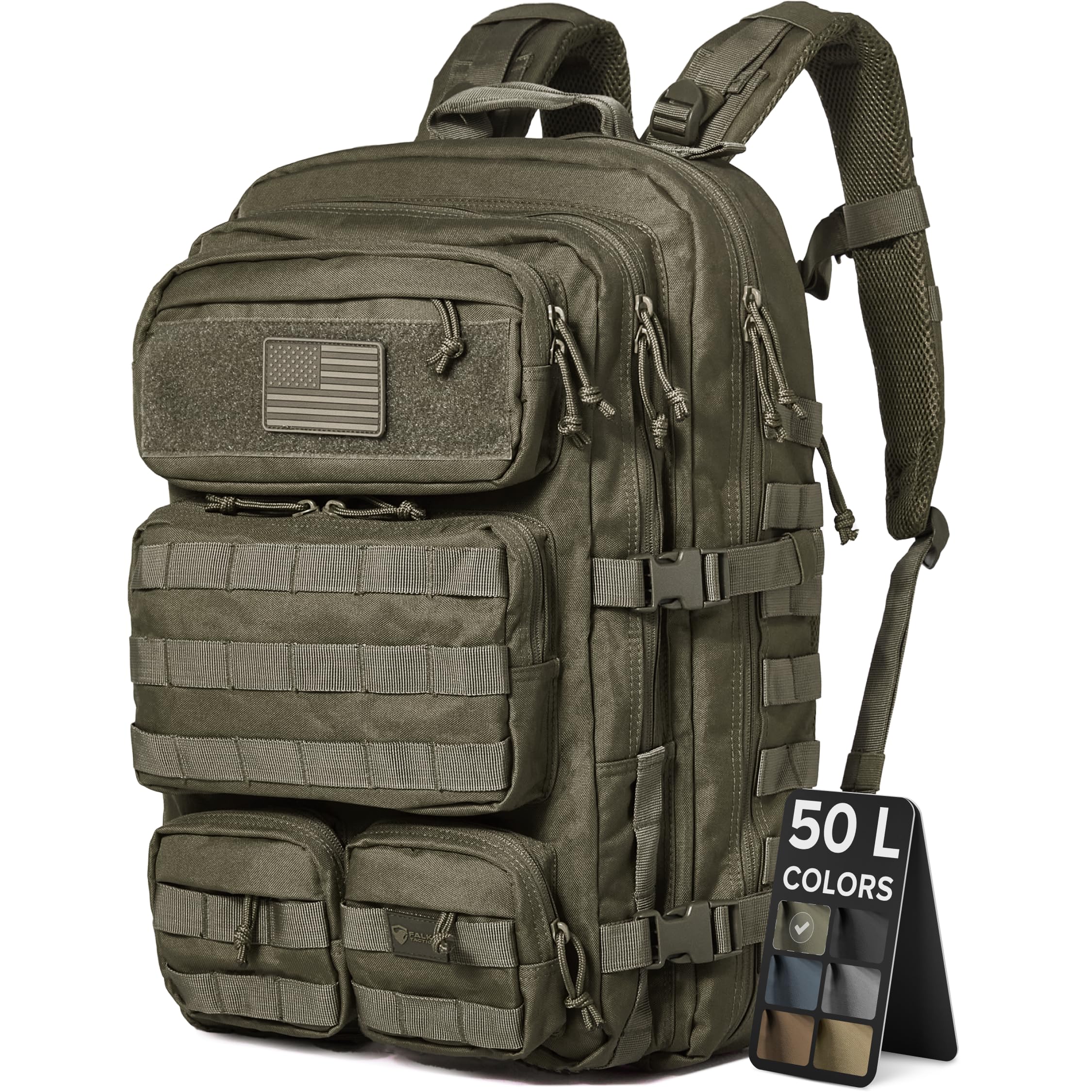
1. Falko Tactical Backpack for Men and Women 50L Backpack
Our pick — over 4.5★ from 2,500+ verified ratings; the strongest balance of quality and price.
The compartment count people keep packing for and never quite fill.
If you want one pack that swallows a full day’s gear plus a laptop and does it for years, this is the crowd favorite — 4.7 stars across 2,600+ owners, which is the kind of volume that sorts out hype from real life. The fabric is heavy canvas, not a thin ripstop, and at 3.7 pounds it is noticeably heftier than the LOVEVOOK below at 2.2 pounds — a heavier shell that handles abrasion and trail abuse but weighs more on your back before you even start loading.
What wins people over is the organization. Prospectors have fit a complete kit — pan, classifier, shovel, rock pick, chisel, crevice tools, snuffer bottle, vial, and a hand-wand detector — with room to spare. It has held a 17-inch Dell laptop per buyer reports, which means the main compartment is deep enough that a large laptop does not destroy the pack’s shape. Ham radio operators use the velcro pocket as an exact-fit slot for radio gear, and one buyer reports self-standing vertically when set down.
The honest trade-off is the zipper. Zipper quality is the one mixed signal in the feedback pile — most report smooth, non-jamming pulls even on a full pack, but a minority have dealt with failures. Treat the zips as the part that needs care when the bag is stuffed to the brim. The other minor point: a few buyers report the two lower outer pouches are small enough that they are more decorative than useful for anything bulky.
Where it earns its keep
- Heavy canvas shell built for real abrasion, not just looking tactical
- Handles a 17″ laptop in the main compartment alongside daily gear
- MOLLE loops across the exterior for attaching pouches and tools
- Adjustable padded straps take heavy loads without cutting in
- Self-supports vertically when set down and packs/unpacks easily
What to keep an eye on
- Zipper quality is the one mixed signal — treat full-pack zips gently
- At 3.7 lb, heavier than several travel-first picks on this list
- The two small lower outer pouches will not fit much
- Not padded enough for daily laptop commutes where the bag gets knocked around
The right match: Buyers who want a do-everything pack for travel, day hikes, and prospecting or radio field work with serious pocket depth
Pass it up for: Anyone who walks long distances daily and wants the lightest possible 50L carry
2. Osprey Atmos AG LT 50L Men’s Backpacking Backpack
The mesh back panel that keeps a 50-pound load from riding on your spine.
This is the pack you buy when you already know your miles are long and your load is heavy. Four pounds on the scale sounds like a knock, but the AG suspension system (a tensioned mesh back panel that cradles your back instead of pressing against it) is the whole reason owners put up with the weight. That mesh keeps air moving between you and the pack — no flat slab of fabric glued to your spine on a summer climb.
Owner stories back that up at the load end of the spectrum. One buyer carried 50 pounds up the Na Pali Coast trail — 12 miles round trip, half in rain — with no leaks. Appalachian Trail hikers testing it against a £300-class alternative describe the comfort difference as something you feel rather than measure. Fit-on-the-Fly hipbelt plus a ladder torso adjustment gets the sizing right for a real body, not a marketing average.
The catch is straightforward: 4 pounds is on the heavy side for a stripped-back model, and one buyer who tried it for non-hiking travel noted the suspension is overkill if you’re not actually carrying it on a trail. Would you rather travel light with a soft-shell bag, the Osprey Rook at 3.6 pounds and £170 cheaper is the more sensible answer.
What the price buys: A just-in-case suspension does not sit on the shelf — it is the day-after-day comfort that makes a 50-pound load manageable on a 12-mile day in the rain.
Honest limit: If your trips are hotel-based or your load stays under 25 pounds, this pack’s design advantages barely register.
Buy it if: You are putting multi-day trail miles on a heavy pack and want the mesh-gap suspension doing the work for you
Skip it for: Weekend car campers or carry-on flyers who’d rather have 3.6 pounds and a simpler design
3. Osprey Rook 50L Men’s Backpacking Backpack
the just-right pick for a three-day trip that suddenly becomes five.
Here is the head-to-head that matters most in Osprey’s own lineup: the Rook is 3.6 pounds and the Atmos is 4 pounds, and the Rook costs about half of what the Atmos does. For someone who is not carrying 50 pounds and does not need the mesh-gap back panel, the Rook is the obvious choice — same 50L volume, same brand reputation for quality, less money.
The pack is built around Osprey’s AirSpeed suspension — a tensioned backpanel that keeps air moving and adjusts to a range of torso lengths — with a LightWire frame that hands the load to your hipbelt rather than your shoulders. A zippered sleeping bag compartment with a floating divider means you do not have to rebuild your pack every morning. The integrated raincover stows in its own pocket so you are not digging for a loose bag when the sky turns.
Real-world proof spans the full body range. Boy Scouts at 5’2″ and 100 pounds carry it on multi-day trips; owners on the Appalachian Trail at 6’4″ and 185 pounds report the same comfortable fit. One less-obvious caveat: this is a hiking-first design. Buyers who tried it as a suitcase replacement for non-hiking travel wished they’d packed differently — the suspension only earns its keep when you’re actually on a trail. On the trail, though, what owners praise most is that quality sensation — a pack that feels made to last.
Who this quietly wins for: The packer whose weekend trips keep getting extended by a day or two and who wants one bag to cover the whole range.
Fair caution: If your travel is planes and hotels rather than trailhead-to-trailhead, the frame and harness are features you pay for and never use.
Suited to: Scouts, weekend backpackers, and 2-to-5-day campers who want real suspension without the full premium
Not for: You if you’ll mostly fly with this bag and want flat-pack convenience instead
4. Mardingtop 50L Hiking Backpack, Backpacking Backpack with Rain Cover
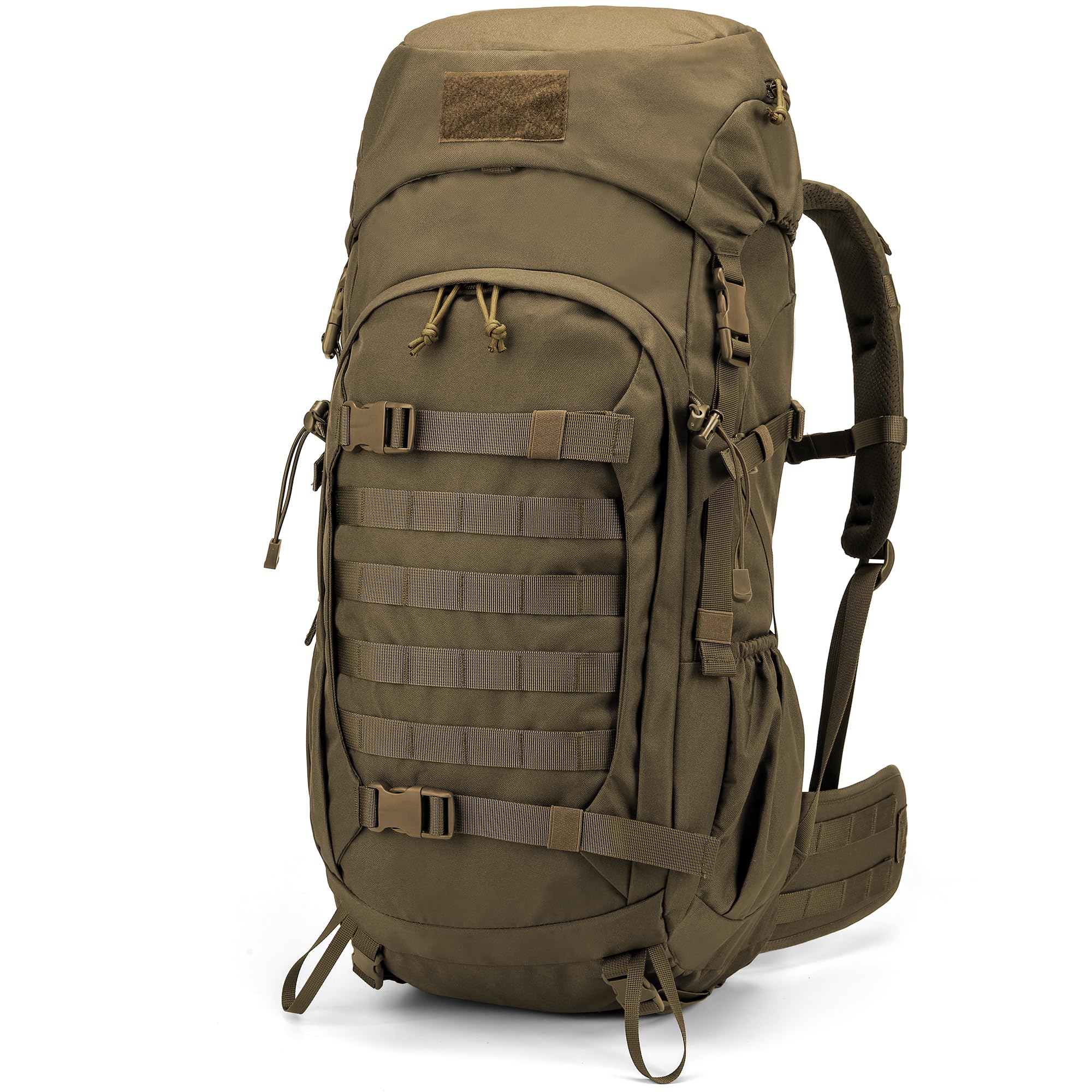
Bug-out bag, hunting pack, and nine-day travel hauler in one shell.
Look at the zipper brand and you know where this pack is aimed: YKK hardware on a 50L internal-frame rucksack at a mid-range price. YKK zippers have the reputation for a reason — they’re the part that tends to fail first on cheaper packs, and the absence of that failure point is why this model shows up in so many bug-out and hunting conversations. Add a 5L hydration sleeve or a 15.6-inch laptop compartment, and the configurability stretches across contexts that most packs only pick one of.
The load-testing stories are convincing. One buyer logged 150 trail miles with no stitching problems; another took it through nine days of travel without complaint. What buyers praise most is material quality, and the second-most-cited note is about how much you can actually cram in. Owners regularly describe it as a 3-to-5-day pack that packs down tight when you want it to look civilian. Hunters specifically note the external pole and tent straps and the large brain/mesh top pouch.
Two honest limitations surface in the reviews. Some buyers find the storage layout less generous than the descriptions suggest — the main compartment is one big bay with minimal internal pouches, so you’ll want packing cubes or stuff sacks to keep order. And the back panel does not breathe well during high-output climbs. Neither is a dealbreaker at this price point; both are worth knowing before you choose this over a mesh-suspension Osprey.
What you’re paying for
- YKK buckles and zippers — the brand that tends to be the weak point on cheaper packs
- 600D Polyester with a rain cover included
- MOLLE webbing for pouches, tools, or first aid kit
- Fits a 5L hydration bladder or a 15.6″ laptop
- Adjustable sternum strap and hip belt fit a wide torso range
Where it needs planning
- Interior is a large open bay — packing cubes are almost required for organization
- Back panel ventilation is weak on warm climbs
- Not ultralight; add serious weight and the loaded pack gets heavy fast
Right pick for: The buyer who wants one mid-priced pack that can serve as bug-out bag, hunting pack, trail pack, and travel hauler
Think twice if: You want pre-organized pockets inside a pack and won’t add your own cube system
5. IX INOXTO 55L Internal Frame Waterproof Hiking Camping Backpack
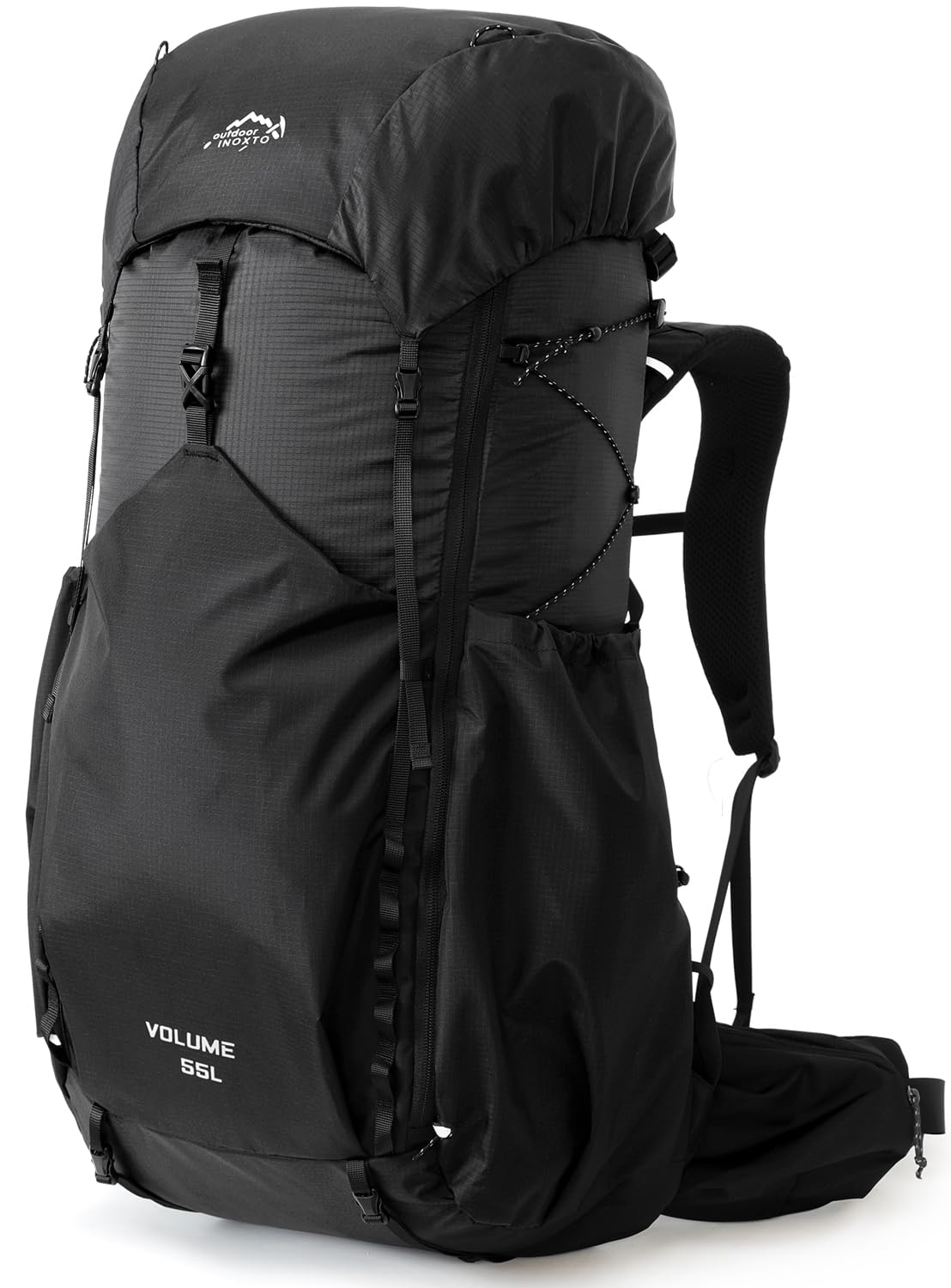
Budget pack, genuinely capable suspension — and a 3L bladder already inside.
This is the pack you buy when you want to actually discover whether backpacking is your thing before dropping serious money. It leans 5 liters over the standard 50 — 55L of volume on a claimed 3-pound frame, and that small bump makes a real difference on a 4- or 5-day trip where food weight pushes you close to capacity. The elastic steel frame runs an internal stay down the back, distributing load where a soft-shell bag would just sag.
What buyers rave about most is the price-to-capability ratio. Experienced hikers comparing it to £300-tier alternatives describe the components as comparable — non-mesh side pockets, a full side-zip for easy access, extendable top lid, and a bendable aluminum stay system that lets you tweak the frame back to your own shape. One buyer carried 30 pounds four miles comfortably with the velcro back panel locked in. Another carried 15 pounds comfortably over 25 miles in the Tetons.
The honest trade-off is the shoulder-and-hip hardware. A few owners mention it isn’t the most comfortable pack in the world — the harness is functional rather than plush, and the hip belt runs small for larger builds. Weight on the scale also runs slightly over the claimed number once you add straps and hardware, so don’t count the pack as strictly ultralight. Neither of those is a flaw at this tier — they are the compromises that make the price possible.
Where this shines: Includes a 3L leak-proof hydration bladder with a 47-inch drinking line and a switch valve plus cover cap for double leak protection — a real cost saver on top of the pack.
Fair warning: The hip belt is sized on the smaller side, so a bigger frame will want to test that fit before committing.
Best fit: First-time backpackers, casual weekend hikers, and anyone who wants a complete kit including hydration ready to go out of one package
Look elsewhere if: You want top-shelf harness padding and are willing to pay premium prices for it
6. LOVEVOOK Travel Backpack for Women Men, 50L Large Capacity Travel Bag
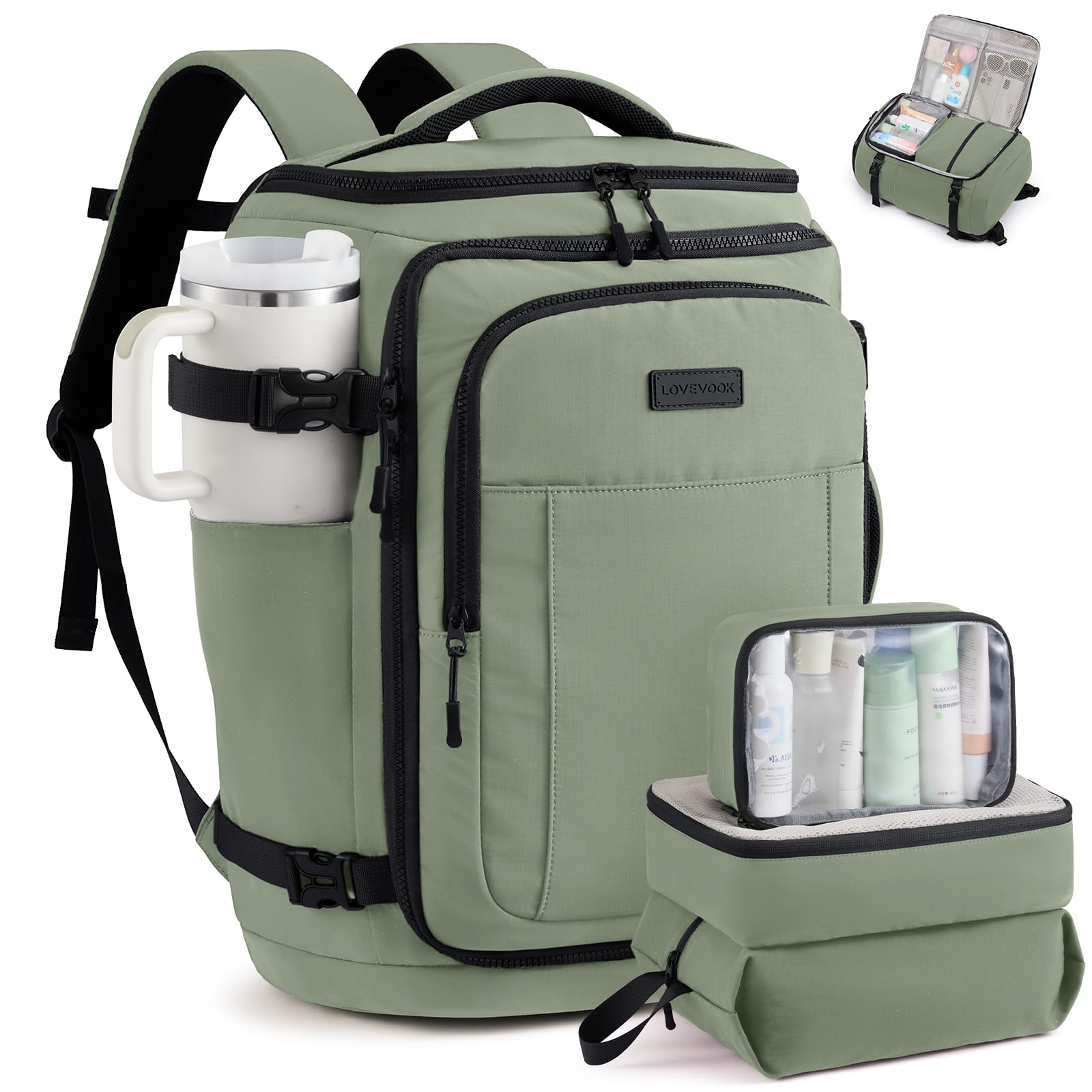
Fits under the seat, opens flat, and still hauls a week of clothes.
If your trips are flights, hotel check-ins, and packing once per city rather than once per trailhead, this is the shape of bag that actually makes sense. It comes in at 2.2 pounds — the lightest pick in this lineup, roughly 1.5 pounds lighter than the Falko — and it folds and flexes in a way heavy tactical rucksacks simply don’t. The silhouette is 14 by 7 by 17 inches, sized to slip into the personal-item space under most airline seats, and customers note clearing Avelo, Transavia, and Aegean size checks without a fight.
Organization is where it quietly runs away with the field. Five compartments and 18 pockets, a padded 17.3-inch laptop sleeve, and a hidden anti-theft back pocket give you a place for every item by category. The top quick-grab pocket is a common favorite in buyer reports — sunglasses, passport, and headphones live within arm’s reach without opening the main bag. Two included packing cubes and a shoe bag help you live out of it comfortably for a week.
The main caveat: the S-curve shoulder straps work well for short hops and airport days but are not backpacking-grade. Owners who tried to carry it loaded for a 40L-class hike found the straps uncomfortable and heavy across the shoulders and recommended a wheeled bag or a dedicated hiking pack instead. And the 180° flat opening means the pack has no structure when the zipper is fully down — you will load it flat on a bed, not standing on the floor.
Traveler’s win: The 180° flat-open design combined with a TSA-ready profile and a top-and-side grab handle means airport security, hotel packing, and day-of access are basically easy.
Not a trail pack: Buy this for planes and trains; carry it loaded for real distances and the harness will tell you so.
Made for you if: You fly frequently on tight-size airlines and want one personal-item bag that replaces a small carry-on suitcase
Choose a different shape if: You are planning multi-day hiking or needing a framed suspension system
7. BARRERA Tactical Backpack 50L, Military MOLLE Backpack
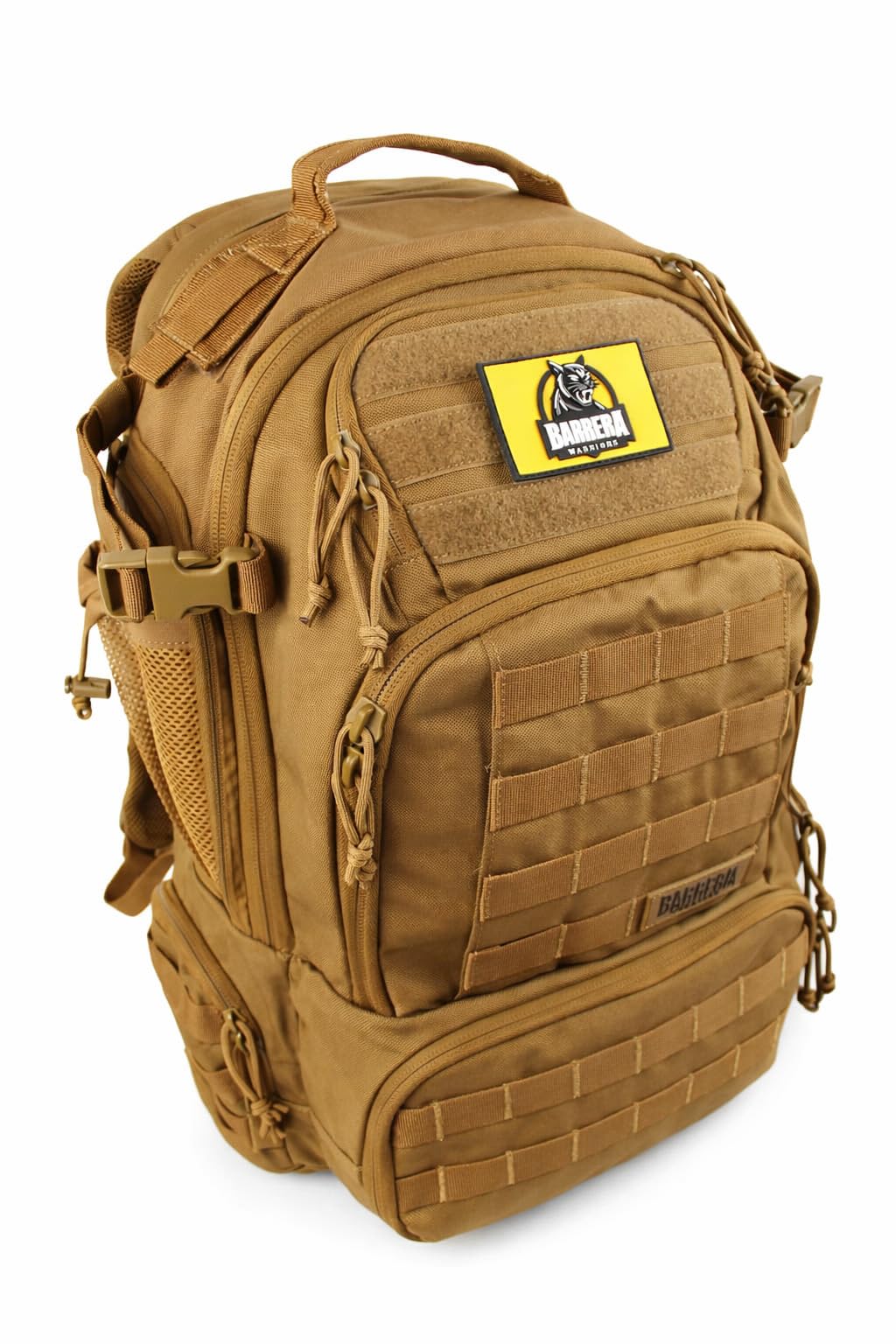
The heavy nylon shell that shrugs off Florida heat and airport security alike.
Weight of fabric is the number to watch here — 1000D nylon, the heavy end of what you see in tactical packs and a couple of steps up from the 600D shell on the Mardingtop above. If your gear rubs against rock, truck beds, or gear lockers on a regular basis, that thicker weave pays you back in years. The waterproof coating plus reinforced stitching lands it firmly in the “put it away wet, wipe it down later” category rather than the “genuine waterproof submersion” one.
Buyer stories run the full range of environments. One owner took it through Disney and Universal in July heat, where four frozen bottles stayed partly frozen in the main compartment all day. A Fire Department user calls it his “man purse on the go” with enough internal storage to organize work kit inside the large main compartment. Size passes FAA requirements per buyer reports — the 22-inch height fits the carry-on envelope — and the removable waist belt plus adjustable chest strap let you tune the carry style between tactical and travel.
The one recurring concern in the reviews is strap durability under prolonged heavy load — most owners wear it daily without issue, but one reviewer noted shoulder strap stress after about three months of use. The pack is not the lightest either; the heavyweight fabric comes with weight. If your load stays moderate and your trips are scheduled rather than brutal, both of those are non-issues.
The heavy-duty angle: 1000D nylon, waterproof coating, reinforced stitching, and heavy-duty zippers form the field-conditions spec sheet you want if you actually beat up your gear.
Carry strategy tip: The removable waist belt lets you shift between a waist-belted trail carry and a strap-only travel carry as your trip changes.
Built for: Equipment-heavy users — fire service, outdoor instructors, tactical commuters — who want the toughest fabric on the list
Might be overkill if: Your heaviest load is a laptop, lunch, and gym clothes
8. Jueachy 50L Internal Frame Hiking Backpack
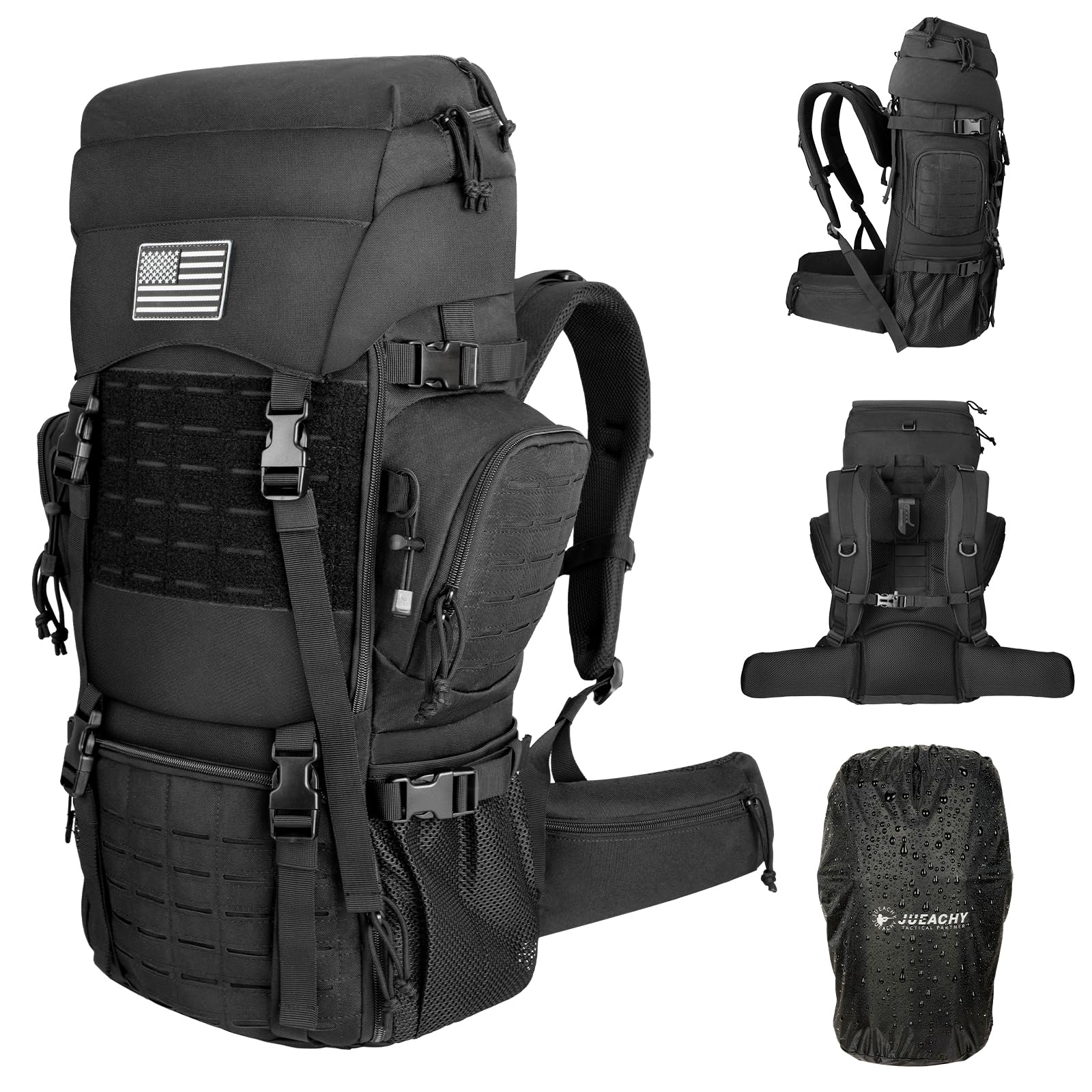
Heavier than most picks here — and it carries loads the lighter ones can’t.
There is a fair trade-off hiding inside this pack’s fabric choice. It is built from tear-resistant 600D Oxford below and reinforced by an aluminum internal frame, but reviewers point out it weighing 4-plus pounds, which puts it 1 to 2 pounds heavier than some lighter picks. That weight is not an accident — it’s the structural cost of a pack that actually distributes a heavy load across your hips instead of loading up your shoulders.
Owners testing it for real backpacking describe the load transfer working as intended — multi-day trips and bug-out configurations ride well because the frame passes weight to the waist belt and not the collar bones. The rain cover has been tested by owners in an actual downpour and kept gear dry. The bottom bottom-side waterproof compartment for dirty shoes or wet clothes is the small, practical detail most packs at this price skip entirely, and the unique drawstring main-compartment closure prevents gear from spilling while you dig for a specific item.
The catch that recurs across reviews is ventilation. The back panel is padded but not aggressively vented, so a summer climb produces the sweat you’d expect on a £70 framed pack. The straps also come stiff from the start and need a break-in period before they feel comfortable. Both are things to plan around rather than reasons to skip — pack smart, hydrate, and the pack will hold up its end.
Where it delivers: An adjustable carrying system that lets you raise or lower the pack height according to your torso, with thick foam on the shoulder straps and eight attachment straps for tents, sleeping bags, and pads.
The trade-off: That structural support costs you weight on the scale and warmth on the back panel in hot weather.
Match for: Beginner and intermediate backpackers who want a legitimately framed pack for multi-day hikes without stretching the budget
Not the one for: Ultralight distance hikers or summer-climb specialists where every ounce and every degree of airflow counts
9. Large Black Tactical Backpack for Men, 40L/50L Expandable Military Rucksack
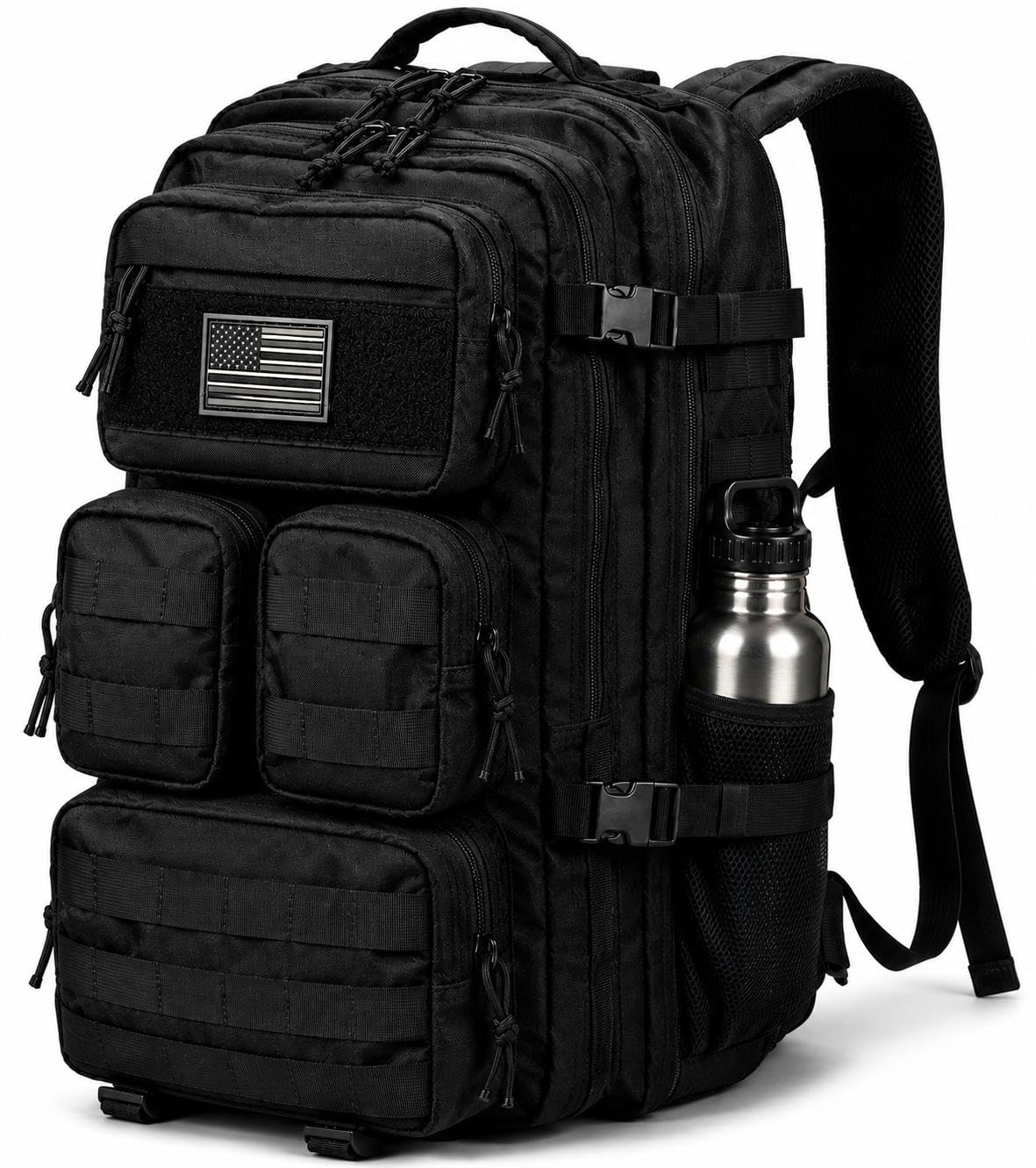
A 50L pack that grows to 70L when the trip runs long.
The expandability is the real story here. The perimeter zip pushes this bag from a 50L carry-on to a 60L or 70L hauler depending on how much you unzip — a flexibility most fixed-volume packs cannot touch. It is built from 900D PVC fabric, heavier than standard polyester and explicitly weather-resistant rather than merely water-repellent, and the main compartment opens a full 180° for genuinely easy packing.
Buyer scenarios cover exactly the range you would want this for. An Air Force veteran called it a modern version of the “go bags” he used in service and uses it as an earthquake-readiness kit — expanding the main compartment, attaching smaller packs via MOLLE and U-clips, and locking everything to the bag. A college user reports fitting a laptop, a binder, two textbooks, and two notebooks with the stitching still holding under the load. A frequent traveler cut the spare straps with scissors and started carrying it with designated pockets for medications, headphones, and a battery bank. The MOLLE exterior plus a velcro patch surface lets you customize the look and function as you go.
Two things buyers flag honestly: the attachments are untested long-term, so nobody has road-tested the zippers and hardware through five years of use yet. And one reviewer says the pack holds shape well when loaded but softens noticeably when empty — normal for a structured bag without a frame. Consider this the pack for someone who wants one shell that fluidly scales up and down with the trip.
Where the value lands: 50-to-70L expansion, 180° main-compartment opening, MOLLE exterior, hidden rain cover, and padded straps with chest and waist support — a lot of functional design stacked into the entry-level slot.
Long-game caveat: Longitudinal durability is unproven at this stage — the build looks right and the users testing it are not gentle, but a five-year track record simply isn’t there yet.
Best home for it: Preppers, road-trippers, and students who want a single bag that runs from everyday carry to full expand mode
Not the right match if: You need a fixed-frame suspension system for serious trail miles
Understanding the Specs
Liter Rating vs Real Usable Space
A 50L rating is the total internal volume, but only a fraction of that is ever usable for the gear you actually pack. Pack design decides the rest — pockets, access zips, frame intrusion, and lid shape all steal or recover usable space. That is why a 50L internal-frame pack like the Jueachy sometimes fits more gear than a soft 50L daypack with more outer pockets; the frame lets you compress and stack efficiently. Flexibility is the key word: choose by type and trip length, not by the strict number on the listing.
Frame, Harness, and Load Transfer
An internal frame (a stiff aluminum stay or frame sheet inside the pack) transfers weight to your hips. A shoulder-only harness keeps the load on your shoulders the whole trip. Real-world consequence: 40 pounds feels meaningfully lighter on your spine in a framed pack than the same load in a frameless one. Look for a hip belt that lands on the hip bones themselves, a sternum strap that keeps the shoulder straps from sliding, and load lifters that pull the top of the pack toward your back. The Atmos AG LT pushes the strongest version of this idea with a tensioned mesh back panel; the Rook uses an AirSpeed version at a lower tier.
Fabric Denier and What It Tells You
Denier is the thickness rating of the woven fabric used for the shell. Higher denier means heavier, more abrasion-resistant, and typically more water-shedding. 600D is a solid middle ground seen on hiking packs like the Mardingtop and Jueachy; 900D on the Large Black Tactical and 1000D on the BARRERA mark the heaviest-duty tier of this list. A rain cover or waterproof compartment on top of that denier is a genuine upgrade for any trip where the weather can turn.
Carry-On Size and Airline Fit
Airline compliance is roughly about dimensions, not liters — a 50L pack that is 22 inches tall typically passes domestic carry-on rules, while a longer pack at the same volume may not. Several picks here target this: the LOVEVOOK at 14 by 7 by 17 inches is built around personal-item sizing, the Large Black Tactical is FAA-friendly per buyer reports, and the BARRERA has been cited as FAA-compliant by owners. The IX INOXTO meets most airline size requirements per its own spec. If flying is a major use, favor the picks that make carry-on fit part of the design brief.
FAQ
How much can a 50L backpack actually hold for a real trip?
Is a 50L backpack too big for a carry-on flight?
Internal frame or frameless — which do I actually need?
How do I pick the right torso size for a 50L hiking pack?
Do I need a rain cover if the pack is waterproof?
What does the denier number on backpack fabric mean?
Can I use a 50L backpack as a daypack too?
How long does a 50L backpack typically last?
Is a 55L backpack too big for a short trip?
How much weight can a 50L backpack carry comfortably?
Final Thoughts: The Verdict
For most people, the 50l backpack that earns its spot at the top is the Falko Tactical 50L because it packs an enormous amount of usable organization into a heavy canvas shell that survives real use — 4.7 stars across thousands of owners is the kind of track record that tells you a lot before you have even opened the box. If you want the lightest carry-on that still holds a week of clothes, grab the LOVEVOOK Travel Backpack. For multi-day trail miles with a serious load, the Osprey Atmos AG LT 50L is the one worth stretching for. And if you want a tested, budget-friendly starter kit that arrives with a hydration bladder and rain cover already inside, the IX INOXTO 55L gets you on the trail for a lot less.
How We Picked
We do not accept paid placement. Every pick is matched to a real buyer and a real use-case; we do not hands-on test units.
Sources & Methodology
Specifications: manufacturer listings and product documentation. Review insights: verified customer reviews, as of September 2026. Pricing: not shown on this page (it changes often); check the current price via the retailer link.
As an Amazon Associate, Gadgets Feed earns from qualifying purchases. This does not affect which products we feature.