
Our readers keep the lights on and my morning glass full of iced black tea. As an Amazon Associate, I earn from qualifying purchases.
Specs are compiled from manufacturer listings and verified buyer reviews and can change over time — please confirm the key details on the product page before buying.
Here is the short answer: buy the YETI Panga if your gear has to survive a full dunking, and pick the AquaQuest White Water if a rainy weekend and a truck bed are as wet as your trips get. One quick note before the picks — this list matches the 50-liter capacity flexibly, accepting the nearest sold size, roughly 45 to 55 liters, so not every bag here is the exact number you searched. A 45L or 55L roll-top does the same job as a 50L, so check the stated capacity on each listing.
I’m Min — the founder and writer behind Gadgets Feed. This guide is built by comparing the manufacturers’ published specifications and the patterns across verified customer reviews, so you get each pick’s real strengths and trade-offs instead of marketing spin.
Capacity gets the attention, but the closure decides whether your sleeping bag survives a river dunking. Roll the top down tight, clip it, and the seal does the work — pick the wrong build and you find out the hard way. This breakdown covers the closure types, fabric weights and submersibility claims that decide which 50l dry bag earns its spot on your rack.
Our Picks at a Glance

How To Choose The Best 50L Dry Bag
Fifty liters is the awkward middle of the dry bag world, and that is exactly why it is the most useful size. It is big enough for a week of clothes for one person, or a weekend for two who pack light. It is small enough to strap across a pillion seat or drop into a canoe without swallowing the whole boat. The volume is not the question. It is what the bag is made of and how it closes.
Closure first: roll-top versus zipper
Almost every bag worth buying here uses a roll-top closure. You fold the mouth over three or four times, then clip the buckle. That folded, compressed fabric is the seal. A zipper bag can be quicker to open, but the teeth and the tape are extra places for water to find a way in, so a zipper bag tends to be rated for rain rather than full submersion. If your plans involve the bag going completely under, the roll-top with welded seams is the safer architecture.
Fabric weight is the real trade-off
Light ripstop nylon packs down small and carries like nothing, but it is thin and can be punctured. Heavy tarpaulin and PVC shrug off rocks and exhaust pipes, but they add bulk and stay stiff in the cold. Both are valid choices. A paddler who hikes the bag to a put-in wants the light fabric. A rider strapping a bag to a tail rack over a hot exhaust wants the tough stuff.
Submersible or just splash-proof
“Waterproof” on a listing can mean anything from surviving a rainstorm to surviving a river. Read the exact wording. A bag described as keeping contents dry in rain is a rain bag. A bag described as airtight and submersible is built for going under. Match the listing’s wording to the wettest thing you will actually do to the bag.
Quick Comparison
| Model | Best For | Stated Capacity | Closure Type | Fabric | Amazon |
|---|---|---|---|---|---|
| YETI Panga★ Best Overall | Full submersion and rough water | 100 L (model Panga 100) | Zipper | — | Amazon |
| Lifeventure Ultralight Dry BagUltralight Pick | Packing light and organising a backpack | 75 L | Roll-top, cross buckle | Siliconised ripstop nylon | Amazon |
| Haimont Waterproof Duffel | Strapped to a bike in the rain | 70 L (50L/70L options) | Roll-top | Tarpaulin | Amazon |
| WILD HEART Dry Motorcycle Tail Bag | Tail-bag fit on a street bike | 50 L and 70 L options | Velcro plus top roll | TPU / PVC | Amazon |
| AquaQuest White Water Duffel | All-round travel and truck-bed duty | 50, 75 or 100 L | Roll-down top with Velcro guides | 420D ripstop nylon with welded seams | Amazon |
In‑Depth Reviews
1. YETI Panga
Our pick — over 4.5★ from 350+ verified ratings; the strongest balance of quality and price.
The bag you stop worrying about the moment it goes under the water
Buyers describe this as an airtight, waterproof, submersible duffel — submersible meaning the bag is built to go fully under water and keep what is inside dry. That is a different promise from the rain-shedding bags further down this list. The model here is the Panga 100, and the same line is sold in other volumes: reviewer comments reference a 50L used as a camera bag on water and floatplane trips, and a 75L described as likely sufficient for travel. That range of volumes is why it leads the list.
What wins people over is the build itself. Quality comes up as the most-praised trait in the owner feedback, followed closely by durability, and the material carries that reputation in practice — webbing and buckles that owners describe as overbuilt, and on the heavy side compared to lighter alternatives. One long-riding family packs it as a spacious overnight and camping bag, and reports it still looks new after use. A shoulder strap makes it manageable to carry even when it is loaded.
The honest catch is the closure. The zipper is the one place opinions split, and owners themselves describe it as cumbersome, while noting in the same breath that it has to be that way to keep water out. If you want a bag you can flip open one-handed at a campsite, this is not that bag. On value, some owners call it pricey, but the same comments usually land on “worth it for confidence” — which is the point of a submersible bag.
What holds up in the field
- Airtight and submersible build, sold in several volumes across the line
- Owners treat it as an overnight, camping and off-roading bag all in one
- Shoulder strap keeps a loaded bag carryable
- Fits a 17′ Old-town canoe according to owner feedback
Where it asks patience
- The zipper is deliberately stiff and takes some effort to work
- Heavier than the nylon bags on this list
- Some owners find the price hard to swallow on day one
Buy it if: your gear goes fully under water — floatplanes, river crossings, rough off-road runs where a splash is not the worst case.
Think twice if: you want fast, one-handed access at camp, because that stiff zipper is the trade you make for the airtight seal.
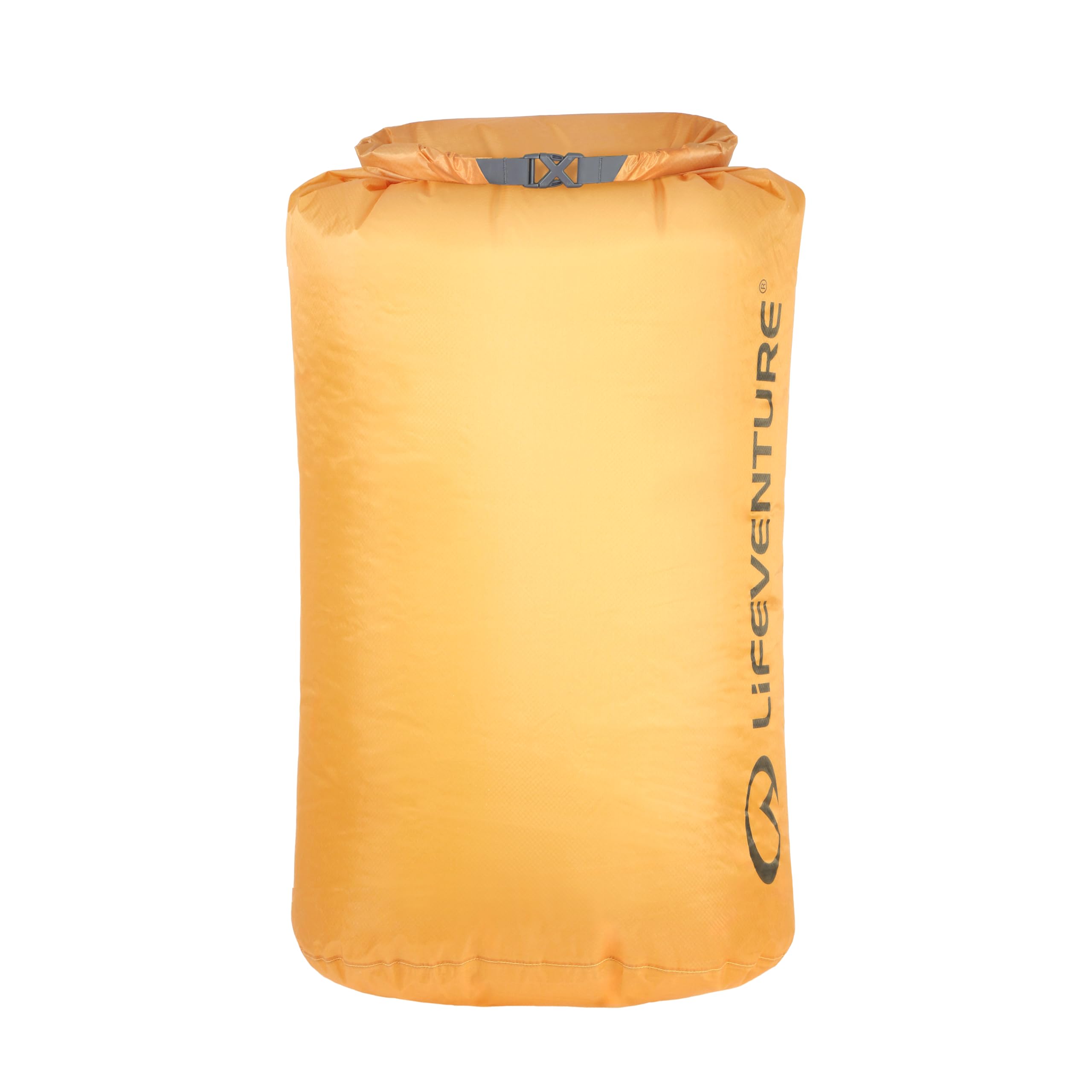
2. Lifeventure Ultralight Dry Bag, Siliconized Rip-Stop Fabric with Fully Taped Seams Lightweight Waterproof Dry Sack for Kayaking Camping Hiking Traveling Boating Water Sports
The one you forget is in your pack until you need it
Start with the fabric, because that is the whole point here. It is siliconised ripstop nylon with a fully taped seam construction, and a roll-top closed off by a cross buckle. Ripstop means the weave is reinforced with a grid of heavier threads so a small tear stops instead of running. Taped seams mean the stitching lines are covered over to seal them. Together they are why this bag weighs so little while still holding water out — one buyer filled it with water to test it and reported it worked completely.
The scale of it is genuinely small, and that is deliberate. Owners describe it as light and compact, ideal for hiking, and useful for splitting a load into separate bundles inside a bigger backpack. That is the trick with a bag this thin: it is a lightweight inner layer that keeps one set of gear dry inside a larger pack, not your only line of defence.
Durability is where you should set your expectations honestly. The material is thin, and the manufacturer does not dress that up. Owners put it plainly — the fabric is thin enough that a fall onto rocks or a slide on a motorbike could damage it. That does not make it fragile in normal use; a long-term owner running it hard across roughly six months of intensive use reported the bags were still watertight. Just do not expect it to be the bag strapped to the outside of anything.
Two-year verdict: the waterproofing held up across roughly six months of heavy use for at least one owner, which tells you the taped seams do their job for the long haul.
Pack-flat bonus: it folds down small enough to live permanently in a rucksack as a just-in-case layer, and comes in a range of sizes so you can colour-code your kit.
Reach for it when: you are travelling light, hiking, or organising gear inside a larger pack and want the bag to almost disappear in weight and bulk.
Not the one for: strapping externally to a rack or sliding it across sharp ground — the thin ripstop is the compromise you accept for the low weight.
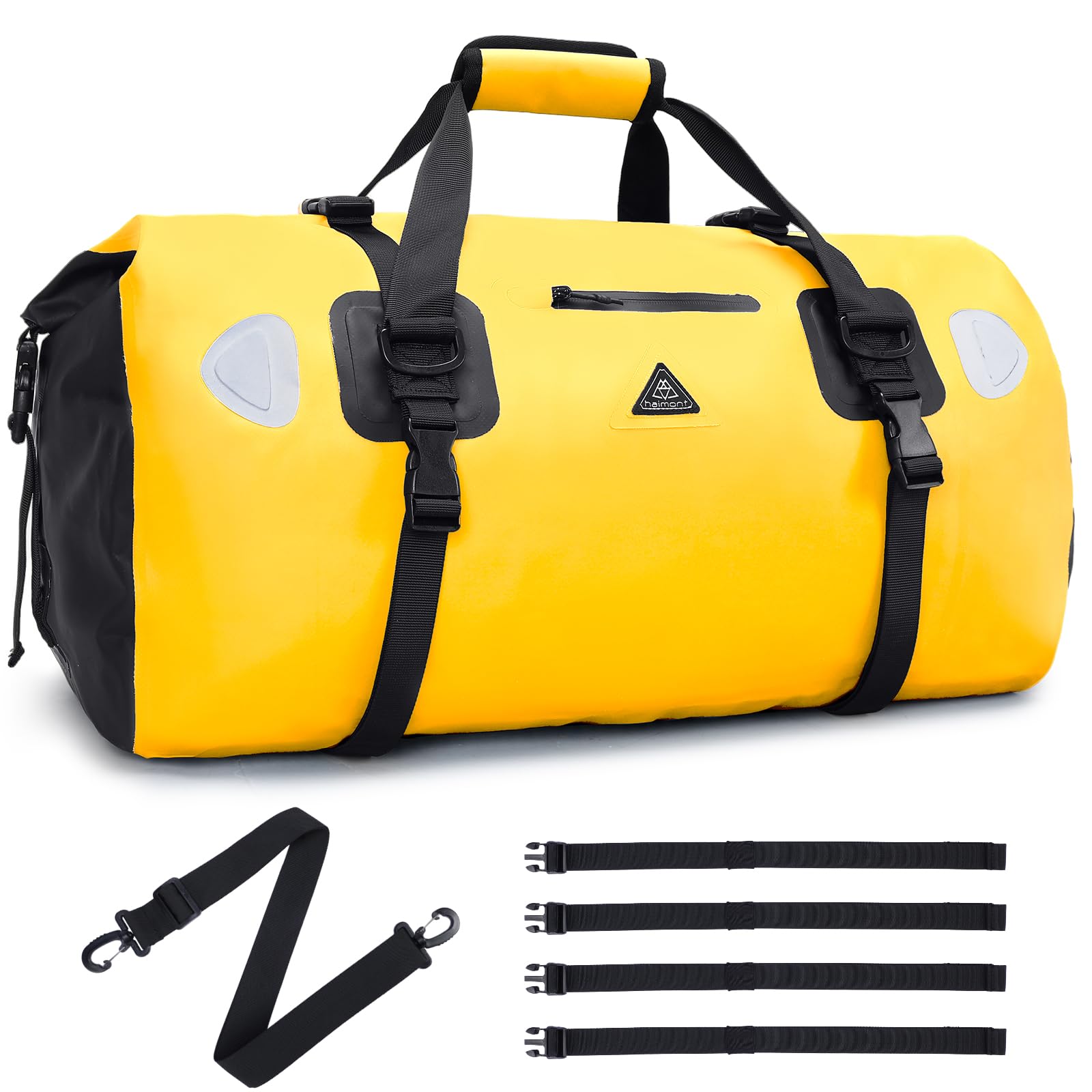
3. Haimont Waterproof Duffel Bag Roll-top Dry Duffel Bag with Quick-fixed Straps for Motorcycling, Rafting, Boating, SUP, Kayaking, Travel, 50L/70L
Built for the rider who has to strap it down and forget it for a thousand miles
Four quick-release straps and a tarpaulin shell is the short version of why this bag works on a bike. High-frequency welded seams are the joinery detail that matters — the panels are fused rather than stitched, so there are no needle holes to leak. Buyers describe gear staying dry through rain, and the strap hardware earns constant praise: owners rig it as tie-downs across the load and report it held tight over long, rough rides. The listing also carries four high-brightness reflectors, which is a small thing that matters a lot on a night ride.
Owner reports read like a road log. One rider ran a 70L version through a long rough KLR650 ride with crashes and a river submersion and reported everything stayed dry in heavy rain. Another used a 70L strapped to the back of a kayak on a remote camping trip and packed cookware and electronics with no damage. The capacity conversation usually lands the same way: a 70L swallows three to four days of riding gear and clothing comfortably, and a 50L covers about a week for one packer.
The recurring gripe is the closure routine. The top Velcro only covers part of the mouth, and buyers report folding the roll three or four times takes a little practice — squeeze the air out first, then roll from the centre outward. There is also a note of a chemical smell from the start that airing plus a dryer sheet clears. Neither is a deal-breaker, but they are the two wrinkles worth knowing before it shows up.
Ride-tested: submerged in a river and rained on for hundreds of miles with the contents still dry, according to rider accounts of the 70L version.
Easy to live with: a wide opening makes packing and unpacking straightforward, and the material wipes clean with a cloth.
The right call for: motorcyclists, kayakers and rafters who need four strap points, quick-release buckles and a welded seal that shrugs off rain and splashes.
Look past it if: you expect to fully submerge the bag — owners rate it for rain and splash protection rather than extended submersion.
4. WILD HEART Dry Motorcycle Tail bag 70L/50L With Rope Straps and Inner Pocket Waterproof PVC 500D for Travel,Motorcycle and so on

The soft-sided bag that molds itself onto a pillion seat and refuses to budge
The defining detail here is the fabric. It is a high-density TPU shell — TPU being a flexible, tear-resistant waterproof material — and the listing points out that this grade is normally used for diving bags. The bottom is thickened and non-slip, and the closure combines Velcro with a top roll so nothing falls out on the road. Capacity is the single thing owners talk about most, and the shaped, rounded profile is what makes it work: it flexes over a tail box or seat hump instead of perching on top of it.
The mounting story is what seals it. It goes on in under three minutes in owner accounts, comes off in about one, and rides steady. Riders report it holding firm through stretchy mountain roads and a multi-thousand-kilometre trip through South America with a few drops along the way and no wear to show for it. The oversized 70L carries enough for two people who overpacked for a week. One owner noted it even carried a dog’s kennel safely over a three-hour run.
Where it can trip you up is bike fit. Tall adventure and dual-sport bikes with a high exhaust are called out as a poor match, while 70s and 80s street bikes and sport-tourers take to it well. A couple of owners also found the supplied straps were not quite enough on their particular seat and added a ratchet strap or bungees of their own. Budget for that possibility if your seat is unusually shaped.
What riders rate highest
- Shape and padding grip the seat and quiet the wind-flap that plagues tall backpacks
- TPU shell survived an accidental exhaust-pipe contact without failing
- Roll plus Velcro closure kept contents dry through rain
- Outer pockets plus a large waterproof inner pocket for separating wet gear
Before you strap it on
- High-exhaust adventure and dual-sport bikes are a poor fit
- Some owners needed extra straps beyond what ships in the box
- Buckles are described as good but not the very best available
Made for: street-bike and sport-touring riders who want a soft, seat-hugging bag that mounts in minutes and holds a week of gear for two.
Give it a miss if: you ride a tall dual-sport with a high exhaust — the fit is where this bag falls short.
5. AquaQuest White Water Duffel – 100% Waterproof, Heavy Duty, Versatile, Comfortable – Durable Protective Dry Bag for Travel, Sport, Motorcycle, Boat, Fishing – 50, 75, or 100 L

The one bag that hauls snorkel kit, clothes and camping gear without complaint
This is the bag with the clearest all-round spec sheet on the list. The 50L version is built from 420D ripstop nylon with welded seams — 420D being a fabric weight, and the higher the denier the tougher the weave — then coated in TPU and PU for water resistance. It carries 6 Duraflex D-rings on the body and 4 heavy-duty webbing loops on the base, which is why it is the most versatile pick here: you can lash it to a roof rack, a truck bed or a motorcycle with real confidence.
Owners put it through exactly that. It has ridden on a roof rack and held up well, sat in a truck bed through three days of an eight-day storm with socks, t-shirts, books and camping gear all dry, and spent a rainy camping trip in a puddle with no leaks. A five-day paddle trip with heavy rain and hours in a canoe puddle left the interior bone dry. The capacity earns the most praise in owner feedback, and it is genuinely generous — one account filled it with two trash bags of clothing.
The recurring gripe is the shoulder strap, which a few owners describe as flimsy and non-grippy and simply swap out. The closure also grabs some mixed feedback, though the roll-down top with Velcro guides and a stiffener is what most owners prefer over a zipper for keeping water out. Material feel is a personal thing too: some find this nylon softer and easier to grip than stiffer PVC bags, while that softness is exactly what makes others worry about abrasion.
The packing advantage: a huge opening and compression straps make loading fast, and packing cubes drop straight in — which is why it doubles as travel luggage, not just outdoor gear.
Carry-on friendly: the 50L meets carry-on criteria for at least one traveller, and the bag folds away for checked luggage when it is empty.
Pick this one when: you want a single bag for travel, sport, motorcycling and boat days, with the most mount points and the widest size range of the group.
Factor in first: the shoulder strap has a soft, slippery feel that a handful of owners chose to replace — worth a glance before your first trip.
Understanding the Specs
Stated capacity in liters
Capacity is the volume the main compartment holds, and it is the number buyers scan first. Fifty liters is roughly a week of clothing for one person or a weekend for two who pack carefully. The bags on this list are sold in several volumes — 50, 70, 75 and 100 liters all appear across the picks — and the rule for reading them is simple: a bigger bag is not automatically better, because a bag that is too large for your trip just means dead air and wasted mounting space.
Closure type and seam construction
A roll-top closure folds the mouth of the bag over itself and clips it shut; the layers of compressed fabric become the seal. Welded seams join panels by fusing them, while taped seams cover stitched lines. Both aim at the same goal — removing the holes a needle would otherwise leave. This is the spec that decides whether a bag is rated for rain or for full submersion, so match the closure and seam build to the wettest thing you will actually do.
FAQ
Is a 50L dry bag big enough for a week long trip?
What is the difference between waterproof and submersible on a dry bag?
Will a 50L dry bag fit on a motorcycle rear seat or rack?
How many times should you roll a dry bag top to seal it?
Can you fully submerge a roll-top dry bag underwater?
Is ripstop nylon or tarpaulin better for a dry bag?
How do you mount a dry bag so it does not shift at speed?
Do dry bags have a chemical smell when new?
Final Thoughts: The Verdict
For most people, the 50l dry bag winner is the YETI Panga, because it is the only pick here described as airtight and submersible — the bag you buy when getting wet is the whole risk. If your gear rides on a bike in the rain and you want four quick-release straps and welded seams, the Haimont Waterproof Duffel is the one to reach for. And if you want the most versatile all-rounder with the widest size range and the most mounting points, the AquaQuest White Water Duffel covers travel, motorcycling and boat days in one bag — while the Lifeventure Ultralight stays the smart pick when weight is the deciding factor.
How We Picked
We do not accept paid placement. Every pick is matched to a real buyer and a real use-case; we do not hands-on test units.
Sources & Methodology
Specifications: manufacturer listings and product documentation. Review insights: verified customer reviews, as of September 2026. Pricing: not shown on this page (it changes often); check the current price via the retailer link.
As an Amazon Associate, Gadgets Feed earns from qualifying purchases. This does not affect which products we feature.