
The 54-degree wedge sits in the most versatile spot in your bag — the gap between your pitching wedge and sand wedge that most amateurs either ignore or fill with the wrong club. A properly chosen 54-degree wedge turns those dreaded 80-to-100 yard approach shots into legitimate scoring opportunities, and it pulls double duty as a reliable chipping tool from the fringe. The problem is that with so many grind options, bounce angles, and face technologies on the market, most golfers grab the first shiny head they see and regret it three rounds later.
I’m Min — the co-founder and writer behind Gadgets Feed. After comparing groove geometry, sole grind profiles, and bounce configurations across this entire field, I’ve isolated the wedge characteristics that actually translate to lower scores rather than just better marketing copy.
This guide breaks down the seven strongest contenders on the market to help you find the best 54 degree wedge for your swing type and typical course conditions without wasting money on features you don’t need.
How To Choose The Best 54 Degree Wedge
Selecting a 54-degree wedge isn’t about picking a brand — it’s about matching the bounce, grind, and face technology to how you actually hit the ball. A wedge that works perfectly for a steep swing on soft turf will dig like a shovel on tight fairway lies. Here are the three filters that separate a scoring tool from a bag filler.
Bounce Angle and Sole Grind
Bounce angle — the measurement between the leading edge and the lowest point of the sole — determines how the wedge interacts with the ground. For a 54-degree wedge, 10 to 14 degrees of bounce is the sweet spot for most players. Low bounce (6-8 degrees) suits firm turf and sweepers. High bounce (14+) helps in soft sand and fluffy rough but makes tight lies tricky. The sole grind shapes that bounce into specific profiles: a C-grind removes material from the heel and toe for face manipulation, while a full sole provides maximum stability for square-faced shots.
Groove Design and Face Texture
Grooves are the only thing between your clubface and the ball at impact. Deeper, sharper grooves with tighter spacing generate more spin by channeling away moisture and debris. Premium wedges now combine CNC-milled grooves with laser-etched or blasted surface roughness (HydraZip, Spin Gen) to maintain spin in wet conditions. For a 54-degree wedge, which handles both full swings and delicate pitches, a full-face groove pattern adds forgiveness on off-center strikes.
Construction: Forged vs. Cast
Forged wedges — made from a single billet of metal pressed into shape — deliver denser grain structure and softer feel at impact. Cast wedges are poured into molds and tend to feel firmer but allow more complex sole shapes. The 54-degree benefits from forged construction because it’s the wedge most likely to be used for feel-based partial shots. That said, a well-designed cast wedge with proper weighting can outperform a poorly forged one. Look for head weight around 290-300 grams for consistent swing tempo.
Quick Comparison
On smaller screens, swipe sideways to see the full table.
| Model | Category | Best For | Key Spec | Amazon |
|---|---|---|---|---|
| Callaway Opus Wedge | Premium | All-around spin control | 10° bounce, S Grind | Amazon |
| Cleveland RTX 6 Zipcore | Premium | Maximum spin consistency | 95% more ZipCore material | Amazon |
| Callaway Jaws Raw Wedge | Premium | Aggressive groove grip | 12° bounce, raw face | Amazon |
| Cleveland Smart Sole Full-Face | Mid-Range | Forgiveness and versatility | 14° bounce, three-tiered sole | Amazon |
| TaylorMade Milled Grind Wedge | Mid-Range | Balanced feel and launch | 4-way camber sole | Amazon |
| Full Choice Golf Wedges | Budget | Entry-level versatility | Micro-milled face | Amazon |
| AM20XX Golf Wedge | Budget | Value-for-money starter | Forged, micro-milled face | Amazon |
In‑Depth Reviews
1. Callaway Golf Opus Wedge

The Callaway Opus represents the brand’s most refined wedge engineering to date, built around Spin Gen Face Technology that combines three distinct spin elements — precision-milled grooves, a roughened surface texture between grooves, and a laser-etched pattern that maintains friction even when the grooves are wet. The 10-degree bounce paired with the S Grind (a medium-width sole with heel and toe relief) makes this wedge playable for both square-faced full swings and open-faced flop shots without digging.
At address, the Opus sits flat with a clean topline that inspires confidence — the head shape was refined through hours of Tour player feedback, and it shows in how naturally the leading edge aligns to the target. The regular flex steel shaft delivers a consistent trajectory window between 85 and 105 yards with a controlled mid-flight that holds greens well. The chrome finish reduces glare significantly compared to raw wedges, which helps during afternoon sun rounds.
Real-world testing from reviewers shows immediate improvement in spin consistency on 80-to-90 yard pitches, with several 19-handicap players noting the wedge eliminated their tendency to blade the ball from tight lies. The feel at impact is crisp without being harsh, characteristic of Callaway’s forging process, and the sound provides clear feedback on center versus off-center strikes.
Why it’s great
- Three-layer spin tech maintains grip in wet conditions
- S Grind provides versatility for square and open face shots
- Tour-refined head shape inspires alignment confidence
Good to know
- Premium pricing places it at the top of the market
- The chrome finish shows bag wear more quickly than raw finishes
2. Cleveland Golf RTX 6 Zipcore Wedge

Cleveland’s RTX 6 Zipcore pushes the boundaries of wedge spin engineering with a proprietary low-density core that occupies up to 95% more volume inside the head than the previous generation. This allows the engineers to position the center of gravity precisely behind the impact zone while simultaneously increasing the moment of inertia by 20% — meaning off-center hits lose less ball speed and spin than any conventional wedge construction can deliver.
The 6-degree bounce on this configuration makes it ideal for players with shallower swing paths who play on firm turf conditions. The Tour Satin finish reduces glare while providing enough surface texture to complement the UltiZip groove system — a network of sharper, deeper, and more tightly spaced grooves that slice through debris and bite harder than the older TourZip design. The blade-style head with a plumber neck hosel suits players who prefer to shape shots and manipulate face angle.
Reviewers consistently report that the RTX 6 makes chipping and bunker shots more predictable, with one 5-star review describing how the 60-degree version gave them “a lot more confidence in my short game.” The soft feel at impact — a direct result of the ZipCore dampening vibration — provides excellent feedback for partial swings, which is precisely what a 54-degree wedge demands around the green.
Why it’s great
- 95% more ZipCore material for unmatched CG control
- UltiZip grooves deliver Tour-level spin consistency
- Matte finish virtually eliminates glare at address
Good to know
- 6-degree bounce suits firm turf but struggles in soft sand
- Blade head demands consistent ball-striking for full swings
3. Callaway Golf 2022 Jaws Raw Wedge

The Jaws Raw stands out for one reason: it has the most aggressive groove geometry Callaway has ever put into a production wedge, and the raw (unplated) steel face accelerates the natural oxidation process that creates a micro-rough surface texture — exactly what you want for gripping the ball on wet grass or from the rough. The tungsten weighting technology embedded in the head shifts mass to the perimeter, raising stability on off-center hits without sacrificing the ability to open the face for flop shots.
The 12-degree bounce paired with a cavity-back head design makes this wedge more forgiving than traditional blade wedges, particularly for mid-to-high handicap players who tend to hit the ground before the ball on full swings. The corded grip provides excellent traction in humid conditions, though it may feel abrasive to players who prefer softer rubber. The regular flex shaft launches the ball with a mid-to-high trajectory that stops quickly on firm greens.
Multiple verified buyers describe the Jaws Raw as a “must have” for short game improvement, though one 3-star review notes that the head profile is noticeably more compact than the non-raw Jaws wedge, which may require adjustment for players used to larger clubheads. The raw face will develop a rust patina over time — this is intentional and actually increases surface friction, but golfers who prefer pristine-looking clubs should consider the chrome version.
Why it’s great
- Raw face rusts for increasing surface grip over time
- Tungsten weighting boosts forgiveness on thin strikes
- Most aggressive groove pattern in Callaway’s lineup
Good to know
- Raw face requires accepting aesthetic rust development
- Compact head less forgiving than larger cavity designs
4. Cleveland Golf Smart Sole Full-Face Wedge

The Smart Sole Full-Face is Cleveland’s answer for golfers who struggle with wedge consistency — and the design philosophy is radically different from traditional wedges. The extra-wide three-tiered sole incorporates three distinct levels of bounce: a high leading edge bounce to prevent digging on full swings, a mid-sole relief for versatility on tight lies, and a trailing edge bounce that glides through sand and thick rough. This is the most forgiving sole geometry in the wedge market today, period.
The full-face groove coverage means you can strike the ball anywhere on the clubface and still generate meaningful spin — a feature that reviewers consistently praise for eliminating the bladed shots that plague high-handicap wedge play. The 14-degree bounce angle is higher than most 54-degree wedges, making it specifically optimized for soft turf conditions, bunker play, and situations where you need the club to resist digging. The cavity-back head further increases MOI for stability on off-center hits.
Buyers report that the Smart Sole transformed their short game within the first round — one verified reviewer who described themselves as “not very good at golf especially with wedges” said the club made hitting clean contact “a lot easier.” The chipper configuration within the Smart Sole family is particularly praised for bump-and-run shots. The trade-off is that the wide sole makes opening the face for high-floating flop shots more difficult than with a traditional blade wedge.
Why it’s great
- Three-tiered sole eliminates digging in all turf conditions
- Full-face grooves provide spin across the entire clubface
- Cavity-back design maximizes forgiveness for off-center strikes
Good to know
- Wide sole limits face manipulation for advanced shot shapes
- Higher bounce struggles on hardpan and tight fairway lies
5. TaylorMade Golf Milled Grind Wedge

TaylorMade’s Milled Grind Wedge takes a precision-engineering approach to the sole — every wedge sole is CNC-milled from a raw forging to achieve tolerances that hand-grinding cannot replicate, ensuring the 4-way camber profile is identical from wedge to wedge. This design incorporates variable relief across the leading edge, heel, toe, and trailing edge, providing a versatile sole that works for square-faced full swings and open-faced pitches without the specialized niche performance of extreme grinds.
The mass placement in the head is intentionally positioned higher than typical wedge designs, which raises the center of gravity to produce a more controllable launch angle with increased spin rates. This is particularly valuable on full 54-degree swings where you want the ball to launch on a predictable trajectory and stop quickly. The chrome finish is classic and durable, resisting the rust that affects raw wedges while still providing a clean look at address.
Multiple verified buyers describe the Milled Grind as the “best wedge I’ve had to date” and note immediate improvement in short game performance. The regular flex shaft and standard grip suit a wide range of players, making this one of the most accessible premium wedges for golfers who don’t want to obsess over custom fitting. The main limitation is that the 52-degree configuration reviewed here is slightly stronger than a true 54-degree gap wedge, so players looking for the exact 54-degree loft should confirm availability before purchasing.
Why it’s great
- CNC-milled sole delivers unmatched grind consistency
- High CG placement produces controllable spin-rich launch
- Classic chrome finish is durable and glare-resistant
Good to know
- Tour-proven grind may feel vanilla to advanced shot-makers
- 52-degree configuration may not match exact 54-degree need
6. Full Choice Golf Wedges (50/52/54/56/58/60/70 Degree)
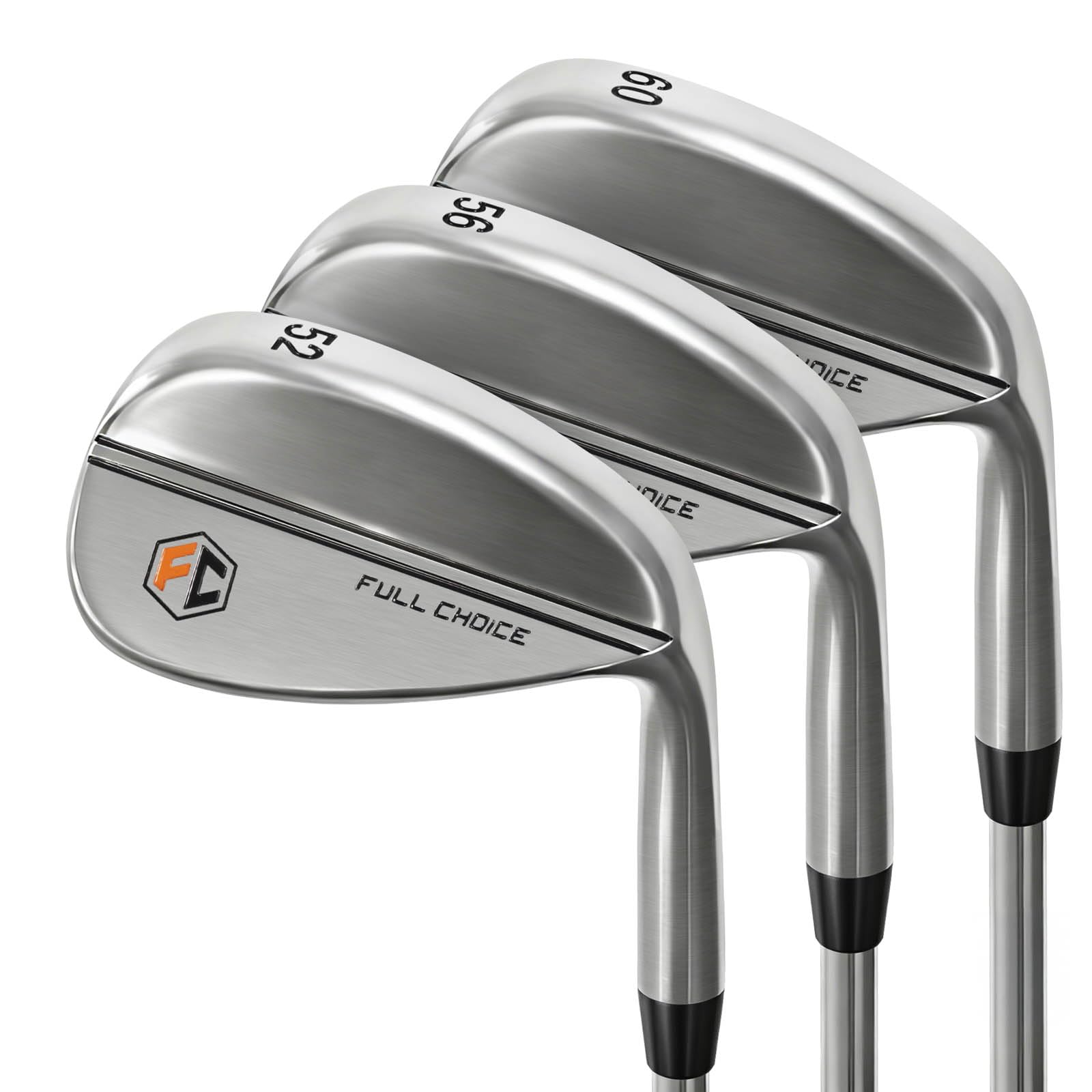
The Full Choice wedge lineup attacks the budget tier with a simple proposition: provide all the standard lofts (including the oddball 70-degree option) with a micro-milled face that delivers respectable spin for the price point. The stainless steel shaft and synthetic rubber grip are basic but functional, and the standard blade head profile offers a classic look that won’t intimidate beginners. For golfers building their first complete bag or replacing a single missing wedge, this is the most cost-effective entry point available.
The micro-milled face pattern creates surface roughness that promotes friction at impact, generating enough spin for greenside control on most course conditions. At 79.99 for a single wedge, this sits firmly in the budget category, but verified buyers consistently note that the feel and balance exceed expectations — one 20-handicap reviewer said “the feel and balance are great” and another described it as a “nice wedge” without caveats. The regular flex shaft suits moderate swing speeds, and the standard grip size fits most hands without modification.
The most notable limitation is weight — several reviewers noted the clubs feel “a little heavy,” particularly for older or physically smaller players. The 70-degree loft option is a novelty that experienced golfers may find gimmicky, but the core lofts (50 through 60) perform well enough for weekend play. The one-year warranty provides basic protection, and buyers report reliable Amazon fulfillment with quick shipping.
Why it’s great
- Micro-milled face delivers surprising spin at this price
- Full loft range from 50 to 70 degrees covers every need
- One-year warranty provides basic purchase protection
Good to know
- Head weight runs heavy for players with slower swing speeds
- 70-degree loft offers niche use at best for most golfers
7. AM20XX Golf Sand Wedge (Premium Forged)
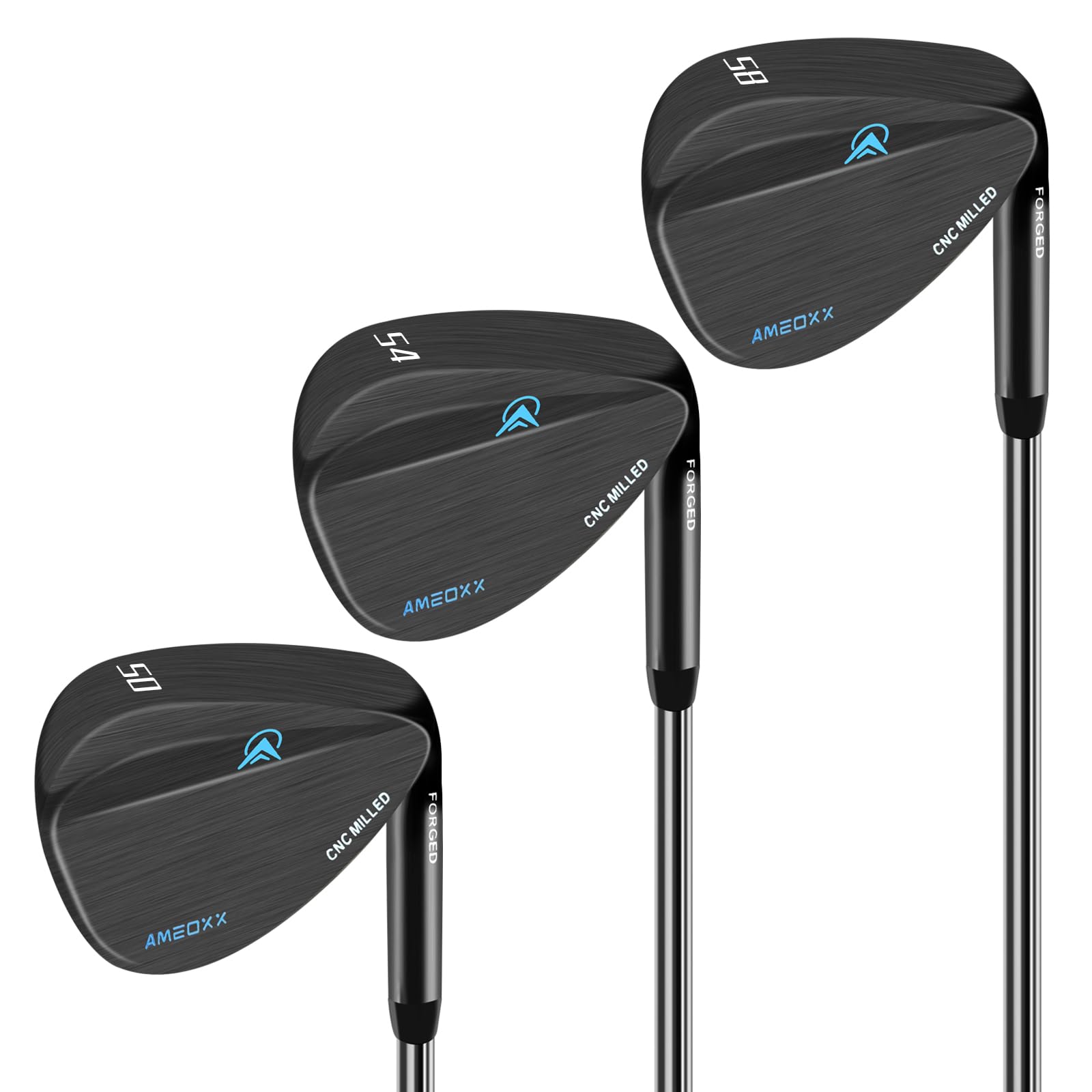
The AM20XX wedge punches well above its price bracket by offering forged construction — a manufacturing process typically reserved for wedges costing three times as much — combined with a CNC micro-milled face that optimizes surface roughness for maximum friction at impact. The beveled back sole is specifically designed to prevent digging into the ground, providing improved forgiveness on fat shots that would normally cost you significant distance. This engineering makes it a legitimate option for everyone from beginners to single-digit handicaps.
The full-face precision-machined groove pattern runs edge to edge, ensuring that strikes anywhere on the face generate meaningful spin. The black matte finish reduces glare effectively, and the stiff flex shaft provides a stable feel for players with faster swing speeds who want to control trajectory on full 54-degree swings. The alloy steel head offers a dense, solid feel at impact that approaches the sensation of premium forged wedges from major brands.
Real-world feedback is remarkably positive — one verified buyer who describes themselves as a 10 handicap directly compares this wedge to their Vokey, stating it performs “just as well for a fraction of the price.” Multiple reviewers note the comfortable grip, good weight distribution, and immediate improvement in sand play and approach shots. The lack of spec markings (bounce angle, swing weight) makes precise fitting difficult, but the on-course performance speaks for itself across dozens of positive reviews.
Why it’s great
- Forged construction delivers premium feel at budget pricing
- Beveled sole prevents digging for consistent turf interaction
- CNC micro-milled face generates spin competitive with top brands
Good to know
- No bounce or swing weight markings for precise fitting
- Stiff flex may feel harsh for players with slower tempos
FAQ
What bounce angle should I choose for a 54-degree wedge?
Should I get a 54-degree wedge if I already have a 52 and a 56?
What is the difference between a forged and a cast 54-degree wedge?
How often should I replace my 54-degree wedge grooves?
Final Thoughts: The Verdict
For most golfers, the best 54 degree wedge is the Callaway Opus Wedge because its Spin Gen Face Technology and S Grind deliver the most balanced combination of spin consistency, turf versatility, and shot-making freedom across the widest range of conditions. If you prioritize maximum spin off the face and play on firm turf, grab the Cleveland RTX 6 Zipcore — its 95% larger core placement and UltiZip grooves produce Tour-level control. And for beginners or high-handicap players who need forgiveness above all else, nothing beats the Cleveland Smart Sole Full-Face Wedge, whose three-tiered sole makes it nearly impossible to dig or blade a shot from any lie.