
Our readers keep the lights on and my morning glass full of iced black tea. As an Amazon Associate, I earn from qualifying purchases.
Specs are compiled from manufacturer listings and verified buyer reviews and can change over time — please confirm the key details on the product page before buying.
If you are around 5’11” to 6’3″, a 58 cm frame is the size that puts the handlebar and pedals where your reach and leg extension actually want them. This guide covers the 58 cm bikes worth your money and, just as importantly, explains what a 58 cm actually fits so you do not order the wrong size and pay return shipping on a bicycle.
I’m Min — the founder and writer behind Gadgets Feed. This guide is built by comparing the manufacturers’ published specifications and the patterns across verified customer reviews, so you get each pick’s real strengths and trade-offs instead of marketing spin.
Three very different rides sit below: a steel single-speed city bike, a mid-range carbon gravel build with 11 gears, and a premium 20-speed carbon gravel machine. All three use the same 58 cm fit math, and the frame size matters more than any component on the list. This breakdown of the best 58 cm bike options settles the size question first, then the spec question.
Our Picks at a Glance
How To Choose The Best 58 Cm Bike
Frame size is not a style preference — it is a fit measurement, and a 58 cm frame is one of the largest sizes sold for adult road and commuter bikes. Pick the wrong size and no component upgrade fixes the reach to the bar or the knee tracking over the pedals.
Start With Your Height, Then Check Your Inseam
Height is the quick filter. One maker on this list publishes a clear ladder: 50 cm suits roughly 5’1″ to 5’6″, 54 cm covers 5’6″ to 5’11”, and 58 cm is built for riders from about 5’11” to 6’3″. If you sit right at the 5’11” line, your inseam decides it — a longer leg points you up to the 58 cm, a shorter one keeps you on the 54 cm.
The consequence of getting it wrong is concrete. A 58 cm frame that is too big leaves you reaching for the bar and rocking your hips to pedal. Too small and your knees drive up toward your chest on every stroke.
Decide if you want Gears At All
A single-speed with a flip-flop hub gives you one gear ratio and a hub that can run either fixed (pedals always turn with the wheel) or freewheel (you can coast). That is a great match for flat city riding and a poor match for hills. Geared bikes here run 11-speed and 20-speed drivetrains, which cover mixed terrain but add maintenance and adjustment.
Match Tire Width To Where You Actually Ride
Smoother pavement favors a narrower 700 x 28C tire. Loose gravel, packed dirt, and rough shoulders favor a wider 700x40c tire. Wider rubber adds stability at the cost of a little rolling speed on smooth tarmac, so match the tire to the surface you ride most days, not the one you ride twice a year.
Quick Comparison
| Model | Best For | Frame Material | Drivetrain | Tire Size | Amazon |
|---|---|---|---|---|---|
| AVASTA Loop Single-Speed Fixie★ Best Overall | Flat-city commuting on a budget | High-tensile steel | Single-speed, flip-flop hub | 700 x 28C | Amazon |
| SAVADECK T800 Gravel (U6000) | Mixed pavement and trail on a mid-range budget | T800 carbon fiber | Shimano U6000, 11-speed | 700 x 40c | Amazon |
| SAVADECK T800 Gravel (GRX400) | Long-distance gravel and fast group rides | T800 carbon fiber | Shimano GRX400, 20-speed | 700 x 40c | Amazon |
In‑Depth Reviews
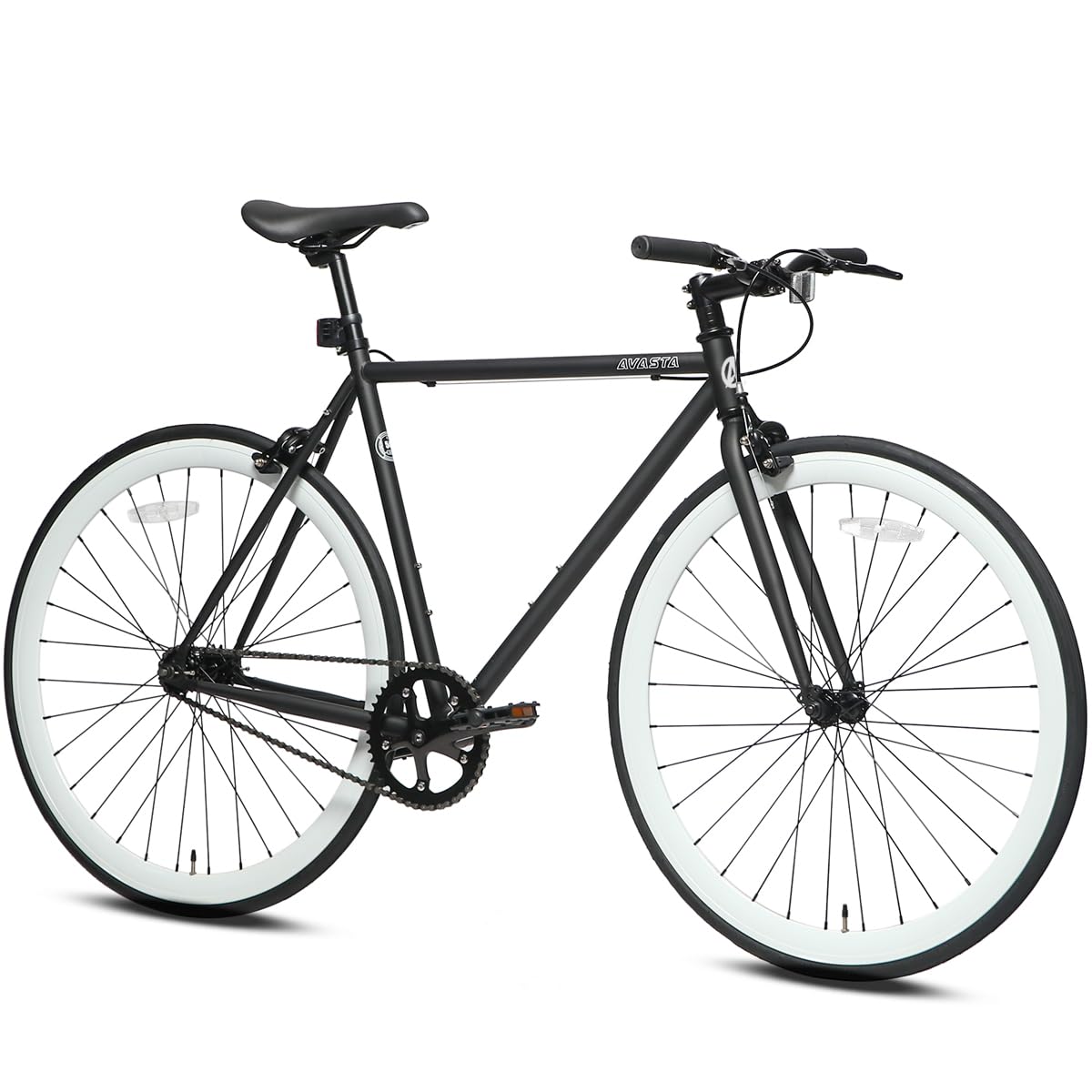
1. AVASTA Loop Single-Speed Fixed Gear Fixie Bike, 58cm
Our pick — 4.0+★ from 150+ verified ratings; the strongest balance of quality and price.
One gear, two modes, and a fifteen-minute build — the city bike that skips the fuss.
The AVASTA Loop gives you simplicity you can feel in the first hundred metres. You get a single gear ratio through a flip-flop hub — that is a rear hub with a sprocket on each side, so you can run it fixed (pedals turn whenever the wheel does) or spin the wheel around for freewheel mode and coast. A flat handlebar keeps you upright and visible in traffic, and the high-strength carbon steel frame is built to soak up road buzz rather than transmit it into your wrists.
What wins people over here is the tire setup. The bike rolls on 700 x 28C tires with 40mm deep V rims — a narrow-ish tire on a deep-section rim that looks fast standing still and handles smooth pavement well. Riders also consistently rate it as strong value for what it costs, and the colored rims earn real compliments. Setup is genuinely easy: it arrives 90% assembled with the tools in the box, and the maker quotes roughly 15 minutes to finish the job.
The honest catch is where the steel and the single gear both show their limits. Steel is the heavier frame material on this list, so this is not a bike you want to carry up three flights. The single gear also has no answer for a steep climb. On the durability side, the recurring gripe is the tires — a handful of owners have ended up replacing them early, and rust has been reported at the rear rack holes. Treat the tires as a wear item rather than a lifetime component and you will go in with the right expectations.
Where The Loop Earns Its Keep
- Flip-flop hub gives you fixed or freewheel from one bike — swap modes by flipping the rear wheel
- Arrives 90% assembled with tools included; the maker quotes about 15 minutes to finish
- Carbon steel frame absorbs bumps on paved and urban terrain
- 700 x 28C tires on 40mm deep V rims, plus dual caliper brakes and a KMC chain
What To Weigh Before Buying
- High-tensile steel is the heaviest frame option here — awkward on stairs
- One gear ratio means climbs are all leg, no bailout
- Tires are the most-discussed weak point, with early replacements reported
- Rust at the rear rack holes comes up in a portion of durability feedback
Reach for this if: your ride is flat pavement, you want a low-maintenance commuter, and you are between 5’11” and 6’3″ so the 58 cm frame lands right.
Look elsewhere if: your route has serious hills or you carry the bike upstairs daily — the single gear and the steel frame both work against you there.
2. SAVADECK Carbon Gravel Bike — T800 Frame, Shimano U6000 11-Speed
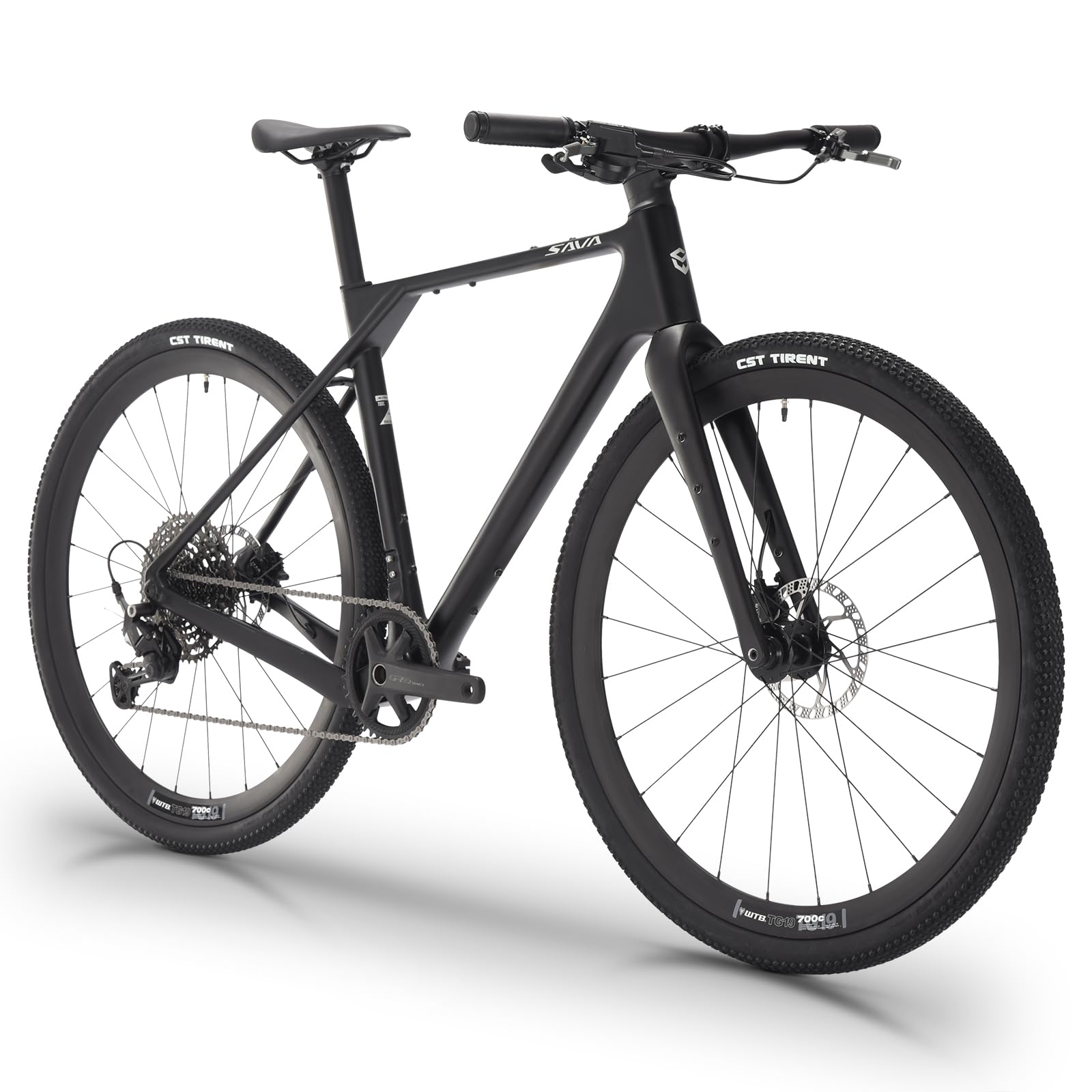
The 22.92 lb carbon build that makes the steel bike above feel like a different sport.
Here is the number to anchor on: 10.4kg, or 22.92 lbs, for a complete carbon gravel bike. The frame and fork are T800 R21 carbon fiber, and the maker claims five times the strength-to-weight ratio of aluminum. Whatever you make of the marketing, the practical result is a bike you can shoulder up a stairwell without cursing — a real contrast with the high-tensile steel AVASTA above.
The drivetrain is Shimano U6000 with eleven gears: U6000 shifters, a U6000 rear derailleur, an LG400 cassette, and a CN-LG500 chain working together. That is a big jump in capability from a single-speed, and it is the difference between a bike that survives a hill and a bike that enjoys one. Stopping power comes from hydraulic disc brakes — fluid-driven brakes that keep their bite in wet weather — and the cables run internally, which keeps them out of the weather and off the frame’s clean lines.
Where it steps away from the premium SAVADECK below is the gear count. The GRX400 model runs a 20-speed groupset against this bike’s 11-speed setup, and that is the single largest gap between the two. For commuters and weekend trail riders the eleven gears cover almost everything; the twenty-gear build is aimed at riders who want tighter steps between ratios on long, undulating gravel. Both roll on 700x40c tires and 45-spoke wheels, and both arrive 90% assembled with a tool kit.
The real-world read: 700x40c tires and 45-spoke wheels carry you from pavement onto unpaved trails without a wheel swap, and the upright frame design keeps long rides tolerable. A tapered head tube stiffens the front end so steering stays planted when you push it.
One thing to plan around: carbon fiber is light but it is not a material you toss into a truck bed. And with just 11 gears, a rider chasing tight cadence on rolling gravel will notice the wider jumps between ratios.
The smart-money pick: if you want carbon weight, hydraulic brakes, and gravel tires without stepping into the top tier, this is the one that delivers all three.
Step up if: you ride long, hilly gravel regularly and want the tighter gear spacing only the 20-speed GRX400 build provides.
3. SAVADECK Carbon Gravel Bike — T800 Frame, Shimano GRX400 20-Speed
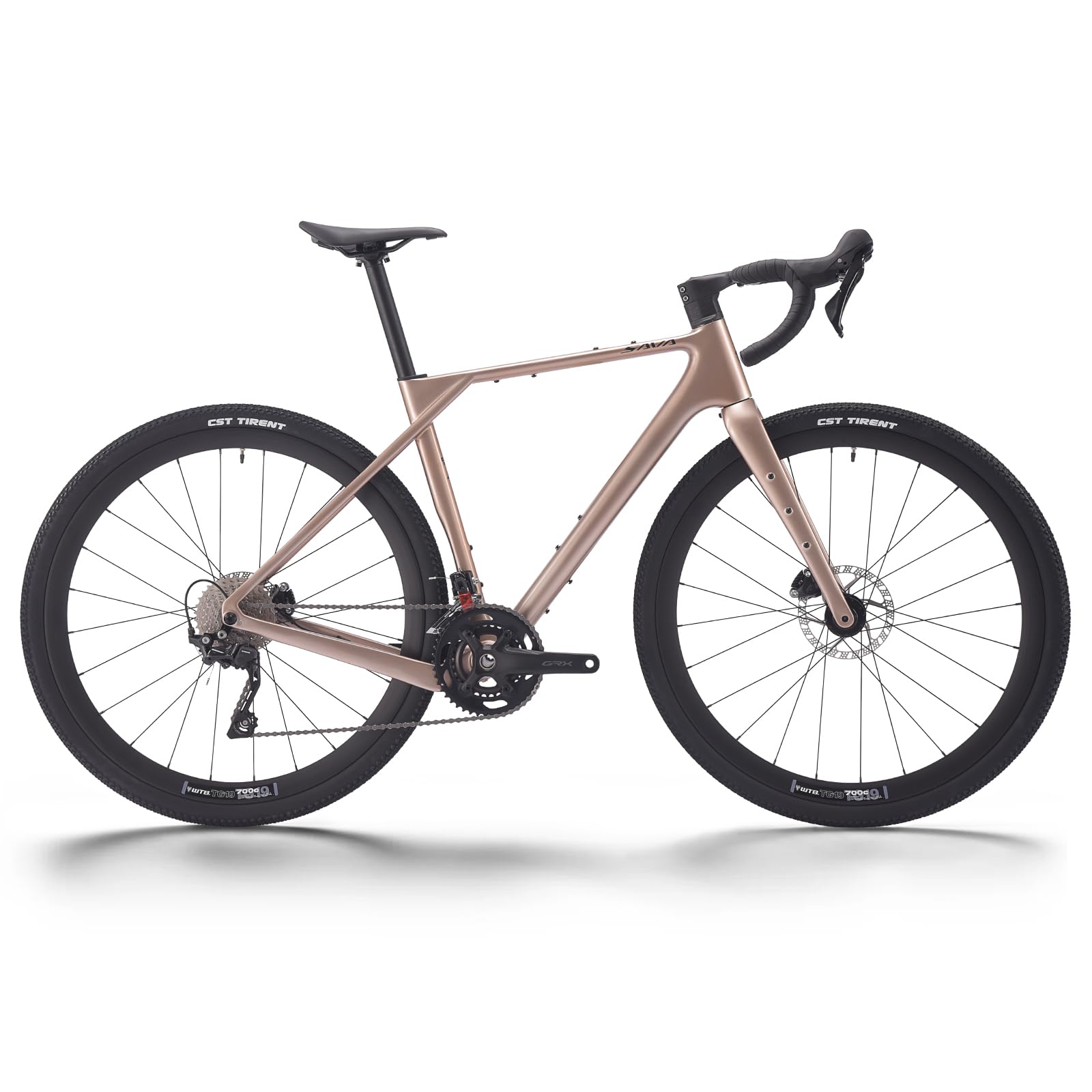
Twenty gears, RX400 brakes, and a gold frame that earns the top tier honestly.
The spec that decides this bike is the groupset: Shimano GRX400, with GRX400 shift levers and RX400 front and rear derailleurs driving twenty speeds. Against the eleven-speed U6000 SAVADECK above, that is twenty gears versus eleven — which matters most when the terrain keeps changing under you. Tight steps between ratios mean you can hold your cadence on a rolling gravel road instead of hunting for a gear that does not exist.
The frame story is shared with its cheaper sibling: T800 R21 carbon fiber for the frame and fork, 10.4kg (22.92 lbs) complete. What buyers consistently notice is the quality of the build and how light it feels to ride — the lightweight design is the thing that comes up again and again. Assembly is straightforward too, and the tool kit arrives in the box so you are not hunting for a hex key set on day one.
Two details separate it further. The Shimano RX600 crankset is built for efficient power transfer and durability, and the brakes are RX400 hydraulic discs rather than a generic house-brand set. Fully internal cable routing keeps the lines aerodynamic and the cables protected, and the tapered head tube adds torsional rigidity — meaning the frame resists twisting when you push hard, so the front end tracks where you point it. Tires are 700x40c on 45-spoke rims, same all-terrain footprint as the mid-tier bike.
Who this is actually built for: the rider who has outgrown an entry bike and wants a gravel machine that will not be the limiting factor on a long day. The 20-speed range and the RX400 braking package are the two things you cannot easily add later.
The trade-off to accept: this is the top-tier pick here, and carbon fiber at 10.4kg rewards careful handling — it is not a beater you lock up overnight in a rough neighbourhood and forget about.
Buy it when: gear range and brake quality are the two things you refuse to compromise, and your rides regularly mix fast pavement with loose gravel.
Pass if: your riding is flat and short — the eleven-speed sibling covers that for less, and you would be paying for range you never reach.
Understanding the Specs
Frame Size And Rider Height
A 58 cm frame is a measurement of the frame itself, and it lines up with a specific band of rider heights. AVASTA publishes a clear ladder for its Loop model: 50 cm for roughly 5’1″ to 5’6″, 54 cm for 5’6″ to 5’11”, and 58 cm for 5’11” to 6’3″. If you are on the boundary, your inseam decides which way to go — a longer leg favors the larger frame. Get the size wrong and you will feel it in your shoulders and lower back within the first hour.
Frame Material And Ride Weight
High-tensile steel is strong and absorbs road vibration, but it is the heavier option — the AVASTA Loop uses it. T800 carbon fiber is the alternative on both SAVADECK builds, and both of those bikes weigh 10.4kg (22.92 lbs) complete. Carbon’s advantage is weight you do not feel on climbs or stairs; its trade-off is that it wants careful handling rather than rough treatment. Neither is automatically better — steel suits a locked-up city commuter, carbon suits a rider covering distance.
Drivetrain: Single-Speed Versus Geared
A single-speed with a flip-flop hub runs one gear ratio and lets you choose fixed or freewheel by flipping the rear wheel. It is the lowest-maintenance setup on this list and the worst on hills. Geared bikes here run eleven speeds (Shimano U6000) or twenty speeds (Shimano GRX400). More gears means tighter steps between ratios, so you can hold a comfortable pedal cadence as the terrain changes — useful on rolling gravel, unnecessary on a flat commute.
Tire Width And Brake Type
Tire width is written as a pair of numbers, like 700 x 28C or 700x40c. The 700 is the wheel diameter, and the second number is the tire width in millimetres. The AVASTA runs 28C for smooth pavement; both SAVADECK bikes run 40c for gravel and mixed surfaces. Brakes matter just as much: caliper brakes on the AVASTA are simple and light, while hydraulic disc brakes on both SAVADECK builds use fluid pressure to hold their stopping power in wet or gritty conditions.
FAQ
What height does a 58 cm bike frame actually fit?
Is 58 cm the same as a large frame?
What does a flip-flop hub do on a single-speed bike?
How much assembly is required when the bike arrives?
Is an 11-speed gravel bike enough for hilly terrain?
What is the difference between 700x28C and 700x40c tires?
Do hydraulic disc brakes really stop better than caliper brakes?
How much does a carbon gravel bike weigh compared to a steel one?
Can I ride a gravel bike on paved roads every day?
Final Thoughts: The Verdict
For most riders standing between 5’11” and 6’3″, the best 58 cm bike starting point is the AVASTA Loop — the flip-flop hub covers both riding styles, setup takes about 15 minutes, and it handles flat city pavement without asking much of you. Plan on replacing the tires at some point and you will be happy with it for years.
If your route leaves the pavement, the SAVADECK U6000 11-speed is the value play: 10.4kg of carbon, hydraulic disc brakes, and 700x40c tires for mixed surfaces. And when gear range is the thing you refuse to give up, the SAVADECK GRX400 20-speed earns its place at the top with the tighter ratio steps and RX400 braking package. All three share the same 58 cm fit math — nail the size, then pick the drivetrain and tires for your terrain.
How We Picked
We do not accept paid placement. Every pick is matched to a real buyer and a real use-case; we do not hands-on test units.
Sources & Methodology
Specifications: manufacturer listings and product documentation. Review insights: verified customer reviews, as of November 2026. Pricing: not shown on this page (it changes often); check the current price via the retailer link.
As an Amazon Associate, Gadgets Feed earns from qualifying purchases. This does not affect which products we feature.