
Our readers keep the lights on and my morning glass full of iced black tea. As an Amazon Associate, I earn from qualifying purchases.
Specs are compiled from manufacturer listings and verified buyer reviews and can change over time — please confirm the key details on the product page before buying.
Here is the part most listings won’t tell you: on a 5ct tennis bracelet, the stones are rarely the thing that lets you down — the clasp is. A line of diamonds that won’t stay closed can drop off your wrist without warning. So the check that matters most is the closure, then the metal, then how the carat weight is spread around your wrist.
I’m Min — the founder and writer behind Gadgets Feed. This guide is built by comparing the manufacturers’ published specifications and the patterns across verified customer reviews, so you get each pick’s real strengths and trade-offs instead of marketing spin.
In this lineup, some bracelets hold up for years of daily wear while others arrive noticeably smaller than the listing photos suggest. This breakdown of the 5ct tennis bracelet picks separates the ones built to stay on.
Our Picks at a Glance
How To Choose The Best 5ct Tennis Bracelet
Three things decide whether a tennis bracelet earns its place on your wrist: what the stones are made of, how much metal protects them, and how the clasp behaves after constant wear. Everything else — the box, the appraisal paperwork — is a bonus. Get those three right and you wear it daily instead of leaving it in a drawer.
Total Carat Weight Is Not the Same as One Big Stone
Carat weight measures the combined mass of every diamond in the row, so a 5ct bracelet might hold fifty small stones or fifteen larger ones. The spread is what changes the look. More, smaller stones read as a continuous sparkle line. Fewer, chunkier stones catch more light individually but show gaps of metal between them. Neither is wrong — but the number alone never tells you which you’re getting.
Match the Metal to How You’ll Actually Wear It
Sterling silver offers the coolest tone and resists everyday tarnish when you keep it on. White gold holds its bright finish with rhodium plating and takes knocks better. Rose gold blends warm against most skin tones and hides surface scratches more gracefully. If the bracelet never comes off — shower, gym, sleep — go for the harder metal.
Judge the Clasp Before the Stones
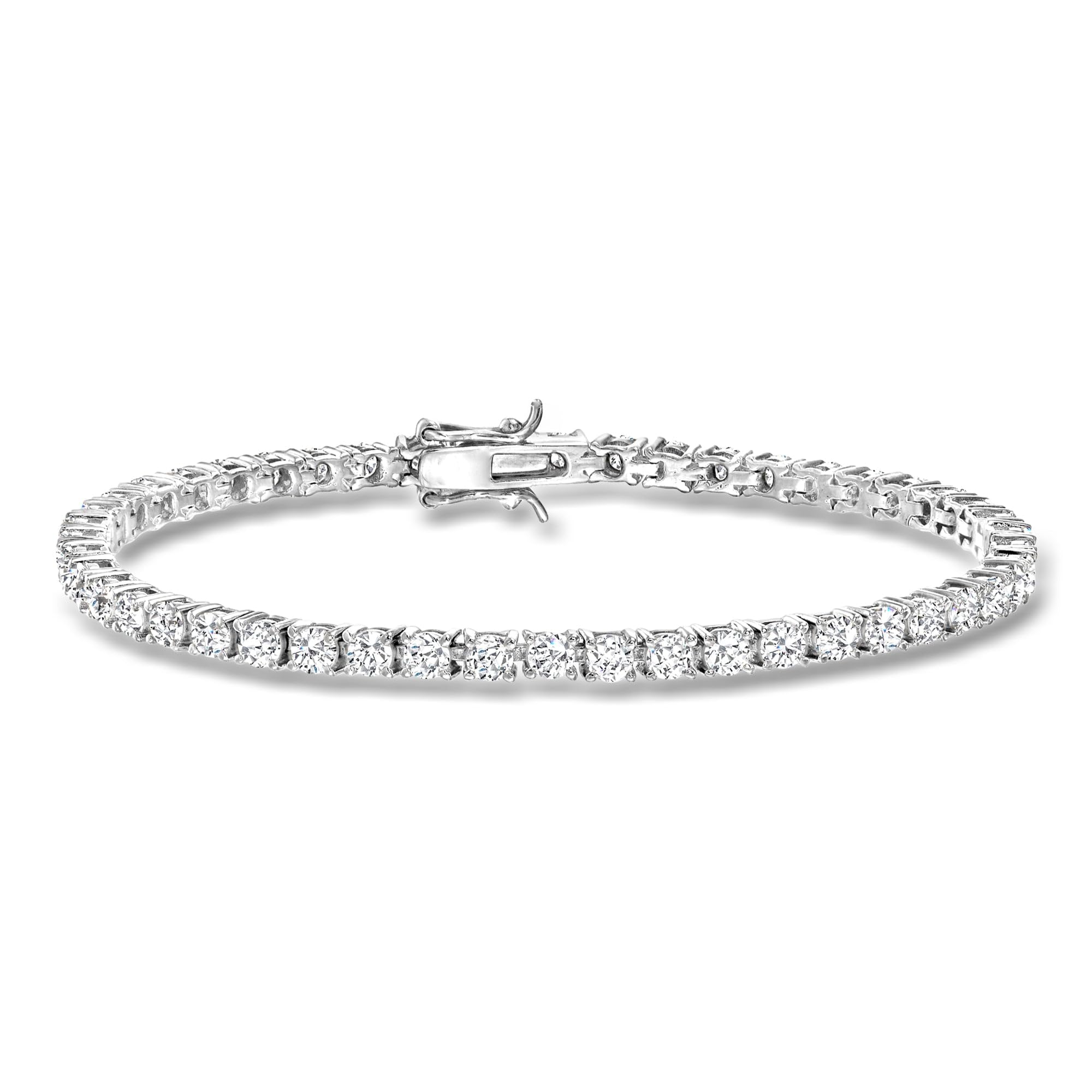
A box clasp with a fold-over safety catch is the standard for a reason: two independent locks reduce the odds of a straight drop. The catch is what keeps the bracelet on if the main clasp loosens. Before you commit to any bracelet, look for a clasp that clicks positively and a safety catch that sits flush against the metal.
Quick Comparison
| Model | Best For | Metal | Length | Stone Type | Amazon |
|---|---|---|---|---|---|
| Ross-Simons 5.00 ct. t.w. CZ Tennis Bracelet in Sterling Silver★ Best Overall | Everyday sparkle without the diamond budget | Sterling Silver | 7 inches | Cubic Zirconia | Amazon |
| Houston Diamond District 2 to 28 CT Lab Grown Diamond Tennis Bracelet | Real stones, custom carat weight | 14K White Gold | 16 inches | Lab Grown Diamond | Amazon |
| 2 to 21 Carat 14K White Gold Lab Grown Diamond Tennis Bracelet (H-I Color) | A statement piece with an appraisal included | 14K White Gold | 16 inches | Lab Grown Diamond | Amazon |
| Houston Diamond District 3 to 15 Carat Diamond Tennis Bracelet 3 Prong Value Plus Collection | Natural diamonds on a value budget | 14K White Gold | — | Natural Diamond | Amazon |
In‑Depth Reviews
1. Ross-Simons 5.00 ct. t.w. CZ Tennis Bracelet in Sterling Silver
Our pick — over 4★ from 350+ verified ratings; the strongest balance of quality and price.
The diamond-look bracelet that survives the gym, the shower, and the sleeping wrist — without a diamond decision.
If you want the sparkle of a 5-carat diamond line without the inflated price tag, this is the bracelet that starts the search — 4.4 stars across 354 ratings, and the crowd favorite of the bunch. The 5.00 ct. t.w. total carat weight (the sum of every cubic zirconia stone, not one giant rock) is delivered as a dense row of clear stones on a 7-inch sterling silver band. Zirconia does the visual work of diamond at a fraction of the everyday risk — if you scratch it, drop it, or crack a stone at the gym, you aren’t destroying a four-figure investment.
The story here isn’t the stone count, it’s the durability most people never expect from a synthetic stone. Buyers report years of continuous wear — one account describes two straight years with no lost stones and no tarnish before the clasp finally gave way. That’s the real promise of going with zirconia on sterling: you get the look, you get the years, and you don’t agonize over it. Sterling silver does tarnish eventually, so a quick polish every few months keeps it bright.
The recurring gripe is the closure, not the stones. Several owners mention the clasp loosening after weeks of daily wear, and a few describe the safety catch being stiff or slow to engage — exactly the complaint you’d want to know about before it decides whether your bracelet stays on your wrist for a decade or winds up in someone’s jewellery box. Treat the clasp as the weak link and you’ll get the value this bracelet is built to deliver.
What Owners Rave About
- Dense 5.00 ct. t.w. zirconia row reads like real stones
- Sterling silver stays bright with minimal care
- Years of continuous-wear reports with no lost stones
- Owners say it looks real, without the real price
The Sticky Points
- Clasp can loosen with daily wear
- Safety catch is fiddly on some units
- 7-inch length runs snug on larger wrists
- Zirconia won’t hold its sparkle forever
Reach for this: if you want the tennis-bracelet look on your wrist every day without worrying about losing real money when it takes a knock.
Look elsewhere: if you need real diamonds for the occasion, or you have a wrist that runs longer than 7 inches.
2. Houston Diamond District 2 to 28 CT Lab Grown Diamond Tennis Bracelet

Real lab-grown diamonds, a carat number you choose, and a setting that lets the stones do the talking.
This is the pick for a buyer who wants genuine diamonds on the wrist and will not accept a look-alike. You choose the carat weight across a 2 to 28 CT range, and every configuration arrives in lab-grown diamond set in 14K white gold. Lab-grown stones share the same physical hardness and sparkle as mined diamonds, so a scratch or a knock that would mar cubics simply won’t matter here. The huge carat range is the headline — you can start at the small end for a subtle line or scale all the way up for a full statement piece.
Where it wins people over is the consistency of the make. Buyers describe the diamonds as exceeding expectations in colour and clarity, well-set, with a smooth clasp that feels weighted and secure rather than tinny. The slender style with little visible metal between the stones gets the most praise — that’s the “continuous sparkle” effect serious buyers chase, and at the 4ct level the piece is lighter on the wrist than you’d expect.
Two things to size up before you click. The adjustable length runs long enough to extend well beyond your wrist, so plan on possibly needing a resize for a close fit normally worn tight — customers note a brief return turnaround for a half-inch extension when the stock length was too generous. And the fit is built for smaller wrists: an owner whose arm needed more room found it better suited to a slimmer wearer and returned it. Buy the size you’ll actually wear, and the gem sparkle — the aspect buyers praise most, with the colour and cut as the runner-up — delivers for years.
The stone quality story: among the whole lineup, this is the one where buyers talk about the diamonds themselves, not the price tag. The make, the set, and the visual density all read as premium — the exact qualities you’d walk into a jewellery store to compare.
The honest trade: part of what you’re paying for is the stone, which means you’re on the hook for a real investment if it goes missing, so buy the insurance. And confirm the length carefully, because this bracelet has more than once proven longer than a buyer’s wrist needed.
Buy it if: your heart is set on real diamonds and you want to dial the carat weight to fit how bold you want the sparkle.
Pass on it if: you need a snug-fit bracelet from the start on a longer wrist, or you want zero maintenance risk on an expensive piece.
3. 2 to 21 Carat 14K White Gold Lab Grown Diamond Tennis Bracelet (H-I Color)

A gradient flow of lab-grown diamonds in 14K gold — the statement piece that comes with its own paperwork.
Buyers chasing maximum visual impact with lab-grown stones tend to land on this one. It runs a gradient of carat weights from 2 to 21 carats (H-I colour), all in 14K gold, and it ships with a signed appraisal certificate — a real document on your purchase. For a first big online jewellery purchase, that’s the reassurance that matters: you’re not just trusting the photo.
The appraisal is a big part of the appeal here. One owner of the 8-carat 14K rose gold version found the appraisal valued the bracelet at double the purchase price. Owners also praise the sparkle specifically: the smaller stones are numerous and catch light constantly, and they report frequent compliments when the bracelet is out in public. The colour grade runs H-I, which lands in the near-colourless range that most buyers won’t distinguish without side-by-side comparison against a top D colour stone.
The catch, and it’s worth naming: the mix of stone sizes in a single bracelet means colour and cut can vary stone to stone. At least one owner felt the represented top colour didn’t match what arrived, and chose to keep the piece anyway because the appraisal over-delivered the value. Do you want a uniform row of stone sizes or a graduated look? That single choice is what separates this bracelet from the fixed-spread alternatives.
What buyers highlight most: the appearance of the piece itself — the way the lab-grown stones are visibly set and how the row reads as a continuous sparkle line rather than individual marks of light. Owners consistently lead with the way it looks on the wrist, not the specs on the page.
The honest catch: with the gradient size range you’re reviewing a whole series of stone sizes in one purchase, and some buyers receive a slightly wider colour range than expected. The piece is still a fantastic value — just know the appraisal paperwork is your confirmation of what’s on your wrist.
The right call if: you want a graded-stone statement bracelet in 14K gold with appraisal documents in the box, and you’re shopping lab-grown for maximum carat per dollar.
Consider a different pick if: you want a uniform stone size door-to-door, or a natural-diamond certificate instead of a lab-grown one.
4. Houston Diamond District 3 to 15 Carat Diamond Tennis Bracelet 3 Prong Value Plus Collection

The entry price into natural diamonds — a 3-prong setting that leaves almost nothing between the stones.
Natural diamonds are the whole point of this bracelet, and that’s the line buyers cross here. It’s the value-tier option in this lineup — a Houston Diamond District 3 to 15 carat range with a 3-prong setting that leaves more stone exposed per diamond than a 4-prong would, which is why the sparkle jumps. Natural diamonds mean a real, certified stone, and at this price point that’s the appeal over lab-grown alternatives. The range lets you start small and move up.
Here’s the detail that separates this bracelet from the crowd: the seller proactively reaches out and recommends upgrading the 3-prong to a 4-prong setting for security — at reportedly no extra charge. Buyers describe that conversation landing surprisingly well. One owner praised the up-front call, which ended with a better-protected bracelet and no surprise charge. That kind of touch is rare for a value-tier piece, and it’s the quiet story here.
The honest trade-off: this is the entry-level configuration, which is reflected in the lower rating. Craftsmanship varies across the range, and one owner’s local jeweller appraised the piece below its purchase price. Buy from this collection because you want real natural diamonds at a lower entry, and review the return policy carefully before you commit.
Why a buyer picks this: because of the stones and the seller’s reputation. The proactive upgrade recommendation runs through nearly every positive review here — people really do get a better-protected bracelet after a single phone call.
What to bring in: a jeweller’s eye and a clear plan for returns. Value-tier natural diamonds are a real purchase with real variance, and a couple of owners have ended up less happy than the price tag suggested they’d be.
Buy it if: you specifically want natural diamonds, you like the 3-prong sparkle-first look, and you’re comfortable making a bigger call after the seller’s recommendation.
skip it if: you want lab-grown quality at a lower weight-per-dollar, or a guaranteed-finished piece without a jeweller check.
Understanding the Specs
Total Carat Weight (t.w.)
The “t.w.” on a bracelet label stands for total weight — the combined heft of every diamond or cubic zirconia stone in the row, not the size of one. A 5ct t.w. piece can hide fifty small stones or fifteen larger ones. More, smaller stones create a smoother sparkle line; fewer, chunkier stones give individual flashes. Read the total alongside the setting style to understand what will actually sit on your wrist.
Stone Type: Cubic Zirconia, Lab Grown, and Natural Diamond
Cubic zirconia is a synthetic stone that mimics diamond’s look at a fraction of the cost and won’t survive a hard impact the way real diamond does. Lab-grown diamonds share the same hardness and sparkle as mined stones because they’re chemically identical. Natural diamonds are mined, carry their own market premium, and stay the most expensive option. The choice isn’t about quality — it’s about which risk you want to carry on your wrist every day.
Metal Choice: Sterling Silver vs 14K Gold
Sterling silver is the softest of the three at a cool bright tone; it tarnishes with contact and loves a polish every few months. 14K white gold is 58.5% gold alloyed for hardness and holds a bright rhodium finish with rare tarnish. 14K rose gold blends warm against most skin tones and hides surface scratches more gracefully than the bright tones. If you wear the bracelet 24/7, harder wins.
Clasp and Safety Catch
The clasp closes the two ends; the safety catch is the second lock behind it. A box clasp with a fold-over catch is standard on quality tennis bracelets because it gives two independent holds. If the main clasp loosens, the catch is what keeps the bracelet from dropping off mid-stride. Check both before you commit — a wobbly catch is the single most-reported failure on any tennis bracelet.
FAQ
What does 5ct mean on a tennis bracelet?
Is a cubic zirconia bracelet worth buying over a lab-grown diamond?
How do I know what length tennis bracelet to buy?
Will sterling silver tarnish while I wear it?
What is the difference between a 3 prong and a 4 prong setting?
Can I wear a 14K gold tennis bracelet in the shower or pool?
How long should a quality tennis bracelet last?
Should I buy a bracelet with a safety catch?
Can I resize a tennis bracelet if it does not fit?
What should I check on a tennis bracelet when it arrives?
Final Thoughts: The Verdict
For most buyers, the 5ct tennis bracelet to start with is the Ross-Simons 5.00 ct. t.w. CZ Tennis Bracelet in Sterling Silver because it delivers the dense diamond look at the least financial risk and holds up for years of daily wear. If your heart is set on real stones, step up to the Houston Diamond District Lab Grown Diamond Bracelet and choose your carat weight. For a wrist statement with paperwork in the box, the 2 to 21 Carat 14K White Gold Lab Grown Diamond Bracelet earns its place. And if natural diamonds are the whole point, the 3 to 15 Carat 3 Prong Value Plus Bracelet opens that door at the friendliest entry. Check the clasp on whichever you land on — it’s the single detail that decides whether the bracelet stays on your wrist.
How We Picked
We do not accept paid placement. Every pick is matched to a real buyer and a real use-case; we do not hands-on test units.
Sources & Methodology
Specifications: manufacturer listings and product documentation. Review insights: verified customer reviews, as of September 2026. Pricing: not shown on this page (it changes often); check the current price via the retailer link.
As an Amazon Associate, Gadgets Feed earns from qualifying purchases. This does not affect which products we feature.