
A weak cellular signal turns a fast 5G connection into a frustrating slideshow. The difference between buffering and seamless streaming often comes down to a single hardware decision: the external antenna tethered to your modem or hotspot. A well-chosen directional antenna locks onto the nearest tower, pulling stable, high-speed data from thin air, while a poor choice leaves you guessing at placement and chasing phantom signals.
I’m Min — the co-founder and writer behind Gadgets Feed. I’ve spent countless hours analyzing signal-to-noise ratios, gain figures, and MIMO configurations to help you match the right antenna to your specific coverage challenge, whether you’re on the edge of a rural cell tower or fighting interference in a suburban home.
This guide breaks down the critical specs — from frequency bands and connector types to mounting hardware and cable loss — so you can confidently choose the best 5g antenna for your unique setup and location.
How To Choose The Best 5G Antenna
Picking the right antenna starts with understanding your physical environment. The distance to the nearest cell tower, the presence of trees or metal roofs, and whether you have a clear line of sight all dictate which design will work. A low-gain panel antenna might be perfect for a suburban home three miles from a tower, while a high-gain parabolic grid is necessary for a rural property ten miles away. Start by mapping tower locations using apps like CellMapper or OpenSignal to gauge your true coverage gap.
Gain, Directivity, and MIMO Configurations
Gain, measured in dBi, tells you how focused the antenna’s beam is. A higher dBi number means a narrower, longer-reaching beam that picks up a weaker signal at a distance but requires precise aiming. A 15 dBi log periodic can reach far but is less forgiving. A 7-10 dBi panel offers a wider beam, making it easier to install. MIMO (Multiple Input Multiple Output) is equally critical — a 2×2 MIMO antenna uses two separate radios to double data throughput, while a 4×4 MIMO antenna quadruples it. Your router or modem must support that same MIMO count, or the extra ports won’t help.
Frequency Bands and Cable Quality
Not all 5G antennas cover the same spectrum. The Sub-6 GHz bands (600 MHz to 6 GHz) carry the bulk of 5G coverage, but some antennas specifically support newer C-band frequencies (3.7-3.98 GHz) and Band 71 (600 MHz). Confirm your carrier’s primary bands and ensure the antenna’s frequency range fully covers them. The cable is the silent performance killer — a long run of RG58 can lose 3-4 dB of signal, effectively cutting your antenna’s gain in half. For runs over 15 feet, step up to LMR400 or equivalent low-loss cable to preserve the signal before it reaches your modem.
Quick Comparison
On smaller screens, swipe sideways to see the full table.
| Model | Category | Best For | Key Spec | Amazon |
|---|---|---|---|---|
| Waveform QuadPro | 4×4 MIMO Panel | Maximum Throughput with T-Mobile/Verizon/AT&T | 9.1 dBi, 600-6000 MHz | Amazon |
| Bolton Technical Long Ranger | Parabolic Grid | Ultra-Long Range over 20 Miles | +28 dBi, 600-6500 MHz | Amazon |
| Bolton Technical Ultra Gain | Parabolic Grid | Long Range with Signal Booster | +26 dB, 600-6500 MHz | Amazon |
| weBoost High Gain LPDA | Log Periodic | Upgrading weBoost Signal Booster Systems | 50 Ohm, All cellular bands | Amazon |
| Proxicast Cross-Polarized Panel | Directional Panel | Rural Fixed Wireless & Modems (MOFI, Cradlepoint) | 7-10 dBi, 600-6000 MHz | Amazon |
| MOPHAMP Log Periodic Kit | 2×2 MIMO Log Periodic | Complete Kit for Quick Installation | 15 dBi, 698-3800 MHz | Amazon |
| Eifagur 11dBi MIMO | Directional MIMO | Budget Boost for Netgear Hotspots | 11 dBi, 698-2700 MHz | Amazon |
In‑Depth Reviews
1. Waveform QuadPro 4×4 MIMO Signal Boosting Panel Antenna Kit

The Waveform QuadPro represents the current peak of consumer 5G antenna engineering. Its 4×4 MIMO configuration uses four separate antenna elements inside a single panel, allowing your router to simultaneously communicate over four data streams — a setup that can more than double the throughput of a standard 2×2 MIMO antenna. With a wide frequency sweep of 600 to 6000 MHz, it covers every relevant 4G and 5G band in North America, including T-Mobile’s Band 71 and the C-band frequencies used by Verizon and AT&T.
This antenna ships as a complete kit, which dramatically reduces the friction of installation. You get 20 feet of high-quality UltraFlex-Quad cable, a window entry adapter that avoids drilling holes, a FlexMount for pole or wall attachment, and weatherproofing boots for the connections. Real-world user reports show T-Mobile Home Internet speeds jumping from 50 Mbps to over 300 Mbps after proper placement, and AT&T Internet Air users reporting doubled download speeds and tripled upload speeds. The build quality and documentation are consistently praised.
The trade-off is price and complexity. The QuadPro sits at the premium end of the market, and installation requires disassembling your gateway to attach internal pigtail connectors — a process that voids the warranty on devices like T-Mobile’s G4AR or Nokia 5G21. The directional beam also demands careful aiming using the carrier’s placement app. This is not a plug-and-play solution, but for users with moderate to strong signal who want to unlock the full potential of their 5G connection, it delivers unmatched real-world results.
Why it’s great
- Full 4×4 MIMO delivers massive speed and stability improvements
- Complete all-in-one kit with tools, cables, and window adapter
- Excellent build quality and industry-best customer support
Good to know
- Requires opening the gateway, which voids the device’s warranty
- Premium price point may be overkill for users with strong signal
- Directional design needs precise aiming with the carrier’s app
2. Bolton Technical Long Ranger Antenna (BT974822)
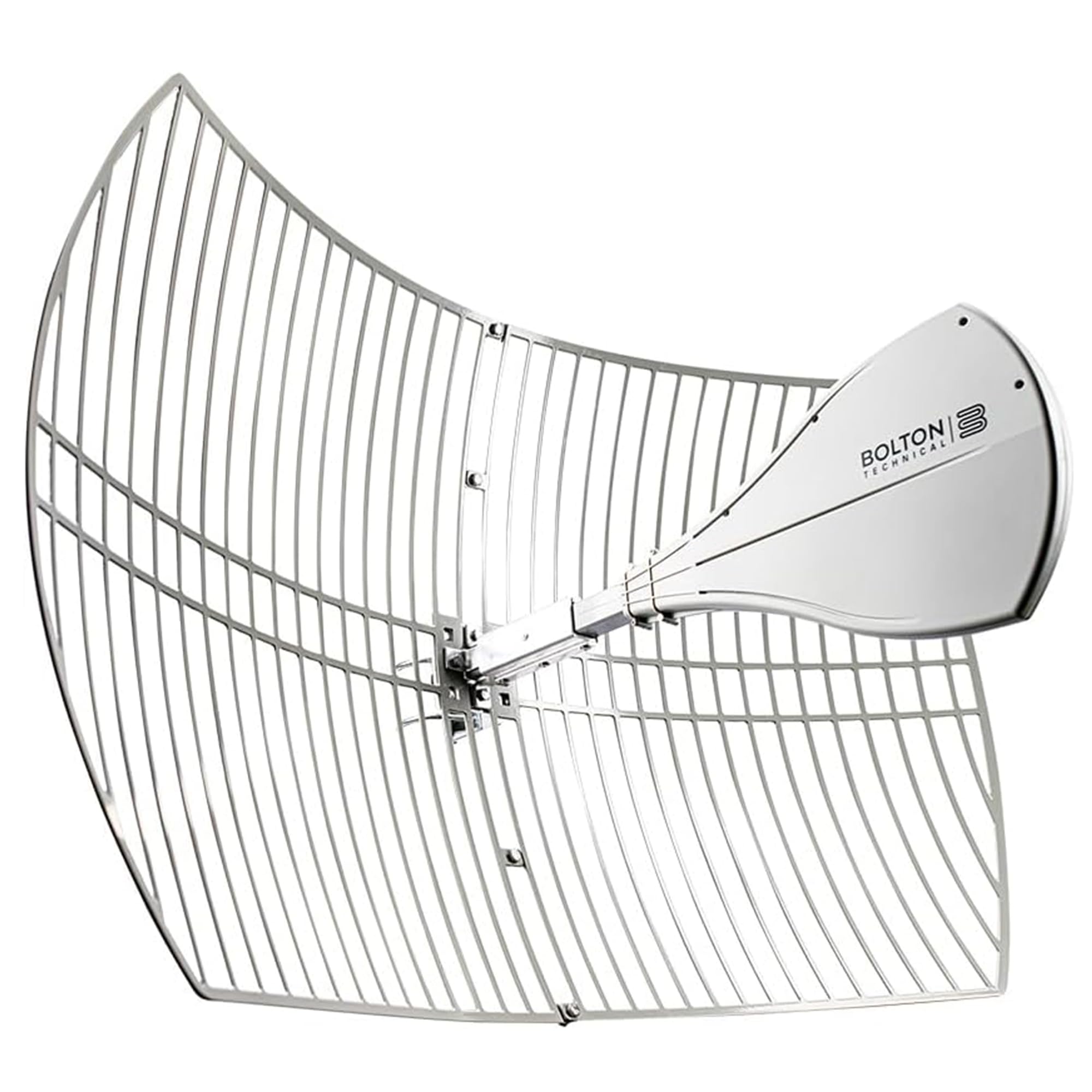
The Bolton Technical Long Ranger is a parabolic grid antenna designed for one purpose: pulling a signal from towers that are over 20 miles away. Its massive 39-inch physical aperture and +28 dBi gain create an extremely narrow 10-degree beam that acts like a radio laser. This makes it the most powerful option available for the most challenging rural situations where other antennas simply fail to register a signal. The wide frequency coverage (600-6500 MHz) ensures it works with 5G, LTE, WiFi, and even GPS bands.
User reports from rural properties 5 to 7 miles from the nearest tower show dramatic results. One user replacing a standard Yagi with the Long Ranger saw signal quality jump to 80% and maintained 14-25 Mbps download speeds even during heavy rain. Another user paired two Long Rangers in a 2×2 MIMO configuration on a T-Mobile gateway, jumping from 10 Mbps to 70 Mbps through dense forest. The antenna requires a separate signal booster amplifier (like a weBoost or Cel-Fi unit) and does not connect directly to most modems. Improved N-Female connection ports and a redesigned feedhorn make assembly easier than earlier models.
The downsides are significant. The antenna is physically large (39 x 24 inches) and relatively heavy, requiring a sturdy mast and mounting solution. The 10-degree beamwidth is unforgiving — a misalignment of just a few degrees can cost you 10-15 dB of signal. Assembly is required out of the box, and some users report sharp edges on the metal grid. This is not an antenna for the casual user; it is a specialized tool for the rural power user who has already exhausted simpler options and is willing to invest time in precise, iterative aiming.
Why it’s great
- Highest gain available (+28 dBi) for 20+ mile range
- Covers all bands 600-6500 MHz including 5G C-band
- Proven to transform unusable signals into usable connections
Good to know
- Requires a separate signal booster amplifier to function
- Very narrow beam makes aiming extremely critical
- Large and heavy; needs a robust mounting mast
3. Bolton Technical Ultra Gain Cellular Antenna (BT974822-V2)

Before the Long Ranger, the Bolton Technical Ultra Gain was the king of long-range cellular antennas, and it remains a formidable option for those bridging the gap between standard panel antennas and extreme parabolic grids. With a gain of +26 dB and the same 600-6500 MHz bandwidth, it offers nearly the same reach as the Long Ranger but at a lower price point. The parabolic grid design concentrates the signal into a 4-20 degree radiation cone, making it up to six times more powerful than the stock antennas that come with most signal booster kits.
Real-world results from rural AT&T users show this antenna can be transformative. One user, located 4-6.5 miles from the nearest towers, replaced their standard weBoost 4G booster setup and went from 2-5 Mbps to 40-50 Mbps download speeds. Another user reported that a mere 4-degree rotation adjustment (from 220° to 224° magnetic) improved signal by approximately 12 dBm. The antenna is optimized for use with a signal booster amplifier and works with all major brands. The build quality is robust, though some ham radio operators have criticized the design for uneven gain across the frequency spectrum.
The Ultra Gain shares many of the same ergonomic challenges as the Long Ranger: it is large, requires assembly, and demands precise aiming. The instruction sheet is sparse and lacks the detailed tuning guidance that first-time users need. Additionally, the antenna requires a booster to function — it is not a standalone solution. For users within 10-15 miles of a tower who already own a booster, the Ultra Gain offers a massive performance upgrade without the premium cost of the Long Ranger, making it a strong mid-premium choice.
Why it’s great
- Exceptional +26 dB gain reaches towers 10-20 miles away
- Works with all major signal booster brands (weBoost, SureCall, Cel-Fi)
- Substantially outperforms stock Yagi and log periodic antennas
Good to know
- Requires a signal booster amplifier; not a standalone antenna
- Narrow beamwidth (4-20 degrees) makes aiming very critical
- Instruction manual lacks sufficient setup and tuning detail
4. weBoost Wilson Electronics High Gain LPDA Antenna (311228)

The weBoost High Gain LPDA is a purpose-built upgrade for weBoost and WilsonPro signal booster systems. As a log periodic directional antenna (LPDA), it offers a tighter beam and higher forward gain than the omnidirectional or Yagi antennas that typically ship with these booster kits. This design allows it to reach farther and reject interference from the sides, making it ideal for marginal coverage areas where the stock antenna is barely holding on. It covers all worldwide cellular bands (LTE, CDMA, GSM, UMTS, AWS) for both voice and data.
User results are dramatic when paired with the right booster. One user, located 37 miles from the nearest Verizon tower with no line of sight, went from a noisy, unreliable signal to a consistent 8-15 Mbps connection. Another user saw download speeds jump from 2-5 Mbps to 40-50 Mbps after swapping the stock antenna. The installation is relatively straightforward, with a simple tilt/swivel bracket that mounts to a 1.5- to 2-inch mast. The antenna is fully weatherproofed for outdoor use. However, it requires the Wilson 971128 N-Male to F-Female connector adapter for most installations, which is not included in the box.
The primary limitation is that this antenna is strictly an aftermarket upgrade for booster systems — it has no utility on its own. Some users in the 5-7 mile range have reported that it offered no improvement over a lesser Yagi, suggesting the performance gains are most pronounced in the far-edge range. Additionally, it is highly directional, so identifying your tower’s exact location before mounting is essential. For existing weBoost users dealing with a weak signal at the edge of coverage, this LPDA is the most cost-effective major upgrade available.
Why it’s great
- Significant upgrade over stock omnidirectional and Yagi booster antennas
- Proven to reach towers up to 37 miles with a compatible booster
- Rugged, weatherproof construction with 2-year warranty
Good to know
- Works only as an upgrade to a weBoost or WilsonPro signal booster kit
- Requires a separate adapter cable (Wilson 971128) for most setups
- Very directional and demanding of precise tower alignment
5. Proxicast Cross-Polarized MIMO Panel Antenna (ANT-129-001)

The Proxicast ANT-129-001 is a cross-polarized MIMO panel antenna that hits a sweet spot for rural fixed-wireless internet users. With its 75-degree directional beamwidth and 7-10 dBi gain, it offers a much wider capture angle than the log periodic or parabolic options, making installation more forgiving while still delivering a meaningful signal boost. Its dual N-Female connectors support 2×2 MIMO natively, and two panels can be combined (one vertical, one at 45 degrees) to create a 4×4 MIMO array. The antenna covers 600-960 MHz and 1710-6000 MHz, supporting all 4G LTE and 5G Sub-6 bands including T-Mobile’s Band 71.
User reports with MOFI4500 routers show consistent, measurable improvements. One user on an island over 10 miles from the tower replaced stock antennas and jumped from 1.5 Mbps DSL to a stable 10-20 Mbps connection. Another user, approximately 1 mile from an AT&T tower with the antenna mounted 25 feet high, saw download and upload speeds more than double. The build quality is solid, and the panel includes mounting hardware. The antenna works with routers from CalAmp, Cradlepoint, Digi, MoFi, Netgear, Pepwave, and many others.
The main drawback is that the antenna requires two separate coax extension cables (not included) to connect to your router. The coiled pigtail cable can also reduce performance if not uncoiled properly. The compact size (11.8 x 7.2 x 2.75 inches) is a plus for space-constrained installations, but the modest 7-10 dBi gain means it may not be sufficient for extreme long-range scenarios beyond 10 miles without a line of sight. It represents a balanced, well-engineered mid-range option for users who need a reliable boost without the complexity of a parabolic grid.
Why it’s great
- Wider beamwidth makes aiming easier than high-gain alternatives
- Compact panel design fits in tight mounting spaces
- Supports 4×4 MIMO when using two panels in orthogonal orientation
Good to know
- Requires two separate coax extension cables (not included)
- Modest 7-10 dBi gain may not suffice for extreme rural distances
- Coiled pigtail cables must be straightened to avoid signal loss
6. MOPHAMP 2×2 MIMO Log Periodic Antenna Kit
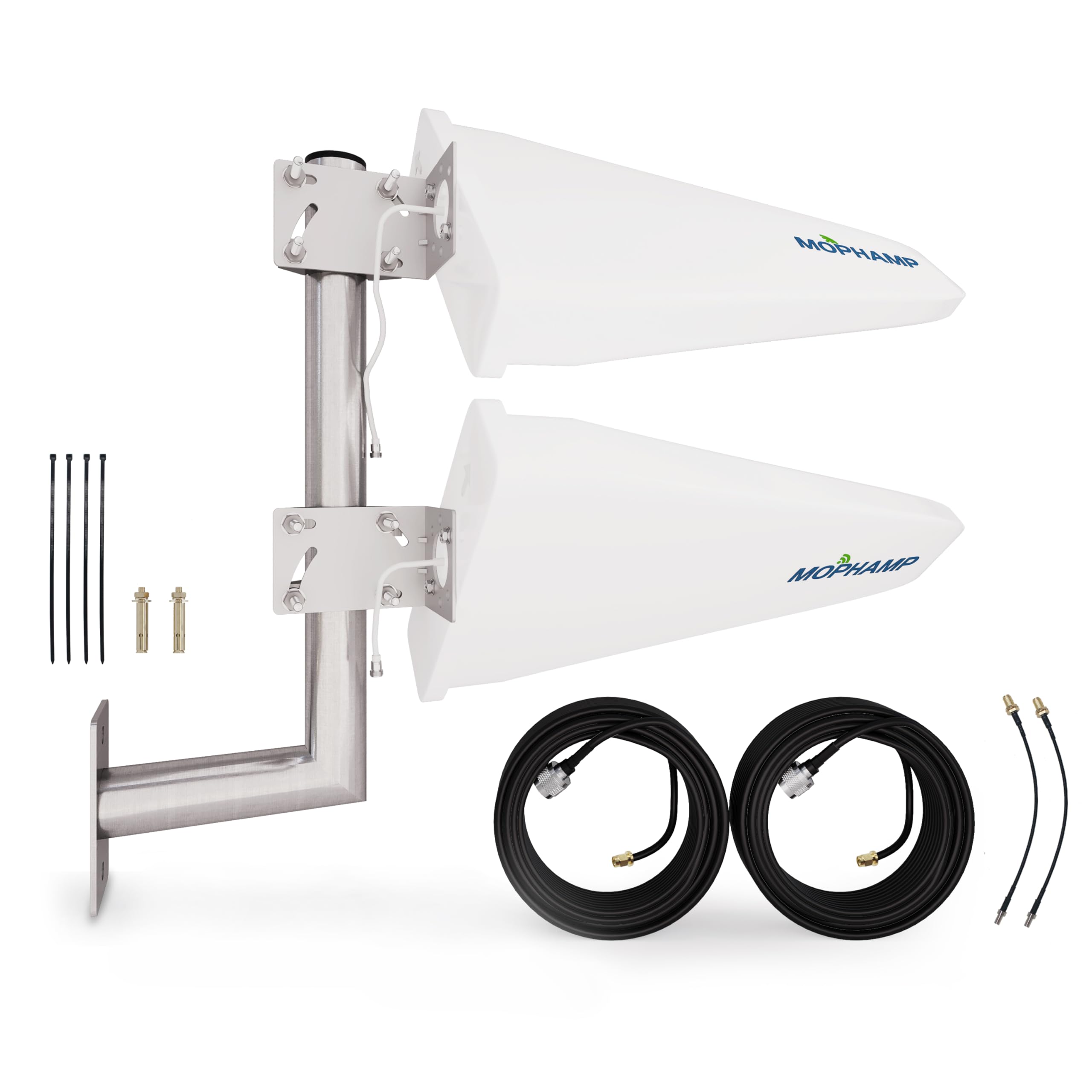
The MOPHAMP 2×2 MIMO Log Periodic Kit delivers impressive specifications at an entry-level price point, making it the most accessible route to a serious signal boost. The kit includes two antennas (for MIMO diversity), two 32-foot low-loss coaxial cables, TS9 adapters, a solid L-mount, and installation hardware — everything needed for a complete installation except the mast. The 15 dBi gain is high enough to make a substantial difference in marginal signal areas, and the 698-3800 MHz frequency range covers 4G and most 5G Sub-6 bands used in the US.
User feedback confirms strong performance when the setup is dialed in. One user with a Netgear Nighthawk MR6500 hotspot saw speeds jump from under 1 Mbps indoors to approximately 300 Mbps down and 20 Mbps up after mounting the antenna on a tripod near a window. The complete kit approach reduces the frustration of sourcing individual components — everything arrives in one box with step-by-step guides. The low-loss cable minimizes signal degradation over the 32-foot run, preserving the antenna’s high gain.
The critical weakness is the mounting hardware. Multiple users report that the included L-bracket is poorly constructed, with only a few tiny tack welds holding the base plate, and it has been known to snap in wind or on the first installation attempt. This is a safety and reliability issue that forces many users to purchase a separate heavy-duty mount or construct their own solution, adding to the total cost. The antennas themselves are decent, but the flimsy mount undermines the value proposition. If you have a robust mounting solution already, this kit is a fantastic bargain; if not, factor in an additional expenditure for proper hardware.
Why it’s great
- Excellent value with complete kit including cables and adapters
- High 15 dBi gain can transform weak signals into fast connections
- 32-foot low-loss cables minimize signal degradation
Good to know
- Included L-mount is poorly welded and prone to failure
- Requires a separate heavy-duty mounting solution for safety
- Log periodic design needs careful aiming for best performance
7. Eifagur 11dBi High Gain MIMO Antenna

The Eifagur 11dBi MIMO antenna is a budget-friendly directional antenna designed primarily for Netgear Nighthawk hotspots (M6, M6 Pro, M5, M1) and similar mobile routers. With 11 dBi of gain and a frequency range of 698-2700 MHz, it covers 4G LTE and the lower 5G NR FR1 bands. The package includes dual 5-meter RG58 cables with dual SMA connectors and adapter cables for TS9 connectors, making it nearly plug-and-play for compatible hotspots. The dual-polarized MIMO design uses two separate antennas in a single housing to improve throughput and reliability.
Real-world success stories show this antenna can dramatically improve connectivity in weak signal areas. One user reported speed tests jumping from 0-10 Mbps to 80-100 Mbps after installation and enabling the antenna ports on their modem. Another user successfully revived an alarm system’s cell transmitter that had been non-functional for months, mounting the antenna outside and pointing it at a tower one mile away. The weatherproof construction is suitable for exterior mounting, and the included U-bolt brackets fit standard 1.5- to 2-inch masts.
However, performance is inconsistent. One user reported that this larger antenna actually performed worse than a smaller, cheaper Waveform antenna despite two weekends of repositioning, suggesting possible quality control issues or a defective unit. The RG58 cable, while functional, introduces more signal loss than LMR400 cabling over longer runs, which can eat into the 11 dBi gain. It also only covers up to 2700 MHz, meaning it does not support the C-band frequencies (3.7-4.0 GHz) that are increasingly important for modern 5G networks. For users with older modems or those on a tight budget, it is a reasonable starting point, but serious users will quickly outgrow its capabilities.
Why it’s great
- Very affordable entry point for signal improvement
- Nearly plug-and-play with Netgear Nighthawk hotspots
- Proven to turn unusable signals into 80+ Mbps connections
Good to know
- RG58 cable introduces higher loss than LMR400 alternatives
- Frequency range (698-2700 MHz) lacks support for C-band 5G
- Some units show inconsistent performance or quality control issues
FAQ
Can I use any directional 5G antenna with my existing router?
How does cable length and type affect my antenna’s performance?
What is the difference between a log periodic and a parabolic grid antenna?
Final Thoughts: The Verdict
For most users, the best 5g antenna winner is the Waveform QuadPro because it combines the highest MIMO configuration with a complete, thoughtfully designed kit that delivers massive, measurable speed improvements for T-Mobile, Verizon, and AT&T users. If you want extreme long-range performance over 10 miles, grab the Bolton Technical Long Ranger. And for the best balance of performance and simplicity in a compact package, nothing beats the Proxicast Cross-Polarized Panel.