
Our readers keep the lights on and my morning glass full of iced black tea. As an Amazon Associate, I earn from qualifying purchases.
Specs are compiled from manufacturer listings and verified buyer reviews and can change over time — please confirm the key details on the product page before buying.
That moment when your music cuts out, the map freezes, or a call drops right as you hit a rural stretch—it’s the real reason you’re looking at a 5G Cell Phone Signal Booster For Car. A booster doesn’t create a signal out of thin air, but it grabs the weak one your phone can’t hold onto and makes it strong enough to actually use. The key to choosing well isn’t the fanciest brand—it’s matching the bands your phone uses and picking a gain level that fits how far off the beaten path you travel.
I’m Min — the founder and writer behind Gadgets Feed. This guide is built by comparing the manufacturers’ published specifications and the patterns across verified customer reviews, so you get each pick’s real strengths and trade-offs instead of marketing spin.
After breaking down the specs and real owner experiences, we’ve ranked the best 5g cell phone signal booster for car options to help you stay connected on every road trip.
Our Picks at a Glance
How To Choose The Best 5G Cell Phone Signal Booster For Car
You can waste money on a car signal booster that amplifies the wrong frequencies, leaving your phone just as dead as before. The fix is simple: check which cellular bands (the specific frequency ranges your carrier uses) your phone supports, and match them to the booster. Your driving environment—open highway versus dense city—also matters, because boosters work best when they can reach a tower. Here’s what actually matters.
Check Your Phone’s Bands First
Your phone connects to towers using specific frequency bands—think of them as different radio channels. Most budget and mid-range car boosters only amplify Band 12, 13, and 17 (700 MHz frequencies). If your carrier uses a different band in your area, the booster will be useless. Look up your phone’s specs or use a signal app to see which bands you’re on before you buy anything.
Understand dB Gain, Not Just the Number
Gain is measured in dB, and it tells you how much the booster amplifies the signal it receives. A 50 dB unit can take a faint signal and make it usable, while a 65 dB unit pushes further into weak zones. But higher gain isn’t always better—in a small car, too much power without proper antenna separation can cause feedback loops that kill the signal entirely.
Consider Your Driving Environment
If you mostly drive highways near cities, a budget-friendly unit with omni-directional reception will handle it fine. If you’re headed deep into national forests or remote mountain passes where you’re miles from the nearest tower, you need a premium unit with higher uplink power to reach towers that are farther away. Be honest about where you actually drive.
Quick Comparison
| Model | Best For | Max Gain | Bands Supported | Installation | Amazon |
|---|---|---|---|---|---|
| weBoost Drive Reach Overland★ Best Overall | Off-road and overlanding | 50 dB | Band 12/17, 13, 5, 4, 25/2 | Mounting bracket included | Amazon |
| SureCall Fusion2Go UltraWide Coverage | Rural commuters and trucks | 50 dB | Band 12/17, 13, 5, 2/25, 4 | Magnetic antenna, DIY | Amazon |
| HiBoost C30G-5S-BTWSmart Pick | Daily drivers and sedans | High power | Band 12/17, 13, 5, 4, 25/2 | Magnetic antenna, app-guided | Amazon |
| Metarepeater MT1 | RV and truck multi-device | 5–8 mile range | Band 12/17, 13, 5, 2/25, 4 | Omni antenna, spring mount | Amazon |
| SignalBrick Car Booster | All-carrier family trips | — | Band 12/17, 13, 5, 2/25, 4 | No-drill magnetic setup | Amazon |
| Phonetone C20 (Grey) | Budget band-matching | — | Band 12, 13, 17 | Omni roof antenna | Amazon |
| Phonetone C20 (Black) | Entry-level car and RV | — | Band 12, 13, 17 | Magnetic antenna, weatherproof | Amazon |
| GAGBK Car Booster | Budget all-carrier users | 65 dB | Band 12, 13, 17 | No-drill magnetic whip | Amazon |
In‑Depth Reviews
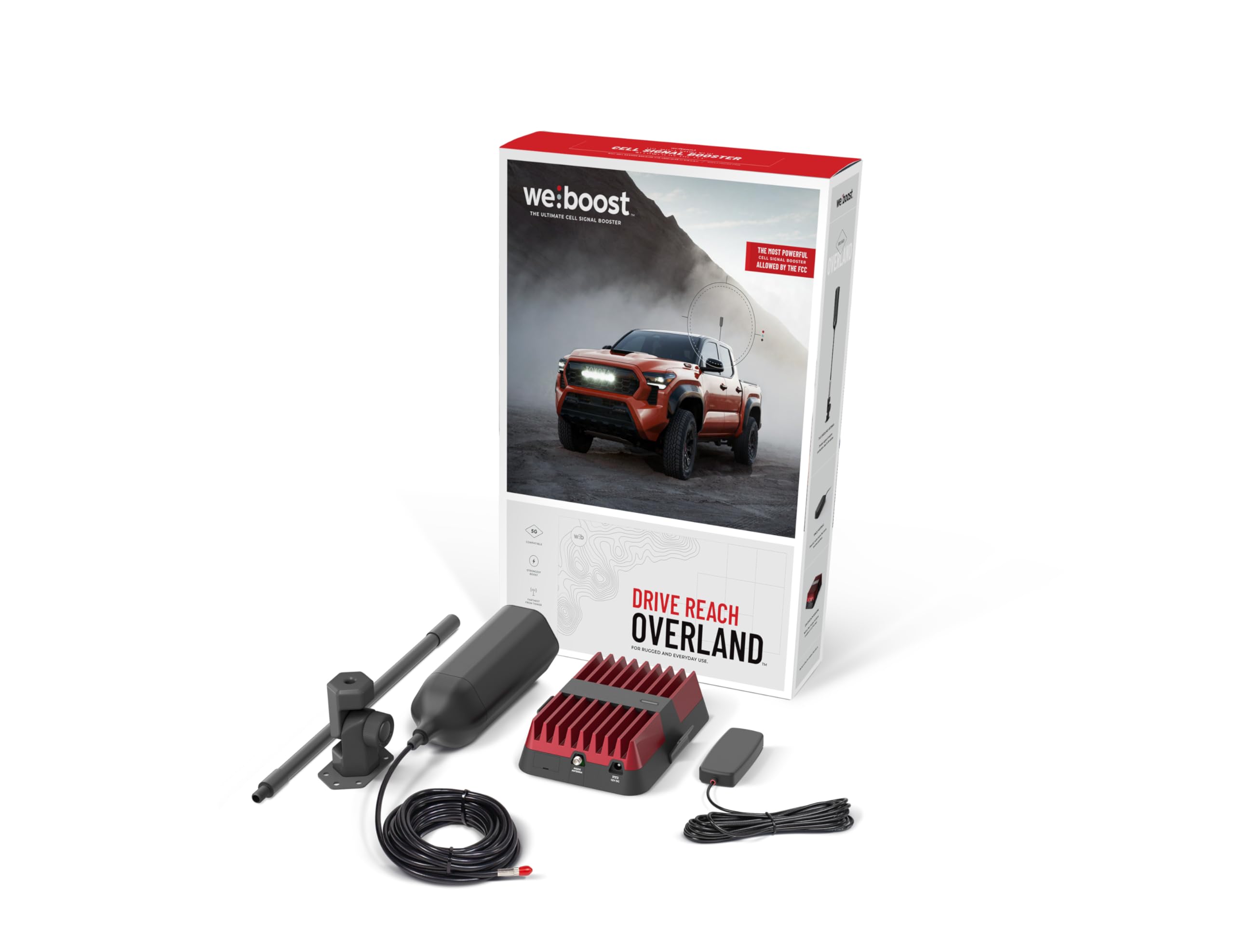
1. weBoost Drive Reach Overland
Our pick — over 4★ from 400+ verified ratings; the strongest balance of quality and price.
The overlanding kingpin that turns SOS bars into usable calls on the trail.
This is the unit serious off-roaders reach for when pavement ends. The Drive Reach Overland pairs a powerful booster with a tough outdoor antenna and a versatile mounting bracket, so it’s built for the constant vibration and weather of true overland travel. It covers Quad-Band frequencies spanning Band 12/17, 13, 5, 4, and 25/2, which means it works with all major U.S. carriers including Verizon, AT&T, T-Mobile, and UScellular.
The 50 dB max gain is the headline spec, but real-world stories show it’s about turning a 1-bar emergency signal into a workable connection. Buyers report boosting a van from 1 bar or SOS up to 3-4 bars, making navigation and calls possible where they weren’t before. One honest note from owners: the stock antenna is weak, and upgrading to a stronger model makes a noticeable difference if you need to support multiple phones at once.
Setup is genuinely approachable—owners describe installing it on a Ford Bronco easily even as beginners, with all parts included and clear guides plus YouTube support. The build quality gets mixed feedback, with some praising the high-quality materials while a few note the antenna mount feels less substantial than the rest of the kit. It’s FCC approved with a two-year warranty and expert U.S.-based support through app, chat, phone, or email.
Trail cred: Owners mention it’s pricey but a one-time investment that saves money compared to relying on satellite data in dead zones—though even the most enthusiastic note you’ll still need Starlink in truly remote areas with zero signal.
The honest catch: A few customers note minimal amplification and a fragile antenna mount, so this shines brightest when you start with at least a faint signal to boost.
Best for: Overlanders and off-roaders who need reliable communication in remote backcountry and already understand they’ll be in areas with at least a whisper of signal.
Think twice if: You only commute through suburban dead zones—a more budget-friendly unit will handle that job without the premium cost.
2. SureCall Fusion2Go Ultra
Hits distant towers with the market’s highest uplink power for rural reliability.
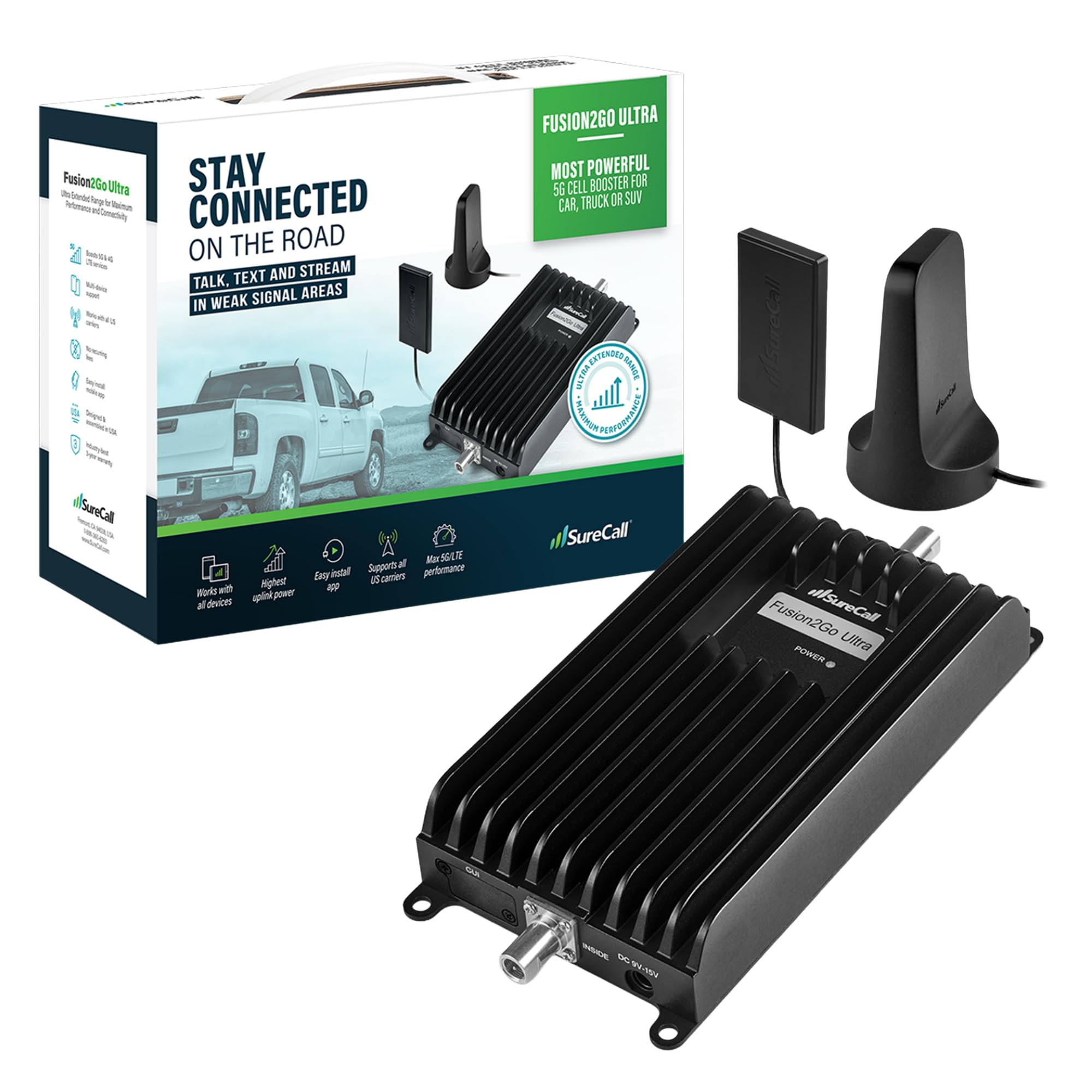
When you’re the kind of driver who logs serious miles through rural territory, the Fusion2Go Ultra is engineered for exactly that fight. It delivers up to 50 dB gain but pairs it with an industry-leading 30 dBi uplink power—that’s the spec that lets your phone “shout” louder to reach towers that are far away. The result, per owners who measured it, was a 17x upload speed improvement and a ping drop from 2000 ms to 344 ms on a weak connection.
This unit supports 5G and 4G LTE across all major U.S. carriers—AT&T, T-Mobile, Verizon, US Cellular, Google Fi, Mint Mobile, Boost Mobile and more. It also keeps multiple devices connected simultaneously, from phones and tablets to mobile hotspots and even cellular security cameras. The complete kit includes the amplifier, a magnet-mount exterior antenna with a 12.5 ft cable, an interior antenna, and power supply.
The free SureCall app guides you to the best antenna placement, which matters because installation is the difference between a great signal and a frustrating one. Owners who wired it into a car with a 55-mile commute eliminated dead zones entirely. The catch: cable routing takes time and the included cables are on the short side for larger vehicles like big trucks.
Rural reach that pays off
- Highest uplink power on the market at 30 dBi pushes signal to distant towers
- FCC certified and proudly built in the USA
- One-time purchase with no subscriptions or monthly fees
- 3-year warranty with lifetime U.S.-based support
Setup realities
- Cable routing can be time-consuming for a clean professional install
- No hardwire kit included—you’ll use the 12 ft DC power supply
- Roof antenna cable exits from the side, which some owners found limiting
Reach for this if: Your daily drive crosses long rural stretches where even a 1-bar signal is a win—the 30 dBi uplink is what actually keeps you connected farther from the tower.
Look elsewhere if: You only need help in occasional suburban dead zones and don’t want to invest premium dollars or install time.
3. HiBoost C30G-5S-BTW
The daily-driver booster that pairs a rugged metal body with app-guided placement.
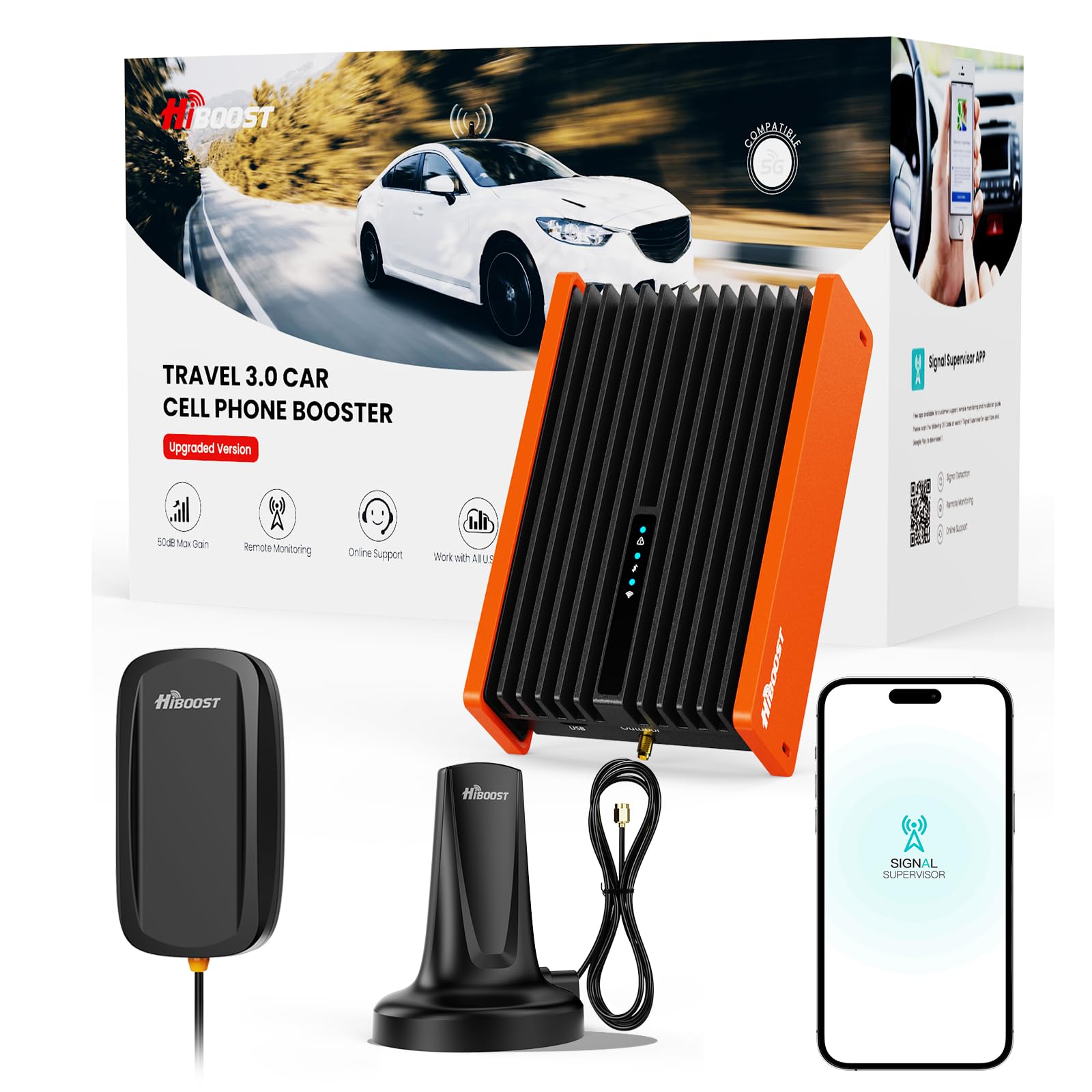
If your signal problems happen on the highway commute, in parking garages, or along rural roads—but you’re not heading into the deep backcountry—this HiBoost C30G hits a smart middle ground. It boosts 5G and 4G LTE for most major carriers including AT&T, Verizon, and T-Mobile, covering Band 12/17, 13, 5, 4, and 25/2. The rugged metal booster is wrapped in a protective silicone cover that resists bumps, scratches, and outdoor conditions.
What makes this unit stand out is the free companion app that helps with signal detection and installation guidance. Reviewers point out that getting it set up correctly is the key to success—one Tacoma owner noted you need proper antenna separation (roughly from the foot pedal to the tailgate) to avoid feedback, but once dialed in, it works. The magnetic outdoor antenna mounts on the roof quickly and connects to an inside antenna with a 13.12 ft cable.
Real-world results show it takes a driveway signal from one bar to two and eliminates dropped Apple CarPlay connections on the way to work. It works across T-Mobile, Verizon, AT&T, and Boost, with owners reporting full bars on 5G UC after installation. The honest limitation: it needs some existing signal to amplify—it won’t create coverage from nothing.
Daily driver’s choice: Owners sum it up as a quality unit that improves call quality even in dead zones, with responsive proactive customer support via text when you need help with placement.
Value check: A few find it pricey for smaller vehicles where antennas can’t be separated enough, but it still adds 1-2 bars in most cases.
Confident pick for: Commuters and sedan drivers who want a sturdy, app-guided booster that improves calls and data on familiar routes with weak spots.
Not ideal for: Compact cars where you physically can’t separate the inside and outside antennas enough to prevent a signal loop.
4. Metarepeater MT1 Truck Cell Booster
An LCD-equipped powerhouse built for trucks and RVs that never stop moving.
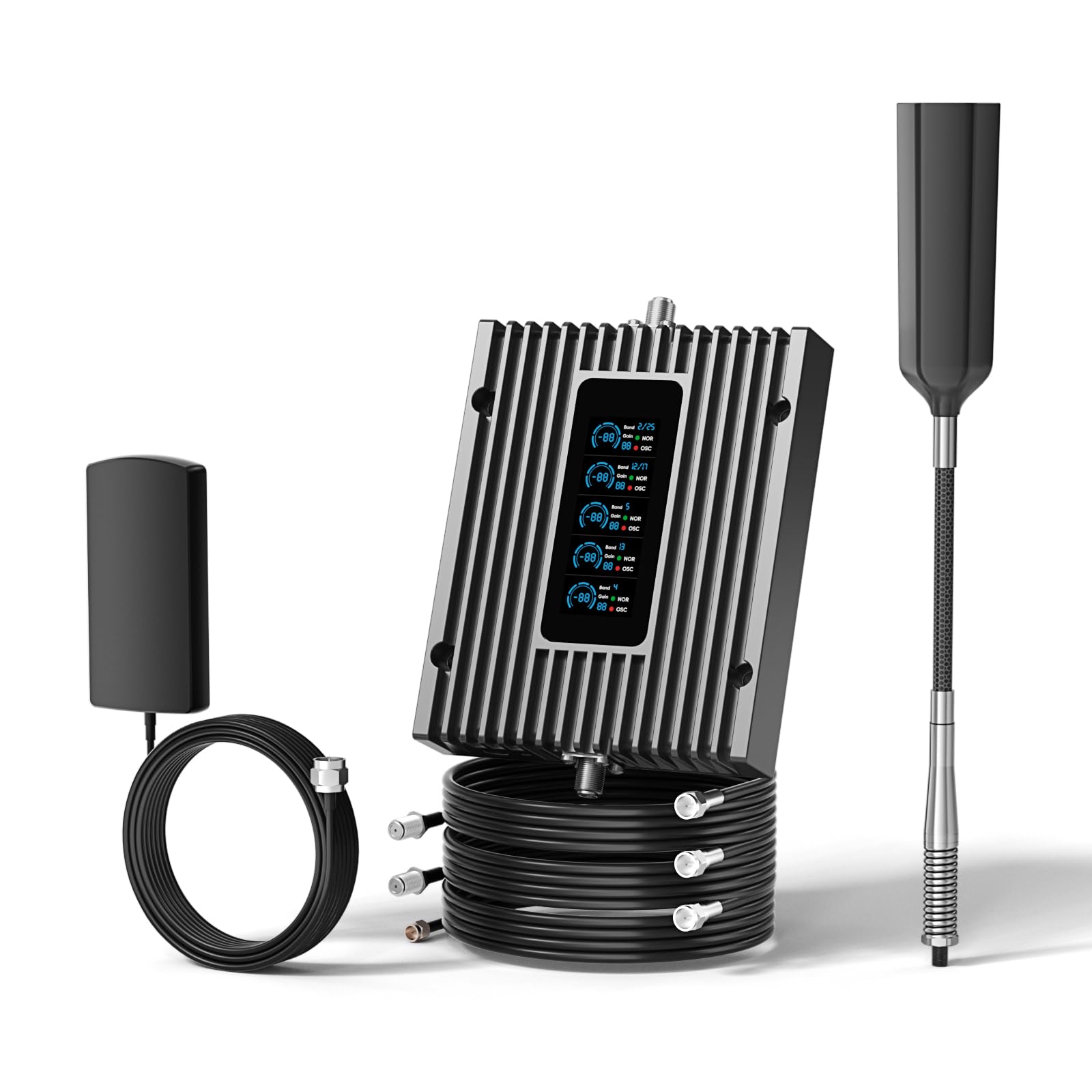
Long-haul truckers and RVers face a unique problem: their “home” is moving, and signal dead zones shift with every mile. The MT1 is built specifically for that life, with a large color LCD display that shows the working status of the booster in real time, including the gain on all five frequency bands simultaneously. That display isn’t just a gimmick—it lets you see at a glance whether you’re actually boosting or just guessing.
The MT1 amplifies Band 12/17, 13, 5, 2/25, and 4 across 4G LTE and 5G, supporting multiple users and devices at the same time—smartphones, tablets, and data modems all stay connected. It’s rated to extend communication range up to 5-8 miles and enhance weak signals up to 100x. The included omni-directional antenna captures signals from all directions with a spring-mounted design that flexes on rough roads instead of snapping.
Owners who drive trucks across rural areas report it keeps their phones usable for navigation and calls in places where they used to lose connection completely. The rugged outdoor antenna resists dust, oil, and water, making it durable for off-road and long-distance travel. It’s FCC certified with a 3-year warranty.
One owner put it plainly: it doesn’t create a signal where there is none, but when there’s a weak signal available, it makes it stronger and more stable. That’s the honest expectation for any booster in this category.
Built for the long haul
- Real-time LCD display shows gain on all five bands
- Extends range up to 5–8 miles in open terrain
- Spring-based omni antenna survives rough roads and weather
- Supports multiple phones, tablets, and modems at once
Realistic limits
- Can’t create a signal where literally none exists
- One dissenting owner called it not worth the cost for their situation
Made for: Full-time truckers and RVers who want a durable, multi-device booster with a display that confirms it’s working as you cross state lines.
Skip if: You’re a weekend commuter—the 5–8 mile range and LCD are overkill for a 30-minute highway drive.
5. SignalBrick Car Cell Phone Booster
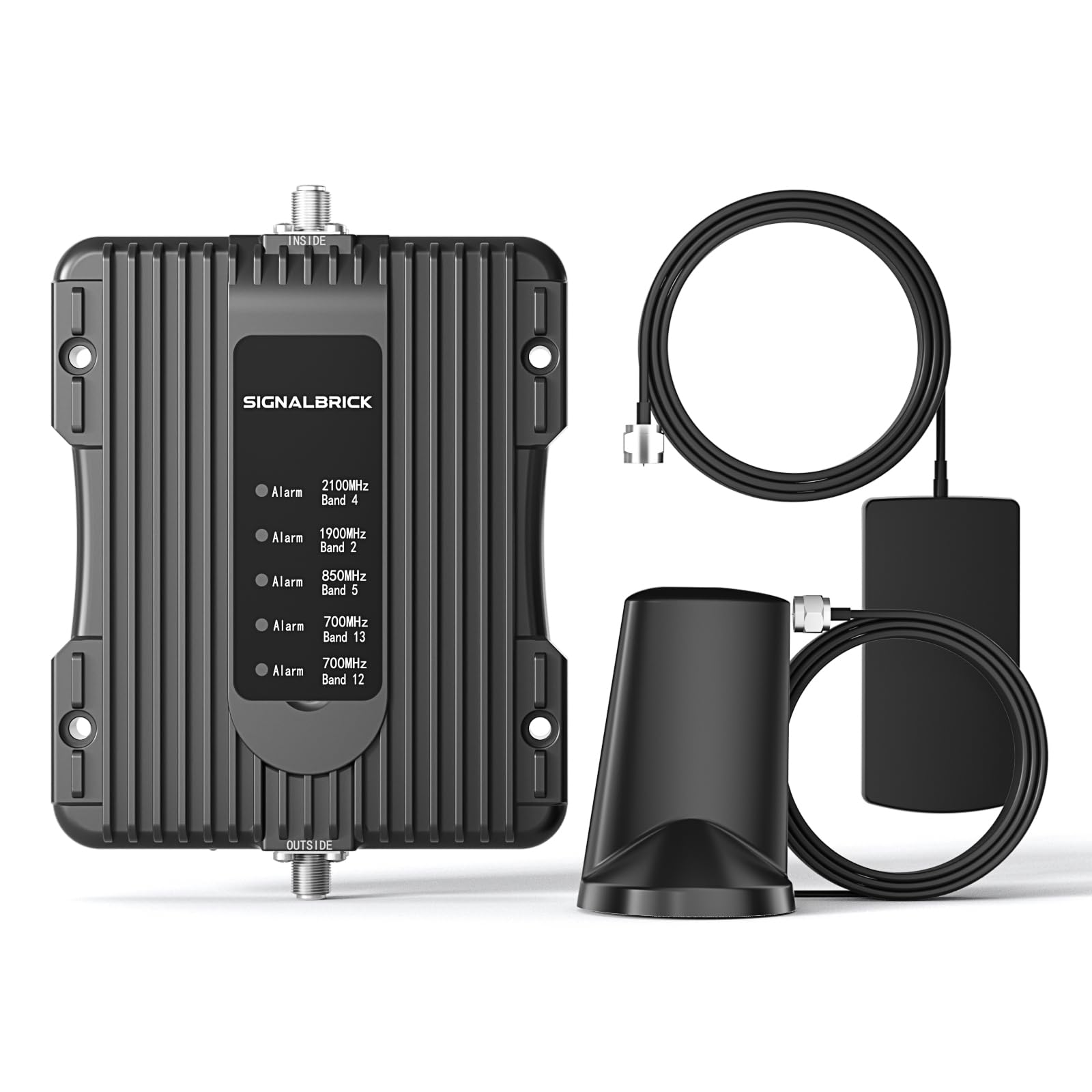
Omni-directional reception that saves your road trip without drilling a single hole.
This is the booster for families and road-trippers who want broad carrier compatibility without overthinking installation. The SignalBrick supports band 12/17, 13, 5, 2/25, and 4 for multiple users and devices at the same time—meaning everyone in the car gets clearer calls and faster data, not just the driver’s phone. It works with all U.S. carriers including Verizon, AT&T, T-Mobile, Sprint, and Straight Talk.
The defining feature here is genuinely smart for beginners: the omni-directional outdoor magnetic antenna receives signals from all directions, so you don’t have to point it at a tower. That removes the most common installation mistake entirely. The advanced automatic gain control adjusts signal strength in real time, reducing energy consumption while maintaining a stable connection.
You can install this booster alone in under 30 minutes without drilling—just stick the magnetic antenna on your roof and place the interior patch antenna (a flat panel that rebroadcasts the signal inside). Shoppers say their signal jumping from 1-2 bars to 4 bars in remote areas, and a long-haul trucker in remote NW Canada confirms no dropped calls and excellent data across a full haul with Bell. The 3-year warranty adds confidence.
Family road-trip winner: Owners highlight that it supports GPS, hotspots, and music simultaneously while making calls crisp, even across Canadian carriers.
Know the limit: If you live on the extreme edge of coverage with difficult geography, one owner found only slight range extension—it helps, but can’t overcome truly impossible terrain.
Reach for this if: You want a set-and-forget booster for family trips where multiple phones and devices need a lift, without fussing over antenna aiming.
Not for you if: You’re in extreme remote terrain where towers are 10+ miles away—you’ll want the higher uplink power of a premium unit.
6. Phonetone C20 Cell Phone Booster (Grey)
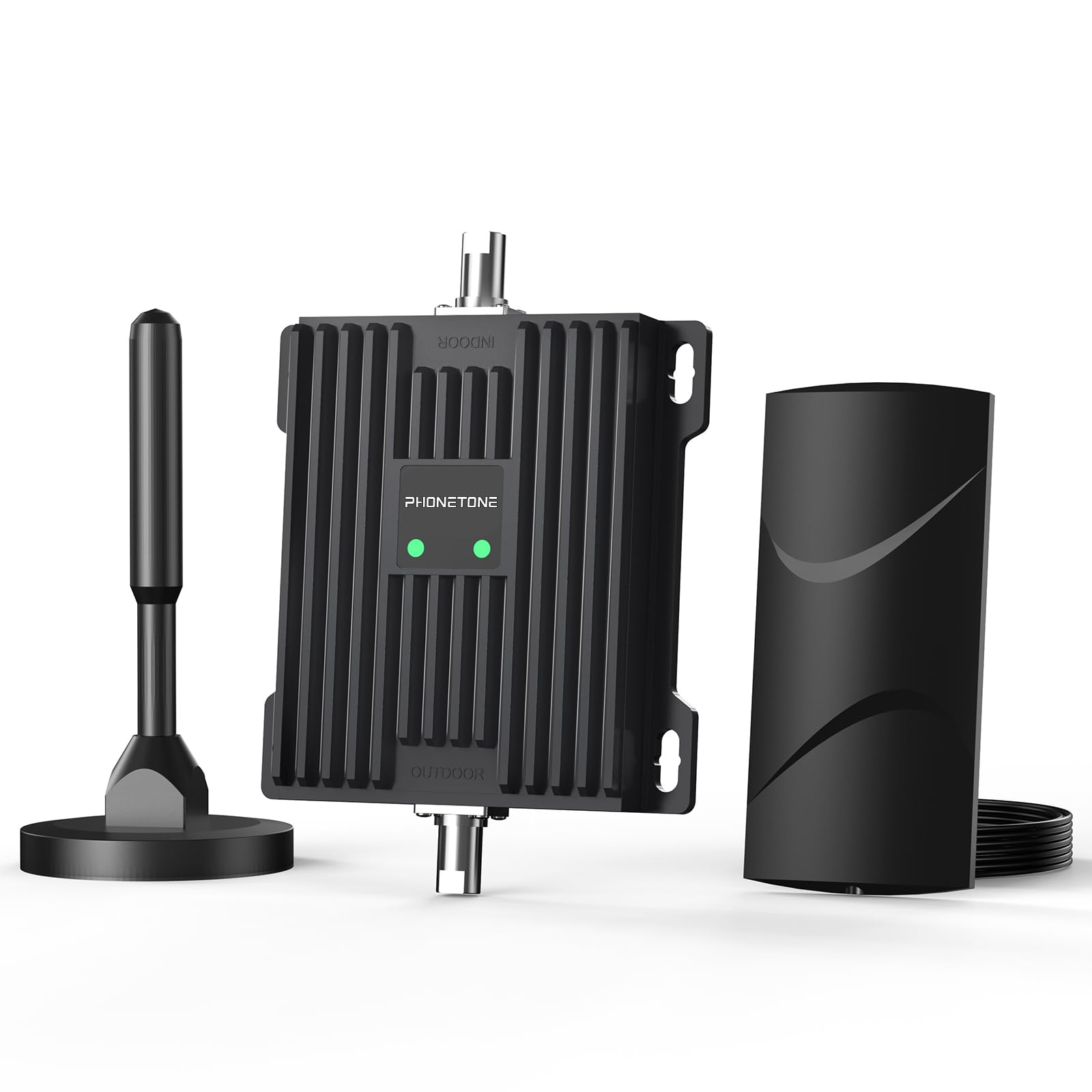
A straightforward band-matched booster that shines when your phone’s bands align perfectly.
Sitting at the more budget-friendly end of the spectrum, this Phonetone C20 in Grey delivers solid results for drivers who’ve done their homework on frequency bands. It amplifies 5G, 4G LTE, and VoLTE specifically on Band 12, 13, and 17—the 700 MHz frequencies that many carriers use for long-range rural coverage. It’s FCC certified with certification number 2ALZEL50VA-01.
What wins people over is the real-world improvement when conditions are right. Buyers report boosting a weak Rogers 4G LTE signal from 1-2 bars to 3-4 bars consistently at a cabin, supporting 4K streaming, calls, and multiple users at once. Another owner watched their signal jump from 1-2 bars to 4 bars in seconds after proper antenna positioning. The omni-directional roof antenna (which picks up signals from all directions) makes aiming less critical, but you’ll still want to find the balance.
The honest trade-off: this unit only works if your phone actually uses Band 12, 13, or 17. One owner found it worked great for their phone and their wife’s but did nothing for their son’s phone on a different carrier. That’s the reality of band-matched boosters—check your bands before buying, and don’t expect miracles if your carrier uses other frequencies in your area.
Band-matched value: When your phone lines up with bands 12/13/17, the C20 delivers a reliable 2-bar boost that supports streaming and calls for multiple users.
The fine print: One measured test showed range limited to roughly 2 feet from the indoor antenna, so placement in the cabin matters more than with pricier units.
Fair choice for: Budget-conscious drivers who’ve verified their phone uses Band 12, 13, or 17 and want a simple omni-antenna booster.
Walk away if: You’re unsure of your phone’s bands or use a carrier that relies on other frequencies—this booster simply won’t help you.
7. Phonetone C20 Cell Phone Booster (Black)
A friendly entry point for RVers who want clearer calls without premium pricing.
If you’re new to signal boosters and want to test the waters with a capable unit, this black Phonetone C20 is a reasonable starting point. It’s designed for car and RV use, tackling dropped calls and slow-loading 4G LTE and 5G networks on the road. Like its grey sibling, it works specifically on Band 12, 13, and 17, so band checking before purchase is non-negotiable.
The weatherproof magnetic antenna is a thoughtful touch for RVers who leave their rig parked outside in all seasons. Setup is genuinely easy—owners describe quick installation with the omni-directional roof antenna, and one measured a +25 dB improvement to 4 bars at 15-20 km from the tower. The 2-year warranty covers you if anything goes wrong.
The biggest caveat is range inside the vehicle. One owner noted the indoor range is less than 10 feet, which means the interior antenna placement needs to be close to where you actually sit or use your phone. Instructions are also on the vague side, so you’ll want to watch setup videos to get the antenna separation right.
Newbie-friendly features
- Easy magnetic antenna install with no drilling required
- Weatherproof outdoor antenna holds up in the elements
- FCC approved with 2-year warranty and email support
Watch these limits
- Indoor signal range under 10 feet requires careful interior antenna placement
- Only boosts bands 12, 13, and 17—check compatibility first
Fine first booster for: RVers and casual road-trippers who want a low-cost upgrade for clearer calls and know their phone operates on bands 12, 13, or 17.
Not your unit if: You need whole-cabin coverage for multiple devices spread across a large RV—the indoor range is simply too short.
8. GAGBK Car Cell Phone Booster

An aggressive 65 dB gain at a friendly price for multi-user vehicles.
This GAGBK booster is the most budget-friendly option here, but it doesn’t skimp on the core spec that matters: 65 dB of max gain—the highest raw amplification number in this lineup. That means it works hard to pull a usable signal out of very weak coverage on Band 12, 13, and 17, supporting Verizon, AT&T, T-Mobile, Sprint, Straight Talk, Cricket, and U.S. Cellular. It’s designed for trucks, RVs, SUVs, vans, and campers with multi-user support.
The kit includes everything you need: an inside patch antenna with a 10 ft cable and an outside magnetic whip antenna with a 16 ft cable. The automatic gain control (AGC) detects incoming signal strength and adjusts itself to prevent self-oscillation—that annoying squeal when a booster feeds back on itself. A sleep mode reduces power draw when the booster isn’t in use, which matters for anyone worried about draining their vehicle’s battery.
The aluminum alloy body keeps it compact while improving heat dissipation for longer life. GAGBK backs it with a 30-day money-back guarantee and a 3-year manufacturer warranty. Just remember the note in the listing: turn it off if you won’t use it for a long time to avoid draining your car’s battery.
Big gain, small price
- Highest raw gain in this guide at 65 dB for weak-signal areas
- No-drill install with magnetic whip antenna in 10-20 minutes
- Automatic gain control prevents feedback and self-oscillation
- Strong 3-year warranty and lifetime technical support
Proceed with eyes open
- Only amplifies Band 12, 13, and 17—not a full-spectrum booster
- A few owners hit reliability issues with the unit and returns process
Smart for: Multi-user vehicle owners on a strict budget who need maximum boost on Band 12/13/17 and want a long warranty as a safety net.
Steer clear if: Reliability is your top concern or your carrier relies on bands outside 12/13/17—check those bands before committing.
Understanding the Specs
What dB Gain Really Means
Gain, measured in dB, tells you how much the booster amplifies whatever signal it captures from the outdoor antenna. A 50 dB unit can turn a faint 1-bar signal into a usable 3-4 bar connection in most conditions. Higher numbers like 65 dB promise more reach, but the real-world limit is always the same: if there’s literally zero signal outside your car, no amount of gain will create one.
The Uplink Power Factor
While gain gets the marketing attention, uplink power—measured in dBi—determines how well your phone can “talk back” to a distant tower. This matters most in rural areas where towers are far away. A booster with strong uplink power like 30 dBi can reach towers that weaker units simply can’t connect to, which is why the SureCall Fusion2Go Ultra stands out for rural drivers.
Why Bands Matter More Than Brand
Every carrier uses specific frequency bands, and budget boosters often only amplify Band 12, 13, and 17 (the 700 MHz range). If your carrier uses those bands for coverage in your area, a budget booster works great. If not, you need a full-spectrum unit covering bands 2/25, 4, and 5 as well. Always check your phone’s band support before buying.
Antenna Separation and Placement
Signal boosters work by pulling in signal through an outside antenna and rebroadcasting it inside. If those two antennas are too close together, the booster can pick up its own signal and create a feedback loop that ruins performance. In most vehicles, you need several feet of separation, which is why magnetic roof antennas paired with interior patch antennas are the standard design.
FAQ
Will a 5G car booster work with my specific carrier?
How do I check what bands my phone uses?
Can a car signal booster create signal where there is none?
What is the difference between 50 dB and 65 dB gain?
Do I need a booster for 5G specifically?
How long does installation actually take?
Will a booster drain my car battery?
Can multiple phones use a car booster at the same time?
Final Thoughts: The Verdict
For most drivers, the 5g cell phone signal booster for car that makes the strongest case is the weBoost Drive Reach Overland because its 50 dB gain (a measure of how much it amplifies the signal), quad-band coverage (supporting four frequency bands), and rugged overland design tackle the toughest conditions while staying easy to install. If you log serious rural miles and want the market’s highest uplink power to reach distant towers, the SureCall Fusion2Go Ultra is the one to reach for. And if you’re watching your budget but still want real gains on the road, the GAGBK Car Booster delivers the biggest raw gain in this lineup at the friendliest price. No matter which you choose, verify your phone’s bands first—that single step determines whether any booster actually works for you.
How We Picked
We do not accept paid placement. Every pick is matched to a real buyer and a real use-case; we do not hands-on test units.
Sources & Methodology
Specifications: manufacturer listings and product documentation. Review insights: verified customer reviews, as of September 2026. Pricing: not shown on this page (it changes often); check the current price via the retailer link.
As an Amazon Associate, Gadgets Feed earns from qualifying purchases. This does not affect which products we feature.