
Our readers keep the lights on and my morning glass full of iced black tea. As an Amazon Associate, I earn from qualifying purchases.
Specs are compiled from manufacturer listings and verified buyer reviews and can change over time — please confirm the key details on the product page before buying.
If your only internet options are a slow DSL line or a phone hotspot that dies every two hours, a 5G cellular modem replaces both with one box that pulls its own signal from the tower. The trick is knowing which one keeps working after the novelty wears off — because the difference between a great 5G router and a frustrating one usually depends on how it handles a weak signal, how many SIM slots it has, and whether it can run your whole house or just your laptop.
I’m Min — the founder and writer behind Gadgets Feed. This guide is built by comparing the manufacturers’ published specifications and the patterns across verified customer reviews, so you get each pick’s real strengths and trade-offs instead of marketing spin.
We break down nine real options by the specs that actually change how you use them — SIM setup, band support, and failover — so you can find the right 5g cellular modem for your home, RV, or job site without guessing.
Our Picks at a Glance


How To Choose The Best 5G Cellular Modem
The single biggest mistake people make is buying a 5G modem based on its top-speed claim. Real-world speed depends on your carrier’s tower coverage, which band it uses, and whether your modem supports it. A modem rated at 3.4 Gbps won’t hit that number if you’re in a low-signal area or on a deprioritized data plan.
Carrier compatibility over raw speed specs
Before you spend anything on a 5G modem, you need to know which carrier you will actually use. Some modems are certified for specific carriers — like AT&T and T-Mobile IoT certification — while others are open up but may still restrict certain SIM cards. Read the carrier compatibility carefully. A modem that lists “open up” can still refuse a Verizon SIM if the firmware is carrier-specific.
Dual-SIM and failover for uninterrupted connectivity
Dual-SIM means two SIM card slots inside the modem. Single standby mode keeps both slots ready but only runs one at a time, switching automatically if your primary carrier drops. This is essential if you work remotely, run a business, or live somewhere with inconsistent coverage.
Wi-Fi generation and how many devices you need to run
Wi-Fi 6 supports multiple devices without slowing down. Older Wi-Fi standards choke when ten or more devices connect at once. Look at the maximum device count — some 5G modems support up to 32 devices, others up to 64. If you’re running a small office or a full household, you want the higher number.
Battery, portability, and antenna options
Battery-powered modems free you from an outlet but add weight and heat. Plug-in routers give you stable power and more external antenna options. Detachable antennas let you attach high-gain replacements if you’re in a low-coverage area. If you rely on your modem for home internet, a fixed router with antenna ports is almost always the better choice over a pocket hotspot.
Quick Comparison
| Model | Best For | 5G Type | Wi-Fi Standard | Battery / Power | Amazon |
|---|---|---|---|---|---|
| GL.iNet GL-X3000 (Spitz AX)★ Best Overall | RV and home 5G router | 5G NR (NSA/SA) | Wi-Fi 6 | Plug-in only | Amazon |
| Hitron D60Best Value | Home and SOHO use | 5G (NSA/SA) | Wi-Fi 6 | Plug-in only | Amazon |
| NETGEAR Nighthawk M6 Pro (MR6500)Best for Travel | Travel and international roaming | 5G mmWave + Sub-6 | Wi-Fi 6E | 5040mAh battery | Amazon |
| GlocalMe Numen Air 5G | Global travel without a SIM contract | 5G NR | Wi-Fi 6 | Built-in battery | Amazon |
| NETGEAR Nighthawk M7 Pro | Multi-device home and office use | 5G mmWave | Wi-Fi 7 | Built-in battery | Amazon |
| UOTEK 5G SIM Card Router CPE | Fixed indoor smarthome and office | 5G NR (NSA/SA) | Wi-Fi 6 | Plug-in, 8 antennas | Amazon |
| Cudy 5G NR AX3000 (P5) | Business continuity and remote sites | 5G NR (SA/NSA) | Wi-Fi 6 | Plug-in, quad antenna | Amazon |
| GL.iNet GL-XE3000 Puli AX | Portable 5G with battery backup | 5G NR (NSA/SA) | Wi-Fi 6 | 6400mAh battery, 8-hour | Amazon |
| TP-Link 5G Mobile Hotspot M8550 | Travel with external antenna needs | 5G NR | Wi-Fi 6E Tri-Band | 4680mAh, up to 14 hours | Amazon |
In‑Depth Reviews
1. GL.iNet GL-X3000 (Spitz AX) Cellular Gateway 5G Router
Our pick — over 4★ from 900+ verified ratings; the strongest balance of quality and price.
The dual-SIM workhorse that keeps RVs and rural homes online when one carrier drops.
If you’re a full-time RVer or you live far enough out that cable never made it to your street, this is the router to know. It pulls its internet straight from a 5G tower via a SIM card — no cable line, no DSL box. Two SIM slots let you switch providers on the fly or keep a backup carrier ready, and the router hands off between them automatically so you’re not the one swapping cards.
You get Wi-Fi 6, which handles many devices at once without choking — 574Mbps on the 2.4GHz band (the longer-range one that punches through walls) and 2402Mbps on the 5GHz band (the faster one for close-range devices). Six detachable antennas let you swap in higher-gain ones if your signal is weak. You also get OpenVPN and WireGuard built in, plus OpenWrt firmware with access to more than 5,000 plug-ins if you like tinkering. Buyers consistently praise its build quality and signal strength.
What keeps this at the top is that people genuinely use it — the crowdsourced consensus here is the strongest of the routers in this roundup, holding a 4.2-star average across 900+ ratings. In practice it delivers stable 5G at an average of 150 Mbps inside an SUV cargo area, and one RV owner running two SIMs reports speeds over 300 Mbps that never dropped below 90 Mbps even when the campground got busy. It also covers about 2.1x the frequency range of the Hitron D60. One honest catch: it needs roughly two minutes on startup to lock onto 5G and advertise to your devices, and a few units have slowed down after days of uptime, so treat a reboot as periodic maintenance.
what separates it
- Dual-SIM with automatic failover — switch carriers without touching the hardware
- Six detachable antennas you can upgrade for weak-signal areas
- Wi-Fi 6 handles a whole household without bottlenecking
- OpenWrt firmware with 5,000+ plug-ins for deep customization
Who should think twice
- Takes about two minutes to connect on startup — not instant
- Some units slow down after extended uptime and need a reboot
- Plug-in only — needs a power outlet wherever you set it up
Best for: RVers, rural homes, and anyone who needs a real router pulling 5G from a SIM card with automatic carrier switching.
Look elsewhere if: you need battery-powered portability — this one stays plugged in.
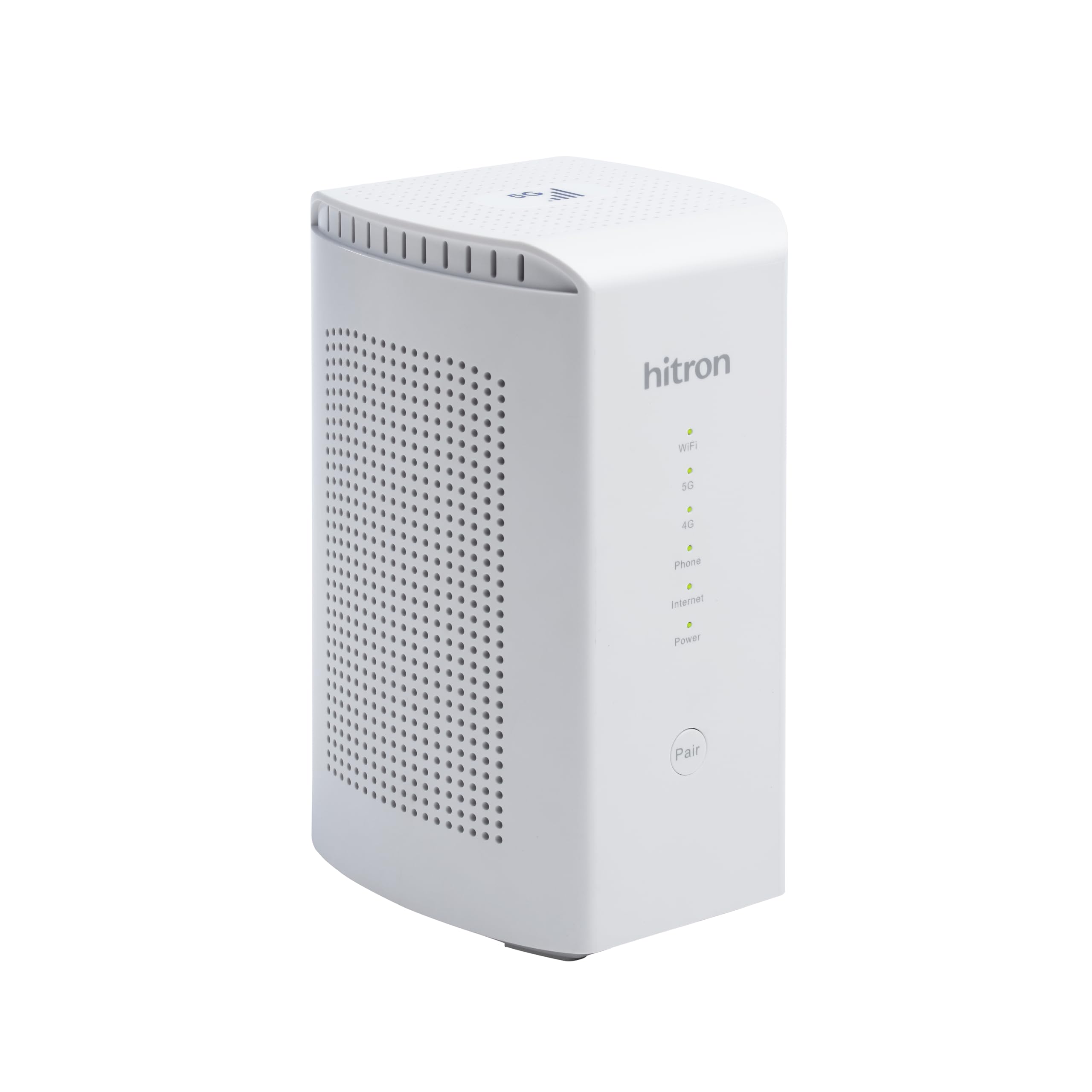
2. Hitron D60 5G Cellular Router with SIM Card Slot
A fixed 5G home router that hits hard in the basement — when it stays booted.
The D60 is built for someone who wants to replace their home internet line with a 5G SIM and not think about it. It runs on Wi-Fi 6 and can hit download speeds up to 3.4 Gbps on 5G NSA. The 4×4 5GHz MIMO radios spread across four antennas inside the unit, which is what lets it push its signal through interior walls well — one buyer running a T-Mobile SIM hit 300 Mbps from the basement of their house. It handles up to 3.4 Gbps downloads at a budget-friendly price.
The setup story is mostly positive — the app handles the initial configuration, and reports from buyers in Chile and rural AT&T coverage describe a straightforward plug-in-and-go experience. It’s certified for T-Mobile, AT&T, and US Cellular, so you know going in whether your carrier is on the list. That matters because the firmware here doesn’t play nice with everyone. And here’s the honest catch: the D60 has a higher top speed than the Spitz AX on paper, but until every batch ships reliably, the GL.iNet stays ahead for buyers who need it to just work.
Where it stumbles is reliability over time. Some units boot fine once and then crash after 6 to 48 hours, leaving only the power light on. There’s also no firmware update path — whatever version ships is what you’re stuck with. And it’s carrier-locked: Verizon SIMs won’t work. If you’re on T-Mobile or AT&T and you want a fixed home router at a budget-friendly tier, the D60 is worth a serious look. If your carrier is anyone else, or you need long-term stability without a reboot dance, pass.
Worth grabbing if: you’re on T-Mobile, AT&T, or US Cellular and want a straightforward fixed 5G home router for under two hundred.
Skip if: you need Verizon support or want ongoing firmware updates — neither is available here.
3. NETGEAR Nighthawk M6 Pro Mobile Hotspot 5G mmWave (MR6500)
A pocket hotspot wired for the fastest 5G bands — if your carrier is on the shortlist.
The M6 Pro is a different animal from the fixed routers above. It’s a battery-powered pocket hotspot running the Qualcomm SD X65 chipset (a processor built to handle both flavors of 5G) with a 5040mAh battery and a 2.8-inch color touch LCD. It supports both 5G mmWave — the very fast, very short-range band — and Sub-6 for broader coverage. It’ll connect up to 32 devices and has a 2.5G Ethernet port for a wired hookup. Weighing 8.96 ounces, it’s small enough to slide into a jacket pocket, and it runs on Wi-Fi 6E for the faster 6GHz band.
Travelers pick it for the international roaming support and refurbished units at roughly a fifth of the new retail price. Setups tend to be quick, and T-Mobile SIM recognition works even on AT&T-branded units. One buyer running a T-Mobile SIM reported the hotspot found 5G in about 90 seconds and held it for days.
The trade-offs are real, though. Battery drains fast, and even properly-refurbished units occasionally arrive defective. If you run it in high-power mode, the battery has to come out due to heat — there’s a reason NETGEAR expects you to use a separate 9V adapter for that. The locking mechanism is a common gripe, and a handful of buyers report it isn’t truly open up from Verizon. Buy from a reputable seller with a clear return window, and treat that caveat as the cost of admission.
Why travelers reach for it: you get mmWave 5G and international roaming in a 8.96-ounce package, with 32-device capacity and a 2.5G Ethernet port for wired reliability.
The realistic caveat: battery life is short and high-power mode demands removing the battery entirely — plan on keeping it plugged in for anything beyond a few hours.
Reach for this if: you’re a frequent traveler who wants fast 5G on the go and you’re comfortable with a refurbished unit.
Look at the GL-X3000 instead if: you need plug-in stability for a fixed location.
4. GlocalMe Numen Air 5G Mobile Hotspot
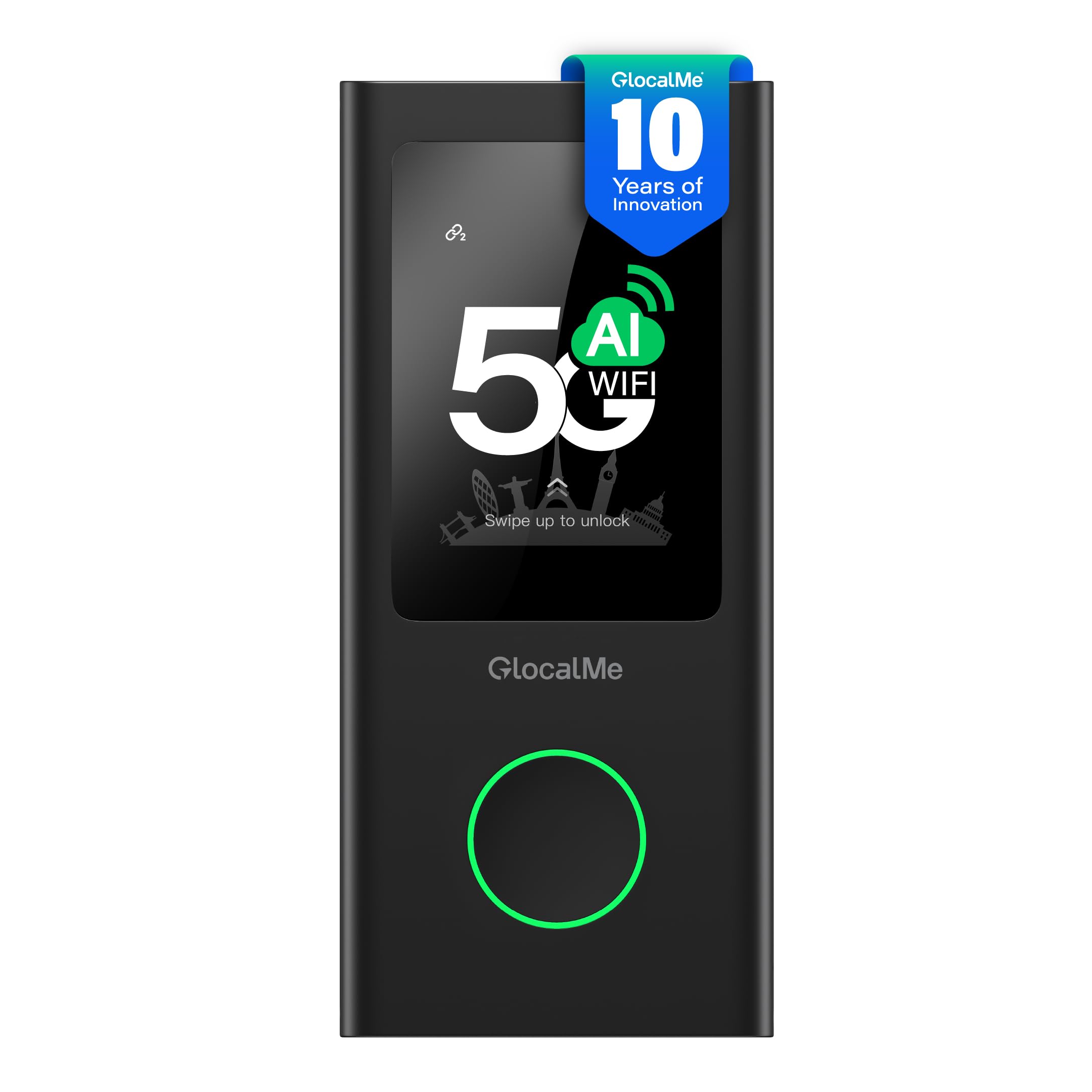
The travel hotspot that works in over 200 countries without ever touching a SIM card.
If “which carrier SIM do I need” is the question that stops you from buying a 5G modem at all, the Numen Air sidesteps it entirely. GlocalMe’s CloudSIM technology (a virtual SIM that lives in the cloud and connects to whatever local network is strongest) means you don’t need a physical SIM card to get online — you just buy data by the day, month, region, or gigabyte directly through the app. It supports more than 90 commercialized 5G countries and over 390 operator networks, so you can land almost anywhere and have service before you clear customs.
You’re not locked out of a physical SIM either. There’s a slot for one, and it’s open up — so you can pop in a Google Fi data-only SIM or a local prepaid card if that’s cheaper. Speeds top out at up to 2.5 Gbps, and the 2.4-inch LCD touch screen shows data usage, signal strength, and which devices are connected. It handles up to 16 devices at once and can double as a power bank to top up your phone. In use, it’s quick to boot — people report 7 to 10 seconds from power on to ready — and it matches phone 5G speeds at 25-40 Mbps indoors and 80-110 Mbps outdoors.
Where it gets shaky is value and long-term support. The pay-as-you-go GlocalMe plans are convenient but often pricier than a local carrier SIM, and one long-term owner reported their unit’s battery stopped charging after a firmware update before a proper charger revived it — support email bounced. That’s the honest calculus of a subscription-based hotspot: you trade a few dollars of data cost for plug-and-play global connectivity. If you travel internationally often enough that “buy a local SIM every trip” has become a chore, the trade is a good one.
What makes it different: CloudSIM means no local SIM shopping — you buy data through the app and it connects to the strongest network automatically.
A note on upkeep: this is a portable hotspot with a built-in battery, so plan on plugging it in every night and carrying it in addition to your phone.
Built for: frequent international travelers who want 5G without hunting down a local SIM every trip.
Not for: full-time home internet replacement — 16-device capacity and a daily-charge battery make it a travel tool, not a cable replacement.
5. NETGEAR Nighthawk M7 Pro Mobile Hotspot 5G

A Wi-Fi 7 hotspot that covers up to 2,000 square feet — more than most apartments.
The M7 Pro is the newest Wi-Fi generation in this lineup — Wi-Fi 7, which is the standard after Wi-Fi 6 and Wi-Fi 6E, and it brings the new 6GHz band. It claims up to 5.8 Gbps throughput, up to 2,000 square feet of coverage, and support for 64 devices at once. That device count blows past the M6 Pro (32) and the Numen Air (16) — genuinely useful if you’re setting this up as a small office or household router rather than a pocket hotspot. It’s a refurbished unit running 5G mmWave and manages multi-gigabit speeds for gaming, streaming, and video calls.
The reported experience is broadly positive: one buyer replaced a T-Mobile hotspot and had 5G running in 90 seconds with flawless performance for days, even in weak-signal areas. Another reports it hitting 150-200 Mbps. A food-vendor buyer ran it unplugged for 10 hours straight processing card transactions at events. Home coverage is strong enough that one reviewer noted the signal reached through their whole house.
Compatibility is where this gets honest. Several owners mention the refurbished unit isn’t truly open up — it works with AT&T but refuses Verizon. The “open up” label on this listing can’t be taken entirely at face value, so verify carrier support before you commit. It’s also a renewed unit, meaning the price-to-performance ratio is a big part of the appeal, but you’re rolling the dice on a previously-used device. If AT&T is your carrier or you’re willing to accept the carrier limits, this is the most capable hotspot in the roundup. Otherwise, check the fine print first.
Standout strengths
- Wi-Fi 7 with 6GHz band — the newest wireless standard in this group
- Handles up to 64 devices — enough for a small office or large household
- Covers up to 2,000 square feet from one device
- Runs 10 hours unplugged in real-world buyer reports
What to know before buying
- Carrier compatibility reported as spotty — works with AT&T, not Verizon
- Renewed unit — condition can vary from listing to listing
- No full user manual for the specific open up status
The pick for: AT&T users who need wide coverage, high device count, and Wi-Fi 7 in one portable box.
Consider the Spitz AX instead if: you need confirmed dual-carrier support from the start.
6. UOTEK 5G SIM Card Router CPE, WiFi 6

A black-box 5G router that punches above its price with eight physical antennas.
For a fixed 5G router at the entry end of the budget tier, the UOTEK delivers more physical antenna real estate than almost anything else — eight total, split as four for 4G and four for 5G, giving you more simultaneous connection paths at once. It runs Wi-Fi 6 with OFDMA (which lets multiple users share the same wireless channel more efficiently) and supports up to 1800 Mbps across the 2.4GHz and 5GHz bands. The 5G response is instant — customers note picking up the T-Mobile signal straight from the start with no configuration beyond inserting a SIM.
Owners praise its reliability, and it accepts a T-Mobile Home Internet SIM. It has two RJ45 LAN ports and a familiar web interface. In a difficult signal area, one buyer measured around 200 Mbps, with RSRP at -84dBm versus -97dBm on their previous gateway — a stronger signal capture. The 5G uses the 5G NR bands for downloads while the LTE path handles the return trip, which is a standard hybrid mode.
Two catches worth knowing. The firmware is older — it ships with an older chipset generation, so it needs a manual firmware update through the web GUI to open up its full performance, and support requires an email to UOTEK for the latest file. Some buyers also note the mesh feature is promised in the marketing but hard to actually configure — there’s no mesh button and no clear instructions. If you’re comfortable poking around a browser interface and you’re on T-Mobile or a compatible carrier, this is the strongest budget 5G router in the list. If you want “plug in and forget about it,” look higher up.
The argument for it
- Eight antennas (4 for 4G, 4 for 5G) for stronger signal capture
- Works from the start on T-Mobile sims
- Wi-Fi 6 with 1800 Mbps throughput across dual bands
- Two RJ45 LAN ports for wired devices
The honest fine print
- Ships on older firmware — manual update needed for full performance
- Mesh capability marketed but poorly documented
- Support requires an email request for firmware
Right for you if: you’re on T-Mobile (or a compatible carrier) and want a fixed 5G home router with strong antenna hardware at the budget tier.
Skip if: you need a verified mesh system or immediate plug-and-play with no manual firmware steps.
7. Cudy 5G NR AX3000 Wi-Fi 6 Router, 4X GE, Dual SIM, SA/NSA (P5)

A business-grade 5G router with two SIM slots and three ways to stay online.
If you’re running a retail store, a warehouse, a job site, or a home office where dropping offline costs real money, the Cudy P5 is the pick built for that scenario. It runs the Qualcomm X62 modem and supports up to 3.4 Gbps on 5G. Two Nano SIM slots give you carrier redundancy — if one network goes down, the router switches to the other without you touching anything. It also has a wired WAN backup, so you get triple failover: cellular SIM 1, cellular SIM 2, or a wired line. That’s a lot of insurance for a single box.
The wired side is generous too. Wi-Fi 6 delivers 2402 Mbps on the 5GHz band and 574 Mbps on the 2.4GHz band, and there are four Gigabit Ethernet ports — three regular LAN plus one that can be configured as WAN or LAN. Four detachable SMA cellular antennas can be replaced with high-gain ones if you’re in a weak coverage area. Buyers here report download speeds up to 300 Mbps without any additional antennas, which is a strong baseline. It also runs VPN server and client software — WireGuard, OpenVPN, IPsec, Zerotier, PPTP, L2TP — plus a Cudy App with cloud management, parental controls, WPA3, and band lock. Band lock, in particular, lets you pin the router to the strongest 5G frequency for your location instead of leaving it to chance.
The complexity is the real cost. The SIM setup is not plug-and-play; buyers describe it as involved and one recommends it mainly for home or RV use where you have time to configure it. There’s also a report of a router failing outright against a T-Mobile static IP that required disabling the static IP to work, and another of speeds coming in 5x slower than a competing hotspot. Both are edge cases, but they underline a real point: this is pro-grade gear that rewards a confident hand with the admin panel and punishes someone expecting a one-step setup.
Built for uptime: dual SIM plus wired WAN gives you three simultaneous paths to the internet, and detachable antennas plus band lock give you control over the signal itself.
What to weigh: the setup assumes you’re comfortable in a router admin panel — this isn’t a plug-and-go consumer box.
Choose this if: you run a business or remote site where an internet outage is unacceptable and you want carrier failover plus wired backup.
Think twice if: you want a zero-configuration setup — the Cudy expects you to work the settings.
8. GL.iNet GL-XE3000 Puli AX 5G Router with Dual SIM and 6400mAh Battery
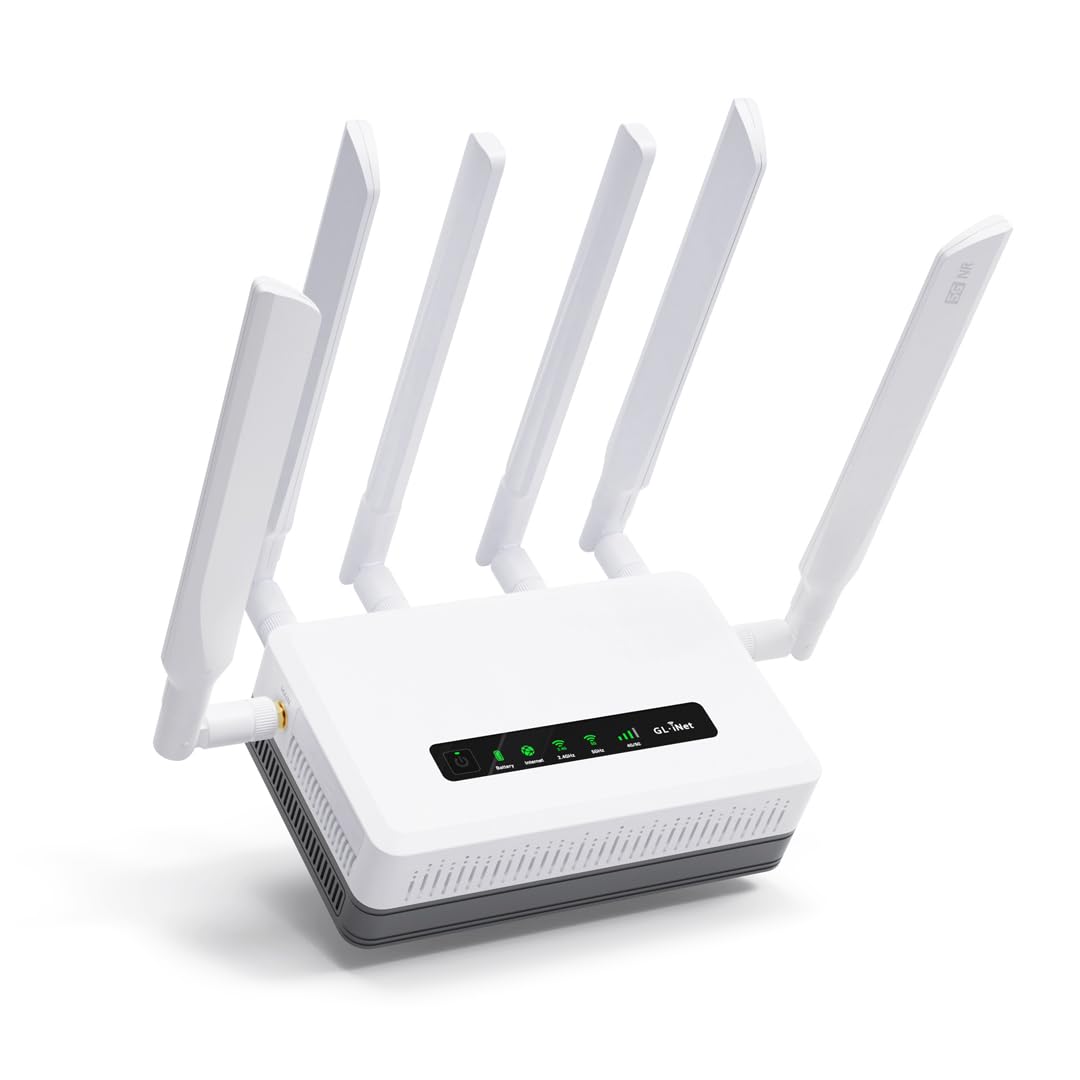
The 5G router that keeps working through a blackout, thanks to its built-in battery.
Most 5G routers in this lineup die the moment the power goes out. The Puli AX doesn’t — a built-in 6400mAh battery keeps it running for up to 8 hours of uninterrupted connectivity. That single feature reshapes what this router is for: offices that can’t lose their point-of-sale system, construction sites without reliable grid power, outdoor events, and anyone who’s ever watched a storm kill their internet for a day. It runs the same Wi-Fi 6 radio as the GL-X3000 — 574Mbps on 2.4GHz and 2402Mbps on 5GHz — and adds dual-SIM with automatic failover between two networks.
In the field, it delivers. It has been used on a road trip through Arizona, Idaho, Oregon, Nevada, Utah, and Washington with better service and faster speeds than a phone got in the same remote spots. It’s been used as a primary 5G modem for a new facility to avoid a costly fiber install. And it’s been used in an RV with a Verizon SIM where the SIM auto-detected and connected on the first try. The 4×4 omnidirectional external antenna is a real upgrade over the single-antenna hotspots, and it handles a hotel captive portal login through its Wi-Fi repeater mode without any fuss.
Two things to plan around. First, it’s hefty — buyer reports put it in the “chunky, fits in a backpack with the antennas removed” category, not the “slip into your pocket” one. Second, the dual SIM slots share a single IMEI, which complicates carrier setup for some people, and the initial configuration can be fiddly if your carrier’s activation isn’t smooth. Buyers describe fast, responsive GL.iNet support when they’ve needed it, so it’s worth contacting support early if the SIM doesn’t recognize on the first try. Once you get past setup, this is the most capable portable router in the roundup.
Where it earns its spot
- 6400mAh battery serves up to 8 hours of backup — rare in this lineup
- Dual-SIM failover keeps you online when one carrier drops
- 4×4 omnidirectional external antenna for stronger signal capture
- OpenWrt custom firmware with 5000+ plug-ins for deep control
Before you commit
- Heavier and bulkier than the pocket hotspots
- Dual-SIM slots share a single IMEI, which can complicate setup
- Initial configuration has been rocky for a handful of buyers
Best when: you need a 5G router that survives a power cut and can travel between job sites or campgrounds with real signal performance.
Overkill for: a renter who wants a small desk hotspot — the Puli AX is heavier and pricier than that job calls for.
9. TP-Link 5G Mobile Hotspot Tri-Band AXE3600 6E Portable WiFi Router
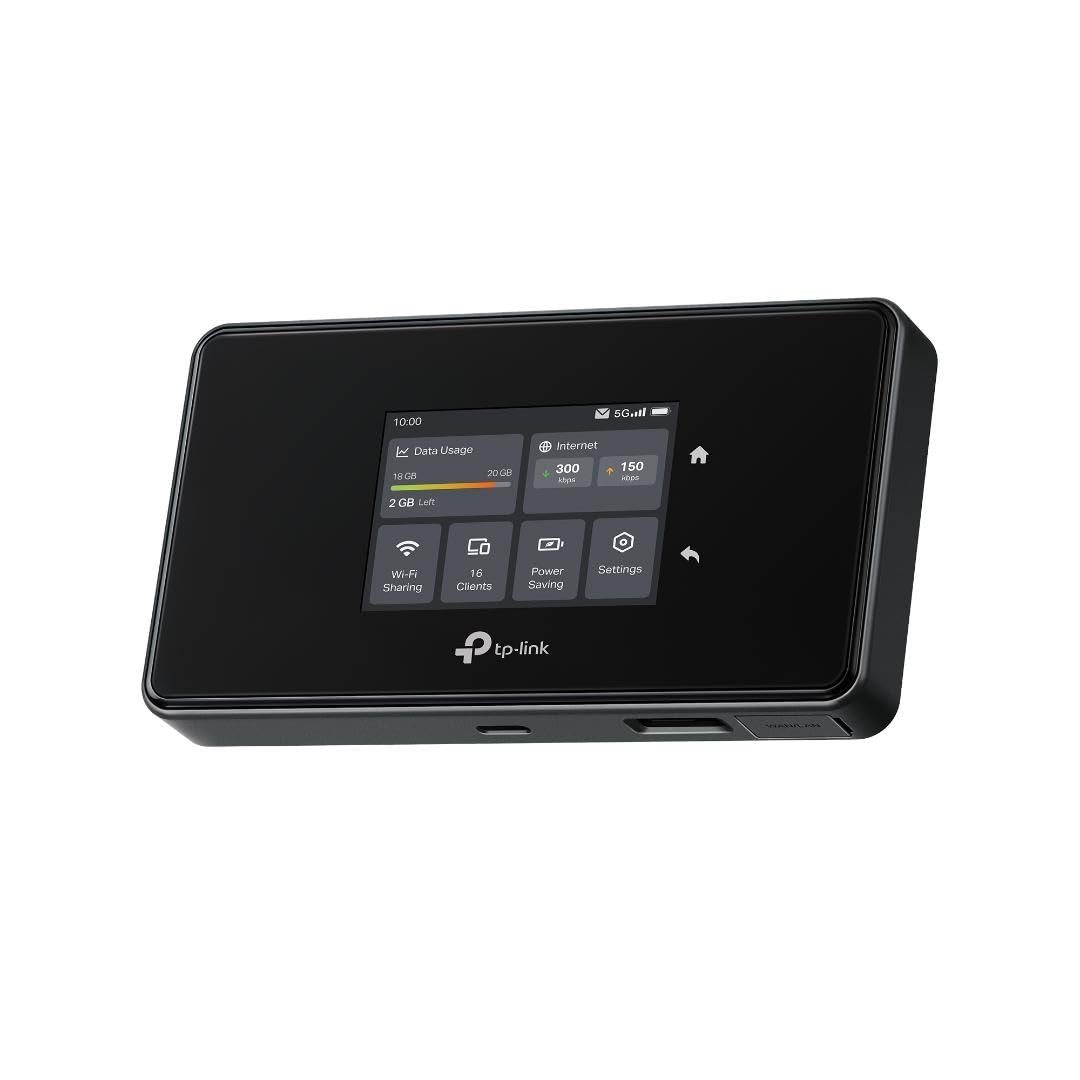
Tri-band Wi-Fi 6E and a 14-hour battery, undone by a heat problem.
On paper, the TP-Link M8550 is the most capable portable hotspot here. It’s tri-band Wi-Fi 6E — meaning it broadcasts on the 6GHz band alongside 2.4GHz and 5GHz — with claimed speeds up to 2,880 Mbps on both 6GHz and 5GHz and 688 Mbps on 2.4GHz. The 4680mAh battery is rated for up to 14 hours, the highest in this roundup. It supports up to 32 devices, has a USB 3.0 port for file sharing, two TW-9 connectors for external antennas, and an Ethernet mode for wired backhaul. It’s certified for AT&T, T-Mobile, and Verizon — though no eSIM support. The device itself is 5.31 inches long and 0.81 inches thick — genuinely pocket-sized.
Early reviewers point out fast, stable 5G, easy SIM setup, Norton security, no drops, and all-day battery on a full charge. One buyer mentioned the Ethernet port requires removing the battery and running on wall power to get full wired speed — a quirk worth remembering.
Here’s the honest catch — this device runs hot. Some shoppers say the unit cutting off cellular to cool itself down, with the battery lasting only about 45 minutes in the worst reports before needing a plug. The 14-hour rating clearly applies under lighter load; heavier use brings the heat. That’s the reason this sits at the bottom of the roundup despite having the best raw specification sheet. If you’re a light-traffic traveler, this could still be a fit. If you plan to run multiple 4K streams or connect a dozen devices, the thermal ceiling is the limiting factor. Verify carrier compatibility carefully too — the specs flip between lists depending on the batch.
The big spec advantage: tri-band Wi-Fi 6E and a rating of up to 14 hours of battery life per charge make it the most feature-complete hotspot here on paper.
The practical catch: heat throttling in normal use keeps real-world battery life well below the rated number.
Suits you if: you’re a light-duty traveler who wants tri-band Wi-Fi 6E and maximum rated battery hours with a small pocket device.
Better options exist if: you run heavy multi-device loads — the GL.iNet Puli AX or Nighthawk M7 hold up better under sustained use.
Understanding the Specs
5G NR vs mmWave vs Sub-6
5G NR (New Radio) is the umbrella term for the current generation of cellular data. Within it, Sub-6 refers to 5G on frequency bands below 6 GHz — these travel farther and penetrate walls better, which is why most home routers rely on them. mmWave refers to higher-frequency 5G above 24 GHz — it’s much faster but has very short range and struggles to pass through almost any obstruction. If you’re replacing home internet, prioritize a modem with strong Sub-6 support. If you’re a traveler who wants maximum speed at a street corner, mmWave matters.
Dual-SIM, failover, and multi-WAN
Dual-SIM means two SIM card slots; the modem applies them either in single-standby (running one at a time) or with automatic failover (switching if the active carrier drops). Failover protects against network outages and coverage dead zones. Multi-WAN extends the same idea to wired connections — a router might support Ethernet, cellular, repeater, and USB tethering simultaneously, load-balancing traffic across them or automatically switching when one fails. Business and RV users tend to care about this more than casual home users, but it’s the difference between “internet went out” and “internet kept running.”
Detachable vs internal antennas
Internal antennas are built into the case and can’t be upgraded — they’re the standard on pocket hotspots. Detachable antennas use SMA connectors and can be unscrewed and replaced with high-gain models, which is useful in low-coverage areas. If you live in a rural location or a metal-framed building, detachable antennas are the single easiest upgrade you can make to a 5G modem’s signal capture.
Wi-Fi 6 vs Wi-Fi 6E vs Wi-Fi 7
Wi-Fi 6 handles crowded environments with multiple devices using OFDMA and MU-MIMO, which share airtime more efficiently. Wi-Fi 6E adds the new 6GHz band — cleaner because fewer devices use it. Wi-Fi 7 moves to even higher throughput and lower latency. For most home users, Wi-Fi 6 is enough; the differences matter most when you’re running dozens of devices at once or streaming high-bitrate video to multiple screens.
FAQ
Can a 5G cellular modem replace my home internet entirely?
Do I need a SIM card from a specific carrier?
What is the difference between NSA and SA 5G?
How many devices can a 5G modem handle at once?
Can I use an external antenna to boost my 5G signal?
How long does a 5G mobile hotspot battery actually last?
Will a 5G modem work with my existing VPN?
Is a fixed 5G router better than a portable hotspot for home use?
What’s the difference between a 5G modem and a 5G router?
Do these modems require a data-only plan or can I use my phone’s SIM?
Which 5G modem works best in a rural area?
Final Thoughts: The Verdict
For most people, the 5g cellular modem that makes the most sense is the GL.iNet GL-X3000 (Spitz AX) — it combines dual-SIM failover, six detachable antennas, and Wi-Fi 6 for a whole home or an RV, and it’s the strongest performer across the widest range of situations. If you mainly need portable coverage in your bag, the GlocalMe Numen Air 5G skips the SIM card entirely for travel across 200+ countries. And if your priority is keeping the internet on through a power cut, the GL.iNet Puli AX with its 6400mAh battery is the one to reach for. Pick based on where you’ll actually use it — tower signal and carrier support matter far more than the top speed printed on the box.
How We Picked
We do not accept paid placement. Every pick is matched to a real buyer and a real use-case; we do not hands-on test units.
Sources & Methodology
Specifications: manufacturer listings and product documentation. Review insights: verified customer reviews, as of September 2026. Pricing: not shown on this page (it changes often); check the current price via the retailer link.
As an Amazon Associate, Gadgets Feed earns from qualifying purchases. This does not affect which products we feature.