
A 5G router isn’t just a fancy modem replacement — it’s your ticket to cutting the cord from traditional cable or fiber internet. If you live in a rural area with spotty wired options, travel full-time in an RV, or simply want a reliable backup connection when your primary ISP goes down, a cellular gateway delivers real broadband speeds straight from the cell tower. The trick is sorting through the chipset specs, SIM configurations, and antenna options to find the one that actually works for your specific carrier and location.
I’m Min — the co-founder and writer behind Gadgets Feed. I’ve spent hundreds of hours comparing 5G router chipset performance, carrier certification lists, and real-world user throughput tests across budget and premium tiers to build this guide.
Whether you need a permanent full-time replacement for a wired connection or a rugged travel companion, the right pick comes down to four things: band support, SIM flexibility, antenna design, and software stability. This guide breaks down the best 5g router options on the market to help you make a confident, informed choice.
How To Choose The Best 5G Router
Not all 5G routers are created equal. A device that works flawlessly on T-Mobile might refuse to connect to Verizon, and a model with a blazing fast Qualcomm Snapdragon X62 chipset will handle congestion much better than a generic board. Here are the three most important factors to consider before buying.
Carrier Certification and Band Support
Before anything else, confirm the router is certified to work on your specific carrier — AT&T, T-Mobile, and Verizon all maintain whitelists. A generic “unlocked” 5G router may lack the proper firmware bands or VoLTE profiles, leading to slow LTE fallback or outright incompatibility. Check for official AT&T IoT certification and T-Mobile certification. Also verify that the router supports the key frequency bands your carrier uses in your area, particularly Band 71 (T-Mobile’s extended-range 5G) and Band n77 (Verizon’s C-band).
SIM Configuration: Failover vs. True Multi-WAN
Many “dual SIM” 5G routers only offer automatic failover — if the primary SIM loses signal, the router switches to the backup SIM. For most home or RV users, that’s fine. But if you need to combine two connections for higher speed or uninterrupted VPN sessions, you need a router that supports true dual-WAN with load balancing. Look for models that explicitly advertise simultaneous active SIM slots or multi-WAN bonding across cellular, Ethernet, and tethering interfaces. OpenWrt-based routers often give you the most flexibility here.
Antenna Design and Power
The built-in antennas on a 5G router determine how well it can grab a weak signal. Detachable, high-gain antennas (often 5–7 dBi) let you place the router in a window or mount external antennas on the roof for significantly better performance in fringe areas. A router with internal antennas only is better suited to urban environments with strong nearby towers. Also consider models with dedicated external antenna ports (usually TS-9 or SMA connectors) that allow you to attach a directional Yagi or panel antenna for maximum range.
Quick Comparison
On smaller screens, swipe sideways to see the full table.
| Model | Category | Best For | Key Spec | Amazon |
|---|---|---|---|---|
| GL.iNet GL-X3000 (Spitz AX) | Cellular Gateway | RV & remote work | Wi-Fi 6, Dual SIM, OpenWrt | Amazon |
| ASUS RT-BE92U BE9700 | Prem. Home Router | Wi-Fi 7 smart home | Tri-band, 2750 sq. ft., MLO | Amazon |
| MOFINETWORK MOFI6500-5GXeLTE-RM520-HP | Business-class | Rural permanent install | Rugged metal case, amplified Wi-Fi 6 | Amazon |
| GL.iNet GL-XE3000 (Puli AX) | Portable w/ Battery | Power-outage resilience | 6400mAh battery, 8 hrs runtime | Amazon |
| Cudy P5 | Dual SIM CPE | Band-lock & VPN control | Qualcomm IPQ5018, SDX62 | Amazon |
| NETGEAR Nighthawk RS600 | High-end Home | Large home, 100+ devices | Wi-Fi 7, 10 Gig port, 3300 sq. ft. | Amazon |
| TP-Link Archer BE550 Pro | Multi-gig Value | Gaming & streaming | 1x10G + 4×2.5G LAN, BE9700 | Amazon |
| ASUS RT-BE58U | Entry-level Wi-Fi 7 | Budget future-proofing | Dual-band, 3600 Mbps, AiProtection | Amazon |
| NETGEAR Nighthawk RS140 | Budget Wi-Fi 7 | Compact home upgrade | BE5000, 2.5 Gig port, 2250 sq. ft. | Amazon |
In‑Depth Reviews
1. GL.iNet GL-X3000 (Spitz AX) Cellular Gateway

The GL.iNet GL-X3000 strikes the perfect balance between cellular performance, software flexibility, and build quality. Powered by an OpenWrt-based firmware, it gives you granular control over DNS over TLS, WireGuard VPN at up to 300 Mbps, and multi-WAN failover across Ethernet, repeater, tethering, and its dual-SIM 5G modem. AT&T and T-Mobile certification means you can pop in a SIM and be online within minutes — no carrier whitelist headaches.
In real-world use, the Spitz AX delivers reliable 5G speeds in both NSA and SA modes. The six detachable antennas (four cellular, two Wi-Fi) give you the flexibility to position the router for best signal, and the rugged white enclosure handles the bumpy roads of RV life without issue. Users consistently report stable throughput over weeks of uptime, with the main caveat being that the router’s 2.4 GHz band is best reserved for low-bandwidth IoT devices rather than latency-sensitive streaming.
If you live off the beaten path or travel full-time, the GL-X3000 is the most well-rounded 5G gateway available. The dual-SIM failover is seamless, the VPN performance is best-in-class for the price tier, and the community support behind the OpenWrt platform means bugs get squashed quickly. Just be aware that advanced configuration — like AT commands for tower locking — may be needed to stabilize speeds in marginal signal areas.
Why it’s great
- Unlocked dual-SIM with automatic failover between carriers
- Pre-installed OpenVPN and WireGuard with high VPN throughput
- Detachable antennas for external high-gain upgrades
Good to know
- 2.4 GHz band can struggle with packet loss during heavy smart-home loads
- Carrier aggregation limited to two bands, which may cap top speed
2. ASUS RT-BE92U BE9700 Tri-Band WiFi 7 Router

The ASUS RT-BE92U is a Wi-Fi 7 powerhouse that delivers up to 9.7 Gbps over its tri-band arrangement, including a 320 MHz-wide 6 GHz channel. Multi-Link Operation (MLO) lets supported devices bond across two bands simultaneously, reducing latency and buffering during 8K streaming or competitive gaming. The Qualcomm chipset inside handles 30+ devices without breaking a sweat, and the AiMesh compatibility means you can add older ASUS nodes for whole-home mesh coverage.
Setup is handled through the ASUS Router app, which guides you through firmware updates and basic configuration in minutes. The subscription-free AiProtection Pro security suite — powered by Trend Micro — blocks known malicious sites and scans IoT devices without an annual fee. The USB 3.0 port supports external storage for a basic NAS, and the guest network tools let you isolate smart home traffic from your main devices.
While the RT-BE92U is technically a wired router first (it works with any cable/fiber modem), its 5G tethering capability via the USB port provides a reliable backup cellular connection. The main downsides are that MLO can cause dropouts with some Samsung and Apple devices, and the included wall mount kit feels flimsy given the router’s weight. For users who want the fastest possible local Wi-Fi speeds and a robust security suite, this is a top-tier mid-range choice.
Why it’s great
- Tri-band Wi-Fi 7 with 320 MHz channels for massive throughput
- Subscription-free AiProtection Pro network security
- USB port supports 4G LTE / 5G dongle for cellular failover
Good to know
- MLO can cause compatibility issues with some phone and tablet chipsets
- Wall mount kit is not robust enough for permanent installation
3. MOFINETWORK MOFI6500-5GXeLTE-RM520-HP
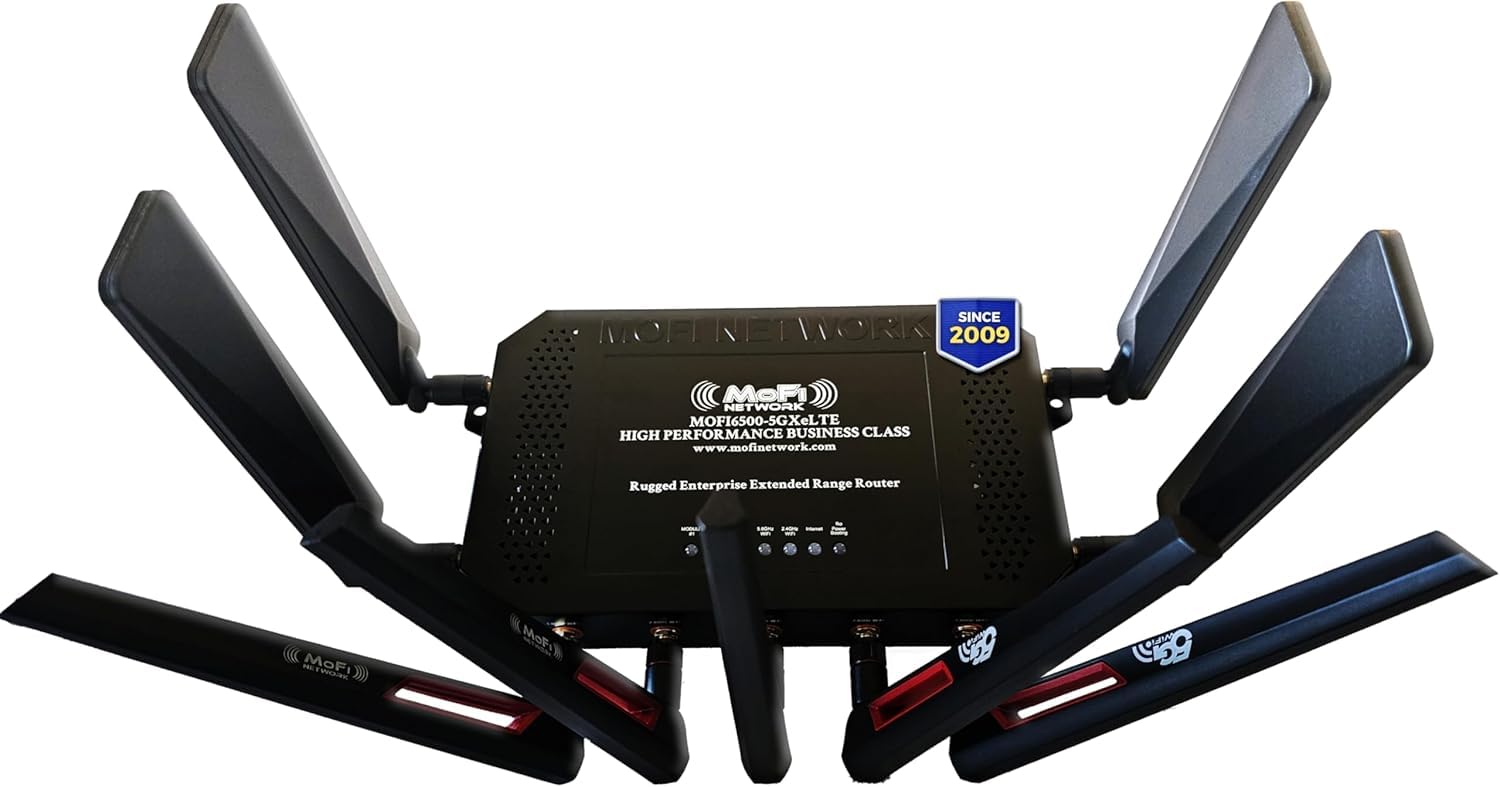
The MOFI6500-5GXeLTE-RM520-HP is built for one thing: delivering reliable 5G internet where wired options don’t exist. Its full metal chassis houses amplified Wi-Fi 6 and a Qualcomm Snapdragon X62 modem that supports carrier aggregation and band locking — crucial for locking onto a single tower in fringe areas. The included 4x5dBi cellular antennas provide excellent baseline signal sensitivity, and the external TS-9 ports allow you to attach a high-gain Yagi antenna for truly long-range reception.
Setup is remarkably straightforward for a business-class device. Insert your SIM, connect the power adapter and Ethernet cable, and the router auto-configures within two minutes. The IP pass-through mode lets you use a separate router if you prefer your own firewall or VPN hardware, and the automated periodic reboot feature helps maintain stability on congested towers. Users in rural RV parks and permanent homes report consistent 4-bar signals where their previous Jetpacks showed only 1 bar.
The main catch is that the dual-SIM functionality is failover-only, not simultaneous bonding. If you need true bonding, you’ll need the “DUAL” model variant. The price is premium, but for anyone who depends on cellular internet as their primary connection in a low-coverage area, the MOFI6500 delivers enterprise reliability that cheaper routers can’t match.
Why it’s great
- Rugged metal casing with superior heat dissipation for 24/7 operation
- External antenna ports for Yagi or panel antenna upgrades
- Two-minute setup with IP pass-through and carrier-aware firmware
Good to know
- Dual SIM is automatic failover, not simultaneous bonding (check model number)
- Premium price tier; value depends on severity of your coverage problem
4. GL.iNet GL-XE3000 (Puli AX) 5G Router
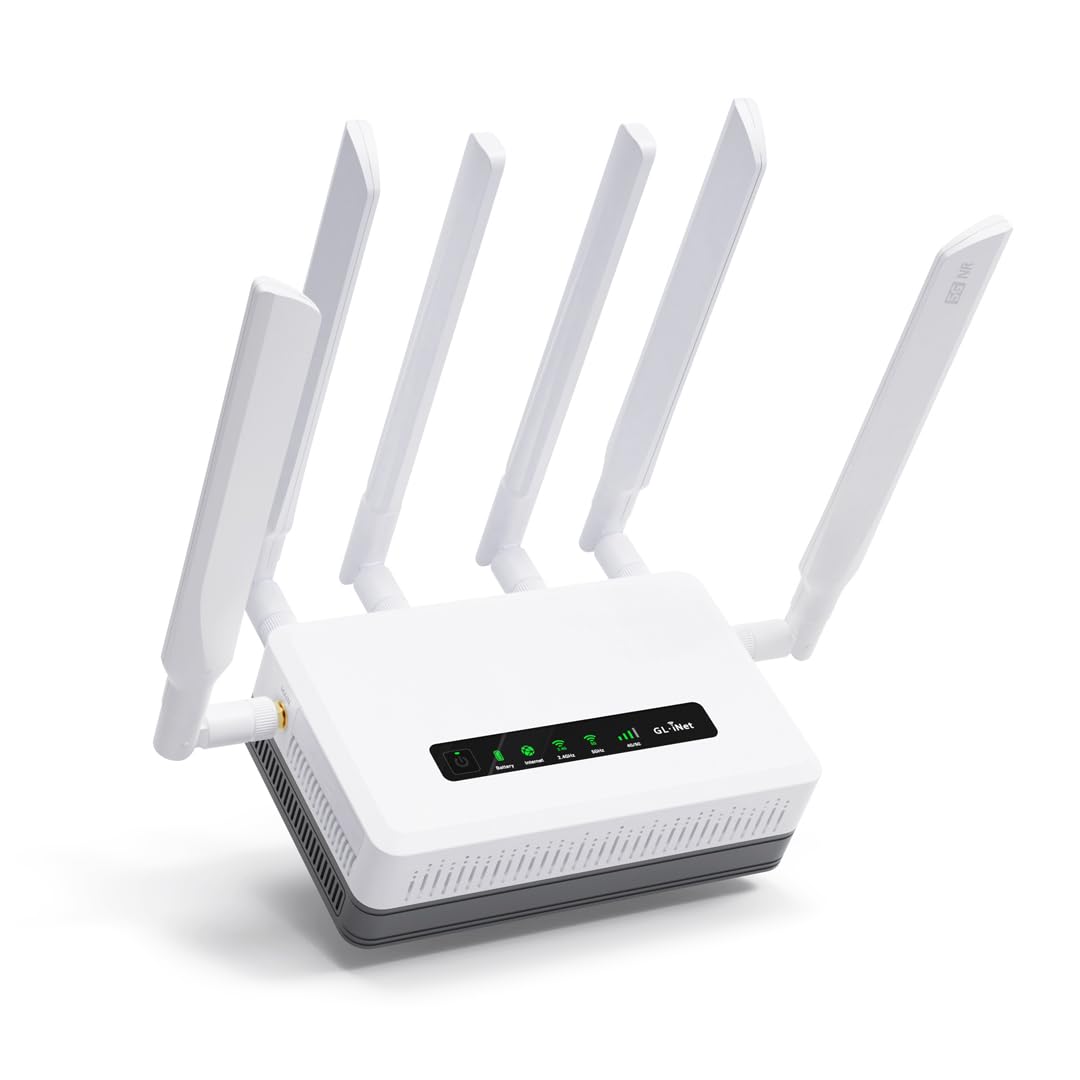
The GL.iNet GL-XE3000 (Puli AX) takes the cellular gateway concept and adds a built-in 6400mAh battery that keeps your network running for up to 8 hours during a power outage. That single feature makes it invaluable for home offices, construction sites, and event setups where grid power isn’t guaranteed. Like its Spitz sibling, the Puli AX runs on OpenWrt, giving you full control over VPN profiles, DNS encryption, and multi-WAN failover across Ethernet, repeater, cellular, and tethering.
The 5G modem handles both NSA and SA standards, and the dual-SIM slots (single standby) automatically switch to the backup carrier if the primary goes down. Verizon certification means it works out of the box with most major US carriers, and the included wall-mount plate makes permanent installation straightforward. Users consistently praise the Puli’s ability to maintain stable speeds for video conferencing and streaming even when used as a primary connection in remote areas.
The main tradeoffs are physical heft — the battery adds significant bulk — and a single IMEI shared between both SIM slots, which caused setup issues for some users. For anyone who needs a portable 5G router with enough juice to survive a brownout or a day of off-grid work, the GL-XE3000 is the most capable option in its class.
Why it’s great
- Built-in 6400mAh battery provides 8 hours of backup runtime
- OpenWrt firmware supports advanced VPN, DNS over TLS, and multi-WAN
- AT&T and T-Mobile certified with Verizon compatibility
Good to know
- Single IMEI across dual SIM slots caused activation issues for some users
- Physically bulky compared to hotspot-style alternatives
5. Cudy P5 5G NR Router

The Cudy P5 is built around the Qualcomm Snapdragon SDX62 chipset, the same modem found in many higher-end mobile hotspots, giving it a proven track record for stable 5G speeds up to 3.4 Gbps in NSA mode. The standout feature for power users is the visual band-locking interface — you can manually lock the router to a specific 5G band (like n71 or n77) to avoid congested towers or weak signals. Combined with TTL adjustment for hotspot data plans, this gives you fine-grained control that most consumer routers hide behind simplistic toggles.
The AX3000 dual-band Wi-Fi 6 delivers solid 2.4 GHz and 5 GHz performance, and the four detachable 5dBi cellular antennas provide excellent baseline reception. Dual SIM slots handle failover automatically, and the router supports a full suite of VPN protocols including OpenVPN, WireGuard, and even Zerotier for remote access. The web UI is clean and responsive, making advanced configuration accessible without needing to SSH into the device.
The primary downsides are that the P5 runs warm under load (plan for adequate ventilation) and Verizon compatibility is inconsistent — some users report it never connects, while others have it working fine with a specific APN. For users on T-Mobile or AT&T who need granular control over band selection without paying a fortune, the Cudy P5 offers exceptional value for a mid-range dedicated 5G router.
Why it’s great
- Visual band-locking and TTL adjustment for advanced users
- Qualcomm SDX62 chipset provides proven 5G stability
- Multiple VPN clients including WireGuard and Zerotier
Good to know
- Not certified for Verizon; compatibility is hit-or-miss
- Runs hot under sustained load — ensure good airflow
6. NETGEAR Nighthawk Tri-Band WiFi 7 Router (RS600)

The NETGEAR Nighthawk RS600 is a tri-band Wi-Fi 7 beast that pushes wireless throughput up to 18 Gbps — enough to saturate even the fastest multi-gig fiber connections. The headline feature is the 10 Gig Ethernet WAN/LAN port, which future-proofs your home network for the day your ISP offers 5 Gbps or 10 Gbps plans. The RS600 covers up to 3,300 square feet and handles 150+ devices concurrently, making it one of the strongest consumer routers for large homes with dense smart-device ecosystems.
Setup is handled through the Nighthawk app, which guides you through network naming, password setup, and device management. The 360-degree antenna array delivers strong signal penetration through walls and floors, and the router’s compact footprint is a welcome change from the spiky “spaceship” designs of previous Nighthawk generations. Users upgrading from older models consistently report noticeable improvements in latency for gaming and video calls, even on the 5 GHz band.
The main downside is that some RS600 units have shown poor WAN-to-LAN throughput (around 200-250 Mbps) out of the box, requiring firmware updates or returns. The app also lacks a consolidated view for devices connected to extenders. For users who want maximum wired and wireless throughput today and are willing to pay for it, the RS600 is the most future-proof conventional home router on this list.
Why it’s great
- 10 Gig Ethernet port enables multi-gig wired and wireless speeds
- Tri-band Wi-Fi 7 with 18 Gbps aggregate throughput
- Covers up to 3,300 sq. ft. and supports 150+ devices
Good to know
- Some units require a firmware update to resolve poor WAN-to-LAN speeds
- Nighthawk app lacks consolidated device view when using extenders
7. TP-Link Tri-Band BE9700 Archer BE550 Pro

The TP-Link Archer BE550 Pro delivers an impressive port configuration for its price tier: one 10 Gbps WAN/LAN port plus four 2.5 Gbps LAN ports, giving you wired multi-gig connectivity that most routers at this price simply don’t offer. The tri-band BE9700 speeds ensure that even the newest Wi-Fi 7 clients — like the iPhone 16 Pro and Samsung Galaxy S24 Ultra — can hit their full potential for 8K streaming and large file transfers without a wired bottleneck.
TP-Link’s HomeShield suite provides comprehensive network protection, including IoT device scanning, parental controls, and real-time threat detection — all manageable from the Tether app. Setup via the app is straightforward, and the router automatically configures EasyMesh compatibility if you want to add extenders for more coverage. The six internal antennas and Beamforming technology do a solid job covering a 2,000-square-foot home with strong 5 GHz and 6 GHz signals.
The tradeoff is that some users report intermittent connection drops, especially when MLO is enabled on mixed-device networks. Disabling MLO and airtime fairness usually stabilizes things, but it’s an extra step. For anyone building a multi-gig home network on a mid-range budget, the Archer BE550 Pro offers the best wired port density you’ll find without jumping to the premium tier.
Why it’s great
- 1×10 Gbps + 4×2.5 Gbps LAN ports deliver best-in-class wired value
- Tri-band BE9700 Wi-Fi 7 fully utilizes multi-gig fiber plans
- EasyMesh compatible for seamless whole-home coverage expansion
Good to know
- MLO can cause intermittent drops on networks with mixed Wi-Fi 6/7 devices
- Some users report high latency after weeks of uptime
8. ASUS RT-BE58U WiFi 7 Router

The ASUS RT-BE58U is the most affordable entry point into Wi-Fi 7 networking, offering dual-band speeds up to 3.6 Gbps with 4096-QAM and MLO support. While it’s primarily a wired router (you’ll need a separate cable or fiber modem), the USB port supports 4G LTE and 5G tethering dongles, giving you a reliable cellular backup option. The ASUS Router app makes setup painless, and the Web GUI is packed with advanced features like dual-WAN configuration, VPN fusion, and VLAN support.
The commercial-grade AiProtection Pro, powered by Trend Micro, is included free for the life of the router — a significant value compared to competitors that charge annual subscriptions. The 1 GHz quad-core CPU and 1 GB of RAM handle 30+ devices without slowdown, and the dark-themed GUI is one of the cleanest in the industry. Users upgrading from older Wi-Fi 5 or Wi-Fi 6 routers consistently report dramatically improved coverage and fewer dropouts in apartments and small homes.
The main drawback is that some advanced features, particularly parental controls and URL filtering, require a paid subscription to work reliably. Also, a small number of units have shown defective WAN ports that dramatically reduce throughput. For budget-conscious buyers who want Wi-Fi 7 future-proofing without the premium price, the RT-BE58U is the best value in the crop.
Why it’s great
- Lowest price Wi-Fi 7 router with dual-band MLO and 4096-QAM
- Subscription-free AiProtection Pro security suite
- USB port accepts 4G/5G dongle for cellular failover
Good to know
- Parental controls and URL filtering require a subscription
- A small percentage of units have defective WAN ports
9. NETGEAR Nighthawk Dual-Band WiFi 7 Router (RS140)

The NETGEAR Nighthawk RS140 brings Wi-Fi 7 to the entry-level segment with BE5000 speeds that still deliver a genuine upgrade over Wi-Fi 6 — especially for households with newer laptops and phones. The 2.5 Gig internet port is the standout feature at this price point, giving you enough headroom for gigabit-plus fiber plans without the multi-thousand-dollar price of a full 10 Gig setup. The compact, sleek chassis with high-performance internal antennas covers up to 2,250 square feet with strong 5 GHz throughput.
Setup is as simple as it gets: plug in, connect to the Nighthawk app, and follow the on-screen prompts. The app gives you basic device management, guest network creation, and speed tests. Users report that the RS140 plays well with most cable modems, including Motorola models like the B12, and that the auto-configuration of 2.4 GHz and 5 GHz bands happens without user headaches.
The main limitation is that the RS140 is a dual-band router — you don’t get the 6 GHz band found on tri-band Wi-Fi 7 models. That means you won’t unlock the full potential of Wi-Fi 7 on the newest devices. For someone upgrading from an old AC or early AX router who wants the fastest possible local Wi-Fi for streaming and gaming without the premium tier investment, the RS140 is a solid, no-nonsense choice.
Why it’s great
- 2.5 Gig internet port provides real multi-gig support at a budget-friendly price
- Simple app-based setup with excellent modem compatibility
- Compact footprint and 2,250 sq. ft. coverage suits most homes
Good to know
- Dual-band only — lacks the 6 GHz band for full Wi-Fi 7 potential
- No built-in modem; requires separate cable or fiber modem
FAQ
Can I use a 5G router as my only internet connection?
Do all 5G routers work with every carrier?
What is the difference between NSA and SA 5G?
Why do I need external antennas for a 5G router?
Can I use a data-only SIM or a regular phone SIM in a 5G router?
Final Thoughts: The Verdict
For most users, the best 5g router winner is the GL.iNet GL-X3000 (Spitz AX) because it combines carrier-certified dual-SIM performance, OpenWrt flexibility, and detachable antennas into one reasonably priced, rugged package that works equally well for RV travel and permanent rural installations. If you need a backup battery for power-outage resilience, grab the GL.iNet GL-XE3000 (Puli AX). And for the fastest wired local networking alongside uncongested Wi-Fi 7 speeds in a large home, nothing beats the NETGEAR Nighthawk RS600.