
The 5ms gray-to-gray response time label on a gaming monitor is the single most misunderstood spec in the entire category. While manufacturers slap that number on boxes to meet marketing checklists, actual competitive gamers have moved past it — the real battlefield is now sub-1ms, measured in tenths of a millisecond, where OLED and Fast IPS panels eliminate the ghosting and motion blur that once defined budget displays. If you are still shopping by the 5ms badge, you are leaving a generation of fluidity on the table.
I’m Min — the co-founder and writer behind Gadgets Feed. I’ve spent hundreds of hours dissecting panel technologies, cross-referencing independent response time measurements against manufacturer claims, and mapping real-world motion clarity performance across OLED, Fast IPS, and QD-OLED displays for this guide.
Whether you play competitive shooters at 360Hz or immersive single-player titles in 4K HDR, the 5ms gaming monitor you should actually buy depends on measurable response time, true refresh rate capability, and panel type rather than a marketing badge.
How To Choose The Best 5Ms Gaming Monitor
The single most important thing to understand is that a 5ms GtG (Gray-to-Gray) number is baseline, not impressive. Modern Fast IPS panels hit 1ms GtG, and OLED panels go down to 0.03ms GtG — that 100x difference dictates whether fast-moving objects appear crisp or smeared. When choosing a monitor, you are really choosing between three panel families: Fast IPS (budget to mid-range), OLED/WOLED (premium), and QD-OLED (top-tier).
Response Time: GtG vs. MPRT vs. Real World
Manufacturers often quote MPRT (Moving Picture Response Time) which can be gamed by backlight strobing and looks lower than real GtG. Always look for “GtG” (Gray-to-Gray) measurements because that represents actual pixel transition speed. For competitive shooters, aim for ≤1ms GtG; for mixed use, ≤5ms GtG is acceptable but you will notice motion blur in fast scenes. OLED panels consistently deliver sub-0.1ms GtG, making them the clear choice for motion clarity.
Refresh Rate vs. Resolution Tradeoff
The 240Hz-360Hz range delivers buttery motion but demands high rendering power from your GPU. At 1440p (2560×1440), a 240Hz panel like the AOC Q27GAZDV or LG 27GR83Q-B hits the sweet spot for most mid-range builds. For 4K, 160Hz is the practical ceiling today without DSC (Display Stream Compression). If you play competitive esports titles, prioritize refresh rate over resolution; for RPGs and cinematic games, 4K 160Hz on the ROG XG32UCG gives you both worlds via dual-mode switching.
Adaptive Sync: G-Sync vs. FreeSync vs. VRR
AMD FreeSync Premium and NVIDIA G-Sync Compatible are now virtually interchangeable on mid-range and premium monitors. The key spec is the VRR range — look for LFC (Low Framerate Compensation) support below 48Hz. FreeSync Premium (on the Dell S2725QS and LG 27GR83Q-B) requires at least 120Hz at minimum resolution, which guarantees smooth operation. OLED panels with FreeSync Premium Pro add HDR support to the sync, which matters in games with dynamic lighting.
Panel Type: IPS vs. OLED vs. QD-OLED
Fast IPS panels (Acer VG270K, LG 27GR83Q-B, ASUS XG32UCG) offer good color, 1ms GtG response, and excellent brightness up to 400 nits, but they suffer from IPS glow and limited contrast (1000:1). OLED panels (Samsung Odyssey G5 OLED, AOC Q27GAZDV) deliver infinite contrast, true blacks, and 0.03ms response — but peak brightness is lower (~200-280 nits) and burn-in risk exists with static elements. QD-OLED (Alienware AW2725DF, MSI MPG 271QRX) adds quantum dots for higher color volume and brighter HDR highlights, making them the best overall, though slightly more expensive.
Quick Comparison
On smaller screens, swipe sideways to see the full table.
| Model | Category | Best For | Key Spec | Amazon |
|---|---|---|---|---|
| ASUS ROG XG27AQDMG | OLED | Competitive 240Hz Gaming | 0.03ms GtG / 240Hz | Amazon |
| Alienware AW2725DF | QD-OLED | 360Hz Esports & HDR | 0.03ms GtG / 360Hz | Amazon |
| MSI MPG 271QRX | QD-OLED | Pro Gaming & KVM | 0.03ms GtG / 360Hz | Amazon |
| ASUS ROG XG32UCG | Fast IPS | 4K 160Hz / FHD 320Hz Dual Mode | 0.3ms GtG / 160-320Hz | Amazon |
| AOC Q27GAZDV | QD-OLED | Budget OLED Entry | 0.03ms GtG / 240Hz | Amazon |
| Samsung Odyssey OLED G5 | QD-OLED | Cinematic HDR & Media | 0.03ms GtG / 180Hz | Amazon |
| LG 27GR83Q-B | Fast IPS | 240Hz 1440p All-Rounder | 1ms GtG / 240Hz | Amazon |
| Dell S2725QS | IPS | 4K Productivity & Light Gaming | 0.03ms MPRT / 120Hz | Amazon |
| Acer VG270K | Fast IPS | Budget 4K 160Hz Entry | 0.5ms GtG / 160-320Hz | Amazon |
In‑Depth Reviews
1. ASUS ROG Strix XG27AQDMG

The XG27AQDMG uses a third-generation WOLED panel with a glossy finish — this matters because glossy OLED eliminates the matte grain that dulls QD-OLED panels while keeping blacks truly infinite. At 240Hz with a 0.03ms GtG response, there is zero ghosting even at the highest frame rates in Apex Legends or Valorant. The custom heatsink and ASUS OLED Care suite actively manage temperature to reduce burn-in risk, and the uniform brightness option prevents the auto-dimming that plagues some OLEDs.
Color volume hits 99% DCI-P3 with great accuracy out of the box, and the anti-flicker technology smooths out VRR fluctuations that cause noticeable flicker on other Gen 3 panels. The ergonomic stand offers height, tilt, swivel, and pivot adjustments, something many OLED competitors skip. Connectivity includes HDMI 2.1, DisplayPort 1.4, and two USB 3.2 Gen 1 Type-A ports, plus a 3.5mm audio jack.
The main tradeoff is peak brightness — the glossy WOLED caps around 450 nits peak, which is fine indoors but struggles in bright rooms. Text clarity is slightly softer than a high-PPI IPS panel, though the Gen 3 panel reduces the fringing seen on earlier WOLEDs. The 3-year warranty includes burn-in coverage, which is essential for peace of mind.
Why it’s great
- Glossy WOLED delivers reference blacks and vibrant color with no matte haze
- Full ergonomic stand with height, tilt, swivel, pivot adjustments
- Burn-in coverage included in 3-year warranty
Good to know
- Peak brightness limited to ~450 nits; not ideal for sunlit rooms
- Requires 6-minute pixel cleaning cycle triggered periodically
2. Alienware AW2725DF

The AW2725DF is a 26.7-inch QD-OLED panel pushing 360Hz at 1440p — that combination of refresh rate and response time (0.03ms GtG) makes it the undisputed king for competitive esports. In practice, motion clarity is so sharp that 360fps gameplay on a high-end GPU looks like CRT-level fluidity with no perceivable blur. The infinite contrast ratio and VESA DisplayHDR True Black 400 deliver HDR highlights that pop against true black backgrounds, making single-player titles like Cyberpunk 2077 equally stunning.
Color accuracy is factory-calibrated to Delta E <2 with 99.3% DCI-P3 coverage. The stand offers full height, tilt, swivel, and pivot adjustments. The monitor includes DisplayPort 1.4 and HDMI 2.1 inputs, plus a USB 3.2 Gen1 upstream cable and hub. The anti-glare coating is a semi-gloss that reduces reflections without introducing the purple tint seen on some QD-OLED panels.
The downsides: peak brightness in SDR mode sits around 250 nits, which is typical for QD-OLED but feels dim next to high-end IPS panels. The 16:10 aspect ratio is slightly taller than standard 16:9, which may require adjustment in some games. Periodic pixel refresh is mandatory to prevent burn-in, and the monitor ships with it disabled by default — you must enable it through the OSD.
Why it’s great
- 360Hz refresh rate with 0.03ms GtG — elite motion clarity for competitive fps
- Factory-calibrated Delta E <2 with 99.3% DCI-P3
- Full ergonomic stand and 3-year burn-in warranty
Good to know
- SDR brightness limited to ~250 nits; struggles in brightly lit rooms
- Periodic pixel refresh must be manually enabled through OSD
3. MSI MPG 271QRX

The MSI MPG 271QRX matches the Alienware’s 360Hz / 0.03ms GtG spec but adds a built-in KVM switch and a full 48 Gbps HDMI 2.1 port — this matters if you switch between a gaming PC and a PS5 or Xbox Series X. The KVM lets you control both systems with one keyboard and mouse, a rare feature at this refresh rate tier. The QD-OLED panel delivers 1,000,000:1 contrast ratio and True Black 400 HDR, producing stellar HDR game visuals.
MSI’s OLED Care 2.0 includes pixel shift, panel refresh, and a static screen detection algorithm that automatically dims static elements to prevent burn-in. The Gaming Intelligence app lets you tweak color profiles, crosshair overlays, and response time settings without diving into the OSD. The stand is height-adjustable, though it lacks swivel and pivot — a tradeoff compared to the ASUS ROG Strix.
Peak SDR brightness is 250 nits, identical to the Alienware, so this is not a room-friendly bright monitor. The anti-glare coating has a slight purple tint when viewed from extreme angles, which is a known QD-OLED quirk. The 27-inch 1440p size hits the pixel density sweet spot for both gaming and office work, with text clarity that is noticeably sharper than 32-inch 4K panels at the same viewing distance.
Why it’s great
- Built-in KVM switch supports dual-device workflows seamlessly
- Full-bandwidth 48 Gbps HDMI 2.1 for console gaming at high refresh
- Comprehensive OLED Care 2.0 with automatic burn-in mitigation
Good to know
- Stand lacks swivel and pivot adjustments
- QD-OLED coating shows slight purple tint at extreme side angles
4. ASUS ROG Strix XG32UCG
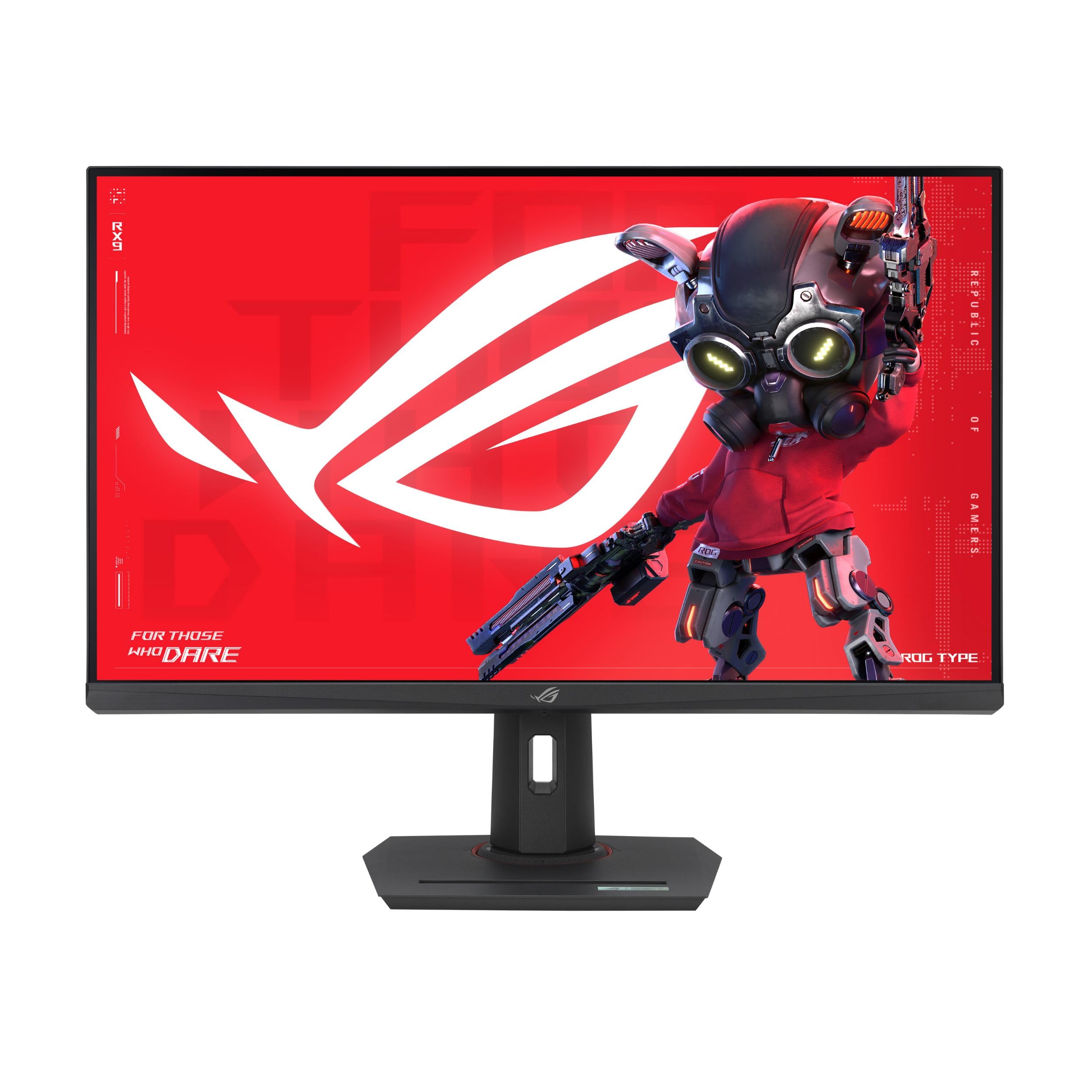
The XG32UCG is a 32-inch 4K Fast IPS panel with a clever dual-mode trick: it runs at 4K 160Hz natively, but a single button press drops resolution to 1080p while boosting refresh rate to 320Hz. This is perfect for gamers who want 4K clarity for RPGs and then need 320Hz low-latency motion for fast-paced shooters — all on one monitor. The 0.3ms GtG response time (minimum) ensures that even at 320fps, motion stays crisp with no perceivable ghosting.
Color performance is strong with 95% DCI-P3 coverage and 130% sRGB, backed by ASUS’s advanced gray-scale tracking for smooth gradients. The Extreme Low Motion Blur Sync (ELMB SYNC) allows strobing and VRR to work simultaneously, which is rare — most monitors force you to choose between motion blur reduction and adaptive sync. The stand is fully adjustable (height, tilt, swivel, pivot) and includes a tripod socket for streamers who mount cameras above the monitor. Connectivity includes DisplayPort 1.4, two HDMI 2.1 ports, and USB-C with DP Alt mode.
The IPS panel has a 1000:1 static contrast ratio, which means blacks are gray in dark rooms compared to OLED. The 32-inch 4K size also requires a fairly deep desk (at least 30 inches) to avoid neck strain. The dynamic contrast ratio of 100,000,000:1 is purely a marketing number — real-world contrast is standard IPS.
Why it’s great
- Dual-mode switching: 4K 160Hz to 1080p 320Hz with one button
- ELMB SYNC combines backlight strobing with VRR for no-compromise clarity
- USB-C with DP Alt mode and tripod socket for streamers
Good to know
- 1000:1 contrast ratio means black levels are gray compared to OLED
- 32-inch 4K requires ~30-inch desk depth for comfortable viewing
5. AOC Q27GAZDV
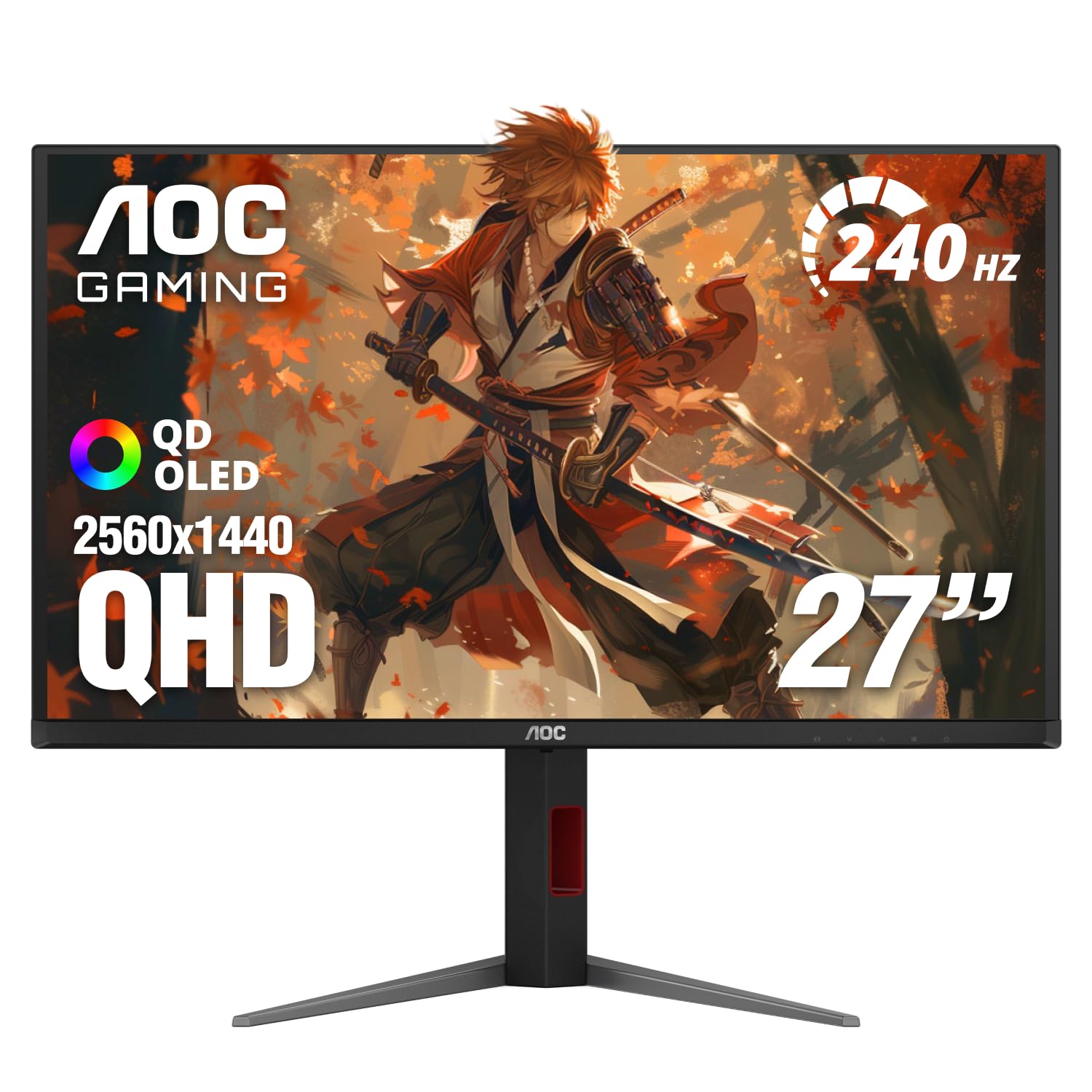
The AOC Q27GAZDV brings QD-OLED performance to a mid-range price point without sacrificing the core specs that matter: 1440p, 240Hz, 0.03ms GtG, and 1500000:1 contrast ratio. The anti-glare coating is semi-gloss, which preserves contrast in dark scenes better than matte IPS finishes.
The ergonomic stand is a standout in this budget bracket — height, tilt, swivel, and pivot adjustments are all included, plus a USB 3.2 hub with two downstream ports. The OSD menu includes a Gamer 2 mode and pixel refresh option (disabled by default, must be triggered manually). The build quality feels solid with a metal backplate, though the bezels are thicker than premium OLEDs (~0.5 inches on sides).
Peak brightness is rated at 200 nits, which is dim — even by OLED standards. The HDR experience is good for dark scenes but lacks the punch of the ASUS XG27AQDMG or Alienware AW2725DF. Out-of-box color may require adjustment: users report a brownish hue in default modes that can be corrected by switching to Gamer 2 or custom profiles. The monitor lacks built-in speakers and HDMI 2.1 on both ports (only one is full-bandwidth).
Why it’s great
- QD-OLED with infinite contrast and 0.03ms response at accessible price
- Fully ergonomic stand with height, tilt, swivel, and pivot adjustments
- USB 3.2 hub and G-Sync Compatible support included
Good to know
- 200 nits peak brightness is dim even for OLED; HDR lacks punch
- No built-in speakers; default color profile may need calibration
6. Samsung Odyssey OLED G5

The Odyssey OLED G5 is a 27-inch QD-OLED that trades top-tier refresh rate (180Hz vs. 240-360Hz) for absolute color fidelity and burn-in protection. Samsung’s OLED Safeguard uses a Thermal Modulation System to keep the panel cool under load, reducing the chemical degradation that causes burn-in. The Glare Free technology eliminates reflections better than most anti-glare coatings, making it usable in rooms where glossy OLEDs would wash out. Pantone Validation covers 2100+ colors, and the 1,000,000:1 contrast ratio delivers cinematic HDR with HDR10 support.
The 0.03ms GtG response time still demolishes any IPS panel, and the 180Hz refresh is more than sufficient for 95% of gamers — only competitive esports players will crave the extra 60-180Hz. G-Sync Compatible and AMD FreeSync Premium work flawlessly across the VRR range. The Auto Source Switch+ feature seamlessly detects input devices, which is handy if you toggle between PC and console frequently.
The stand is tilt-only, which is disappointing at this tier — you will want a monitor arm for full ergonomic adjustment. Input ports are limited to one HDMI 2.1 and one DisplayPort 1.4, with no USB hub. There are no built-in speakers. Peak SDR brightness caps at 280 nits, and HDR peak is around 400 nits, which is decent but not class-leading. The OLED panel’s pixel shift can be slightly distracting when reading static text, though it prevents burn-in.
Why it’s great
- Thermal Modulation System actively prevents burn-in better than standard OLED care
- Pantone Validated with 2100+ colors for professional-grade color accuracy
- Glare Free coating eliminates reflections without matte haze
Good to know
- Tilt-only stand — no height, swivel, or pivot adjustment
- Limited to one HDMI and one DisplayPort input; no USB hub or speakers
7. LG 27GR83Q-B
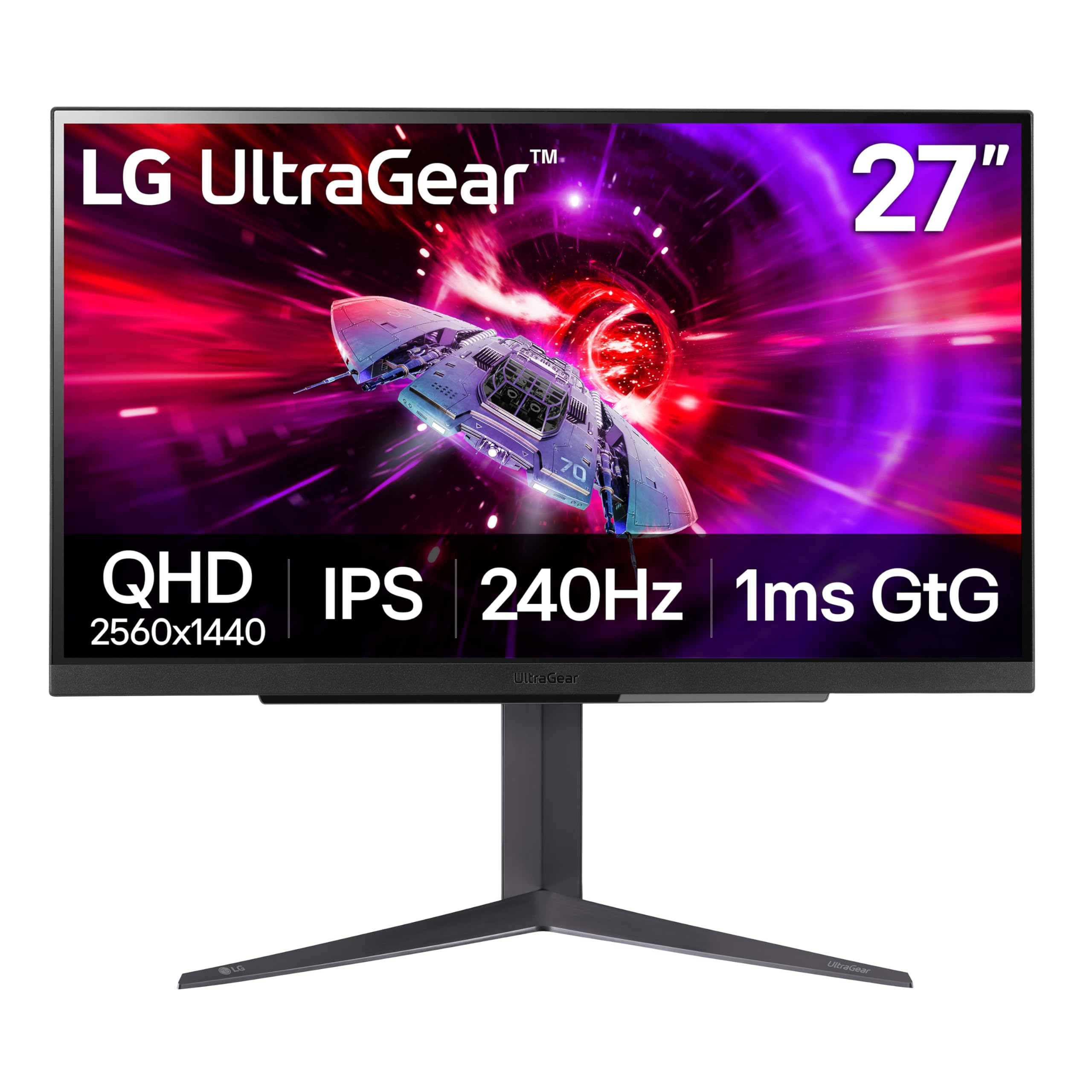
The LG 27GR83Q-B is a 27-inch 1440p Fast IPS panel that hits 240Hz with a 1ms GtG response time — the sweet spot for mid-range gaming PCs that cannot consistently push 360fps. It supports both NVIDIA G-Sync Compatible and AMD FreeSync Premium, works with HDMI 2.1 (full 48 Gbps) and DisplayPort 1.4, and includes DTS Headphone:X for 3D spatial audio through the 4-pole headphone jack. The HDR 400 certification means it can hit 400 nits peak brightness, which is respectable for an IPS panel in this bracket.
Color gamut hits 95% DCI-P3, and the Dynamic Action Sync reduces input lag below 1ms for near-instant response. The ergonomic stand is superb — height, tilt, swivel, and pivot adjustments are all present, and the joystick OSD controller makes navigation intuitive. The monitor includes Black Stabilizer for dark scene visibility and a Crosshair overlay for FPS games. The build quality feels premium with a brushed metal finish.
The 1000:1 contrast ratio means blacks are visibly gray in dark rooms, which is the inherent limitation of IPS. Some units have reported stuck pixels — QA consistency is not perfect. The 1ms GtG rating is at its best in the “Faster” overdrive setting, but that introduces slight overshoot; the “Fast” setting is cleaner but measures closer to 3-4ms. HDR performance is basic — 400 nits does not qualify as impactful HDR.
Why it’s great
- 240Hz 1440p with full HDMI 2.1 bandwidth and dual adaptive sync support
- Excellent ergonomic stand with height, tilt, swivel, pivot adjustments
- DTS Headphone:X provides spatial audio over 4-pole headphone jack
Good to know
- 1000:1 contrast ratio means black levels show gray in dark scenes
- Inconsistent QA: multiple reports of stuck pixels on first units
8. Dell S2725QS

The Dell S2725QS is a 27-inch 4K IPS monitor that targets the hybrid worker/gamer — 120Hz refresh rate and FreeSync Premium make it suitable for light to moderate gaming, while the 1500:1 contrast ratio and 99% sRGB coverage make it excellent for photo editing, design, and spreadsheet work. The 0.03ms MPRT response time is misleading (that is MPRT, not GtG), but in practice the real GtG is around 4-5ms, which is fine for RPGs and strategy games but not for competitive shooters.
ComfortView Plus reduces blue light output to ≤35% without the yellow tint that plagues most blue light filters. The built-in speakers have been re-engineered for more decibel range and deeper frequency response than the previous generation — they are usable for video calls and casual media, though not for immersive gaming. The ash white finish with ultra-thin bezels looks clean on a desk setup, and the ergonomic stand supports height, tilt, swivel, and pivot adjustments.
The 4K resolution at 27 inches gives a high 163 PPI density, making text razor-sharp for productivity. However, the 120Hz limit means it cannot match the fluidity of 240Hz+ panels in fast-paced games. Some users report a persistent yellow tint on the panel and text distortion after extended use, though these seem to be isolated QA issues. The 350 nits brightness is adequate but not HDR-capable in any meaningful way.
Why it’s great
- 27-inch 4K with 163 PPI delivers exceptional text clarity for productivity
- ComfortView Plus reduces blue light to ≤35% with minimal color shift
- Full ergonomic stand plus improved built-in speakers for office use
Good to know
- 120Hz and 4-5ms GtG response time is not suitable for competitive FPS gaming
- Some units exhibit yellow tint or text distortion after extended use
9. Acer Nitro VG270K

The Acer Nitro VG270K is a 27-inch 4K Fast IPS monitor that undercuts most 4K gaming displays on price while still delivering a 160Hz refresh rate (with DFR technology that can push FHD to 320Hz). The 0.5ms GtG response time puts it in the same league as premium IPS panels for motion clarity, though in practice the overdrive may introduce some overshoot at the highest setting. The ZeroFrame design creates a nearly bezel-less look, and the VESA 100x100mm mount compatibility makes it easy to attach a monitor arm.
Color performance is decent with DCI-P3 90% coverage and HDR 10 support, though the 1000:1 contrast ratio and basic HDR mean it cannot compete with OLED for dark scene immersion. AMD FreeSync Premium works well across the VRR range. The stand is tilt-only, which is expected at this price, and the built-in speakers are weak and tinny — external speakers or headphones are essential. Connectivity includes DisplayPort 1.4 and two HDMI 2.1 ports, which is generous for the price bracket.
The main concern is reliability: multiple customer reports indicate HDMI port failure within a month of use and catastrophic panel failure (vertical lines) within two years. The pixel pitch of 0.155mm is standard for 27-inch 4K, but at this price, quality control is inconsistent. The DFR mode that boosts to 320Hz at 1080p is a genuine value-add, but the image becomes noticeably softer due to the upscaling required.
Why it’s great
- 27-inch 4K 160Hz (with DFR to 320Hz at FHD) at attractive entry price
- 0.5ms GtG response time with FreeSync Premium support
- Two HDMI 2.1 ports plus DisplayPort 1.4 for multi-device setups
Good to know
- Inconsistent QA: reports of HDMI port failure and vertical line defects
- Tilt-only stand; built-in speakers are weak and tinny
FAQ
Is a 5ms GtG response time monitor good for competitive gaming?
Does 5Ms refer to response time or input lag?
Can I notice the difference between 1ms and 0.03ms GtG?
Do I need HDMI 2.1 for a 5Ms Gaming Monitor?
Final Thoughts: The Verdict
For most users, the 5ms gaming monitor winner is the ASUS ROG Strix XG27AQDMG because its glossy WOLED panel delivers reference-level blacks, 0.03ms GtG response, and 240Hz smoothness with a full ergonomic stand and burn-in warranty — at a price that undercuts competing QD-OLEDs. If you want the highest frame rates for esports, grab the Alienware AW2725DF with its 360Hz and 0.03ms GtG. And for a value-driven OLED entry without sacrificing infinite contrast, nothing beats the AOC Q27GAZDV.