
Our readers keep the lights on and my morning glass full of iced black tea. As an Amazon Associate, I earn from qualifying purchases.
Specs are compiled from manufacturer listings and verified buyer reviews and can change over time — please confirm the key details on the product page before buying.
Topping off an engine that has 100,000 miles or doing a full change on a high-mileage daily driver forces you to choose: a 5W30 synthetic blend sits right between the cost of conventional oil and the premium of full-synthetic. The trick is matching the leak-stopping additives and detergents to your engine’s actual age and condition. A high-mileage formula can be overkill on a low-mileage motor, while a basic blend might not hold back sludge in a worn powerplant.
I’m Min — the founder and writer behind Gadgets Feed. This guide is built by comparing the manufacturers’ published specifications and the patterns across verified customer reviews, so you get each pick’s real strengths and trade-offs instead of marketing spin.
Here are the top-performing synthetic blend motor oils for gasoline engines that balance protection, wear-fighting chemistry, and fuel economy to help you pick the right 5w30 synthetic blend for your car, truck, or SUV.
Quick Picks
- Castrol GTX High Mileage 5W-30 Synthetic Blend — Sludge Slayer
- Havoline Motor Oil 5W30 Synthetic Blend Smart — Deep Clean
- ULTRA 1PLUS SAE 5W-30 Synthetic Blend Motor Oil — Turbo Ready
- Quaker State High Mileage 5W-30 Synthetic Blend — Mileage Veteran
- Pennzoil High Mileage Synthetic Blend 5W-30 — Top Pick
- Genuine Ford Fluid XO-5W30-QSP SAE 5W-30 — OEM Exact
- Motorcraft SAE 5W30 Synthetic Blend Motor Oil — Bulk Value
How To Choose The Best 5W30 Synthetic Blend
You pick the right blend based on your engine’s current mileage and the level of deposits inside it. A high-mileage formula adds seal conditioners (chemicals that swell dried-out rubber gaskets to stop external leaks), while a standard blend focuses on fuel economy and general wear protection. A few core specs make the decision straightforward.
API SP and ILSAC GF-6A Certification
The API SP rating (the latest American Petroleum Institute standard for gasoline engines) means the oil is designed to protect against low-speed pre-ignition (LSPI — a destructive misfire in turbocharged engines). The ILSAC GF-6A spec (International Lubricant Standardization and Approval Committee’s current requirement) adds fuel-economy and sludge-fighting rules. Look for both on the label if you drive a newer turbo car.
High Mileage vs Standard Blend
High-mileage oils (usually labeled for vehicles over 75,000 miles) use seal conditioners that swell dried-out gaskets to reduce oil leaks. They also often contain extra detergents to clean sludge from older internals. Standard blends skip those conditioners, which makes them a better choice for a lower-mileage engine that does not need the added viscosity modifiers.
Case Size and Per-Quart Value
Buying by the case of six or twelve quarts typically cuts the per-quart price compared to buying singles. If you change your own oil, a case covers one or two changes and saves you a trip to the store mid-project. A 5-quart jug is the balance for most sedans; full-size trucks often need six or seven quarts per change.
Quick Comparison
| Model | Best For | Volume | Certifications | Mileage Focus | Amazon |
|---|---|---|---|---|---|
| Castrol GTX High Mileage 5W-30 | Sludge protection & fuel economy | 160 fl oz (5 qt) | API SP, ILSAC GF-6 | Over 75,000 miles | Amazon |
| Havoline 5W-30 Synthetic Blend (6 pack) | Dirty engine cleanup | 6 quarts | API SP, ILSAC GF-6 | Universal | Amazon |
| Ultra 1Plus 5W-30 (1 Gallon) | Turbo & supercharged engines | 1 gallon | API SP, ILSAC GF-6A | Universal | Amazon |
| Quaker State High Mileage 5W-30 (Case of 6) | Older high-mileage engines | 192 fl oz (6 qt) | API SP, ILSAC GF-6A | Over 75,000 miles | Amazon |
| Pennzoil High Mileage 5W-30 (Pack of 2) | Stop leaks in worn engines | 64 fl oz (2 qt) | API SP, ILSAC GF-6A | Over 75,000 miles | Amazon |
| Genuine Ford Fluid 5W-30 (1 Qt) | Ford warranty compliance | 32 fl oz (1 qt) | API SN, ILSAC GF-5 | Universal | Amazon |
| Motorcraft 5W-30 (12 Qt Case) | Bulk Ford/Motorcraft users | 384 fl oz (12 qt) | Ford OEM spec | Universal | Amazon |
In‑Depth Reviews
1. Castrol GTX High Mileage 5W-30 Synthetic Blend Motor Oil, 5 Quarts
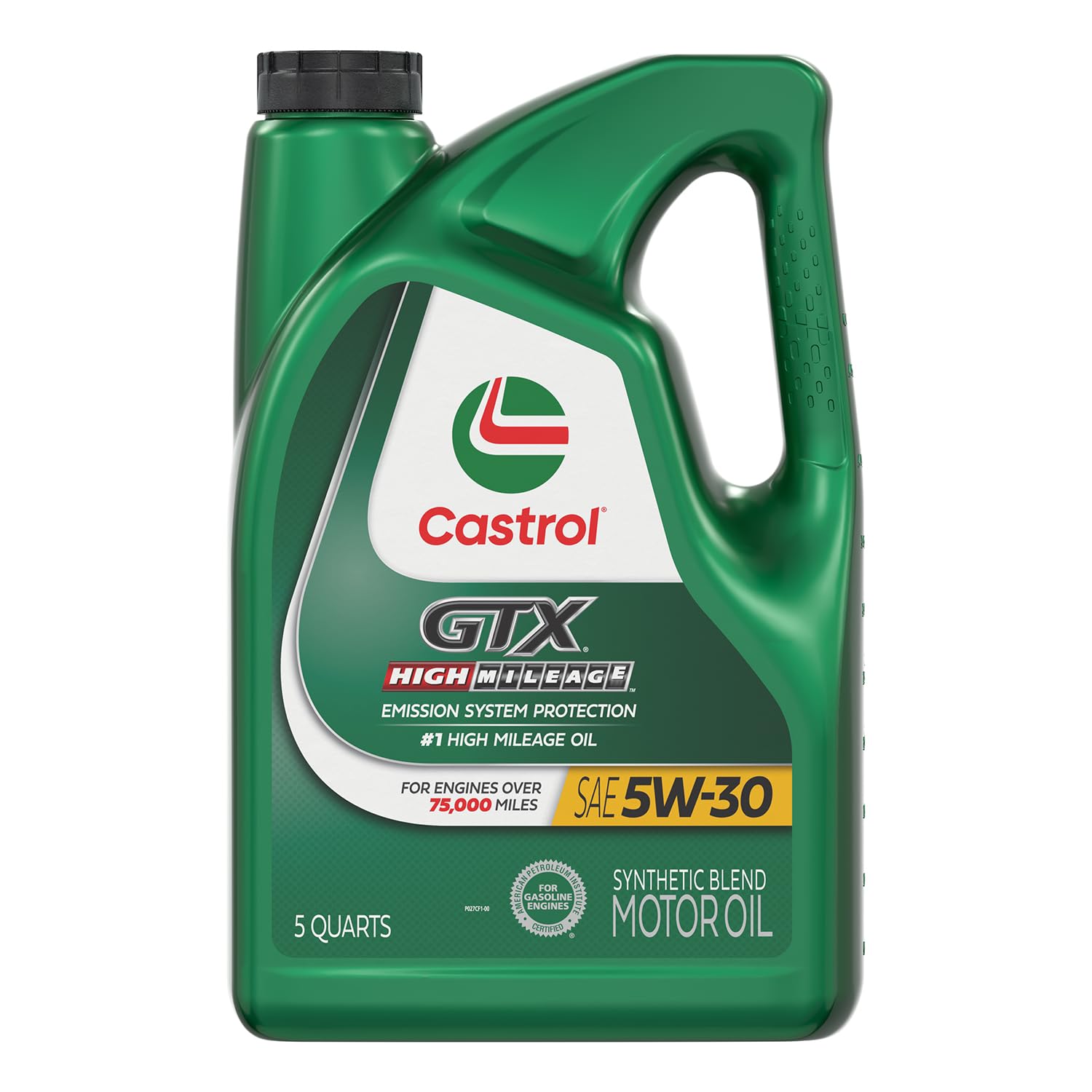
This 5-quart jug lets you fight sludge and save fuel at the same time because of its API SP formula and extra detergents.
Castrol packs this blend with Phosphorus Replacement Technology (a chemical that protects your catalytic converter’s sensors while keeping the engine clean). The 5W-30 grade delivers improved fuel economy compared to industry specifications, and the seal conditioners actively reduce leaks in engines over 75,000 miles. You get 160 fluid ounces in a single jug, enough for most passenger cars without needing a second bottle.
Buyers report using Castrol oils across multiple vehicles “with complete satisfaction and reliability,” backing the brand’s reputation for consistent quality. The superior dispersancy here fights sludge buildup better than many competing blends, and the oil burn-off protection exceeds industry standards so you do not have to top off between changes.
Unlike the Ultra 1Plus single-gallon option, the Castrol comes in a 5-quart format that matches the exact capacity of most sedan oil pans — no measuring or leftover storage needed. The main trade-off is that this is formulated for high-mileage engines, so if your car has fewer than 50,000 miles, a standard blend might deliver better fuel economy performance.
Why it wins
- Phosphorus Replacement Technology protects emission systems
- 5-quart jug fits most cars without leftover oil
- Superior sludge dispersancy for high-mileage internals
The fine print
- High-mileage formula may slightly reduce fuel economy in low-mileage engines
Best for: Owners of cars, trucks, and SUVs with over 75,000 miles who want one jug that covers the whole change and keeps sludge in check.
skip it if: Your engine is below 50,000 miles — a standard (non-high-mileage) blend is a better match for fuel economy.
2. Havoline Motor Oil 5W30 Synthetic Blend Smart Change Engine Oil, 6 Quarts
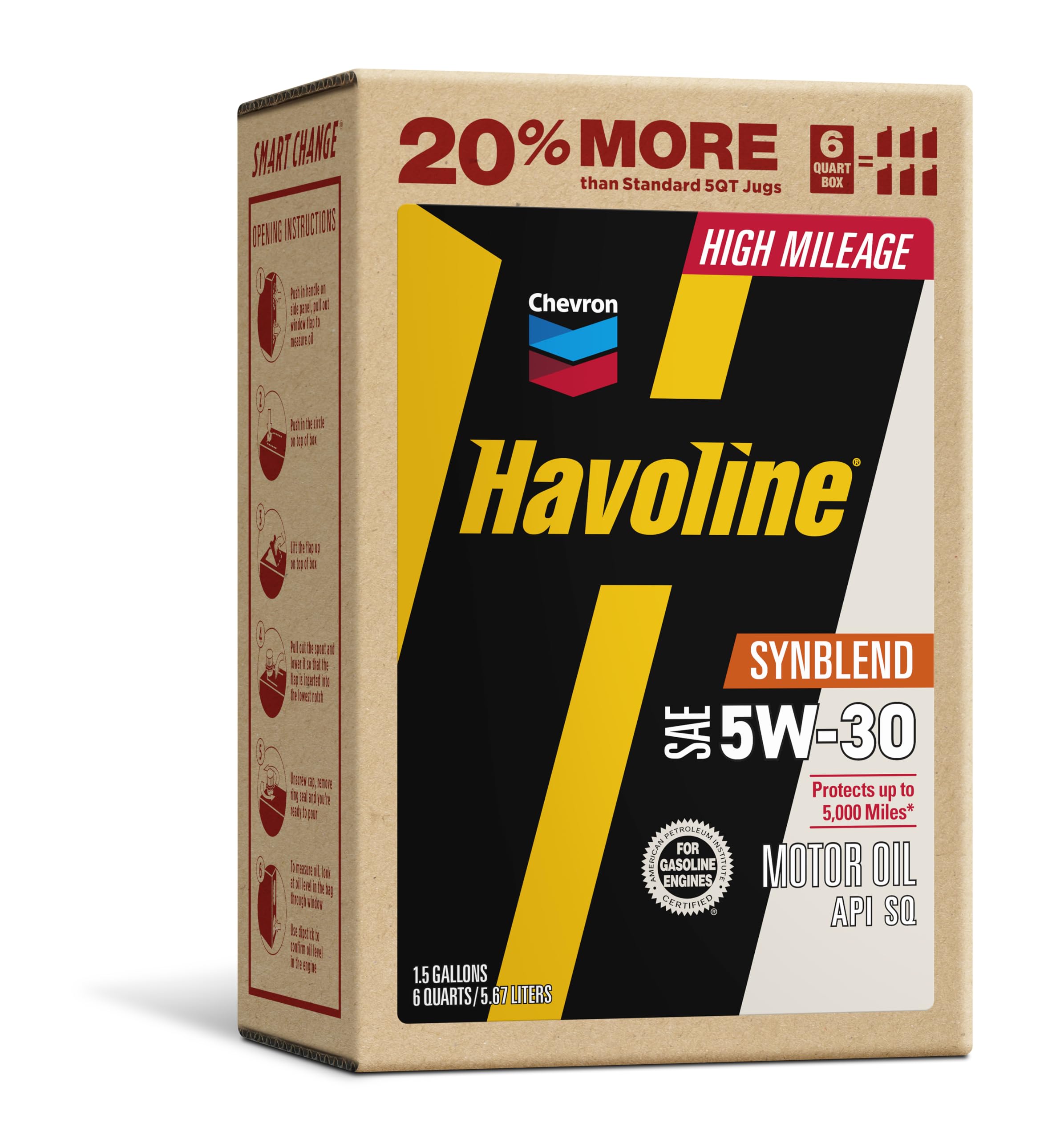
The Havoline uses the most aggressive detergents of any blend here, making it the one for engines with heavy sludge.
Havoline Smart Change is built around aggressive deposit-fighting chemistry that owners mention is “the oil to use if you have an engine with extremely dirty internals.” It delivers outstanding anti-wear protection for camshafts and bearings while preserving fuel economy better than conventional oils. The 6-quart box is ideal for trucks and larger SUVs that need more than five quarts per change.
Cold-start performance is a strong point here — the 5W-30 grade flows at -30°C, so your engine sees immediate lubrication on the coldest winter mornings. The formula meets API SP and ILSAC GF-6 standards, making it safe for modern turbocharged engines that require low-speed pre-ignition protection. At 6 quarts, it holds 192 fluid ounces; the Genuine Ford Fluid single quart holds 32 fluid ounces, covering a full change without running short.
One thing to note: the 6-quart box uses a flexible inner pouch. Buyers mention that if the outer box is damaged in shipping, the thin bag can be tricky to pour from. Still, they find the oil itself reliable, with many using Havoline “for years” and praising the convenience of not buying a separate fifth quart.
Why it stands out
- Highest detergency among these blends for cleaning sludge
- 6-quart box covers trucks and large SUVs completely
- Strong cold-start flow down to -30°C
Watch for
- Pouch system can be messy if the outer box arrives damaged
Reach for this if: You have an older engine with heavy deposits or sludge buildup that needs a gradual, safe cleaning over multiple oil changes.
Look elsewhere if: You prefer rigid bottles — the pouch may be less convenient for precise pouring.
3. ULTRA 1PLUS SAE 5W-30 Synthetic Blend Motor Oil API SP ILSAC GF-6A
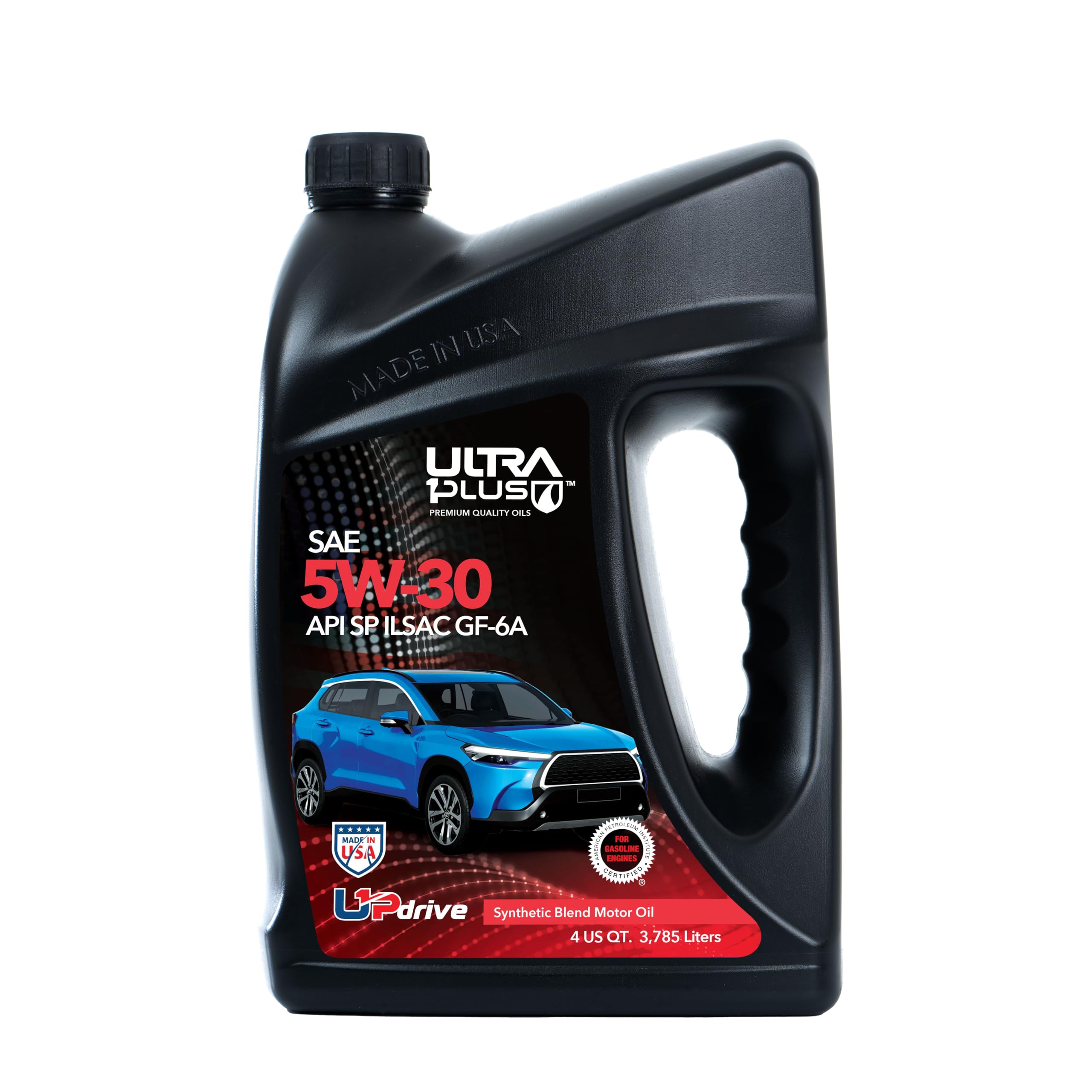
A 210°C flash point makes this gallon jug the best choice for turbo engines that run hot and burn off oil fast.
Ultra 1Plus pushes its anti-wear film to protect engines during both cold starts and high-temperature operation, reducing friction across a wide heat range. The flash point (the temperature at which the oil vapor ignites) is 210°C, meaning the oil resists burning off at high engine loads, so you lose less to evaporation over the change interval. Customers note using this oil in a 2012 Nissan Maxima with 167,000 miles and noticing “very clean” results and better gas mileage.
The formula exceeds both API SP and ILSAC GF-6A requirements, which means it offers low-speed pre-ignition protection essential for modern turbocharged and supercharged engines. One owner noted the oil “stays clear till about 3500 miles then begins to burn dark,” suggesting good oxidation resistance early in the change cycle. At 1 gallon, it holds 128 fluid ounces — a larger single container that works well for engines requiring around 5 quarts plus a spare quart for top-offs.
Compared to the Castrol 5-quart jug, this is a tighter volume — about 4 quarts versus Castrol’s 5 — so if your car takes a full 5 quarts, you will need extra oil. The main angle here is the high-temperature stability and the anti-evaporation formula, which is especially useful if you drive hard or in hot climates.
Why it shines
- 210°C flash point resists burn-off under high load
- Designed for turbocharged and supercharged gasoline engines
- Reviewers point out clean internals and fuel savings
Why to double-check
- 1 gallon is a bit short for cars needing exactly 5 quarts
Best for: Enthusiasts with forced-induction engines who want evaporation resistance and a premium anti-wear film at a competitive per-gallon price.
pass on it if: Your car’s oil capacity is exactly 5 quarts — you will need to buy a separate quart.
4. Quaker State High Mileage 5W-30 Synthetic Blend Motor Oil (1-Quart, Case of 6)
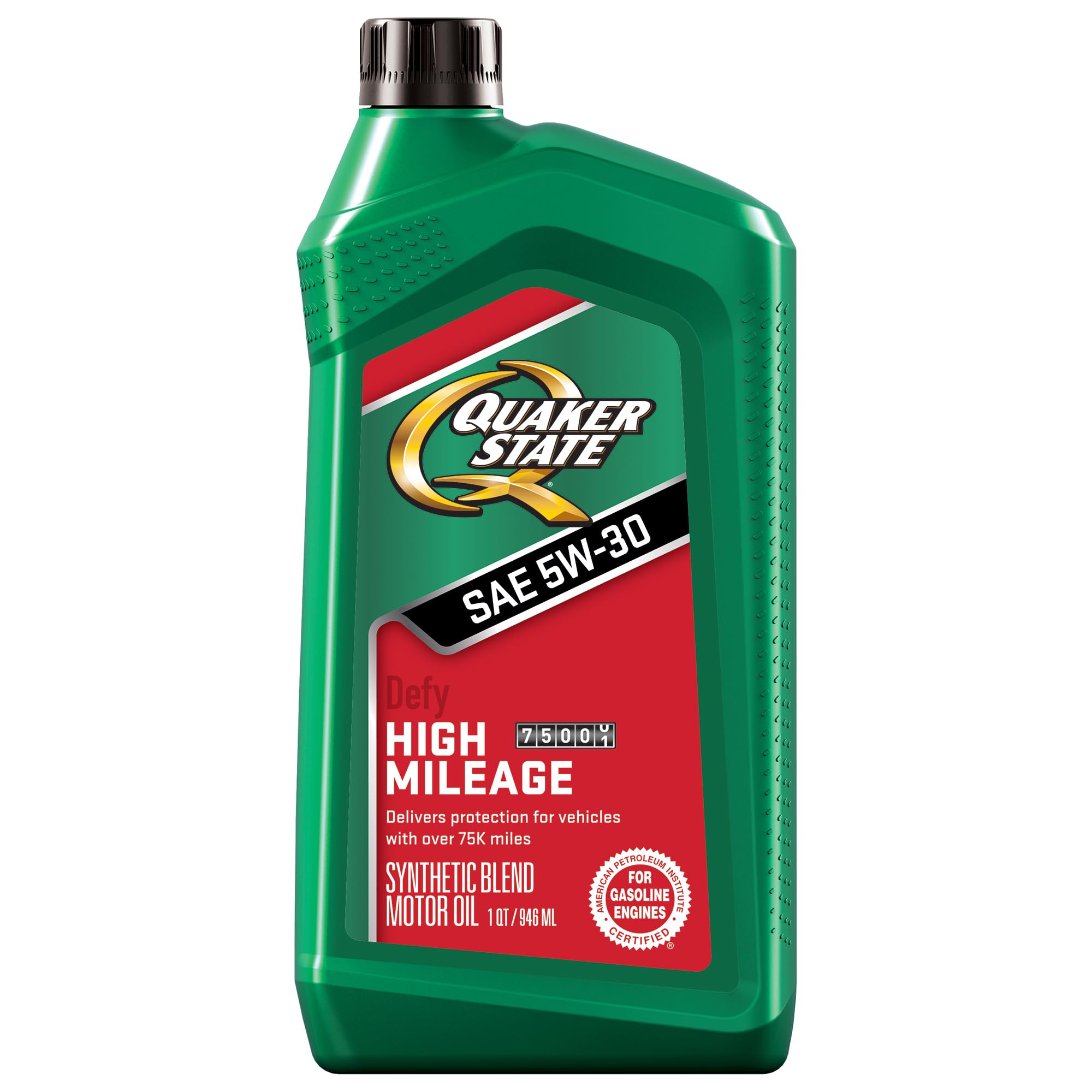
At 192 fluid ounces (six quarts), this case is the go-to for keeping a 200,000-mile engine leak-free and sludge-free.
Quaker State’s Defy formula is packed with active seal conditioning agents that keep older gaskets pliable, directly targeting oil leaks and consumption. The thermal and oxidative stability here helps reduce oil burn-off and boost power output in engines with over 75,000 miles. At 192 fluid ounces (six quarts), it has 192 fl oz, while the Genuine Ford Fluid single quart has 32 fl oz, making it ideal for multi-vehicle households or full-size trucks that need more than 5 quarts per change.
Shoppers say long-term success with this oil at extreme mileage: one owner with 270,000+ miles says the oil “still looks new” at 7,000 miles and that swapping to a competing high-mileage brand triggered a check engine light. The same user notes the engine “runs quiet and smooth” on Quaker State. Another buyer specifically searched for “a very high quality semi-synthetic, high mileage 5-30 oil” for a Lexus V8 and trusts Quaker State to exceed expectations.
The catch is the case price — this is the larger volume format, so the upfront cost is higher than a single 5-quart jug, but the per-quart math works in your favor if you change oil on multiple vehicles or drive something that takes six quarts per change.
Why it leads
- Seal conditioners actively reduce external leaks
- 6 quarts cover trucks and large SUVs completely
- Buyers report oil looking clean at 7,000 miles
What to consider
- Case format is a higher initial spend than a single jug
Reach for this if: You drive a high-mileage vehicle (over 100,000 miles) and want a proven formula that helps stop leaks and maintain clean internals for the long haul.
Look elsewhere if: You only need 5 quarts for a single sedan — a 5-quart jug is more convenient and less bulky to store.
5. Pennzoil High Mileage Synthetic Blend 5W-30 Motor Oil for Vehicles Over 75K Miles (Pack of 2)
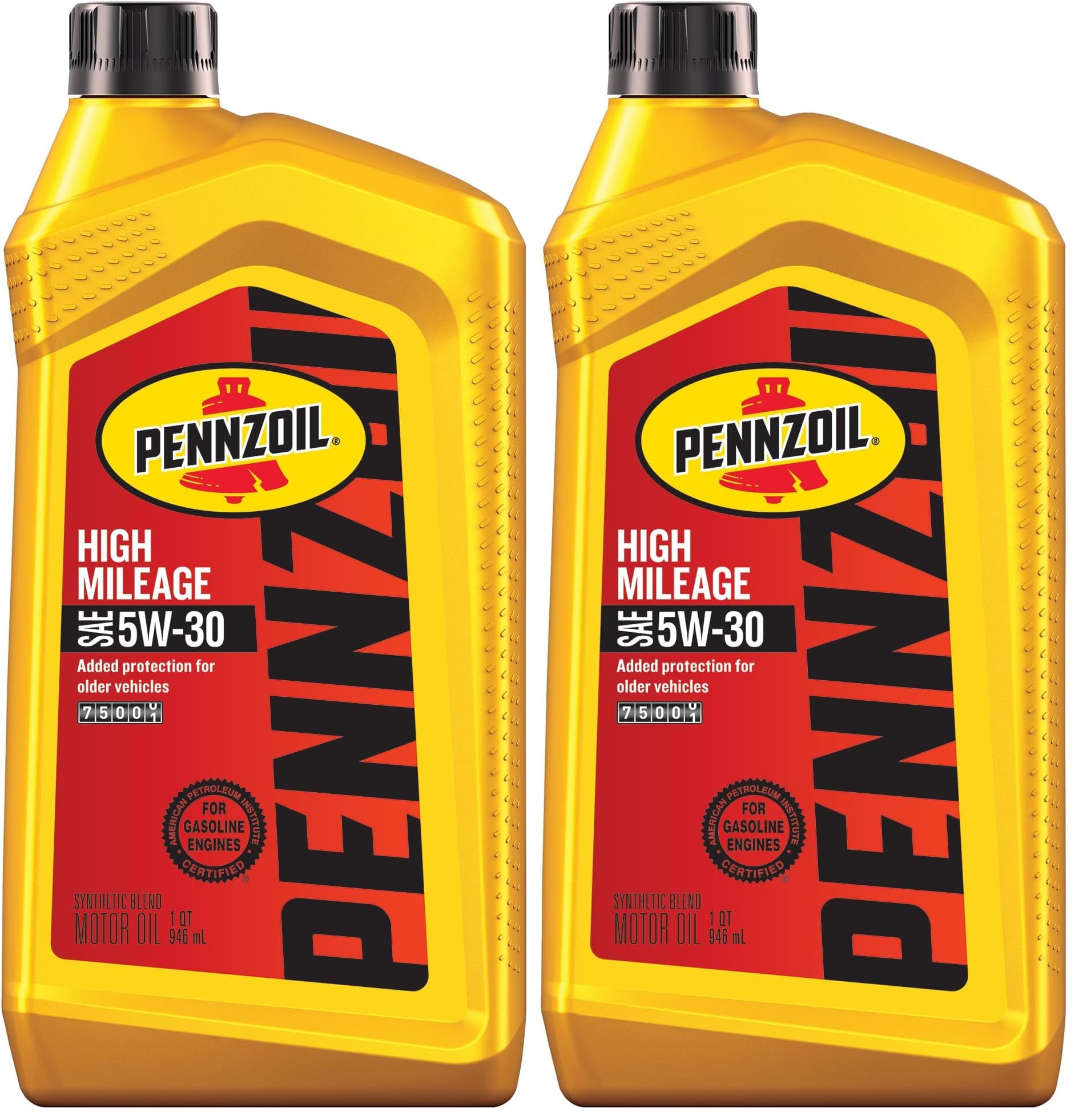
Two quarts of high-mileage formula that comes with a 10-year/300,000-mile limited warranty — rare for a blend at this tier.
Pennzoil’s blend is specially formulated for vehicles with over 75,000 miles, with added seal conditioners that help prevent sludge and other damaging deposits. It meets API SP-Resource Conserving and ILSAC GF-6A, meaning it offers low-speed pre-ignition protection for modern turbo engines. The limited warranty coverage (up to 10 years or 300,000 miles, whichever comes first) adds a layer of assurance that is rare at this price tier.
Buyers find this works well in older cars — one owner reported using it in a 2006 Chevy HHR with good results, while another noted it is “decent oil” for a Lexus IS300. At 64 fluid ounces for the pack, it holds 64 fl oz; the Genuine Ford Fluid single quart holds 32 fl oz. The two-quart format is handy for topping off between changes or for smaller engines that take exactly 4 quarts.
The trade-off is that this is a pack of two individual quarts rather than a single jug, so if you need a full 5-quart change you will have to buy multiple packs. The per-ounce cost is competitive, but the packaging creates more waste than a single 5-quart container.
Why it works
- Reduces oil consumption and stops external leaks in worn engines
- 10-year / 300,000-mile limited warranty
- Turbo-safe with API SP certification
The format catch
- Two separate quarts means more plastic bottles to dispose of
Best for: Quick top-offs or engines that take exactly 2 quarts — the pack fits neatly in a trunk or tool box for emergency use.
it’s not for you if: You need a full oil change quantity; a 5-quart jug is less wasteful and easier to pour.
6. Genuine Ford Fluid XO-5W30-QSP SAE 5W-30 Premium Synthetic Blend Motor Oil – 1 Quart Bottle

This single quart carries Ford’s exact approval for warranty compliance, but it uses the older API SN standard, not the newer API SP.
This is the factory-fill equivalent for Ford gasoline engines, carrying Ford Motor Company’s approval to meet warranty requirements. The API SN and ILSAC GF-5 certifications mean it protects against high-temperature deposits and provides fuel economy benefits, though it falls behind the newer API SP standard in low-speed pre-ignition protection. At 32 fluid ounces, this is the smallest container in the lineup — it has 32 fl oz, while the Quaker State case has 192 fl oz.
Buyers trust this oil for the long term: one owner has “been using it for over two decades” and another reports “engines lasting 150K–300K miles without work” using this exact fluid. It comes in a standard quart bottle that fits any funnel, and the viscosity is rated medium to high, giving good film strength for Ford’s 6.2L V8 and smaller Ecoboost engines alike.
The obvious limitation is that a single quart only covers part of a change — most Ford engines need five to seven quarts. Buyers end up purchasing multiple bottles, which makes the per-quart cost higher than buying by the case. If you drive a Ford, the Motorcraft 12-quart case below is a much better value.
Why it is useful
- Ford-approved for warranty compliance
- Proven track record of engines reaching 300K miles
- Simple quart bottle fits any pour spout
The downside
- Single quart is expensive per ounce compared to multi-packs
Best for: Ford owners who need a single quart for top-offs between changes or who want the exact factory spec for warranty confidence.
look elsewhere if: You are doing a full oil change — the Motorcraft case or a 5-quart jug is a much better value.
7. Motorcraft SAE 5W30 Synthetic Blend Motor Oil 12 Quarts Ford OEM Oil Change
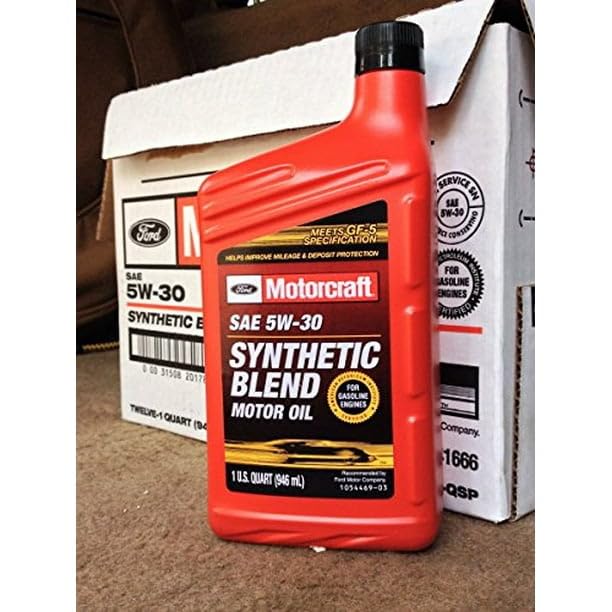
With 12 quarts (384 fluid ounces), this case covers two full oil changes at once — the best per-quart value for Ford owners.
Motorcraft is Ford’s official motor oil brand, making this the same spec that goes into factory-fresh Ford and Lincoln vehicles. The 12-quart case (384 fluid ounces) is the largest single purchase in this lineup, giving you enough oil for roughly two full changes on a typical Ford sedan or one change plus full top-offs for a year on a truck. Buyers love the convenience: one owner notes “this is the way I buy oil for my oil changes” and praises not having to drive 30 miles to a parts store.
The synthetic blend here is “far superior to the junk they use at a Quick Lube joint,” according to one reviewer, and the Motorcraft name is what Ford mandates in owner manuals. The viscosity is medium to high, matching the Genuine Ford Fluid single-quart product, but in a case of 12 quarts (384 fl oz) compared to the single quart’s 32 fl oz. If you drive a Ford, this is the easiest way to stock up; if you drive another brand, the Castrol or Havoline options are more universal.
The main practical limitation is that 12 quarts of oil weigh enough to make storage a consideration — the case is large, and you will need shelf space. It also locks you into a single brand for multiple changes, which is fine if you trust Motorcraft but less flexible if you like to experiment with different formulations.
Bulk advantage
- 12 quarts cover two oil changes or a full year of top-offs
- Ford OEM spec for warranty compliance
- Buyers praise the value and convenience of home delivery
Storage note
- Case is heavy and bulky; needs garage shelf space
Best for: Ford and Lincoln owners who change their own oil and want a year’s supply delivered at once with a lower per-quart cost.
steer clear if: You prefer smaller quantities to switch brands between changes, or you lack shelf space for a 12-quart case.
Understanding the Specs
API SP vs API SN
The API SP rating is the current standard for gasoline-engine oils, adding protection against low-speed pre-ignition (LSPI — a destructive misfire in turbo engines) and better sludge resistance. API SN (found on older blends like the Genuine Ford Fluid XO-5W30-QSP) was the previous standard and still provides solid protection, but lacks the LSPI safeguards. If you drive a modern turbocharged car, look for API SP or ILSAC GF-6A on the bottle.
High Mileage Additives
High-mileage blends contain seal conditioners — chemical compounds that swell dried-out rubber gaskets and valve seals — to reduce external oil leaks. They also usually have extra detergents to break down sludge that accumulates over 75,000 miles. A standard blend skips these conditioners, so it is thinner and better for low-mileage engines that do not need leak-stopping chemistry.
FAQ
Can I use 5W30 synthetic blend in any gasoline car?
What does “high mileage” mean on a bottle of 5W30 synthetic blend?
Is API SP better than API SN for my engine?
How many quarts do I need for a typical oil change with 5W30 synthetic blend?
Can I mix a synthetic blend with conventional oil?
How often should I change 5W30 synthetic blend oil?
Will 5W30 synthetic blend improve my fuel economy?
What is ILSAC GF-6A and why does it matter?
Can I use 5W30 synthetic blend in a lawn mower or generator?
Final Thoughts: The Verdict
Across the board, the 5w30 synthetic blend winner is the Castrol GTX High Mileage because it combines API SP sludge protection, fuel economy benefits, and a 5-quart jug that fits almost every car without leftover oil. If you want the aggressive detergency needed for a dirty engine, grab the Havoline Smart Change. And for long-term high-mileage dependability, the Quaker State Defy case keeps engines running clean well past 200,000 miles.
How We Picked
We do not accept paid placement. Every pick is matched to a real buyer and a real use-case; we do not hands-on test units.
Sources & Methodology
Specifications: manufacturer listings and product documentation. Review insights: verified customer reviews, as of July 2026. Pricing: not shown on this page (it changes often); check the current price via the retailer link.
As an Amazon Associate, Gadgets Feed earns from qualifying purchases. This does not affect which products we feature.