
Our readers keep the lights on and my morning glass full of iced black tea. As an Amazon Associate, I earn from qualifying purchases.
Specs are compiled from manufacturer listings and verified buyer reviews and can change over time — please confirm the key details on the product page before buying.
Wiring a Level 2 EV charger, a 240-volt shop outlet, or a sub-panel in a detached garage is much easier with the right cable. A 6/3 MC cable (metal-clad, 6-gauge wire with three conductors and a ground) comes pre-armored and meets electrical code, so you skip the hassle of pulling individual wires through conduit. But you need one that bends without kinking and handles its rated current without overheating — otherwise, the job gets frustrating fast.
I’m Min — the founder and writer behind Gadgets Feed. This guide is built by comparing the manufacturers’ published specifications and the patterns across verified customer reviews, so you get each pick’s real strengths and trade-offs instead of marketing spin.
Below are the five best 6/3 MC cable options for owners who want professional results without the big-box markup, ranked by real-world durability and owner satisfaction. 6/3 mc cable delivers pre-armored convenience that avoids the frustration of running separate conduit and wire.
Our Picks at a Glance

How To Choose The Best 6/3 MC Cable
Buying armored cable is not complicated, but a few key details separate a smooth install from a frustrating one. Focus on the conductor type, the ground wire gauge, and the armor construction.
Stranded vs Solid Conductors
Stranded copper (made of many thin wires twisted together) is noticeably easier to bend and route inside a wall cavity or through a tight crawl space. Solid copper is stiffer but holds its shape when you need a clean, permanent bend with no spring-back.
Ground Wire Gauge Matters
Many budget cables use a 10 AWG ground wire while the load wires are 6 AWG. Premium options match the ground at 8 AWG or even 6 AWG. That thicker ground provides slightly lower resistance during a fault — a small safety edge for high-current devices like EV chargers.
Armor Thickness and Cutting Effort
The aluminum armor shields the wires inside, but you have to cut it with a hacksaw or a specialized MC cutter. Softer armor is easier to cut and bend; stiffer armor resists rodent damage and impact better. The best balance is armor you can cut without frustration that still protects against accidental bumps.
Quick Comparison
| Model | Best For | Conductor Type | Ground Wire Gauge | Length | Amazon |
|---|---|---|---|---|---|
| 25FT YDDECW 6/3 MC★ Best Overall | Best Overall — EV charger and outdoor | Solid bare copper | 6 AWG | 25 ft | Amazon |
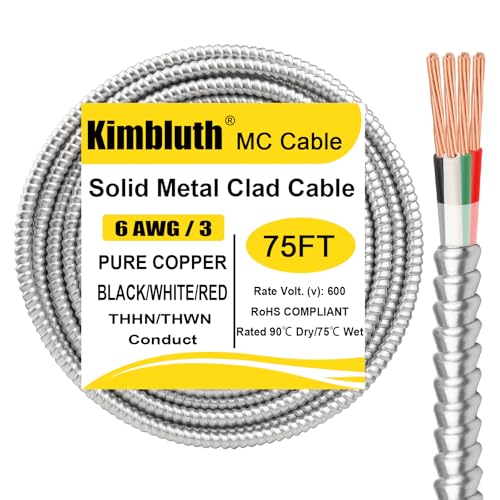
| Kimbluth 6/3 MC (75 ft)Premium Pick | Long outdoor or garage runs | Stranded copper (7 strands) | 8 AWG | 75 ft | Amazon |
| Wirenco 6/3 MC (25 ft) | Easiest to bend and install | Stranded copper (19 strands) | 10 AWG | 25 ft | Amazon |
| Stock Wire 6/3 MC (50 ft) | Mid-length 50-amp runs | Stranded copper | 6 AWG (same as load) | 50 ft | Amazon |
| MOOKEERF 6/3 MC (100 ft) | Maximum length, single purchase | Solid copper | 8 AWG | 100 ft | Amazon |
In‑Depth Reviews
1. 25FT 6/3 MC Cable with Ground — YDDECW
Our pick — over 4.5★ from 397 verified ratings; the strongest balance of quality and price.
A rugged 25-foot spool that handles 48-amp draws with no noticeable heat buildup.
This cable uses solid bare copper conductors rated for 600 volts and 90°C dry conditions, meaning it shrugs off the sustained load of a Level 2 EV charger or a workshop sub-panel without complaint. The aluminum alloy jacket resists corrosion and keeps the wire protected in direct-burial and outdoor applications. Buyers report it “handles 48A with no noticeable overheating” — a direct testament to its current-carrying ability.
The solid copper makes it stiffer than stranded options, but that stiffness is a trade-off for better conductivity and shape-holding. The outer diameter is 21.3 mm, so plan your connector size before ordering. What wins people over is the quality — 44 owners call it out as the cable’s best trait, and value for money runs a close second with 25 mentions.
What buyers love most
- Solid bare copper ground wire is a full 6 AWG — no downgrade
- Aluminum armor bends without kinking and holds shape well
- Versatile across EV chargers, cabin wiring, and construction sites
One thing to plan for
- Solid conductors are less flexible than stranded; budget extra patience in tight spaces
- One owner needed a second delivery; order early to account for possible replacement
Reach for this if: you want the best-reviewed all-rounder (4.6 stars across 397 owners) with a full-gauge ground and rugged armor for outdoor, garage, or industrial use.
Look elsewhere if: you need a very long single run without splicing — 25 ft is its limit straight off the reel.
2. Kimbluth 6/3 MC Cable — 75 ft
A long 75-foot run that electricians recommend for 48-amp hardwired EV chargers.
This cable uses 7-strand stranded copper conductors with an 8 AWG ground and a corrosion-resistant aluminum jacket rated for 90°C dry and 600 volts. That 75-foot length is a huge convenience — you avoid splicing two shorter lengths or paying for 100 feet when you only need 60. The build quality stands out, with 25 owners singling out quality as the top attribute. Buyers using it for HVAC disconnects and commercial bar wiring call it “good moisture proof MC cable” that handles damp environments correctly.
The stranded construction makes it easier to maneuver through walls than the solid-copper option above, but the aluminum jacket is tough to cut if you don’t have a sharp hacksaw. The real-world trade-off is a mixed verdict on ease of use — it is manageable, but the first cut takes some force. At 4.7 stars across 206 owners, this is the highest-rated option on the list.
Why it stands out
- Excellent for long single-run EV charger installs without a splice
- Stranded copper bends easier than solid for tight spaces
- Moisture-resistant armor works for indoor and outdoor applications
Plan ahead for
- Armor takes some grunt to cut cleanly — use a sharp blade
- Mixed feedback on overall ease of use means it’s not the easiest cable to strip
Grab this for: a 60-to-75-foot run where you want stranded flexibility and the highest owner satisfaction score on the list.
skip it if: your project is under 40 feet — the shorter YDDECW or Wirenco saves money and is easier to handle.
3. Wirenco 6/3 MC Cable — 25 ft

Stranded 19-wire copper that makes tight-radius bends feel easy.
That means you can route it through a crowded wall cavity or around a corner without fighting the cable every inch. The THHN insulation is rated for 75 amps, so a 50-amp EV charger or a 50-amp RV outlet is well within its comfort zone.
One couplet: the ground wire is 10 AWG rather than the 6 AWG or 8 AWG on some competitors. That is code-compliant for a 50-amp circuit, but it is worth knowing if you want the heaviest ground possible. Owners praise the quality (15 mentions) and note that the 25-foot length arrived fast and accurate. The cable needs a 1/2-inch clamp connector (not the 3/4-inch that Amazon recommends by default).
Flex champion: The 19-strand construction makes this the easiest option in this list to snake through tight spaces.
Best for: a first-time installer or anyone routing cable through an attic, crawl space, or stud bay with tight turns.
Consider the trade-off: the 10 AWG ground works for 50A but is thinner than the 6 AWG ground on the YDDECW above.
4. Stock Wire 6/3 MC Cable — 50 ft

A 50-foot workhorse with a ground wire that matches the load conductors gauge-for-gauge.
Unlike many cables that step down the ground to 10 AWG, this Stock Wire cable keeps the ground wire at a full 6 AWG — the same gauge as the black, red, and white conductors. That gives you a safety edge for 50-amp circuits because a heavier ground lowers resistance during a fault. Owners confirm it “works well for 50 ampere circuits” and suits Level 2 EV charging. The armor flexes enough for a fairly easy run, though one buyer candidly described it as “heavy, stiff, hard to work with” — a fair warning if your route involves many bends.
The 4.4-star average across 89 ratings is solid, and the unanimous 5-star reviews all praise the cable’s pure copper construction and correct gauge markings.
Safety-minded pick: A full 6 AWG ground wire is rare at this price and gives you real confidence when pulling 50 amps.
Reach for this if: you want a mid-length run with a ground that is not undersized and you are comfortable wrestling with stiff armored cable.
Think twice if: your installation path is especially twisty — the stiffness may frustrate you compared to a stranded-only cable.
5. MOOKEERF 6/3 MC Cable — 100 ft
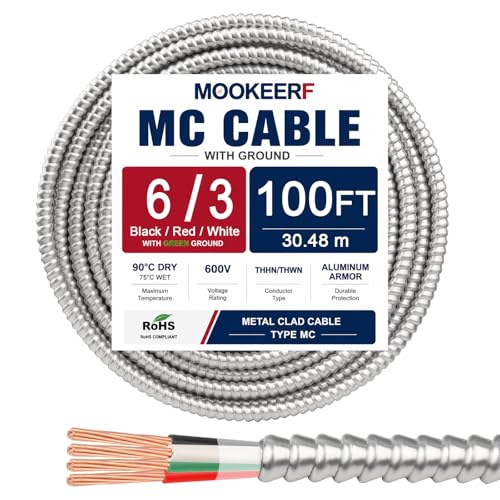
A full 100-foot spool of solid copper that covers a garage run or shop build in one shot.
If your project needs 80 to 100 feet of 6/3, this cable saves you from splicing two shorter pieces or overpaying for a 250-foot spool. It uses solid copper conductors with an 8 AWG ground, 600-volt rating, and UL certification. Owners have used it for 50-amp EV charger plugs and found the metal armor tough to manipulate but worth the effort for the quality. The solid copper makes it stiffer than stranded — you will need decent arm strength and sharp cutters.
The 4.6-star score is excellent, and every review is a full 5 stars, which is rare for any product. Buyers consistently call it “good product” and note it “made the job easy” once they adapted to the stiffness. For a long-run, buy-once scenario, this is the option.
One-and-done length: 100 feet means no splices, no leftovers to store, and no second trip to the store.
Buy this for: a garage-to-house run, a long shop build, or any installation where 100 feet of continuous 6/3 is exactly what the job calls for.
pass on it if: you need less than 60 feet — the shorter cables are cheaper and much easier to handle off the spool.
Understanding the Specs
THHN Rating and Temperature
THHN (Thermoplastic High Heat-resistant Nylon-coated) is the insulation type on most 6/3 MC cable. A “90°C dry” rating means the cable can carry its full current load safely at up to 194 degrees Fahrenheit in dry locations — important for attic runs where summer heat builds. A “75°C wet” rating applies when the cable runs underground or in damp conduit; the safe current capacity drops slightly at that lower temperature rating.
Ground Wire Gauge (Why It Varies)
The NEC code for a 50-amp circuit requires a minimum 10 AWG ground wire, which is why many budget 6/3 cables ship with a 10-gauge ground. Premium cables often step up to 8 AWG or even 6 AWG. A thicker ground reduces voltage drop in a fault path, giving you a small but real safety margin. It does not affect daily operation — it only matters during a short circuit to ground.
FAQ
Will 6/3 MC cable work for my Level 2 EV charger?
What is the difference between 6/3 MC cable and 6/2 MC cable?
Can I bury 6/3 MC cable directly underground?
How do I cut and strip the aluminum armor without damaging the wires inside?
What size clamp connector do I need for 6/3 MC cable?
Is solid copper or stranded copper better for a long garage run?
Can I use 6/3 MC cable for a 60-amp sub-panel?
How many feet of 6/3 MC cable do I need for an EV charger install?
What is the ampacity of 6/3 MC cable at 90°C?
Is 6/3 MC cable the same as BX cable?
Final Thoughts: The Verdict
For the majority of shoppers, the 6/3 mc cable winner is the YDDECW 25-footer because it combines the safest full-gauge ground wire, rugged aluminum armor rated for outdoor use, and a proven 48-amp load capacity backed by 400+ owners. If you need a longer run without splicing, the Kimbluth 75-foot cable gives you stranded flexibility with the highest owner satisfaction score of the group. And for the easiest installation through tight spaces, the Wirenco 25-footer with 19-strand copper is the one to reach for.
How We Picked
We do not accept paid placement. Every pick is matched to a real buyer and a real use-case; we do not hands-on test units.
Sources & Methodology
Specifications: manufacturer listings and product documentation. Review insights: verified customer reviews, as of July 2026. Pricing: not shown on this page (it changes often); check the current price via the retailer link.
As an Amazon Associate, Gadgets Feed earns from qualifying purchases. This does not affect which products we feature.