
Our readers keep the lights on and my morning glass full of iced black tea. As an Amazon Associate, I earn from qualifying purchases.
Specs are compiled from manufacturer listings and verified buyer reviews and can change over time — please confirm the key details on the product page before buying.
Your car’s factory speakers likely turn music into a muddy mess where you cannot hear the vocals or the hi-hat clearly. Swapping them out for a set of 6.5 inch car speakers is the single biggest upgrade you can make to your daily drive. But you need to get the right type — a speaker that matches your car’s stereo power and fits in your door’s mounting depth, or else it will sound quiet or simply not fit. This guide helps you pick by breaking down the specs that really matter.
I’m Min — the founder and writer behind Gadgets Feed. This guide is built by comparing the manufacturers’ published specifications and the patterns across verified customer reviews, so you get each pick’s real strengths and trade-offs instead of marketing spin.
Whether you drive a Subaru Crosstrek, a 2017 Fiesta ST, or a 2005 GMC Sierra, you need to match the speaker’s needs to your car’s electrical setup and measure your door’s depth before you buy.
Quick Picks
- ORION Cobalt Series CB65C Component System — High-Power RMS
- Rockford Fosgate Prime R165-S Component System — Brand Build Quality
- Crunch 2 Pair 6.5 Inch Car Audio Speakers CS-653 — 4 Doors, 1 Box
- Kenwood KFC-1666S Coaxial Speakers — Best Overall
- ORION Cobalt CT-CK655 Coaxial with Tweeters — Tweeter Included
- Alpine SXE-1751S Component System — Proven Reliability
- Hifonics Zeus ZS65C Component System — Highest Peak Rating
How To Choose The Best 6.5 Inch Car Speakers
Picking the right speaker is not just about picking the highest wattage. A high-power speaker paired with a weak factory head unit will sound quiet, not loud, because the speaker needs power to come alive. Start with your car’s electrical reality, then match the speaker’s specs to it.
RMS Power vs. Peak Power: The One That Actually Matters
Peak power (often labeled “Max Power” or “Music Power”) is the short burst a speaker can survive for a split second before burning up. RMS (Root Mean Square) is the continuous wattage the speaker can handle all day long. If you run a speaker off a factory stereo that only pushes 15-20 watts RMS per channel, a speaker with 60 watts RMS will never reach its potential and may sound thin. If you have an aftermarket amplifier, you want your speakers RMS value to match or slightly exceed the amp’s output. Always compare RMS values between speakers; ignore peak numbers for your buying decision.
Sensitivity: How Loud It Gets with Low Power
Sensitivity is measured in decibels (dB) with a standard input of 1 watt measured from 1 meter away (written as dB/w/m or dB SPL). A speaker rated at 92 dB/w/m will sound noticeably louder than a speaker rated at 88 dB/w/m when both are fed the same small wattage from a factory radio. For cars without an external amplifier, choose speakers with sensitivity of 90 dB or higher to get decent volume without distortion.
Coaxial vs. Component: Matching Your Car’s Layout
Coaxial speakers have the tweeter mounted on a bridge or post over the woofer cone, all in one frame. They are a direct drop-in replacement for factory speakers in most doors. Component systems separate the woofer, tweeter, and an external crossover (a filter that splits the audio signal so each driver plays only the frequencies it handles best). Components generally produce cleaner sound and better staging, but require mounting the tweeter separately (in the door sail panel, A-pillar, or dash), which is more work. Choose components if you are willing to drill or modify panels for better sound quality; choose coaxials for a simple weekend swap.
Impedance: Why 4 Ohms Is the Standard
Impedance (measured in ohms) is the electrical resistance the speaker presents to the amplifier. Most factory car audio systems expect a 4-ohm load. All the speakers in this guide are 4-ohm, so they will match your car’s electrical system without causing the stereo to overheat or shut down. Using a 2-ohm speaker on a stereo designed for 4-ohms can cause the stereo to overheat and clip, damaging the speakers over time.
Quick Comparison
On smaller screens, swipe sideways to see the full table.
| Model | Best For | RMS Power | Peak Power | Sensitivity | Amazon |
|---|---|---|---|---|---|
| ORION CB65C Component System | Highest RMS headroom for amplified builds | 70W | 280W | 88 dB | $89.95Amazon |
| Rockford Fosgate Prime R165-S Component System | Authentic Rockford sound with 1-year warranty | 40W | 80W | — | $79.99Amazon |
| Crunch CS-653 3-Way Coaxial x 2 Pairs | Budget full-range upgrade covering all 4 doors | — | 300W | 89 dB | $52.99Amazon |
| Kenwood KFC-1666S Coaxial | Reliable drop-in replacement with wide vehicle fit | 30W | 300W | 92 dB | $38.90Amazon |
| ORION CT-CK655 Coaxial + Tweeters | Budget component-style kit for added flexibility | 50W | 450W | — | $39.95Amazon |
| Alpine SXE-1751S Component System | Proven reliability with no reported failures | 45W | 280W | — | $39.99$43.95Amazon |
| Hifonics Zeus ZS65C Component System | Budget component with moisture-resistant build | 60W | 400W | — | $39.95$45.99Amazon |
In‑Depth Reviews
1. ORION Cobalt Series CB65C Component System

The best pick for amplified builds, offering the highest RMS power handling in this guide for clean, distortion-free output.
The Orion CB65C delivers 70W RMS (continuous power) and can handle up to 280W peak, meaning it needs an external amplifier to shine. This is the highest RMS rating in this lineup, at 70W RMS versus the Alpine SXE-1751S at 45W RMS, so it stays clean and controlled at higher volumes. It uses a 1-inch silk dome tweeter (softer highs than Mylar, with less harshness) and an external passive crossover, which is a filter that directs the right frequencies to the woofer and tweeter separately for better separation. The woofer has a polypropylene cone with a butyl rubber surround (a durable material that resists tearing and fatigue better than foam).
Buyers report these woke up a Buick Lucerne, with crisp vocals and strong midbass, and the factory brackets were reusable. Another owner noted that if your car uses 6.75-inch mounting holes, you will need a universal 6.5-to-6.75 adapter, which does not come in the box. The sensitivity is 88 dB (lower than the Kenwood below, so it will not play as loud with a factory stereo), and the frequency response ranges from 70Hz to 20kHz.
Ideal with an amp: The 70W RMS headroom gives serious flexibility for grow-your-system buyers.
Adapter gotcha: Not a drop-in for every 6.5-inch hole; measure or order adapters upfront.
Reach for this if: you have (or plan to buy) a separate amplifier and want the most sustainable RMS power in this guide for clean high-volume listening.
Look elsewhere if: you are using a factory stereo with no amp, because the lower 88 dB sensitivity means it will sound quieter than a high-sensitivity coaxial like the Kenwood.
2. Rockford Fosgate Prime R165-S Component System

A solid mid-range component system that delivers authentic Rockford sound at a more accessible price point.
The Prime R165-S runs at 40 watts RMS and 80 watts peak — versus the Orion above at 70 watts RMS and 280 watts peak — which means it pairs better with a moderately powered factory head unit or a small amp. It uses a mica-injected polypropylene cone for the woofer (mica adds stiffness for better midrange clarity) and a 1-inch Mylar balanced dome tweeter with an in-line crossover, making it easier to install than a box-style crossover. The kit includes two 6.5-inch woofers with grilles and two 1-inch tweeters with mounting hardware for flush, surface, and angle mounting.
Owners mention it was a drop-in replacement for the front door and dash speakers in a 2004 Monaro/GTO with no modifications to the main speaker holes. Some owners note that the bass is adequate for a reference sound, but lacking if you want heavy low-end thump. There is a full 1-year warranty from Rockford Fosgate, which is among the most straightforward warranty periods in this lineup.
Install-Friendly Setup
- In-line crossovers simplify wiring compared to separate crossover boxes
- Grilles included for the woofers
- Three mounting options for the tweeter (flush, surface, angle)
Bass Ceiling
- 40W RMS limits clean output compared to higher-RMS competition
- Some noise at max volume with heavy bass due to door panel fit
Solid middle-ground pick: a clean-sounding component set from a trusted brand, ideal for a budget audio build that does not stretch into pro-amperage.
The single caveat: if deep bass is your priority, this set is not designed to deliver it — you would want the Orion CB65C with a dedicated subwoofer.
3. Crunch 2 Pair 6.5 Inch Car Audio Speakers CS-653
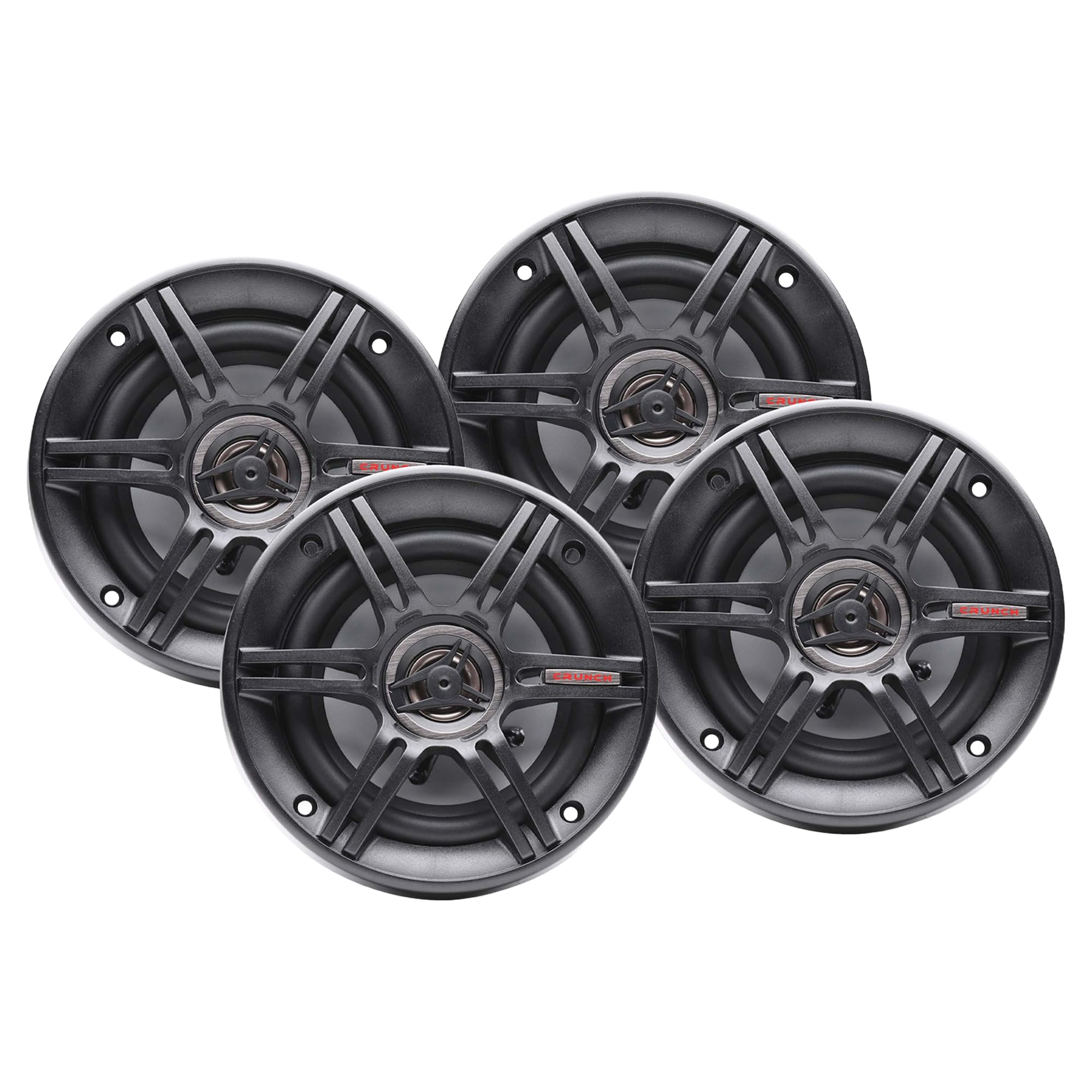
The most affordable way to replace all four factory speakers in a single purchase.
The Crunch CS-653 is a 3-way coaxial design, meaning it has a woofer, a tweeter, and an additional midrange driver on the same frame to cover the frequency gap between them. It handles up to 300 watts maximum power (no RMS given in the data) and has an 89 dB sensitivity rating, versus 88 dB for the Orion CB65C. The package includes two pairs of speakers (four total), so this is the cheapest way to replace all factory speakers in a four-door car at once. It uses impact-resistant Neo-Mylar soft dome tweeters for the highs and Silver Alpha-Cellulose cones for the mids, with moisture-resistant rubber surrounds on the woofers to add longevity by preventing foam rot over time.
Customers note these replaced 18-year-old car speakers and brought life to the audio system in a 2007 Silverado crew cab when powered by two channels of a 4-channel amp. However, the same reviewer noted that after a month of use, the highs started to sound poor and the rear-only sound was bad, with a recommendation to buy something else if you care about sound quality over saving money.
The four-at-once deal: no other pick in this guide gives you eight speakers for all four doors in a single purchase.
Quality ceiling: at about per speaker, the compromise is long-term clarity; it is a basic replacement, not an audiophile upgrade.
Best for: anyone replacing four blown factory speakers on a tight budget to get the car playing again with decent volume across all positions.
skip it if: you prioritize crisp vocal clarity or extended high-frequency detail — a higher-RMS coaxial or component set will serve you better long-term.
4. Kenwood KFC-1666S Coaxial Speakers

The loudest drop-in choice for factory radios, thanks to its 92 dB sensitivity that maximizes every watt.
The Kenwood KFC-1666S is a 2-way coaxial speaker rated at 30 watts RMS and 300 watts peak, with a very high 92 dB/w/m sensitivity. This sensitivity is the highest in this entire guide, at 92 dB versus the Orion CB65C at 88 dB, which means on a factory head unit — which typically delivers 15-22 real watts per channel — the Kenwood sounds louder and fuller without an external amplifier. It uses a 6.5-inch polypropylene (PP) cone for the woofer and a 1-inch balanced dome tweeter for the highs. The Kenwood also includes a feature called Sound Field Enhancer, which is their proprietary circuitry that widens the perceived soundstage to make the music feel less directional.
Reviewers point out these replace stock speakers in both a 2017 Kia Sorrento and a Subaru Crosstrek. One owner noted that you need to drill new screw holes; the stock mounts are not directly compatible. Another reviewer pointed out they did not fit standard 6.5-inch adapter brackets. These speakers reportedly need a break-in period — they sound disappointing for the first few hours before the cone suspension loosens up and the bass and clarity improve substantially.
Factory-Radio Friendly
- 92 dB sensitivity delivers the highest volume-per-watt for unamplified cars
- Polypropylene cone resists moisture better than paper cones in humid climates
- Sound Field Enhancer expands perceived spaciousness
Fitment Notes
- Does not always align with stock 6.5-inch screw holes or aftermarket adapter brackets
- Requires a break-in period before sounding their best
The unamplified champion: if your car runs a stock radio with no separate amp, this is the speaker that sounds loudest and clearest without extra hardware.
One real limit: the 30-watt RMS rating means it can be overdriven easily if you pair it with a high-power aftermarket amplifier — it is best as a stereo-driven speaker.
5. ORION Cobalt CT-CK655 Coaxial with Tweeters

A budget-friendly coaxial kit that includes separate tweeters for flexible placement options.
The Orion CT-CK655 is technically a 2-way coaxial speaker with an unusual twist — the package includes a set of two 6.5-inch coaxial speakers plus two dedicated 0.5-inch neodymium Mylar dome tweeters. This gives you the option to use the built-in tweeter on the coaxial frame, or wire in the separate tweeter somewhere else on the door panel for better aiming. The speaker handles 50 watts RMS, 130 watts nominal, and up to 450 watts max music power at 4 ohms. The woofer uses a polypropylene injection cone for rigidity and consistent sound reproduction.
Shoppers say it works well as a great budget upgrade for a 2017 Fiesta ST with a Sony head unit and no amplifier. The same reviewer noted that the bass lacks power but frequencies at and below 60Hz are crisp, and they recommend pairing these speakers with a 30-60 watt amplifier. However, one buyer warned that the frame is bulky and the overall diameter is too large for some cars that take standard 6.5-inch speakers, meaning you need to measure your door cutout carefully before buying.
Extra tweeter as plan B: having the option to mount a tweeter separately gives you tune-ability that pure coaxials lack.
Bulk measurement needed: the oversized frame makes this pick riskier for tight factory mounting holes — less universal than the Kenwood.
The flexible budget pick: best for DIYers who want the option to mount tweeters separately without buying a full component system.
pass on it if: your car has tight, shallow door panels because the oversized frame and tweeter bracket can cause fitment headaches.
6. Alpine SXE-1751S Component System

A reliable budget component set with verified owner reports of no buzzing or failures after over a year of use.
The Alpine SXE-1751S runs at 45 watts RMS and 280 watts peak at 4 ohms, with a frequency response of 60Hz to 20kHz. That 60Hz low-end extension is the deepest in this lineup, versus the Orion CB65C at 70Hz, meaning it can reproduce deeper bass tones before distortion sets in. It uses a polypropylene woofer cone and a plastic/polypropylene enclosure material. As a component system, the tweeters and woofers are separate, requiring you to mount the tweeters in a location on the sail panel or dash and wire them through the supplied external crossover.
Buyers report these were a major upgrade from factory speakers in a 2005 GMC Sierra running alongside an Alpine subwoofer and a Sundown amplifier. Another owner noted they sounded amazing and were originally bought as cheap replacements for expensive Focal speakers, which is a strong endorsement for the value-to-price ratio. The data shows 280W peak and 45W RMS for the Alpine, versus 80W peak and 40W RMS for the Rockford.
Low-End Extension
- 60Hz frequency response reaches lower than the Orion CB65C’s 70Hz
- Reported reliability — no buzzing or failures after 1+ year in one owner’s truck
- Accepts both voice control and wired connection
Body Check
- 45W RMS is lower than the Hifonics Zeus (60W RMS) and Orion CB65C (70W RMS)
- Some buyers ordered them and found the speakers too big for their setup despite being labeled as 6.5-inch
Reliable pick for amplified builds: the deep 60Hz response and proven lack of buzzing make it a safe bet for daily-driving performance without failures.
The honest trade-off: you are paying for reliability and low-end response, not raw power handling; the Hifonics below gives you a higher RMS number for the same dollars.
7. Hifonics Zeus ZS65C Component System
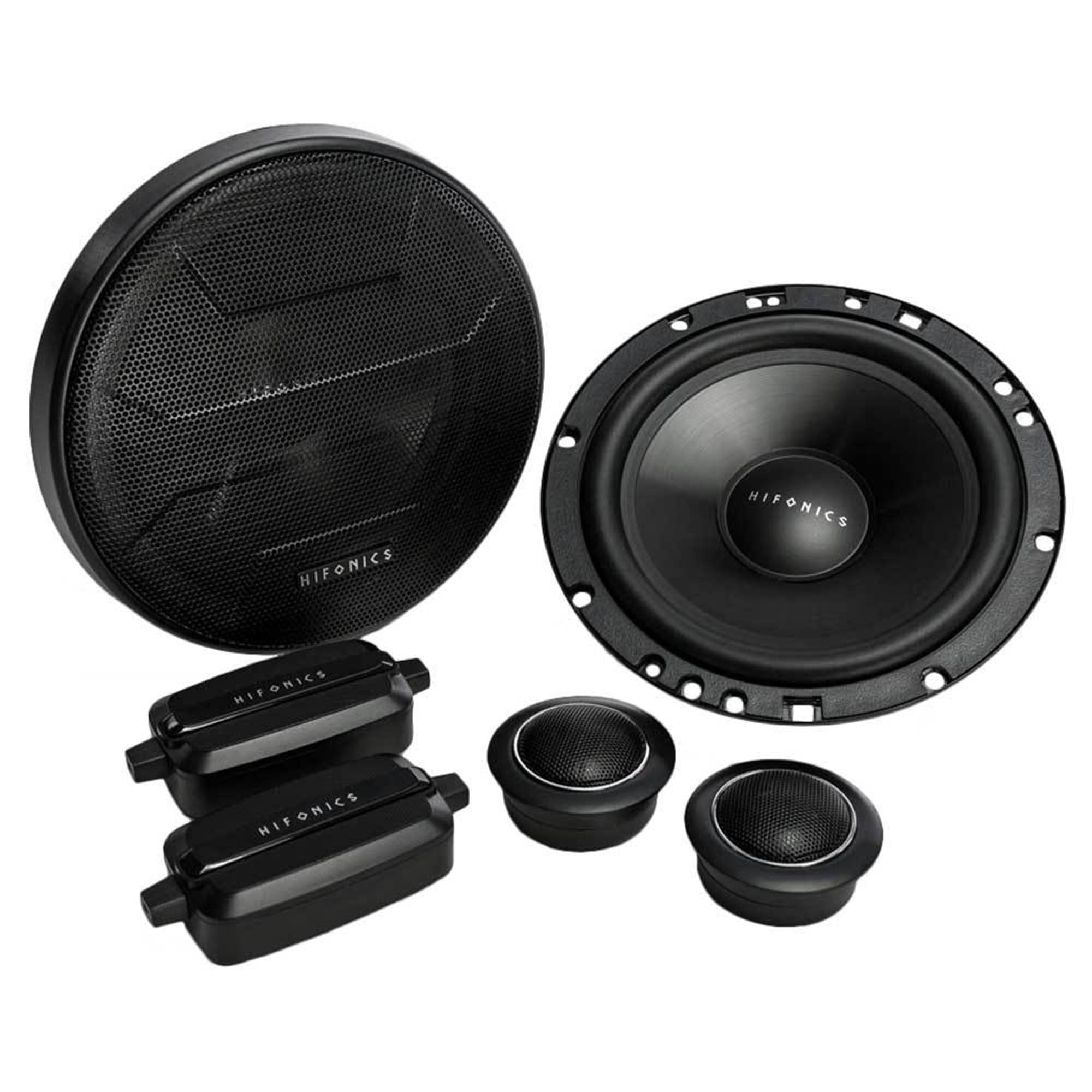
The component system with the highest peak power rating in this guide, offering headroom for occasional volume spikes.
The Hifonics Zeus ZS65C handles 60 watts RMS and 400 watts peak power, making it the absolute highest peak number in the entire lineup, at 400W versus the Crunch’s 300W peak. When mounted, it uses a moisture-resistant rubber surround on the woofer to protect against door moisture and a high mid-bass impact design. The kit includes a 12 dB in-line crossover, all tweeter mounting hardware, and grilles for the mid-woofers. The speaker impedance is 4 ohms, matching standard car audio requirements.
Owners mention these fit well in a 2010 Jeep Wrangler without needing any adapters. Some owners were very impressed, calling them amazing and easy to install, while one reviewer had an opposite experience, reporting crackling on one speaker and a feeling that the quality had dropped compared to older Hifonics gear. This split of reviews (mostly positive but with one quality complaint) makes this pick best for buyers willing to take a small risk on consistency for the reward of high peak-power handling at a budget price.
Peak power value: 400W peak is the highest in this guide, making it the best option for withstanding accidental volume spikes.
Quality split: the reviews are very polarized — most are 5-star, but one buyer got a crackling unit, suggesting batch variance.
Best for: anyone who wants the highest peak-power headroom (400W) on a budget and drives a vehicle (like a Jeep Wrangler) where the rubber surround’s moisture resistance is an actual advantage.
Consider the risk: the split reviews indicate a possible quality inconsistency, so buy from a retailer with a reliable return policy.
Understanding the Specs
RMS Power — Your Real Continuous Volume
RMS stands for Root Mean Square, and it is the only power figure that matters for daily listening. It represents the continuous wattage a speaker can handle indefinitely without overheating or distorting. A speaker with 70W RMS has more continuous power handling than one with 30W RMS, but only if your amplifier can deliver that much power. A high-RMS speaker on a low-wattage factory head unit will sound quiet because it cannot reach its potential.
Sensitivity (dB/w/m) — How Efficient the Speaker Is
Sensitivity tells you how loud a speaker gets from a fixed 1-watt input, measured at 1 meter distance. A measurement of 92 dB/w/m is higher than 88 dB/w/m for the same power input. For a factory radio that only puts out 15-20 watts per channel, a high-sensitivity speaker in the 90-92 dB range is the smarter choice than a lower-sensitivity speaker that would sound quiet without an amp.
Frequency Response — The Range of Sound
Frequency response (measured in Hz to kHz) shows the lowest and highest sounds a speaker can reproduce. A lower number on the left (like 60Hz vs 70Hz) means the speaker produces deeper bass tones before rolling off. A higher number on the right (like 20kHz) covers the highest treble frequencies. Most car speakers cover from around 60-70Hz up to 20kHz, with the sub-bass below 60Hz typically requiring a dedicated subwoofer.
Mounting Depth and Cutout Diameter
Mounting depth is the distance from the bottom of the speaker magnet to the top of the mounting flange. If the magnet is too deep, it hits the window mechanism or inner door panel when the window is rolled down. Cutout diameter is the hole size needed in the door metal. Most 6.5-inch speakers require a hole about 5.75 to 6.0 inches in diameter. Always confirm both measurements against your car’s factory speaker specs or look up vehicle-specific adapters before buying.
FAQ
Will any 6.5-inch car speaker fit my car’s factory hole?
Do I need an amplifier for 6.5-inch car speakers?
What is the difference between coaxial and component speakers for door installation?
Can I replace 6.5-inch speakers with 6.75-inch speakers?
What does 4-ohm impedance mean for car speakers?
How long do 6.5-inch car speakers typically last?
Is a 3-way speaker better than a 2-way speaker?
What tools do I need to install 6.5-inch car speakers?
Will upgrading to 6.5-inch speakers drain my car battery faster?
Can I mix coaxial speakers in the rear with component speakers in the front?
Final Thoughts: The Verdict
Across the board, the best 6.5 inch car speakers winner is the Kenwood KFC-1666S because its 92 dB sensitivity makes it the smartest choice for the vast majority of cars that run on a factory head unit — it delivers loud, clear sound without spending money on an amplifier. If you want the highest RMS power handling for a serious amplified build, grab the ORION CB65C Component System with its 70W RMS rating. And for the most budget-friendly option to replace all four blown factory speakers in one box, the standout is the Crunch CS-653 2-Pair Set.
How We Picked
We do not accept paid placement, and we did not hands-on test every unit. Instead, we match each pick to a real buyer and use-case by comparing the manufacturers’ published specifications against the patterns in verified customer reviews — so you get each pick’s real strengths and trade-offs instead of marketing copy.
Sources & Methodology
Specifications: manufacturer listings and product documentation. Review insights: verified customer reviews, as of July 2026. Pricing: not shown on this page (it changes often); check the current price via the retailer link.
As an Amazon Associate, Gadgets Feed earns from qualifying purchases. This does not affect which products we feature.
Product prices and availability are accurate as of the date/time indicated and are subject to change. Any price and availability information displayed on Amazon at the time of purchase will apply to the purchase of this product. As an Amazon Associate I earn from qualifying purchases.
CERTAIN CONTENT THAT APPEARS ON THIS SITE COMES FROM AMAZON. THIS CONTENT IS PROVIDED "AS IS" AND IS SUBJECT TO CHANGE OR REMOVAL AT ANY TIME.
Amazon and the Amazon logo are trademarks of Amazon.com, Inc. or its affiliates.