
Our readers keep the lights on and my morning glass full of iced black tea. As an Amazon Associate, I earn from qualifying purchases.
Specs are compiled from manufacturer listings and verified buyer reviews and can change over time — please confirm the key details on the product page before buying.
Upgrading your car’s sound starts with the speakers that carry vocals and guitars — the midrange. The right 6.5-inch mid can make a stock stereo feel like a custom build, while the wrong one distorts or dies when you push it. This guide breaks down nine proven 6.5 midrange speakers, focusing on the specs that actually decide how loud and how clean they play.
I’m Min — the founder and writer behind Gadgets Feed. This guide is built by comparing the manufacturers’ published specifications and the patterns across verified customer reviews, so you get each pick’s real strengths and trade-offs instead of marketing spin.
If you want vocals that cut through bass without distortion, these are the best 6.5 midrange speakers you can buy for power, clarity, and long-term reliability.
Our Picks at a Glance


How To Choose The Best 6.5 Midrange Speakers
Before you buy, you need to know what a midrange speaker actually does. It handles the frequencies between the deep bass of a subwoofer and the high hiss of a tweeter — vocals, guitars, horns. The trick is matching the speaker’s power limits and sensitivity to your amplifier.
Match RMS Power To Your Amplifier
RMS is the amount of power a speaker can handle continuously — it’s the real-world number, not the peak. If you feed a speaker more RMS than it’s rated for, you risk frying the voice coil. If you feed it too little, you’ll never hear what it can do. A midrange rated around 250W RMS pairs well with a strong 4-channel amp, while a 100W RMS speaker works for a factory head unit.
Check The Sensitivity Rating
Sensitivity, measured in decibels (dB), tells you how loud a speaker plays with a single watt of power. A higher number means more volume from less power — a 96 dB speaker will be noticeably louder than an 89.5 dB one on the same amp. For midrange speakers that sit behind doors and panels, a higher sensitivity means you hear vocals clearly even over road noise and bass.
Bullet Or No Bullet
A bullet phase plug sits in the center of the speaker cone, acting like a radiator to cool the voice coil and shape the sound. Speakers with a bullet reach up into the higher frequencies without losing the mids, which makes them ideal for 3-way systems. If you only want clean midbass, a traditional cone design without the bullet may suit you better.
Quick Comparison
| Model | Best For | RMS Power | Sensitivity | Size | Amazon |
|---|---|---|---|---|---|
| ORION Cobalt CM654★ Best Overall | Overall Power & Value | 250W | 96.67 dB | 6.5″ | Amazon |
| Harmony Audio HC-CMB65Budget Pick | Budget Carbon Cone | 100W | 89.5 dB | 6.5″ | Amazon |
| Timpano TPT-MR6-4Compact Fit | Shallow Mount Install | 500W Max | — | 6.5″ | Amazon |
| RECOIL MS65-4P | High Power Budget | 300W | — | 6.5″ | Amazon |
| CT Sounds MESO65-4 | Clear Vocals & Guitar | 250W | 96 dB | 6.5″ | Amazon |
| DS18 PRO-X6.4BM | Pro Build Quality | 250W | — | 6.5″ | Amazon |
| PRV AUDIO 6MR400-4 | Heavy Duty Power Handling | 400W | — | 6″ | Amazon |
| ORION XTR XTX654 | Highest Output ORION | 350W | 97 dB | 6.5″ | Amazon |
| Deaf Bonce AP-M67AC | Extreme Power & Clarity | 300W | — | 6.5″ | Amazon |
In‑Depth Reviews
1. ORION Cobalt CM654
Our pick — over 4.5★ from 800+ verified ratings; the strongest balance of quality and price.
The crowd favorite that turns a stock door into a pro sound stage without breaking your budget.
Sound quality is the thing that wins people over here — it’s the most-discussed aspect by a wide margin. Owners consistently describe the sound as clear and strong, with many noting an immediate improvement after swapping out factory speakers. The 1000W max power and 250W RMS at 4 ohms give you serious headroom for a dedicated amplifier.
What makes this pick special is the efficiency: a 96.67 dB sensitivity rating means it plays loud even when your amp isn’t cranking. The 1.5″ high-temperature voice coil handles the heat of extended play, and the bullet phase plug lets it reach high frequencies without sacrificing the mids. With a mounting depth of just 2.75″, it fits most factory locations without major modification.
The crowd favorite — 4.6 stars across 800+ ratings — is proof of its value. Owners rave about the “bang for your buck,” with several calling it a clear upgrade over more expensive brands they’d considered. The one honest warning: this speaker demands a proper amp, and tuning matters. As buyers report, “Bridging on 4ch amp fried voice coils in ~2min” — run one channel per speaker and set your gains carefully.
Why It Wins
- Extremely high 96.67 dB sensitivity for loud output on moderate power
- 250W RMS handles real amplifier power without distortion
- Bullet design extends high-frequency response for a dynamic range
Handle With Care
- Requires a proper amplifier — not for stock head unit power alone
- Gain and frequency tuning is critical; wrong settings can fry the voice coil
Reach for these if: you want the proven blend of loud, clear output and value that thousands of owners already trust.
Look elsewhere if: you don’t plan to run a dedicated amp with careful tuning — these need real power to shine.
2. Harmony Audio HC-CMB65
An entry-level carbon cone that delivers clean, natural sound for a factory-replacement price.
Quality and sound clarity are the top-mentioned aspects, and the consensus is that this is a solid budget speaker. The carbon fiber cone is lightweight yet rigid, which keeps distortion low and detail high in the midbass and midrange frequencies. The 4-ohm impedance makes it a drop-in match for most factory stereos and basic amplifiers.
At 200W max with 100W RMS, this isn’t a speaker for massive builds — it’s for clean, everyday listening. The 89.5 dB sensitivity is on the lower side, so it won’t blast as loud as the ORION Cobalt above (which hits 96.67 dB — about 8% more output). That’s the trade-off for the budget price, and it plays perfectly fine for vocals and podcasts at normal volumes.
The honest catch: power handling is limited. Owners mention that “Initially couldn’t handle power, bottomed out/distorted; after adjusting amp gains, plays loud/clean” — so treat it gently with a modest amp setting and it will reward you with clear sound. Fit is praised in custom door pods, and the build quality feels solid for the money.
The Good
- Carbon fiber cone minimizes distortion for clear midrange
- 4-ohm impedance matches a wide range of factory systems
- Solid build quality that fits custom door pods well
The Limit
- Lower 89.5 dB sensitivity means less volume on same power
- Limited power handling — easy to overdrive and distort
Choose this if: you want a cheap, clean-sounding upgrade for a factory stereo without adding a powerful amp.
skip it if: you’re building a loud system — this one needs modest power to stay clean.
3. Timpano TPT-MR6-4
A shallow bullet speaker that slides into tight door spaces and still gets loud on modest power.
The shallow mount design is the headline here — it’s built for tight spaces like car doors where a deeper magnet won’t fit. That slim profile doesn’t sacrifice output; with a 500W max rating at 4 ohms, it’s a single-speaker solution (sold individually, not as a pair) that works well in a 3-way system with a sub and tweeter.
Efficiency is the star. Customers note that “With only 60 watts RMS, they get pretty loud” — proof of how well this speaker converts low power into volume. That makes it a great match for a modest amplifier in the recommended 25-200W RMS per channel range. The bullet phase plug helps it extend into higher frequencies without losing the mids.
The sound clarity gets rave reviews; one owner called it “one of the best sounds” they’d put in their Jeep Wrangler, comparable to pricier speakers that look similar. The slim build is a genuine fit saver for factory locations, though you’ll want speaker adapters for a clean install in many vehicles.
Standout trait: The shallow profile combined with high efficiency makes this the go-to for tricky door installs that need real volume.
Who it’s for: Anyone upgrading factory door speakers where depth is a problem and amp power is limited.
4. RECOIL MS65-4P

A budget-priced power beast that delivers 300W RMS of clean, crisp midrange for serious builds.
Sound quality leads the conversation here by a massive margin, and value for money is right behind it. The 600W max with 300W RMS at 4 ohms (per pair) is genuinely high output for the price point — more than enough to keep vocals cutting through loud bass. Owners describe the sound as “crisp” and “crisp” at high volumes.
The secret is the 1.5″ high-temperature Kapton voice coil, which handles extreme heat and keeps its shape over time. High-strength ferrite magnets produce a wide range of tones and take tremendous power at volume. It’s a true pro-audio/car-audio hybrid designed to pump high output from factory speaker locations.
The honest note: durability gets mixed feedback, with some concern about longevity, and several owners had to trim their door for fit — one Audi owner needed a 1/8″ trim ring. For the price, the performance is remarkable; reviewers point out it easily bests pricier brands like DS18 and PRV. Just pair it with a decent amp and cross it over around 80-100Hz for best results.
What Stands Out
- High 300W RMS power handling for loud, clean output
- Kapton voice coil resists heat for longer life
- Exceptional value — outperforms speakers costing much more
Where To Be Careful
- Durability is mixed — some report issues over time
- May need minor trimming or adapters for some stock locations
Choose this for: maximum output per dollar in a midrange that loves a strong amplifier.
Think twice if: you need a guaranteed easy fit and plan to run them hard every day for years.
5. CT Sounds MESO65-4

The vocal specialist — owners say guitars and singers cut through louder than their subwoofer.
Sound quality is the overwhelming theme here, with the most-discussed aspect being how clear and loud the midrange comes through. Owners specifically note that “vocals and guitar are now louder than the 10″ subwoofer” — the ultimate compliment for a midrange speaker that’s supposed to carry the music’s soul. The 96 dB sensitivity rating at 250W RMS means it plays efficiently and handles real power.
The engineering is what enables this clarity. A CCAW voice coil (copper-clad aluminum wire) runs cooler and plays louder at middle and high frequencies than standard copper coils. The custom tooled basket lets the spider sit higher, so the lead wire never hits the front plate at high power — a clever detail for durability.
Build quality is heavy and reassuring, with large magnets that owners describe as “outperforming DS18” in direct comparison. It handles 150-200W RMS easily even though it’s rated to 250W, staying crisp at high volumes. The only note: the push terminals protrude, which can make for a tight fit in some doors like a Honda Civic, and it really wants a solid 200W amp to shine.
The verdict: If your priority is hearing every vocal and guitar lick with stunning clarity over heavy bass, this is the one.
Amp requirement: Plan on feeding it 150-200W RMS — it needs a real amplifier to show what it can do.
6. DS18 PRO-X6.4BM

A tough, good-looking pro midrange with a bullet design that handles big power and big vocals.
Sound quality leads here too, with amazing mids and clear vocals being the consistent praise. The 500W max power with 250W RMS at 4 ohms is plenty for a full-range build, and shoppers say zero distortion even at high volume with the right amplifier. The 1.5″ high-temperature CCAW voice coil keeps things cool under pressure.
The bullet dust cover is the defining feature — it protects the voice coil and shapes the sound for optimal output every time. This is a speaker that “sounds great with just instrumentals and, even better with vocals,” making it a strong pick for a 3-way system. The red cone color also stands out visually if you run an open install.
Value and reliability get consistent praise; one owner ran them for 8 months without issue, another for a full year and ordered a second set. The honest caveat: durability is mixed, with a small number reporting blown units early on — one at 75W RMS after a minute, which appears to be a defective unit rather than a pattern. And they’re “kinda bulky,” so measure your mounting depth first.
Strengths
- Clear, loud mids and vocals with zero distortion on good power
- Bullet design protects the voice coil and extends frequency range
- Strong build quality that holds up over a year of daily use
Watchouts
- Bulkier frame needs careful depth measurement before install
- A small minority report early failures — quality control varies
Best for: builders who want a proven, good-looking pro midrange with excellent vocal reproduction.
Not for: tight factory locations — the bulky frame demands space behind the door panel.
7. PRV AUDIO 6MR400-4
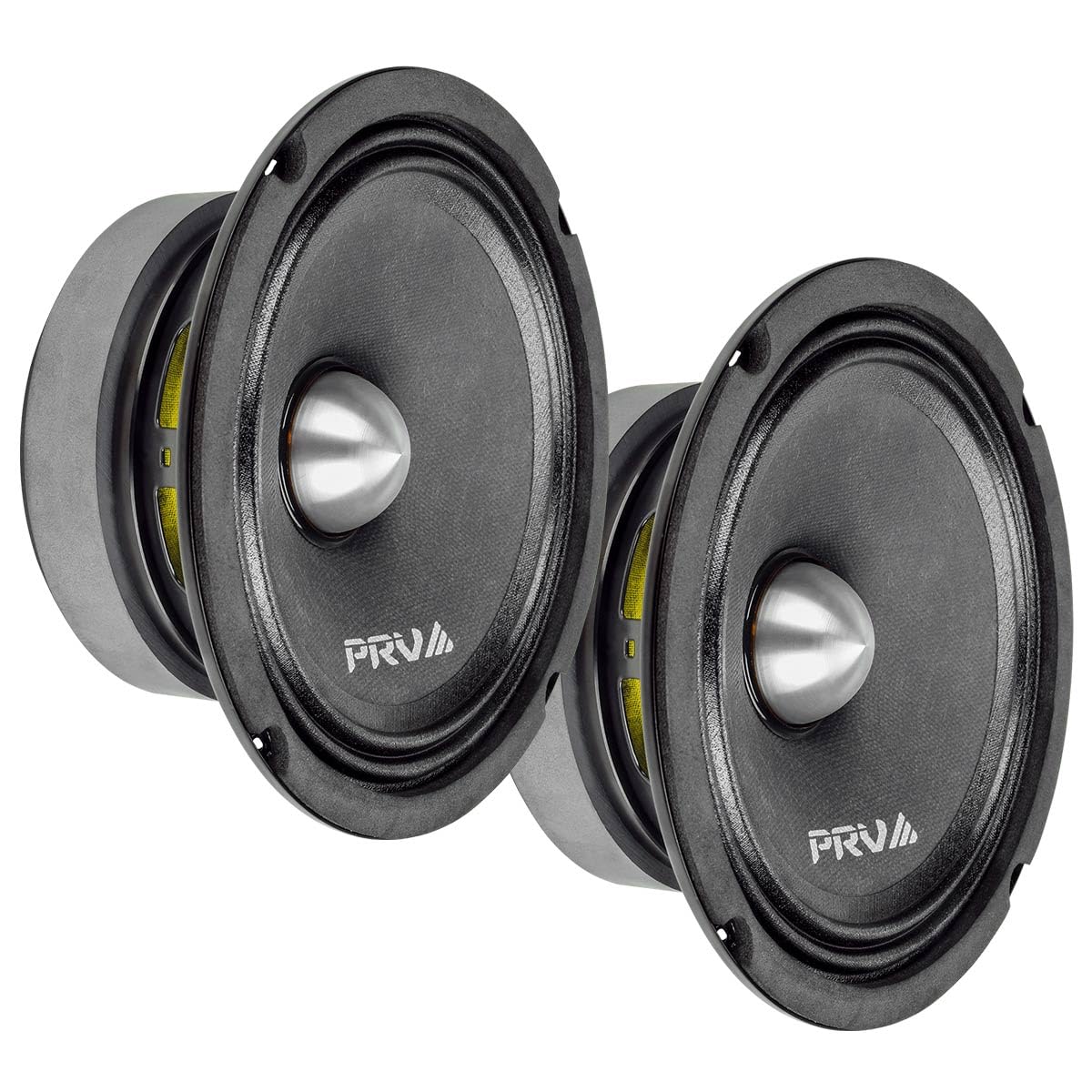
A heavy-duty pro bullet with a pure aluminum phase plug that cools the coil and plays loud.
Sound quality is the most-cited aspect, with owners loving how loud and clear these play. The headline spec is the 400W continuous program power (RMS) — serious headroom for a custom door system. It’s designed as part of a 3-way setup alongside a subwoofer and tweeter, and it delivers “outstanding sound stage quality and realistic sound reproduction.”
The engineering detail that sets PRV apart is the bullet phase plug made from pure aluminum. It acts as a radiator cooling system for the voice coil, letting you push the speaker hard without heat failure. The stamped steel enclosure and heavy magnet (owners note each one weighs around 2-3 pounds) speak to the pro-grade construction.
That weight is a double-edged sword. Owners in an F150 found it a great upgrade for rear doors, but someone installing in a Jeep JKU pod had to modify the pod because “the magnet was too big.” Check your mounting depth — this is a deep speaker built for serious custom work, not always a drop-in factory replacement.
The draw: 400W RMS of bullet-style power with cooling that lets you hammer it for hours.
The catch: The heavy, deep frame means you’ll likely need custom pods or modification in many vehicles.
8. ORION XTR XTX654

The most efficient ORION with a 97 dB rating — maximum output on minimum amplifier power.
Sound quality leads here, with a special focus on midrange performance that owners call “the best quality and clarity 6.5 speakers out there.” The 1400W max power with 350W RMS at 4 ohms is the top of the ORION line, but it’s the 97 dB sensitivity that makes it special — the highest in this lineup, meaning it plays louder than anything else on the same wattage.
The 1.5″ high-temperature voice coil and 40 oz magnet structure handle the power, while the bullet design extends the high frequencies without losing the lows. Buyers report it even outperformed their Hertz coaxial door speakers, and one Silverado owner swapped out JBL 6.5s for these and called the CT Sounds in their front doors “not as good as the Orion’s.”
The serious caveat is reliability — it’s the one aspect with a clear negative flag, with some units arriving dead or failing quickly. Fit is also tight: at a 2.96″ mounting depth, it’s a deep speaker that won’t fit every door without adapters or modification. For the performance at this price, it’s worth the effort if your install allows it, but check your depth first.
Why It’s A Top Performer
- Highest 97 dB sensitivity in the lineup — maximum loudness per watt
- 350W RMS and 1400W max for serious headroom
- Bullet design with 40 oz magnet plays a wide dynamic range
The Risks
- Reliability is the recurring concern — some units fail or arrive dead
- Deep 2.96″ mounting depth needs careful fit checking
Choose this if: you want the absolute loudest, most efficient ORION and you’re comfortable with a custom-depth install.
Weigh the risk: the reliability reports mean you’ll want to test them immediately and know your return window.
9. Deaf Bonce AP-M67AC

The Apocalypse series brings 300W RMS of crisp, clean power that owners say can light up a neighborhood.
Loud and clear is the consistent theme, with one owner noting their sound is so powerful it “can light up a neighborhood.” The 300W RMS power handling is the headline, and owners confirm it takes serious watts: one reports running 600 watts without melting the voice coils, while another runs just two of these on a 250W x2 channel amp and hears a clear clarity difference over their old 95 dB speakers.
There’s no tweeter in the middle to get in the way — that’s the design philosophy here. The result is a speaker built to “run a lot of watts and not melt the voice coils,” with sound so good and clear you might turn off your super tweeters once you tune these in. The build weight is “perfect” — heavy enough to know they’re quality, light enough to install easily.
The 4-ohm impedance keeps installation versatile across different audio systems, and the professional-grade build is aimed at both enthusiasts and installers. Sound quality and value are the top-mentioned aspects, with owners consistently recommending buying again. Just remember these are sold as a pair (2 speakers) and they want a serious amplifier to reach their potential.
The appeal: Extreme power handling and clean, crisp output with a no-tweeter design that lets the midrange shine.
The requirement: This is a 300W RMS speaker — feed it real power or you won’t hear what it can do.
Understanding the Specs
RMS vs Max Power
RMS (root mean square) is the continuous power a speaker can handle safely — think of it as the speed you can drive all day. Max power is the brief burst it can survive — like a quick sprint. A speaker rated 250W RMS and 500W max can play at 250W continuously, which is the number that matters when matching an amplifier.
Sensitivity (dB)
Sensitivity measures how efficiently a speaker converts power into volume, using decibels (dB). A 96 dB speaker will be significantly louder than an 89.5 dB speaker when both get the same wattage. For midrange speakers that need to cut through road noise and bass, higher sensitivity means your vocals stay clear without cranking the amp.
FAQ
What is the difference between a midrange speaker and a full-range speaker?
How much RMS power do I need for 6.5 midrange speakers?
Will a 6.5 midrange speaker fit in my factory door location?
What does a bullet phase plug do in a midrange speaker?
Can I run midrange speakers without a subwoofer?
Why do my midrange speakers sound distorted at high volume?
What is the best amplifier for 6.5 midrange speakers?
How do I know if a midrange speaker is good quality?
Are more expensive midrange speakers worth the money?
What does the frequency response range mean on a midrange speaker?
Final Thoughts: The Verdict
For most people, the 6.5 midrange speakers winner is the ORION Cobalt CM654 because it balances a high 96.67 dB sensitivity, solid 250W RMS power, and a price that makes it the crowd favorite. If you want the absolute loudest output and have depth to spare, grab the ORION XTR XTX654 with its 97 dB rating. And for a budget-friendly carbon cone that’s perfect for a factory upgrade, the Harmony Audio is the one to reach for.
How We Picked
We do not accept paid placement. Every pick is matched to a real buyer and a real use-case; we do not hands-on test units.
Sources & Methodology
Specifications: manufacturer listings and product documentation. Review insights: verified customer reviews, as of September 2026. Pricing: not shown on this page (it changes often); check the current price via the retailer link.
As an Amazon Associate, Gadgets Feed earns from qualifying purchases. This does not affect which products we feature.