
Factory-installed car speakers are typically built to a cost, using paper cones and undersized magnets that distort at moderate volume and roll off the treble and bass long before your music demands it. Upgrading to a set of dedicated aftermarket drivers transforms the listening experience, revealing detail in recordings you never knew existed and adding punch to the low end without requiring a subwoofer.
I’m Min — the co-founder and writer behind Gadgets Feed. I’ve spent many hours analyzing frequency response charts, sensitivity ratings, and real-world user reports to understand exactly which models deliver measurable improvements over stock audio systems.
Whether you are refreshing a daily driver or building a dedicated sound system, finding the right set of 6 auto speakers is the single most impactful upgrade you can make for in-car audio fidelity.
How To Choose The Best 6 Auto Speakers
A car speaker’s job is to reproduce audio accurately inside a hostile environment: temperature swings, road vibration, and limited air space inside the door panel. Knowing how to evaluate the key specs keeps you from buying a speaker that sounds worse than the one you are replacing.
Sensitivity and Power Handling
Sensitivity, measured in decibels (dB) at 1 watt/1 meter, tells you how loud the speaker plays with a given amount of amp power. A rating of 91 dB or higher means the speaker will produce ample volume from a factory head unit without an external amplifier. Lower sensitivity models (under 88 dB) typically need dedicated amplification to sound their best. Power handling splits into peak (brief loud bursts) and RMS (continuous clean power); focus on RMS — that is the number that predicts real-world performance without distortion.
Cone Material and Tweeter Type
Polypropylene cones resist moisture and temperature changes better than paper, delivering consistent midbass and midrange over years of use. Mica-infused cones add stiffness for cleaner transients. For the tweeter, a silk dome produces smooth, non-fatiguing highs ideal for long listening sessions, while a PEI (polyether imide) dome offers more sparkle and detail at the cost of potential harshness on poorly recorded tracks. Your choice depends on whether you prioritize fatigue-free listening or airy, extended treble.
Quick Comparison
On smaller screens, swipe sideways to see the full table.
| Model | Category | Best For | Key Spec | Amazon |
|---|---|---|---|---|
| Pioneer TS-A1681F | Premium | Overall upgrade with factory radio | 4-way, 80W RMS, 91 dB sensitivity | Amazon |
| Rockford Fosgate P16 | Premium | Compact mounting depth | 55W RMS, 1.93″ mount depth | Amazon |
| NVX VSP60 | Premium | High-power amp setups | 200W RMS/pair, silk tweeters | Amazon |
| JBL Stage3 627FHI | Mid-Range | Plug-and-play replacement | 45W RMS, 92 dB sensitivity | Amazon |
| Pioneer TS-F6935R | Mid-Range | 6×9 rear fill in vans/trucks | 30W RMS, 87 dB sensitivity | Amazon |
| RECOIL REM525 | Mid-Range | 5.25″ component upgrade | 80W RMS/pair, silk tweeters | Amazon |
| JVC CS-J620 | Budget | Entry-level clarity improvement | 30W RMS, 92 dB sensitivity | Amazon |
In‑Depth Reviews
1. Pioneer TS-A1681F 6.5″ 4-Way Speakers

The Pioneer A-Series Plus TS-A1681F packs a 4-way driver arrangement into a standard 6.5″ frame, using separate diaphragms for lows, mids, and highs to reduce intermodulation distortion. With an 80-watt RMS rating and 91 dB sensitivity, these speakers produce clear, distortion-free output even when driven by a factory radio — no external amp required for decent volume.
The 35 Hz to 29 kHz frequency response extends deeper than most coaxial speakers in this class, giving kick drums and bass lines real weight. The included multi-fit installation adapters simplify mounting in vehicles that require a non-standard screw pattern, and the open basket design reduces trapped air resonance behind the cone.
Real-world owners report a dramatic improvement over paper-cone factory speakers, with clean highs, solid midbass, and no distortion at normal listening levels. The only trade-off is that the 4-way design can sound slightly busy on very complex tracks, but for daily driving and music variety, this is a minor concern.
Why it’s great
- 4-way driver design for detailed sound separation
- High 91 dB sensitivity works well with stock head units
- Includes mounting adapters for flexible installation
Good to know
- 4-way layout may sound cluttered on intricate passages
- Plastic basket less rigid than stamped steel alternatives
2. Rockford Fosgate P16 Punch 6.0″ 2-Way Coaxial

The Rockford Fosgate P16 Punch series is engineered for tight spaces — the mounting depth measures only 1.93 inches, making these 6-inch speakers a direct fit in many doors that would reject a deeper basket. The FlexFit basket geometry uses strategically placed cutouts to clear window tracks and regulators, a common pain point in Japanese and European vehicles.
Rated at 55 watts RMS with 110 watts peak, these coaxial speakers produce controlled bass and crisp highs without an outboard amplifier. The included grilles and adapter plates simplify the swap, and the rubber foam mounting ring isolates vibration to prevent buzz and rattle at higher volumes. Owners consistently praise the clear, concert-like soundstage in trucks and older sedans.
One minor drawback is that the speaker wire is not included in the package, so you will need to supply your own 16-gauge or thicker cable. The narrow 5.05-inch mounting diameter also means you should measure your factory cutout before purchase, especially if your vehicle uses a non-standard 6-inch frame.
Why it’s great
- Ultra-shallow 1.93″ mounting depth fits tight doors
- FlexFit basket clears window tracks easily
- Known Rockford build quality and 1-year warranty
Good to know
- Speaker wire not included in the box
- Mounting diameter may require measurement for some vehicles
3. NVX VSP60 6″ Premium Car Speakers

The NVX VSP60 is built for listeners who plan to feed their speakers real power. With a combined RMS of 200 watts per pair (100 watts per speaker), these 6-inch coaxials can handle serious amplifier output without thermal compression. The polypropylene cone and NBR rubber surround provide the stiffness and durability needed for sustained high-SPL playback.
A 1-inch silk dome tweeter with a built-in crossover delivers smooth, extended highs that avoid the harshness typical of metal-dome designs. The 68 Hz to 20 kHz frequency response leans toward the midbass region, meaning these speakers punch hard on kick drums and bass guitar but roll off below 60 Hz — a compromise that keeps distortion low at high output.
Installation requires a cutout diameter of 5.11 inches and a top-mount depth of 2.51 inches, which fits most standard 6-inch openings. Some owners report needing to drill new mounting holes for older American trucks, so verify your bolt pattern before committing.
Why it’s great
- High 200W RMS power handling for amplified systems
- Silk dome tweeters for fatigue-free highs
- Heavy build quality with polypropylene/NBR construction
Good to know
- Rolls off below 60 Hz — not for deep sub-bass without a subwoofer
- Bolt pattern may not match older domestic vehicles
4. JBL Stage3 627FHI 6″ 2-Way Coaxial Speakers

The JBL Stage3 627FHI uses an injection-molded polypropylene woofer cone with a Plus One geometry that increases cone area without enlarging the basket, boosting overall output efficiency. The 92 dB sensitivity rating means these 6-inch speakers produce noticeably higher volume than most competitors when driven by the same head unit power — ideal for factory radio upgrades.
A PEI balanced dome tweeter handles high frequencies up to 20 kHz, delivering the crisp, detailed treble JBL is known for. The vented basket frame reduces back-pressure behind the cone, improving midbass articulation. At 45 watts RMS, they are best paired with a head unit that delivers at least 15-20 clean watts per channel to avoid clipping at high volume.
Fit and finish are typical JBL quality, and the included mounting hardware covers most applications. A small number of owners have reported premature failure on one speaker, but the overall trend shows reliable performance for daily driving. If your priority is maximum volume from a stock radio, this model delivers loud and clear.
Why it’s great
- High 92 dB sensitivity for loud output from factory power
- Plus One cone increases effective radiating area
- PEI tweeter delivers detailed, extended highs
Good to know
- A small number of reliability reports on early units
- Needs at least 15W clean power to avoid distortion
5. Pioneer TS-F6935R 6×9″ 3-Way Coaxial Speakers

The Pioneer TS-F6935R brings a 3-way coaxial design to the 6×9 form factor, adding a dedicated midrange driver between the woofer and tweeter for improved vocal clarity. Power handling is rated at 230 watts peak and 30 watts RMS — modest numbers that pair naturally with factory amplifiers in vans, trucks, and SUVs that use the larger 6×9 footprint.
With an 87 dB sensitivity rating, these speakers benefit from an external amplifier to reach their full potential, but owners report a massive upgrade over paper factory drivers even on stock power. The flush-mount black and silver design looks clean behind factory grilles, and the standard 6×9 bolt pattern fits without modification in most Chrysler, Ford, and Toyota applications.
Real-world users note that these speakers shine when paired with an aftermarket head unit or a small amp, producing clear sound across all frequencies. At low volumes without amplification, the sound can lack bass impact, making them a better choice for those willing to add a small amp later.
Why it’s great
- 3-way design adds dedicated midrange driver
- Standard 6×9 fitment for vans and trucks
- Massive upgrade over factory paper speakers
Good to know
- 87 dB sensitivity benefits from external amplification
- Low bass impact without an amp at moderate volume
6. RECOIL REM525 Echo Series 5.25″ Component System
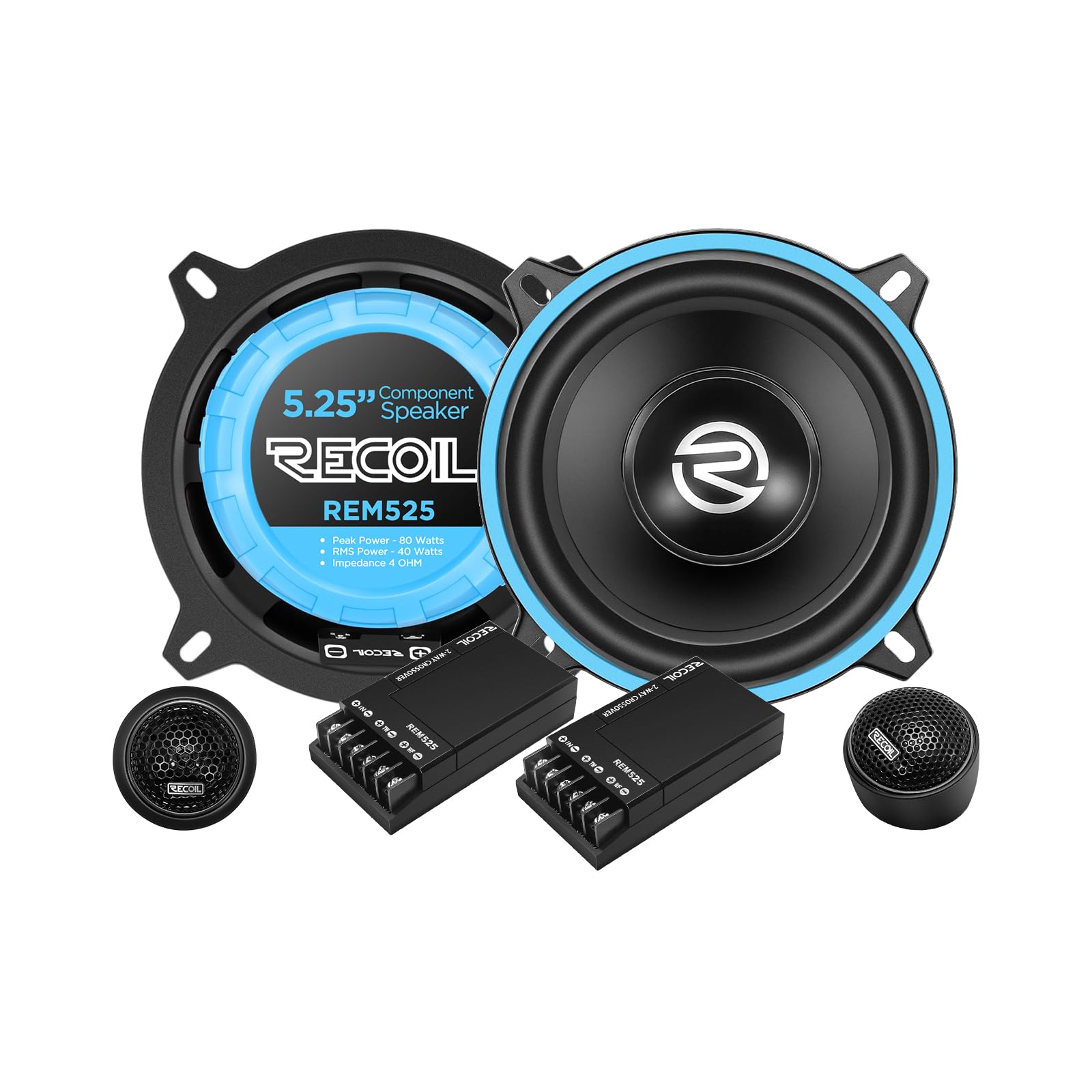
The RECOIL REM525 takes a component approach with separate woofers and tweeters, giving you the flexibility to position the tweeter for optimal imaging — typically on the sail panel or A-pillar. The 5.25-inch polypropylene woofer uses a nitrile butadiene rubber surround for better mid-bass compliance and long-term durability, while the 1-inch silk dome tweeter includes a triple-level attenuation switch to match your car’s acoustics.
Rated at 80 watts RMS for the pair, these speakers cleanly handle moderate amplifier power. The ferrite magnet motor is compact enough to fit tight factory locations without spacer rings, a common advantage of the 5.25-inch form factor over 6.5-inch drivers. Owners report a dramatic improvement in midrange detail and vocal clarity compared to factory coaxial replacements.
One important note: as a component set, these require running speaker wire from the woofer to the external crossover and then to the tweeter. Installation is more involved than a coaxial swap, but the soundstage improvement is significant for anyone willing to invest the extra time.
Why it’s great
- Component design allows separate tweeter placement
- Silk dome tweeter with 3-level attenuation
- Compact motor fits tight factory locations
Good to know
- More complex installation than coaxial speakers
- 5.25″ size limits ultimate low-end extension
7. JVC CS-J620 6.5″ 2-Way Coaxial Speakers

The JVC CS-J620 proves you do not need to spend heavily to hear a genuine upgrade. Using a 6.5-inch mica cone woofer with a rubber surround and a 1-inch PEI tweeter, these coaxial speakers achieve a 92 dB sensitivity that plays loudly and cleanly on factory head unit power. The 30-watt RMS rating is modest, but the high efficiency means even a 15-watt radio channel will drive them to satisfying volume.
The frequency response spans 35 Hz to 22 kHz, covering the audible spectrum with reasonable extension. The shallow 1-23/32-inch top-mount depth helps avoid interference with window tracks, a common fitment issue in Japanese sedans. The included wire extensions, screws, and mounting tabs reduce the hassle of sourcing separate hardware.
Owners consistently report clear vocals and improved treble detail compared to factory speakers. The bass is punchy but not deep — expect a noticeable improvement over stock but not subwoofer-level low end. For anyone wanting a straightforward, cost-effective sound upgrade, these deliver remarkable value.
Why it’s great
- Excellent 92 dB sensitivity for loud output on stock power
- Shallow mount depth fits tight doors
- Includes wire extensions and mounting hardware
Good to know
- Bass extension is limited — no subwoofer replacement
- May need adapters for some vehicle bolt patterns
FAQ
Can I install 6.5-inch speakers in a 6-inch factory opening?
Do I need an amplifier for 6 auto speakers with 92 dB sensitivity?
Final Thoughts: The Verdict
For most users, the 6 auto speakers winner is the Pioneer TS-A1681F because its 4-way design, 80W RMS rating, and 91 dB sensitivity deliver balanced, detailed sound from a factory head unit without requiring an external amplifier. If you need a shallow mount for tight doors, grab the Rockford Fosgate P16. And for an amplified build where high power handling is critical, nothing beats the NVX VSP60.