
When you are running a high-amp circuit for a sub-panel, a welder, a solar array, or an EV charger, that thick spool of 6 AWG copper wire is the only thing standing between a clean install and a fire hazard. This is not the time to guess at construction or settle for copper-clad aluminum that looks the same but carries current like a clogged pipe. You need the real thing — full-stranded or solid-drawn copper — with the right jacket, the right strand count, and the right temperature rating for your specific environment.
I’m Min — the co-founder and writer behind Gadgets Feed. I spend my days dissecting manufacturer spec sheets, pulling apart customer review patterns, and comparing the actual metallurgy and insulation chemistry behind commodity electrical cables so you never have to. (And Homer 🐱 supervised the entire stack from a coil of NM-B, unimpressed by anything less than OFC.)
Whether you are wiring a new workshop sub-panel, building a 50-amp generator transfer cord, or finishing a marine battery bank, choosing the right 6 AWG conductor is a safety decision you make once. This guide cuts through the marketing to give you a clear, spec-by-spec breakdown of the 6 awg copper wire options that actually deliver on their rated performance.
How To Choose The Best 6 AWG Copper Wire
Selecting the right 6 AWG wire is not as simple as grabbing the cheapest spool on the shelf. You need to match the conductor type, strand count, and jacket material to the specific voltage, environment, and mechanical demands of your project. The wrong choice means either a frustratingly stiff cable that fights every bend, or a thin-jacketed wire that chafes and fails in a conduit run.
Conductor Material: OFC vs. CCA vs. Bare Copper
Oxygen-free copper (OFC) is the gold standard for 6 AWG battery and welding cable. It contains 99.9% pure copper with minimal oxide content, delivering lower resistance and superior conductivity compared to standard copper. Copper-clad aluminum (CCA) looks identical at a glance but has roughly 60% of the conductivity of pure copper — a dangerous shortcut for high-amp circuits. For grounding and bonding applications, solid bare copper (soft-drawn temper) is the code-required choice because it provides a continuous, corrosion-resistant path to earth.
Strand Count and Flexibility
Strand count directly determines how easily a 6 AWG cable bends and how well it withstands vibration. A standard THHN building wire might use 19 strands, which is stiff enough to hold its shape in a conduit but will fight you in a tight battery box. Welding cable often uses 423 or more ultra-fine strands (0.2mm–0.25mm each), making it flexible enough to route around sharp corners in an inverter installation. For marine and automotive use, high-strand-count wire also resists work-hardening and fatigue failure at crimp terminals.
Jacket Material and Temperature Range
The outer insulation must match the installation environment. PVC jackets (common on THHN and general-purpose wire) offer good abrasion resistance and a temperature range around -40°C to +105°C. EPDM rubber jackets are more flexible in cold weather and resist oil, saltwater, and UV — making them ideal for marine and outdoor use. SOOW cable uses a tough rubber outer jacket rated for service, oil, and water resistance, and is the standard for portable power cords. Always check the jacket’s continuous operating temperature: a 90°C rating is fine for most residential circuits, but an engine bay or solar array in direct sun may require a higher threshold.
Quick Comparison
On smaller screens, swipe sideways to see the full table.
| Model | Category | Best For | Key Spec | Amazon |
|---|---|---|---|---|
| NAOEVO Marine Wire (30ft Red+Black) | Tinned Copper | Marine, RV, high-corrosion environments | 245 strands / 0.25mm tinned OFC | Amazon |
| Southwire Bare Copper (50ft) | Solid Bare | Residential grounding, bonding | Solid soft-drawn, 0.162-inch diameter | Amazon |
| XMK NM-B 6/3 w/ Ground (15ft) | NM-B Cable | Indoor branch circuits, sub-panels, EV chargers | 3x 6 AWG + 10 AWG ground, 600V | Amazon |
| Geosiry Welding Cable (15ft Red+Black) | OFC Welding | Battery banks, solar, inverters, welding | 423 strands / 0.2mm OFC, EPDM jacket | Amazon |
| CLLOMAGY SOOW 6/4 (6ft) | SOOW Cord | Generator cords, portable power, 50A welders | 4 conductor OFC, 600V, oil/water resistant | Amazon |
| MEIHUIJI THHN (25ft, Red) | THHN/THWN-2 | Conduit wiring, control panels, CNC machines | 19 strands / PVC+Nylon, 90°C rated | Amazon |
| Kimbluth Welding Cable (10ft Red+Black) | PVC Welding | Automotive, solar, small battery banks | Multi-strand OFC, 90mil PVC jacket | Amazon |
In‑Depth Reviews
1. NAOEVO 6 Gauge Marine Wire (30ft Red + 30ft Black)

The NAOEVO 6 Gauge Marine Wire is purpose-built for the harshest environments, using 245 strands of 0.25mm tinned oxygen-free copper. That tinning is the critical difference — it prevents the black cupric oxide corrosion that plagues bare copper in saltwater and humid boat bilges. With an IP68 waterproof rating and a thick PVC jacket rated from -40°F to 221°F, this wire handles everything from a trolling motor battery to a full RV solar array without insulation cracking or strand fatigue.
Each spool delivers a true 6 AWG outer diameter of 8mm, meeting UL 1426, SAE, and ABYC standards — certifications that matter when insurance inspectors and marine surveyors check your work. The 30-foot red and black pair gives you enough length to run from a battery bank to a distribution panel in most boats and trailers, with plenty left over for future additions.
Customers consistently note the wire’s excellent flexibility for a 6 AWG cable, making it easy to route through tight chase tubes and battery boxes. The only recurring observation is that shipping can take up to two weeks, so plan ahead if you are on a deadline. For any project where moisture is a constant factor, this is the most reliable choice available.
Why it’s great
- Tinned OFC strands resist saltwater and galvanic corrosion
- IP68 jacket rating ensures long-term performance in wet compartments
- Full ABYC/UL compliance for marine and RV inspections
Good to know
- Shipping times can stretch to 2 weeks in some regions
- PVC jacket is less flexible than EPDM in extreme cold
2. Geosiry OFC Welding Cable (15ft Red + 15ft Black)
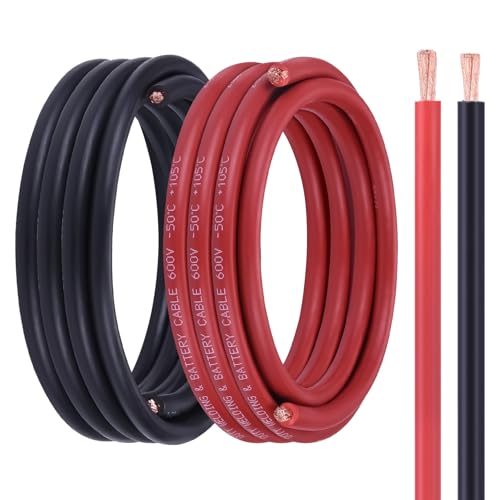
The Geosiry 6 Gauge battery cable sets a new benchmark for flexibility in this category. With 423 individually stranded 0.2mm oxygen-free copper conductors wrapped in an abrasion-resistant EPDM jacket, this cable bends like a much smaller gauge — critical when you are threading a line through a crowded inverter compartment or around a battery box corner. The EPDM insulation handles temperatures from -122°F to +221°F, making it one of the most thermally robust options in its class.
It is rated for 600 volts and designed for DC applications like high-voltage battery banks, solar combiner boxes, and welding leads. The fully annealed OFC conductors deliver minimal voltage drop over the 15-foot length, a real advantage when you are pushing 100+ amps from a lithium bank to an inverter. Customers consistently mention the wire’s premium feel, high strand count, and how easily it accepts a good quality crimp without springing back.
One detail worth noting: the EPDM jacket has a slightly matte finish that resists scuffing and can be wiped clean with solvent — a practical benefit for mobile installs that see dirt and grease. The dual-spool (red + black, 15 feet each) covers a typical positive/negative run for a medium-sized solar or inverter setup with no waste.
Why it’s great
- 423 ultra-fine OFC strands for unrivaled flexibility
- EPDM jacket withstands wide temp range and resists solvents
- Minimal voltage drop on high-amp DC circuits
Good to know
- EPDM jacket is slightly thicker than PVC, taking a bit more space in tight bundles
- Not rated for direct burial or conduit pull (welding cable spec)
3. Southwire 6-Gauge Bare Copper Wire (50ft)
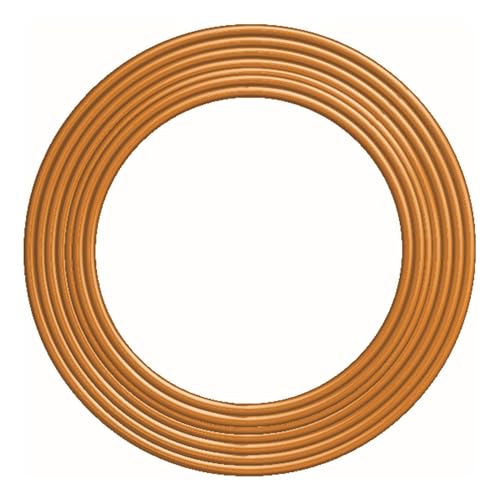
When code calls for a solid copper grounding electrode conductor, the Southwire 6-Gauge bare copper wire is the industry reference. It uses a solid, soft-drawn copper conductor — not the hard-drawn stuff that fights your bends and springs out of ground clamps. This temper gives you a clean, controlled bend while maintaining the structural integrity needed for a permanent ground path. At 0.162 inches in diameter, it meets the NEC 250.66 requirement for a 6 AWG copper grounding electrode conductor.
The 50-foot length is generous enough to run from a main panel to a pair of ground rods or a Ufer ground, with leftover for bonding water pipes and structural steel. Customers repeatedly verify that this is genuine copper, not copper-plated steel (a cheap trick that can be caught with a magnet). Southwire’s reputation for consistent quality means you are getting a clean, oxide-free surface that makes for a reliable bond to acorn clamps and lay-in lugs.
The only practical limitation is inherent to solid wire: it is not suitable for applications that require repeated flexing or vibration resistance. For a fixed ground run inside a wall or foundation, it is perfect. Just plan your bending carefully — tight 90-degree turns require a proper bending tool or a gentle radius to avoid kinking.
Why it’s great
- True soft-drawn temper for easy routing and secure clamping
- 50-foot spool covers most residential grounding runs
- Industry-trusted brand with consistent copper purity
Good to know
- Solid conductor not rated for repeated flexing or vibration
- Requires careful bending to avoid permanent kinks
4. XMK NM-B 6/3 w/ Ground (15ft)
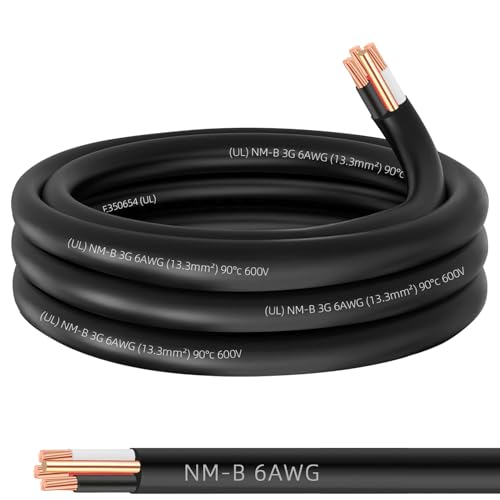
For residential indoor wiring that requires a 50-amp feed — EV chargers, electric ranges, sub-panels, or A/C units — the XMK NM-B 6/3 cable with ground is the correct building wire. It bundles three 6 AWG stranded copper conductors (black, white, red) plus a 10 AWG bare ground wire inside a rugged PVC jacket. The conductors use 99.99% oxygen-free copper for maximum conductivity, and each conductor has an additional nylon layer over the PVC insulation for a slimmer profile that pulls easier through joists and wall cavities.
The UL-listed NM-B construction is approved for dry indoor locations only, but within that scope it performs flawlessly. The stranded inner conductors offer noticeably more flexibility than solid NM-B, which makes a difference when you are maneuvering the cable through attic rafters and into a panel knockout. Customers consistently report that the jacket strips cleanly without nicking the conductor insulation — a time-saver when you have multiple terminations to make.
One point to keep in mind: this cable is designed for fixed installation, not portable cord use. The outer PVC jacket is stiff enough to hold its shape once stapled but should not be subjected to continuous flexing. For a dedicated 240V circuit from your main panel to a garage sub-panel or a Level 2 EV charger, it is exactly what the code requires at a fraction of big-box-store pricing.
Why it’s great
- True OFC stranded conductors for low resistance and easy termination
- Includes a full-sized 10 AWG ground wire per NEC requirements
- UL-listed and priced well below local hardware store rates
Good to know
- For indoor dry locations only — not rated for damp or outdoor use
- PVC jacket is stiff relative to portable cord; not for flexing applications
5. CLLOMAGY SOOW 6/4 (6ft)
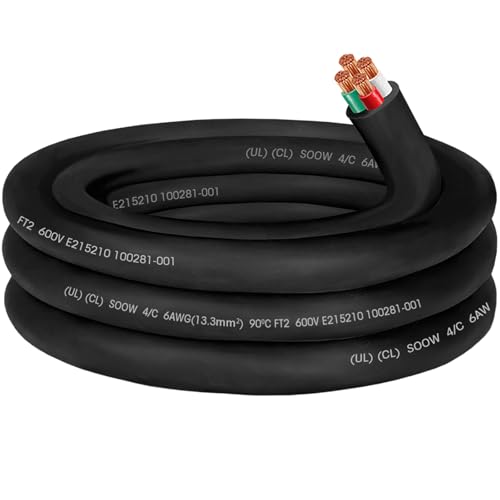
When you need a heavy-duty portable power cord that can take abuse — think generator hookups, 50-amp welders, and EV chargers at job sites — the CLLOMAGY SOOW 6/4 cable is built for the job. SOOW stands for Service, Oil, and Water resistant, and this cable delivers on all three. The outer jacket is a thick, rugged rubber compound that shrugs off oil, saltwater, and sunlight, while the inner insulation layers protect four stranded OFC conductors rated for 600V and up to 50 amps continuously.
At 6 feet, this cord is purpose-length for connecting a generator inlet box to a transfer switch or a welder plug to a NEMA 14-50 receptacle. Customers who built generator transfer cords consistently praise the cable’s flexibility in cold weather compared to PVC-jacketed alternatives. The fine-stranded OFC construction also accepts high-quality crimp connectors for field-mounting your own male and female plugs.
The only caution from real-world use is that the outer jacket cuts relatively easily when scoring it with a utility knife; you need to be careful not to nick the inner conductor insulation during stripping. That minor extra attention aside, this is the most durable and weather-resistant portable 6/4 cable in its price range, ideal for any application where the cord will be coiled, dragged, and exposed to the elements.
Why it’s great
- SOOW rubber jacket resists oil, water, and UV — true industrial grade
- Four fine-stranded OFC conductors rated for 50A continuous
- Pre-cut 6ft length is perfect for generator inlet box connections
Good to know
- Outer jacket is softer than expected; requires care when stripping
- Limited to 6ft length — longer runs require purchasing bulk and terminating yourself
6. MEIHUIJI THHN/THWN-2 6 AWG (25ft, Red)
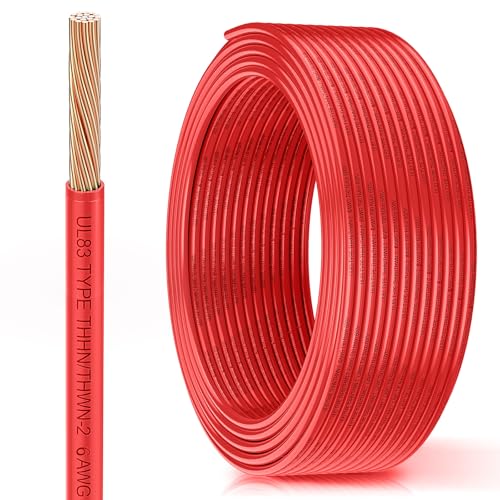
The MEIHUIJI THHN 6 AWG wire is the standard building wire for conduit runs, rated for 600V and certified to UL 83 as both THHN and THWN-2. That dual rating means it is safe in both dry and wet locations up to 90°C, making it suitable for outdoor conduit, underground raceways, and damp industrial environments. The 19-strand construction offers a good balance of flexibility for pulling through conduit elbows while still holding its shape in a panel gutter.
At 25 feet in a single red color, this is an ideal length for a specific phase or circuit wire where you do not want to buy a full 100-foot spool. The nylon outer jacket over the PVC insulation creates a slick surface that reduces pulling friction — a real time-saver on long runs with multiple 90-degree bends. Customers consistently report that the wire strips cleanly and the conductor strands are bright copper with no signs of surface oxidation.
The main limitation is that this is a single-conductor wire; you will need to purchase separate black, white, and green (or bare) conductors for a complete 240V/120V circuit. It serves its role as a high-quality, code-compliant conduit wire perfectly, but it is not a complete kit. For CNC machines, control panels, and residential branch circuits where you pull individual conductors through EMT or PVC conduit, this is exactly what you need.
Why it’s great
- Dual THHN/THWN-2 rating for wet and dry locations
- Nylon jacket minimizes pulling friction in conduit
- UL 83 certified with consistent conductor quality
Good to know
- Single conductor only — requires separate neutral and ground wires
- 19-strand construction is less flexible than welding cable for tight bends
7. Kimbluth 6 Gauge Welding Cable (10ft Red + 10ft Black)

The Kimbluth 6 Gauge welding cable delivers the most critical performance specs — 99% pure OFC copper, 600V rating, and a thick 90mil PVC jacket — at an entry-level price point that makes it attractive for budget-conscious builds. Each 10-foot spool uses multi-strand 0.256mm copper wires twisted together for better conductivity and flexibility than a basic battery cable. The PVC jacket resists gasoline, battery acid, and abrasion, with a temperature range of -40°C to +105°C that covers most automotive and solar applications.
Customers consistently note that the cable makes clean, solid crimps with standard lugs and is flexible enough to route around a car amplifier rack or a small battery box. The 10-foot length per color is enough for a compact solar array connection or a car audio power run in a sedan, and the PVC surface strips cleanly with a standard cable stripper without sticking or melting.
The trade-off for the lower price point is in the strand count and jacket technology. At a coarser strand construction than premium welding cables, it is not as supple for extreme tight-radius bends, and the PVC jacket lacks the cold-weather suppleness of EPDM. For a protected indoor install or a short battery connection where cost is the primary constraint, this cable performs reliably without cutting corners on copper purity.
Why it’s great
- Genuine OFC copper with no CCA substitution at a low price
- Thick 90mil PVC jacket adds durability and cut resistance
- Good flexibility for a basic welding cable in short runs
Good to know
- Coarser strand count than premium cables — less supple in tight spaces
- PVC jacket stiffens in cold temperatures compared to EPDM
FAQ
Can I use welding cable for a residential 50-amp circuit in conduit?
How do I tell if a 6 AWG cable is genuine copper or copper-clad aluminum?
What is the ampacity of 6 AWG copper wire for different applications?
Final Thoughts: The Verdict
For most users, the 6 awg copper wire winner is the Geosiry OFC Welding Cable because its 423-strand construction and EPDM jacket offer the best balance of flexibility, durability, and thermal range for battery banks, solar, and inverter installations. If you need a marine-grade corrosion barrier for a boat or RV, grab the NAOEVO Tinned Marine Wire. And for code-compliant residential branch circuits with a 50-amp feed, nothing beats the XMK NM-B 6/3 cable for its value and UL-listed construction.