
Our readers keep the lights on and my morning glass full of iced black tea. As an Amazon Associate, I earn from qualifying purchases.
Specs are compiled from manufacturer listings and verified buyer reviews and can change over time — please confirm the key details on the product page before buying.
You are wiring up a multi-room audio system, a boat stereo, or a whole-home sound setup. That means you need an amplifier that feeds six separate zones without cutting out. The market is packed with budget-friendly receivers and premium rack-mount beasts. Specs often look stronger on paper than they sound in real life. You need to know which real-world numbers—RMS (root mean square, the continuous power output) power, impedance (a speaker’s electrical resistance, measured in ohms), and build quality—actually determine whether you get clean, loud audio or a frustrating hiss.
I am Min — the founder of Gadgets Feed. This guide compares published specs and patterns across verified customer reviews. You get each pick’s real strengths and trade-offs.
Understanding the critical specs behind a 6 channel amp is the difference between a system that delivers clear sound and one that disappoints.
Quick Picks
- Pyle Bluetooth Hybrid Home Amplifier — Best Overall
- Rockville RXM-S6 2600W Peak/660W RMS 6-Channel — Wet & Wild
- Donner Stereo Receivers, Premium 1000W Peak — Digital & Sleek
- Pyle Home Audio Amplifier with Bluetooth — Six-Zone Budget King
- Pyle Bluetooth Home Audio Amplifier — Entry-level Whole-Home
- Rockville RCS180-6 180W 6-Zone 70v Commercial — Commercial Grade
- Kicker 48KMA6006 KMA600.6 6x100w 6-Ch — Premium Marine
- OSD Audio Nero 6-Channel Home Theater Amplifier — High-End Flex
How To Choose The Best 6 Channel Amp
Picking the right six-channel amplifier depends on matching its electrical output to your speakers and knowing where you will mount it. Here are the three most common traps buyers run into and how to avoid them.
RMS Power vs. Peak Power — The Reality Check
The biggest source of confusion is the difference between “peak power” and “RMS power.” Peak power is the brief maximum burst an amp can handle. RMS (root mean square, the continuous power) is what it delivers to your speakers over time. Many products advertise a huge peak wattage that says nothing about how they sound at normal listening levels. Always compare the RMS rating (look for a “continuous power” spec) to see how cleanly an amplifier will drive your speakers.
Impedance (Ohms) and Speaker Matching
Amplifiers work within a certain impedance range, typically 4 to 8 ohms for a standard home setup. A speaker at 4 ohms draws more current than an 8-ohm speaker. That means the amp can deliver more power per channel at 4 ohms—but it also produces more heat. If you connect several low-impedance speakers to a 6-channel amp, you increase the load. Check the amp’s spec for what it can handle per channel at your speaker’s impedance to avoid overheating or clipping (distortion from power limits).
Environment and Form Factor
Where the amplifier lives matters a lot. A boat or outdoor installation needs a marine-grade amp with a conformal-coated circuit board (a protective coating that resists moisture and salt corrosion) and stainless-steel hardware. A commercial setting like a restaurant or retail store often needs a 70-volt amplifier with independent zone volume controls to manage sound in different areas separately. A home theater setup can use a standard Class A/B or Class D amplifier that prioritizes sound quality and bridging flexibility rather than weather resistance.
Quick Comparison
| Model | Best For | Peak Power | Dimensions (D x W x H) | Key Feature | Amazon |
|---|---|---|---|---|---|
| Pyle Bluetooth Hybrid Home Amplifier | High-power rack-mount home theater | 2000W | 11.81″D x 16.93″W x 4.72″H | Dual 10-band EQ | Amazon |
| Rockville RXM-S6 | Marine and boat audio | 2600W | 16.14 x 8.66 x 2.09 inches | Conformal-coated PCB | Amazon |
| Donner MAMP6 | Home karaoke and multi-room stereo | 1000W | 15″D x 3.9″W x 9.8″H | Bluetooth 5.3 | Amazon |
| Pyle PTA66BT.5 | Whole-home 6-pair speaker systems | 600W | 9.84″D x 16.9″W x 3.54″H | Dual mic with talkover | Amazon |
| Pyle 6 Channel Stereo Receiver | Budget whole-home audio | 600W | 9.84″D x 16.9″W x 3.54″H | Six independent volume controls | Amazon |
| Rockville RCS180-6 | Commercial/retail 70V systems | 180W RMS | 19″ x 16″ x 4″ | 6-zone independent volume | Amazon |
| Kicker 48KMA6006 | Weather-resistant vehicle audio | 600W | 18.3 x 9 x 4.3 inches | 316L stainless steel hardware | Amazon |
| OSD Audio Nero HTX-6150 | High-end home theater expansion | — | — | Flexible bridging to 400W | Amazon |
In‑Depth Reviews
1. Pyle Bluetooth Hybrid Home Amplifier – 6-Channel 2000W Rack Mount
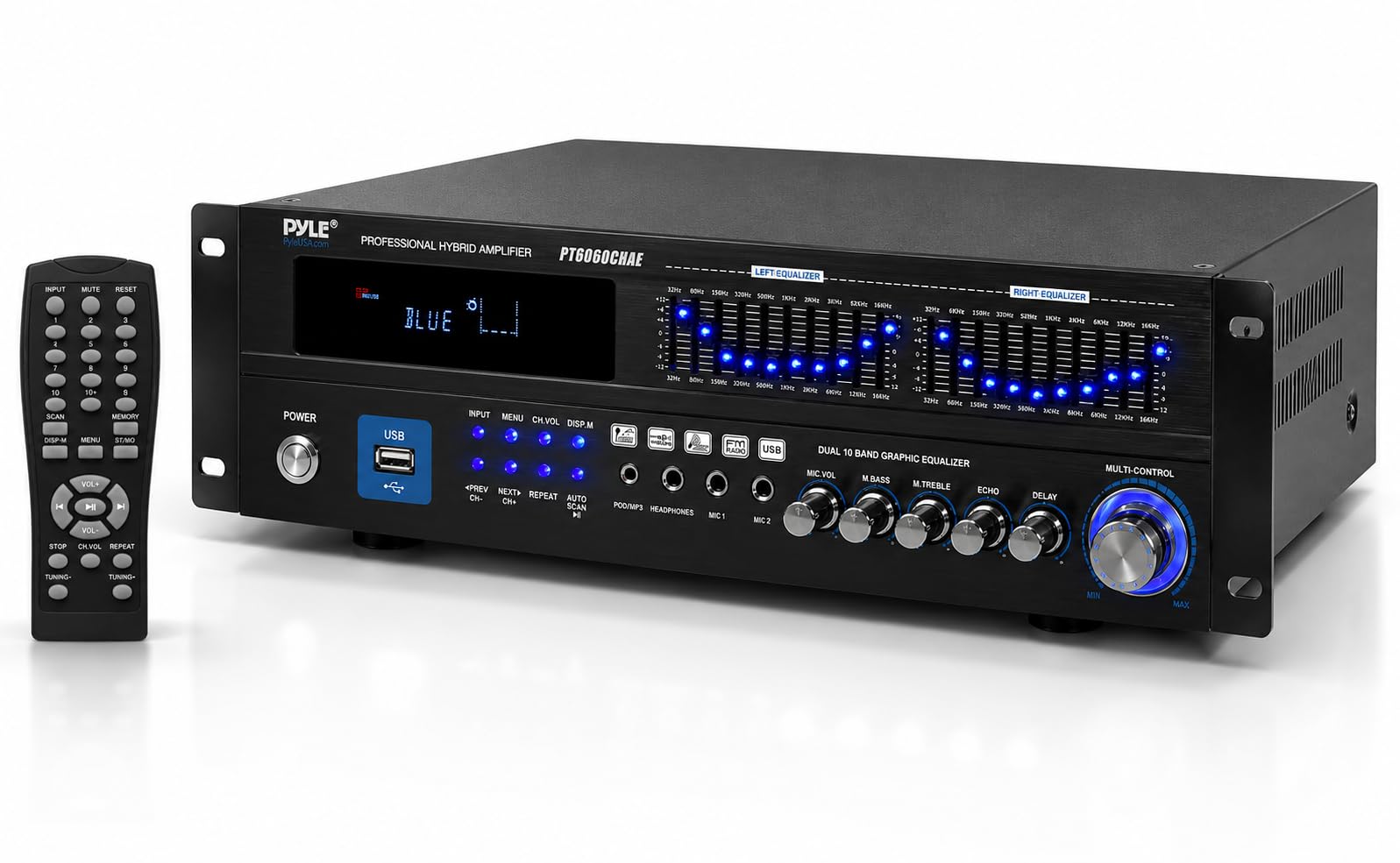
The rack-mount powerhouse that flattens the gap between budget units and professional gear.
You want headroom to spare? Grab this Pyle. Its 2000W peak power compares to the 600W peak output of the Pyle models, so it can drive a home theater or semi-pro PA with room to spare. The front panel gives you dual 10-band graphic equalizers (separate sliders for left and right audio bands). That lets you dial in the exact sound for a room—something the simpler tone-knob amps cannot do.
Buyers report this amp “shook the windows” in a man cave. One said the build feels “heavy duty real beefy,” suggesting it could handle light commercial DJ use. Another owner found the graphic EQ knobs and sliders “all did nothing to the sound whatsoever,” which points to a quality-control risk on individual units. If you get a good one, you get HDMI, optical, and coaxial inputs plus a built-in cooling fan. That rivals features on amps costing twice as much.
The High-Power Edge
- 2000W peak power (versus the 600W peak of the Pyle units)
- Dual 10-band EQ for precise sound shaping on each channel
- Rack-mountable with cooling fan, ideal for permanent installs
Known Pitfalls
- Some units arrive with non-functional EQ sliders
- Lacks per-channel independent volume controls
- Heavy and large at 11.81″ deep
Snag it if: you need a high-powered amp for a dedicated home theater or a semi-pro karaoke/PA setup that demands more than 600W.
Look elsewhere if: you require independent volume per zone, as this model has a single master volume for all six channels.
2. Rockville RXM-S6 2600W Peak/660W RMS 6-Channel Marine Amplifier

The saltwater-proof workhorse built to deliver 660W RMS cleanly on the water.
If your amp lives near a boat, jet ski, or outdoor golf cart, pick this Rockville. Its conformal-coated PCB (a protective coating that shields the circuit board from moisture, salt, and dust) and stainless-steel screws prevent corrosion. It delivers 660W RMS (6 x 110W at 2 ohms), so each channel can continuously drive marine speakers without the distortion from a peak-only rating. Owners mention powering “6 speakers + sub” and even “8 speakers + 2 subs” with clear sound. One owner warned it gets hot and needs good airflow. The included PA microphone with auto-volume circuitry drops the music level when you key it—a plus for dockside announcements. One owner reported the unit died after a few months (powers on but no output) and the warranty replacement process was slow. It is heavy at 16.14 x 8.66 x 2.09 inches, so plan your mounting space.
Built for the elements: conformal-coated PCB and stainless steel hardware mean this amp can take moisture and salt spray that would kill a standard car amp in weeks.
The catch: a small number of units have failed after a few months, and the 1-year warranty replacement process drew complaints about being slow.
Perfect for: boat owners and anyone mounting an amp in a humid, dusty, or outdoor environment where standard gear would rust.
Give it a miss if: you are wiring a dry indoor home theater and do not need the marine-grade protection; a cheaper indoor amp with better quality control suits you better.
3. Donner Stereo Receivers, Premium 1000W Peak Power 6 Channel Audio Amplifier (MAMP6)

The modern all-in-one with Bluetooth 5.3, optical inputs, and independent zone control.
Donner packed this amp with connectivity: Bluetooth 5.3 (a newer wireless standard with longer range), USB up to 64GB, dual RCA inputs, optical and coaxial digital inputs for a TV, and an FM radio you tune by entering numbers. It advertises 1000W peak power, but buyers spotted the fine print: “unit states 25W peak per channel.” That means sustained power is much lower. One reviewer noted “low volume output even with three speaker pairs.” Still, the MAMP6 earns its spot with true independent channel knobs—you set a different volume for each of the six zones—and a remote that controls treble, midrange, bass, and echo. One owner called it a “great lil amp” for a camp setup with four speakers, noting “plenty of power for Bluetooth also.” It weighs 5.44 kilograms (about 12 pounds). It is best matched with efficient, high-sensitivity speakers (speakers that convert power into volume efficiently) rather than power-hungry towers.
Connectivity Highlights
- Bluetooth 5.3 for stable, long-range streaming
- Optical and coaxial inputs for direct TV connection (no HDMI needed)
- Independent volume knob for each of the 6 channels
Honest Reality
- Advertised 1000W peak is misleading; real RMS is about 25W per channel
- Onboard EQ is poor, per one reviewer’s experience
- Not powerful enough for large rooms or low-sensitivity 4-ohm speakers
Reach for this if: you need a feature-rich, compact 6-channel amp for a small to medium room, karaoke, or a camp setup where independent zone volume matters more than raw wattage.
Pass it over if: you are powering large floor-standing speakers or need serious volume for a big space; pick the 2000W Pyle instead.
4. Pyle Home Audio Amplifier with Bluetooth – 6 Channel 600 Watt Peak Power (PTA66BT.5)

The whole-house workhorse that controls six pairs of speakers while staying affordable.
One buyer nailed it: “Controls 6 channels (12 speakers) with 200+ ft wire runs.” That is the use case for this Pyle. It is not built for pristine stereo separation—buyers confirm it is NOT a true stereo amp. Each channel carries a summed mono signal rather than a dedicated left/right channel. For a distributed audio setup where you want the same music in the kitchen, patio, bedroom, and garage, that is a feature. It delivers 600W peak power, loud enough for background music across a whole home. The trade-offs are real: Bluetooth always starts on Line-In mode, so you manually select Bluetooth each time. When a phone connects, the amp emits a loud chirp you cannot disable. There is no per-channel volume control—just master volume, treble, bass, and echo knobs. The remote needs direct line of sight. One owner gave it a 10/10 for sound quality, calling it “distortion-free at high volume.”
Best for distributed mono audio: perfect for feeding music to six different rooms or zones where you do not care about left/right separation.
Watch out for: the annoying Bluetooth quirks and the lack of any bass/treble adjustment per zone; also, it lacks a subwoofer output.
Buy it for: a budget whole-home audio system with long wire runs, or for a retail/storefront background music setup where simple loud mono is enough.
skip it if: you want dedicated left/right stereo imaging for a listening room or need to control volume in each zone separately.
5. Pyle Bluetooth Home Audio Amplifier – 6 Channel Stereo Receiver Amp, 600 Watt Power

The bare-bones six-channel with independent zone knobs for the budget-conscious.
This is the most stripped-down Pyle 600W unit—and the most popular for it. Unlike the PTA66BT.5 above, this model gives you six independent volume knobs. You can turn down the bedroom speakers while cranking up the patio. One buyer called it a “great bargain for 6-zone, 12-channel whole home amplifier,” reporting the Bluetooth paired easily with a tablet and the USB port worked with a 64GB USB 2.0 drive full of MP3s. The FM radio auto-scans, and the signal-to-noise ratio (a measure of how much background hiss the amp adds) is rated above 81dB—decently quiet. The catch is Pyle quality control: one buyer received a “used unit had blown channels A and F,” describing the sound as “flat and tin-can-like with clipping at higher volumes.” Another called it “the worst purchase I ever made from Amazon.” Still, five-star reviews note “excellent sound quality” and “clear, distortion-free sound at high volume.” A good unit delivers exactly what the spec promises: 600W peak with Bluetooth, FM radio, USB/SD reader, and dual mic inputs with a talkover function for paging.
What Works
- Six independent volume knobs for zone-by-zone control
- FM radio with digital LCD display and auto-scan
- USB/SD reader supports up to 64GB USB 2.0 drives
What Can Fail
- Blown channels on some units; quality control is inconsistent
- Sound can be flat and clipping at higher volume if amp is defective
- Instructions are unhelpful, per one owner
Grab this for: a budget multi-zone home system where independent zone volume is a must and you are willing to gamble on Pyle’s QC.
Avoid if: your install cannot tolerate a risk of receiving a unit with bad channels; consider the Donner MAMP6 for a more consistent experience at a similar price point.
6. Rockville RCS180-6 180W 6-Zone 70v Commercial Amplifier

The 70-volt six-zone system built to pipe audio through a restaurant, office, or retail space.
This is a fundamentally different kind of amplifier. It uses 70-volt distributed audio (a standard for commercial installations where a single amp drives many speakers across long wire runs using a step-up transformer at each speaker) rather than the direct low-impedance wiring of home gear. It delivers 180W RMS, which is modest. In a 70-volt system, that power travels efficiently to many small speakers without signal loss. Customers note covering a “2,400 sqft deck” with one channel for a sub and another for 12 serial speakers, calling it “easy to install & use.” Each of the six zones has its own independent volume knob. You also get three mic inputs with echo control, a built-in FM tuner, Bluetooth, USB/SD playback, and an optical input for a TV. One owner called it a “true workhouse for daily commercial use since 2021,” until it died in February 2026, noting “repair cost exceeds replacement.” It is heavy—22.7 lbs with detachable Euro-block terminals—and takes up 2U of rack space (a standard 19-inch rack unit). For background music in a business, this is the right tool.
Built for commerce: 70-volt distribution means you can run 50+ speakers across a single amp, with six independent zone knobs to set different volume levels by area.
The trade-off: the amp died after about 5 years of daily use for one owner, and repair cost more than a replacement—acceptable for commercial gear at this price point, but not a lifetime purchase.
Choose this for: a restaurant, retail store, office, or any commercial space needing multi-zone background music with paging capability.
Do not buy for: a home theater or personal listening room; this is a purpose-built commercial distributed-audio amplifier, not a hi-fi component.
7. Kicker 48KMA6006 KMA600.6 6x100w 6-Ch Weather-Resistant Full-Range Amplifier

The Kicker marine amp that trades gimmicks for bulletproof build and clean power.
Kicker is a known name in car and marine audio. The KMA600.6 focuses on durability. It uses conformal-coated circuit boards and 316L stainless-steel, no-rust hardware, so every screw is corrosion-resistant. It delivers 600 watts maximum output power—6 x 100 watts per channel—and features built-in variable crossovers (filters that divide the audio signal so only the right frequencies reach each speaker type). That lets you match it precisely to your boat’s subwoofers and full-range speakers. Its compact footprint (18.3 x 9 x 4.3 inches) tucks under a seat or dry compartment easily. Buyers are overwhelmingly happy: one called it “crisp clear and awesome” after a professional under-seat install. Another said it “deserves the reviews its been getting.” The small footprint fits in tight spaces, but it lacks Bluetooth streaming and multi-input flexibility. This is a straight-up power amplifier—you feed it a signal from a head unit or receiver, and it amplifies it cleanly. If your boat already has a marine stereo with Bluetooth, this is a perfect match.
Built to Last at Sea
- 316L stainless steel hardware means zero rust even after years in salt air
- Conformal-coated circuit boards repel moisture and spray
- Small footprint (18.3″ wide) fits under a boat seat or dash
Limited Versatility
- No built-in Bluetooth, FM, or multi-input switching
- No EQ controls or zone volume knobs
- Higher upfront cost than marine rivals
Perfect for: boat owners who already have a marine head unit and want a clean, powerful, rust-proof amplifier they can install and forget about.
Not for: anyone who wants a standalone receiver with Bluetooth, radio, and multiple inputs built in—this is a pure amp, not a receiver.
8. OSD Audio Nero 6-Channel Home Theater Amplifier (HTX-6150)
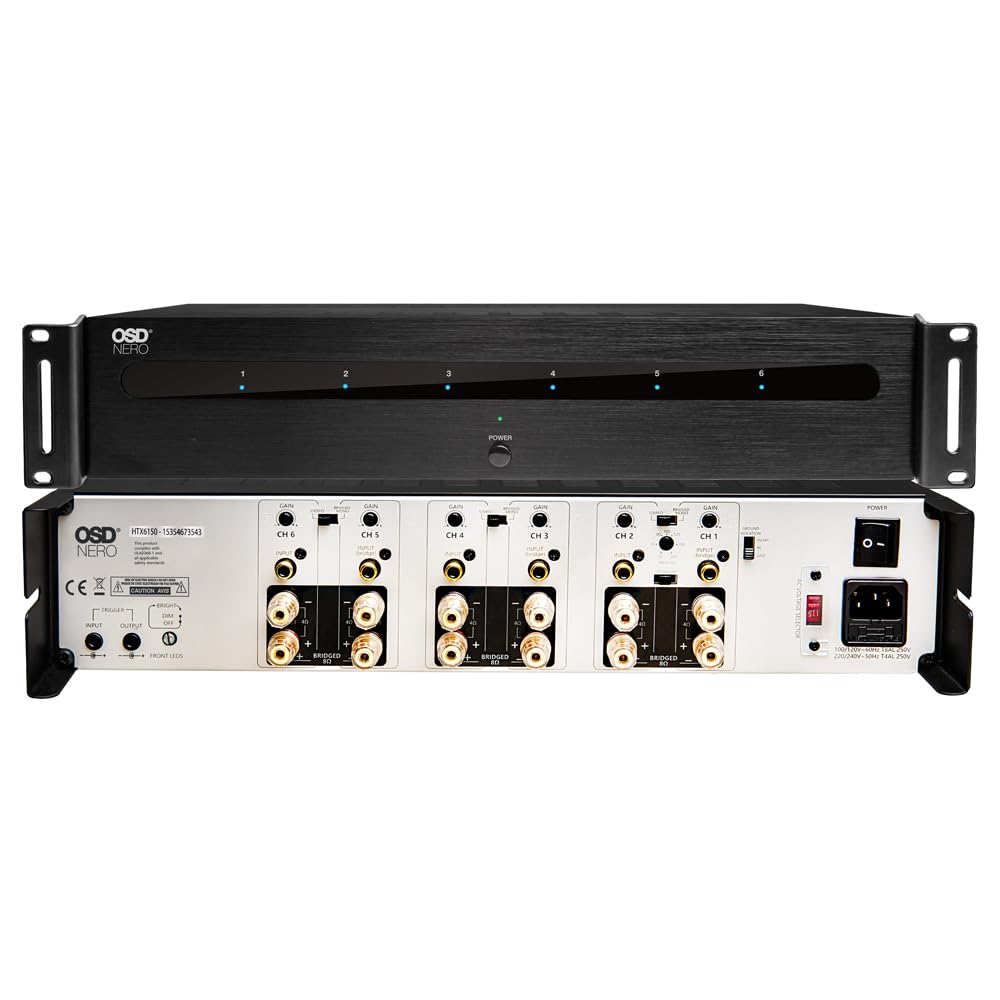
The premium Class-D brick that reconfigures from 6-channel to 3-channel 400W beast mode.
Building a serious home theater and your AV receiver (the device that processes surround sound and sends signals to the amp) runs out of juice for extra channels? This OSD Nero is the upgrade path. It uses Class D amplification (an efficient design that runs cooler and wastes less power as heat than older Class A/B designs). It delivers 6 x 175W at 4 ohms or 100W at 8 ohms. The killer feature is bridging: combine channels to create 3 x 400W at 8 ohms, or 2 x 400W plus 2 x 175W, or even 1 x 400W plus 4 x 175W. That means you can drive power-hungry front speakers with 400W each while running surround and height channels from the other outputs. One buyer wrote it “powers LCR channels with Yamaha RX-A4A” and “provides more power to front towers,” calling it “well-made” with “reasonable price.” He noted the rear adjustment knobs “should be actual knobs, not screw adjustments.” Another owner received a unit with “box open and tape cut,” and it was non-functional with “relays clicking.” That points to a shipping issue. On a good unit, the individual channel LEDs and 12V trigger for auto power-on make this a premium solution for expanding a home theater.
Flexible power distribution: the bridging options let you create a hybrid setup—400W to each front speaker plus lower wattage to surrounds and heights—without buying a second amp.
Heads up: some reviewers point out receiving clearly used or opened boxes, and a few units arrived non-functional; check your unit’s condition immediately on arrival.
Ideal for: home theater enthusiasts whose AV receiver lacks the power to drive all channels, especially those with 4-ohm front speakers that need clean current.
Not the right fit for: anyone who just wants a simple plug-and-play receiver for background music; this is a high-end component meant for a complex A/V system.
Understanding the Specs
Peak Power vs. RMS Power
Peak power is the maximum wattage an amplifier can deliver in a very short burst—think of it as a flash of lightning. RMS (root mean square) is the continuous power the amp can sustain over time, which is what actually matters for real listening. A 2000W peak amp might only deliver 100W RMS per channel, so always look for the RMS number or a “continuous power” spec to compare amps fairly.
Impedance (Ohms) and Speaker Matching
Impedance is the electrical resistance your speakers present to the amplifier, measured in ohms. A 4-ohm speaker lets more current through than an 8-ohm speaker, which means the amp can deliver more power—but it also runs hotter. Most 6-channel amps are rated for 4 to 8 ohms. If you connect three pairs of 4-ohm speakers to a six-channel amp, you are effectively asking the amp to double its output, so check the per-channel spec at your speaker’s impedance.
FAQ
Can I use a 6-channel amp for home theater surround sound?
What is the difference between a 6-channel amp and a 6-zone amp?
Can I run 12 speakers from a 6-channel amp?
Is a marine amp necessary for a boat, or can I use a car amp?
What does “bridging” an amplifier channel mean?
Will a 70-volt amp work with regular home speakers?
How many watts do I need per channel for a 6-channel amp?
Can I use a 6-channel amp for karaoke?
Final Thoughts: The Verdict
For the majority of shoppers, the 6 channel amp winner is the Pyle Bluetooth Hybrid Home Amplifier because its 2000W peak power, dual 10-band EQ, and rack-mount design deliver a feature set that covers home theater, karaoke, and semi-pro use for a fraction of what equivalent brands charge. If you want a marine-safe amp that can take salt spray and still sound clean, grab the Rockville RXM-S6. And for a high-end home theater expansion that lets you bridge channels for serious front-speaker power, the standout is the OSD Audio Nero HTX-6150.
How We Picked
We do not accept paid placement. Every pick is matched to a real buyer and a real use-case; we do not hands-on test units.
Sources & Methodology
Specifications: manufacturer listings and product documentation. Review insights: verified customer reviews, as of July 2026. Pricing: not shown on this page (it changes often); check the current price via the retailer link.
As an Amazon Associate, Gadgets Feed earns from qualifying purchases. This does not affect which products we feature.