
Our readers keep the lights on and my morning glass full of iced black tea. As an Amazon Associate, I earn from qualifying purchases.
Specs are compiled from manufacturer listings and verified buyer reviews and can change over time — please confirm the key details on the product page before buying.
If you are wiring a battery bank, a winch, or a car audio amp, the connector is the part that decides whether your 6 gauge cable stays cool or starts smelling hot. The right lug grips the copper strands hard enough that vibration never loosens it, the tin plating keeps green corrosion off the joint, and the stud hole actually matches your battery post. This guide sorts nine 6 gauge wire connectors by what they are genuinely good at, so you can match one to your job instead of guessing at the hardware bin.
I’m Min — the founder and writer behind Gadgets Feed. This guide is built by comparing the manufacturers’ published specifications and the patterns across verified customer reviews, so you get each pick’s real strengths and trade-offs instead of marketing spin.
Some options here are crimp-only ring lugs, some are screw-down splices you can redo, and a couple are mixed-gauge kits that cover 4, 6, and 8 wire in one box. Below you will find the full breakdown of the 6 gauge wire connectors worth putting on your bench.
Our Picks at a Glance


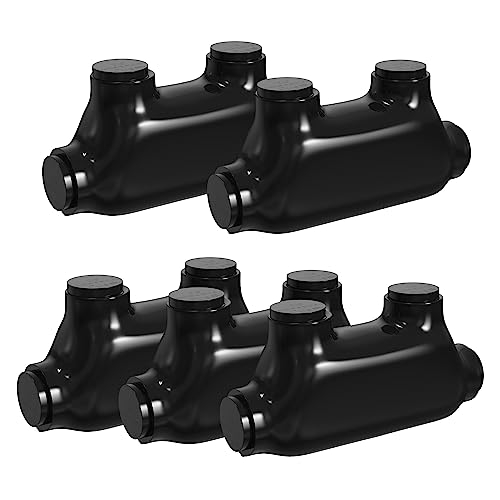
How To Choose The Best 6 Gauge Wire Connectors
A 6 gauge cable carries serious current, so the connector has to match the cable in three places: the barrel bore, the stud hole, and the metal itself. Get any one of those wrong and you get a loose joint, a hot spot, or a terminal that will not sit flat on the post.
Match the barrel to the wire, not the label
Look for a connector that lists 6 AWG by name in its size range, because some kits are listed by model code only. A flared or bell-mouth entry lets the strands slide in without fraying, and a closed-end barrel keeps moisture out of the crimp. If you are running audio cable, check the actual cable dimensions first — some audio manufacturers oversize their gauge labels.
Pick the right stud hole for your post
Ring terminals come with 3/8″ (M10) or 5/16″ (M8) holes, and a mismatched hole means the lug rocks on the post instead of seating flat. Kits that include both sizes in one box save you a second order when you are wiring several batteries at once.
Crimp, solder, or screw down
Crimp lugs need a properly sized crimping tool and give a permanent joint. Screw-down mechanical splices need no special tool at all and can be reopened if you change the layout. Solder works on both but takes longer and needs heat control so you do not cook the insulation.
Quick Comparison
| Model | Best For | Wire Sizes Covered | Stud / Entry | Connection Type | Amazon |
|---|---|---|---|---|---|
| haisstronica 60PCS Tinned Battery Cable Lug Kit★ Best Overall | Battery and marine cable ends | 4 / 6 / 8 AWG | #10, 1/4″, 5/16″, 3/8″ | Ring, crimp | Amazon |
| SVAAR 4 6 8 AWG Battery LugsSolar and Vehicle Pick | Solar and vehicle wiring | 4 / 6 / 8 AWG | 5/16″ and 3/8″ | Ring, crimp or solder | Amazon |
| RVBOATPAT Insulated Inline Splice, 5 PackBest for Aluminum-to-Copper | Aluminum-to-copper splices | 2/0 to 6 AWG | 3/16″ slotted Allen hex | Screw terminal | Amazon |
| SVAAR 6 Gauge Wire Butt Connector, 6PCS | No-tool wire repair | 6 AWG | Inspection window | Mechanical butt splice | Amazon |
| RIOCAN 6 AWG Tinned Copper Ring Terminals | Precise 6 AWG marine jobs | 6 AWG | 3/8″ and 5/16″ | Ring, crimp or solder | Amazon |
| smseace 80pcs Butt Connectors Kit | Auto and marine splices | 4 / 6 / 8 AWG | Center wire barrier | Non-insulated butt splice | Amazon |
| HOUSUN 132PCS Copper Lugs | All-in-one starter kit | 4 / 6 / 8 / 10 AWG | SC-series ring sizes | Ring, crimp | Amazon |
| Twidec 180PCS Battery Cable Ends | Widest gauge spread | 2 to 16 AWG | #10, 1/4″, 5/16″, 3/8″ | Ring, crimp | Amazon |
| SQQHXX 260Pcs Copper Wire Lugs | Bulk shop supply | 2 / 4 / 6 / 8 / 10 / 12 AWG | SC-series ring sizes | Ring, crimp or solder | Amazon |
In‑Depth Reviews
1. haisstronica 60PCS Tinned Battery Cable Lug Kit AWG 8/6/4 4 Sizes
Our pick — 4.5+★ from 350+ verified ratings; the strongest balance of quality and price.
Sixty tinned copper ends in one labeled case, so you stop hunting for the right lug mid-job.
The kit covers the three sizes that most battery work actually needs — 4, 6, and 8 wire gauge — and gives you four stud openings to choose from: #10, 1/4″, 5/16″, and 3/8″. That spread means one box handles a starting battery, a bus bar, and an accessory circuit without a second order. It is also the highest-rated pick in this group at 4.5+ stars across 370+ ratings.
The barrels are made from pure annealed copper, and the tin plating on the surface is there to keep corrosion and oxidation off the joint. The flared entry lets the strands slide in cleanly so the crimp closes evenly. Closed construction on top means the barrel end is sealed rather than open, which is the detail that keeps moisture out of a marine or RV connection.
Buyers single out the build quality more than any other trait in the product’s reviews. The maker states the terminals are tested to UL and ABYC safety standards — a claim that matters for marine wiring. The trade-off is simple: this is a crimp-only lug, so you need a proper crimping tool sized for the barrel, and the kit is built around 4/6/8 gauge rather than finer wire.
Where the kit earns its keep
- Four stud sizes — #10, 1/4″, 5/16″, 3/8″ — cover most battery posts and bus bars in one box
- Tin plating on annealed copper resists corrosion and oxidation
- Flared entry makes wire insertion and even crimping easier
- Labeled storage case keeps 60 pieces sorted
What to plan around
- Crimp-only design means a correctly sized crimping tool is required
- Built for 4/6/8 gauge, so finer wire runs need another product
Reach for this if: you are terminating battery, marine, or RV cable and want one matched set of tinned lugs with the stud size already sorted.
Pass if: you have no crimping tool — a screw-down splice will get you further.
2. SVAAR 4 6 8 AWG Battery Lugs Heavy Duty Battery Cable Ends
These smooth copper barrels (one-piece tubes with no seam to split) are built to survive the constant vibration of a vehicle or a boat.
These lugs take vibration seriously. The barrel is one continuous piece of copper tube with no seam, so when you crimp it the pressure lands evenly and the terminal holds tight instead of loosening over miles of road. The specification line lists UL, and the terminals are rated for 600 volts — well beyond what a typical 12-volt battery circuit asks for, which leaves headroom for higher-voltage projects.
Both stud sizes come in the box: 5/16″ and 3/8″ mounting holes, so the same lug seats on most battery posts, bolts, and studs. The pad is stamped with its size so you can identify one after it has been sitting loose in a toolbox. Crimp or solder both work here, which gives you an out if your crimping tool is sized for a different barrel.
Owners consistently call out the copper quality, the top praise category in the product’s listing. For solar installs in particular, the closed-end pad design keeps moisture away from the joint and stops solder from leaking through during installation. One honest note: the maker warns that audio cable is sometimes oversize, so check your cable’s real dimensions before you commit.
Why it holds up: the barrel is smooth and fully annealed (softened so it bends without splitting). That lets it resist cracking when you crush it hard in a crimper or bend the pad, which is where cheaper stamped lugs fail.
Fits and misfits: ideal for solar panels, marine, and vehicle battery work; less so if you need one kit that also covers 10 or 12 gauge accessory wire.
The copper is the pitch: buy this when the joint has to survive daily vibration on a road or a hull.
Different job: if you are wiring audio runs, measure your cable first — oversize audio wire may not seat.
3. RVBOATPAT Insulated Inline Splice Connector 2/0-6 Gauge, 5 Pack
The splice that lets aluminum and copper meet without a crimping tool in sight.
Mixing conductor metals is where a lot of home wiring goes wrong, and this connector is built specifically for that problem. It is rated to join copper-to-copper, aluminum-to-aluminum, and copper-to-aluminum, which makes it the option to reach for on a service cable or a feeder line where the two metals meet. The wire range is broad: 2/0 AWG all the way down to 6 AWG, so one part covers a lot of jobs.
Instead of a crimp, a hex screw clamps the wire down, and the ports ship with a lubricating oil carrying antioxidant properties. The body is insulated in a high dielectric strength plastic sol — meaning it resists electrical leakage through the shell — for chemical protection and wear resistance. Rated to 600 volts, it also comes with a 3/16″ slotted Allen hex so you can tighten it with a standard driver. Removing and re-inserting cable is easy, which beats a butterfly-nut connector when you need to make a change.
Owners describe it as working well for service cables and praise how it handles large wire. One thing to note about the design: the antioxidant oil in the ports is there to protect the joint, so do not wipe it out before you insert the wire.
The fit that matters: if your only splice option is copper-to-copper, you are paying for a metal-mixing feature you may not need — but if you are joining aluminum to copper, few connectors are built for it.
Buy it for the metal mix: this is the one to pick when aluminum and copper wire have to meet safely.
Skip it when: both ends are copper and a plain crimp lug would do the same job for less fuss.
4. SVAAR 6 Gauge Wire Butt Connector 6PCS Tinned Brass Mechanical Butt Splice

Six screw-down splices that repair a 6 gauge run without a crimper in the toolbox.
This is the pick for the person who wants to fix a cable and does not own a crimping tool. Each splice is a one-piece tinned brass tube with a screw that clamps down on the wire, so installation takes a screwdriver and nothing else. The tinned brass — brass with a matte tin coating — is there for low contact resistance and to keep galvanic corrosion and oxidation off the joint.
The barrel is longer than a typical splice, with chamfered entries at both ends so the wire slides in without catching on a burr. An inspection hole in the center lets you see the cable is fully inserted, and it doubles as a spot to add solder if you want extra hold. Six splices ship with 24 galvanized screws, 24 brass screws, and six pieces of 3:1 dual-wall adhesive heat shrink — three black and three red, so you can color-code polarity.
The design also lets you back a screw out and swap a wire later, which is a real advantage if your layout might change. The honest catch: the screws are on the small side, which makes them fiddly to drive, and owners note the included heat shrink runs large for the connector. Rated to 600 volts and suited to both solid and stranded conductors.
Why it suits a quick repair
- No crimping tool needed — a screwdriver is enough
- Inspection window confirms full cable insertion
- Splices can be reopened to swap or add wire later
- Color-coded 3:1 heat shrink helps mark polarity
Where it asks for patience
- The screws are small and take steady hands to drive
- Heat shrink tubing runs large relative to the connector body
Right call when: the wire is already run and you need a re-openable 6 gauge splice without special tools.
Think again if: you want a permanent, low-profile joint — a crimped butt splice sits flatter.
5. RIOCAN 6 AWG Tinned Copper Ring Terminals, 4 Pack 3/8″ and 4 Pack 5/16″

A focused 6 gauge only kit, with both stud sizes and heat shrink already in the bag.
Where most kits spread themselves across four wire sizes, this one commits to 6 gauge and does it well. You get four ring terminals with 3/8″ (M10) stud holes and four with 5/16″ (M8) holes — eight lugs total — plus four red and four black pieces of 3:1 dual-wall heat shrink. Sixteen pieces in one pack for a single wire size means you are not short a terminal halfway through a job.
The copper is 99.9% pure annealed, tin-plated on the surface for conductivity, low resistance, and protection from corrosion and oxidation. The closed-end thick-wall barrel is the detail that matters most for marine work: it reduces moisture intrusion while the thick walls hold the crimp firmly. Rated at 12 volts DC, it is a natural fit for battery and bus bar connections, solar panel wiring, RV and marine systems, car audio amplifiers, power inverters, and DC distribution blocks.
Buyers report these crimp well and work especially well with 8AWG marine wire (8-gauge, a thick wire for high-current boat runs), and the heat shrink gets repeated praise. Compare this to the SVAAR splice at position 4: that one is a 6-position screw splice rated to 600 volts, while this RIOCAN pack is a 12-volt-rated ring terminal set. Different jobs, and the voltage rating tells you which is which.
Where it wins: buying a pack dedicated to one wire size means every terminal fits, and the 3:1 dual-wall tube seals the whole joint rather than just covering it.
Before you order: if your project needs 4 or 8 gauge lugs too, this pack will not cover them — that is a multi-gauge kit’s job.
Choose it when: every connection on the bench is 6 gauge and you want a matched set with the stud hole already chosen.
Look wider if: your wiring spans several gauges and you would rather stock one mixed box.
6. smseace 80pcs 4/6/8AWG Non Insulated Butt Connectors Kit
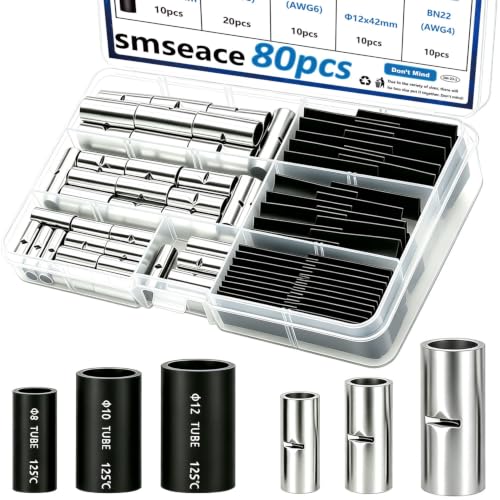
Forty butt splices with a center stop so both wire ends meet evenly, plus heat shrink to seal them.
This kit is built around joining two cable ends, not bolting to a post. You get 40 non-insulated butt connectors and 40 pieces of heat shrinkable tube, sorted by gauge: 10 pieces each at 4 AWG and 6 AWG, and 20 pieces at 8 AWG. Everything arrives in a transparent plastic box, so you can see what you have before you open it.
The connectors are purple copper with a tin-plated surface for conductivity, and each one has a wire barrier in the center. That barrier is the useful part — it holds pressure evenly on both sides so neither wire slips through while you crimp. The surface goes through an acid pickling process for extra oxidation resistance, which is what keeps corrosion off a joint that lives under a hood or in a hull. Rated to 257 degrees Fahrenheit.
Owners mention the kit works perfectly for car audio power wires, with build quality the top praise category in its reviews. Customers note the fit receives mixed feedback, with one customer noting the 8ga connector being 1/4″ short — so check your wire length before you cut. For automotive, marine, or industrial splicing, this is a solid working supply.
What the barrier does for you: a center stop means each wire stops at the same point, so your splice sits balanced instead of lopsided.
Sizing note: a few reviewers point out the 8 gauge bodies come up short against the wire, so leave slack in your cut length.
Best for: splicing 4, 6, or 8 gauge cable in a car audio run or an accessory circuit where you need a straight-through join.
Not the one for: bolting to a battery post — you need ring terminals for that.
7. HOUSUN 132PCS 4 6 8 10 Gauge Copper Lugs and Heat Shrink

Nine lug types across four gauges, with a heat shrink tube cut to match every one.
The count here is even: 66 battery terminal connectors and 66 pieces of 2:1 heat shrink tubing, all pre-cut to the most common sizes. That matching is the practical advantage — you are not hunting through a loose bag of tube looking for the one that fits your lug. Nine lug types cover 4, 6, 8, and 10 gauge wire, listed as SC4-6, SC6-6, SC6-8, SC10-6, SC10-8, SC16-6, SC16-8, SC25-6, and SC25-8.
The connectors are 100% copper with a tinned surface for corrosion protection, rated to 257 degrees Fahrenheit. The range of sizes means the same box handles automobile, motorcycle, distribution box, golf cart, solar panel, and marine work. If you are stocking a first wiring kit and want one order to cover a few projects, that breadth is the reason to pick it.
What shoppers say is mixed on the metal: some describe the terminals as sturdy and others as flimsy, and a few note the connectors run very thin. That tracks with the honest read — this is a versatile, budget-friendly assortment rather than a heavy-duty lug for a high-current battery cable. Buyers praise the functionality and the spread of sizes most; the thin walls are the trade-off at this price.
Why the assortment is the point: 9 lug types from 4 to 10 AWG with 66 matched heat shrink tubes makes it a genuine starter supply, not a one-job pack.
The honest limit: the connectors are thin-walled, so treat them as light-to-medium duty and reach for a heavier lug on main battery cable.
Worth grabbing if: you are building out a first electrical toolbox and want every gauge from 4 to 10 covered in one go.
Step up if: the joint carries heavy starting current — the thin walls are not built for that.
8. Twidec 180PCS Battery Cable Ends AWG 2 to 16 Gauge Copper Wire Lugs
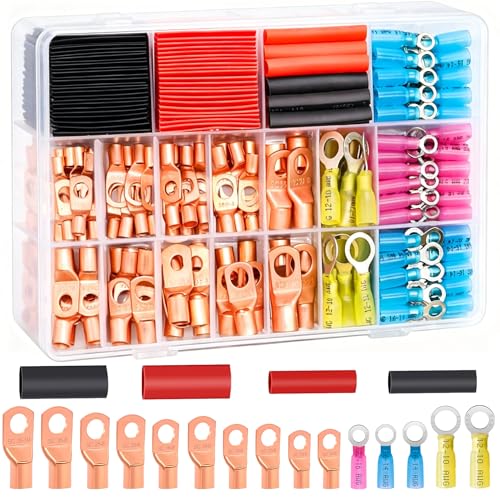
Eight gauges in one box, from a heavy 2 AWG down to fine 16 AWG control wire.
No other kit here reaches as wide. This one spans 2, 4, 6, 8, 10, 12, 14, and 16 AWG, plus ring crimp openings at #10, 1/4″, 5/16″, and 3/8″, with heat shrink tubing in two sizes. That is 180 pieces in total — compare it to the RIOCAN pack’s 16 pieces, and the difference is a shop supply versus a single job. For a 6 gauge connector search, the value is having 6 AWG in the box alongside everything else you might need.
The connector uses a standard bell-mouth design so cable enters more easily, and an open window lets you confirm the wire is seated before you crimp so it will not slip out. The copper is pure and rated to resist high temperature and corrosion, and the heat shrink is built for flame retardancy, electrical insulation, and air tightness. Rated at 24 volts, it suits cable, distribution box, home, solar panel, machinery, power, automobile, motorcycle, boat, and RV work.
Here is the split you need to know about. Copper quality is the most-praised trait by a wide margin. But the size options draw disagreement — some buyers find the terminals too small for their wire — and the thin material on the smaller lugs is a recurring note. Treat this as a wide-coverage assortment for light and medium jobs rather than a heavy-duty battery lug.
The one number that sells it: 180 pieces across eight gauges — the widest spread here — so one order covers a whole wiring project.
What to check first: the smaller terminals run thin, so size up a gauge if you are terminating a heavy battery cable.
Go here for breadth: ideal when your project has cables of several gauges and you want one box to cover all of them.
Not your lug if: every connection is a heavy 6 gauge battery cable — the thicker-walled picks hold up better there.
9. SQQHXX 260Pcs Copper Wire Lugs with Heat Shrink Set

The biggest box on this list, at 260 pieces, built to keep a busy bench stocked.
This one is about volume. The plastic case holds ring terminals across SC35-10, SC35-8, SC25-10, SC25-8, SC25-6, SC16-10, SC16-8, SC16-6, SC10-10, SC10-8, SC10-6, SC6-8, and SC6-6, covering 2, 4, 6, 8, 10, and 12 AWG, plus a 3:1 heat shrink tubing kit. If you are running a repair bench or a multi-battery bank, the case means you are not reordering every week.
The terminals are made from 100% annealed electrolytic grade copper, described as heat and corrosion resistant, and they can be crimped or soldered to your preference. The listing rates them to 600 volts. The intended uses are the usual set — distribution boxes, marine, golf carts, solar panels, vehicles, motorcycles, power inverters, RV, and DIY home wiring.
The trade-off here is real and worth saying clearly: the lugs are reported as very thin and prone to breaking, and the quality rating comes in mixed. Buyers also disagree on amperage use, with a note that the lugs are not suited to higher amperage applications. What does get praised is the wide variety of sizes and how well the connectors work for general jobs. So this is a bulk assortment for everyday light and medium wiring, not the pick for a high-current battery run.
Where it fits: 260 pieces and a 3:1 heat shrink kit make it a genuine restock box for anyone wiring regularly across several gauges.
The trade-off: thin walls and mixed quality mean it suits general connections, not high-amperage battery cable.
Reach for this if: you wire often across 2 to 12 AWG and want one big case to draw from instead of small packs.
Skip it for: a main battery cable carrying heavy current — the thin lug walls are not up to it.
Understanding the Specs
Wire Gauge (AWG)
AWG means American Wire Gauge, and a lower number is a thicker wire. A 6 AWG cable is heavier than an 8 AWG and carries more current, so the connector’s barrel has to match it. Many kits list several gauges at once — 4, 6, and 8, for instance — because those three cover most battery and accessory work. If a kit only names model codes, look for the gauge in the size list before you buy.
Stud Hole Size
The stud hole is the round opening the battery bolt passes through. Common sizes are 3/8″ (M10) and 5/16″ (M8). A lug with the right hole sits flat on the post; the wrong one rocks and can work loose. Buying a kit that includes both sizes, or a ring terminal pack that offers both, saves a second order when you are wiring more than one battery.
Tin Plating and Copper Type
Tin plating is a thin coating on the copper surface that resists corrosion and oxidation. Pure annealed copper is soft enough to crimp without cracking. Together they keep a joint stable in damp spots like a marine hull or a wheel well. A closed-end barrel adds another layer of protection by blocking moisture from entering the back of the crimp.
Crimp vs Screw vs Solder
A crimp lug needs a correctly sized crimping tool and makes a permanent joint. A screw-down mechanical splice needs only a screwdriver and can be taken apart again. Solder works with both styles but needs heat control. Each has a job: crimp for a permanent connection, screw for a quick repair or a layout that may change, solder for extra hold on a crimp that has an inspection hole.
FAQ
Will a 6 gauge connector fit an 8 gauge wire?
Do I need a special crimping tool for 6 gauge lugs?
What is the difference between 3/8″ and 5/16″ ring terminals?
Can I connect aluminum wire to copper wire with these?
How long does a tinned copper connection last?
Is 600V rating important for a 12-volt battery circuit?
Should I use a butt splice or a ring terminal?
Can I solder a lug instead of crimping it?
What is 3:1 heat shrink and why does it matter?
Do smaller 6 gauge kits still handle a heavy battery cable?
Final Thoughts: The Verdict
For most people wiring a battery, a boat, or a solar array, the haisstronica 60PCS kit is the one to grab. It pairs tin-plated annealed copper with four stud sizes and a labeled case, so you can find the right size fast. It holds 4.5+ stars across 370+ ratings, with build quality the most-praised trait in its reviews. If the joint has to survive constant road or hull vibration, the SVAAR 4 6 8 AWG lugs bring a smooth barrel rated to 600 volts. And if you need to join aluminum wire to copper, the RVBOATPAT inline splice is the connector built for that specific mix.
How We Picked
We do not accept paid placement. Every pick is matched to a real buyer and a real use-case; we do not hands-on test units.
Sources & Methodology
Specifications: manufacturer listings and product documentation. Review insights: verified customer reviews, as of November 2026. Pricing: not shown on this page (it changes often); check the current price via the retailer link.
As an Amazon Associate, Gadgets Feed earns from qualifying purchases. This does not affect which products we feature.