
Cutting a clean, perfectly round 6-inch hole through a solid door, thick concrete foundation, or brittle porcelain tile is one of the most punishing jobs you can ask from a power tool accessory. The wrong saw grabs, kicks back, burns through its teeth in seconds, and leaves a ragged, oversized hole that ruins your material. The right one disappears through the cut with a steady hum, ejecting the plug instantly, and stays sharp for dozens of holes.
I’m Min — the co-founder and writer behind Gadgets Feed. I’ve spent countless hours cross-referencing cutting diameters, tooth geometries, shank types, material compatibilities, and arbor systems to separate the 6-inch hole saws that actually deliver from those that waste your time.
Whether you’re punching through hardwood for a vent, drilling into rebar-laced concrete for a drain line, or coring granite for a faucet, picking the right 6 inch hole saw means the difference between a ten-minute job and a scrap pile of ruined material.
How To Choose The Best 6 Inch Hole Saw
Selecting a 6-inch hole saw is not about finding the cheapest one on the shelf. The massive diameter creates immense torque and friction, which punishes poor tooth material, a weak arbor, and an unsuitable pilot system. You need to match the saw’s construction to your specific material and your drill’s capability.
Tooth Material: Bi-Metal vs. Carbide Tipped vs. Diamond
For wood, plastic, drywall, and thin sheet metal, a bi-metal hole saw (high-speed steel teeth welded to a flexible steel back) offers the best balance of sharpness, durability, and low cost. For stainless steel, thick aluminum, and abrasive materials like fiberglass, tungsten carbide-tipped (TCT) teeth hold their edge much longer but are more brittle — you can’t abuse them with high speed or lateral wiggling. For porcelain tile, granite, glass, and masonry, only diamond-impregnated segments can scratch through the hardness. A standard steel saw will be instantly dulled on these materials.
Cutting Depth and Arbor Compatibility
Standard hole saws offer about 1-1/2 inches of cutting depth, which is fine for single-layer sheathing and drywall. For double-stud walls, thick countertops, or insulated doors, look for deep-cut models that reach 2-3/8 inches. The arbor system matters critically at 6 inches: a hex shank or 3/8-inch round shank must fit your drill chuck securely, and the pilot bit must be long enough to engage the material before the saw teeth touch. For concrete, an SDS-Plus shank with a dedicated connecting rod is mandatory. Premium systems like Snap-Lock allow tool-free changes and push-button plug ejection, saving you from hammering stuck cores out.
Speed Control and Lubrication Discipline
A 6-inch hole saw spinning at high speed generates dangerous torque. For wood, keep RPM between 400 and 800. For metal, drop to 150–200 RPM and use cutting oil. For tile and stone, use water cooling and never let the bit run dry. Ignoring these speeds is the single fastest way to snap a pilot bit, strip teeth, or lose control of the drill. Every pro review in this guide warns about it for a reason.
Quick Comparison
On smaller screens, swipe sideways to see the full table.
| Model | Category | Best For | Key Spec | Amazon |
|---|---|---|---|---|
| Diablo DHS6000CT | Premium | Deep cuts in wood & metal | 2-3/8″ cutting depth; Snap-Lock mandrel | Amazon |
| Spyder 600111 Rapid Core | Premium | Wood & plywood with fast plug ejection | 1-7/8″ cutting depth; variable tooth pitch | Amazon |
| DKIBBITH 6″ Dry Diamond Core | Premium | Tile & stone with angle grinder | 5/8-11 thread; 10,000-14,000 RPM | Amazon |
| DKIBBITH Diamond Tile Hole Saw | Mid-Range | Porcelain, granite & glass bottles | Diamond-tipped; 1-3/8″ cutting depth | Amazon |
| DKIBBITH TCT Hole Saw Set | Mid-Range | Stainless steel & hard metal | Tungsten carbide tipped; 1″ cutting depth | Amazon |
| SALI Concrete Hole Saw | Mid-Range | Concrete, masonry & brick walls | Tungsten steel; SDS-Plus shank | Amazon |
| PLG2SUPT Bi-Metal Hole Saw | Value | Budget-friendly wood & soft metal | Bi-metal; 1-1/2″ cutting depth | Amazon |
In‑Depth Reviews
1. Diablo Carbide Teeth Hole Saw DHS6000CT
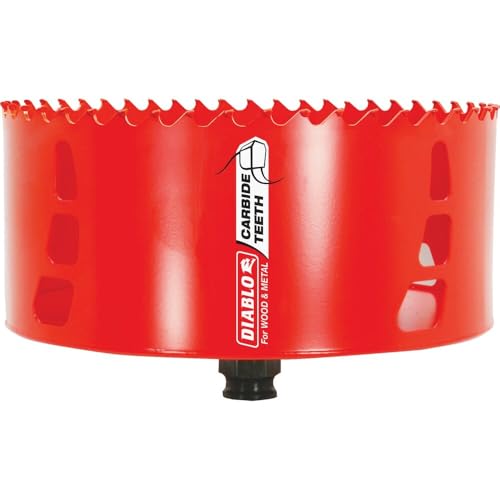
The Diablo DHS6000CT stands apart because of its 2-3/8-inch cutting depth — a full 40 percent deeper than the typical 1-1/2-inch saw. This lets you punch through a 2×4 stud wall or a thick solid-core door in a single pass without flipping the workpiece. The Snap-Lock Plus mandrel system is the fastest in this segment: you swap saws and eject the plug without any tools, which directly translates to less downtime on the job.
Carbide teeth on this model deliver up to 50 times longer cutting life than standard bi-metal saws, according to the manufacturer, and user reports confirm it stays sharp through dozens of holes in wood and metal. The variable tooth pitch reduces vibration and grabbing on entry, which is critical at the 6-inch diameter where kickback forces are magnified. The arbor pilot bit is the only weak link — several users report snapping it if they apply lateral pressure or overspeed.
This saw handles wood and metal cleanly, but it isn’t designed for masonry, tile, or stainless steel. Stick to pine, oak, plywood, MDF, aluminum, and mild steel. For those materials, it cuts faster and cleaner than anything else on this list.
Why it’s great
- Class-leading 2-3/8″ cutting depth eliminates the need to flip material
- Snap-Lock system provides tool-free plug ejection and instant size changes
- Carbide teeth last far longer than bi-metal saws in wood and metal
Good to know
- Pilot bit is brittle and can snap if the saw snags
- High cost makes sense only for frequent use or professional work
2. Spyder 600111 Rapid Core Eject Hole Saw

The Spyder Rapid Core Eject earns its name from a unique spring-loaded mechanism: you push a button on the back of the arbor, and the plug — the disc of material trapped inside the saw — pops out instantly. If you’ve ever spent five minutes hammering a stuck wooden core out of a standard saw, this feature alone can save serious frustration. The bi-metal construction with variable tooth pitch ensures a fast, clean cut across all thicknesses and reduces the chatter that plagues cheaper hole saws.
Cutting depth hits 1-7/8 inches, enough for most single-layer applications like 3/4-inch plywood, OSB sheathing, and drywall assemblies. Users consistently report it rips through 1-inch plywood in about 20 seconds with a corded drill. The downside is the sheer aggression: the teeth grab hard on entry, and the high torque can cause the drill to kick back dangerously if you’re not braced. Several reviews warn about the initial grab. The mandrel shank is also slightly oversized, which may require a file to fit some 1/2-inch chucks.
This saw is optimized for wood — plywood, oak, pine, MDF — and works reasonably well on drywall and thin-gauge sheet metal. It is not designed for masonry, tile, or hard metals. If your work is all wood-based and you value the rapid core ejection, the Spyder is a well-engineered, premium choice that justifies its price with every plug it spits out.
Why it’s great
- Push-button core ejection eliminates stuck-plug hammering
- Variable tooth pitch delivers smooth, chatter-free cuts in wood
- Bi-metal steel construction offers good durability for the price
Good to know
- Aggressive entry grab can cause dangerous kickback if not braced
- Mandrel shank may be too wide for some drill chucks
3. DKIBBITH 6″ Dry Diamond Core Drill Bit
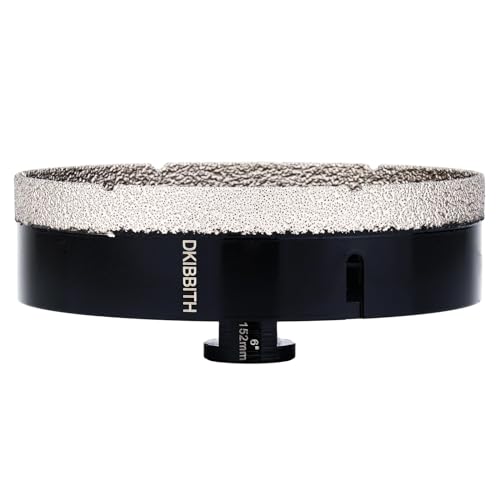
This is not a standard drill chuck hole saw. The DKIBBITH dry diamond core bit uses a 5/8-11 threaded connection to mount directly onto an angle grinder or wet polisher, running at 10,000 to 14,000 rpm. That spindle speed is far beyond what a standard drill can provide, and it is exactly what you need to cut through porcelain tile, granite, marble, and engineered stone without chipping. The diamond segments are brazed onto the steel barrel, and the side slot allows debris to escape so the bit doesn’t bind.
The cutting depth is listed at 2 inches, adequate for most tile and countertop thicknesses. Users report it drills perfect holes in porcelain tile for shower pipes and faucet holes with clean, non-chipped edges. The technique requires starting at a 45-degree angle to score a groove, then slowly tilting upright and moving in a circular motion. Running it dry works, but dipping in water between passes dramatically extends the diamond life. It also grinds stucco and brick effectively when you need to enlarge an existing hole.
This bit is completely unsuitable for wood, metal, or plastic — the diamond segments will load up and stop cutting. It is a purpose-built tool for tile, stone, glass, and masonry. If that is your material, this saw outperforms every twist-drill-based hole saw on the market. The value relative to Milwaukee and Bosch equivalents is excellent, coming in at roughly half the price for comparable performance.
Why it’s great
- 5/8-11 thread fits angle grinders for high-speed tile cutting
- Diamond segments cut porcelain and granite without chipping
- Debris slot prevents binding and improves cut speed
Good to know
- Requires angle grinder — not compatible with standard drill chucks
- Water cooling is strongly recommended to prevent diamond wear
4. DKIBBITH 6″ Diamond Hole-Saw Bit with Pilot Drill
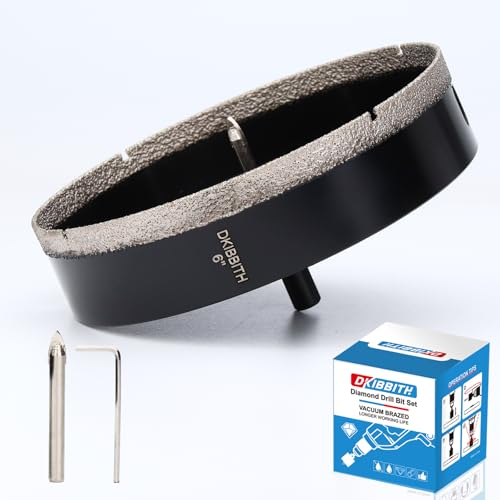
Where the previous DKIBBITH saw targets angle-grinder users, this one fits a standard 1/2-inch drill chuck and adds a removable pilot bit for precise positioning. The diamond-tipped edge cuts ceramic tile, porcelain, granite, stone, glass bottles, and even carbon fiber panels. The diamond height is 3/8 inch, and the total tool length is 2-1/2 inches, with a usable cutting depth of 1-3/8 inches. That depth is sufficient for most tile and countertop applications but will not pass through a 2-inch slab.
User feedback highlights its performance on problematic porcelain tile — the hardest variety that dulls carbide bits almost instantly. The diamond grit chews through it cleanly. One user drilled two holes through a granite desk in 20 minutes per hole, with the diamond grit looking like new afterward. The pilot bit is a critical advantage over core-style bits because it prevents the saw from walking across slick glazed tile. For glass, a water dam made of blue tape and a pre-drilled guide hole are recommended.
This saw is not intended for wood, metal, or concrete — the diamond segments are not designed for those loads. It lives in the tile-and-stone niche and performs there better than any carbide-tipped alternative. The included hex wrench allows quick pilot bit changes. The value proposition is strong, outperforming Milwaukee diamond hole saws at a lower price point.
Why it’s great
- Removable pilot bit prevents walking on slick tile and glass
- Diamond grit cuts the hardest porcelain and granite easily
- Fits standard 1/2″ drill chucks with no special adapter needed
Good to know
- 1-3/8″ cutting depth limits use on thicker stone slabs
- Water cooling is required to prevent diamond overheating
5. DKIBBITH TCT Hole Saw Set
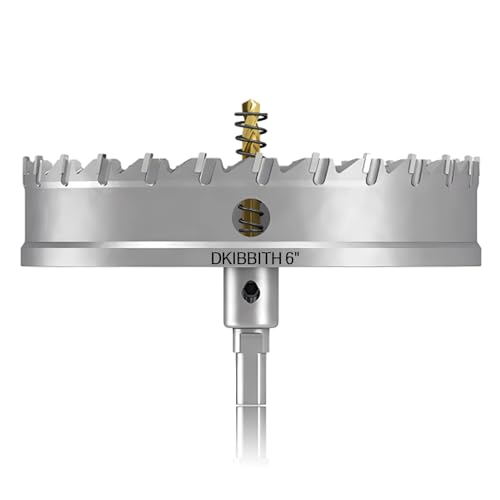
The TCT (tungsten carbide tipped) construction of this 6-inch hole saw targets the toughest metal-cutting jobs: stainless steel, high alloy steel, iron, and copper. The carbide tips are brazed onto a reinforced steel body with a debris-removal slot, and the 3/8-inch three-flatted shank provides a secure grip that resists slipping under high torque. Cutting depth is 1 inch, which is sufficient for sheet metal, pipe, and thin plate but not for structural steel or thick-walled pipe.
Users confirm it cuts through steel doors for deadbolts in seconds without the smoke and burning that cheap bi-metal saws produce. The included titanium-plated pilot bits are detachable, allowing you to replace them when dull. The kit comes in a carrying case with an Allen wrench for changing bits. Some users note the carbide tips arrive not exceptionally sharp — the saw cuts more by grinding than slicing — which produces clean hole edges but can cause burning in wood if you apply pressure.
This saw works on wood, plastic, and FRP, but it truly shines on stainless and mild steel. The cutting depth limitation (1 inch) means you may need to finish deeper blind holes by other means. Also, a few reports of pilot bits snapping on the first cut in 1/8-inch steel suggest the bits are the weakest link. Use cutting oil and the lowest speed your drill can manage to keep the TCT teeth intact.
Why it’s great
- Tungsten carbide teeth power through stainless steel without burning
- 3-flatted shank prevents slipping in high-torque metal cutting
- Detachable pilot bits allow replacement when dull
Good to know
- 1-inch cutting depth is not enough for thick materials
- Pilot bits can snap on first use in hard steel if too much pressure is applied
6. SALI Concrete Hole Saw Kit
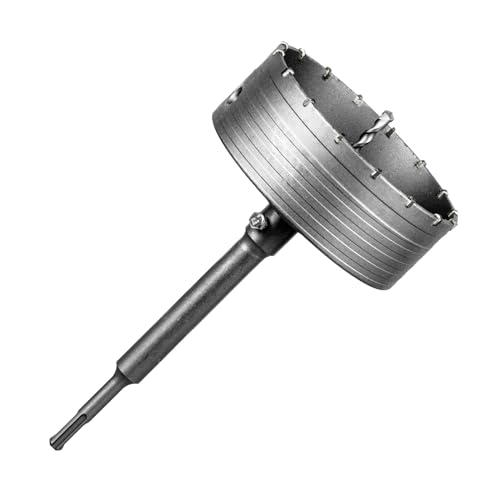
The SALI concrete saw is built with tungsten steel segments that can withstand the abrasive wear of cement block, brick, stone, and masonry. The key differentiator is the SDS-Plus shank connecting rod, which fits rotary hammers and SDS-Plus hammer drills from all major manufacturers. The kit includes a 220mm SDS-Plus rod, a 110mm center positioning drill bit, and a positioning screw. The cutting segments are welded using high-frequency technology, and the saw can handle rebar up to 6mm thick embedded in concrete.
User experiences confirm it cuts through 1930s-era cement block in about 2 minutes using a 20V hammer drill. Cutting through a 12-inch concrete foundation requires a real rotary hammer with water cooling — without water, teeth loss occurs quickly. The pilot bit is not self-centering on smooth surfaces and can drift before the full diameter engages. Some users recommend pre-drilling a center hole with a masonry bit to keep the saw on track. The depth is limited by the length of the tungsten segments, but for wall penetrations for dryer vents, drain pipes, and air conditioning lines, it does the job.
This saw is unsuitable for wood, metal, or tile. It is a dedicated masonry tool. For occasional concrete cutting — a few holes per year — it offers exceptional value compared to brand-name diamond core bits that cost three times as much. For daily commercial use on reinforced concrete, a diamond core bit with water cooling will last longer per dollar.
Why it’s great
- SDS-Plus shank connects securely to rotary hammers for concrete work
- Tungsten steel segments handle rebar and abrasive masonry
- Budget-friendly alternative to diamond core bits for occasional use
Good to know
- Not for wood or metal — purpose-built for masonry only
- Water cooling required for thick concrete to avoid tooth loss
7. PLG2SUPT Bi-Metal Hole Saw with Arbor
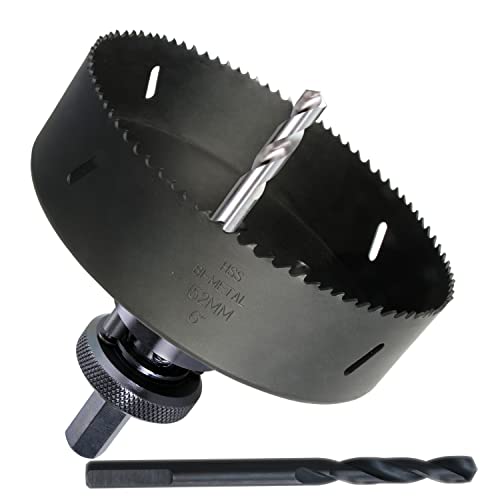
The PLG2SUPT bi-metal hole saw delivers the core function — cutting a 6-inch hole in wood, drywall, PVC, and soft metals — at a price that undercuts every other saw on this list. It includes the hole saw bit, a mandrel for 1/2-inch drill chucks, and two HSS pilot drill bits: one for wood and soft metal, one for harder metal. The bi-metal strip is laser-welded and vacuum heat-treated for hardness, and the company claims up to 30 holes in 0.12-inch low-carbon steel plate.
Real-world users confirm it cuts hardened 4140 steel at 70 RPM with pecking and lubrication, though the saw runs slightly out of round — more of a roughing tool than a precision instrument. It performs well on 2-inch thick hardwood (oak, beech, elm) in two passes at 800 RPM, staying sharp after 13 cuts. The included mandrel is the weakest component: multiple users report trashing it and swapping to a Starrett or Lenox arbor. The arbor pins also arrive loose. The saw body itself, however, is heavier and less flimsy than expected at this price point.
This saw is the right choice if you need to cut a few 6-inch holes in wood or thin metal and want to spend the minimum. The bi-metal construction means it can handle occasional metal cuts that would destroy a carbon steel saw. It is not built for daily professional use or for precision cabinet work where consistent roundness matters. Stick to low speeds and light pressure, and consider upgrading the arbor separately.
Why it’s great
- Very low entry cost for a functional 6-inch bi-metal hole saw
- Comes with two pilot bits for wood/soft metal and hard metal
- Laser-welded bi-metal construction is tougher than carbon steel saws
Good to know
- Included mandrel and arbor pins are low quality — plan to use a different arbor
- Saw can run slightly out of round, unsuitable for precision work
FAQ
What RPM should I use for a 6-inch hole saw in wood?
Can I use a 6-inch hole saw in a cordless drill?
Why does my 6-inch hole saw keep grabbing and kicking back?
How do I remove a stuck plug from a 6-inch hole saw?
Final Thoughts: The Verdict
For most users, the 6 inch hole saw winner is the Diablo DHS6000CT because its 2-3/8-inch cutting depth and Snap-Lock mandrel system set a new standard for productivity in wood and metal. If you need clean tile and granite holes with a standard drill, grab the DKIBBITH Diamond Hole-Saw Bit with pilot drill. And for cutting through concrete and masonry on a budget, the SALI Concrete Hole Saw Kit with SDS-Plus shank delivers the best value per hole.