
Our readers keep the lights on and my morning glass full of iced black tea. As an Amazon Associate, I earn from qualifying purchases.
Specs are compiled from manufacturer listings and verified buyer reviews and can change over time — please confirm the key details on the product page before buying.
With a 6-inch orbital sander, the real decision is air versus electric power, and how much vibration your hands can take over a long panel. If you already run a compressor, an air unit gives you the most sanding per dollar and the lightest tool in your hand. A corded brushless model frees you from the hose and the tank. Below are nine six-inch machines that hold up on real surfaces — filler, paint, bare wood — with the specific reason each one earns its place and the honest catch you should know before you click.
I’m Min — the founder and writer behind Gadgets Feed. This guide is built by comparing the manufacturers’ published specifications and the patterns across verified customer reviews, so you get each pick’s real strengths and trade-offs instead of marketing spin.
Orbit diameter, power source, and pad attachment decide which sander suits which job, and each pick below is matched to a specific task. Every entry in this 6 inch orbital sander shortlist earns its place on measured specs and owner experience, not on hype.
Our Picks at a Glance


How To Choose The Best 6 Inch Orbital Sander
Start with your compressor. A compressor with a tank and a hose changes the whole calculation, because air tools are lighter and simpler than electric ones. Without one, a corded sander is the only practical route, so weigh brushless motor type and dust control instead.
Air or electric, decided by your compressor
An air sander needs a steady supply of compressed air, measured in CFM (cubic feet per minute — how much air the tool gulps while running). The TCP Global unit lists 4.5 CFM at 90 PSI (pounds per square inch, the air pressure it wants) and suggests a 2-horsepower compressor. If your tank and motor cannot hold that pressure under load, the tool will bog down mid-panel. Corded electric sanders skip this problem entirely — you just need an outlet.
Orbit diameter: the number that decides cut versus finish
The orbit is the small circle the pad traces as it spins. A 3/16-inch orbit, as on both Ingersoll Rand models, is a fine-finishing size — it removes material gently and leaves fewer scratch marks. A larger 5mm orbit, as on the VEVOR and BUCKTOOL, cuts faster but can be more aggressive on delicate work. Match the orbit to the job: a 5mm orbit for heavy material removal, a 3/16-inch orbit for final finishing.
Pad attachment and dust
PSA stands for pressure-sensitive adhesive — you peel and stick the disc to the pad, which holds firm but leaves residue over time. Hook and loop is the reusable fabric-style grip that lets you swap grits in seconds. Several picks here include both styles of backing pad, which is worth having if you change grits often. Dust collection matters too: a hose port that connects to a vacuum keeps the surface clear so the abrasive keeps cutting.
Quick Comparison
| Model | Best For | Power Source | Max Speed | Weight | Amazon |
|---|---|---|---|---|---|
| Chicago Pneumatic CP870★ Best Overall | Body shop blending and filler work | Air-powered | 10,000 rpm | 4.3 lb | Amazon |
| TCP Global 6″ Dual-Action Air Palm SanderBudget Champion | Budget air setup with both pad styles | Air-powered | 10,000 rpm | 1.89 lb | Amazon |
| Astro 300SPQuietest Pick | Quiet feather edging and finish work | Air-powered | 9,000 rpm | 16 oz | Amazon |
| SUNEX TOOLS SX203N | Quiet dual-action on a mid budget | Air-powered | 10,000 rpm | — | Amazon |
| VEVOR Random Orbital Sander 6-Inch | Corded brushless with grit variety | Corded Electric | 10,000 rpm | 4 lb | Amazon |
| Ingersoll Rand 311A | High-rpm surface prep and finishing | Air-powered | 12,000 rpm | 4.2 lb | Amazon |
| Ingersoll Rand 300G | Lightweight fine finishing with vacuum hookup | Air-powered | 10,000 rpm | 1.2 kg | Amazon |
| BUCKTOOL 6-Inch Random Orbital Sander | Corded power with 5″/6″ flexibility | Corded Electric | 10,000 rpm | — | Amazon |
| MAXXT Random Orbital Sander | Heavy-use brushless with instant braking | Corded Electric | 10,000 rpm | — | Amazon |
In‑Depth Reviews
1. Chicago Pneumatic CP870, Air Random / Rotary Sander, 6 in, Non-Vacuum, PSA
Our pick — 4.5+★ from 250+ verified ratings; the strongest balance of quality and price.
The dual-action body-shop workhorse that blends filler without digging divots
If you are prepping a panel for paint — feathering an edge, smoothing body filler, scuffing before a coat — this is the tool that makes the job feel controlled. It runs up to 10,000 rpm in free speed and switches between rotary and random orbital motion, so you can cut with one and finish with the other on the same pad. The 6-inch non-vacuum PSA pad (pressure-sensitive adhesive — you peel and stick the disc) is exactly what you want where dust is handled by other means.
Where it wins people over is value, and the numbers support the reputation — 21 owners single it out as the reason they bought it, the single biggest positive in its review pages. Its 4.5+ stars across 200+ ratings back that up. The composite over-sleeve grip and straight handle let you hold it steady through a long sanding pass, and the power regulator lets you dial the speed down for delicate filler work instead of blasting it.
A couple of things to weigh. The build quality draws a mixed reception — some find it well-built, others find it cheaply made — so treat the housing with a little care and it will serve you. For a body shop, those few ounces are the price of air-powered simplicity — no cord to drag, no brake to wait on.
Why It Belongs Up Top
- Switchable rotary and random orbital motion covers rough cutting and fine finishing
- 10,000 rpm free speed with a power regulator for controlled passes
- Insulated composite over-sleeve grip keeps fatigue down on extended sanding
- Safety lever and lock-off throttle guard against accidental starts
What To Keep In Mind
- Build quality draws mixed feedback — handle with care
- Non-vacuum pad means you supply your own dust strategy
- Needs a compressor that can feed it at 90 PSI
Reach for this if: you have a compressor and want one air tool that feathers edges and finishes filler with equal confidence.
Hold off if: your setup is corded-only — this one simply will not run without air.
2. TCP Global Heavy Duty 6″ Dual-Action Random Orbit Air Palm Sander
Two backing pads in the box, under two pounds in your hand, and a price that undercuts the rest
You can start air sanding right from the start, because this kit includes a PSA backing pad (a sticky pad for adhesive discs) and a hook and loop pad (for reusable discs), plus a coupler plug, lubricating oil, and a wrench. It spins to 10,000 rpm at 90 PSI (pounds per square inch of air pressure) and draws 4.5 CFM (cubic feet per minute of air flow), so a 2-horsepower compressor is suggested to keep up. Surface prep on metal, wood, and fiberglass is right in its lane.
At 1.89 pounds, this is the lightest air unit on this list — less than half the 4.3 pounds of the Chicago Pneumatic above — so you can sand a door panel top to bottom without your forearm complaining. Five owners specifically call out the lightweight design. Value is the headline, with 29 owners naming it the reason they are happy — the largest positive count in its reviews. It carries 4.0+ stars across 300+ ratings.
Now the honest catch, because this one is priced for a reason. Durability is the recurring gripe — several buyers report the sanding pads breaking during first use, and the speed control knob runs loose. A few also note it uses more air than claimed, so size your compressor generously. Treat the pads as consumables and buy spares, and this stays a solid starter tool.
The real trade-off: feather-light in the hand and cheap to try, but the included pads are the weak point — budget for replacements and you will get good service.
The honest verdict: a smart first air sander for a hobbyist with a small compressor, provided you accept it is a consumables-friendly tool, not a lifetime investment.
3. Astro 300SP 6-Inch DAQ Random Orbital Sander with Pad
Built to run quiet through the finishing pass, at 9,000 rpm and just one pound
For finish work where the sander runs for long stretches and the noise starts to wear on you, the sealed silencer in this one is the whole point. A built-in muffler and motor insulation keep the pitch down, and balanced ball bearings keep the pad smooth so the finish comes out even. The built-in regulator lets you lock the speed where you want it.
At 16 ounces it is the lightest air tool here by a wide margin, and that matters when you are feathering edges or working body filler one-handed. It tops out at 9,000 rpm — a touch below the 10,000 of the VEVOR electric above — but that lower ceiling suits fine finishing rather than aggressive removal. Quality is the thing everyone points to, with nine owners naming it directly and seven more praising performance. It holds 4.5+ stars across 80+ ratings.
The quieter design does come at a cost: the non-vacuum configuration on this one means dust control is on you, and once you step into this range a vacuum-ready port is nice to have. It is a smaller-volume pick, too, so parts and pads are worth sourcing before the job rather than mid-sand.
Best for: shop or garage work where a long finishing session with low noise is the priority.
Not for: heavy material removal — it is tuned for finesse, not fast stock removal.
4. SUNEX TOOLS SX203N 6-Inch Quiet Dual Action Sander
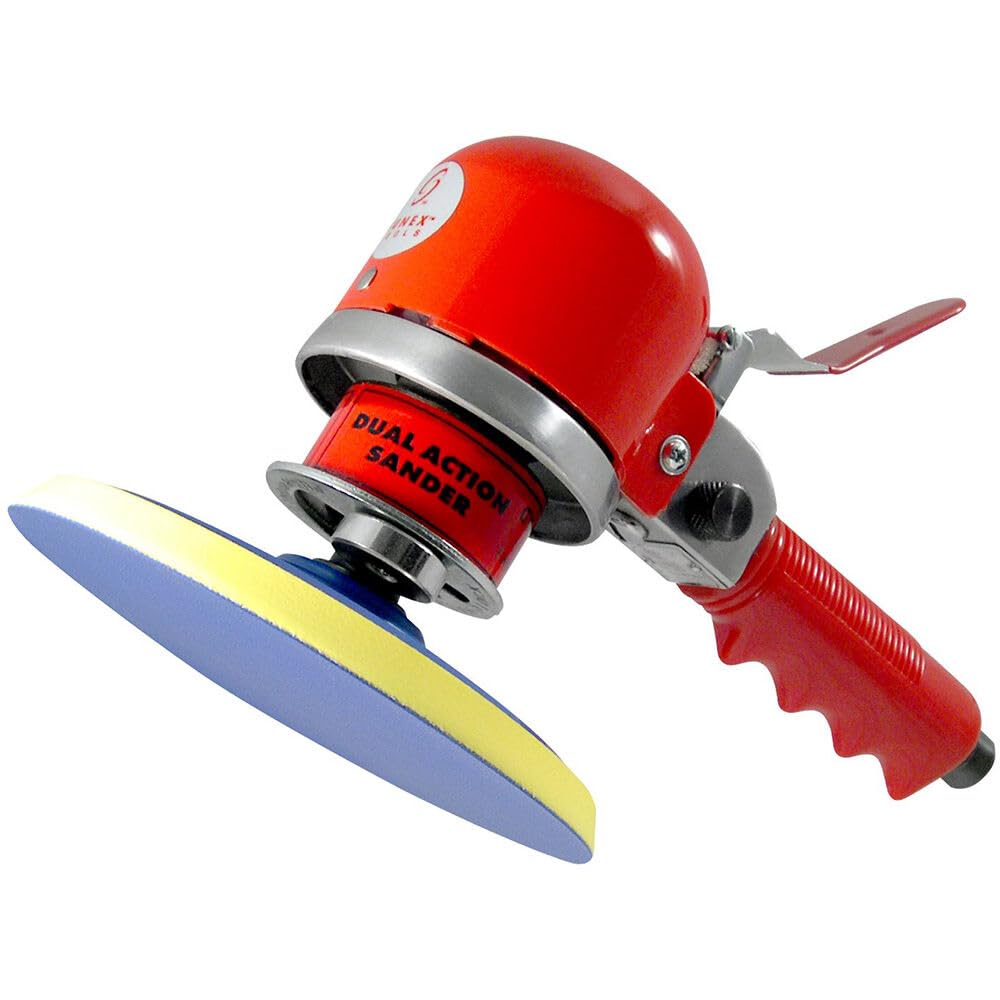
Quiet housing, ball-bearing balance, and a variable-speed lever you can feel through the pass
You get the bench features that matter at a mid-band air-tool price: an insulated motor housing to keep the noise down, a built-in regulator for speed, and ball-bearing construction for a vibration-free stroke. It tops out at a listed 10,000 rpm and connects at 1/4-inch NPT (a standard air-fitting thread) with a 3/8-inch minimum hose, so it works with a standard shop setup.
Functionality is where this one earns its keep, with 12 owners calling it out specifically, and quality close behind at 11. It is the sort of tool that quietly outperforms a palm sander on larger flat surfaces, and the variable-speed lever throttle lets you ease into a cut. It comes with a pressure-sensitive foam pad and a sheet of bonded sanding pad so you can start immediately.
The honest note: this is a mid-priced air unit, and the quiet-label marketing oversells a bit — it is quieter than a whining rotary, but not silent. The non-vacuum configuration means you will want to work near a dust source or add a vacuum adapter. If you want the vacuum port built in, the Ingersoll Rand 300G below carries a 360-degree swivel adapter for it.
What Earns It A Slot
- Insulated motor housing and ball bearings keep vibration and noise down
- Variable-speed lever throttle gives tactile control through a pass
- Includes a PSA foam pad and a bonded sanding sheet to start working
What You’ll Add On
- Non-vacuum — a separate dust solution is on you
- Quiet, but not silent as the name might suggest
Choose it when: a quiet, controllable air sander is what your bench needs and you can live without a built-in vacuum port.
5. VEVOR Random Orbital Sander 6-Inch, 350W Brushless
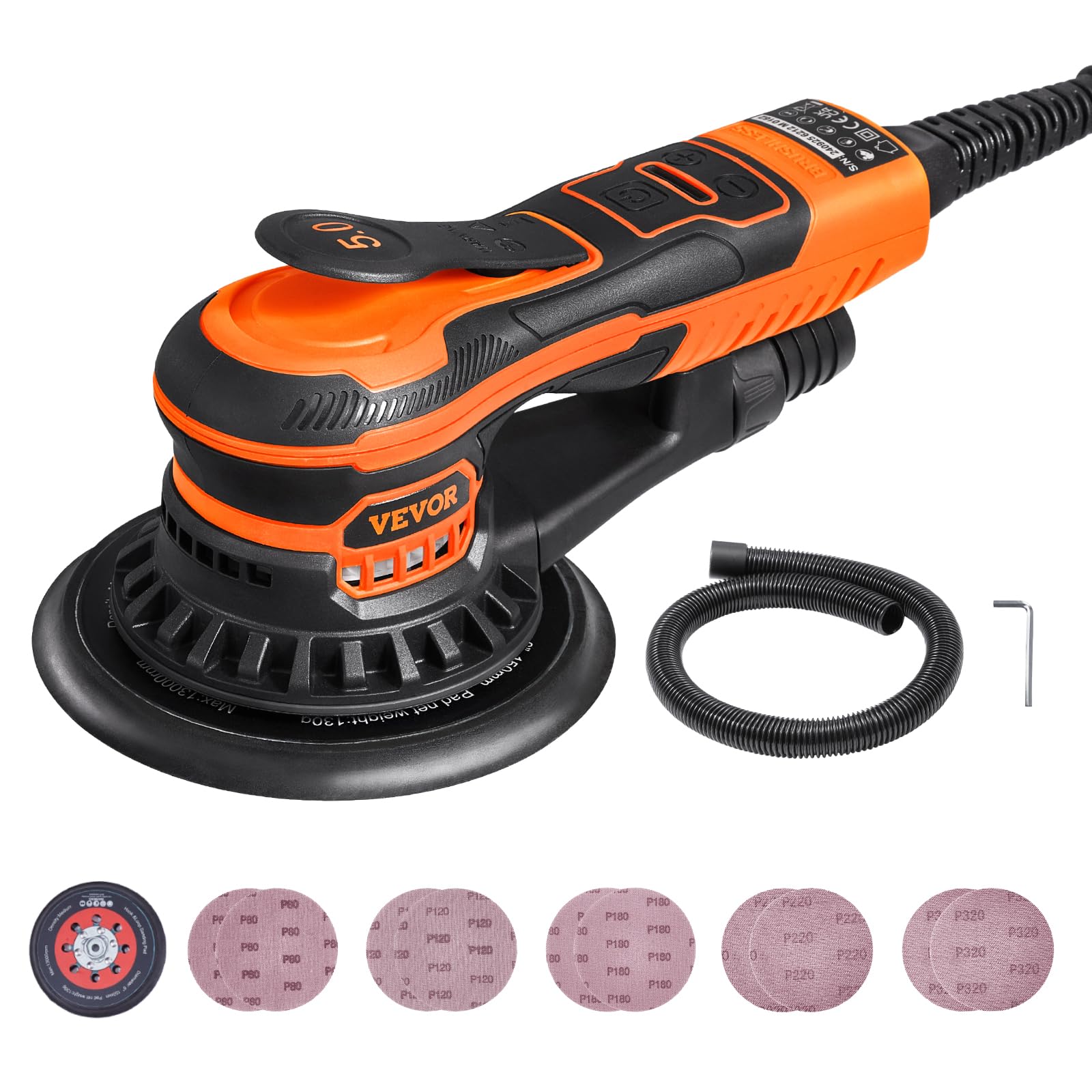
A corded brushless sander that brings the grits with it, no compressor required
For anyone who does not have an air setup, this is a strong argument for staying electric. The 350W brushless motor runs to 10,000 rpm with a 5mm orbit — a larger stroke than the 3/16-inch orbit on the Ingersoll Rand units, so it removes material faster. Six speeds from 4,000 to 10,000 rpm let you pick the pace for delicate polishing or rapid stock removal.
What comes in the box matters here: ten 6-inch sanding sheets in 80, 120, 180, 220, and 320 grit — a true progression from rough to finish, so you are not buying abrasives separately. The dust connector and hose connect to a vacuum, and there is a symmetric grip that works for left- and right-handed use. Performance is what people come for, and 25 owners name it specifically — the dominant positive in its reviews. It carries 4.5+ stars across 100+ ratings.
Two things to know. The “instant stop” function halts rotation when you release the handle, which is a real safety plus, but dust collection draws mixed feedback — the port works, though it is not the vacuum-clean-up-everything experience you might assume. Durability is also mixed, so run it within its limits on long sessions. At 4 pounds it sits about as heavy as the Chicago Pneumatic air unit, so expect a solid handheld feel rather than a flyweight one.
Standout spec: ten included discs across five grits is the most complete out-of-the-box sanding setup on this list.
Keep in mind: it needs a dust hose and vacuum on hand to make the most of the collection, and it is a corded tool — plan your reach.
This one is for you if: you work without air and want brushless efficiency plus a full grit range on day one.
Look elsewhere if: you are allergic to cords or want maximal dust extraction without a separate vacuum.
6. Ingersoll Rand 311A Dual-Action Angle Air Sander, 6-Inch

The speed leader at 12,000 rpm, built to tear through prep fast
If surface prep is the bottleneck in your workflow, the 0.25 hp motor and 12,000 rpm free speed here are the numbers that change the pace. The 3/16-inch orbit keeps the finish controlled even at that higher ceiling, so you can move quickly without leaving deep swirl marks. An adjustable regulator and dual-action pad motion give you a fine degree of speed and power control on the fly.
The built-in silencer muffles the airflow noise, and ball-bearing construction adds balance for a longer, lower-fatigue session. At 4.2 pounds and compact enough for tight spaces, it handles feather edging and body-filler work with confidence. Of the picks here, it spins faster than the Astro 300SP at 9,000 rpm and the SUNEX at 10,000 rpm — a real gap in material removal.
The honest caveat: this is a premium air tool and it wants a capable compressor feeding it at that higher rpm. It is not vacuum-ready on its own, so plan dust control separately, and it is a bigger footprint for a hand tool. The 4.0+ stars across 700+ ratings reflect a mature, well-known design — but read the manual on that lock-off switch before your first run.
The bottom line: if you are prepping panels all day and want every second back, the extra headroom here beats the quieter, slower picks.
7. Ingersoll Rand 300G 6″ Random Orbital Air Sander

A 1.9-pound air finisher with a swivel vacuum port for cleaner dust control
This is the pick for long finishing sessions where your arm does the talking. At 1.9 pounds it is one of the lightest tools on the list, and the contoured grip plus low-vibration design keeps a full panel from feeling like a workout. It tops out at 10,000 rpm with a 3/16-inch orbit, the classic fine-finishing combination for wood and metal prep.
The 360-degree swivel vacuum adapter is the standout — you connect a compatible dust system and clear debris as you work without the hose fighting you. A diffused rear exhaust keeps the air blast aimed away from the surface. It is built from quality materials that shrug off drops and harsh chemicals, according to the spec sheet, and the 4.0+ stars across 300+ ratings back a proven design.
Where it falls short of the 311A above is raw speed — a 0.20 hp motor versus 0.25 hp, and 10,000 rpm versus 12,000 — so it is tuned for finesse, not fast stock removal. It also has no pad-included kit beyond the tool itself, so add discs and a vacuum setup to your list. The rear-exhaust routing is a plus for some, but it means the hose can be a little farther from the surface than on a straight-design tool.
Where It Excels
- 1.9 pounds keeps fatigue low over long sessions
- 360-degree swivel vacuum adapter clears dust as you sand
- Diffused rear exhaust keeps airflow off the work surface
Who Should Skip It
- Not a high-removal tool — 0.20 hp is for finishing
- Bare tool only — discs and vacuum are separate
Reach for this if: you do long finishing passes and dust control matters as much as the finish itself.
Not the one if: you need fast severe material removal — pick the 311A instead.
8. BUCKTOOL 6-Inch Random Orbital Sander, 3A Brushless
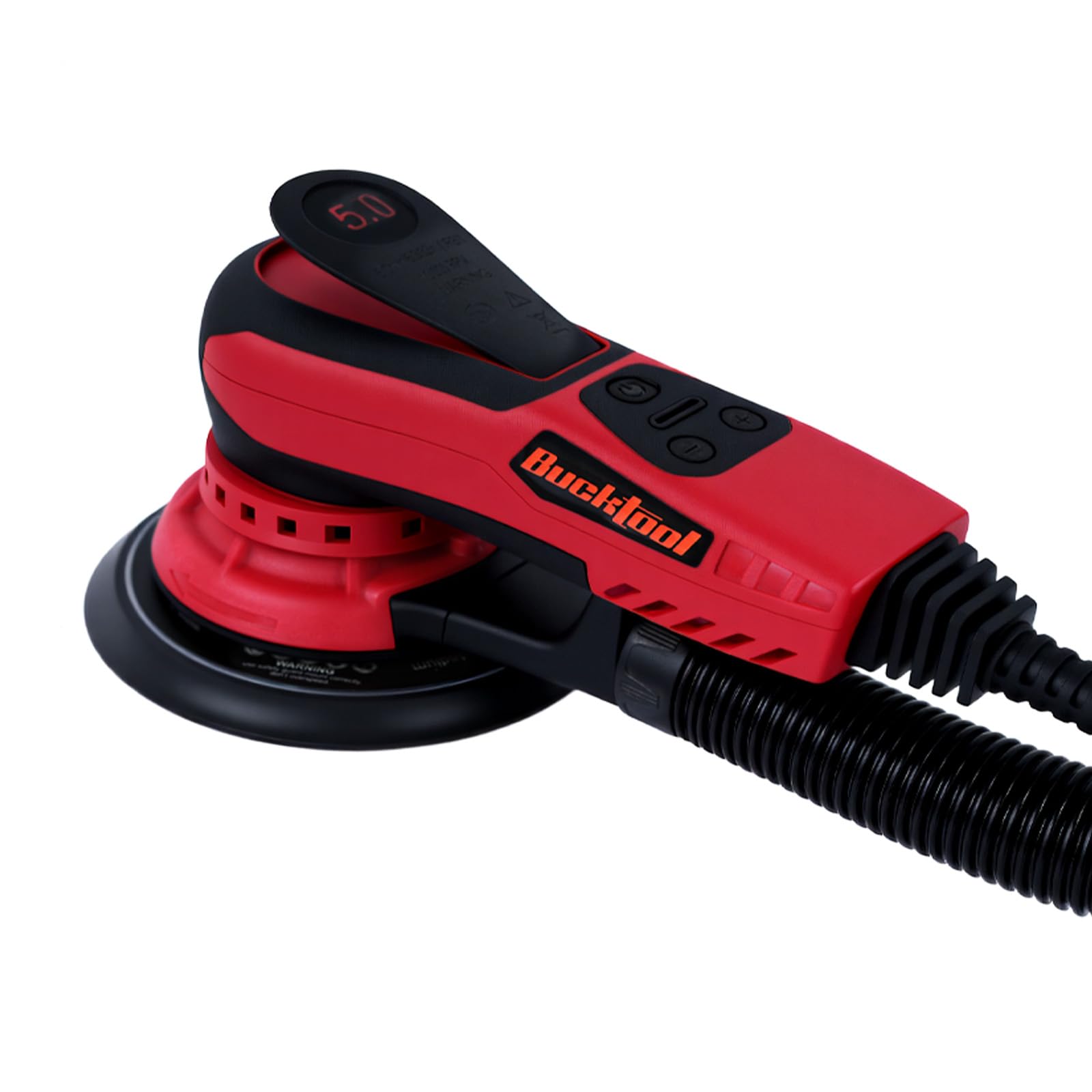
One pad that runs both 5-inch and 6-inch discs — flexibility where it counts
Here is a sander that bends to your sanding stock instead of forcing you to stock one size. The included 6-inch backing pad accepts both 5-inch and 6-inch discs, so you can swap pad sizes without swapping tools. The 1/2HP 3.0 Amp brushless motor spins to 10,000 rpm with a 5mm orbit — the larger stroke that cuts a bit faster than the 3/16-inch orbit on the Ingersoll Rand 300G above.
Performance is the reason this one stands out, with 20 owners naming it specifically — the most-discussed positive in its reviews. Durability earns a second strong mention at six, and you can feel the described build quality; the integrated dust extraction with a universal port handles dust as you sand, and the one-hand push switch makes for quick starts. It carries 4.5+ stars across 50+ ratings.
The catch is vibration — it receives mixed feedback, with some owners finding it smooth and others noting it buzzes more than expected. That is the honest trade-off of a larger orbit and higher power. Noise level, by contrast, draws positive notes, so long sessions are more comfortable than the power suggests.
What you gain: a variable-speed brushless sander that runs 4000–10000 OPM and gives you both 5-inch and 6-inch capability on one pad.
What you accept: a little more vibration on long sessions, and you will want to add your own discs beyond the four included 80/120/180/220 grits.
Best fit: a woodworker who wants one corded sander that handles both pad sizes and runs brushless.
Skip if: you demand minimal vibration at high speed — the mixed feedback on that score is worth noting.
9. MAXXT Random Orbital Sander for 6 Inch, 10000 RPM Brushless EC Motor
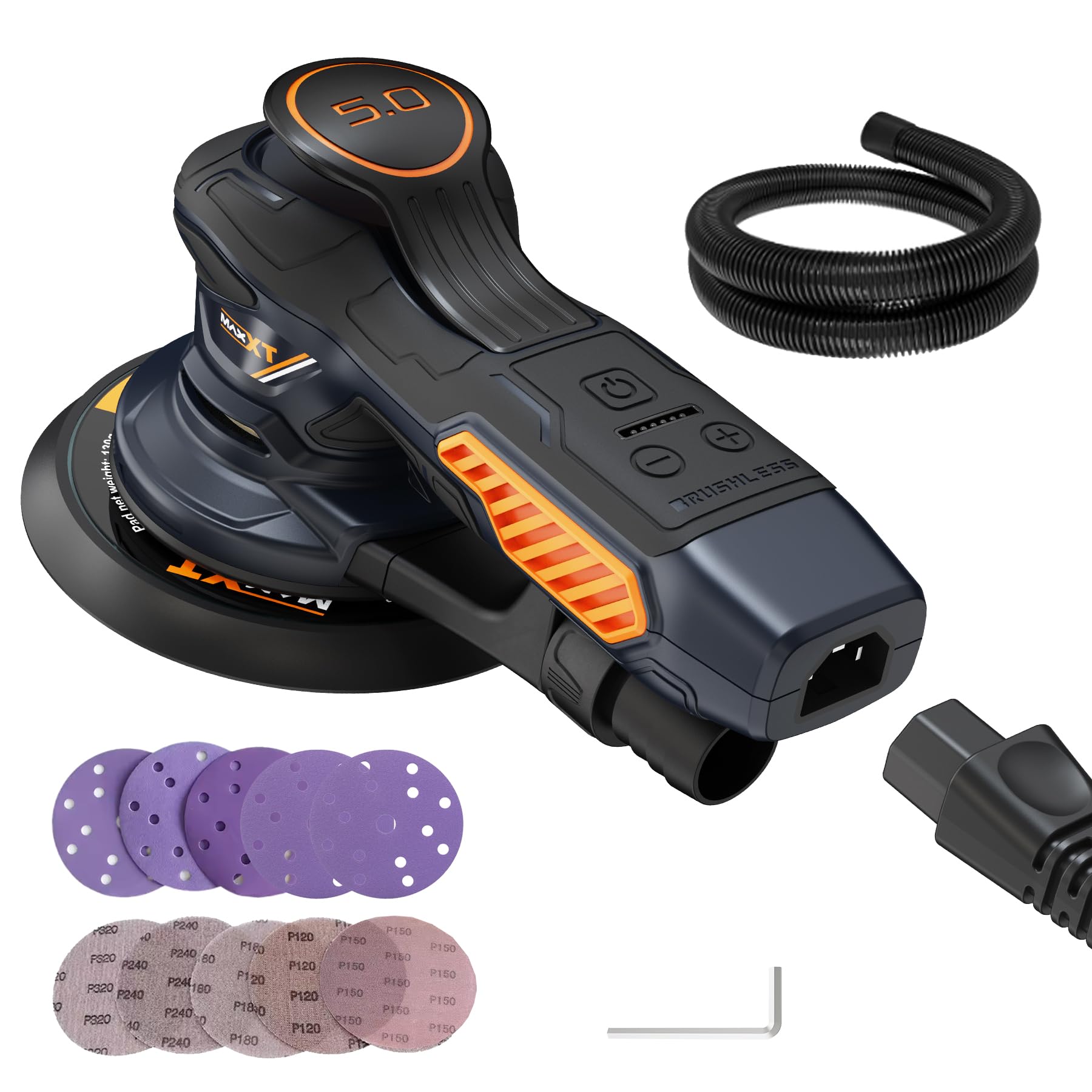
A brushless EC motor with instant pad braking, aimed at high-use sanding
The premium corded pick here, and the one that leans hardest into safety and motor life. The 350W brushless EC motor runs to 10,000 rpm across two speed settings from 4,000 to 10,000, so you can ease into fine detailing or open it up for heavy removal. The instant pad braking stops the disc quickly when you lift off, protecting your workpiece from the swirl marks that come from a pad coasting down on the surface.
Where it earns its keep is what buyers experience around quality and function — quality is the most-discussed positive with 14 owners naming it, and functionality follows right behind at 13. The dust management system gets specific praise, and the dual speed range suits both floor sanding and furniture refinishing. It carries 4.5+ stars across 100+ ratings.
Two honest limits. It is the top of the price band here, so this is the one to pick when you want the extra safety and motor life, not the value option. And it is a corded tool with a 110-volt requirement — you need an outlet near the work, and the ten included sanding discs cover your first project but not your fifth.
For the heavy user: instant pad braking and a brushless EC motor make this the one to buy if sanding is regular work, not an occasional afternoon.
Understanding the Specs
Orbit Diameter
The orbit is the small circle the pad traces as it spins — think of it as the shape your finish will carry. A 3/16-inch orbit, as on the Ingersoll Rand 311A and 300G, is a fine-finishing size: it is gentler on the surface and leaves fewer scratch marks. A larger 5mm orbit, as on the VEVOR and BUCKTOOL, cuts faster but needs a steadier hand on delicate work. For body filler and paint prep, a smaller orbit is often easier to control; for fast stock removal on flat panels, the bigger circle pays off.
Air Power: CFM and PSI
Air sanders are rated in CFM (cubic feet per minute — how much air the tool consumes while running) and PSI (the pressure it wants at the inlet). The TCP Global unit lists 4.5 CFM at 90 PSI and suggests a 2-horsepower compressor. If your compressor cannot sustain both the pressure and the flow, the sander will lose power mid-pass. Check your compressor’s rated output at 90 PSI before committing, because a tool that outruns your tank becomes frustrating quickly.
FAQ
Will a 6-inch orbital sander work with my existing 5-inch sanding discs?
Do I need a compressor to run an air orbital sander?
Is a 3/16-inch orbit or a 5mm orbit better for finishing?
What does PSA mean on a sanding pad?
How do I control dust with a 6-inch orbital sander?
Is a brushless electric sander worth it over an air sander?
What grits should I use for paint prep versus bare wood?
How much does weight matter in a 6-inch orbital sander?
Can I use one 6-inch sander for both wood and automotive work?
Which sander is best for a first-time buyer without a compressor?
Final Thoughts: The Verdict
Across the board, the 6 inch orbital sander winner is the Chicago Pneumatic CP870, because it combines switchable rotary and random orbital motion with a 10,000 rpm ceiling and a composite grip that keeps a long body-shop pass controlled. If you want brushless electric without a compressor, grab the VEVOR for its 350W brushless motor and ten-disc grit range. And for fine finishing with dust control built in, the Ingersoll Rand 300G is the one to reach for, thanks to its 1.9-pound body and 360-degree swivel vacuum adapter.
How We Picked
We do not accept paid placement. Every pick is matched to a real buyer and a real use-case; we do not hands-on test units.
Sources & Methodology
Specifications: manufacturer listings and product documentation. Review insights: verified customer reviews, as of November 2026. Pricing: not shown on this page (it changes often); check the current price via the retailer link.
As an Amazon Associate, Gadgets Feed earns from qualifying purchases. This does not affect which products we feature.