
Our readers keep the lights on and my morning glass full of iced black tea. As an Amazon Associate, I earn from qualifying purchases.
You have more than one plug that needs power, but most power strips are flimsy and offer little real protection. A 6 outlet surge protector built to handle the heavy stuff keeps your gear safe from power spikes (sudden voltage increases), fits bulky adapters without blocking adjacent outlets, and survives years in a workshop or behind an entertainment center.
I’m Min — the founder and writer behind Gadgets Feed. This guide is built by comparing the manufacturers’ published specifications and the patterns across verified customer reviews, so you get each pick’s real strengths and trade-offs instead of marketing spin.
Whether you are outfitting a home office, a garage workshop, or a living room entertainment setup, finding the best 6 outlet surge protector means matching the right joule rating (the energy-absorption capacity), outlet spacing (the distance between sockets), and build material (plastic vs. metal) to your specific daily use.
Quick Picks
- Green Box Innovations 3300J 6-Outlet Power Strip — Premium Pick
- CRST 6 Outlet Heavy Duty Power Strip with Switch — Best Overall
- Belkin 6-Outlet Surge Protector Power Strip with 360° Rotating Plug — Versatile Pick
- GE Surge Protector Power Strip with Flat Plug and Safety Covers — Budget Friendly
- Unidapt Multi Plug 6 Outlet Extender Wall Splitter — Compact Pick
How To Choose The Best 6 Outlet Surge Protector
Every 6-outlet surge protector looks similar at first glance, but three key specs determine whether it will protect your expensive electronics or just act as a basic extension cord. Focus on these to avoid buying a dud.
Joule Rating: Your Gear’s Real Shield
The joule rating tells you how much energy (measured in joules) the surge protector can absorb before it gives out. A higher number means it can handle larger or more frequent power spikes — 800 joules is fine for a lamp, but 2100 or 3300 joules offers real protection for computers, TVs, and power tools. Think of it as the capacity of the shield, not just a marketing number.
Outlet Spacing: The Bulky Plug Problem
Not all plugs are the same size. Wall warts (chunky power adapters for laptops, routers, and game consoles) can easily block two or three adjacent outlets on a tightly spaced strip. Look for models that advertise wide-spaced outlets — typically 1.7 inches or more from center to center — so every outlet stays usable with larger plugs.
Build Material and Mounting: Where It Lives Matters
Plastic enclosures are common and perfectly fine for desks or behind entertainment centers. For garages, workshops, or any place with dust, tools, or moisture risk, a metal housing (like aluminum alloy) is safer because it won’t melt or catch fire as easily. Also check for keyhole slots or mounting brackets if you plan to screw it under a desk or onto a wall.
Quick Comparison
On smaller screens, swipe sideways to see the full table.
| Model | Best For | Joule Rating | Build Material | Special Plug | Amazon |
|---|---|---|---|---|---|
| Green Box Innovations | Workshop & full control | 3300 J | Metal | 45° flat plug | $32.99Amazon |
| CRST | Heavy-duty & bulky plugs | 2100 J | Aluminum alloy | 45° flat plug | $21.99Amazon |
| Belkin | Desk & rotating access | 1080 J | Plastic | 360° rotating | $17.95Amazon |
| GE | Budget home & furniture fit | 800 J | Plastic | Flat plug | from $15.99Amazon |
| Unidapt | Wall-travel compact use | 900 J | ABS plastic | Wall tap (no cord) | $13.99Amazon |
In‑Depth Reviews
1. Green Box Innovations 3300J 6-Outlet Power Strip

You control power to each device by name, and the 3300-joule shield handles the biggest spikes in a workshop.
This metal power strip gives you a separate on/off switch for every one of its 6 outlets — so you can leave a shop vac plugged in but powered off until you flip its switch. The 3300-joule surge rating is the highest here, meaning it can absorb more energy (measured in joules) than any other pick before the protection stops working. Wide-spaced, recessed outlets let chunky adapters for power tools or monitors sit side by side without blocking each other.
Buyers report that the individual lighted switches make it easy to see which outlets are live, and the metal bracket at each end makes wall-mounting simpler than keyhole slots — though one reviewer noted the screw holes don’t align perfectly with standard 16-inch stud spacing. The 45° flat plug keeps the cord flush against the wall, freeing the lower outlet on your wall socket for another device. At 1.4 pounds (identical to the CRST), it feels dense and durable.
For anyone running a woodshop, aquarium, or home office with multiple power-hungry devices, the per-outlet control and 3300-joule protection make this the most versatile and secure pick here. It leads on surge capacity, individual switching, and mountable metal build — a combination no other model in this comparison matches. The CRST has no per-outlet switches, so if that matters, this is your pick.
Why it’s great
- Highest joule rating at 3300 J for maximum device protection.
- Individual recessed switches with indicator lights let you cut power per device.
- Metal housing with end-mount brackets for secure wall or desk installation.
Good to know
- Mounting holes may not align with 16-inch stud spacing without brackets.
- Yellow accent color might not suit every decor style.
Best for: Workshops, garages, or any setup needing per-device power control and maximum surge protection.
Skip if: You only need a simple, no-frills power strip for a lamp and a phone charger — this is more than you need.
2. CRST 6 Outlet Heavy Duty Power Strip with Switch

A metal-clad workhorse with 2100 joules and outlets 1.7 inches apart for the fattest adapters — this is the one most buyers should choose.
The CRST strikes the best balance of protection, build quality, and price among all 5 picks. Its aluminum alloy housing and reinforced engineering plastic ends make it tough enough for a garage or workshop, and the 2100-joule surge rating is more than double the GE’s 800 joules — so it can absorb bigger spikes before the protection wears out. Buyers specifically call out the “wide-spaced 1.7-inch center-to-center outlet, perfect for bulky plugs and power supplies” — a real advantage when you have multiple wall warts to plug in without losing an outlet.
At 1.4 pounds, it is 2.7 times heavier than the lightweight GE (0.52 pounds), which you feel in the solid metal construction the moment you pick it up. The 45° angled flat plug keeps the cord tight against the wall, and the integrated mounting slots let you screw it under a desk or onto a pegboard. It lacks individual outlet switches (unlike the Green Box Innovations above), but the single master switch with a circuit breaker provides overload protection for all 6 outlets.
If you need a surge protector that feels built to last and can handle power tools, kitchen appliances, or a computer setup while staying affordable, this is the one. It falls short on joule rating compared to the premium Green Box Innovations (2100 vs 3300), but for most homes and workshops, 2100 joules is plenty of protection. For individual outlet control, you would pay more for the Green Box.
Why it’s great
- Aluminum alloy housing is extremely durable for garages and workshops.
- Wide-spaced outlets at 1.7 inches center-to-center accommodate large power adapters.
- 2100 joule rating provides solid protection for most electronics and tools.
Good to know
- No individual per-outlet switches; uses a single master switch.
- Rated at 15A (amperage, the max current draw), not 20A — cannot run two high-draw tools simultaneously.
Best for: Anyone who needs a rugged, metal-surge protector for a garage, workshop, or high-traffic home area.
Skip if: You need individual power control per device — get the Green Box Innovations instead.
3. Belkin 6-Outlet Surge Protector Power Strip with 360° Rotating Plug

The 360-degree rotating plug solves awkward socket positions — you can spin it to face any direction behind desks and furniture.
Belkin’s 6-outlet model is built for convenience in tighter spaces. Its standout feature is the 360-degree rotating AC plug (the part that goes into the wall) — you can spin the head to face any direction so the power strip lays flat against the wall or wraps neatly around a desk leg. Owners mention the “flat rotating plug fits specific needs” and call it well-made for tight-space uses.
The outlets are widely spaced to fit larger charger bricks, though one buyer warned that “larger power packs may block outlets” if you push them too close together. The strip is compact at 10.23 inches long and weighs just 1.01 pounds, making it easy to tuck into a media cabinet or behind a monitor. Unlike the GE, it has no individual outlet covers or twist-to-close safety shutters, so dust could get into unused ports over time. Its 1080-joule rating is moderate — the GE has 800 joules, and both are fine for low-power devices but not for shop tools.
For a home office desk, a TV stand, or a bedside setup where the wall socket is badly positioned, the rotating plug solves a real problem that fixed-plug strips cannot. It beats the cheaper GE on outlet spacing and plug flexibility, but if you need heavy-duty workshop protection, step up to the CRST or Green Box Innovations. The CRST’s 2100 joules and metal housing are a big jump for similar money.
Why it’s great
- 360-degree rotating plug fits any wall socket orientation.
- Compact size and 1.01-pound weight make it easy to position behind furniture.
- Backed by a 2-year warranty and connected equipment warranty (the brand’s promise to cover damage up to a certain amount if the protector fails).
Good to know
- No on/off switch or indicator light — you plug it in and it’s live.
- 1080 joule rating is moderate; not ideal for high-power shop tools.
Best for: Home offices, desks, and entertainment centers where wall socket orientation is awkward.
Skip if: You need a master power switch or individual outlet control — this strip has none.
4. GE Surge Protector Power Strip with Flat Plug and Safety Covers
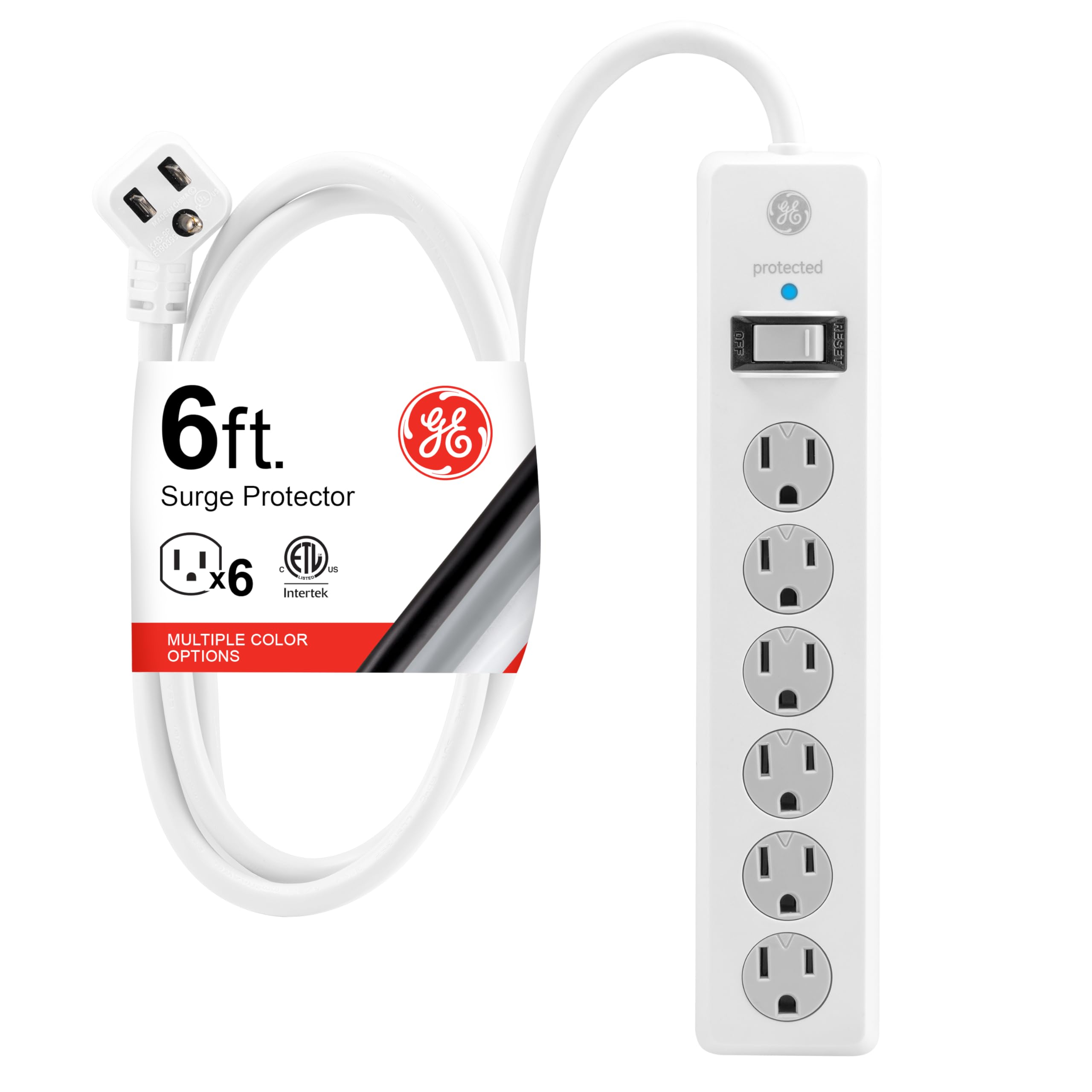
The twist-to-close safety covers keep dust out of unused sockets — a smart touch for $15.
The GE delivers exactly what most homes need: a no-nonsense 6-outlet surge protector with a low-profile flat plug that fits behind furniture without bending the cord. Buyers praise the “flat plug design fits tight spaces behind furniture, prevents cord bending and outlet damage” — a frequent pain point with bulky plugs. The twist-to-close safety covers on each outlet are a thoughtful touch, letting you seal unused sockets against dust and debris, especially useful in a garage or basement.
At 800 joules, the surge protection is entry-level — the CRST holds 2.6 times more protection (2100J vs 800J), so the GE is better suited for lamps, phone chargers, and low-power electronics than for expensive computers or power tools. The 0.52-pound weight is the lightest in this lineup, 2.7 times lighter than the CRST, which makes it easy to move but also reflects the all-plastic construction. It has a built-in 15A circuit breaker and a protected indicator light that confirms the surge protection is still active.
For a simple, affordable way to add 6 outlets in a bedroom, living room, or kitchen counter, this GE model is a solid, trusted choice from a recognizable brand. Just be realistic about the 800-joule limit — do not rely on it to protect a high-end home theater or a workshop full of power tools. For those uses, the CRST or Green Box Innovations is the safer bet.
Why it’s great
- Twist-to-close safety covers keep each outlet dust-free when not in use.
- Flat plug saves space behind furniture and prevents cord damage.
- ETL safety certified with a limited lifetime replacement plan.
Good to know
- 800 joule rating is low — not enough protection for high-end computers or power tools.
- Plastic enclosure feels less durable than metal alternatives.
Best for: Budget-conscious buyers needing a basic, space-saving strip for low-power household devices.
Skip if: You need high joule protection for a computer, TV, or workshop equipment — go with the CRST or Green Box.
5. Unidapt Multi Plug 6 Outlet Extender Wall Splitter
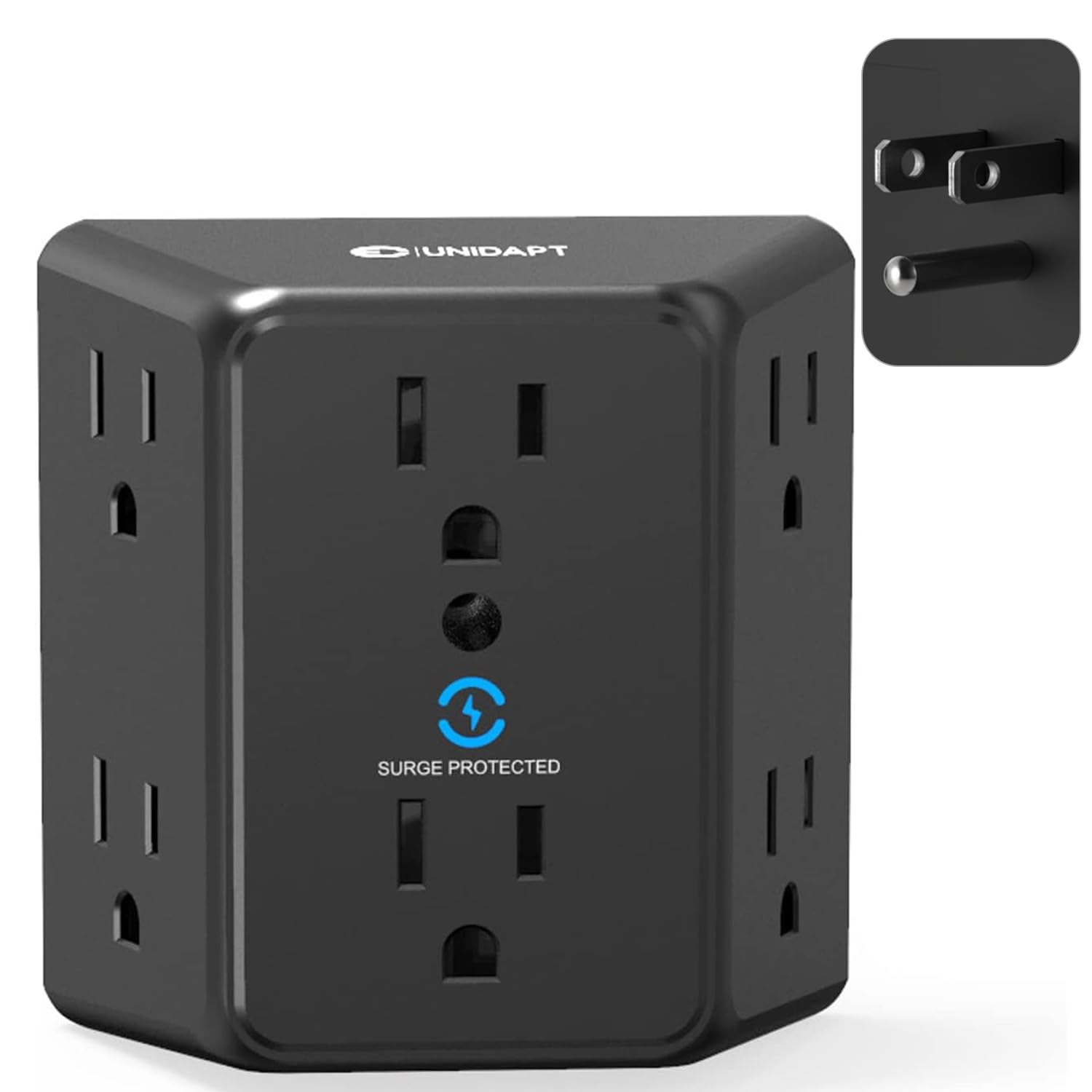
No cord, no clutter — this wall tap turns one socket into six without any wire trailing to the floor.
The Unidapt is a completely different form factor from the other picks — instead of a corded power strip, it plugs directly into your wall outlet and expands it into 6 grounded outlets spread across three sides. Buyers describe it as a “compact outlet extender that doesn’t hang below outlet; hides well behind TV” and say it “fits solidly in horizontal GFCI sockets” (GFCI stands for Ground Fault Circuit Interrupter, a safety outlet with test/reset buttons) — perfect for travel trailers, dorms, or anywhere you want to avoid a trailing cord.
Because it has no cord, it is the most portable option here — you can toss it in a suitcase for hotel rooms, where outlets are often scarce. The 3-side outlet layout gives you better spacing for bulky plugs than a standard wall tap, though you still cannot fit six large wall warts on it. The build is ABS plastic with a fire-proof shell, and it is ETL listed (a safety certification mark from a testing lab) for safety. Unlike the Green Box Innovations or CRST, it has no master switch, no individual switches, and no mounting holes — it simply occupies the wall socket and stays there.
If you hate power strip cords dangling across the floor or need a compact travel companion, this Unidapt extender is the smartest approach. It falls short on raw protection compared to the metal-bodied options, but for light electronics in controlled indoor spaces, 900 joules is sufficient. For a workshop, the CRST’s 2100 joules and metal build are far safer.
Why it’s great
- Zero-cord design keeps your space tidy and eliminates floor clutter.
- Compact enough for travel; fits in a suitcase or backpack easily.
- 900 joule surge protection in a wall-tap form factor that is rare at this price.
Good to know
- No master switch or individual controls — surge protection is always active.
- Cannot fit six very large power adapters simultaneously despite wide spacing.
Best for: Travelers, dorm rooms, and anyone who wants to avoid a power strip cord on the floor.
Skip if: You need a long reach cord or high joule protection for workshop equipment.
Understanding the Specs
Joule Rating
The joule rating measures how much electrical energy (in joules) the surge protector can absorb before it fails. Think of it like a bucket — a higher number (2100, 3300) means a bigger bucket that can absorb a larger power spike before it overflows and reaches your devices. For a lamp or phone charger, 800-900 joules is fine. For a computer, TV, or power tools, look for at least 1080 joules, and ideally 2100 joules or more.
Wide-Spaced Outlets
Many power adapters (especially for laptops, routers, and game consoles) are physically wide and can block adjacent outlets on a standard strip. Wide-spaced outlets — often measured at 1.7 inches or more from center to center — let you plug in several bulky adapters side by side without losing outlets. Always check the spacing if you plan to use more than one large adapter.
Metal vs. Plastic Housing
Plastic is the most common enclosure material and works fine for desks and living rooms. Metal housings (typically aluminum alloy) are safer for garages and workshops because they are fire-resistant, more durable, and dissipate heat better than plastic. If the strip will live in a dusty or high-traffic area, a metal enclosure is worth the extra cost.
Flat and Rotating Plugs
A flat plug sits flush against the wall, keeping your furniture tight against the baseboard and preventing the cord from bending at a sharp angle. A rotating plug adds the ability to swivel the plug head (up to 360 degrees) so the power strip can lie flat no matter how your wall socket is oriented. Both designs protect the cord from damage and save space behind heavy furniture.
FAQ
What does the joule rating actually mean for my devices?
Will a 6-outlet surge protector fit behind my couch or bed?
Can I use a metal surge protector in a damp garage?
How do I know when my surge protector has stopped working?
Is a 900-joule surge protector enough for a TV and gaming console?
What is the difference between a power strip and a surge protector?
Can I plug a power strip into another power strip (daisy chaining)?
How long does a surge protector last before I should replace it?
Are individual outlet switches worth having on a surge protector?
Can I mount a surge protector under my desk or on a wall?
Final Thoughts: The Verdict
If you want one dependable pick, the best 6 outlet surge protector is the CRST Heavy Duty Power Strip because it pairs a 2100-joule surge rating, a rugged aluminum alloy housing, and wide-spaced outlets at a price that makes sense for homes, garages, and workshops. If you want maximum protection with individual outlet control and mounting flexibility, grab the Green Box Innovations 3300J Power Strip. And for a compact, cord-free solution that disappears behind a TV or fits in a suitcase, the Unidapt Wall Tap Extender is the best zero-cord approach.
How We Picked
We do not accept paid placement, and we did not hands-on test every unit. Instead, we match each pick to a real buyer and use-case by comparing the manufacturers’ published specifications against the patterns in verified customer reviews — so you get each pick’s real strengths and trade-offs instead of marketing copy.
Sources & Methodology
Specifications: manufacturer listings and product documentation. Review insights: verified customer reviews, as of June 2026. Pricing: not shown on this page (it changes often); check the current price via the retailer link.
As an Amazon Associate, Gadgets Feed earns from qualifying purchases. This does not affect which products we feature.
Product prices and availability are accurate as of the date/time indicated and are subject to change. Any price and availability information displayed on Amazon at the time of purchase will apply to the purchase of this product. As an Amazon Associate I earn from qualifying purchases.
CERTAIN CONTENT THAT APPEARS ON THIS SITE COMES FROM AMAZON. THIS CONTENT IS PROVIDED "AS IS" AND IS SUBJECT TO CHANGE OR REMOVAL AT ANY TIME.
Amazon and the Amazon logo are trademarks of Amazon.com, Inc. or its affiliates.