
A battery that reads 6.3 volts at rest can still be completely dead the moment you hit the starter. Surface voltage is a lie — only a proper load test reveals the truth about internal resistance and real cranking power. Without a dedicated 6-volt tester, you are essentially guessing whether that lawn tractor, motorcycle, or RV battery has any life left under the hood.
I’m Min — the co-founder and writer behind Gadgets Feed. I specialize in dissecting the technical specifications of niche diagnostic tools, cross-referencing customer test data against manufacturer claims to separate genuine utility from marketing fluff.
After analyzing charging system data, waveform reports, and real-world CCA accuracy across seven distinct models, this guide delivers a definitive breakdown of the best 6 volt battery tester for every workshop and budget.
How To Choose The Best 6 Volt Battery Tester
Six-volt batteries are common in vintage cars, motorcycles, lawn tractors, golf carts, and marine applications. Unlike 12V systems, 6V batteries have a narrower voltage tolerance, making accurate load testing critical. You need a tester that can apply the correct load—typically 50 amps for a 6V starter battery—without damaging the cell structure. The three factors below determine whether a tester delivers actionable data or just confusing needle swings.
Load Capacity Matters More Than Voltage
Not all 6V testers are built equally. An analog carbon-pile tester applies a physical resistive load (usually 50 amps for 6V) and measures voltage drop under that stress. A digital conductance tester sends a small AC signal through the battery to calculate internal resistance. For deep-cycle 6V batteries used in trolling motors or golf carts, a conductance tester with a low 2AH mode is often safer because it doesn’t stress the plates. For automotive 6V starting batteries, the brute-force carbon-pile approach remains the gold standard for accuracy.
CCA Range and Battery Type Compatibility
Cold Cranking Amps (CCA) ratings on 6V batteries can range from 100 CCA on a small motorcycle battery to over 1000 CCA on a tractor or marine battery. Your tester must cover your battery’s specific CCA rating. Digital testers also let you select battery chemistry — Flooded, AGM, GEL, or EFB. Selecting the wrong type can skew the SOH (State of Health) reading by 20% or more, so look for a tester with at least four chemistry presets.
Data Output and Clamp Quality
A tester is only as good as its connection to the battery post. Insulated four-wire Kelvin clips—where the current and sense wires are separate—eliminate resistance from the clamps themselves and produce far more accurate readings. If the clamps feel flimsy or the cable is under three feet, you’ll struggle to test batteries still installed in tight compartments. Some premium testers offer waveform graphs that let you spot a failing alternator diode or a starter drawing excessive current before you even replace the battery.
Quick Comparison
On smaller screens, swipe sideways to see the full table.
| Model | Category | Best For | Key Spec | Amazon |
|---|---|---|---|---|
| KONNWEI KW650 | Digital Analyzer | Waveform analysis & firmware updates | 100-2000 CCA, STM-32 chip | Amazon |
| ANCEL BA101 Plus | Digital Analyzer | Data logging & fleet management | 20-2000 CCA, 1400 records | Amazon |
| KINGBOLEN BM580 | Digital Analyzer | Low-capacity 6V batteries (2AH) | 100-2000 CCA, 2AH mode | Amazon |
| VEHLIVE BT910 | Digital Analyzer | Lithium battery testing (upgradable) | 5-3000 CCA, waveform analysis | Amazon |
| Battery Tender 026-0020 | Analog Load Tester | Heavy-duty carbon-pile load testing | 50A at 6V, 100A at 12V | Amazon |
| TOPDC BT100 | Analog Load Tester | Budget-friendly 6V/12V analog testing | 50A at 6V, 100A at 12V | Amazon |
| ZTS MBT-1 | Pulse Load Tester | Multi-chemistry battery management | Pulse load, 1.2V to 12V cells | Amazon |
In‑Depth Reviews
1. KONNWEI KW650 6V 12V Car Battery Tester

The KONNWEI KW650 is driven by an STM-32 processor that delivers test reports in milliseconds with better than 99.5 percent accuracy. It supports 6V and 12V batteries from 100 to 2000 CCA, covering flooded, AGM flat plate, AGM spiral, and gel chemistries. The voltage waveform analysis function tracks real-time voltage fluctuations, which makes identifying a bad alternator diode or a weak cell straightforward even for beginners.
What sets the KW650 apart from the mid-range competition is its firmware update capability and the ability to upload continuous voltage monitoring data to a computer for detailed analysis. This is a feature normally found on testers costing twice as much. The color screen reports SOH, SOC, internal resistance, and CCA in a single glance, and it can switch between twelve languages. The included clips use four-wire Kelvin sensing, though the cable length is on the shorter side at roughly three feet.
Users consistently report that the KW650 identified failing batteries that shop testers missed, particularly on RV and lawn equipment batteries. The starter cranking test and alternator ripple graph provide data that goes far beyond a simple pass/fail verdict. For anyone who manages multiple vehicles with 6V electrical systems, the KW650 is the most capable tool in its price range.
Why it’s great
- Waveform analysis and computer upload for professional diagnostics
- Firmware updatable for future battery chemistries
- Accurate internal resistance and CCA within 0.5% of lab-grade testers
Good to know
- Short test cable makes in-vehicle testing slightly awkward
- Voltage reading can be 0.06V off compared to a calibrated multimeter
2. ANCEL BA101 Plus 6V 12V Battery Tester
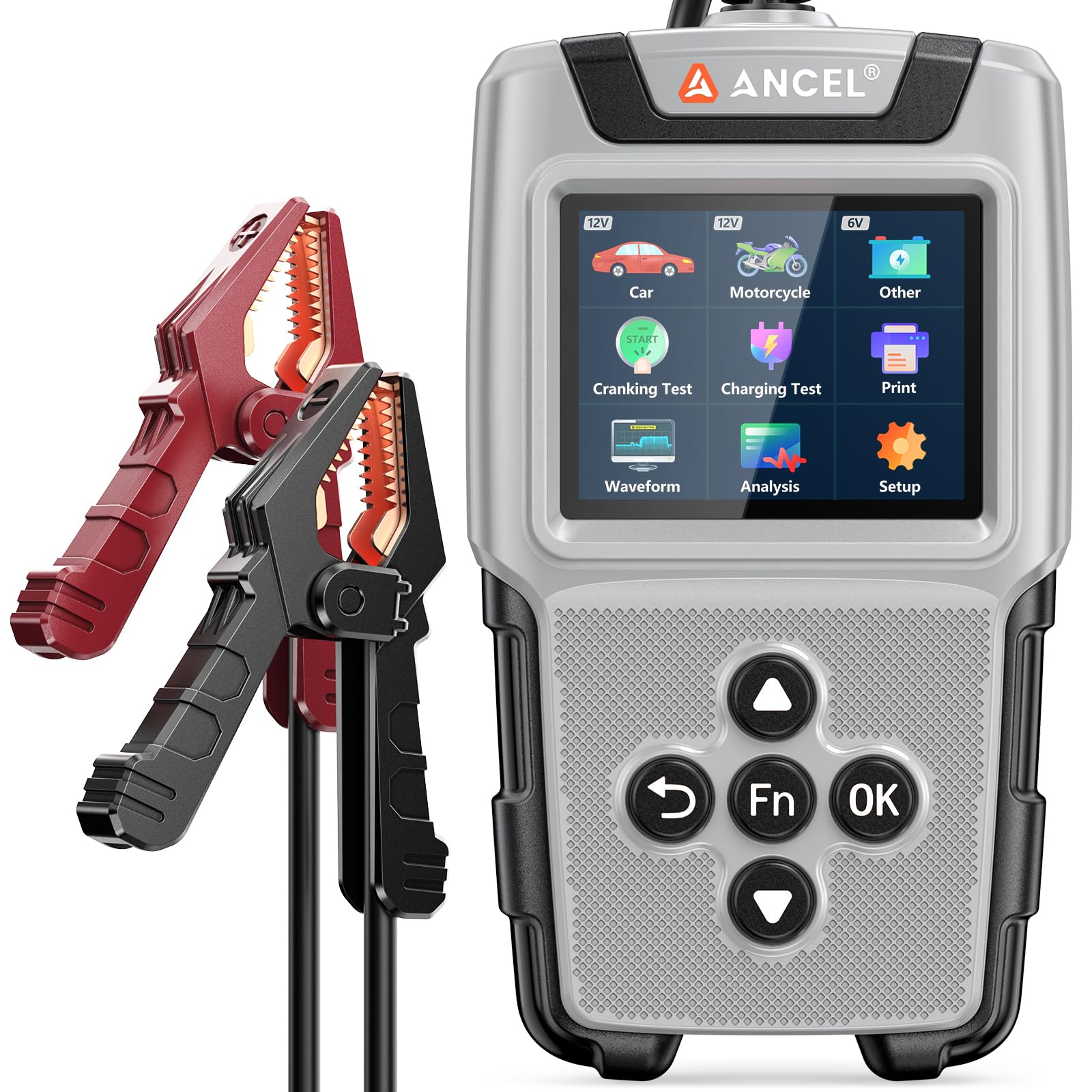
The ANCEL BA101 Plus is built for the user who needs to test 6V lead-acid batteries across a fleet of vehicles and wants to keep a permanent record. It stores up to 1,400 test records on board, so you can track battery health trends over months. The 2.8-inch color TFT screen displays real-time voltage curves, and the Fn one-touch quick test button bypasses the menu for rapid sequential checks.
This unit handles a wider CCA floor than most competitors—starting at just 20 CCA—which makes it ideal for testing small 6V motorcycle and scooter batteries alongside larger marine and tractor batteries up to 2000 CCA. It supports Regular Flooded, AGM Flat Plate, AGM Spiral, GEL, and EFB chemistries. The four-wire Kelvin clamps provide accurate internal resistance readings, and the reverse polarity and overvoltage protection reduce the risk of user error.
One of the BA101 Plus’s standout features is the 120-second voltage replay function, which lets you review cranking and charging events after they happen. Mechanics have noted that the screen is difficult to read with polarized sunglasses, but the brightness is adequate for direct sunlight. The device does not support lithium or LiFePO4 batteries, so keep that limitation in mind if you manage newer 6V lithium builds. For pure lead-acid diagnostics with heavy data logging, this is the most complete package.
Why it’s great
- 1400-record storage for fleet battery management
- 120-second voltage curve replay for cranking diagnostics
- One-touch Fn button for fast sequential testing
Good to know
- No lithium battery support
- Screen polarization can cause visibility issues with certain eyewear
3. KINGBOLEN BM580 6V 12V Battery Tester

The KINGBOLEN BM580 solves a specific problem that most battery testers ignore: accurately testing low-capacity 6V batteries. While many digital analyzers struggle below 10AH, the BM580 includes a dedicated 2AH ultra-low-capacity detection mode. This makes it the only mid-range tester on the market that can reliably assess a 6V golf cart battery, a small lawn mower battery, or a vintage motorcycle battery without throwing a false error.
The device covers a CCA range of 100 to 2000 and tests six battery chemistries including Regular Flooded, AGM Flat Plate, AGM Spiral, GEL, and EFB. The 2.4-inch screen reports SOH, SOC, voltage, internal resistance, and CCA in about three seconds. It also includes a four-function test: battery health, cranking test, charging systems test, and load test. One unusual but practical feature is the intelligent polarity identification—the tester automatically detects positive and negative even if you reverse the clamps, eliminating the risk of damage.
Users report that the BM580 accurately predicted battery failure weeks before a load test at a chain auto shop confirmed it. The primary complaint is that the included test cables are short, which can make in-vehicle cranking tests awkward—you may need a helper to start the engine while you watch the screen. The lack of waveform graphing means you won’t get the depth of diagnostics that the KW650 provides, but for straight battery health checks on small 6V systems, the BM580 is the specialist pick.
Why it’s great
- 2AH ultra-low-capacity mode for tiny 6V batteries
- Intelligent polarity reversal protection
- Accurate SOH and CCA readings in three seconds
Good to know
- Short test cables require close proximity during cranking tests
- No voltage waveform analysis for alternator diode diagnostics
4. VEHLIVE BT910 6V 12V Battery Tester
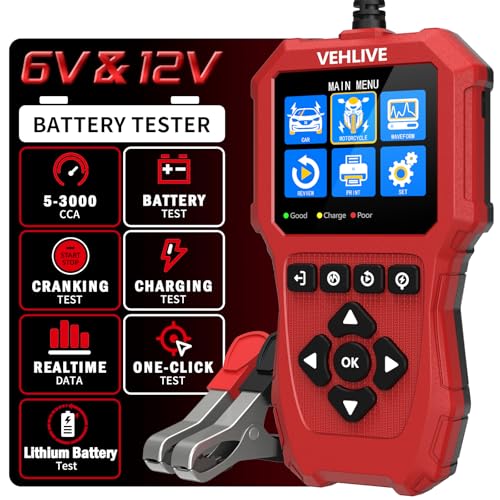
The VEHLIVE BT910 is the most versatile 6V battery tester in this lineup because it covers the widest CCA range—from 5 to 3000 CCA—and supports lithium battery testing after a free firmware upgrade. This makes it future-proof for users who may transition from lead-acid to lithium 6V batteries as the technology becomes more common in marine and powersport applications. It handles 12 language options and is powered either through USB-C or battery power, giving you flexibility in the shop.
The 2.8-inch color LCD screen displays SOH, SOC, internal resistance, CCA, and voltage. The built-in voltage waveform analysis function tracks real-time changes and allows continuous monitoring results to be uploaded to a computer for comparison. The test clamps feature anti-spark technology and reverse polarity protection, and the reinforced ABS case provides basic drop protection. The package includes a 3.28-foot diagnostic cable, which is slightly longer than most competitors.
Reviewers highlight the BT910’s accuracy—it matched results from professional-grade AutoZone testers—and the clarity of the display in direct sunlight. The main drawbacks are the light-duty build quality and the instruction manual, which users found unhelpful for navigating the lithium battery upgrade process. For the price, the BT910 offers an unmatched combination of CCA range and chemistry compatibility, especially if you have both lead-acid and lithium 6V batteries in your inventory.
Why it’s great
- 5-3000 CCA range covers the widest battery types
- Free firmware upgrade adds lithium battery testing
- USB-C and battery power for flexible operation
Good to know
- Build feels lighter than premium competitors
- Lithium upgrade process lacks clear instructions in the manual
5. Battery Tender 026-0020 6V 12V Load Tester
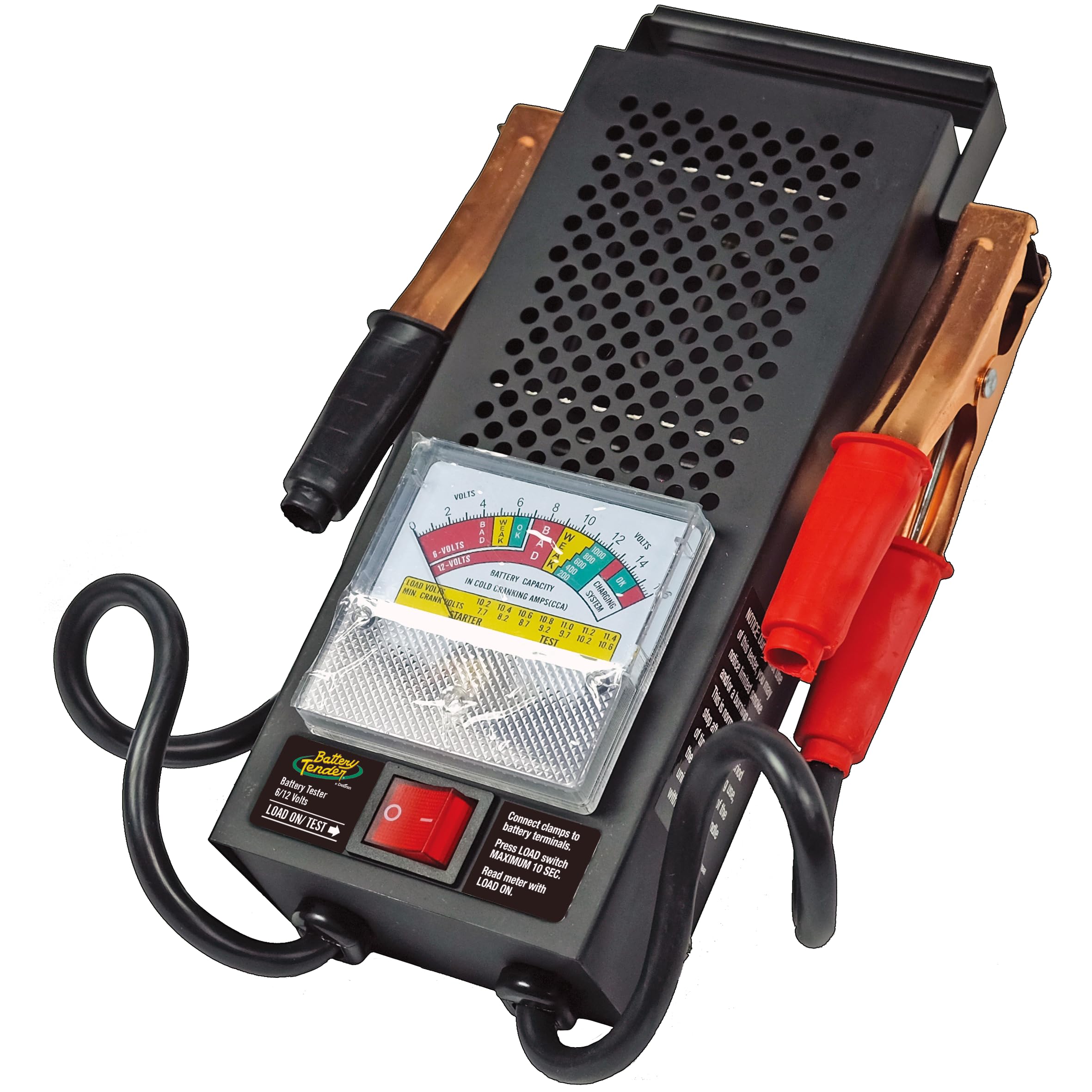
The Battery Tender 026-0020 is a no-nonsense analog carbon-pile load tester that has been a staple in commercial garages for decades. It applies a 50-amp load to 6V batteries and a 100-amp load to 12V batteries, then reads the voltage drop on a color-coded analog dial. There are no menus, no firmware updates, and no wireless connections. You clip the color-coded alligator clamps to the battery, toggle the switch, and read the needle.
The housing is built from heavy-duty steel with a rubber-insulated carrying handle, and the unit weighs 2.1 pounds. The clamps are thick-gauge copper with rubber boots, and the wire leads are permanently attached. The analog meter is marked with green (good), yellow (weak), and red (bad) zones, so interpreting results is instantaneous. This tester can handle batteries in cars, pickup trucks, SUVs, motorcycles, RVs, boats, and ATVs with up to 1,000 cranking amps.
The biggest trade-off with the analog design is that it cannot test internal resistance or provide a CCA value. The carbon-pile element also heats up during extended use—users report a slight burn-off smell if you exceed the recommended duty cycle. It also does not test deep-cycle batteries as gently as a digital conductance tester would. For a shop that primarily needs a passing verdict on 6V starting batteries and doesn’t want to navigate digital menus, this is the most reliable tool in the lineup.
Why it’s great
- True carbon-pile load test with no electronic failure points
- Color-coded dial provides instant pass/fail results
- Strong copper clamps and thick insulation for daily use
Good to know
- No internal resistance or CCA measurement
- Carbon pile can overheat if used beyond its cooling cycle
6. TOPDC Car Battery Tester 6V 12V 100 AMP
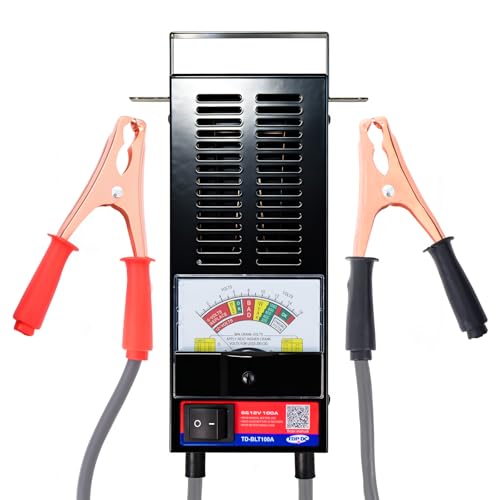
The TOPDC BT100 is the budget version of the analog load tester formula, offering the same fundamental 50-amp load at 6V and 100-amp load at 12V for a lower entry cost. It measures CCA from 100 to 1000, which covers most consumer-grade 6V batteries found in lawn tractors, motorcycles, and small boats. The analog dial display uses color-coded zones for quick interpretation, and the rubber-insulated carrying handle makes it easy to move around the shop.
The unit features heavy-duty alligator clips with red and black color coding to prevent incorrect connections. The housing includes a perforated ventilation design for cooling, and the meter is shock-resistant behind a clear-view plastic window. It’s compact enough at 11.8 x 6.7 x 3.2 inches to fit into a standard tool bag. The weight is 2 pounds, comparable to the Battery Tender unit.
Early user feedback indicates the BT100 works reliably for roadside assistance checks and basic battery sorting. The analog reading is sensitive enough to distinguish between a healthy battery and one with a weak cell. The main compromise is the build quality—the plastic housing and thinner gauge wire won’t survive the drop-and-bang abuse that the Battery Tender unit can handle. It’s also limited to a 1000 CCA ceiling, which excludes larger 6V marine and tractor batteries. For occasional use on smaller 6V batteries, it gets the job done for less.
Why it’s great
- True analog load test at a budget-friendly price
- Color-coded dial and clamps for safe operation
- Compact and portable for roadside use
Good to know
- Lower CCA ceiling of 1000 limits compatibility
- Plastic housing and wire quality are not shop-grade rugged
7. ZTS Multi-Battery Tester MBT-1

The ZTS MBT-1 occupies a unique position in this guide because it is not a dedicated 6V automotive battery tester—it is a multi-chemistry pulse load tester that covers everything from button cells to 12V lead-acid batteries, including 6V lantern and motorcycle batteries. The patented Pulse Load Test technology applies a precise electronic load that mimics real-world draw, then classifies each cell with a 1-to-10 bar graph display. No switches, no menus, no setting selection.
This unit tests AA, AAA, C, D, 9V alkaline, 1.5V lithium, CR123, CR2032, CR2016, CR2, and 18650 Li-ion cells, plus 6V and 12V lead-acid batteries. It uses the battery’s own power to run the test, so there is no external power required. The housing is a rugged yellow and black molded case measuring 8 x 4.5 x 1.25 inches. The unit is made in the USA and has a reputation for reliability that exceeds any consumer-grade digital tester.
Where the MBT-1 falls short for 6V automotive use is that it does not apply a 50-amp carbon-pile load. The pulse load test is designed for cell-level diagnostics, not starting battery load checks. It also cannot measure CCA, internal resistance in milliohms, or SOH as a percentage. For a home garage that needs to sort through a drawer of household batteries and occasionally check a 6V lantern battery, it is the best tool. For a mechanic testing a tractor battery, the analog or digital automotive-specific testers above are more appropriate.
Why it’s great
- Pulse load test identifies failing cells that other testers miss
- Tests over a dozen battery chemistries and form factors
- Made in the USA with proven long-term reliability
Good to know
- Cannot perform a 50-amp automotive load test
- No CCA, SOH, or internal resistance numeric readout
FAQ
Can I use a 12V battery tester on a 6V battery?
What does a low internal resistance reading on a 6V battery mean?
How often should I load test a 6V lawn tractor battery?
What is the difference between a carbon-pile tester and a digital conductance tester for 6V?
Final Thoughts: The Verdict
For most users, the best 6 volt battery tester winner is the KONNWEI KW650 because it balances professional-grade waveform analysis, firmware upgradeability, and accurate CCA/SOH readings at a mid-range price that undercuts traditional shop testers. If you manage a large number of small 6V batteries and need a 2AH low-capacity mode, grab the KINGBOLEN BM580. And for pure analog reliability with no electronics to fail, nothing beats the Battery Tender 026-0020.