
Our readers keep the lights on and my morning glass full of iced black tea. As an Amazon Associate, I earn from qualifying purchases.
Specs are compiled from manufacturer listings and verified buyer reviews and can change over time — please confirm the key details on the product page before buying.
A dead 6 volt lantern battery can cut a camping trip short, so choosing the right one matters. We compare specs and owner feedback to help you pick a reliable 6V cell.
I’m Min — the founder and writer behind Gadgets Feed. This guide is built by comparing the manufacturers’ published specifications and the patterns across verified customer reviews, so you get each pick’s real strengths and trade-offs instead of marketing spin.
Here are the best 6 volt lantern batteries, ranked by specs and verified reviews.
Our Picks at a Glance


How To Choose The Best 6 Volt Lantern Battery
Before you buy, you need to match three things: the voltage (must be 6V), the physical terminal type, and the chemistry that matches how often you use the light.
Terminal Type: The First Compatibility Test
Your lantern has a specific connector, and the battery must match it exactly. Spring terminals are the classic square 4R25 style found in most old camping lanterns, while F1 and F2 are the smaller tabbed connectors used on sealed lead acid cells. A terminal mismatch means no power, so verify compatibility first.
Quick Comparison
| Model | Best For | Chemistry | Capacity | Reusability | Amazon |
|---|---|---|---|---|---|
| Eveready 1209★ Best Overall | Classic fit & long shelf life | Zinc-Manganese Dioxide | 6 V | Single Use | Amazon |
| Interstate DRY1403Value Pick | Dependable standard replacement | Zinc Carbon | 7000 mAh | Single Use | Amazon |
| Mighty Max ML4-6Revival Pick | Rechargeable Coleman revival | Sealed Lead Acid | 4.5 Ah | Rechargeable | Amazon |
| Rayovac 2 Pack | Budget multi-device backup | Zinc-Carbon | 6 V | Single Use | Amazon |
| TOPUSSE LiFePO4 | Lightweight rechargeable swap | LiFePO4 | 6 Ah | Rechargeable | Amazon |
| Duracell MN908 | Premium alkaline longevity | Alkaline | 13000 mAh | Single Use | Amazon |
| PKCELL 4 Pack | Multi-device single-use value | Carbon Zinc | 6 V | Single Use | Amazon |
| Miady 2 Pack | Exit signs & security gear | Lead-Acid (AGM) | 5 Ah | Rechargeable | Amazon |
| NASTIMA LiFePO4 | Long-cycle heavy use | LiFePO4 | 6000 mAh | Rechargeable | Amazon |
In‑Depth Reviews
1. Eveready 1209 6 Volt Super Heavy Duty Lantern Battery
Our pick — over 4.5★ from 500+ verified ratings; the strongest balance of quality and price.
A classic 4R25 square cell that revives old flashlights and lanterns.
If you need a dependable power source for a classic lantern, this battery fits without fuss. It uses a zinc-manganese dioxide chemistry (a common, reliable type) with no added mercury or cadmium, and it is rated to work from 0 degrees F to 130 degrees F, so it holds up in a cold garage or a hot summer shed.
At 21.2 oz, it is not the featherweight of the group, but the weight is a trade-off for the dependable, single-use power that owners say lasts over a year with occasional use. The classic square design matches the standard 4R25 format, so it slots into most older flashlights and lanterns without adapters.
What wins people over is the runtime — battery life is the most-praised trait by a wide margin. Buyers report it works great in their flashlights and that it fits perfectly in the old lanterns they thought were beyond saving.
What Owners Love
- Lasts over a year with regular light use
- Perfect standard 4R25 fit for classic gear
- Rated for extreme cold and heat
Watch Out For
- A few units arrive with a cracked top
- Single-use only, so you buy again
Reach for this if: you own a classic spring-terminal lantern and want a dependable, well-priced single-use cell that fits the first time.
Think twice if: you need something rechargeable to avoid repeat purchases.
2. Interstate Batteries 6V HD Lantern Battery (DRY1403)
A lightweight zinc-carbon cell that revives a Rayovac Beam without the bulk.
At just 1.2 pounds, this is nearly 1.9x lighter than the Rayovac 2 Pack above, so you will feel the difference on a long walk with a lantern. It is a zinc carbon cell (a standard, budget-friendly type) that directly replaces common models like the 1209, MN908, and 6VHD, making it a versatile drop-in for older gear.
It puts out 6 A of power, the same amperage as the Eveready, and owners specifically mention it bringing a large Rayovac Lantern Beam Flashlight back to life. The battery quality gets consistent praise, but the reliability is a real mixed bag — some units arrive with the top partially separated, and a handful report being completely dead after six months of shelf storage.
The genuine risk here is that you might get one that sat too long. If you plan to install it right away, the value is strong; if you want to stockpile spares, you are gambling on shelf life.
Lightweight power: The 1.2-pound weight makes it the easy-carry choice for a handheld lantern, beating the Rayovac’s 2.31 pounds by a noticeable margin.
Buyer beware: The shelf-life complaints are real enough that this is best bought for immediate use, not long-term storage.
3. Mighty Max Battery 6V 4.5AH SLA for Coleman 5348
A rechargeable SLA that resurrects a 25-year-old Coleman lantern.
This is not a disposable cell — it is a 6V 4.5Ah sealed lead acid battery that you recharge, and it is UL certified. For anyone with a beloved old Coleman 5348 lantern sitting in the garage, this is the fix that owners describe as bringing the light “right up” the moment it is installed.
The performance is the standout here, earning more praise than any other trait. It is an SLA battery, meaning it is spill-proof and can be mounted in any position, so you are not limited on how you pack it. At 2 pounds, it is heavier than the disposable Interstate, but that heft buys you a rechargeable cell with a full one-year warranty.
The honest trade-off is that it runs at 4 A, which is 50% less amperage than the Interstate’s 6 A, so it may not sustain the brightest bulbs as long. Owners also note it runs slightly smaller physically than the original, so a scrap of foam may be needed to stop it rattling around inside the lantern.
The Payoff
- Rechargeable, so you stop buying disposables
- Fits the classic Coleman 5348 perfectly
- UL certified with a 1-year warranty
The Quirks
- 4 A output vs. 6 A on some rivals
- Slightly smaller case may need padding
Best for: the owner of an old Coleman lantern who wants a rechargeable heart for it, not another disposable.
Not for: anyone who needs maximum brightness for long stretches, given the lower amperage.
4. Rayovac Heavy Duty 6V Lantern, Spring Terminals 2 Pack

Two budget zinc-carbon cells that do the job without the premium price tag.
This is the value play for anyone who just needs spare power on the shelf. You get two 6V zinc-carbon batteries in one box, and the value for money is the trait owners mention most. They are made with no added mercury or cadmium and meet EPA requirements for landfill disposal, so they are an environmentally-conscious disposable choice.
At 2.31 pounds for the pair, they carry some heft, but the feedback is consistently that they “work great in my flashlights” and hold up well for the price. Owners note they are not truly “heavy duty” as the name suggests, but they get the job done with no complaints.
The catch is durability — multiple owners mention the plastic tops breaking off, so treat the terminals gently when installing. And despite some listing language, these are not rechargeable, so plan for single use.
Two for the price of one: The 2-pack format makes this the best budget-friendly way to keep spares on hand for multiple devices.
Handle with care: The recurring plastic-top issue means you should push them in gently rather than forcing them.
5. TOPUSSE Rechargeable 6V 6Ah LiFePO4 Lantern Battery with Charger
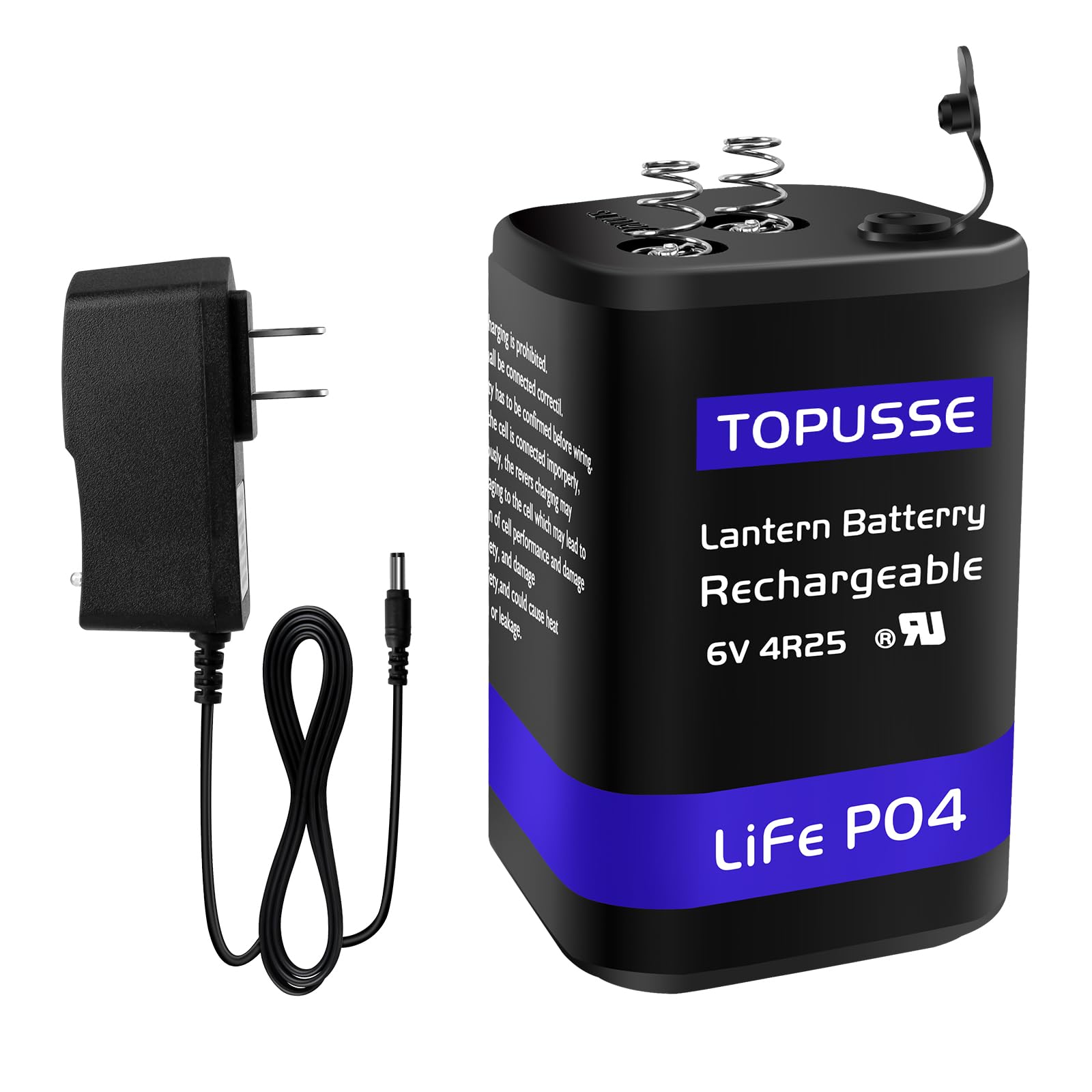
A lightweight LiFePO4 rechargeable that replaces disposables.
This is the modern answer to the classic problem of throwing away dead 6V batteries. It is a LiFePO4 cell rated for 1500+ charge cycles, so you can recharge it over and over instead of buying again. Owners describe it as weighing “a fraction of conventional batteries,” which makes it a real upgrade for anyone carrying a lantern any distance.
The performance is what owners praise most, with one using it in a deer feeder through below-zero winter temperatures without a hitch. It has a self-discharge rate of less than 7% per month, so it holds its charge well when sitting between uses, and the included charger plus DC cable make topping it up easy.
This is the smart-buyer warning: battery life is the most-discussed trait, and it is mixed. Some say it holds a charge well, others report it does not stay charged very long. The spring contacts also feel flimsy to a few owners, and the charger works one battery at a time.
Why Switch
- 1500+ recharge cycles vs. throwing away disposables
- Weighs a fraction of a conventional 6V cell
- Low self-discharge keeps it ready for emergencies
Know Before Buying
- Mixed reports on how long a charge lasts
- Spring contacts feel delicate to some owners
Reach for this if: you use a lantern rarely but want it always ready, and you hate buying disposables.
Look elsewhere if: you need a battery that runs for very long stretches on a single charge.
6. Duracell MN908 6V Non-Rechargeable Alkaline Lantern Battery

A premium alkaline with a 5-year shelf life for emergency kits.
If you are stocking an emergency kit and need a battery you can trust to be alive when the power goes out, this is the one. It is an alkaline cell with a 13000 mAh capacity, which is the highest capacity in this lineup, and it comes with a 5-year freshness guarantee so you know it will hold its charge on the shelf.
That capacity is the standout spec — it is why owners trust it for deer feeders that need to run for months. The battery quality gets the most praise, and it is date-coded so you can check it is fresh before you install it. At just 8 ounces, it is also remarkably light for its size.
The trade-off is the classic disposable dilemma: it is single-use only, and while some customers note 4-5 months of life in a feeder, others find it drains faster than expected. It is also a premium product, so you pay for that name-brand reliability.
Set-and-forget power: The 5-year freshness guarantee and 13000 mAh capacity make this the most dependable choice for emergency lights that sit untouched for long stretches.
The honest catch: It is single-use and costs more, so it is not the pick for heavy daily use — it is for the gear you hope you never need.
7. PKCELL 6V 4R25 Battery with Spring Terminals 4 Pack

Four ready-to-use spring-terminal cells for every device that takes a 6V square.
This is the bulk option for households with multiple 6V devices. You get four non-rechargeable carbon zinc batteries in one pack, and the quality is the trait owners praise most. They are designed to work in camping lanterns, flashlights, deer feeders, fencing systems, and even exit signs, so one pack can cover a lot of ground.
There is no charging required — they are ready to use straight from the start, which is ideal for emergencies where you need instant power. The leak-proof construction and low self-discharge rate mean they should hold up well in storage between uses.
The honest note is that battery life is mixed — some last a long time, others lose power within a few months. And since it is a 4-pack, there is a slightly higher chance one in the box is a dud, which a few owners have reported, though the other three worked fine.
Stock-Up Appeal
- Four batteries cover multiple devices at once
- Works across lanterns, feeders, and alarms
- Ready to use instantly, no charging
Bulk Bet
- Mixed lifespan reports across the 4-pack
- Occasional dead cell in the box
Best for: a household with several 6V gadgets that wants one box to cover them all.
Not for: anyone who needs a single guaranteed-long-lasting cell for a critical device like an alarm system.
8. Miady 6V 5Ah Rechargeable Sealed Lead Acid Battery (2 Pack)

Two maintenance-free AGM cells built for alarms, exit signs, and ride-on toys.
This is the workhorse for gear that runs on sealed lead acid, not the classic spring-terminal lantern. It is a 6V 5Ah AGM battery, and the battery quality is the most-praised trait by a wide margin. Owners use it in everything from a grandchild’s 4-wheeler to a Moultrie Deer Feeder, and the feedback is consistently that it works exactly as expected.
The AGM technology makes it spill-proof and mounts in any position, and the ABS plastic case resists shock and vibration. It is rechargeable and maintenance-free, so you install it and forget it until it needs a top-up. Owners specifically mention it comes fully charged and fits perfectly, with the F1 terminal matching common gear.
The recurring note is the F1 terminal type — this is not a spring-terminal battery, so it will not fit a classic 4R25 lantern without an adapter. Charging gets mixed feedback, with some finding the cells need a proper SLA charger to top up correctly.
Install-and-forget: The AGM design and exact-dimension fit make it the go-to replacement for exit signs and security lights, with owners noting it matches the 4.5Ah versions perfectly.
Check your terminals: The F1 connector means this suits tabbed devices, not spring-terminal lanterns.
9. NASTIMA 6V 6Ah LiFePO4 Battery with BMS

The F2-terminal LiFePO4 that outlasts lead-acid with 2000+ charge cycles.
For the buyer who wants the absolute longest service life, this is the technical king. It is a LiFePO4 battery rated for 2000+ cycles, compared to the 200-300 cycles of a traditional lead-acid cell. It packs 6000 mAh of capacity into a package that weighs just 12.35 oz, which owners note is lighter than the original SLA they replaced.
The built-in BMS (battery management system) protects against over-charge, over-discharge, short-circuit, and over-temperature, so you can run it with confidence in a camping lamp or a power-fail light. Owners describe one powering a camping lamp for days, and another running both bulbs for 12 hours before needing a recharge.
The honest catch is the F2 terminal (a flat, spade-style connector), which limits it to devices designed for that connector. Battery life feedback is mixed — some say it lasts a long time, others report it will not recharge after a while. A detailed teardown from one owner notes the protection circuit lacks cell balancing, which could affect longevity over many cycles.
The Long Game
- 2000+ cycles vs. 200-300 for lead-acid
- Lightweight at 12.35 oz
- Built-in BMS for over-charge and short-circuit safety
Before You Commit
- F2 terminal only fits specific devices
- Mixed reports on long-term recharging reliability
Pick this if: you want a lightweight, long-cycle rechargeable for a device with F2 connectors, like a modern emergency light.
skip it if: you have a classic spring-terminal lantern, since the F2 terminal will not match without an adapter.
Understanding the Specs
Terminal Types
Your battery’s connector must match your device exactly. Spring terminals are the classic square 4R25 style found in old camping lanterns and flashlights. F1 and F2 are smaller tabbed connectors used on sealed lead acid and LiFePO4 cells. A mismatch means no power, so check before you buy.
Capacity & Chemistry
Capacity, measured in mAh or Ah, tells you how long a charge lasts — higher numbers mean longer runtime. Chemistry matters too: alkaline and zinc-carbon are single-use, while SLA and LiFePO4 are rechargeable. LiFePO4 offers the most cycles but costs more upfront.
FAQ
Will a 6 volt lantern battery fit my old Coleman lantern?
What is the difference between F1 and F2 terminals?
How long does a 6 volt lantern battery last?
Can I use a rechargeable 6V battery in my non-rechargeable lantern?
What does mAh mean on a 6V battery?
Are all 6 volt lantern batteries the same size?
Is a LiFePO4 battery worth the higher price?
What is the shelf life of a 6V battery?
Final Thoughts: The Verdict
For the majority of shoppers, the 6 volt lantern battery winner is the Eveready 1209 because it delivers a perfect classic fit and reliable long runtime — the traits owners praise most. If you want to stop buying disposables, grab the Mighty Max SLA to revive an old Coleman. And for emergency gear that must always be ready, the Duracell MN908 with its 5-year freshness guarantee is the one to reach for.
How We Picked
We do not accept paid placement. Every pick is matched to a real buyer and a real use-case; we do not hands-on test units.
Sources & Methodology
Specifications: manufacturer listings and product documentation. Review insights: verified customer reviews, as of August 2026. Pricing: not shown on this page (it changes often); check the current price via the retailer link.
As an Amazon Associate, Gadgets Feed earns from qualifying purchases. This does not affect which products we feature.