
A wire wheel that shudders on contact isn’t just annoying — it’s dangerous. That vibration can fatigue the grinder’s bearings and send loose wires flying toward your face. The wrong 6-inch brush turns a simple rust removal job into a fight with your own tool, while the right one melts away corrosion and leaves a clean surface in seconds.
I’m Min — the co-founder and writer behind Gadgets Feed. I’ve spent countless hours cross-referencing wire diameter, arbor compatibility, and balance consistency across the most popular 6-inch bench grinder brushes to find the ones that feel smooth and cut fast.
Every second your grinder wobbles is time and material you’re wasting. That’s why I built this guide to the best 6 wire wheel options that deliver true concentric running and aggressive cleaning without the vibration.
How To Choose The Best 6 Wire Wheel
The right 6-inch wire wheel for your bench grinder comes down to three critical decisions: wire style, wire thickness, and arbor fit. Ignore these and you’ll either burn through material too slowly or end up with a wheel that throws balance every time you spin it up.
Knot vs. Crimped: Two Different Personalities
Knot-style wheels use twisted strands of wire that act like stiff fingers. They’re aggressive, last longer under heavy pressure, and excel at stripping thick rust, weld scale, and paint. Crimped wheels have wavy, flexible wires that conform to contours and produce a smoother finish. Choose knot for brute-force cleaning; choose crimped for general purpose work and minor deburring where you don’t want to gouge the base metal.
Wire Diameter Dictates Cut vs. Polish
Wire wheels are measured in thousandths of an inch (0.008″, 0.012″, 0.014″). A finer 0.008″ wire burnishes threads and removes light rust without eating into the part. A coarser 0.014″ or 0.020″ wire tears through heavy corrosion but will leave a textured surface. Match the wire thickness to the job — using too coarse a wire on a soft metal like aluminum can ruin the piece in seconds.
Balance and Arbor Fit Are Non-Negotiable
An unbalanced wheel will shake your grinder loose from its mount and can snap the arbor shaft under repeated stress. Precision-balanced brushes run smooth at 3,450 RPM, which is the standard speed of most bench grinders. The arbor hole must match your grinder’s shaft — most 6-inch wheels come with a 5/8″ to 1/2″ adapter bushing, but double-check before buying.
Quick Comparison
On smaller screens, swipe sideways to see the full table.
| Model | Category | Best For | Key Spec | Amazon |
|---|---|---|---|---|
| Weiler 36203 Wolverine | Crimped Wire | General cleaning and deburring | 0.014″ Steel Fill | Amazon |
| Forney 72895 Industrial Pro | Crimped Wire | Multi-arbor compatibility | Patented multi arbor 1/2″-2″ | Amazon |
| Forney 72751 Narrow Face Fine | Fine Crimped | Thread burnishing and polishing | 0.008″ Wire Diameter | Amazon |
| Mercer Industries 184010 | Knot Wire | Heavy rust removal on steel | 9,000 Max RPM | Amazon |
| Lincoln Electric KH321 | Crimped Wire | Budget-friendly general purpose | 6,000 Max RPM | Amazon |
| OSFTBVT 2-Pack | Crimped Wire | Value two-pack for light use | 0.012″ Wire Diameter | Amazon |
| DEWALT DW4917 | Knot Cup Brush | Aggressive surface prep on concrete | 6,600 Max RPM | Amazon |
In‑Depth Reviews
1. Weiler 36203 Wolverine 6″ Crimped Wire Wheel

The Weiler Wolverine is engineered with a solid ring construction that holds every wire strand in place, which dramatically reduces shedding compared to pressed-ring brushes. At 0.014″ wire thickness, it strikes the ideal balance between aggressive cleaning action and surface finish — it tears through rust without leaving deep gouges in the underlying steel. The 5/8″-1/2″ arbor hole adapts easily to almost any bench grinder shaft.
What sets this wheel apart is the balance precision. Users consistently report zero wobble at full 3,450 RPM, which means less strain on your grinder’s bearings and a safer working experience. The medium face width (7/16″ thick at the plates) gives enough surface area to clean wide parts quickly while still reaching into tighter spaces.
Made in the USA, this wheel uses heat-treated carbon steel wire that resists fatigue far longer than standard imports. While it carries a premium over entry-level options, the longer service life and consistent performance make it the right choice for anyone who uses their grinder more than once a month. It’s the benchmark that other 6-inch crimped wheels are measured against.
Why it’s great
- Exceptional balance eliminates grinder vibration at speed
- Solid ring construction resists wire loss and extends service life
- USA-made heat-treated steel outperforms imported alternatives
Good to know
- Premium price may exceed what casual users want to spend
- Not recommended for stainless steel applications due to carbon steel fill
2. Forney 72895 Industrial Pro Crimped Wire Wheel

The Forney 72895 solves one of the most annoying problems in the category: arbor size mismatch. Its patented multi-arbor bushing system accepts seven different shaft sizes from 1/2-inch up to 2 inches, which means this single wheel can move between a bench grinder, a pedestal buffer, and even a larger shop motor without swapping adapters. The 0.012-inch wire diameter is fine enough for light deburring but still aggressive on light rust and paint.
Forney uses a proprietary 3D crimping and balancing process that produces a higher wire density than standard crimped wheels. This translates to more wire strands making contact per revolution, which speeds up cleaning without requiring extra downward pressure. Users report that the wheel runs true with no perceptible wobble, solving vibration issues that plagued their previous brushes.
The high carbon steel construction holds its shape well under continuous use. This is a mid-range option that delivers professional-grade balance and density without the top-tier price tag. If you own multiple machines with different arbor sizes, the 72895 is the most practical single purchase you can make.
Why it’s great
- Patented multi-arbor fits 1/2″ through 2″ shafts without extra parts
- 3D crimping creates dense wire packing for faster cleaning
- Precision-balanced construction eliminates wobble on most grinders
Good to know
- 0.012″ wire is too fine for heavy rust or weld scale removal
- Face width may be narrower than some users expect for large flat surfaces
3. Forney 72751 Narrow Face Fine Crimped Wire Wheel
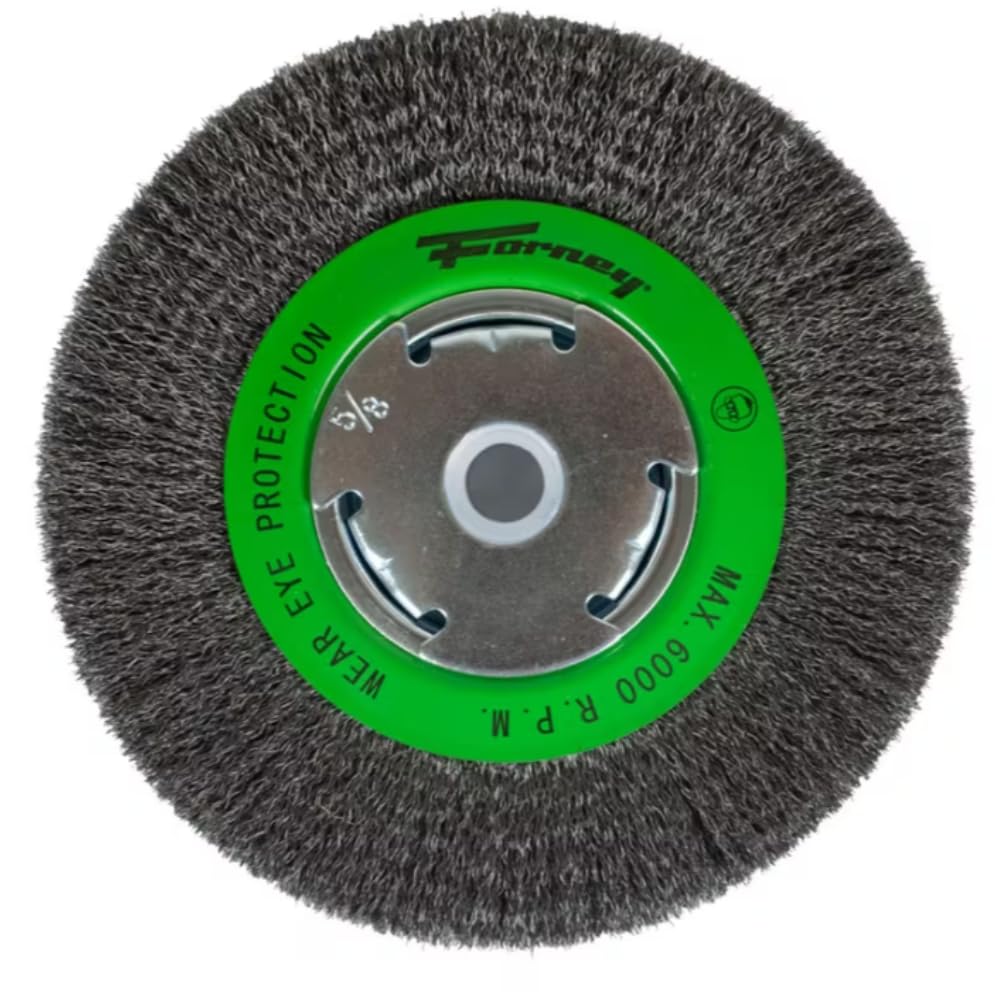
When you need to polish threads, burnish a surface, or remove feather-light rust without removing any base metal, the 0.008-inch fine wire of the Forney 72751 is precisely the tool. This is not a wheel for stripping paint or knocking down heavy corrosion — it’s a finishing brush that leaves a clean, smooth surface ready for paint or assembly. The narrow face width concentrates the brushing action into a precise zone.
Users consistently praise the wire retention on this model. Compared to cheaper fine-wire wheels that shed strands rapidly, the Forney’s construction keeps the wires firmly planted. One reviewer reported four months of daily use with virtually no visible wear. The wires are noticeably denser than budget alternatives, which means more cutting edges per square inch.
The balance is generally excellent, though a small number of users have reported needing to add a weighted screw to a mounting hole to cancel minor vibration. Made in the USA with a 5/8-inch and 1/2-inch arbor combination, this wheel is the specialist’s choice for anyone who frequently dresses threads or finishes machined parts.
Why it’s great
- Ultra-fine 0.008″ wire burnishes threads without altering dimensions
- Exceptional wire retention outlasts budget fine-wheels significantly
- Dense packing provides more cutting contact per revolution
Good to know
- Not suitable for heavy rust or thick paint removal
- Occasional balance issues require minor corrective weight
4. Mercer Industries 184010 Knot Wire Wheel

The Mercer 184010 brings knot-style aggression to a 6-inch diameter, making it the right choice when you need to strip thick mill scale or heavy rust from steel stock. Knot wheels use twisted wire groups that are much stiffer than crimped wires, and this Mercer is built with 0.014-inch carbon steel knots that bite aggressively without losing their shape. The 1/2-inch face width is narrow enough to concentrate force for deep cleaning.
Rated for up to 9,000 RPM, this wheel is safe on most bench grinders and even some higher-speed pedestal units. Users report excellent balance with no vibration that could cause machine bounce — a common complaint with cheaper knot wheels. The carbon steel wire handles tough applications like cleaning cast iron and structural steel where a crimped wheel would wear out in minutes.
One limitation: this wheel is not recommended for stainless steel because carbon steel particles can become embedded and cause rust spots. But for ferrous metals, the Mercer delivers heavy material removal rates that make quick work of restoration projects. It’s a workhorse worth considering if your grinding jobs regularly involve thick corrosion or weld splatter.
Why it’s great
- Knot-style wire construction outperforms crimped on heavy rust removal
- High 9,000 RPM rating provides safety margin on most grinders
- Well-balanced design eliminates machine vibration common with knot wheels
Good to know
- Carbon steel wire will contaminate stainless steel surfaces
- Narrower face width requires more passes for large flat areas
5. Lincoln Electric KH321 Crimped Wire Wheel Brush

Lincoln Electric’s KH321 is a straightforward, no-frills crimped wire wheel that does exactly what a general-purpose brush should do: it cleans, deburrs, and blends without drama. The 1-inch face width is wider than many competitors, which means you cover more surface area per pass when working on larger parts. The 6-inch diameter fits standard bench grinders, and the 5/8-inch x 1/2-inch arbor covers the two most common shaft sizes.
Users report that the wheel sheds some storage oil and loose wires on first use — this is normal for wire brushes and disappears after a short break-in period. Once settled, the KH321 removes rust efficiently without excessive shedding. The crimped wire provides a flexible brushing action that conforms to slight contours in the workpiece, making it suitable for cleaning around bolt heads and uneven surfaces.
The 6,000 RPM rating means this wheel is best suited for standard-speed bench grinders; using it on a higher-speed machine risks wire fatigue and reduced lifespan. At its tier, the KH321 delivers honest performance with no surprises. It’s an excellent backup brush to keep on the shelf for everyday shop tasks.
Why it’s great
- Wide 1-inch face covers larger areas quickly in each pass
- Crimped wire flexes into contours for better cleaning around details
- Reliable performance from a trusted industrial brand at a fair price
Good to know
- Initial use will shed storage oil and some loose wires — wear eye protection
- 6,000 RPM limit restricts use to standard-speed grinders
6. OSFTBVT 6in Wire Wheel Brush 2-Pack

The OSFTBVT two-pack is built for the budget-conscious shop that needs functional wire wheels without the premium branding. Each wheel uses 0.012-inch crimped carbon steel wire, which is a versatile middle ground — aggressive enough for rust and paint removal but not so coarse that it destroys the base metal. The 13/16-inch thickness is slightly slimmer than some competitors but still adequate for most cleaning tasks.
Crucially, these wheels come with adapter bushings that convert the 5/8-inch arbor hole to 1/2-inch, so they fit most bench grinders right out of the box. Users report that the wheels run reasonably balanced for the tier, with one reviewer noting that the Ryobi 6-inch grinder they fit was vibration-free during use. The carbon steel wire holds up well to intermittent light use in 10-15 minute sessions.
The main trade-off is durability. These wheels won’t outlast a Weiler or Forney under heavy daily use, and the wire will fatigue faster at high pressure. But for the price of a single premium brush, you get two functional wheels — making this ideal for the hobbyist who needs a spare or for tackling one-off restoration projects where brush wear is expected.
Why it’s great
- Two wheels per pack provide excellent value for budget buyers
- 0.012″ wire is versatile for light rust and general cleaning tasks
- Arbor bushings included for 5/8″ to 1/2″ conversion
Good to know
- Wire fatigue accelerates faster than premium options under heavy load
- Thinner face width means less material per pass on wide surfaces
7. DEWALT DW4917 Knotted Wire Cup Brush
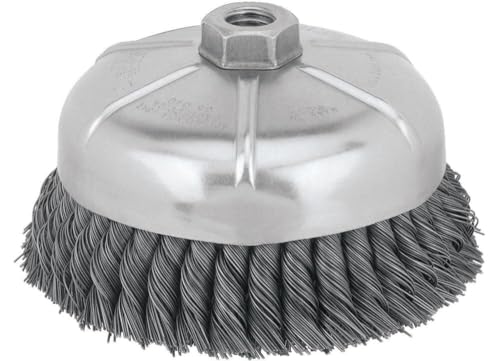
The DEWALT DW4917 is a 6-inch knotted cup brush, which is a fundamentally different tool from a standard wheel brush. Instead of a thin disc, this is a heavy-duty cup with dense, twisted wire knots that extend outward for aggressive surface prep on large areas. The 3-pound mass provides substantial inertia that helps the brush power through paint, rust, and concrete coatings without bogging down.
This is the brush you mount on a powerful angle grinder for jobs that would destroy a standard wire wheel in minutes. Users have used it to prep concrete floors for painting, strip the rust off bathtubs, and clean dross from plasma-cut steel. The internal holding plate ensures the wires stay locked in place even under the extreme forces of high-pressure scrubbing.
The trade-off is sheer physicality. The DW4917 is heavy and aggressive enough to yank an angle grinder out of your hands if the brush catches an edge. It’s also rated for only 6,600 RPM, which means you need a grinder with speed control or one that naturally runs at that range. This is not a bench grinder attachment — it’s a cup brush for serious surface prep on concrete and heavy steel. Respect the power rating and the weight.
Why it’s great
- Massive 3-pound knotted cup design powers through concrete coatings and heavy rust
- Internal holding plate locks wires securely for safe operation
- Versatile for metal and masonry surface prep applications
Good to know
- Extreme torque can be dangerous on smaller or low-powered grinders
- Not designed for bench grinder mounting — angle grinder only
FAQ
Should I choose a knot wire wheel or a crimped wire wheel for rust removal?
Why does my new wire wheel wobble on the grinder arbor?
Can I use a 6-inch wire wheel on a drill or angle grinder?
Final Thoughts: The Verdict
For most users, the best 6 wire wheel winner is the Weiler 36203 Wolverine because its solid ring construction, tight balance, and 0.014-inch carbon steel fill deliver reliable cleaning without vibration or premature wire loss. If you want the unmatched versatility of a multi-arbor system that fits nearly any machine, grab the Forney 72895 Industrial Pro. And for aggressive heavy rust and weld scale removal on ferrous metals, nothing beats the Mercer Industries 184010 knot wire wheel.