
Our readers keep the lights on and my morning glass full of iced black tea. As an Amazon Associate, I earn from qualifying purchases.
Specs are compiled from manufacturer listings and verified buyer reviews and can change over time — please confirm the key details on the product page before buying.
You want to hear the vocals and drums the way they were recorded, not a muddled mess, and you do not want a door panel science project. This guide covers the exact 6×8-inch size, and because a few popular picks stretch to 5×7 for a near-universal fit, we flag that where it matters so you never get caught off guard hoping for a magic bolt-in.
I’m Min — the founder and writer behind Gadgets Feed. This guide is built by comparing the manufacturers’ published specifications and the patterns across verified customer reviews, so you get each pick’s real strengths and trade-offs instead of marketing spin.
The right choice here balances power, mounting depth, and the adapters you’ll need, so let’s find the best match in 6 x 8 car speakers.
Our Picks at a Glance


How To Choose The Best 6 X 8 Car Speakers
Your head unit’s power output determines which speaker efficiency you need. Factory radios need high-efficiency speakers (90 dB or higher), while an amplifier open up higher-rated models.
Sizing, Fit, and Adapters
The 6×8-inch size is a direct replacement for many F-150s, Explorers, and Ranger pickups, but some trucks use a 5×7 opening. A true 6×8 can mount into those spots, but you should plan on an adapter plate or some careful trimming of the mounting bracket rather than expecting the screw holes to line up perfectly.
Power Ratings and Sensitivity
Use RMS for continuous power handling; treat peak wattage as a rarely-hit ceiling. Sensitivity (dB) measures loudness per watt; 90 dB or higher suits factory decks.
The Price-to-Performance balance
Mid-range pairs deliver the biggest quality leap, with stiffer cones and smoother tweeters that stay clean at highway volume. Premium models add refined imaging and smoother highs, worth the cost if you plan to add an amplifier later.
Quick Comparison
| Model | Best For | Peak Power | Frequency Response | Sensitivity | Amazon |
|---|---|---|---|---|---|
| KICKER DSC680★ Best Overall | Crisp Stock Replacement | 200W | 45-20k Hz | 90 dB | Amazon |
| Pyle PL6183BKBudget Champion | Loud Budget Triaxial | 400W | — | — | Amazon |
| Kenwood KFC-C6866RAudiophile Pick | Balanced Audiophile Tune | 250W | 40Hz – 22kHz | — | Amazon |
| MB Quart FKB168 | Four-Speaker Upgrades | 200W (Pair) | 46 Hz – 20 kHz | 88 dB | Amazon |
| JBL CLUB 8620 | Amped Up Punch | 330W (Pair) | — | — | Amazon |
| CERWIN-VEGA! H7683 | Factory Amp Friendly | 360W MAX | — | — | Amazon |
| Pioneer TS-A683FH | Efficient 2-Way Upgrade | 370W | 34 Hz to 49 kHz | 90 dB | Amazon |
| Infinity Kappa | Detailed High Fidelity | 300W | 40-25,000 Hz | 94 dB | Amazon |
| Rockford T1682 | Power Series Purity | 160W | — | — | Amazon |
In‑Depth Reviews
1. KICKER DSC680 6×8-Inch Coaxial Speakers
Our pick — over 4.5★ from 450+ verified ratings; the strongest balance of quality and price.
The factory-door favorite that makes crackly originals sound genuinely musical
KICKER earns its place as the top pick by fixing the most common complaint about stock speakers — harsh, muddy sound — with a 200W peak rating and a 45-20k Hz response that reaches deep into the bass and up to crisp cymbals. The 90 dB sensitivity (how loud a speaker plays with a given power input) means you do not need a massive amplifier to get lively volume, which is exactly what owners notice when they swap out weak factory units.
What wins people over is the fidelity: buyers report a 1982 Ford Thunderbird sounding far more dynamic after ditching its crackly factory pair, and others praise “very clear sound” with a balanced system rather than expecting floor-shaking lows from a door speaker. The bass boost helps round out the low end, but the honest note here is that this is a full-range speaker, not a subwoofer substitute.
Installation is the easiest part of the story, with the necessary components included right in the box and a design that fits 5×7 openings without fuss. The trade-off is durability feedback that is mixed — a handful of owners hit issues, so treat them gently if you push extreme volume on a stock deck.
Why It Wins
- Dynamic, clear sound across the 45-20k Hz range
- High 90 dB sensitivity suits a stock head unit
- Simple bolt-in fit for 6×8 and 5×7 openings
Worth Knowing
- Mixed durability reports from heavy users
- Bass is punchy, not subwoofer-level
Reach for these if: you want a reliable, crisp factory replacement that plays loud on stock power in a truck or SUV.
The reminder: a dedicated sub still handles the deepest lows.
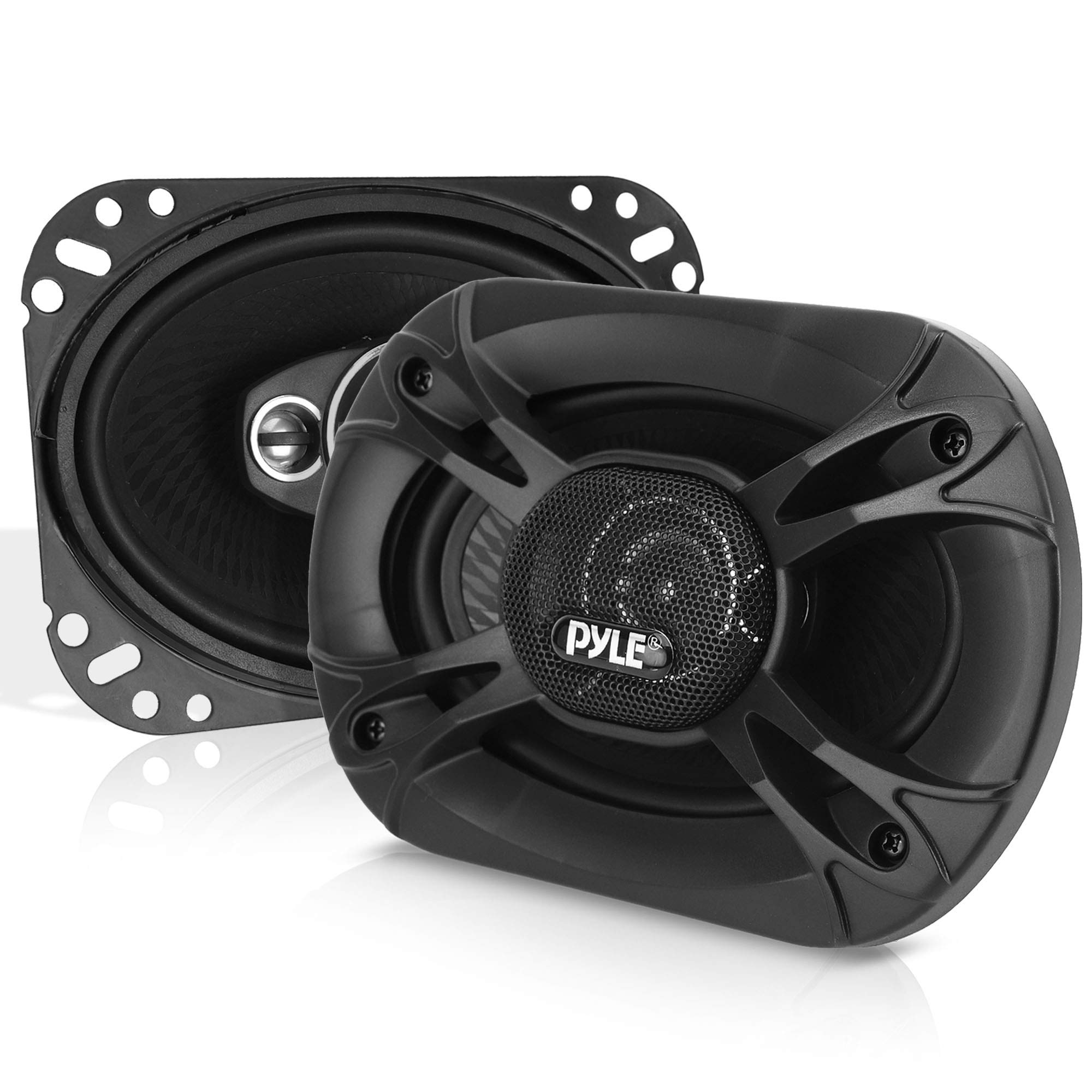
2. Pyle 3-Way Universal 6” x 8” Triaxial Speakers
A budget triaxial that shocks listeners with big volume and a rock-solid fit
This Pyle pair peaks at 400W versus the KICKER’s 200W peak, and while that number is mostly marketing headroom, the real story is the 3-way design — a ¾” piezo tweeter (a type of high-frequency driver) and a 1” neodymium film dome midrange sit alongside the main 7.95” cone to keep vocals clear even when you crank it. Owners confirm the lows “shake the ground” and call the sound quality superb far beyond the price tag.
The fit is the headline for pickups: it mounts perfectly into existing F150 mounts with no cutting, a direct fit in a Mustang, and one builder turned a pair into a DIY soundbar for a TV and computer, praising the quality enough to hear dialogue without captions. The 25oz rubber magnet boot and butyl rubber surround add durability that fights off weather wear.
The honest caveat is durability mixed with an occasional blown unit, and one owner found them merely average behind an aftermarket Pioneer head unit. For the price, though, the consensus is loud and clear — this is a huge upgrade from factory speakers for DIYers who do not want to cut wires.
The value verdict: owners call this the best deal they found across dozens of speaker pairs — incredible output and fit for the money.
3. Kenwood KFC-C6866R Road Series 6″x8″ 2-Way Speakers
A refined Road Series tune that keeps the original recording intact
Kenwood plays the audio purist card with a cloth woofer cone and balanced dome tweeter designed to make the music “sound like the original,” backed by a 250W peak and a 40Hz – 22kHz response that delivers pristine highs and deep lows without distortion. The 30W RMS rating (continuous power handling) tells you it is efficient enough for a factory radio while leaving room for an amp later.
Owners mention a 2004 Toyota Sienna where these fit straight into the OEM speaker casing after trimming the backing trim, and an F-150 buyer called them a “great replacement” that fit like a glove once the adapter was purchased. A Tacoma owner said these sound “ten times better than stock”, even after needing a small housing modification to make the fit work.
The heavy duty magnet and shallow depth are the practical stars here — they slide into tight factory pods without clearance fights. The only recurring ask is to buy the correct wiring adapter up front, and to expect some minor bracket work depending on your truck model.
The sound read: clearer highs and lows than you expect at this price, with an installation curve that rewards patience.
4. MB Quart FKB168 6×8 Car Stereo Coaxial Speakers (2 Pairs)

A four-speaker bundle that upgrades every door for the price of a single premium pair
You are getting two pairs of MB Quart FKB168s here, each rated at 100W peak per speaker, with an 88 dB sensitivity and a 46 Hz – 20 kHz response that owners describe as crisp with great highs and mids. The 1-inch aluminum dome tweeters deliver clean top end, while butyl rubber surrounds deepen the mid-bass impact and hold up in weather.
The 5.67″ mounting cutout and 2.13″ chassis depth let these drop into most 6×8 and 5×7 factory locations, and owners call them an ideal stock upgrade with a huge improvement over factory units, even on a 2011 Ford Ranger’s stock head unit. The catch is weak bass below 60Hz — customers note you will want a subwoofer for that 35-60Hz range, and a few note the lack of included speaker covers.
Owners recommend pairing these with an aftermarket stereo to open up the full 50W RMS per speaker, and note that the mids can run slightly bright until break-in settles them. As a complete four-speaker refresh, the value is hard to argue with.
Grab these for: a cost-effective whole-car refresh where clear highs and easy fit beat deep sub-bass.
Bring your own: a subwoofer for the lowest octaves.
5. JBL CLUB 8620 5×7/6×8 2-Way Coaxial Speakers

Punchy little drivers that fill a cabin with sound when an amp gets involved
JBL builds this as a 5×7″/6×8″ 2-way with a 330W peak per pair — 165W each — and a 3-ohm impedance, a slightly lower load that lets a modest amplifier squeeze out more output. Owners bolted them into a 2009 Ford Taurus X SEL and a PT Cruiser where the “punchy and clear” sound with an amp made them a standout upgrade over factory units.
The glowing thread across feedback is that they “sound great” even as -class speakers, with some bass response and a clean, crisp, vibrant character at high volume. A Lincoln MKX owner reported a drastic improvement over stock with no distortion even at full volume on the factory head unit.
The honest notes: no wires are included, so you will solder or buy a harness, and a 2000 Town Car owner found the initial bass lighter than stock until a two-week break-in period rounded things out.
The Upside
- High 110W RMS per pair handles real amplifier power
- Clean, punchy sound praised across many vehicle fits
- Rubber enclosure material adds weather resilience
The Fine Print
- No wiring included — expect to solder
- Needs break-in time to reach full bass response
6. CERWIN-VEGA! HED Series 6×8 3-Way Coaxial Speakers

A 3-way design that stays clear at high volume without demanding a new amp
Cerwin-Vega packs a 60W RMS rating and 360W MAX ceiling into a 3-way layout with a 1.0” balanced PEI tweeter for crisp highs, and the stamped steel vented frame keeps things rigid under stress. The graphite-injected cone with a rubber surround is the engineering highlight — owners call the sound “amazing” and “super clear” even at louder levels.
F-150 reviewers point out a perfect fit in front and rear doors with no modifications — just four screws and factory hardware, using adapter cables to avoid cutting wires. One buyer preferred these over the JBL 6x8s they replaced, and a 2011 F150 owner said they are superior to factory speakers with a new radio and factory amp.
The recurring guidance is to feed them real power; a 30W deck will not wake up the 360W-rated drivers, and a 50W/channel JVC head unit is where they shine. Durability draws some mixed feedback, so an amp that respects the 60W RMS rating keeps them singing.
The fit call: a true drop-in for Ford doors that sounds far better than stock once it gets adequate power.
7. Pioneer A-Series MAX TS-A683FH 6″ x 8″ 2-Way Speakers

A high-efficiency 2-way that makes stock radios sound dramatically alive
Pioneer’s 370W max and 85W continuous ratings are impressive, but the 90 dB sensitivity is what makes this an ideal factory replacement — it produces clear, loud sound even from low-power inputs. The 34 Hz to 49 kHz frequency response is the widest in this lineup, stretching both deeper and higher than most rivals for detail across every genre.
Owners praise “tight controlled bass” and “clear vocals” with clean highs, noting the factory holes align for easy installation on many trucks. One buyer found them louder and better than stock in their 2010 Mini Cooper, while the efficiency suits a stock amp nicely.
The practical catch is the included adapters only fit GM and Chevy vehicles — a Ford or Mini owner will need correct brackets, and some report the hardware requires dremeling. Bass on deck power alone is modest, so an amplifier open up the real headroom this driver carries.
Choose these if: you run a factory or low-power unit and want efficiency plus a huge frequency range.
The fine print: budget for correct vehicle-specific adapters and an amp for full bass.
8. Infinity Kappa 6X8″/5X7″ 2-Way Coaxial Speakers

The enthusiast’s 94 dB high-fidelity pick that excels when an amp takes the wheel
Infinity’s Kappa line is the sound-quality benchmark here, with a 1″ edge-driven soft dome tweeter and a Plus One+ glass-fiber woofer cone with hi-roll rubber surround. Rated at 300W max (100W RMS) with a 94 dB sensitivity and a 40-25,000 Hz response, it is the most power-hungry and most revealing speaker in this list — owners say it reproduces everything from mid-bass on up.
The 2-ohm impedance, 100W RMS, and 94 dB sensitivity made buyers pick it over Alpine and JBL offerings, with a four-year owner report noting the audio quality still exceeds spec. Installed in all four doors of an F-150 Supercrew, owners call it better than Polk two-ways and on par with Alpine Type-Rs, with superior low-range making a subwoofer optional.
The trade-offs are real: it is a true 6×8, not a 5×7, so vehicles with smaller openings need adapters or modification, and some owners dremeled mounting brackets to get the fit. Durability and performance draw mixed notes, so pair it with a quality amp and clean wiring to protect the investment.
The audiophile trade: exceptional clarity and bass depth for music lovers willing to handle mounting brackets and real amplifier power.
9. Rockford Fosgate Power T1682 6×8 2-Way Speakers

Rockford’s Power series in a drop-in 6×8 with deep, distortion-free bass
This is the flagship of the 6×8 world, with the T1682 rated at 80W RMS and 160W MAX per pair, integrated concealed crossovers, and a build quality that carries Rockford Fosgate’s famous reputation and a full 1-year warranty. Owners describe deep, rich bass with clear instrument separation and absolutely no distortion at max volume.
The package includes adapter plates, mounting hardware, and an installation manual — everything you need for a clean drop-in. A 1996 Ford Explorer owner confirms it is a true 6×8 with a factory gasket and heavy magnet, handling 75W per channel at 2 ohms fine in the front, while a 2000 Ford Ranger driver swapped blown factory units for these and called the install easy with only minor terminal work.
The honest catches: the fit is mixed across vehicles, with some owners trimming brackets for recessed mounts and others noting the screw holes misalign, plus the magnet size can push the tweeter into the door grill in tighter pods. One buyer lost a woofer within a week, though Amazon replaced it free — but for pure sound quality, the Power series earns its premium standing.
Invest in these for: distortion-free, high-output bass and build quality that justifies the premium price.
Plan ahead: some vehicles need bracket trimming for a clean mount.
Understanding the Specs
Peak Power vs. RMS Power
Peak wattage is a brief burst limit; RMS is the continuous safe power level. Match amp output to the speaker’s RMS rating to avoid blowing the voice coil.
Impedance and Sensitivity
Impedance, measured in ohms, is the electrical load a speaker places on the amp — most factory systems run 4-ohm speakers, but some aftermarket setups use lower loads for more output. Sensitivity (dB) tells you how efficiently a speaker converts power into volume; a 94 dB speaker is louder than a 90 dB speaker on the same amplifier, which matters when you are stuck with a stock head unit.
FAQ
Will a 6×8 speaker fit a 5×7 factory opening?
Do I need an amplifier for aftermarket 6×8 speakers?
Why does my new speaker sound worse than the factory one until break-in?
What wiring adapters do I need for these 6×8 speakers?
Is a 3-way 6×8 speaker better than a 2-way?
Can I run 6×8 speakers in the rear doors of a truck?
What is the difference between peak and RMS power?
Do 6×8 speakers need a subwoofer for bass?
Final Thoughts: The Verdict
For most drivers, the winner in 6 x 8 car speakers is the KICKER DSC680 — the crowd favorite with the best blend of crisp sound, easy bolt-in fit, and efficiency on stock power. If you want maximum volume on a budget, the Pyle PL6183BK delivers a 400W peak with a 3-way design that shocks at the price. And for the audiophile ready to run an amplifier, the Infinity Kappa brings a 94 dB sensitivity and 100W RMS handling that reveals every layer in the recording.
How We Picked
We do not accept paid placement. Every pick is matched to a real buyer and a real use-case; we do not hands-on test units.
Sources & Methodology
Specifications: manufacturer listings and product documentation. Review insights: verified customer reviews, as of August 2026. Pricing: not shown on this page (it changes often); check the current price via the retailer link.
As an Amazon Associate, Gadgets Feed earns from qualifying purchases. This does not affect which products we feature.