
Our readers keep the lights on and my morning glass full of iced black tea. As an Amazon Associate, I earn from qualifying purchases.
Specs are compiled from manufacturer listings and verified buyer reviews and can change over time — please confirm the key details on the product page before buying.
This guide covers nine 600-watt-class amplifiers — four-channel, monoblock, and one marine model — and explains which fits your build.
Each pick is based on the manufacturer’s published specs and patterns across verified customer reviews, so you get real strengths and trade-offs instead of marketing spin.
Wattage ratings are not always apples-to-apples. So this list includes same-class amps roughly within the 600-watt neighborhood, not just amps rated at exactly 600 watts. That way you see the nearest real-world fit for a 600 watt amp.
Our Picks at a Glance


How To Choose The Best 600 Watt Amp
First, decide whether you are powering speakers or a subwoofer. That choice splits this list in two and decides which amp belongs in your car.
Match the channel count to your build
Channel count is how many separate audio signals the amp can drive at once. A four-channel amp powers four door speakers (or two speakers plus a bridged sub), while a monoblock (single-channel) amp is built for bass duty only.
If you run a front stage and want subs on the rear channels, a four-channel amp handles both. If you already have a head unit driving your speakers and just need bass, a monoblock is the simpler pick.
RMS watts, not peak watts
RMS (root mean square) is the power the amp can deliver continuously — that is the number that actually drives your speakers. Peak or max power is a much higher, brief-burst figure you should ignore for real-world planning.
Several amps here are honestly rated and even dyno-tested above their label, while a few buyers report advertised numbers that fall short. Watch for a real RMS figure at a stated ohm load.
Ohms decide how hard the amp works
Ohms measure electrical resistance. A lower ohm load pulls more power from the amp, which is why a 1-ohm stable monoblock can run far hotter than a 4-ohm setup. Always match your sub’s impedance to what the amp is rated to handle.
Easy installation and cooling
Compact chassis fit under seats and behind trim panels, which matters when you are short on space. Cooling design matters too — a Class D amp (a highly efficient switching design) runs cooler than a Class A/B amp, which is a real advantage in small, poorly ventilated spots.
Quick Comparison
| Model | Best For | Channels | RMS Power | Min. Ohm Load | Amazon |
|---|---|---|---|---|---|
| Rockford Fosgate P600X4 Punch★ Best Overall | Full-range 4-speaker systems | 4 | 75W x 4 @ 4Ω / 150W x 4 @ 2Ω | 2 Ohms | Amazon |
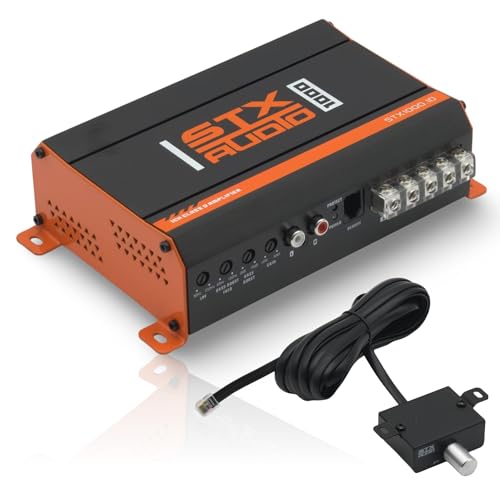
| STX Audio STX1000.1DBest Value | Budget bass on a small sub | 1 | 600W RMS (1000W max) | 1 Ohm | Amazon |
| Hifonics Zeus 600WBudget Pick | Affordable 4-channel power | 4 | 75W x 4 @ 4Ω / 150W x 4 @ 2Ω | 2 Ohms | Amazon |
| CT Sounds CT-700.1D | Compact dedicated sub power | 1 | 700W RMS @ 1Ω | 1 Ohm | Amazon |
| NVX NDA6004 | Flexible 4-channel setups | 4 | 100W x 4 @ 4Ω / 160W x 4 @ 2Ω | 2 Ohms | Amazon |
| Sundown Audio SFB-600D | Small, hard-hitting bass | 1 | 600W | 1 Ohm | Amazon |
| Alpine S-A60M | Reliable subwoofer power | 1 | 600W RMS | 2 Ohms | Amazon |
| Alpine S2-A60M | Hi-Res certified bass | 1 | 600W @ 2Ω | 1 Ohm | Amazon |
| KICKER 48KMA6004 | Marine and boat audio | 4 | 150W x 4 @ 2Ω | 2 Ohms | Amazon |
In‑Depth Reviews
1. Rockford Fosgate P600X4 Punch 600-Watt 4-Channel Amplifier
Our pick — over 4.5★ from 200+ verified ratings; the strongest balance of quality and price.
Four channels of clean, honestly rated power that keeps a full speaker system loud without the mud.
If you are running four door speakers or a three-way front stage with subs on the rear, this is the amp the rest of the list gets measured against. You get 75 watts per channel at 4 ohms, 150 watts per channel at 2 ohms, or 300 watts across two bridged channels at 4 ohms — enough to drive almost any configuration you bring it.
The wiring is refreshingly simple. The RCA inputs accept both high- and low-level signals without a converter, and the RCA pass-thru outputs let you daisy-chain a second amp straight off this one. Class A/B topology keeps the sound warm and full, and the on-board Punch EQ with a +18dB boost at 45Hz lets you dial in chest-thumping bass when you want it.
The built-in C.L.E.A.N. setup is the sleeper feature — a set of LEDs that stops you from dialing in distortion and cooking your speakers. Compared to the NVX NDA6004’s 100 watts per channel at 4 ohms, this one trades a little per-channel wattage for Rockford’s long-running build reputation.
What owners rave about
- Clean sound quality is what wins people over — the single most-praised thing about this amp, with buyers describing a “clean thump” and pristine mids and highs.
- Value ranks a close second — owners routinely call it well worth the money for the caliber of sound it delivers.
- Power comes in third, with buyers reporting it exceeds the factory volume of most systems without maxing out.
- The C.L.E.A.N. setup prevents clipping at high volume, which protects your speakers over the long haul.
Where it falls short
- A rare unit fails just under the two-year mark, so an occasional dud from the start is possible regardless of the badge.
- As a Class A/B amp it runs warmer than the compact Class D models lower on this list.
- The C.L.E.A.N. tuning process takes some patience to learn the first time.
Reach for this if: you are building a four-speaker or three-way system and want warm, distortion-free power from a brand with decades of car-audio history.
Look elsewhere if: you need a tiny amp to hide under a seat, or you only need bass duty from a single channel.
2. STX Audio STX1000.1D Monoblock Class D Car Amplifier
A single-channel bass amp at a wallet-friendly tier, though its 1000-watt headline is optimistic.
This monoblock is purpose-built for one job: feeding a subwoofer low end. It is 1-ohm stable, which means it can support low-impedance subwoofer setups, and the adjustable low-pass filter (a control that sends only bass frequencies to the sub) helps keep your mids and highs clean. A remote sub volume knob is included, so you can dial bass up or down from the driver’s seat.
One thing to understand going in: the 1000-watt figure is a max rating, and the continuous RMS number is the one that actually drives your sub. Owners mention that at full gain it is only adequate for a 10-inch Kicker sub, with the sub left understressed — this is a background-bass amp, not a competition monster.
The upsides that keep it in the mix are practical. It powers cars, trucks, and SUVs, takes a compact single-channel footprint, and the price-to-output ratio is hard to argue with for casual listening. The MOSFET design (the internal switching components that make the amp responsive) keeps it stable for bass-heavy playlists.
The honest read: treat the 600W RMS as the real number and the 1000W max as marketing. For a single moderate subwoofer at low impedance this is a sensible, low-cost entry point.
Who this fits: someone testing the water with a single sub who values the remote bass knob and wants to keep the spend modest.
Buy it if: you are powering one small-to-moderate subwoofer and want simple, low-cost bass with a dash-mounted level control.
Pass on it if: you are driving a demanding high-output subwoofer and need a monoblock with verified real-world RMS headroom.
3. Hifonics HIFINICS Zeus 600WATTS 4CHANNEL @4OHM.AB
A four-channel entry amp that punches above its price tag — if you land a good unit.
On paper the Zeus is a straightforward four-channel: 75 watts per channel at 4 ohms, 150 watts per channel at 2 ohms, and 300 watts across two bridged mono channels. It is a true four-channel design where the STX is a single-channel monoblock, so if your goal is driving door speakers rather than a sub, this is the more useful layout.
What keeps buyers coming back is the sheer sound-per-dollar here. The amp delivers a frequency response of 10 Hz to 22 kHz, and one buyer notes it made their car sound like a night club. Drive a set of 6.5-inch and 6×9 speakers and it confidently exceeds factory volume without maxing out.
The catch with this one is consistency. Sound quality is a genuinely mixed bag — some units are clean and crisp while others introduce noise on multiple channels, and the internal protection quirks mean not every unit calibrates perfectly. Buy from a seller with a solid return policy and you can sort a bad unit fast.
What buyers prize: quality is the number-one thing people praise about this amp, closely followed by value for money — it delivers respectable 4-channel power for a modest outlay.
The fine print: its built-in high-pass filter is fiddly to dial in for some, and the outputs point downward, which can pinch wiring in tight installs — a small extra high-pass adapter sometimes smooths vocals.
Worth it for: budget-conscious builds where you want four channels of real power and can return a dud if one arrives.
Skip the gamble if: you need a plug-and-play amp that arrives calibrated perfectly the first time, every time.
4. CT Sounds CT-700.1D Compact Class D Car Audio Monoblock Amplifier

A tiny monoblock that hides almost anywhere and still pounds a pair of subs.
If you want honest power at low impedance for a dedicated bass amp, this one spells it out: 700 watts RMS at 1 ohm, 380 watts RMS at 2 ohms, and 200 watts RMS at 4 ohms, all measured at 14.4 volts. That is a real, load-specific rating rather than a single headline number — so you know what you actually get when you wire your sub a certain way. Its 0 to 320 Hz frequency response is a bass-focused range, which shows it is built purely for subwoofer duty.
The compact chassis is the selling point for anyone with a crowded trunk. It tucks into tight spots and runs cool thanks to a MOSFET pulse-width-modulated power supply and a heat-dissipation design — helpful when it is bolted behind a seat or under a bench. The included bass knob lets you adjust output from the driver’s seat, and the four-way protection circuitry guards against high voltage, low voltage, over current, and high heat.
The thing buyers single out most is overall build quality, followed closely by raw power — customers note it handling 2-ohm subs with ease and staying out of protect mode even after long, hard sessions. It does run warm in poorly ventilated spots, and the RCA connectors are the fragile point to handle with care during install.
Why it stands out: quality is the most-praised attribute here, with owners noting it runs a pair of 1200W-class subs without drama and keeps its cool.
The trade-off: durability is the mixed note — the plastic RCA connectors feel delicate, and the bass knob is less sturdy than the amp itself, so fit and forget.
A smart pick for: a single sub or a pair of moderate subs in a vehicle where space is tight and you want strong power without a huge footprint.
Not the one if: you are chasing maximum output for a big, low-impedance sub system and want the most headroom possible.
5. NVX NDA6004 1200W Peak (600W RMS) N-Series Class-D 4-Channel Amplifier

Four channels of efficient Class D power in a chassis you can tuck away almost anywhere.
This NVX covers door speakers, a sub, or both, and its numbers are flexible: 100 watts per channel at 4 ohms, 160 watts per channel at 2 ohms, and 320 watts across two bridged channels at 4 ohms. Because it is Class D (a design that wastes less power as heat), it stays more efficient and compact than a comparable Class A/B amp — so it fits easily behind a seat or in a dash void.
Tuning is where it earns its keep. You get selectable crossover modes (FULL, HPF for highs, LPF for lows) plus variable filters from 40 to 400 Hz, so you can shape exactly which frequencies go where. LED power and protect indicators make it obvious when something is off, and the three-way protection circuitry covers thermal, overload, and speaker-short faults.
Buyers routinely mention that it delivers a sizeable jump in sound quality over a stock setup, and one build mounted it under a Ram 1500 driver’s seat for a big gain in clarity. The recurring gripe is heat — several reviewers point out it warms up enough that a fan helps, so give it airflow this one cannot hide from.
The case for it: quality is the most-praised thing here, with sound quality right behind, and owners call it great bang for the buck.
Where it needs help: heat is the real mixed bag — most buyers have no trouble, but it is the one spec to plan around with a mesh opening or a small fan.
Go here if: you want four flexible channels with bright DSP-style controls and Class D efficiency that survives small, tight installs.
Think twice if: your mounting spot is fully sealed with zero airflow — this one prefers a breathing space.
6. Sundown Audio SFB-600D Class-D Monoblock Amplifier

A palm-sized monoblock that hits far harder than its 600-watt label suggests.
Sundown built its name on bass, and this single-channel amp shows why. The label says 600 watts, but the input range is wide — it accepts 10.5 to 15.5 volts of supply — and buyers consistently report it outmuscles its rating, with one noting it is “highly underrated by the manufacturer.” That extra headroom is a gift, but it is also a warning: it can push a modest sub past its limit if you are not careful.
The footprint is the other headline. This amp vanishes into tight builds, so you can mount it under a seat or on a small amp rack where a bigger amp would never fit. A bass knob with clip and power indicator lights lets you see at a glance if you are pushing the sub too hard, which is a genuinely useful safeguard for anyone new to bass tuning.
Owners point to build quality as the standout, followed by raw power output. That said, reliability is the mixed note — most units hold up for years, but at least one failed within the first year. If you want a longer safety net, this is the pick that comes with the confidence of a two-year warranty.
What makes it click: quality is the most-praised trait, and power reviews are just as strong — a few owners say it turns down easily for a sub that starts screaming.
What to keep in mind: reliability splits slightly, with a lone failure reported in the first year, so buy from a seller you trust.
Pick this one if: you want maximum bass in minimum space, backed by a two-year warranty and the reassurance of clip-light feedback.
Consider otherwise if: you would rather have a milder, more predictable amp than one that lives up to its overrated nickname.
7. Alpine S-A60M, S Series Class D Monoblock Subwoofer Amplifier

A single-channel sub amp that never overheats, even when it is working hard.
If you want a bass amp that behaves, the S-A60M is the safest bet in this lineup. It is rated 600W RMS at 1 channel, with a signal-to-noise ratio of 85 dBA — a clean noise floor that keeps your bass its own thing rather than a hiss. It takes both preamp and speaker-level inputs, which means it drops into almost any vehicle, even one that still has the factory radio.
Owners run it with a single 10-inch sub, a 12-inch sub, and even a pair of 15-inch woofers at low gain without drama. It never overheats at high volume, and the tuning is genuinely approachable: variable bass boost and a crossover let you shape the low end without an engineering degree. The compact, single-channel layout makes it an easy hide.
The one trade-off to know is minimalism. There is no subsonic filter (a filter that blocks ultra-low notes below what your sub can play) and no clipping light (a light that warns you when the signal is distorting), and the bass knob is a separate purchase — a few owners note the mounting cover is plastic rather than metal. For years of clean, low-maintenance use, though, few in this range match its track record.
Owners’ favorite part: quality is by far the most-praised attribute, with sound quality, performance, and value all right behind it.
The fine print: the plastic mounting cover and the lack of a built-in clip indicator are minor gripes that come up most often.
Best for: a subwoofer build where you want proven reliability, flexible inputs, and a clean 600W without flab or fuss.
Hold off if: you need built-in output protection like a clip light or want a metal mounting cover stock.
8. Alpine S2-A60M S-Series Class-D Mono Subwoofer Amplifier

The newer Alpine mono that makes 600 real watts and fits under a front seat.
This is the current-generation follow-up to the S-A60M, and it is built to correct the older model’s quirks. It makes a genuine 600W RMS at a 2-ohm load at 14.4 volts, with a total max power of 1100W, and it can also wire down to 1 ohm for more output. The variable low-pass filter from 50 to 400 Hz at -12dB/octave gives you real control over where the bass rolls off.
Hi-Res certification (a label for gear that handles high-resolution audio) separates it from the older S-A60M — it is designed to pass a cleaner signal through to your sub, which matters if you feed it from a high-resolution source. It also brings back features the previous version skipped, making it the more complete Alpine choice for a modern build.
Shoppers say it pushes two 10-inch subwoofers to their maximum capacity and has driven a pair of shallow-mount 12s at 2 ohms with no trouble. One gentle caution: it exceeds its rated power, and at 1 ohm it can hit hard enough to stress a budget sub — a subsonic filter is a smart add-on for anyone running a single shallow woofer.
What owners value most: quality is the top line by a wide margin, with power close behind — several note it drives two subwoofers at full tilt.
Worth your caution: the amp can pump out more than the label promises, so match it to a sub rated for the job or dial the gain back.
Reach for it if: you want the newest Alpine mono, Hi-Res certified output, and the ability to wire into a 1-ohm load for a compact, powerful install.
skip it if: you are running a single low-power subwoofer that would rather not be overpowered.
9. KICKER 48KMA6004 600 Watt 4-Channel Marine Amplifier

A four-channel marine amp built to survive salt, spray, and the open water.
Marine audio is a different game — moisture and corrosion kill ordinary amps, so this KICKER is protected where it counts. The circuit board is conformal-coated (sealed with a thin protective layer against moisture), the power connections meet the ABYC and NMMA marine wiring standards, and the hardware is 316L stainless steel, the corrosion-resistant grade used on boats.
For life on the water, the power is legitimate: 150 watts per channel at 2 ohms stereo, 300 watts across two bridged mono channels, and a dynamic power figure of 725 watts. A variable 12dB crossover from 50 to 200 Hz (a control that sends only the right frequencies to each speaker), selectable high-pass, low-pass, or all-pass, plus a KickEQ boost you can dial from 0 to 6dB at 40Hz, gives you real tuning control whether you are running tower speakers or a cockpit sub.
Buyers who have put it to the test report it holds its own against amps that cost several times as much, and one owner mounted it in a trunk right onto a sub box. As with any discount marine amp, a few report output that falls short of expectations, so give it enough power and clean ground wiring.
Why boaters choose it: the marine-grade build is the reason to buy — conformal coating and 316L hardware hold up where a standard car amp would not.
The caveat: a small number of buyers found the output weaker than the name suggests, so power it properly and do not expect miracles from a single ground run.
The right call if: you are outfitting a boat, UTV, or other damp environment and need four channels that resist water and salt.
Overkill if: your install lives entirely indoors or is fully sealed, since a standard car amp covers that without marine pricing.
Understanding the Specs
RMS Watts vs. Peak Watts
RMS (root mean square) is the continuous power the amp can deliver all day — the number that actually drives your sound. Peak or max watts is a brief, higher burst figure that mostly exists for marketing. When comparing amps, put the RMS number side by side and ignore the bigger headline. A 600W RMS amp will beat a “1000W max” amp that only manages 600 RMS in real use.
Ohms and Channel Count
Ohms measure resistance; a lower number means the amp works harder and delivers more power. That is why 1-ohm-stable monoblocks run hotter than a 4-ohm stereo setup. Channel count is separate: four channels drive speakers (or two speakers plus a bridged sub), while a monoblock handles bass only. Match the channel count to your system before you worry about anything else.
C.L.E.A.N. and Clipping
Clipping is when an amp is pushed past its limit and sends distorted, squared-off waves to your speakers — the fastest way to wreck them. Rockford Fosgate’s C.L.E.A.N. setup uses indicator LEDs to help you tune the gain without crossing that line. Amps without it still sound great, but you have to set gain by ear and watch for distortion.
Filters, Crossovers, and Bass Boost
A crossover sends only the frequency range you want to a given speaker. A low-pass filter sends just the lows to your sub, which keeps bass tight; a high-pass filter protects smaller speakers from low frequencies they cannot handle. Bass boost, like the +18dB boost on the Rockford or the KickEQ 0 to 6dB on the KICKER, lets you emphasize the low end — useful in moderation, muddy when overdone.
FAQ
Do I need a 4-channel or a monoblock amp?
What is the difference between RMS and peak wattage?
Can I run a 600 watt amp on a stock car electrical system?
Is 1 ohm or 2 ohm better for a subwoofer amp?
Why do some amplifiers run hot?
Can I install a car amp in a boat?
What does a crossover do on an amplifier?
How much power is enough for a single subwoofer?
Are cheap amplifiers worth buying?
What does bass boost actually change?
Final Thoughts: The Verdict
For most people building a full-range system, the 600 watt amp winner is the Rockford Fosgate P600X4 Punch — it is the crowd favorite at 4.6 stars across 200+ owners, and its clean sound quality plus flexible 4-channel, 2-ohm-bridged layout handles just about any build. If your goal is a single subwoofer, reach for the Alpine S2-A60M, which makes a genuine 600W RMS and fits under a front seat. And if your system lives on the water, the KICKER 48KMA6004 is the one to grab — marine-grade everywhere a car amp is not.
How We Picked
We do not accept paid placement. Every pick is matched to a real buyer and a real use-case; we do not hands-on test units.
Sources & Methodology
Specifications: manufacturer listings and product documentation. Review insights: verified customer reviews, as of September 2026. Pricing: not shown on this page (it changes often); check the current price via the retailer link.
As an Amazon Associate, Gadgets Feed earns from qualifying purchases. This does not affect which products we feature.