
Our readers keep the lights on and my morning glass full of iced black tea. As an Amazon Associate, I earn from qualifying purchases.
Specs are compiled from manufacturer listings and verified buyer reviews and can change over time — please confirm the key details on the product page before buying.
You want backup power that won’t fry your TV, laptop, or well pump, and you want it loud enough for the neighbors to notice — but not in a bad way. A 6000-watt inverter generator is the balance for powering an entire house during an outage or running heavy tools at a job site, and the inverter part means the electricity is clean and stable enough for sensitive electronics. The real question is which model you can move, start, and fuel without a second job.
I’m Min — the founder and writer behind Gadgets Feed. This guide is built by comparing the manufacturers’ published specifications and the patterns across verified customer reviews, so you get each pick’s real strengths and trade-offs instead of marketing spin.
You need a unit that balances starting watts, noise, runtime, and portability. Here is the shortlist for finding the best 6000 watt inverter generator for your home or RV in plain English.
Our Picks at a Glance


How To Choose The Best 6000 Watt Inverter Generator
Every generator in this class will run your fridge, lights, and a window AC. The differences show up when you push it with a central AC or well pump, or when you have to lift it into a truck bed. Focus on the numbers that match your heaviest appliance, not the biggest number on the box.
Starting watts vs. running watts
Motors like AC compressors and well pumps need a big jolt of power to start, then settle down to a lower steady draw. That jolt is the starting (or peak) wattage, and the steady draw is the running (or rated) wattage. You need a generator whose peak watts clear your appliance’s starting surge, or you’ll trip the breaker on the generator itself, not save the day.
Noise level in dBA
Inverter generators are quieter than open-frame construction units, but “quiet” is a range. A unit rated at 69 dBA and one rated at 62 dBA are a world apart when you’re trying to sleep next to a camper or keep peace with neighbors during a week-long outage. Decibels are logarithmic, so a few points is a big difference in perceived loudness.
Fuel flexibility and runtime
Dual-fuel models run on gas and propane, and tri-fuel adds natural gas. Propane stores longer without going bad, but you give up a little power. Check the runtime figure on the fuel you plan to use most — a big tank sounds great until you realize it’s rated at 25% load, not when you’re running a central AC.
Quick Comparison
| Model | Best For | Starting Watts | Noise (dBA) | Weight | Amazon |
|---|---|---|---|---|---|
| Champion 6250W★ Best Overall | Home backup with central AC | 6250 | 69 | 121 lb | Amazon |
| WEN DF680iXBest for EV Charging | EV charging & RV | 6800 (gas) | — | 99.2 lb | Amazon |
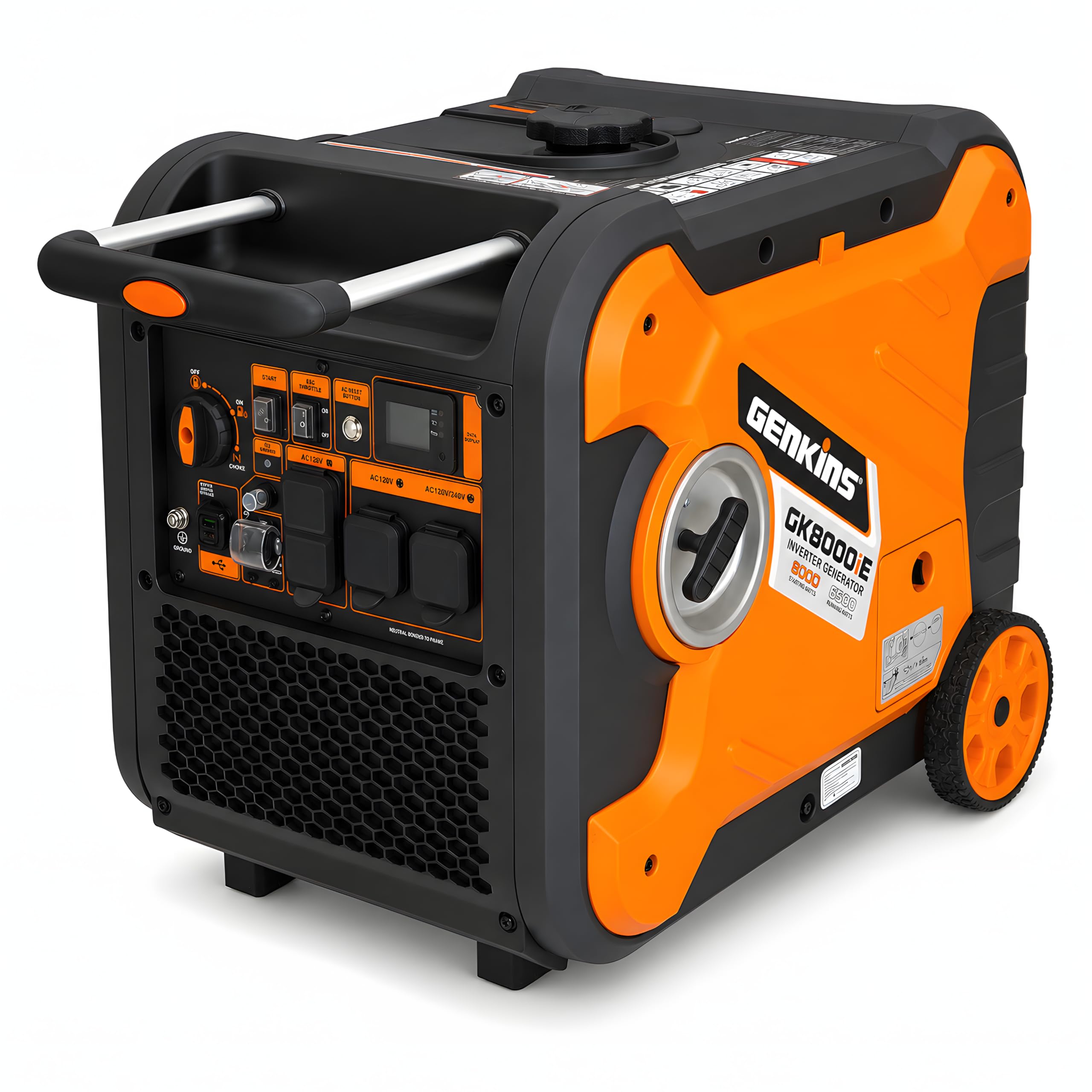
| Genkins GK8000IEQuiet Value Pick | Budget quiet power | 8000 | 62 | 112 lb | Amazon |
| Westinghouse 10000W | High-output home backup | 10000 | — | 147.7 lb | Amazon |
| Pulsar 7250W | Quiet dual-fuel camping | 7250 | — | 118 lb | Amazon |
| A-iPower SUA7600iED | Quiet dual-fuel home | 7600 | 62 | 130 lb | Amazon |
| Westinghouse iGen8200TFc | Tri-fuel whole-home | 8200 | 60 | 134.5 lb | Amazon |
| Gidrox GNV8000D | Dual-fuel RV & home | 8000 | 74 | 122 lb | Amazon |
| Champion 9000W | High-wattage home backup | 9000 | 72 | 152.2 lb | Amazon |
| DuroMax XP11000iH | Heavy jobsite & home | 11000 | — | 216 lb | Amazon |
| Gidrox GNV 11000W | Whole-home tri-fuel | 11000 | 62-65 | — | Amazon |
| Honda EU7000iS | Premium silent power | 7000 | 52-58 | 263.2 lb | Amazon |
In-Depth Reviews
1. Champion Power Equipment 6250-Watt Open Frame Inverter
Our pick — over 4.5★ from 700+ verified ratings; the strongest balance of quality and price.
The rare 240V inverter that eats a 4-ton central AC for breakfast.
This is the pick for the person whose number-one fear is a week-long outage in July with a central air conditioner. Its 6250 starting watts and 5000 running watts are enough that buyers report it runs a 4-ton variable-speed central AC at 60-70% load, and the 69 dBA noise from its quiet technology is fine for a neighborhood. You get both 120V and 240V output from a 120/240V 30A locking outlet, plus a pair of GFCI 120V 20A duplex outlets and a 12V DC automotive port.
The open-frame inverter design is 50% quieter and 20% lighter than a traditional Champion 5000-watt generator, and at 121 pounds it’s the second-lightest full-size unit here. The fuel-saving economy mode drops the engine to a near-idle when loads are light, and the Intelligauge panel — which shows voltage, frequency, and operating hours — is a rare convenience at this level. Buyers consistently report starts on the second pull, and one even measured 64 dB at 23 feet in eco mode.
Owners also warn the quick-start guide skips a few key steps, like oiling the foam air filter, so read the full manual. With a 3-year limited warranty and free lifetime technical support from Champion, this is the best all-around value for serious home backup.
What Wins People Over
- Runs a 4-ton central AC at 60-70% load, per owners.
- Clean, near-perfect sine wave — safe for sensitive electronics.
- Economy mode makes it genuinely quiet at low load.
Know Before You Buy
- 12V output is unregulated — battery charging only.
- Quick-start guide omits key break-in steps.
Reach for it if: your central AC or well pump is the boss, and you want a proven 240V inverter at a sane weight.
Real limitation: at 121 pounds and roughly 26.6″ long, it’s not a tailgating throw-in — it’s a wheeled home-backup workhorse.
2. WEN DF680iX 6800-Watt Dual Fuel Inverter
The one that tops up your EV battery and your RV fridge from the same 30A plug.
This WEN stands out because its bonded-neutral 240V configuration can deliver low-power Level 2 charging for battery-electric and hybrid vehicles — something almost nothing else in this class advertises. That means you can keep a plug-in hybrid topped up during an outage, not just run the house lights. It delivers 6800 surge watts and 5100 rated watts on gasoline, or 6000 surge and 4500 rated on propane.
The dual-fuel 224cc engine makes fuel choice yours on any given day: a 40-pound propane tank stretched across two weekends of eco-mode use, per owners, while others run it on gas for the extra power. The outlet panel is RV-ready with a TT-30R RV receptacle, an L14-30R 120V/240V receptacle, two three-prong 120V receptacles, a 12V DC port, and two 5V USB ports. Owners ran both 15,000 BTU ACs, a stove fan, and lights on the 30A plug, and one pushed a 50A cord at 25 feet on propane. At 99.2 pounds it’s the lightest full-size unit here, beating the Champion by roughly 22% in weight, and its 22.8″ x 16.6″ x 19.7″ footprint is about 17% more compact.
The trade-offs are honest ones. The dipstick lacks a magnet tip, a couple of owners note the front has no battery disconnect switch so you open a side panel, and the noise level is slightly above what the marketing suggests. The WEN Watchdog CO Shutdown Sensor is a real safety net, automatically killing the engine if carbon monoxide builds up, and the fuel shutoff runs the carburetor dry so it stores cleanly. A 3-year warranty backs it, and the fact that owners call WEN an American brand founded in 1951 adds confidence for a 6800W-class unit.
Smart buy for: EV owners, RVers, and cabin users who want the lightest dual-fuel inverter on the list and Level 2 charging on tap.
The catch: a few owners found it a touch louder than expected and had to add their own magnet-tip dipstick for cleaner oil reads — minor, but worth knowing.
3. Genkins 8000W Portable Quiet Inverter Generator
A 62 dBA whisper that still cranks an 8000W peak from a 327cc engine.
If quiet is your non-negotiable and your budget says no to the premium imports, this Genkins is worth a hard look. Its 62 dBA rating at 23 feet is 11% quieter than the Champion’s 69 dBA, and the 327cc OHV engine delivers an 8000W peak and 6500W rated output — so it clears the whole 6000W class while staying genuinely calm. Pure sine wave output at ≤2% THD (total harmonic distortion — a measure of how clean and safe the power is) means your laptop, TV, and fridge control boards are protected.
The 4-gallon tank gives 8+ hours at 50% load and 16+ hours at 25% load, and the ESC mode (a smart idle that adjusts engine speed to the load) sips fuel instead of guzzling. The outlet spread is practical for mixed use: one 240V NEMA L14-30R, one 120V NEMA L5-30R, and two 120V NEMA 5-20R household outlets. Owners mention powering a 240V pump, heater, fridge, and microwave through a transfer switch, and that the electric start works once the battery is connected per the manual — a setup step that isn’t obvious.
The honest caveats: the wheel assembly failed on one unit after a few uses, and several buyers noted the battery ships disconnected, with capped wires near the oil fill that you must join yourself. If you’re not handy with that, the recoil pull start works easily as a backup, per the same owners. At 112 pounds with a telescopic handle and two “explosion-proof” tires, it’s easy to roll into a storage corner between outages.
Strongest for: campers and homeowners who want near-silent 6500W running power without paying flagship prices.
Fair warning: treat the wheel kit gently and read the manual cover-to-cover for the battery hookup — those are the two most common owner gripes.
4. Westinghouse 10000 Peak Watt Inverter

Remote start from the kitchen table while the storm rages outside.
This Westinghouse is for the homeowner who wants one generator that acts like a mini whole-house system. With 7600 running watts and 10000 peak watts on gas, it clears the 6000W class entirely, and the <3% THD clean power means you can run computers and TVs without fear. The remote electric start comes with a key fob, a push button, and a recoil pull start as backup — so you can fire it up from inside while the rain comes down.
The outlet panel is the most complete here: four GFCI 120V 5-20R household outlets, one transfer-switch-ready 120V L14-30R, and one transfer-switch-ready 120/240V 14-50R 50A outlet, all with rubber covers. That 50A outlet lets it feed a whole-house transfer switch or interlock kit, which is exactly what cabin customers note doing. The 420cc 4-stroke OHV engine with a cast-iron sleeve and automatic low-oil shutdown is built for long life, and the 5.28-gallon tank runs up to 12 hours.
The standout feature is convenience: owners say setup is easy, the VFT display (a digital readout showing voltage, frequency, and lifetime hours) is genuinely useful, and everything needed comes in the box — oil, funnel, key fob, battery charger, and tools. The real trade-off is weight: at 147.7 pounds and roughly 24″ x 26.7″ x 25.1″, it’s a two-person lift, not a tailgate toy. One long-term owner did report an inverter failure after about a year, with parts covered under warranty but labor not past the first year — so keep the receipt and the manual handy.
Why Owners Like It
- Remote start with key fob + push button + recoil backup.
- 50A outlet means true transfer-switch home backup.
- 12-hour runtime on a 5.28-gallon tank.
Think Twice If
- 147.7 pounds needs a strong two-person lift.
- Labor on repairs isn’t covered past year one.
Pick this if: you’re wiring a transfer switch or interlock and want remote start convenience from a trusted brand.
Look elsewhere if: you need to haul it solo or you’re on a tight budget — this is a serious home-backup machine.
5. Pulsar 7,250-Watt Super Quiet Dual Fuel Inverter

The quiet brute that faces down a Predator and wins on low idle.
This Pulsar is for the RV owner or job-site regular who wants dual-fuel flexibility and quiet operation in an enclosed frame that doesn’t dominate the truck bed. On gas it pushes 7,250 peak and 6,000 running watts; on propane it drops to 6,500 peak and 5,500 running — which still clears the 6000W class on gas. The 312cc OHV 4-cycle engine sits in a fully enclosed frame, and owners repeatedly describe it as “super quiet” on low idle, with one measuring about 62 dB idle versus 74 dB for a Briggs, and another calling it a brute that can power a camper’s AC, microwave, and lights at festivals and job sites.
The portability story is strong too: 118 pounds with a telescopic handle (about 100 pounds without fuel, per one owner) and parallel capability so you can pair two units and double the output. The outlet panel covers the bases with a USB-A, a USB-C, two GFCI 120V 5-20R outlets, a 120V/240V L14-30R, and a 120V TT-30R RV outlet. The digital control center shows hours, voltage, load, and frequency, and owners say it starts in about 2 seconds on gas, even after the fuel has been drained for storage.
The honest downside: reliability feedback is genuinely mixed, and the two most common complaints are the electric start failing after a few uses and a handle that can bend. One owner had a starter solenoid die after two days (a part he fixed himself), while another ran it daily for a month with zero issues. This is a pick for someone comfortable with basic tinkering who wants dual-fuel flexibility at a price far below the premium imports — not for someone who needs bulletproof electric start every single time.
Best suited for: RVers and job-site users who prioritize quiet, dual-fuel flexibility, and parallel capability and don’t mind occasional DIY fixes.
The trade-off: the electric start is the weak link in owner feedback — if that’s your must-have, lean toward the Champion or Westinghouse.
6. A-iPower SUA7600iED 7600W Dual Fuel Inverter

Auto-swaps from propane to gas mid-outage so the lights never flicker.
This A-iPower’s a neat extra is Fuel Sense Technology, which automatically switches from propane to gasoline for a combined runtime of up to 21.2 hours at 25% load. That’s the kind of feature that matters on day three of an outage when you’re too exhausted to go outside and switch tanks. The 322cc OHV 4-cycle engine delivers 7,600 starting watts and 6,100 running watts on gas, or 6,900 starting and 5,500 on propane, with a sound level as low as 62 dB.
Clean power at 3% THD keeps laptops, TVs, phone chargers, and sensitive power tools safe, and the low-idle technology plus telescoping handle and flat-free wheels make it one of the easier units to move. Run time is 10 hours at 25% load on the 3.6-gallon tank, and the compact design — about 25.1″ x 19.7″ x 21.4″ and 130 pounds — fits a garage corner better than the open-frame giants. Owners consistently describe it as quiet, with a few noting it’s barely audible from 25 feet away, and one praising that it runs his 5000-wh solar generator’s charging with ease.
The trade-offs: one owner had a stuck float bowl cause a fuel leak and no-start, which he fixed by draining and tapping the carburetor, and a few found it runs lean below 60°F, needing the choke. It does come EPA and CARB compliant with a CO sensor, which matters if you live in California or want the safety net.
Why it wins: the auto fuel-switch feature is genuinely unique at this price, and 10-21.2 hours of runtime is class-leading.
Who should pass: anyone who wants zero-maintenance reliability — this one rewards owners who read the manual and aren’t afraid of a carburetor.
7. Westinghouse iGen8200TFc 8200 Peak Watt Tri-Fuel
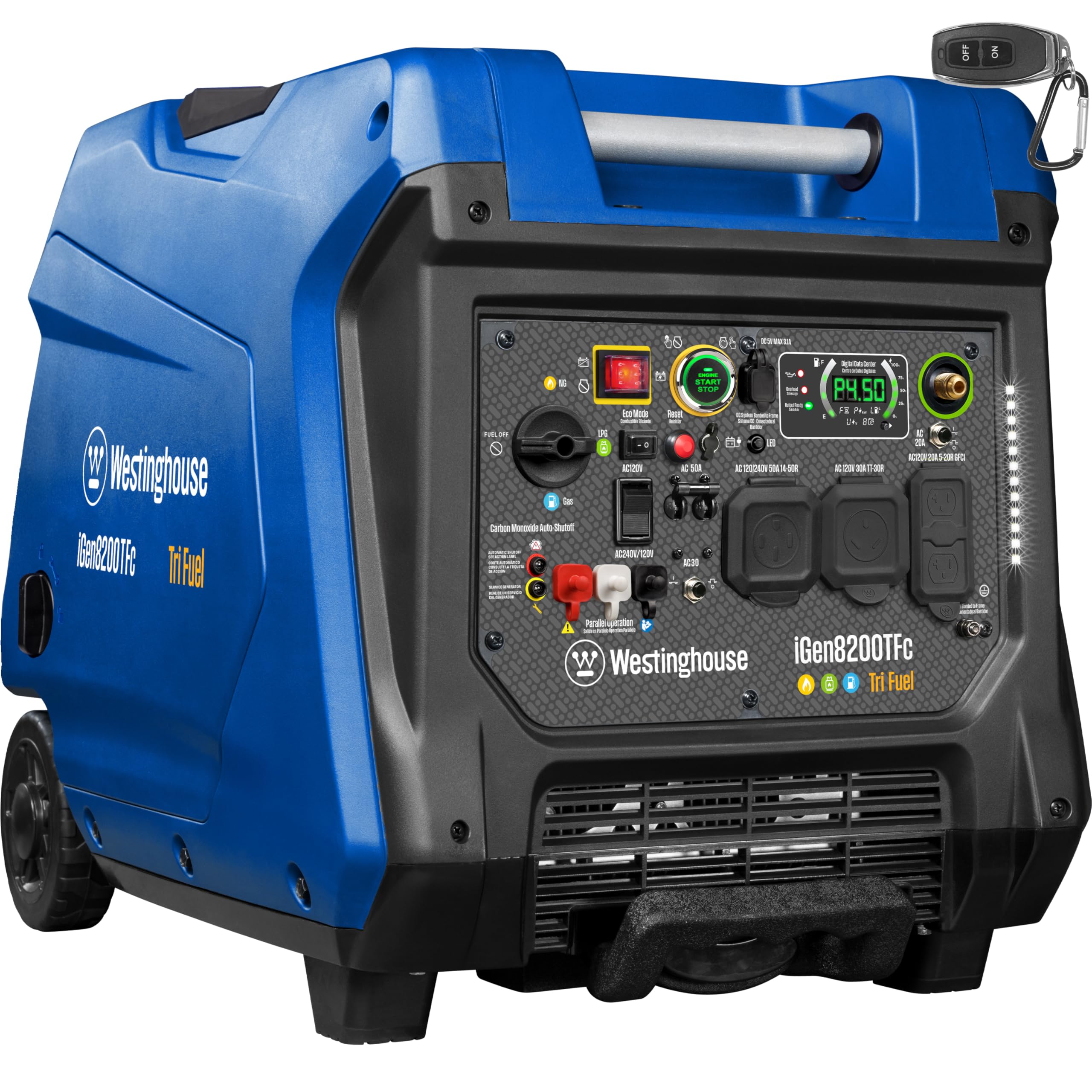
Gas, propane, or natural gas — the whole-home tri-fuel with a 50A outlet.
If you’ve ever been stranded with an empty gas can and a full propane tank you couldn’t use, this Westinghouse is the answer. It’s a true tri-fuel: 8200 peak and 6600 running watts on gasoline, 7380 peak and 5940 running on propane, and 6560 peak and 5280 running on natural gas. That natural gas option is the freedom play — it means you can run your whole house off the gas line that’s already plumbed in, with no fuel storage at all, for as long as the utility gas keeps flowing.
The inverter tech keeps it around 60 dBA at 25% load, making it much quieter than open frames, and copper windings help it run cooler and produce cleaner power — at less than 3% THD, it’s safe for phones, computers, and TVs. The 298cc 4-stroke OHV engine with a cast-iron sleeve and automatic low-oil shutdown drives a 3.9-gallon tank for up to 17 hours at 25% load. The outlet panel is home-backup ready: one 120/240V 14-50R 50A outlet, one RV-ready 120V TT-30R 30A outlet, and one GFCI 120V 5-20R 20A duplex outlet.
Owners are almost uniformly impressed: it powers a 50A fifth wheel with two ACs, one runs a 230V interlocked breaker for HVAC and outlets, and multiple owners praise the clear setup instructions and the remote start with no pull cord needed. At 134.5 pounds it’s about 110 pounds with wheels and handle, per one owner, and easy to move around. The occasional CO shutdown in tight spaces is the only recurring note — give it airflow, and it’s a stellar whole-home backup.
The Big Wins
- Natural gas capability = unlimited outage runtime.
- 50A outlet for true whole-home transfer switch.
- 60 dBA at 25% load — genuinely quiet.
Before You Commit
- Needs good airflow to avoid CO sensor shutdowns.
- 134.5 pounds is a two-person lift.
Your pick if: you have natural gas at home and want a transfer-switch-ready backup that never runs out of fuel.
Not for: budget buyers or anyone who needs to haul it up stairs solo.
8. Gidrox GNV8000D 8000W Dual Fuel Inverter

A quiet 8000W dual-fuel that fires up on the second pull and runs your furnace.
This Gidrox is for the homeowner who wants a serious backup unit with the flexibility of gas and propane, plus remote start so you don’t trudge outside in a storm. It delivers 8000 starting watts and clean sine wave power at less than 3% THD (total harmonic distortion — the measure of how safe the electricity is for delicate gear), so laptops, phones, and even medical devices are protected. The 317cc 4-stroke engine is quiet at 74 dB, and the 3.6-gallon tank gives up to 9.5 hours of runtime at 25% load on gasoline.
The outlet setup is RV-ready from the start: a built-in adapter from NEMA L14-30P to TT-30R connects directly to a travel trailer, and the 30A and 50A outlets mean you can back up your home through a transfer switch or power multiple appliances at once. Safety features run automatically in the background — CO detection, low-oil shutdown, and overload protection — and ECO mode adjusts engine speed to save fuel and cut noise. Reviewers point out it starts right up on the second pull, with one noting it runs a furnace in ECO mode at less than 25% load, and another praising it as “small in size, big in function.”
The reviewer voice is limited here — just a handful of owners so far, and all positive — so the long-term reliability picture is still forming. One owner framed it plainly as “not a workhorse,” recommending it for emergency use rather than daily job-site duty. Still, with remote, electric, and manual start options, a 3-year warranty, and 24/7 support, it’s a well-rounded dual-fuel pick for the money.
Reach for it if: you want remote start, a 50A outlet, and dual-fuel flexibility without paying premium-import prices.
Hesitate if: you need a daily workhorse — this one shines brightest as an emergency backup, per its own owners.
9. Champion 9000-Watt Electric Start Inverter
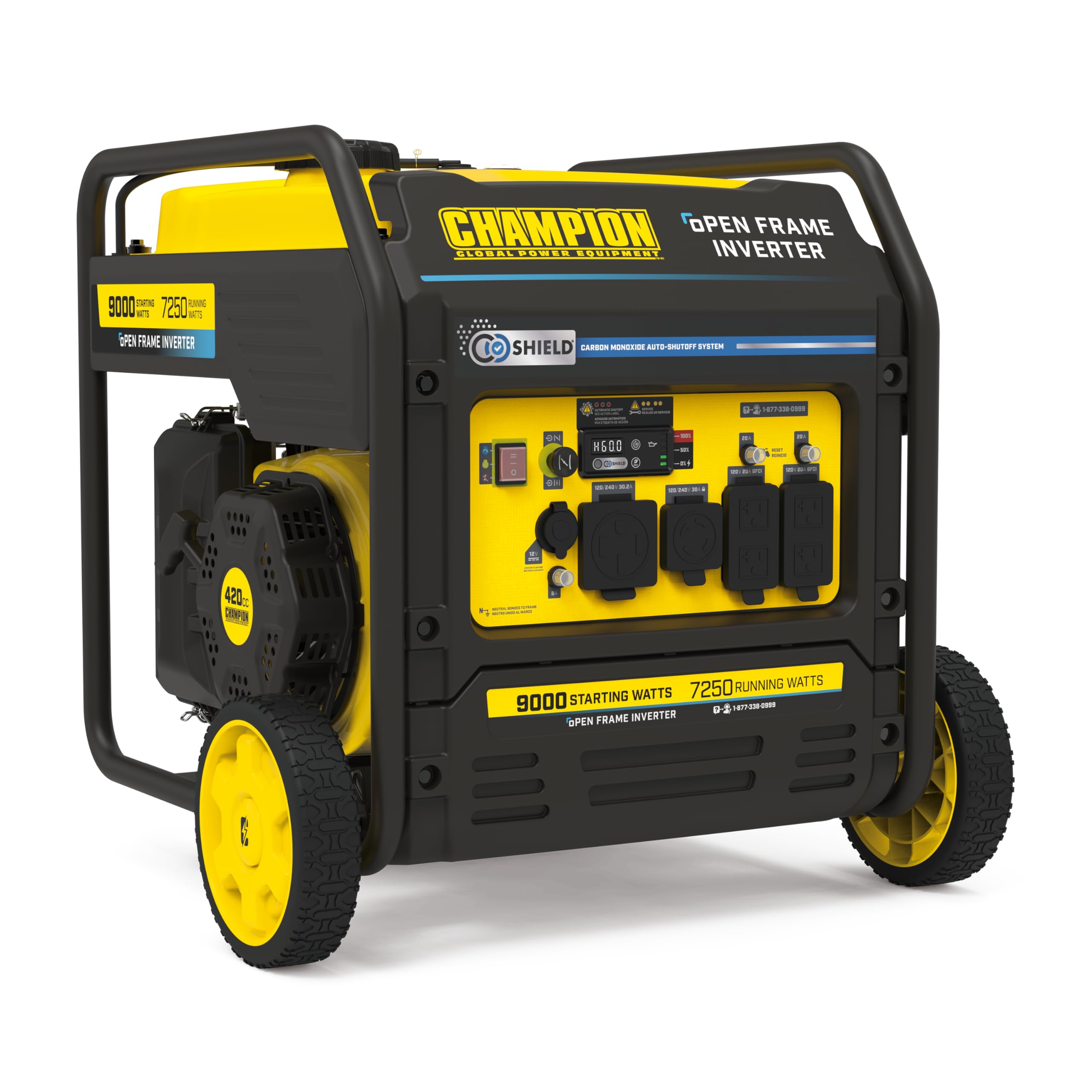
A 9000W peak that’s 50% quieter and 20% lighter than the old 7250W classic.
This is the Champion for the homeowner who wants serious headroom — 9000 starting watts and 7250 running watts — without the deafening roar of a standard construction generator. The open-frame inverter design is 50% quieter and 20% lighter than a traditional 7250-watt generator, running at 72 dBA, and the battery-included electric start features Cold Start Technology for reliable ignition in freezing weather. If you’ve ever fought a pull cord in a snowstorm, you’ll appreciate that immediately.
The power panel is genuinely useful: a 120/240V 30.2A outlet (14-50R), a 120/240V 30A locking outlet, two 120V 20A household duplex outlets with clean power under 3% THD, a 12V automotive-style outlet, and a dual-port USB adapter. Economy Mode saves fuel and extends engine life, and the Intelligauge with Power Meter keeps you informed on voltage, frequency, and operating hours. Up to 10.5 hours of runtime on gasoline covers a full overnight outage, and the cast-iron sleeve 420cc engine is built for the long haul — parts availability is a genuine reason owners choose Champion.
Owner sentiment is warm but mostly from newer buyers: one notes the small footprint and lighter-than-expected feel, another fires it twice a year for testing and says it runs well, and one uses it purely to keep lights on and food cold during outages. The one real complaint in the data is an electric start that didn’t work on arrival — a legitimate reason to buy from a store with easy returns, or at least to test the unit fully before an outage hits. At 152.2 pounds, it’s a wheeled home-backup unit, not a portable toy.
Choose it for: the power headroom of 7250 running watts with quiet inverter technology and a brand known for available parts.
Verify first: the electric start on arrival — one owner had a dead unit, so test it fully before you need it.
10. DuroMax XP11000iH 11,000-Watt Dual Fuel Inverter
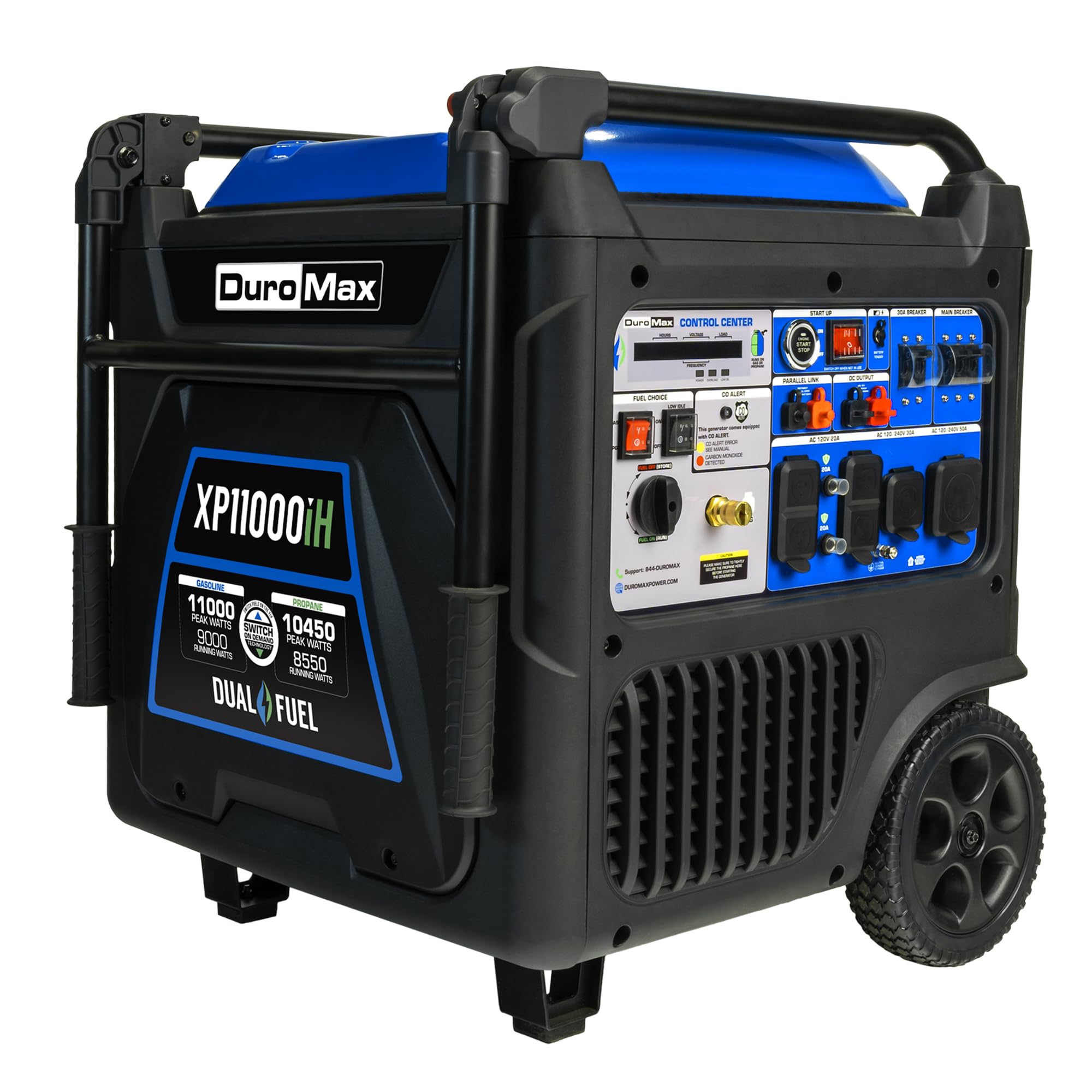
An 11,000W peak that’s “shockingly quiet” and replaces a loud 13kW workhorse.
This DuroMax is the heaviest hitter in the lineup, delivering 11,000 peak watts and 9,000 running watts on gas or propane — far beyond the 6000W class — with inverter technology for clean, stable power safe for televisions and computers. It’s for the person running a serious job site, a large RV, or an entire house during a long outage, and owners consistently describe it as “shockingly quiet” for its size. One owner replaced a loud, fuel-hungry 13kW Northstar and found the DuroMax runs at half the noise under heavy load, with the inverter’s idle-down saving fuel.
The convenience features stack up fast: remote start from the included remote control, an ATS outlet for easy automatic transfer switch connection, a battery tender to keep the start battery topped up, low-oil shutoff, and parallel capability so you can pair two units and double output to 22,000 peak watts (kit sold separately). The 459cc engine is backed by a Battery Tender and EPA/CARB compliance, and owners note the clear instructions, easy transport, and smooth break-in process.
The catch is weight and support. At 216 pounds (about 250 pounds with a full tank, per one owner), this is not a roll-it-alone machine — you want a hand cart and a plan. And while performance earns high marks, one owner waited up to 2.5 months on a backordered starting cup part, a reminder that parts availability matters when your livelihood depends on the machine. The 61 dB claim also drew skepticism — owners call it quiet for the size but note that’s daylight-tolerable, and nighttime use is risky in close quarters.
What It Delivers
- 11,000W peak / 9,000W running — clears the whole class.
- Remote start + ATS-ready + parallel capable.
- Owners call it “shockingly quiet” for the size.
The Heavy Cost
- 216 pounds demands a hand cart and strong back.
- Parts availability can lag badly — a 2.5-month wait was reported.
Your machine if: you need max power for a job site or big RV and have a trailer or truck to move it.
skip it if: you need a solo-lift portable or can’t tolerate a long wait for spare parts — the 9000W Champion is easier to live with.
11. Gidrox GNV 11,000W Tri-Fuel Inverter

Whole-home backup with an 8.7-gallon tank for 21 hours of storm-proof runtime.
This Gidrox is the whole-home answer for people with big loads and a natural gas line. It delivers an 11,000W peak with pure sine wave technology at less than 3% THD, and the maker says it’s engineered to handle everything from a 5-ton central AC to high-end laptops and medical equipment. The oversized 8.7-gallon tank gives up to 21 hours of backup runtime — that’s a full day and night on a single fill, which is the difference between riding out a storm and rationing power.
The tri-fuel freedom is real and ready from the start: gasoline, propane (LPG), and natural gas (NG), with a dial-start system for switching fuels in seconds. A premium touch is the included NG and LPG hose kit, valued by the maker at, so you don’t need a hardware-store run before the storm. The unit runs whisper-quiet at 62-65 dB, quieter than a normal conversation, and the CO sensor monitors around the clock, auto-shutting down if carbon monoxide levels get dangerous.
The power panel is a true hub: a dedicated ATS port for smooth automatic transfer switch integration, a heavy-duty 50A (14-50R) outlet for luxury RVs, and a 30A (L14-30R) 240V outlet for whole-house backup, all with waterproof rubber covers and GFCI safety. Owners praise the easy setup, thoughtful touches like oil drain tubing and a carburetor bowl drain for storage, and the push-button electric start with remote and manual backup. The one dissenting voice noted performance issues above 5,500 watts with high fuel consumption — so treat the 11,000W peak as a surge number, not a sustained-workload claim.
Ideal for: whole-home backup with natural gas, big RVs, and buyers who want a 3-year warranty on a tri-fuel powerhouse.
Watch out for: sustained loads above roughly 5,500 watts drew one owner complaint — this is a sturdy home backup, not a continuous full-load workhorse.
12. Honda EU7000iS 7000-Watt Inverter Generator

The gold standard at 52-58 dB(A) — quieter than a normal conversation.
This is the endgame for buyers who refuse to compromise on noise. The Honda EU7000iS operates at just 52 to 58 dB(A), which the maker notes is less noise than a normal conversation — the quietest unit in this entire lineup by a wide margin. It delivers 7000 watts at both 120V and 240V with advanced inverter technology reliable enough for computers, and the 389cc 4-stroke engine runs 6.4 to 16 hours on a single 5.1-gallon tank thanks to the Eco Throttle System. For campers and RVers who value silence as much as power, this is the benchmark everything else is measured against.
Where it truly separates itself is the My Generator smartphone app, which uses Bluetooth for remote power generator operation, monitoring, wireless stop, and service reminders — all from your phone. The CO-MINDER carbon monoxide detection system continuously monitors CO levels and automatically shuts down before they become dangerous near your home or camper. Owners consistently call it the best in its class, with one noting that two of them paired via the Parallel Cable Kit deliver 11KW of stable power, and another praising the push-button start as a dream compared to years of pull-start generators — especially in bad weather.
The price is steep: this is the most expensive unit here by a wide margin, roughly four to five times the cost of the Champion. But the owners who bought it frame it as insurance. One uses it with a transfer switch as a hurricane-season policy, another powers a whole house via Generlink including a 3-ton AC and water heater, and the reliability reputation is class-leading. At 263.2 pounds, it’s the heaviest unit on this list and not available in California, so check your state before falling in love.
Why It’s The Legend
- 52-58 dB(A) — the quietest generator in this class, period.
- Bluetooth app with remote start, monitoring, and service reminders.
- 16-hour max runtime with Eco Throttle fuel efficiency.
The Honest Cost
- Premium price — roughly four to five times the Champion.
- 263.2 pounds, the heaviest here, and not sold in California.
Buy it if: quiet operation, smartphone control, and bulletproof reliability are worth a premium to you — this is the last generator you’ll ever need.
Pass it by if: you’re on a budget, need to move it solo, or live in California — the 9000W Champion or the WEN dual-fuel will serve you better.
Understanding the Specs
Starting Watts vs. Running Watts
Think of starting watts as the jolt a motor needs to spin up — an AC compressor or well pump can draw two to three times its running load for a split second. The running watts are the steady power it draws after that. You need the generator’s starting watts to clear your heaviest appliance’s surge, or the generator’s breaker trips instead of saving the day.
Noise Level (dBA)
Decibels are logarithmic, which means a small number difference is a big change in perceived loudness. A 69 dBA unit and a 62 dBA unit may look close on paper, but the 62 dBA model sounds dramatically quieter to your ears — the difference between “can’t sleep” and “barely noticeable.” This matters most for neighborhoods, campsites, and overnight home backup.
THD — Total Harmonic Distortion
THD is a measure of how clean the electricity is. Standard generators often produce “dirty” power with distortion that can damage sensitive electronics like laptops, TVs, and modern fridge control boards. Inverter generators clean this up to under 3% THD, making the power safe for your delicate gear. Lower is better — you want under 5% for electronics, and under 3% is the balance for anything you plug in.
Dual Fuel and Tri-Fuel
Dual-fuel generators run on either gasoline or propane, and tri-fuel adds natural gas to the mix. Propane stores for years without going bad and burns cleaner, but you give up a bit of peak power. Natural gas means unlimited runtime if your utility line stays up during a storm, but you’re tied to the house. More fuel options equal more flexibility, but each fuel switch is a compromise in power and convenience.
FAQ
Will a 6000-watt inverter generator run my whole house?
What’s the difference between an inverter generator and a regular generator?
Can I run my RV’s air conditioner with a 6000-watt inverter generator?
How long will a 6000-watt inverter generator run on a full tank?
Is propane better than gasoline for a generator?
Can I connect a 6000-watt inverter generator to my house’s electrical panel?
How much noise does a 6000-watt inverter generator make?
What does THD mean and why does it matter?
Final Thoughts: The Verdict
If you want one dependable pick, the best 6000 watt inverter generator is the Champion 6250W because it pairs genuine 240V central-AC capability with a proven track record and the strongest reliability reputation in this class. If you want dual-fuel flexibility and EV charging, the WEN DF680iX is the smart pick — it’s the lightest full-size unit here at 99.2 pounds. And if you have natural gas at home and want the ultimate whole-home backup, the Westinghouse iGen8200TFc with its tri-fuel capability and 50A outlet is the one to reach for. The Honda EU7000iS remains the quiet gold standard for those who want the best and are willing to pay for it.
How We Picked
We do not accept paid placement. Every pick is matched to a real buyer and a real use-case; we do not hands-on test units.
Sources & Methodology
Specifications: manufacturer listings and product documentation. Review insights: verified customer reviews, as of August 2026. Pricing: not shown on this page (it changes often); check the current price via the retailer link.
As an Amazon Associate, Gadgets Feed earns from qualifying purchases. This does not affect which products we feature.