
Our readers keep the lights on and my morning glass full of iced black tea. As an Amazon Associate, I earn from qualifying purchases.
Specs are compiled from manufacturer listings and verified buyer reviews and can change over time — please confirm the key details on the product page before buying.
A 6000-watt inverter is serious equipment. You are not buying a gadget for a weekend trip — you are building the electrical backbone for a home, a workshop, or an off-grid setup. The wrong pick means flickering lights, dead appliances, or a unit that smokes after a few months of light use. The right pick delivers reliable power without you ever noticing it.
I’m Min — the founder and writer behind Gadgets Feed. This guide is built by comparing the manufacturers’ published specifications and the patterns across verified customer reviews, so you get each pick’s real strengths and trade-offs instead of marketing spin.
Whether you are powering a deep-well pump or a whole-home backup system, this guide cuts through the noise to help you choose the best 6000 watt inverter for your actual loads and budget.
Quick Picks
- SUNGOLDPOWER UL1741 6000W 48Vdc Pure Sine Wave — Best Overall
- AIMS 6000W 24V Pure Sine Inverter Charger — Industrial Strength
- Ampinvt 6000W Peak 18000watts Pure Sine Wave — Budget Champion
How To Choose The Best 6000 Watt Inverter
Choosing a 6000W inverter requires matching input voltage, waveform, surge capacity, and build quality to your loads. You need to match input voltage, waveform, surge capability, and build quality to your actual loads.
Match Input Voltage to Your Battery Bank
The inverter’s input voltage must match your battery bank’s nominal voltage. A 48V inverter like the SUNGOLDPOWER works with four 12V batteries in series. A 24V inverter like the AIMS Power needs two 12V batteries in series. Higher voltage banks draw lower current, which means thinner cables and less voltage drop over long runs. If you have a large battery bank already, choose an inverter that matches its voltage.
Surge Capacity vs Continuous Power
Motors, pumps, and compressors draw several times their running wattage when they start. That surge can last a few seconds. A 6000W inverter with an 18000W peak surge (like the SUNGOLDPOWER and Ampinvt) can start heavy loads that a 6000W continuous unit without surge capacity might struggle with. Check the surge duration — 20 seconds is standard for low-frequency designs.
Low Frequency vs High Frequency Design
Low-frequency inverters use a heavy copper transformer to produce clean power. They handle surge loads better and last longer, but they are heavier — expect 50 to 80 pounds. High-frequency inverters are lighter and cheaper, but they typically have weaker surge capacity and shorter lifespans under continuous heavy use. For whole-home backup or off-grid living, a low-frequency inverter is the safer choice.
Quick Comparison
| Model | Best For | Input Voltage | Surge Power | Weight | Amazon |
|---|---|---|---|---|---|
| SUNGOLDPOWER UL1741 6000W | Whole-home backup with 48V bank | 48 Volts | 18000W for 20s | 76.7 Pounds | Amazon |
| AIMS 6000W 24V Pure Sine Inverter Charger | Heavy-duty shop tools and large loads | 24 Volts | 18000W for 20s | 50 Pounds | Amazon |
| Ampinvt 6000W Peak 18000W Pure Sine Wave | Budget off-grid with split-phase output | 24 Volts | 18000W | 70.5 Pounds | Amazon |
In‑Depth Reviews
1. SUNGOLDPOWER UL1741 6000W 48Vdc Pure Sine Wave Inverter Low Frequency

The heavy lifter for a 48V battery bank that powers your whole home reliably.
If you have a 48-volt battery bank, this is the inverter to build your system around. The 48V input means lower current and less voltage drop over long cable runs compared to a 24V unit like the Ampinvt — a real advantage when your batteries are far from the inverter. Buyers report it runs a 1 HP 240V well pump at just 42% capacity, leaving plenty of headroom for other loads. The split-phase output delivers both 120V and 240V, so you can power standard household circuits and appliances like a well pump or dryer at the same time.
A remote LCD controller with a 32-foot cable comes included, letting you check battery percentage, voltage, and fault codes from anywhere in your home. The 60A battery charger supports AGM, Gel, Lead Acid, Lithium-ion, and LiFePO4 batteries. It also has automatic generator start (AGS) so your generator kicks on when batteries run low. At 76.7 pounds it is heavy, but that weight comes from the pure copper transformer that gives it the surge capacity to start a refrigerator or water pump without bogging down.
One trade-off to know: the unit draws about 100W at idle, so you will want to turn it off when not in use. Reviewers also note that while the inverter itself is solid, customer support response can be inconsistent if you need a replacement fan or help with a warranty claim.
Best for whole-home off-grid: If you already have a 48V battery bank and need a UL1741-listed inverter that handles a well pump and the rest of the house without a hiccup, this is the pick. Buyers confirm its 42% capacity under a heavy pump load shows the headroom is real.
The idling cost: At roughly 100W standby draw, you will need to either switch it off manually or accept the constant drain on your battery bank — not a dealbreaker, but a real design trade-off.
Reach for this if: You have a 48V system, want UL1741 certification, and need clean split-phase power for a well pump, fridge, and lights with solid surge capability.
Look elsewhere if: You only have a 24V battery bank or you need a built-in charger that works reliably with a generator.
2. AIMS 6000W 24V Pure Sine Inverter Charger w/Transfer Switch 120/240V
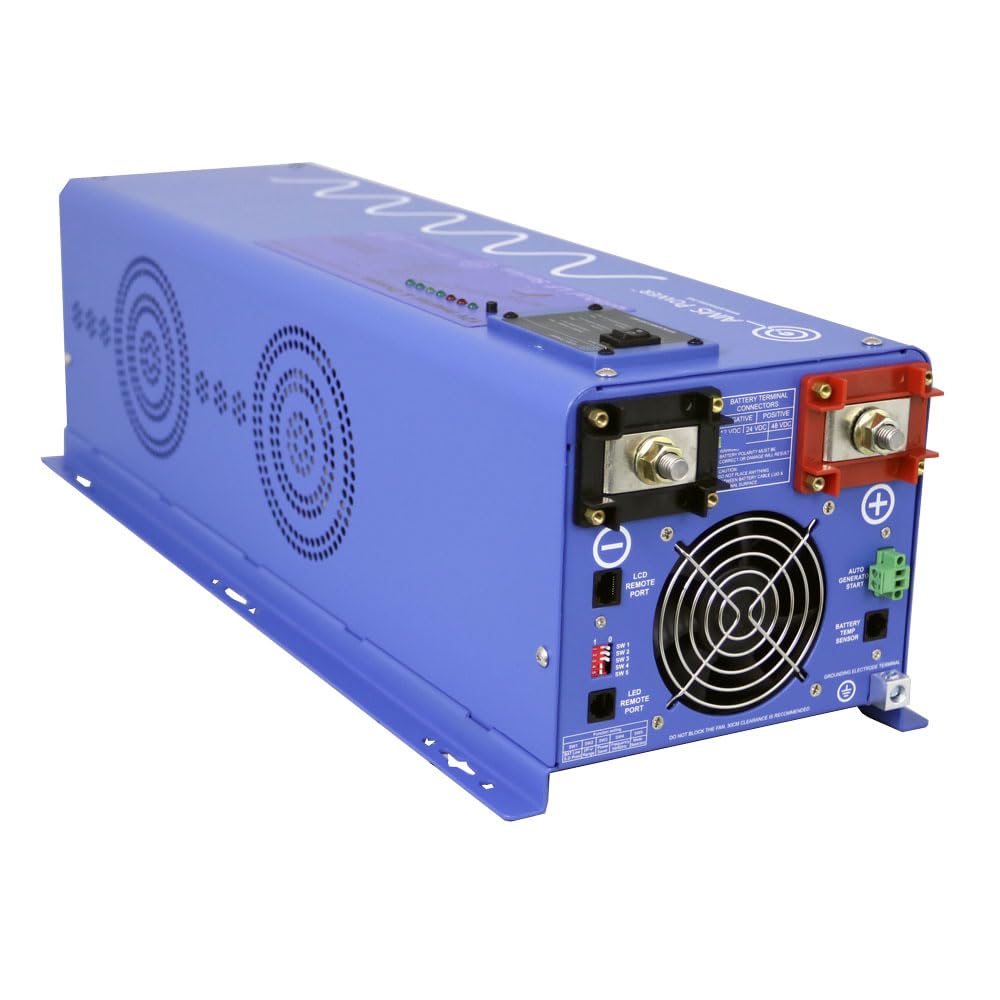
Starts a radial arm saw and a space heater simultaneously without hesitation.
Built for users who have experienced repeated failures from cheaper inverters. One buyer who replaced three failed inverters with this AIMS unit reports running over 180 amps through it at one time. The 18,000-watt surge for 20 seconds gives you the power to start a large compressor, a table saw, a well pump, and more without the inverter cutting out.
You get three devices in one box: a pure sine inverter (produces clean power matching your home’s grid), an 85-amp multi-stage battery charger, and an automatic transfer switch. The transfer switch lets you wire this as a whole-house UPS — when grid power cuts, the inverter takes over smoothly so your lights stay on. The charger supports GEL, Lead Acid, AGM, and Lithium batteries with eight selectable settings, and includes a wake-up feature for over-discharged lithium batteries (so you can revive a deeply drained battery). At 50 pounds it is noticeably lighter than the SUNGOLDPOWER (which is 76.7 pounds), making it slightly easier to mount on a wall.
Some owners mention the AC charger section can be inconsistent — one reviewer described the charger cycling from 0 to 40 amps and cutting off, only charging at full power about 10% of the time when connected to a generator. The inverter itself gets high marks, but consider buying a separate charger if your generator is finicky.
Built for heavy continuous loads: With a 3x surge capacity and verified 180-amp continuous draw from real owners, this is the pick for anyone running power tools, pumps, or large appliances without babying the system.
The charger can be a weak link: If you rely heavily on the built-in charger with a generator, you might get inconsistent charging behavior — a separate external charger could be the safer route.
Reach for this if: You need an industrial-grade inverter that can start heavy shop equipment, run a 180-amp load, and handle a whole-house transfer switch — all on a 24V bank.
Look elsewhere if: You need the built-in charger to work perfectly with a generator every time, or you want lighter weight for mobile installation.
3. Ampinvt 6000W Peak 18000watts Pure Sine Wave Power Inverter 24V DC to AC 120V 240V Split Phase

An entry-level 6000W inverter offering split-phase output at a budget-friendly price.
If you are on a tighter budget but still need 6000W continuous and 18000W peak surge, this Ampinvt gives you the essential features. It is a 3-in-1 unit combining a pure sine inverter, a battery charger with adjustable current from 0% to 100% (max 35A), and an AC auto-transfer switch. The split-phase output delivers 120V and 240V, so you can power standard home circuits and large appliances. Customers note it runs a pool pump and lights with no problem, and the LED display shows battery status at a glance.
It supports five working modes: AC priority, battery priority, generator mode, ECO mode, and unattended mode. The battery priority mode lets you draw from batteries until a low-voltage set point, then automatically switches to AC input. It works with SLA, AGM, GEL, Li-ion, and LiFePO4 batteries. One thing to note: it operates at 50 Hz frequency, not the 60 Hz used in North America. Check your equipment — some appliances designed for 60 Hz may run slower or overheat on 50 Hz.
The catch is reliability. Several reviewers point out the unit smoking after a few months of light use, with one showing an “output short” error. The manufacturer did send free replacement boards, but the warranty process involves shipping charges. Another buyer received two damaged units before getting one that worked.
Budget split-phase for light home backup: At this price point, getting split-phase 120V/240V output (so you can run both standard 120V outlets and 240V appliances like a well pump) with adjustable charging and five operating modes is tough to top — if you accept the higher risk of early failure.
Reliability is a gamble: Multiple reviews mention units failing or smoking within months, so consider this a starter inverter, not something you bet a full off-grid home on.
Reach for this if: You need split-phase output on a tight budget, can tolerate some risk of early failure, and are comfortable with the 50 Hz frequency for your loads.
Look elsewhere if: You need an inverter you can count on for years of daily use, or you have 60 Hz equipment that cannot run on 50 Hz power.
Understanding the Specs
Pure Sine Wave vs Modified Sine Wave
A pure sine wave inverter produces clean power that mirrors the smooth waveform from your home’s grid. This matters for any appliance with a motor (pumps, refrigerators, fans) and sensitive electronics (computers, audio gear, medical devices). Modified sine wave inverters can cause motors to hum, run hotter, and fail sooner. Every inverter in this guide outputs pure sine wave, so you are covered for sensitive loads.
Surge Capacity (Peak Power)
Surge capacity is the burst of power an inverter can deliver for a few seconds to start a motor or compressor. Look for a surge rating of at least 3 times the continuous wattage (so 18000W surge for a 6000W inverter). Both the SUNGOLDPOWER and AIMS offer 18000W surge for 20 seconds. The Ampinvt also lists 18000W peak but without a specified surge duration, so it may handle short spikes less reliably.
Transfer Switch
A transfer switch automatically switches your loads between grid power (or generator power) and battery/inverter power when the grid goes down. The switch should be smooth — you should not notice the transition. The AIMS inverter has a built-in automatic transfer switch. The Ampinvt also includes one. The SUNGOLDPOWER has a 40A transfer switch plus automatic generator start (AGS) for systems with a backup generator.
Battery Charger Capacity
The battery charger in a combined inverter/charger refills your batteries when AC power is available. Higher amp ratings mean faster charging. The AIMS has a 85-amp charger, the SUNGOLDPOWER has a 60-amp charger, and the Ampinvt has a 35-amp adjustable charger. If you have a large battery bank, the higher the amp rating, the less time you wait between discharge cycles.
FAQ
Can a 6000W inverter run a whole house?
What is the difference between 24V and 48V input?
How many batteries do I need for a 6000W inverter?
How long will a 6000W inverter last?
Can I use a 6000W inverter with solar panels?
Is a 6000W inverter too much for an RV?
What wire gauge do I need for a 6000W inverter?
Can I use a 50 Hz inverter in North America?
What size breaker do I need for a 6000W inverter?
Is a low-frequency inverter better than a high-frequency inverter?
Final Thoughts: The Verdict
For most buyers, the best 6000 watt inverter winner is the SUNGOLDPOWER UL1741 6000W because it combines UL1741 certification (a safety standard for grid-tied equipment), true split-phase output (120V/240V), a 60A charger, and a remote LCD controller — all built around a 48V input that keeps cabling manageable. If you want the industrial strength to start heavy shop tools with 180 amps of verified continuous capacity, grab the AIMS 6000W 24V Inverter Charger. And for budget-minded buyers who need split-phase output and can tolerate some reliability risk, the Ampinvt 6000W Peak 18000W gets the job done.
How We Picked
We do not accept paid placement. Every pick is matched to a real buyer and a real use-case; we do not hands-on test units.
Sources & Methodology
Specifications: manufacturer listings and product documentation. Review insights: verified customer reviews, as of July 2026. Pricing: not shown on this page (it changes often); check the current price via the retailer link.
As an Amazon Associate, Gadgets Feed earns from qualifying purchases. This does not affect which products we feature.