
Capturing the hidden geometry of a dewdrop or the intricate texture of a butterfly wing demands a lens that resolves detail at a 1:1 reproduction ratio without optical compromise. A dedicated 60mm macro prime is the tool that bridges the gap between a casual close-up filter and a professional reproduction setup, offering a natural working distance that balances subject access with depth-of-field control. The decision comes down to matching that optical formula to your camera’s sensor size and your specific shooting environment.
I’m Min — the co-founder and writer behind Gadgets Feed. I’ve spent countless hours analyzing the resolving power, chromatic aberration correction, build quality, and autofocus performance across the current 60mm macro lens landscape to identify which models deliver true edge-to-edge sharpness at life-size magnifications.
This guide breaks down the optical and mechanical factors that separate a sharp macro lens from a soft one so you can confidently choose the best 60mm macro lens for your camera system and your specific shooting style.
How To Choose The Best 60mm Macro Lens
Selecting a macro lens involves more than just checking the focal length. For a 60mm lens, the balance between working distance, magnification ratio, and optical correction is critical. You need to consider your camera mount, the type of subjects you shoot, and whether you prioritize manual precision or fast autofocus.
Magnification Ratio and Working Distance
A true macro lens achieves a 1:1 magnification ratio, meaning the subject is rendered life-size on the sensor. The 60mm focal length offers a shorter working distance than a 90mm or 100mm macro — typically around 4 to 7 inches from the front element at 1:1. This is ideal for small, stationary subjects like coins, flowers, and product details, but can be challenging for skittish insects. Some lenses, like the Laowa 60mm, push this to 2:1 for extreme close-ups.
Autofocus System and Manual Override
For handheld macro work, a fast and quiet autofocus system like Canon’s Ring USM or OM System’s MSC mechanism is valuable. However, precise focus at 1:1 is often achieved manually. Look for a lens with a full-time manual focus override and a focus limit switch — this speeds up AF by restricting the focus range to macro distances only, preventing the lens from hunting across the entire range.
Optical Coatings and Build Quality
Macro photography often involves shooting into harsh light or against reflective surfaces. Multi-layer coatings such as OM System’s ZERO coating or Sony’s Nano AR coating suppress flare and ghosting, preserving contrast in fine detail. Weather sealing, including dust and splash resistance, is a major advantage when shooting outdoors in damp environments or near water.
Quick Comparison
On smaller screens, swipe sideways to see the full table.
| Model | Category | Best For | Key Spec | Amazon |
|---|---|---|---|---|
| OM System M.Zuiko 60mm f/2.8 | Mid-Range | Weather-sealed macro on MFT | 1:1 Magnification, 185g | Amazon |
| Canon EF-S 60mm f/2.8 USM (Renewed) | Mid-Range | Canon APS-C DSLR users | 1:1, Ring USM, 0.2m MFD | Amazon |
| Venus Laowa 60mm f/2.8 2:1 | Mid-Range | Ultra-macro (2:1) on Canon EF | 2:1 Magnification, Manual Only | Amazon |
| OM System Olympus 60mm f/2.8 Macro | Mid-Range | Precise focus stacking on MFT | 1:1, Focus Limit Switch, 120mm eq. | Amazon |
| Nikon NIKKOR Z MC 50mm f/2.8 | Premium | Compact walkaround for Nikon Z | 1:1, 0.57 lbs, Fluorine Coating | Amazon |
| Tamron 90mm f/2.8 Di III VXD | Premium | Sony E-mount flat-field macro | 1:1, VXD AF, 90mm | Amazon |
| Sony FE 90mm f/2.8 Macro G OSS (Renewed) | Premium | Sony full-frame with OSS | 1:1, Optical SteadyShot, DDSSM AF | Amazon |
| Canon EF 100mm f/2.8L IS USM (Renewed) | Premium | Canon full-frame with IS | 1:1, Hybrid IS, L-series build | Amazon |
| Canon 60mm f/2.8 EF-S Macro USM | Budget-Friendly | Entry-level Canon APS-C macro | 1:1, Internal Focusing, 4″ working dist. | Amazon |
In‑Depth Reviews
1. OM System M.Zuiko Digital ED 60mm f/2.8 Lens

This OM System lens delivers a rare combination of compact build and robust weather sealing that makes it a genuine all-weather companion for Micro Four Thirds shooters. At just 185 grams, it feels negligible on an OM-1 or Pen body, yet the metal bayonet and dust/splash-proof construction inspire confidence when shooting in damp forests or light rain.
The ZERO coating effectively suppresses ghosting and reflections even when backlighting small subjects, preserving micro-contrast in the fine hairs on a spider’s leg. The autofocus is quiet and snappy thanks to the MSC mechanism, and the internal focusing system means the lens barrel never extends — critical when you’re parked millimeters from a subject.
Paired with the OM-1 Mark II, the focus stacking feature unlocks deeper depth of field at macro apertures without needing a tripod. The 120mm equivalent field of view gives a slightly tighter crop than a standard 60mm, which actually helps isolate small subjects against clean backgrounds.
Why it’s great
- Weather-sealed metal construction in a 185g body
- ZERO coating delivers exceptional flare and ghost resistance
- Focus stacking compatible with OM System bodies
Good to know
- No built-in image stabilization
- Micro Four Thirds mount only
2. Canon EF-S 60mm f/2.8 Macro USM (Renewed)

For Canon APS-C DSLR owners, this lens represents the most logical entry point into true macro photography. The ring-type ultrasonic motor delivers fast, silent autofocus that locks onto subjects without the hunting common in lower-end macro lenses. The 25-degree angle of view gives an effective 96mm equivalent on a crop body, offering a comfortable working distance for tabletop product shots and flower studies.
The Super Spectra coating maintains contrast in mixed lighting, and the floating optical system ensures consistent sharpness from infinity focus all the way down to the 0.65-foot minimum focusing distance. At 1:1 magnification, the lens resolves intricate details like the facets of a gemstone or the veins in a leaf with noticeable clarity.
Renewed units from reputable sellers often arrive in near-mint condition for a fraction of the original retail price, making this an exceptional value. The 1.16-pound weight is moderate, and the 2.9-inch diameter makes it easy to handle even on smaller Rebel bodies.
Why it’s great
- Ring USM provides fast and silent autofocus
- Super Spectra coating reduces flare well
- Life-size 1:1 magnification from a compact build
Good to know
- EF-S mount is APS-C only — not compatible with full-frame EF
- Renewed condition may vary by seller
3. Venus Laowa 60mm f/2.8 Ultra Macro 2:1

The Laowa 60mm f/2.8 stands alone in this lineup for its ability to focus from infinity down to a 2:1 magnification ratio — that is twice life-size on the sensor. This is achieved without extension tubes or close-up filters, thanks to a 9-element, 7-group optical structure optimized for extreme close focusing. The 14-blade aperture produces a near-perfect circular bokeh that renders out-of-focus highlights as smooth, round orbs.
Manual focus only — there is no autofocus motor — but the focus ring is heavily damped and smooth, making precise micro-adjustments intuitive. The fluorine coating on the front element repels dust and moisture, a useful feature when you are inches from damp soil or dewy foliage. Sharpness is excellent from f/2.8 through f/8, though diffraction softens the image noticeably at f/11 and beyond.
The all-metal barrel feels substantial at 1.4 pounds, and the Canon EF mount version works seamlessly with adapter rings for mirrorless bodies. If you need to capture the minute surface texture of an insect’s eye or the crystalline structure of a salt grain, this lens offers magnification no other 60mm in this class can touch at this price point.
Why it’s great
- 2:1 magnification without extension tubes
- 14-blade aperture for smooth circular bokeh
- Robust all-metal construction with fluorine coating
Good to know
- Fully manual focus — no AF or electronic contacts
- Sharpness drops at f/11 and above due to diffraction
4. OM System Olympus M.Zuiko Digital ED 60mm f/2.8 Macro
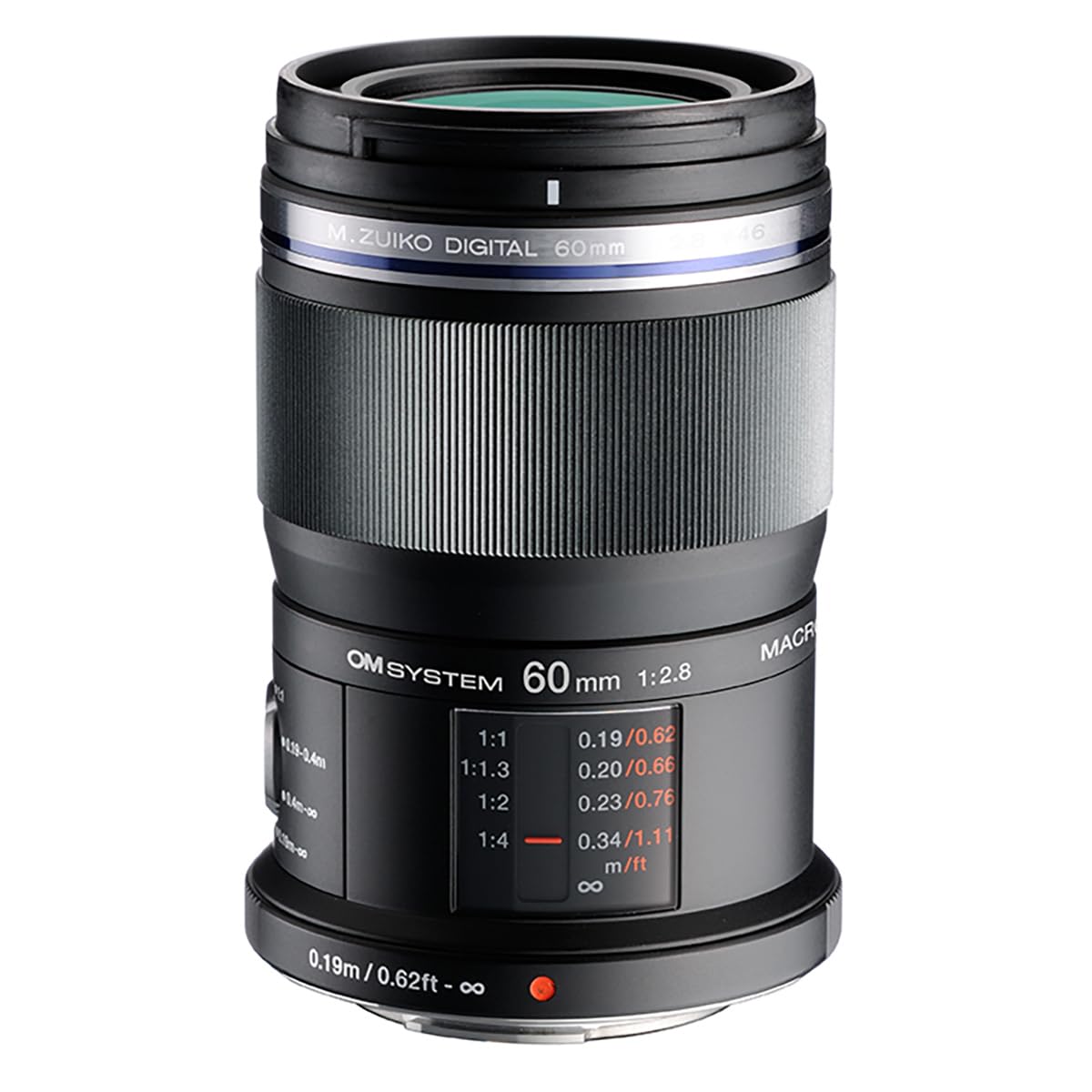
This variant of the OM System 60mm macro shares the same 13-element, 10-group optical formula as its sibling but is packaged specifically for the Olympus OM-D lineup with a bright f/2.8 maximum aperture and a focus limit switch. That switch is a practical advantage: it restricts the autofocus range to macro distances, significantly reducing the time the lens spends racking through the entire focus range before locking on a close subject.
The 7.4-inch minimum focusing distance at 1:1 is generous for a 60mm lens, and the internal focusing mechanism ensures the barrel length stays constant — a critical detail when you have lighting modifiers or diffusers positioned inches from the subject. The High-Speed Imager AF (MSC) is fast enough for handheld use, though the lens lacks built-in stabilization, so you will rely on the camera’s IBIS or a tripod for critical sharpness.
Image quality is exceptionally sharp from center to edge, and the ZERO coating minimises reflections even when shooting into harsh backlight.
Why it’s great
- Focus limit switch speeds up macro AF
- Internal focusing — no barrel extension
- Excellent center-to-edge sharpness with ZERO coating
Good to know
- No optical image stabilization
- Micro Four Thirds mount only
5. Nikon NIKKOR Z MC 50mm f/2.8
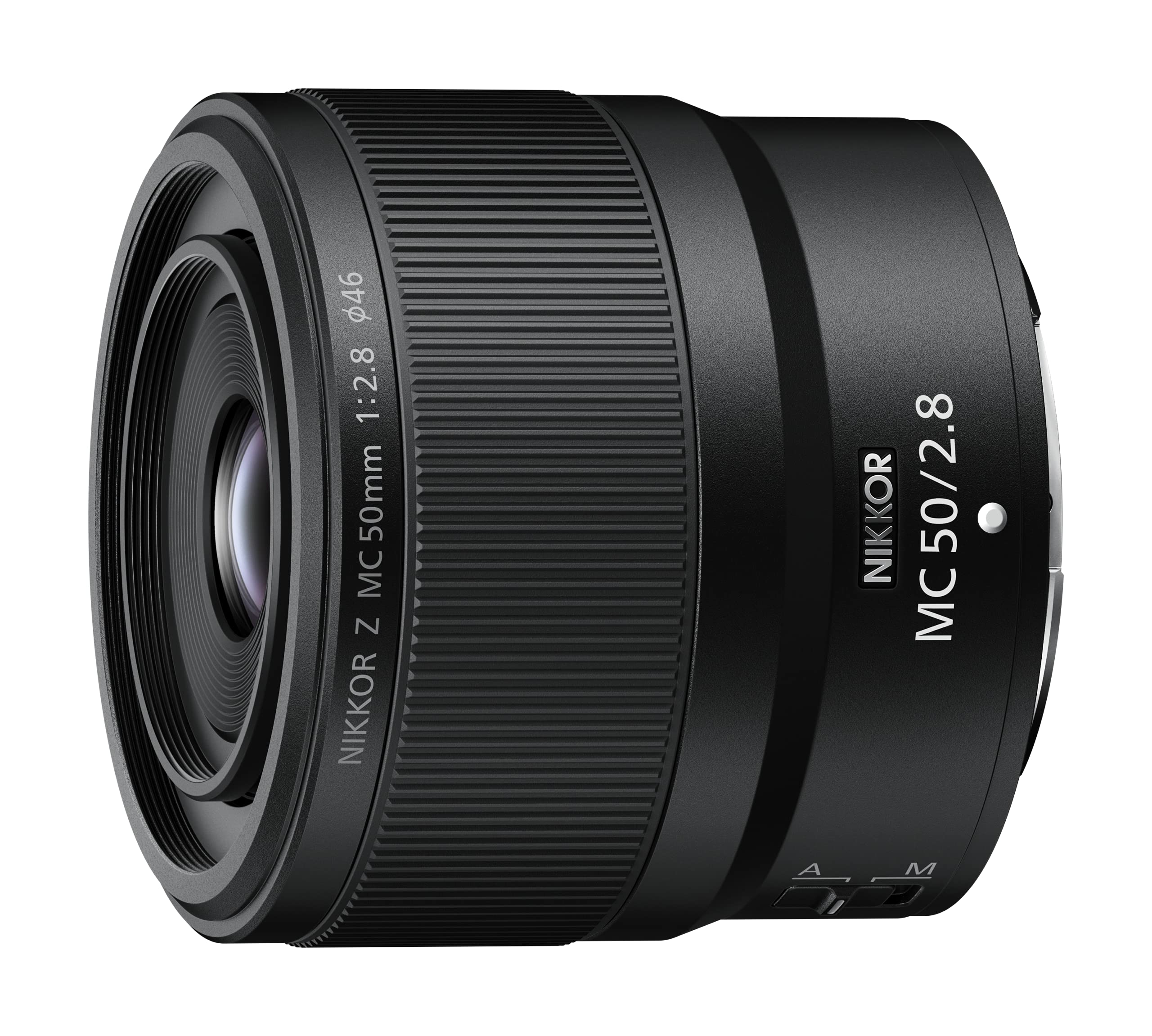
Nikon’s Z MC 50mm f/2.8 is technically a 50mm lens, but it is the closest native macro option in the Z-mount lineup to the 60mm class, and it earns its place here because of how naturally it functions as both a macro tool and an everyday prime. The 50mm field of view mirrors human perspective, making it intuitive for food, product, and candid photography in addition to close-up work.
Life-size 1:1 magnification is delivered through a front-focusing design that keeps the lens compact at just 0.57 pounds. The fluorine coating on the front element resists smudges and water droplets, practical when shooting dewy leaves or handling the lens after a snack. The bright f/2.8 aperture creates pleasing background separation at close distances, and the autofocus is fast and silent on Z-series bodies like the Z6 II and Z7 II.
Some users note that the 105mm Z macro offers more working distance for skittish subjects, but the 50mm’s lightweight form encourages you to keep it mounted as your primary lens. The optical stabilization works in tandem with Nikon’s IBIS for steady handheld frames even at 1:1.
Why it’s great
- Ultra-light 0.57-pound design for all-day carry
- Natural 50mm perspective suits macro and general use
- Fluorine coating repels smudges and moisture
Good to know
- Working distance is shorter than 60mm or 90mm macros
- Maximum reproduction ratio is 1:1, not 2:1
6. Tamron 90mm f/2.8 Di III VXD 1:1 Macro for Sony E
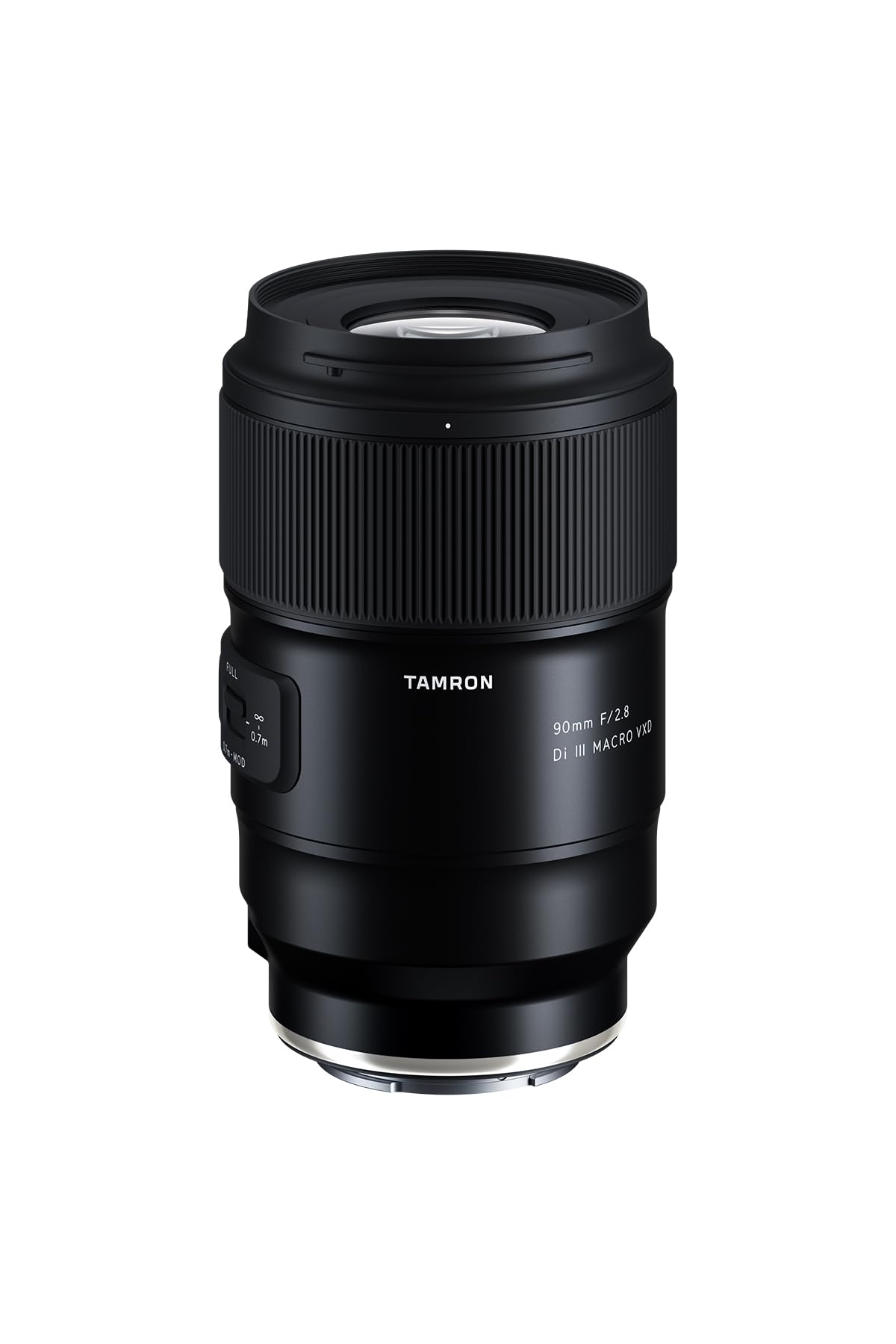
While slightly longer than the 60mm category, the Tamron 90mm f/2.8 VXD earns comparison because its flat-field optical performance is the gold standard for reproduction work — it renders edges as sharply as the center, a non-negotiable property for flat document, stamp, and product photography. The VXD linear motor delivers high-speed autofocus with excellent subject tracking, even when shooting moving insects or handheld macro video.
The BBAR-G2 coating minimizes internal reflections, and the fluorine coating on the front element resists dirt and water. The moisture-resistant construction with seals at the mount and rings adds weather protection for outdoor macro sessions. At 1:1, the longer 90mm focal length provides a more comfortable working distance compared to the 60mm options, making it easier to light your subject without casting shadows.
The lens is designed for Sony E-mount full-frame and APS-C bodies, and it balances well on the Alpha series. For Sony shooters who want a dedicated macro that doubles as a sharp short telephoto portrait lens, this Tamron delivers near-flawless results without the Sony tax.
Why it’s great
- Flat-field design delivers edge-to-edge sharpness
- VXD AF is fast and quiet with reliable tracking
- Longer working distance improves lighting flexibility
Good to know
- No optical image stabilization
- 90mm focal length is longer than a true 60mm macro
7. Sony SEL90M28G FE 90mm f/2.8 Macro G OSS (Renewed)

The Sony 90mm f/2.8 Macro G OSS is the definitive stabilized macro for the E-mount system, with Optical SteadyShot that noticeably steadies the viewfinder image at 1:1 magnifications where hand shake is magnified alongside the subject. The Direct Drive SSM (DDSSM) motor is quiet and precise, though autofocus speed is slightly slower than the newer Tamron VXD — a worthwhile trade-off for the built-in stabilization.
Nano AR coating aggressively suppresses internal reflections and flare, preserving contrast in backlit macro scenes. The dust- and moisture-resistant design withstands outdoor conditions, and the 9-blade circular aperture contributes to creamy out-of-focus highlights. Corner-to-corner sharpness is outstanding thanks to the Advanced Spherical and Super ED glass elements.
Renewed copies offer significant savings over the original retail price, and the lens commonly arrives in near-new condition. The 0.28-meter minimum focusing distance and 1:1 ratio make it ideal for product, jewelry, and nature photography where a longer working distance is preferred.
Why it’s great
- Optical SteadyShot stabilizes handheld macro frames
- Nano AR coating provides excellent flare resistance
- Superb corner-to-corner sharpness with ED glass
Good to know
- AF is slower than newer VXD designs
- Renewed condition may vary; check seller ratings
8. Canon EF 100mm f/2.8L IS USM Macro (Renewed)

Canon’s L-series 100mm f/2.8 macro delivers the professional build quality and optical refinement that serious product and nature photographers demand. The Hybrid Image Stabilization is uniquely calibrated to compensate for both angular and shift shake — the latter being the dominant type at macro distances. This makes handheld shooting at 1:1 far more consistent than with any non-stabilized macro lens.
The UD lens element corrects chromatic aberration to near-zero levels, and the Super Spectra coating maintains high contrast across the frame. The 15-element, 12-group construction includes an inner focusing system that does not extend the barrel, and the ring-type USM provides fast, near-silent autofocus with full-time manual override. The 0.3-meter minimum focusing distance is comfortable for tabletop work.
Renewed units from established sellers deliver L-series performance at a fraction of the new price. The lens pairs beautifully with Canon R-series bodies via the EF-to-RF adapter, maintaining full autofocus and IS functionality. For product photographers using a Canon system, this lens is the gold standard for sharpness and stabilization.
Why it’s great
- Hybrid IS compensates for macro-specific shake
- UD element eliminates chromatic aberration
- Professional L-series build and weather sealing
Good to know
- 100mm is longer than the 60mm class, reducing portability
- Renewed lenses may show minor cosmetic wear
9. Canon 60mm f/2.8 EF-S Macro USM

The original Canon 60mm f/2.8 EF-S Macro USM remains a capable and affordable entry point for photographers stepping into true macro work for the first time. Designed for Canon APS-C bodies like the EOS 20D and Rebel XT series, it delivers 1:1 life-size magnification and fills the frame with a subject the size of a penny — a practical demonstration of its close-focusing capability.
The internal focusing system keeps the barrel length constant, which simplifies both handling and lighting at close distances. The working distance is approximately four inches from the front element at 1x, which is tight but workable for stationary subjects. The ring USM is borrowed from higher-end Canon lenses and provides fast, quiet autofocus that punches above this lens’s position in the lineup.
Optically, the lens is sharp in the center but shows some softening toward the edges on larger APS-C sensors. It lacks modern coatings, so flare can be an issue in harsh sunlight. Photographers on a strict budget who already own a Canon APS-C DSLR will find this lens opens up the world of macro without the financial commitment of newer options.
Why it’s great
- True 1:1 macro at an entry-level price point
- Ring USM provides fast and quiet autofocus
- Compact size and light weight for a dedicated macro
Good to know
- Edge sharpness is softer than modern macro designs
- EF-S mount limits use to Canon APS-C bodies only
- Flare resistance is weaker without modern multi-coatings
FAQ
Is a 60mm macro lens good for portraits?
What does 1:1 magnification actually mean on a 60mm macro lens?
Do I need a tripod for a 60mm macro lens?
Final Thoughts: The Verdict
For most users, the best 60mm macro lens winner is the OM System M.Zuiko Digital ED 60mm f/2.8 because it packs weather sealing, ZERO coating, and exceptional sharpness into a 185-gram Micro Four Thirds body. If you need a stabilized macro for Sony E-mount, grab the Sony 90mm f/2.8 Macro G OSS. And for 2:1 extreme close-ups without extension tubes, nothing beats the Venus Laowa 60mm f/2.8 Ultra Macro.