
Our readers keep the lights on and my morning glass full of iced black tea. As an Amazon Associate, I earn from qualifying purchases.
Specs are compiled from manufacturer listings and verified buyer reviews and can change over time — please confirm the key details on the product page before buying.
Sizing up 6 AWG copper wire means you are likely staring at a big electrical job — a Level 2 EV charger, a 50-amp subpanel, a welder, or a generator hookup. Get the wrong type or a copper-clad imposter, and you risk overheating, voltage drop, or a failed inspection. This guide cuts through the jargon to match the exact wire construction (NM-B, MC, THHN, SOOW, or bare copper) to your specific project and environment.
I’m Min — the founder and writer behind Gadgets Feed. This guide is built by comparing the manufacturers’ published specifications and the patterns across verified customer reviews, so you get each pick’s real strengths and trade-offs instead of marketing spin.
To get the right 6awg copper wire for your job, you need to match the jacket type to where you install it and the strand count to how much you need to bend it — just saying “copper” is not enough.
Our Picks at a Glance


How To Choose The Best 6AWG Copper Wire
Buying 6 AWG wire is different from grabbing a spool of lamp cord. You have to match the conductor count, jacket type, and strand count to a specific electrical code and environment. Here is what you check before you click “add to cart.”
Match the Jacket to the Location
NM-B (often called Romex) is for dry indoor locations only — inside walls, attics, and basements. It has a PVC jacket and nylon-coated conductors rated to 90°C. MC (metal-clad) cable wraps the conductors in an aluminum armor, making it suitable for indoor and outdoor use, and it stands up to rodent chewing. THHN/THWN-2 is single-conductor wire with a tough PVC jacket that is rated for wet locations when marked THWN-2. SOOW cord is a portable rubber-jacketed cable built for extreme cold (-40°F) and standing up to oil and water on job sites.
Solid vs. Stranded vs. Fine-Stranded
Solid 6 AWG is one thick copper rod — great for grounding rods and in-wall runs where the wire will not be moved, but very hard to bend tight. Stranded 6 AWG (like 7 or 19 strands) is more flexible and the standard for NM-B and THHN inside conduit. Fine-stranded cable, often labeled welding cable or battery cable, uses hundreds of tiny copper strands (423 strands, for example) and is incredibly pliable — ideal for tight engine bays and solar battery banks.
Know Your Conductor Count
A simple run to a 240-volt outlet needs 3 conductors plus a ground: two hots, one neutral, and a ground wire. A 6/3 NM-B or MC cable bundles three insulated conductors plus an uninsulated ground wire all in one sheath. For a 50-amp EV charger or welder, 6/3 cable matches the NEMA 14-50 receptacle perfectly. If you only need two hots and a ground (no neutral), 6/2 cable works for a subpanel or water heater.
Check for Real Copper, Not Copper-Clad
Every product on this list is pure copper, but it is worth knowing the trick: copper-clad aluminum (CCA) is lighter and cheaper but carries more resistance and can overheat at high amperage. Real 6 AWG copper will not stick to a magnet and has a distinct reddish tint. The reviews confirm buyers like Southwire because it is “the real stuff” — soft-drawn copper with no steel core.
Quick Comparison
| Model | Best For | Construction | Conductors | Length | Amazon |
|---|---|---|---|---|---|
| Southwire 15 ft. 6/3 NM-B★ Best Overall | Indoor residential circuits | Stranded Cu / NM-B | 3 + ground | 15 ft | Amazon |
| Shirbly 10ft+10ft Battery CableTop Performer | Automotive / solar / DC | Fine-stranded Cu / EPDM | 1 per color (2 total) | 10+10 ft | Amazon |
| YDDECW 5ft 6/3 MC CableArmored Pick | Outdoor / armored runs | Solid Cu / Al armor | 4 (3 + ground) | 5 ft | Amazon |
| WindyNation Welding Cable Kit | DIY battery/crimp kits | Fine-stranded Cu / EPDM | 1 per color + lugs | 10+10 ft | Amazon |
| CLLOMAGY 6ft 6/4 SOOW | Portable gen / EV cord | Fine-stranded Cu / Rubber | 4 | 6 ft | Amazon |
| XMK 15ft 6/3 NM-B | Value indoor 50A circuits | Stranded Cu / NM-B | 3 + ground | 15 ft | Amazon |
| Southwire 100ft Bare Cu | Grounding / earthing | Solid Cu / bare | 1 (no jacket) | 100 ft | Amazon |
| Wirenco THHN 50ft Kit | Wet-location circuits | Stranded Cu / THHN | 4 (indiv. colors) | 50 ft | Amazon |
In‑Depth Reviews
1. Southwire 15 ft. 6/3 Black Stranded Romex SIMpull CU NM-B W/G Wire
Our pick — over 4.5★ from 800+ verified ratings; the strongest balance of quality and price.
The standard-setter for indoor 50-amp circuits, trusted for Tesla chargers and welders alike.
This is the wire most homeowners will grab for a 60-amp subpanel or a NEMA 14-50 outlet in the garage. It is UL Listed and CSA certified, annealed (soft) copper with a 90°C heat capacity and a 600-volt rating. The SIMpull jacket lives up to its name — buyers consistently note it pulls through walls and conduit with much less friction than generic NM-B, and one owner called it “perfectly cut” for a Tesla charger install.
The quality and value for money are the two most-discussed points in the reviews by a wide margin. The cable arrives coiled neatly, which matters when you are working in a tight attic. A few owners mention the outer jacket can be thin near the cut ends, but the conductor insulation underneath is durable. For the price per foot versus a big-box store, the savings are significant — one buyer called it “same as big box just cheaper.”
Keep in mind this is NM-B, so dry locations only — never for outdoor burial or wet crawlspaces. And at 6 AWG, it is stiff; bending sharp 90-degree corners in a stud bay takes a bit of muscle, which is expected for this gauge.
The Crowd Favorite Bits
- UL Listed and CSA certified — passes inspection
- SIMpull jacket makes pulling through joists noticeably easier
- Annealed pure copper for full ampacity
The Honest Caveats
- Outer jacket can be thin near cut ends; handle with care
- Not for wet or outdoor locations
- Stiff at 6 AWG — expect some effort bending in tight spaces
Best for indoor runs: if you are wiring a Level 2 EV charger, a welder, or a subpanel inside a dry garage or basement, start here.
Not for wet areas: this is NM-B only — grab MC cable or THWN for outdoor, underground, or damp applications.
2. 6 Gauge Battery Cable, 10FT Red + 10FT Black 6 AWG Pure Copper Wire
Ultra-flexible 423-strand copper that bends like rope for tight engine bays and solar banks.
This is not a Romex cable — it is a fine-stranded welding/battery cable with an EPDM rubber jacket that is rated from -58°F to +221°F. The 423 strands of 0.2mm AS copper make it dramatically more pliable than solid or 7-strand wire. Owners say the “insulation is double thickness with rubbery, pliable feel” and that the copper itself is “larger than typical #6.”
It handles 600 volts and resists solvents, moisture, and fire, making it a natural fit for automotive battery banks, solar panel arrays, and generator connections. The trade-off is that fine-stranded cable is harder to crimp than standard wire — the insulation thickness requires a quality crimping tool or soldering for secure lugs. The negative aspect that comes up most is an odor from the fresh rubber jacket, which fades over time.
Compared to the Southwire NM-B above, this cable offers about 4x the strand count (423 vs. around 15-19 in standard THHN), which is the difference between wrestling stiff wire and routing it one-handed around corners.
Reach for it if: you need 6 AWG for a DC system — solar, heavy-duty battery, or a 70-amp DC-DC charger — where flexibility makes or breaks the install.
Skip it for: in-wall AC wiring; it is not NM-B or THHN rated for that use, and the odor can be off-putting for indoor spaces.
Wire it your way: the pliability is the standout spec — route it through an engine bay or battery box where solid wire would never fit.
One real head-scratcher: the rubber smell is strong fresh out of the bag; air it out before installing in an enclosed cabin.
3. YDDECW 5FT 6/3 Metal Clad (MC) Cable with Ground
Aluminum armor that protects solid copper from weather, rodents, and rough handling.
MC cable is the go-to for exposed runs in basements, garages, outdoor equipment, and anywhere NM-B cannot go. This 5-foot section from YDDECW has four solid bare copper conductors (three 1.56mm diameter plus a 1.23mm ground) wrapped in an aluminum alloy jacket. It is rated 600 volts and 90°C, meeting UL 83, UL1569, and UL 2556 standards.
The buyers who use it for Level 2 EV chargers and 48-amp car chargers praise how well the armor holds its shape and how easy it is to bend around corners compared to running individual conduit. One owner noted it “provides 100% protection against rodents” — a real advantage in a crawl space or barn. The quality is the most-mentioned aspect, followed closely by value for money. The only occasional criticism is that the cable diameter can be slightly larger than expected, which might make it a tight fit in some connectors.
At 5 feet, this is a short jumper or whip-length cable — ideal for connecting a disconnect to an EV charger or a generator inlet box. If you need a longer run, you may need to buy multiple sections or switch to a different cable type.
Perfect for short outdoor whips: if you need a rugged 6/3 connection from a junction box to outdoor equipment or an EV charger, the armor saves conduit labor.
Length check: 5 ft is short; measure your actual path before buying — you may need multiple pieces for a longer run.
Grab it when: you want the protection of metal armor without the pain of bending EMT conduit.
The thing to know: solid copper conductors are great for conductivity but less flexible at tight-radius bends than stranded alternatives.
4. WindyNation 6 Gauge Welding Cable Kit + Lugs + Heat Shrink
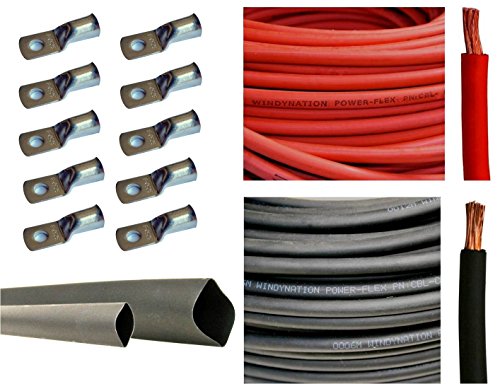
A complete DIY battery-cable bundle that saves a second trip for lugs and shrink tubing.
WindyNation packages 10 feet each of red and black fully annealed pure copper cable (fine-stranded, EPDM jacket) with ten 3/8-inch tinned copper lugs and 3 feet of black heat shrink tubing. The lugs are tinned for corrosion resistance — especially useful in marine or outdoor battery setups. Reviewers consistently call the quality “much higher than anticipated” and note the heat shrink makes connections look professional even in an engine bay.
The flexibility is the second-most praised trait, which makes sense given the high strand count. Buyers use it for everything from 2nd battery installations in Jeeps to building solar charge systems. One owner said the cables are “pure copper and very flexible” and that the lugs fit well with a hammer-type crimping tool. The kit does not come with a crimper, so you will need one separately.
Compared to buying the cable, lugs, and tubing separately, this bundle saves both time and money. The only practical note is that the cable requires stripping and crimping — it is not a plug-and-play extension cord.
For the DIY battery builder: everything you need for clean, professional-looking battery cables in one box — just add a crimper.
The honest trade-off: no crimping tool included, and the tinned lugs are a snug fit; expect to work them onto the cable with some effort.
Reach for this if: you are wiring a secondary battery, solar bank, or audio system and want a one-stop kit with no leftovers to hunt for.
Look elsewhere if: you need a pre-terminated extension cord or in-wall rated cable — this is a bare-wire kit for DC applications.
5. CLLOMAGY 6ft 6/4 SOOW Cable Portable Power Cable
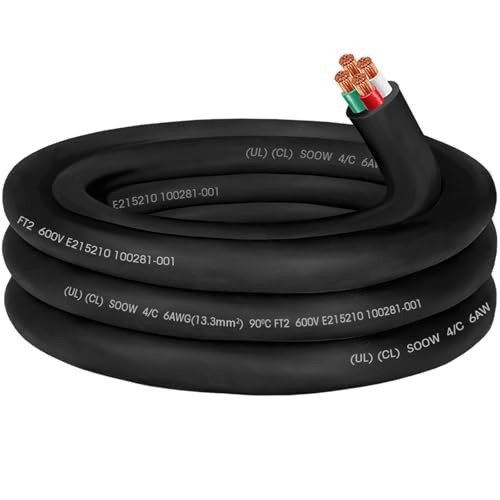
A weatherproof 4-conductor cord built to survive job sites, generators, and EV charging outdoors.
SOOW stands for Service, Oil, and Water resistant — and this cable lives up to it with a rating from -40°F to 194°F and an outer diameter of 27.2mm. The four conductors (black, white, green, plus one extra) make it a direct match for NEMA 14-50 receptacles used by Level 2 EV chargers, welders, and 50-amp RV hookups. Owners say it is “very flexible” and “easy to install” for both generator cords and permanent EV charging projects.
The quality is the most-discussed positive, though the heavy-duty construction gets mixed feedback — some call it “very heavy duty” while a few find the outer jacket cuts more easily than expected. One review cautions that the outer jacket scores readily, so it needs to be handled with care when stripping. The inner wire jackets themselves are durable, though.
The 6-foot length is a short pigtail — perfect for connecting a generator inlet box to a breaker panel or for an EV charger whip. If you need a longer extension cord, the brand offers lengths up to 100 feet in the same series.
Best for portable and outdoor 50A connections: the oil/water resistance and temperature range beat NM-B hands-down for outside work.
The one warning: the outer jacket cuts more easily than some expect; strip carefully to avoid nicking the inner conductor jackets.
Use it for: building a 50-amp generator cord, an EV charging extension, or a weatherproof hookup for a welder or hot tub.
Skip it for: in-wall permanent wiring — SOOW is a portable cord, not rated for concealed installation per electrical code.
6. XMK NM-B 6/3 Wire with Ground, 15ft
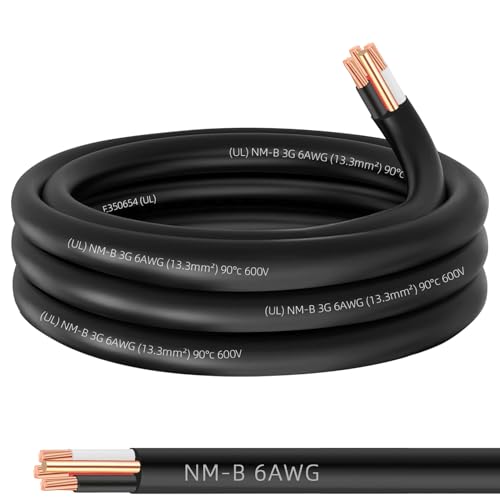
A UL-listed NM-B alternative that undercuts the big-box price while matching the spec sheet.
XMK’s 15-foot NM-B cable is a direct competitor to the Southwire above, using 99.99% oxygen-free copper with a double nylon/PVC jacket. It is rated 600 volts and 90°C, suitable for dry indoor branch circuits — exactly the right spec for a 50-amp EV charger, a hot tub, or an electric oven. The quality and value for money are the two most-discussed positives, with one buyer calculating it was “73.68% cheaper than buying by the foot at major chain stores.”
Buyers consistently report this wire installs easily for NEMA 14-50 outlets and RV plugs. Like any 6 AWG NM-B, it is stiff — one owner noted it is “kind of stiff to make sharp bends,” which is normal for this gauge. The double jacket protects the wire during pulling, but the wire itself stays rigid.
Compared to the Southwire 15 ft. (product 1), this one has fewer total reviews but a perfect 4.8-star score for a crowd of 260+ owners. It lacks the SIMpull low-friction coating, so expect slightly more effort when pulling through long conduit or multiple studs.
The budget pick that still passes inspection: UL listed and built with OFC — no corners cut on safety despite the lower price.
The penalty for saving: no low-friction jacket; it pulls fine in short runs but may fight you through long conduit.
Best for: budget-conscious indoor 50-amp jobs where the run is 15 feet or less and you do not mind a stiffer pull.
Not for: outdoor or wet locations (NM-B only) or extremely long runs through multiple 90° bends where a SIMpull jacket helps.
7. Southwire 6-Gauge Bare Copper Wire – 100ft Solid Soft-Drawn
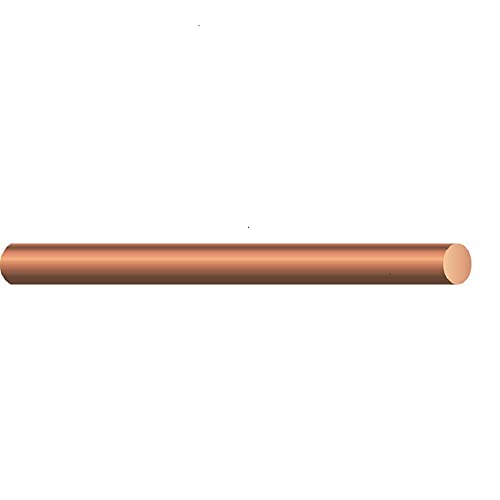
The pure-coat grounding wire that inspectors trust — 100 feet of soft-drawn copper for earthing runs.
If your project involves driving a ground rod and bonding the electrical system, you want bare copper — no insulation required. This Southwire spool is 99.999% copper (CU) conductors, solid 6 AWG with a soft-drawn temper that makes it easier to shape around the rod clamp than fully hard copper. The most-mentioned aspects in the reviews are the material quality and the value for money.
Buyers who have been burned by copper-clad steel wire elsewhere appreciate the confidence: one owner wrote, “this is the real stuff, soft drawn copper… if you buy it cheaper, check it with a magnet.” The stiffness is moderate for solid 6 AWG — you can bend it by hand along a foundation wall, but tight 90-degree turns in a confined space take effort. The 100-foot length covers most residential grounding runs with plenty of slack.
This is a bare conductor only. It is not for current-carrying branch circuits — use it for grounding electrode conductors, bonding jumpers, and equipment grounding, per the National Electrical Code.
For a permanent grounding solution: the 99.999% copper composition means zero rust risk and full conductivity for years underground or exposed.
Where it is not the right call: you cannot use bare wire for hot or neutral conductors; it is strictly for grounding and bonding runs.
Buy it when: you need a long, reliable ground wire from your main panel to earth rods or a UFER ground.
The physical fact: 100 feet of solid 6 AWG copper is heavy — expect a 7-8 lb spool that is awkward to carry one-handed.
8. Wirenco 6 AWG THHN/THWN-2 Stranded Copper Cables (50 Feet)

A color-coded THHN 4-wire kit that is wet-rated and perfect for conduit-fed hot tubs and panels.
This bundle gives you 50 feet each of black, red, and white 6 AWG stranded copper plus 50 feet of 8 AWG green for the ground — all UL 83 and VW-1 approved. The wire is actually THWN-2, which means it is suitable for wet locations and temperatures up to 90°C. That distinction matters: standard THHN is dry-location only, but this wire can handle conduit buried in wet ground or exposed to rain. Reviewers specifically call it out as “ideal for hot tub installs” and for “40 amp 14-50 car charging plug.”
Quality is the most-discussed positive, with owners noting the wire comes “properly cut to length, rolled and packaged neatly.” The 19-strand construction is more flexible than solid or 7-strand wire, so it pulls easier through 3/4″ or 1″ liquidtight conduit. The only practical friction point: the individual wires are not bonded together like NM-B, so you spend a bit more time organizing them during the pull.
Versus the Southwire NM-B (product 1), this is the right choice whenever the run passes through a damp location or needs to be pulled through conduit outdoors. It costs more per foot than NM-B, but it is the correct code-compliant choice for wet environments.
For conduit-fed circuits in wet or damp locations: the THWN-2 rating covers you where NM-B cannot go — outdoor panels, hot tubs, and underground conduit.
One logistics note: four separate spools means more handling at the job site than a bonded NM-B or MC cable.
Reach for this if: you are running conduit to a hot tub, outdoor subpanel, or EV charger in a wet location and need wire that passes inspection.
Look elsewhere for: a simple dry-indoor run where NM-B or MC cable would do the job for less money and less pulling time.
Understanding the Specs
NM-B vs. MC vs. THHN vs. SOOW
The jacket type determines where the wire is allowed. NM-B (nonmetallic) is for dry indoor spaces only — inside walls, attics, and garages. MC (metal-clad) wraps conductors in aluminum armor, letting you run it in exposed or outdoor locations without conduit. THHN/THWN-2 is a single-conductor wire approved for conduit in dry or wet locations. SOOW is a portable rubber cord rated for extreme temperatures and job-site abuse — perfect for extension cords and generator whips, but not for permanent in-wall installation.
Solid vs. Stranded vs. Fine-Stranded
Solid 6 AWG is a single thick copper rod — great for grounding rods but nearly impossible to route through tight bends. Stranded (7 to 19 strands) is the standard for NM-B and THHN; it bends much more easily and still holds its shape in conduit. Fine-stranded cable (hundreds of strands) is as flexible as rope, ideal for battery cables and welding leads, but it requires careful crimping or soldering for secure terminations.
FAQ
Can 6 AWG copper wire handle a 50-amp EV charger?
What is the difference between 6/2 and 6/3 copper wire?
Can I use NM-B Romex outdoors or underground?
How many strands should a good 6 AWG wire have?
Is THHN wire the same as THWN-2?
How much current can 6 AWG copper carry?
Can I use welding cable for permanent house wiring?
What size conduit do I need for 6 AWG THHN?
Final Thoughts: The Verdict
For most buyers, the 6awg copper wire winner is the Southwire 15 ft. 6/3 NM-B because it combines a proven brand, UL listing, and the SIMpull jacket that makes indoor 50-amp wiring a weekend job instead of a wrestle. If you need flexibility for a DC battery system, the Shirbly 6 AWG Battery Cable gives you the fine-strand pliability that solid wire cannot touch. And for outdoor or exposed runs where protection matters most, the YDDECW 5ft MC Cable with its aluminum armor is the one to reach for.
How We Picked
We do not accept paid placement. Every pick is matched to a real buyer and a real use-case; we do not hands-on test units.
Sources & Methodology
Specifications: manufacturer listings and product documentation. Review insights: verified customer reviews, as of July 2026. Pricing: not shown on this page (it changes often); check the current price via the retailer link.
As an Amazon Associate, Gadgets Feed earns from qualifying purchases. This does not affect which products we feature.