
A 6GB graphics card occupies a precise middle ground — enough VRAM for modern textures at 1080p, yet light enough to fit inside prebuilt office desktops and tiny ITX cases without requiring a power-supply overhaul. The buyer’s real task is separating the cards that genuinely handle today’s games from those that only look okay on paper.
I’m Min — the co-founder and writer behind Gadgets Feed. I’ve spent countless hours analyzing GPU specifications, studying benchmark data, and cross-referencing real user feedback specifically across the 6GB graphics card segment to determine which models earn their asking price and which fall short under sustained load.
Whether you are upgrading a compact SFF build, resurrecting an old OptiPlex for light gaming, or adding a dedicated transcoding engine to a media server, this guide breaks down every meaningful 6GB option on the market today. After comparing performance, power draw, form factors, and platform compatibility, you will know exactly which 6gb graphics card fits your specific use case without wasting money on overly ambitious specs.
How To Choose The Best 6GB Graphics Card
Every 6GB card shares the same VRAM capacity, but the underlying architecture, memory bus width, power connector requirements, and physical dimensions create massive real-world differences. Matching the card to your specific system — prebuilt office desktop, compact ITX gaming rig, or media server — will determine whether the upgrade feels like a revelation or a frustrating bottleneck.
Form Factor and Power Constraints
The single most common mistake is buying a dual-slot, 8-pin-powered card for a Dell OptiPlex or HP EliteDesk that only has 75W available over the PCIe slot. Low-profile cards like the MSI RTX 3050 LP or the MAXSUN RTX 3050 SFF draw all their power from the motherboard and fit inside slim cases that reject full-height GPUs. Measure your case clearance and check your PSU wattage before looking at any specs.
Memory Bus Width and Effective Bandwidth
6GB cards ship with either a 96-bit or 192-bit memory interface. The 192-bit bus on the GTX 1660 Super delivers roughly double the memory bandwidth of a 96-bit RTX 3050, which translates directly to higher minimum frame rates in texture-heavy scenes at 1080p. For esports and older titles the difference is minor, but for modern AAA games the wider bus is a genuine advantage.
Driver Maturity and Platform Compatibility
Intel Arc A380 cards offer superb AV1 encoding and low idle power for media servers, but their 3D performance lags behind NVIDIA counterparts and some legacy DirectX 9 titles run poorly. NVIDIA’s RTX 3050 series provides broadest game compatibility and the most mature driver stack, while the GTX 1660 Super lacks ray tracing but still delivers solid rasterization. Match the driver ecosystem to your primary workload.
Quick Comparison
On smaller screens, swipe sideways to see the full table.
| Model | Category | Best For | Key Spec | Amazon |
|---|---|---|---|---|
| GIGABYTE RTX 3050 WINDFORCE OC V2 | Premium | 1080p gaming with ray tracing | 96-bit GDDR6, 1477 MHz | Amazon |
| MSI RTX 3050 LP 6G OC | Premium | SFF and low-profile builds | Dual-slot LP, no external power | Amazon |
| MAXSUN RTX 3050 6GB | Mid-Range | Slim ITX and OptiPlex upgrades | 6.65″ length, 77W TDP | Amazon |
| Yeston RTX 3050 6GB | Mid-Range | PCIe-bus-powered gaming | PCIe 4.0 x8, 2304 shaders | Amazon |
| ZER-LON GTX 1660 Super | Mid-Range | High-bandwidth 1080p gaming | 192-bit bus, GDDR6 14 Gbps | Amazon |
| Sparkle Intel Arc A380 ELF | Mid-Range | Low-power media transcoding | No external power, 6GB GDDR6 | Amazon |
| ASRock Intel Arc A380 Challenger ITX | Budget | Plex AV1 encoding and HTPC | AV1 encode, DP 2.0, 0dB fan | Amazon |
| ASUS RTX 5060 8GB OC | Premium | DLSS 4 and high-FPS 1080p | GDDR7, PCIe 5.0, 623 AI TOPS | Amazon |
| PowerColor Reaper RX 9060 XT 16GB | Premium | Ultra-quiet 4K media builds | 16GB GDDR6, 200mm length | Amazon |
In‑Depth Reviews
1. GIGABYTE GeForce RTX 3050 WINDFORCE OC V2 6G

The GIGABYTE RTX 3050 WINDFORCE OC V2 strikes the best balance between features and accessibility for the 6GB segment. Its dual WINDFORCE fans keep the 1477 MHz core cool under sustained gaming loads, and the 96-bit GDDR6 memory interface provides enough bandwidth for smooth 1080p gameplay with ray tracing enabled in titles like Minecraft and Fortnite.
At 7.5 inches long and requiring only a standard PCIe x16 slot, this card slides into most mid-tower desktops without clearance issues. The HDMI 2.1 and DisplayPort outputs support up to 7680×4320 resolution, giving you future display flexibility even if the card is optimized for 1080p. Users report that it draws no external PCIe power, making it a genuinely plug-and-play upgrade for prebuilt systems with limited PSU overhead.
The Ampere architecture brings second-gen RT Cores and third-gen Tensor Cores, so you get hardware-accelerated ray tracing and DLSS upscaling — features missing entirely from older Pascal and Turing 6GB cards. For someone stepping up from integrated graphics or a 2GB VRAM card, the performance jump is substantial. Driver stability on Windows 11 is excellent out of the box.
Why it’s great
- No external PCIe power required — works in standard office PCs
- Ray tracing and DLSS support at a 6GB price point
- Compact dual-fan design runs cool and quiet
Good to know
- 96-bit memory bus limits bandwidth in heavy AAA titles
- Max boost is lower than the MSI LP variant by 25 MHz
2. MSI GeForce RTX 3050 LP 6G OC

The MSI RTX 3050 LP 6G OC is specifically engineered for small-form-factor systems where every millimeter counts. Its low-profile bracket and dual-fan heatsink fit inside HP Pavilion, Dell OptiPlex, and other slim desktops that cannot accommodate full-height cards. The 1492 MHz boost clock is the highest among the low-profile 3050s reviewed here.
Power delivery comes entirely through the PCIe slot — no 6-pin or 8-pin connector required — which is critical for upgrading office machines with proprietary 180W–240W PSUs. The card includes two HDMI 2.1 ports and one DisplayPort 1.4a, supporting up to 4K output. Users running Fortnite and similar titles report a substantial quality jump over console experience.
MSI Center software lets you monitor temperatures, adjust fan curves, and apply overclocks in real time. The custom PCB uses hardened circuits and optimized trace routing, which contributes to stability in systems with marginal airflow. For anyone building a compact living-room PC or upgrading a work-issued desktop for light gaming, this is the card to beat.
Why it’s great
- True low-profile design fits slim office chassis
- No external power connector — draws 75W from PCIe slot
- Dual HDMI 2.1 ports for multi-monitor setups
Good to know
- PCIe x8 interface may slightly limit bandwidth in some systems
- Fans become audible under sustained gaming load
3. Yeston RTX 3050 6GB GDDR6

Yeston delivers a fully PCIe-bus-powered RTX 3050 with the full 2304 CUDA core count, matching the shader array of higher-tier RTX 3050 variants. The core runs at 1042 MHz base with a 1470 MHz boost, and the 6GB of GDDR6 memory is clocked at 14 Gbps across a 96-bit bus. This combination handles 1080p gaming at medium to high settings in most modern titles.
The card measures only 6.3 inches long and 2.68 inches wide, making it one of the smallest RTX 3050s on the market. It fits comfortably inside Dell OptiPlex 3050/3070 SFF and 1L workstation PCs. No external power cable is needed — the PCIe slot provides the full 75W. Users running Steam games report solid 60 FPS at 1080p medium-high.
Build quality is decent for its price tier, though the single-fan cooler runs at up to 77°C under load and becomes audible. The card supports HDMI 2.1 and DisplayPort 1.4a for 4K output, though frame rates at 4K will be modest. For OptiPlex owners seeking a genuine gaming upgrade without swapping the power supply, this is the most complete option available.
Why it’s great
- Full 2304 CUDA cores — no shader reduction vs larger cards
- Ultra-compact size fits nearly any SFF case
- No external power required
Good to know
- Single fan runs hot and noisy under load
- Reported fan failure after two months in some units
4. ZER-LON GeForce GTX 1660 Super 6GB

The ZER-LON GTX 1660 Super is the only card in this roundup with a 192-bit memory bus, giving it roughly double the memory bandwidth of 96-bit 3050 variants. Paired with 6GB of GDDR6 memory running at 14 Gbps, this card delivers noticeably higher minimum frame rates in texture-heavy titles at 1080p. The 12nm Turing architecture excludes ray tracing cores, but rasterization performance is strong.
The dual-fan cooling system uses copper powder sintered heat pipes that contact the GPU die directly, keeping temperatures in check even during extended gaming sessions. At 9.05 inches long, it is longer than most low-profile options and will not fit inside compact SFF cases. An 8-pin PCIe power connector is required, so verify your PSU has an available lead before purchasing.
Users upgrading from GTX 1060 or older cards report a clean plug-and-play experience. The card supports 8K output via DisplayPort and HDMI, though practical gaming use tops out at 1080p and 1440p for esports. It lacks ray tracing and DLSS, so if those features matter, the RTX 3050 is a better fit despite the narrower bus.
Why it’s great
- 192-bit memory bus provides superior bandwidth for 1080p gaming
- Robust dual-fan cooling with heat-pipe direct-touch design
- Consistent driver maturity and broad game compatibility
Good to know
- No ray tracing or DLSS support
- Requires 8-pin power — not compatible with slot-only systems
5. ASUS Dual NVIDIA GeForce RTX 5060 8GB OC

The ASUS RTX 5060 represents a generational leap with GDDR7 memory and PCIe 5.0 interface, delivering 623 AI TOPS for DLSS 4 frame generation. While it carries 8GB VRAM rather than 6GB, it belongs in this guide because it redefines what buyers expect from the sub-8GB category — 1080p gaming at over 140 FPS in Fortnite and rasterization performance approaching the RTX 2080 Ti.
The dual Axial-tech fan design uses a smaller hub and longer blades to increase downward air pressure, keeping the 2565 MHz boost clock stable without excessive noise. The 2.5-slot profile is thicker than typical entry-level cards but still SFF-Ready Enthusiast certified. Power draw sits around 150W TDP, with real-world gaming loads hovering near 100W — very efficient for the performance delivered.
DLSS 4 is the headline feature here. In supported titles, it boosts frame rates dramatically while maintaining image quality that earlier DLSS versions could not match. For anyone building a new budget gaming PC rather than upgrading an old office machine, the 5060 is worth the stretch over a 6GB 3050.
Why it’s great
- GDDR7 memory and PCIe 5.0 provide massive bandwidth headroom
- DLSS 4 delivers impressive frame-rate boosts in supported games
- Efficient 150W TDP with excellent thermal headroom
Good to know
- 8GB VRAM may still limit texture quality in some future titles
- Requires PCIe 5.0 support for full bandwidth benefit
6. PowerColor Reaper AMD Radeon RX 9060 XT 16GB

At 1080p Ultra, it runs Ark and Borderlands 4 smoothly, and at 4K it averages 53 FPS in Arch Raiders with high settings.
The card is remarkably small for its VRAM capacity: 200 x 100 x 39mm, fitting comfortably in living-room PC cases. Power draw is modest enough that a 500W PSU is sufficient. The dual DisplayPort 2.1a and single HDMI 2.1b outputs support up to 8K displays. Users running local LLMs report the 16GB buffer is adequate for smaller models.
Driver stability on the AMD side still lags behind NVIDIA in some edge cases — a few users needed to disable upscaling and frame generation in Adrenaline to prevent crashes. For pure gaming below 4K, the extra VRAM goes largely unused, but for AI workloads or heavy multitasking with multiple 4K displays, the 9060 XT provides headroom that 6GB cards simply cannot.
Why it’s great
- 16GB VRAM for AI, LLM, and multi-monitor productivity
- Extremely quiet operation — ideal for living-room builds
- Compact 200mm length fits most SFF cases
Good to know
- AMD drivers may require disabling upscaling for stability
- 6GB is sufficient for pure 1080p gaming — extra VRAM not needed there
7. MAXSUN GeForce RTX 3050 6GB

The MAXSUN RTX 3050 is built specifically for the smallest PC cases. Measuring just 6.65 x 2.71 inches, it is the shortest low-profile RTX 3050 in this roundup. The slim design draws all power from the PCIe slot, consuming a maximum of 77W — well within the 75W PCIe spec with negligible margin. It works immediately in Dell OptiPlex 3060 SFF and similar prebuilts.
The GPU core runs at 1042 MHz base with a 1470 MHz boost, matching the Yeston card’s clock speeds. The 6GB GDDR6 memory operates at 14 Gbps on a 96-bit bus. In 1080p gaming, it delivers 80+ FPS in titles like Warzone and Fortnite at optimized settings. The low-profile bracket is included in the box, saving you the hassle of sourcing one separately.
Noise is the primary compromise: the single fan becomes audible under load, and in some OptiPlex configurations it causes the CPU fan to ramp up. Users running 3D design software like Solidworks report smooth performance after enabling registry workarounds for real-view mode. For sheer compatibility with proprietary office PCs, this card is hard to beat.
Why it’s great
- Smallest RTX 3050 available — fits nearly any SFF case
- No external power needed
- Includes low-profile bracket in the box
Good to know
- Single fan is loud under sustained gaming load
- Limited overclocking headroom due to power constraints
8. Sparkle Intel Arc A380 ELF 6GB
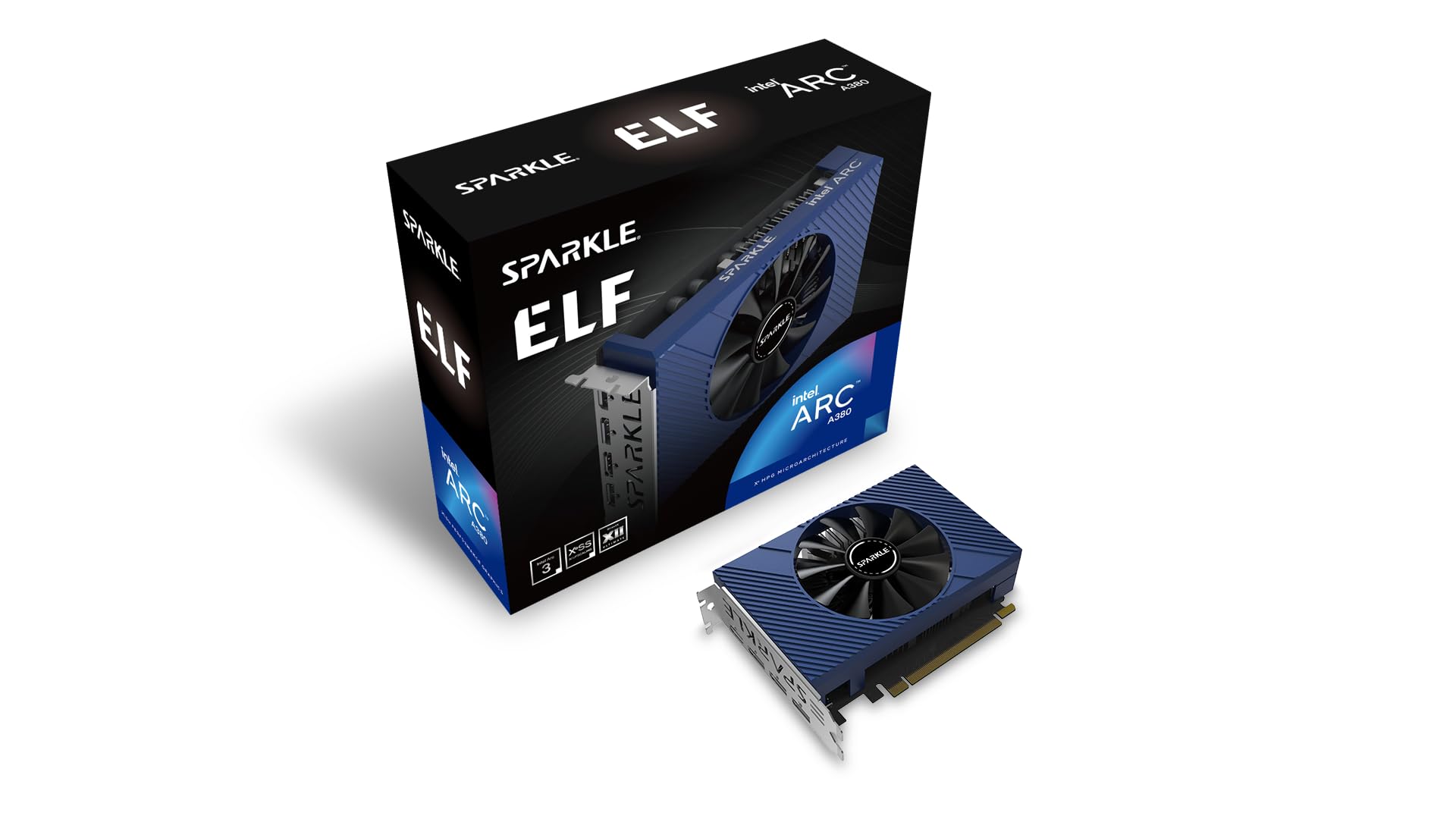
The Sparkle Arc A380 ELF is a Linux-native media transcoding powerhouse that draws zero power from external cables — everything runs through the PCIe slot. The 6GB GDDR6 memory on a 96-bit bus is secondary to the real draw: industry-first AV1 hardware encoding and decoding. Users running Plex, Jellyfin, or Frigate report exceptional transcode throughput with low CPU usage.
At 2000 MHz boost clock, the card handles 4K video playback without stuttering, even without Resizable BAR enabled. The single-fan design runs cool and quiet, making it ideal for NAS and home-server builds. It drives up to 4 displays via three DisplayPort 2.0 ports and one HDMI 2.0b, supporting resolutions up to 8K.
Gaming performance is modest — this is not a card for Cyberpunk or AAA titles. Esports and LAN games at 1440p run at playable frame rates, but the Arc driver stack still has rough edges with older DirectX 9 and DirectX 11 titles. For media-center or server duty where AV1 efficiency matters most, the Sparkle A380 ELF is unmatched at this price tier.
Why it’s great
- Hardware AV1 encode/decode — best Plex transcoding card available
- No external power connector, runs cool and quiet
- Excellent Linux driver support out of the box
Good to know
- 3D gaming performance is weak compared to RTX 3050
- Intel Arc drivers still maturing for older game titles
9. ASRock Intel Arc A380 Challenger ITX 6GB OC

The ASRock Arc A380 Challenger ITX is factory overclocked to 2250 MHz — the highest core clock among all cards in this guide. The 6GB GDDR6 memory runs on a 96-bit bus, and the single striped axial fan supports 0dB mode, stopping completely at low temperatures for silent operation in HTPC builds. It requires a single 8-pin power connector and a 500W PSU recommendation.
The real strength is AV1 hardware encoding. Users running Plex and Frigate report excellent transcode speeds and high-quality AV1 conversions. The card supports up to four displays at up to 8K resolution, with three DisplayPort 2.0 outputs and one HDMI 2.0b. For a compact home-lab streaming and remote-rendering card, the Challenger ITX is exceedingly capable.
Gaming performance is limited to low-to-mid settings in modern titles. Some users experienced no HDMI signal before kernel loading when ReBAR and above-4G decoding were enabled, which complicates KVM-over-IP setups. For pure media encoding duty in an ITX case, the A380 Challenger delivers features no other 6GB card matches at its price point.
Why it’s great
- Highest factory core clock in the 6GB segment at 2250 MHz
- 0dB fan stop for silent HTPC operation
- AV1 encode/decode and XeSS upscaling support
Good to know
- HDMI output may not work before kernel loads with ReBAR enabled
- Weak 3D gaming performance compared to any RTX 3050 variant
FAQ
Can a 6GB graphics card handle modern games at 1080p?
Will an RTX 3050 6GB fit in my Dell OptiPlex?
Is Intel Arc A380 a good option for gaming or just for media?
Should I buy a GTX 1660 Super in 2025?
Final Thoughts: The Verdict
For most users, the 6gb graphics card winner is the GIGABYTE RTX 3050 WINDFORCE OC V2 because it combines ray tracing and DLSS support with no external power requirement, making it the most broadly compatible 6GB option. If you need the absolute smallest card for an OptiPlex SFF, grab the MSI RTX 3050 LP 6G OC. And for pure media transcoding duty with AV1 hardware encoding, nothing beats the Sparkle Intel Arc A380 ELF.