
Our readers keep the lights on and my morning glass full of iced black tea. As an Amazon Associate, I earn from qualifying purchases.
Specs are compiled from manufacturer listings and verified buyer reviews and can change over time — please confirm the key details on the product page before buying.
If your truck or car’s factory speakers sound muddy or crackle at volume, swapping in 6×8 door speakers is the quickest upgrade you can make. These fit the standard 6×8-inch openings in most American trucks, SUVs, and sedans, so you won’t need to cut or modify your door panels. The key is matching the speaker’s power handling (measured in watts RMS) to what your stereo or amp actually delivers — too much speaker on a weak head unit sounds thin, while too little power handling gets you distortion at volume. The picks below are ranked by real owner satisfaction and how well they fit the factory holes in your doors.
I’m Min — the founder and writer behind Gadgets Feed. This guide is built by comparing the manufacturers’ published specifications and the patterns across verified customer reviews, so you get each pick’s real strengths and trade-offs instead of marketing spin.
The right pair of 6×8 door speakers transforms your daily commute from muffled noise into clear, punchy sound you can actually feel.
Our Picks at a Glance


How To Choose The Best 6X8 Door Speakers
Before you buy, you need to understand what powers your speakers. A factory stereo puts out far less clean power than an aftermarket amp, and that single fact decides which 6x8s will sound good in your vehicle. Match the speaker’s RMS (continuous) rating to roughly what your head unit or amp provides per channel.
Power Handling: RMS vs Peak
Peak watts are the marketing number — a brief burst a speaker survives. RMS watts are what it handles continuously, and that is the number that matters. A speaker rated 55W RMS sounds clean on a modest stereo, while one rated 60W RMS needs a bit more headroom to shine without straining.
Sensitivity and Impedance
Sensitivity (measured in dB) tells you how loud a speaker plays with a given amount of power. Higher numbers (like 90 dB and up) mean more volume from a factory radio. Impedance, measured in ohms, is the electrical load a speaker presents — most car stereos are happy with 4-ohm loads, and 3-ohm is common on premium factory systems.
Quick Comparison
| Model | Best For | Power (RMS) | Sensitivity | Impedance | Amazon |
|---|---|---|---|---|---|
| KICKER CS CSC68★ Best Overall | Clean bass on factory power | — | — | — | Amazon |
| JBL CLUB 8620Amp-Ready Punch | Punchy sound with an amp | 110W per pair | — | 3 ohm | Amazon |
| Rockford Fosgate R168X2Crowd Favorite | The proven crowd favorite | 55W | — | 4 ohm | Amazon |
| Pioneer TS-A683FH | Deep bass response | 85W | 90 dB | — | Amazon |
| KICKER DSC680 | Simple OEM replacement | — | 90 | 4 ohm | Amazon |
| JBL Club 864F | High sensitivity on stock power | 60W | 93 dB | 3.0 ohm | Amazon |
| ORION Cobalt CB683 | Budget-friendly 3-way clarity | 70W | 87.5 dB | 4 ohm | Amazon |
| Infinity REF8622CFX | Value with textile tweeters | — | — | 3.0 ohm | Amazon |
| CERWIN-VEGA HED H7683 | Loud 3-way with bass boost | 60W | — | 4Ω | Amazon |
Note: This list uses flexible matching for 6×8 inch speakers (accepting 6×8 or 6×9 where listed as compatible), so not every pick is the exact number searched; the nearest same-type size serves the same purpose.
In‑Depth Reviews
1. KICKER CS Series CSC68 6×8 Coaxial Speakers (2 Pack)
Our pick — over 4.5★ from 450+ verified ratings; the strongest balance of quality and price.
The two-pair Kicker that breathes new life into aging trucks with zero-protrusion tweeters
The reduced mounting depth lets these fit nearly every make and model, reviving a 20-year-old truck stereo. The heavy-duty motor and magnet structure plus the EVC (Extended Voice Coil) work together to push ultra-clean bass, which is exactly what owners say they get — crisp music without distortion.
The stamped-steel frame supports a rigid polypropylene cone, and the zero-protrusion PEI tweeters sit flush so nothing blocks your factory grilles. Neodymium tweeter magnets push more volume into the high frequencies, which is why vocals and cymbals stay clear. A UV-treated poly-foam surround resists heat and direct sunlight, so door-mounted speakers in hot climates hold up better over time.
Owners in Ford Rangers and Tauruses report a perfect factory fit, and the sound quality is the thing everyone raves about — far better than OEM, with good, clear output. Durability is the recurring gripe—a handful of buyers report early failures, so treat them gently with clean power.
Why It Wins Owners Over
- Sound quality is the top praise, singled out by 45 owners.
- Perfect drop-in fit reported in Ford Rangers and Tauruses
- Two pairs included means front and rear doors covered
The Honest Trade-Off
- Durability is the recurring concern — some units fail earlier than expected
- Bass is clean but not subwoofer-deep, as owners note
Reach for these if: you want a two-pair, drop-in upgrade for an older truck or SUV and you value clean, clear sound on factory power.
Look elsewhere if: you run a powerful amp and need speakers that handle serious continuous wattage.
2. JBL CLUB 8620 5×7/6×8 2-Way Coaxial Speaker System
The JBL that carries plenty of punch and stays clean even at full volume
Rated at 330 watts peak per pair (165 watts each) and 110 watts RMS per pair (55 watts each), these JBLs are built for drivers who actually push their system. They run a 3-ohm impedance, which pairs well with premium factory stereos and aftermarket amps alike, and owners mention they sound amazing for the price.
Customers note punchy, clear, well-rounded sound that’s a huge upgrade over OEM in 2010 F150s and Lincoln MKXs. Even at high volume on a stock head unit, the mix stays clean with no distortion, which is the most-discussed trait across reviews. Bass is present but not subwoofer-level, so plan accordingly if you want deep lows.
Installation is straightforward in PT Cruiser C-pillars and Town Car rear decks, though note that no wires are included — some owners solder connections directly. A few note that initial volume and bass improved after a two-week break-in period, so give them time to loosen up.
Volume-ready clarity: these JBLs deliver punchy, distortion-free sound on amp power, with 110W RMS per pair handling real output.
Fit note: easy install in most factory locations, but you’ll need your own wiring to complete the job.
3. Rockford Fosgate Prime R168X2 6×8 2-Way Full Range Speakers
The best-selling Rockford that’s been a dramatic upgrade for over a decade of truck owners
With the largest owner base in this roundup, the Prime R168X2 is the proven workhorse. Rated at 55 watts RMS and 110 watts peak with a 4-ohm load, these are built as factory replacements, and owners consistently call them a dramatic upgrade from stock — crisp sound that’s worth the money. The polypropylene cones reduce distortion while the silk dome flush-mounted tweeter delivers accurate highs that withstand high volume.
Installation is the standout trait here; owners note it takes about 10 minutes to modify, and the integrated high-pass crossovers simplify wiring. One owner’s pair survived 8.5 years and 100k miles, though some units blow within the first month on heavy power. The 1-year warranty from Rockford Fosgate adds a safety net.
If you’re running a large amp, these aren’t the right choice — they’re designed for factory-style power. But for a stock-stereo replacement in a GMC Sierra, Tundra, or Civic, this is the safe, proven pick.
The Proven Strengths
- Sound quality is praised by over 2,200 owners
- Value for money is cited by over 1,000 owners.
- Easy 10-minute installs reported across trucks and sedans
Where It Falls Short
- Some reviewers point out units blowing within the first month on heavy power
- Fit is mixed — a few find it slightly large for some factory locations
4. Pioneer A-Series MAX TS-A683FH 6×8 2-Way Coaxial Speakers

The Pioneer that reaches into the 40-45 Hz range without losing its midrange or highs
With 370 watts max and 85 watts continuous power handling, the TS-A683FH is the most power-hungry pick here, and it rewards that power with deep, tight, controlled bass. Shoppers say it reaches into the 40-45 Hz range — impressive for a 6×8 — while keeping vocals warm and precise and highs clean. The 90 dB sensitivity means it still plays loud on lower power inputs, though deck power alone won’t open up its bass.
The 2-way design uses separate drivers for different frequency ranges, resulting in balanced sound reproduction across genres. Owners note the flat, clean tweeters are not harsh even at high volume, and bass stays smooth and responsive when properly amped. Aramid cones are expected to stand up to hot climates like Florida heat, which is a plus for door mounting.
Installation is generally easy with perfect hole alignment, though the included adapters fit GM and Chevy vehicles only — other owners needed to source correct brackets or do minor modification. The recurring advice: pair these with an amp to hear what they can really do.
Bass response leader: hits 40-45 Hz territory while keeping mids and highs intact, thanks to 85W continuous power handling.
The catch: on stock deck power alone, bass is flat — these want an amplifier to shine.
5. KICKER DSC680 6×8-Inch Coaxial Speakers (Pair)

The Kicker OEM replacement with 90 dB sensitivity that wakes up a factory system
Built as a straightforward 6×8 factory replacement, the DSC680 handles 200W peak power with a 4-ohm impedance and a 90 dB sensitivity rating — that sensitivity number means it plays loudly and clearly even on modest factory power. The frequency response spans 45-20k Hz, giving you solid coverage from bass through highs.
Buyers report dynamic sound that’s a huge upgrade over crackly factory speakers in a 1982 Ford Thunderbird and a 2013 F-150 Lariat. Installation is the easy part here — owners mention it’s simple to hook up with no soldering required, and the fit is perfect in factory locations. The sound is crisp on highs with smooth bass, and it’s a popular Kicker OEM replacement for a reason.
The durability picture is mixed, with one owner reporting a speaker failed after 4 weeks, though most report reliable performance. If you want a bass-heavy speaker, this isn’t it — owners note it’s for balancing out a system, with a subwoofer handling deep lows.
Pick this for: a no-solder, drop-in OEM upgrade where sensitivity matters more than raw wattage.
Think twice if: you expect deep bass from the door speakers alone — that’s the subwoofer’s job.
6. JBL Club 864F 6×8 Two-Way Car Speaker

The JBL with a 93 dB sensitivity rating that brings out sound even on weak factory power
At 93 dB sensitivity, the Club 864F is the most efficient speaker in this lineup — it produces more volume from less power, which makes it ideal for factory stereos and stock amps. Rated at 60W RMS and 180W peak with a 3.0-ohm impedance, it’s a solid match for premium factory systems like the Sony units in Ford trucks.
The patented Plus One woofer cone architecture provides more overall cone area than same-size speakers, resulting in higher sensitivity and increased low-frequency output. The edge-driven silk dome tweeter delivers broad high-frequency response that stays smooth — never harsh — at high output. An acoustically damped, UV-resistant polypropylene cone stands up to car heat and humidity.
Customers note perfect fits in a 2003 Expedition, a 2002 Taurus SE, and a 2014 F-150 Lariat, replacing blown factory speakers. Reviewers point out crisp sound with exceptional mids, vibrant highs, and strong lows without distortion. The honest note from owners: you still need a dedicated sub for real bass, but these make a great system without components.
Best for: premium factory systems where 93 dB efficiency turns stock power into clear, loud sound.
Note: heavy bass lovers should pair these with a subwoofer rather than expecting door-shaking lows.
7. ORION Cobalt CB683 6×8 3-Way Coaxial Speakers
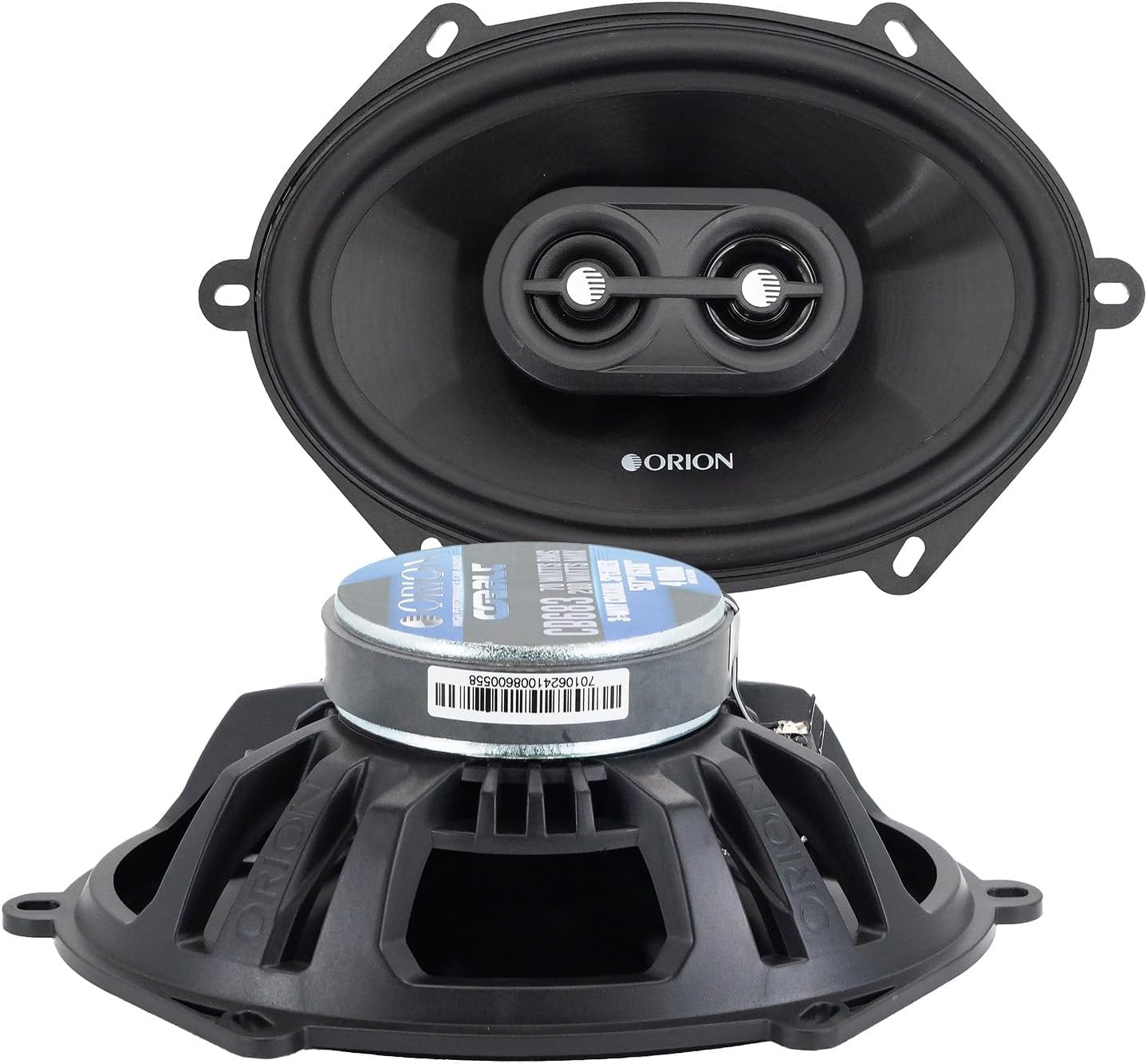
The 3-way Orion that’s particularly loud for door speakers and a huge RV upgrade
With 280W peak and 70W RMS power handling in a 3-way design — dedicated mid-range, woofer, and tweeter — the CB683 delivers a rich blend of frequencies. The butyl rubber surround and polypropylene cone combine for crisp, distortion-free audio, while the 4-ohm impedance and 87.5 dB sensitivity make it easy to drive on factory or aftermarket setups. The wide frequency response of 75Hz-20kHz covers the essentials.
Owners call these particularly loud for 6×8 door speakers, and they’re a solid value — one RV owner reports they were a huge improvement over stock, run off a Pioneer deck. In an 2006 F-150 extended cab, they fit perfectly in the rear suicide doors and delivered excellent sound even with the factory radio. The build quality is repeatedly praised as better than factory units.
For the money, the only real note is that bass isn’t crazy — owners describe them as very good sounding rather than bass-heavy. Pair them with a small amp, as one owner did, and they really come alive.
Value-driven 3-way: 70W RMS and a dedicated mid-range make this the budget pick that surprises with clarity.
Keep in mind: bass is modest on its own — an amplifier open up the full experience.
8. Infinity REF8622CFX 6X8/5X7 Reference Series 2-Way Coaxial Speaker

The Infinity with edge-driven textile tweeters that nails 80s music and old country
This 360W 2-way coaxial uses edge-driven textile tweeters for smooth, detailed highs and a 3.0-ohm impedance that suits many factory systems. Owners describe it as feeling like good quality — not a 6×9 sound, but a great-sounding little speaker with solid performance for 80s music, blues, and old country classics. The sound has good highs and lows when paired with a capable stereo.
In an old 1999 F-250 Super Duty with an inexpensive 55W per channel stereo, the sound is described as amazing with all the highs and lows present. The value proposition is strong — owners got way more than they paid for as a direct-fit replacement in rear corners of a 95 F250 extended cab and a 2008 F-150. The metal and plastic enclosure feels durable.
The honest caveats are mixed: while some owners enjoy the highs and mediums, others report the volume only reaches half, and there are durability concerns with units failing within a year. One owner had the tweeter fall out of the center a day after install, so quality control varies.
Choose this for: a budget-friendly 360W upgrade with smooth textile tweeters that fit factory locations.
Be aware: durability and volume are mixed in owner feedback — inspect units on arrival.
9. CERWIN-VEGA HED Series H7683 6×8 3-Way Coaxial Speakers

The Cerwin Vega with a built-in bass boost feature that stays clear at high volume
The HED Series H7683 packs 60W RMS and 360W MAX power handling into a 3-way design with a graphite-injected cone and rubber surround. The 1.0″ balanced PEI tweeter delivers crisp trebles, and the bass boost feature adds low-end punch. A stamped steel vented frame keeps everything solid and long-lasting in the door.
Shoppers say excellent sound quality that maintains clarity even at high volume — one describes it as amazing and super clear. In an F-150, the fit is direct in front and rear doors with original hardware, and some used adapter cables to avoid wire cutting entirely. It’s repeatedly called a very affordable upgrade to factory speakers, with great quality for the price.
The reliability picture is mixed, with some owners reporting issues while others run them happily. A key insight from owners: don’t underpower these and expect amazing results — a 30W deck isn’t enough, and a 50W per channel JVC head unit open up their potential. Cerwin Vega’s dynamic gear heritage shows when properly driven.
Bass-boosted clarity: 360W MAX with a graphite cone and PEI tweeter delivers clear sound that holds up at loud volumes.
Feed them power: these want at least 50W per channel to really perform — underpowering disappoints.
Understanding the Specs
RMS Power Handling
RMS (Root Mean Square) watts is the continuous power a speaker can handle without damage. It’s the honest number, unlike peak watts which describe a brief burst. To choose well, match the speaker’s RMS to your stereo’s per-channel output — a factory radio puts out roughly 15-25W RMS, while an aftermarket head unit might do 50W or more.
Sensitivity (dB)
Sensitivity tells you how efficiently a speaker turns power into volume, measured in decibels (dB). A speaker rated 90 dB or higher will play loud and clear on modest factory power; a lower number like 87.5 dB needs more wattage to reach the same volume. For stock stereos, higher sensitivity is your friend.
Impedance (Ohms)
Impedance is the electrical load a speaker presents to your stereo or amp, measured in ohms. Most car systems use 4-ohm speakers, which are safe for nearly any receiver. Some premium factory systems use 3-ohm speakers, which can actually draw more power from the same amp — just confirm your stereo handles the load before swapping.
Frequency Response
Frequency response, given in hertz (Hz), shows the range of sound a speaker can reproduce. Lower numbers mean deeper bass potential — a speaker reaching 45 Hz digs deeper than one stopping at 75 Hz. Highs in the 20 kHz range cover everything your ears can hear. For door 6x8s, expect solid midrange with bass that’s good but not subwoofer-deep.
FAQ
Will 6×8 speakers fit my truck or car without modification?
What is the difference between RMS and peak power on 6×8 speakers?
Do I need an amplifier to get good sound from 6×8 door speakers?
What does impedance in ohms mean for my stereo?
Will 6×8 speakers give me strong bass?
What is the difference between 2-way and 3-way coaxial speakers?
How long do 6×8 door speakers typically last?
Can I install 6×8 speakers myself?
Does speaker sensitivity matter if I use an amplifier?
What should I do if my new 6×8 speakers sound bad at high volume?
Final Thoughts: The Verdict
For most drivers, the 6×8 door speakers winner is the KICKER CS CSC68 because the two-pair pack covers all four doors with clean, distortion-free sound and a fit that works in nearly any vehicle. If you run an amplifier and want punchy, clear output, grab the JBL Club 8620. And for the deep-bass seeker who’s willing to amp their system, the Pioneer TS-A683FH reaches into 40-45 Hz territory that few 6x8s can match.
How We Picked
We do not accept paid placement. Every pick is matched to a real buyer and a real use-case; we do not hands-on test units.
Sources & Methodology
Specifications: manufacturer listings and product documentation. Review insights: verified customer reviews, as of August 2026. Pricing: not shown on this page (it changes often); check the current price via the retailer link.
As an Amazon Associate, Gadgets Feed earns from qualifying purchases. This does not affect which products we feature.