
Our readers keep the lights on and my morning glass full of iced black tea. As an Amazon Associate, I earn from qualifying purchases.
Specs are compiled from manufacturer listings and verified buyer reviews and can change over time — please confirm the key details on the product page before buying.
Getting real bass from a 6×8 speaker slot is a surprisingly tough ask. Unlike a round woofer in a dedicated enclosure, an oval speaker fights a shallow door cavity and a plastic baffle that wants to buzz. The right pair delivers chest-thumping kick drum, weighted basslines, and cabin-filling sound that eliminates the need to crank the volume. The wrong pair produces thin, shouty sound and leaves you underwhelmed.
I’m Min — the founder and writer behind Gadgets Feed. This guide is built by comparing the manufacturers’ published specifications and the patterns across verified customer reviews, so you get each pick’s real strengths and trade-offs instead of marketing spin.
Whether you drive an F-150, an Explorer, or a sedan with factory 6×8 cutouts, these are the best 6×8 speakers for bass that actually deliver bottom-end weight instead of just promising it on the box.
Our Picks at a Glance


How To Choose The Best 6X8 Speakers For Bass
Picking a 6×8 speaker for bass is different from picking a full-size woofer. Because the oval shape has less cone area than a round 6.5-inch or 8-inch driver, every material and engineering choice matters more. You aren’t just looking for a high wattage number — you are looking for a speaker that can move air efficiently in a shallow, often unsealed door pocket.
Woofer Cone & Surround: The Foundation of Low-End
The cone material determines how stiff the moving surface is. The stiffest cones, like polypropylene (PP) or glass fiber, resist flexing when the bass hits hard. That stiffness pushes air more directly — meaning you hear the note as a solid thump rather than a flabby noise. The surround, the rubber or foam ring around the cone, needs to be compliant enough to let the cone move freely but tough enough not to tear over time. Butyl rubber surrounds are the gold standard here; they stay pliable in heat and cold and seal the cone edge against the basket.
RMS Power Handling vs. Peak Wattage
Peak wattage (the number that looks huge on the box) tells you what the speaker can survive in a split-second burst. RMS wattage (the continuous power number) tells you what the speaker can handle while actually playing music. For real bass, the RMS figure is the one that matters. A speaker with a high RMS rating can take a steady stream of bass-heavy signal without distorting or burning the voice coil. If your head unit or amp delivers 50 watts RMS per channel, a speaker rated for 80 watts RMS gives you a safe cushion. A speaker rated for 300 watts peak but only 35 watts RMS will struggle with sustained low notes.
Sensitivity: How Loud the Bass Gets on Low Power
Sensitivity, measured in decibels (dB), tells you how efficiently the speaker converts power into volume. For bass, a higher sensitivity number (90 dB and above) means the speaker can produce a stronger low-frequency wave from the same amplifier power. This is especially important if you are running the speakers off a factory head unit or a low-power aftermarket deck. A speaker with 87 dB sensitivity will sound quieter and less punchy at the same volume level as a 90 dB speaker — and that difference is even more noticeable in the bass region, where your ear naturally needs more energy to feel the weight.
Frequency Response: The Low-End Range
The frequency response spec, listed as a low number (like 30 Hz or 65 Hz), tells you the deepest note the speaker can reproduce. A lower number is better for bass — 30 Hz means it can hit subwoofer-territory notes, while 65 Hz means you will miss the very bottom of the bass line. But the number alone is incomplete. A speaker can technically reproduce 30 Hz at a whisper but be completely inaudible at that frequency inside a moving vehicle. The real test is how low the speaker plays with authority. Mid-range speakers that drop to 30 Hz are rare for a 6×8 chassis and typically signal a well-engineered cone and motor assembly.
Quick Comparison
| Model | Best For | Sensitivity | RMS Power | Frequency Response | Amazon |
|---|---|---|---|---|---|
| Rockford Fosgate P1683★ Best Overall | Bass-forward factory replacement | 90 dB | 65 W | — | Amazon |
| Pioneer TS-A6881FTop Performer | Deepest frequency extension | 90 dB | 80 W | 30 Hz – 32 kHz | Amazon |
| JBL Club 864FPremium Pick | Highest sensitivity for clean volume | 93 dB | 60 W | 65 Hz – 20 kHz | Amazon |
| Pioneer TS-A683FH | High power handling for amped systems | 90 dB | 85 W | 34 Hz – 49 kHz | Amazon |
| KICKER KS-Series | Concert-like clarity with bass | — | — | — | Amazon |
| Infinity KAPPA-86CFX | High-efficiency, adjustable tweeters | — | — | — | Amazon |
| KICKER CS Bundle | Ford F-150 1999-2014 plug-and-play | — | — | — | Amazon |
| ORION Cobalt CB683 | Budget-friendly clear upgrade | 87.5 dB | 70 W | 75 Hz – 20 kHz | Amazon |
| NVX VSP68 | High RMS handling for the price | — | 200 W | — | Amazon |
In‑Depth Reviews
1. Rockford Fosgate P1683 Punch 6×8 3-Way Coaxial Speakers (Pair)
Our pick — over 4.5★ from 9,000+ verified ratings; the strongest balance of quality and price.
This oval speaker delivers punch comparable to a round woofer.
The thing that makes this Rockford Fosgate pair stand out is how the bass actually arrives. Buyers report that the 6×8 front speakers match a factory 8-inch subwoofer in output — “punchier and more accurate” is how owners put it. That is unusual for a 6×8 coaxial. The injection-molded mineral-filled polypropylene cone, paired with a butyl rubber surround, is the engineering reason. That combination gives the cone the stiffness to move air hard on the low end without the flabbiness that cheaper cones produce. Power handling is 65 watts RMS and 130 watts max, with a high sensitivity of 90 dB, meaning it gets loud on modest factory or aftermarket power without sounding strained.
What wins people over is the sound quality — over a thousand and a half owners single it out. The PEI dome tweeter with a built-in crossover keeps the high end clear and separate from the bass line; owners mention audible cymbal resonance and detailed soundstage. The FlexFit basket design uses slotted holes instead of single screw holes, so you can nudge the speaker a few millimeters when aligning with factory mounting points — a small detail that saves major frustration. Some owners note that fit varies by vehicle and that the speaker really sings with an aftermarket stereo and proper EQ tuning, but the consensus is clear: this is the bass-forward 6×8 that does not cheat the mids and highs.
What the Bass Head Gets
- Bass output that rivals a factory 8-inch sub, according to owners
- 90 dB sensitivity means strong low-end volume on modest power
- FlexFit slotted basket eases alignment in tricky factory openings
The Fine Print
- Some owners find the fit mixed — compatibility depends on your vehicle’s factory adapter plate
- A proper EQ or aftermarket head unit is recommended to open up the best bass response
Reach for this if: you want the most bass a 6×8 can deliver without adding a subwoofer, and you are okay tweaking the EQ to dial it in.
Look elsewhere if: your vehicle has unusual factory mounting systems that the FlexFit cannot adjust around.
2. PIONEER A-Series Standard TS-A6881F 6″ x 8″ 4-Way Coaxial Speakers 350W Max
This 4-way 6×8 reaches 30 Hz, deeper than most 8-inch subwoofers.
Pioneer’s TS-A6881F uses a 4-way design, meaning it splits the audio signal across separate drivers for different frequency bands. The standout spec is the frequency response: 30 Hz to 32 kHz. A 30 Hz low-end is rare in any coaxial speaker, let alone a 6×8. That number means this speaker can physically reproduce the lowest bass notes that many standalone subwoofers cannot reach. The 80-watt RMS power handling gives it the thermal headroom to play those low notes continuously without overheating the voice coil. Sensitivity is 90 dB, so the deep bass arrives with authority even if you are running a stock radio. The Pioneer is also a direct fit for Ford F-150s — owners with 2014 F-150s call it a “plug and play” install that fits original plastics and brackets perfectly.
Owners consistently praise the sound quality — over 80 highlight it — and the price-to-value ratio. The phrase “great bass” appears in multiple owner accounts alongside “perfect fit.” One owner with a 2005 F-150 described it as restoring sound quality to a reasonable level after years of aging factory speakers. The 4-way architecture means the treble and midrange stay clean while the woofer handles the heavy lifting on the low end. The only real consideration is that at 1.4 pounds per speaker, the magnet structure is substantial — it fits the depth, but you should confirm your door cavity can accommodate it.
Depth That Stands Out
- 30 Hz frequency response is exceptional for a 6×8 — genuine subwoofer-territory low end
- 80W RMS gives it the muscle to play bass-heavy music at high volume without distortion
- Straightforward fit in Ford F-150 doors with standard wire adapters
One Thing to Check
- The 1.4-pound weight means the magnet is large — measure door depth if your vehicle has tight clearance
Who this is for: F-150 owners looking for the deepest possible bass from a drop-in 6×8 without adding an amplifier.
Who might pass: anyone with ultra-shallow door panels where a larger magnet could contact the window mechanism.
3. JBL Club 864F 6″x8″ Two-Way Car Speaker, 60W RMS, 180W Peak
Boasts the highest sensitivity in its class for clean, hard-hitting bass on low power.
The JBL Club 864F is built around a patented Plus One woofer cone architecture that gives it more cone area than other 6×8 speakers of the same size. More cone area means more air movement, and that translates directly into higher sensitivity and increased low-frequency output. The spec backs it up: 93 dB sensitivity, which is three decibels higher than the Rockford Fosgate P1683 and five and a half decibels higher than the ORION CB683. In practical terms, those three decibels mean the JBL sounds roughly twice as loud at the same amplifier power — a significant advantage when you are running a factory head unit. The edge-driven silk dome tweeter delivers broad high-frequency response without the harshness that cheaper tweeters produce, even at high output levels. The UV-resistant polypropylene cone is acoustically damped to suppress unwanted resonances that muddy the bass.
Sound quality is the most-praised trait, with over a hundred owners calling it out. Fit is the second most-praised aspect — owners mention a perfect fit in vehicles ranging from a 1999 4Runner to a 2013 Suzuki Jimny. The recurring owner note is that the speakers deliver clear, crisp highs and distinct mids, though some report the bass is adequate rather than overwhelming. One owner of a Gen 3 Jimny called it an “incredible sound quality and loudness upgrade” when paired with sound dampening. The 3-ohm nominal impedance is slightly lower than the standard 4-ohm, which means the speaker draws slightly more power from the amplifier — a design choice that contributes to the higher sensitivity but also means you should confirm your amp is stable at 3 ohms.
what separates it
- 93 dB sensitivity is the highest of any speaker on this list — louder bass from less power
- Plus One cone increases surface area without changing the 6×8 footprint
- Edge-driven silk dome tweeter stays smooth at high volumes
The Nuance
- Some owners find the bass “weak” or “good” rather than thumping — it trades ultimate depth for clarity
- 3-ohm impedance means you need an amp or head unit stable at that load
Best for: anyone running a low-power factory stereo who wants the loudest, clearest bass possible without adding an amp.
skip it if: you want chest-pounding subwoofer-level bass from the door speakers alone.
4. Pioneer A-Series MAX TS-A683FH 6″ x 8″ 2-Way Coaxial Car Speakers 370W Max

Handles 85 watts RMS without flinching, ideal for amped systems.
The Pioneer TS-A683FH is the higher-power sibling in the A-Series MAX line. With 85 watts RMS and 370 watts maximum, it holds the highest continuous power rating of any speaker on this list. That matters when you are pairing the speakers with a dedicated amplifier — the 85W RMS figure means the voice coil is built to take sustained bass-heavy signal without thermal breakdown. The frequency response of 34 Hz to 49 kHz extends deep into subwoofer territory (34 Hz) while the high end reaches into ultrasonic range. Sensitivity is 90 dB, so the speaker does not need high power to produce volume, but it can absorb high power when you push it. For a 6×8 chassis, the 2.16-pound weight per speaker hints at a substantial magnet and motor assembly that drives the cone with authority.
Owners consistently confirm the “great sound” and describe it as “better than OEM at an amazing price.” One owner with a 2004 F-150 called it a direct bolt-in replacement for all four doors and recommended a set of speaker harness adapters for a truly plug-and-play installation. Another owner installed them in a 2003 Toyota Tacoma front door and was impressed with the sound quality from a simple swap running off the Pioneer deck alone. The 2-way design keeps things simple — a single woofer and a single tweeter — which often produces a cleaner crossover point than multi-way designs. The fit is specifically confirmed for Ford F-150s from 2004 onward, though owners of other vehicles also report a straightforward install.
Why It Earns the “MAX” Name
- 85W RMS is the highest continuous power handling in this roundup
- 34 Hz bottom end reaches into dedicated subwoofer range
- Plug-and-play installation with simple harness adapters for most Fords
The Trade-off
- At 2.16 pounds, it is heavy — check door clearance before buying
- 2-way design means the tweeter handles all high frequencies without a dedicated super-tweeter
Reach for this if: you have an aftermarket amp and want a 6×8 that can actually use that power on the low end without distorting.
Look elsewhere if: your door cavity is shallow or you are running strictly on factory head-unit power.
5. KICKER 51KSC6804 KS-Series 6×8 Coaxial Speakers with.75″ Tweeters, 4-Ohm, Pair
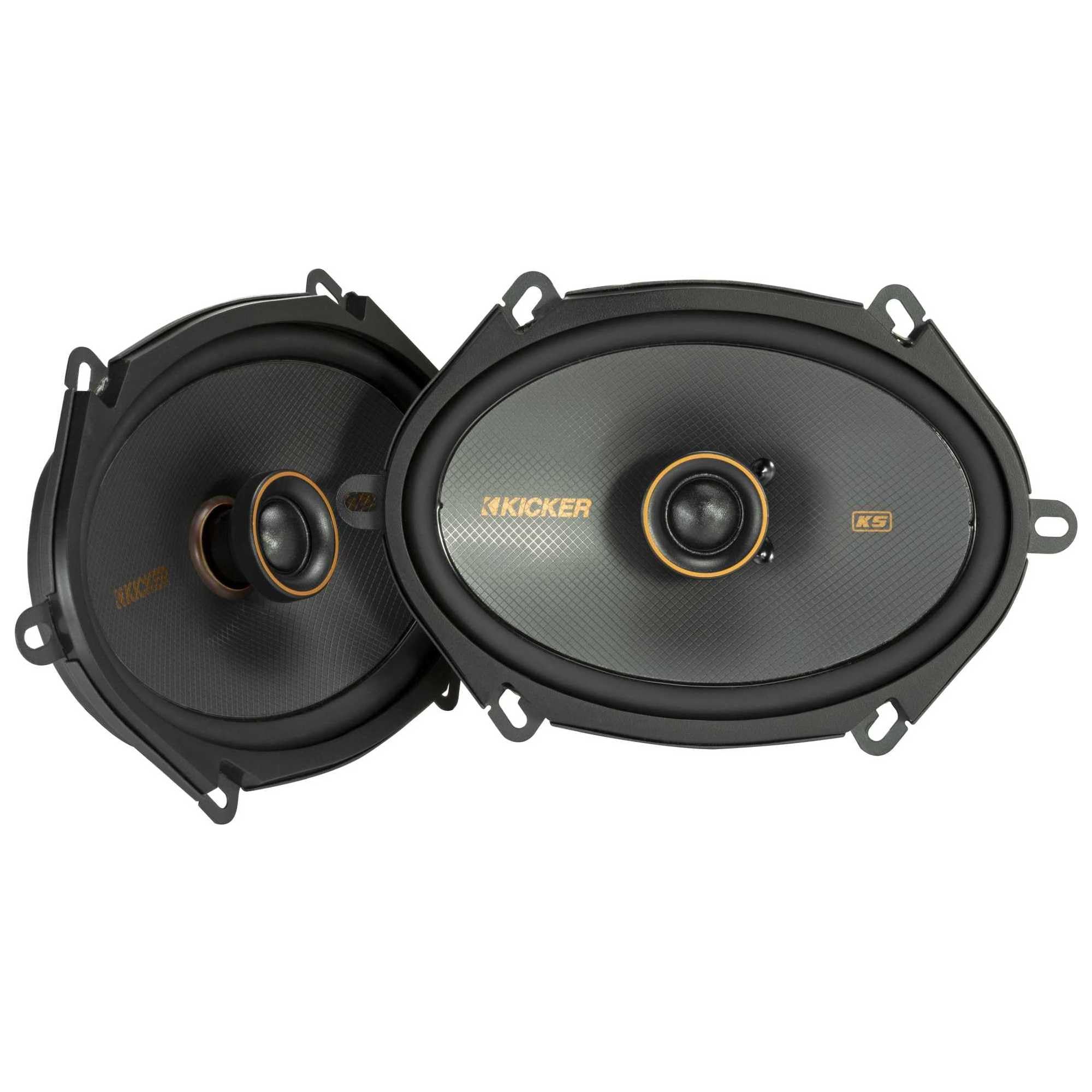
Delivers concert-level volume with bass detail that satisfies discerning listeners.
The KICKER KS-Series uses internally dampened polypropylene cones with tough rubber surrounds — a combination that delivers outstanding midrange detail and what the brand calls “pounding bass.” The redesigned woofer cones, voice coils, and crossovers mean this is not a carry-over design from previous KICKER generations. The zero-tweeter-protrusion design is a practical advantage: the speaker face is flat, so it fits in vehicles where a protruding tweeter would hit the factory grille or door panel. That makes it a particularly strong candidate for Subaru WRX, Jeep Wrangler JL, and other vehicles with tight fitment. Sound quality is the most-discussed feature by a wide margin — nearly 150 owners cite it, and the fit is the second most-praised aspect. Owners note “strong bass,” “crisp audio quality,” and that the speakers are “much louder” than factory units, even running off the stock head unit.
Installation flexibility is a hidden strength of the KICKER KS line. The speakers ship with multiple mounting brackets covering GM, Chrysler, and Toyota patterns, plus tinned wire leads and capacitors for those running a 2-ohm wiring configuration. One owner who upgraded a 2025 Subaru Crosstrek called the detail “incredible for budget/intermediate” and noted that the speakers opened up significantly when paired with a DSP for warmer EQ. A recurring owner caveat is that the fit is not universal — some vehicles require drilling a new mounting hole or grinding a small amount of plastic from the speaker pod. The durability aspect receives a mixed handful of mentions, but the overwhelming majority of customers note reliable performance.
The Standout Features
- Internally dampened polypropylene cone with rubber surround delivers punchy, controlled bass
- Zero tweeter protrusion means it fits under tight factory grilles without modifications
- Includes multiple mounting brackets for GM, Chrysler, and Toyota vehicles
What to Watch For
- Some vehicles need minor grinding or a new mounting hole for perfect fit
- A DSP or EQ adjustment helps open up the best tonal balance
Who this fits: Subaru, Jeep, and Toyota owners who want high-output bass with precise midrange and do not mind a few minutes of custom fitting.
Who should check fit first: anyone with an uncommon factory mounting pattern that the supplied brackets may not cover.
6. Infinity KAPPA-86CFX Kappa 6X8/5X7 Inch Two-Way Coaxial Speakers (Two Pairs)

Glass-fiber cone stiffness and adjustable tweeters deliver clean, accurate bass.
The Infinity Kappa uses glass fiber woofer cones — a material that is both lighter and stiffer than standard polypropylene. That stiffness matters for bass because a cone that flexes less pushes air more efficiently, producing tighter, more accurate low-frequency output. The Kappa also uses edge-driven textile dome tweeters rather than the common W-domes found in most competitors. Edge-driven tweeters deliver broader and smoother high-frequency response, so the transition from the bass notes to the high end feels smooth rather than abrupt. The high-output 2.5-ohm architecture with low-impedance voice coils is designed to extract every watt from your amplifier — the lower impedance draws more current, translating into higher output at the same voltage. That means the Infinity can play louder and with more bass authority than a 4-ohm speaker driven by the same amp.
Owners describe the sound as “excellent,” “superb,” and “beautiful.” One owner running a 4-channel amplifier at roughly 125 watts RMS called the Infinity superior to Alpine Type-Rs costing less. The adjustable tweeters with a -3 dB switch let you tame the high end if the speaker sounds too bright — a feature several owners used to dial in a warmer sound with EQ. Fit is confirmed for the 2010 F-150 with an adapter, and one owner noted that the speakers deliver “crisp, clear, good low-end bass, no distortion at high volume.” The two-pair package means you get four speakers — enough for front and rear doors in most vehicles. A small number of owners reported cracked mounting tabs on arrival, though the consensus was that the tabs did not affect installation.
What Makes It Premium
- Glass fiber cone is lighter and stiffer than plastic-based cones for tighter bass
- 2.5-ohm impedance pulls maximum power from your amp
- Adjustable tweeters with a -3 dB switch let you tune the sound to your preference
Things to Know
- Occasional reports of cracked mounting tabs on arrival — inspect before installation
- The low impedance means you need an amplifier stable at 2.5 ohms per channel
Best for: audiophiles with a quality 4-channel amp who want the most accurate bass reproduction from a 6×8 chassis and value the ability to tune the tweeter output.
pass on it if: you are running a factory head unit without an external amplifier — the low impedance is wasted on low-power sources.
7. KICKER Front and Rear Door 6×8 Speakers Kit for Ford F-150 1999-2014 Upgrade Kit — 2 Pairs of CS Series with Harnesses

The all-four-doors upgrade for the F-150 — harnesses included, guesswork removed.
This KICKER CS bundle is specifically engineered for the Ford F-150 from 1999 to 2014. It includes four Kicker 46CSC684 6×8 speakers (two pairs) and two pairs of pre-matched Vixen Go speaker harnesses, so the entire installation is plug-and-play with no cutting or splicing. The CS Series speakers are 2-way coaxial units with polypropylene cones and poly-foam surrounds that deliver a full-range sound with what the brand calls “ultra-clean bass.” Each pair handles 225 watts max power, and the high sensitivity ensures the speakers get loud on the factory stereo without an external amp. For F-150 owners who want to upgrade all four doors without figuring out which adapters to buy separately, this kit solves that problem in one box.
Owners are clear on what this kit does well. Speaker quality is the most-praised aspect (20 mentions), followed by sound quality (18 mentions). One owner with a 2010 F-150 XL Super Cab called them “phenomenal” with “clear crisp highs and mids” and bass that is “boomy but not overpowering.” Another owner of a 2002 F-250 confirmed a perfect fit and “no distortion even when you turn it up.” The sound is described as a “little better” than stock by one owner — not a dramatic night-and-day difference, but a clear improvement in clarity and distortion reduction. Poly-foam surrounds are lighter than butyl rubber and slightly less durable over a decade, but they are more compliant, which helps the cone move freely for bass response.
The Kit Advantage
- Includes four speakers and plug-and-play harnesses for 1999-2014 F-150s
- Clear highs and mids with “boomy” bass that does not overpower the mix
- No cutting, splicing, or adapter research required
Consider This
- Poly-foam surrounds are less durable long-term than butyl rubber
- Some owners note it is only a modest improvement over stock, not a dramatic transformation
Reach for this if: you own a 1999-2014 F-150 and want a guaranteed-fit, no-research upgrade for all four doors with included wiring.
Look elsewhere if: you drive a non-Ford vehicle or want a more dramatic bass upgrade that requires an amplifier.
8. ORION Cobalt Series CB683 6×8” 3-Way Coaxial Car Speakers, 280W, 4 Ohms (Pair)
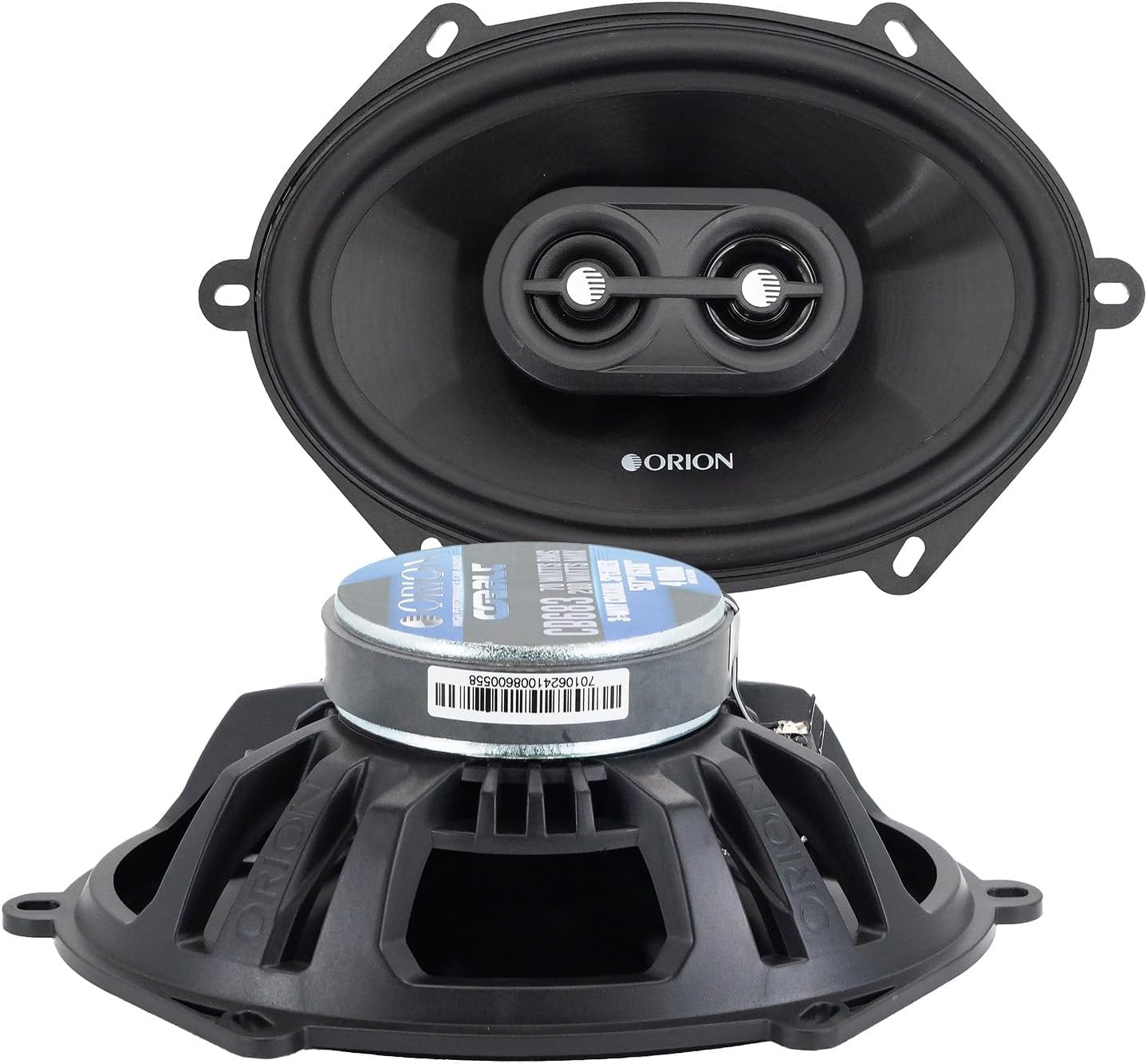
Respectable clarity at a price that leaves room for a subwoofer later.
The Orion Cobalt CB683 is a 3-way coaxial speaker (dedicated woofer, mid-range driver, and tweeter) with a polypropylene cone and a butyl rubber surround. The butyl rubber is a meaningful feature at this price point — it stays flexible in cold weather and resists cracking over time, unlike cheaper foam surrounds. Power handling is 70 watts RMS and 280 watts peak, with a sensitivity of 87.5 dB and a frequency response of 75 Hz to 20 kHz. The 75 Hz low-end means the speaker will reproduce bass guitar and kick drum fundamental frequencies, but it will not reach the deepest sub-bass notes. That is the honest trade-off at this tier: the Orion delivers clear, warm sound and a noticeable upgrade from factory paper-cone speakers, but the real low end comes from an external subwoofer.
Owners consistently praise the sound quality and value for money. An owner who installed them in a 2006 F-150 called them a “great upgrade from factory issued speakers with excellent sound.” Another owner paired the Orions with a small amp and reported they “sound really good” while honestly noting they are “not too crazy with bass.” The advice from owner experience is clear: run these with a modest amp to wake them up, and the “warm, transparent sound” becomes genuinely enjoyable. The 4-ohm impedance is standard and compatible with any aftermarket or factory head unit. Build quality is noted as solid — Orion has been around a long time, and owners recognize the brand’s reputation.
What You Get at This Price
- Butyl rubber surround for real durability, not foam that rots
- 3-way design with dedicated drivers for cleaner frequency separation
- Warm, transparent sound that improves significantly with a small amplifier
The Honest Limit
- 75 Hz low end means no sub-bass — you will want a subwoofer for deep bass
- 87.5 dB sensitivity is lower than class leaders; louder on an amp than a head unit alone
Who this is for: budget-conscious buyers who want a clear, warm upgrade from paper-cone factory speakers and plan to add a subwoofer for the deep stuff.
Who might skip: anyone wanting chest-thumping bass from the door speakers alone without a subwoofer.
9. NVX VSP68 600W Peak (200W RMS) 6×8 V-Series 2-Way Coaxial Speakers with 25mm Silk Dome Tweeters

200 watts RMS in a 6×8 shell — built for the amp crowd who loves bass boost.
The NVX VSP68 is designed for one specific buyer: someone with a powerful amplifier who wants a 6×8 that can handle serious continuous power without melting. The 200-watt RMS rating is more than double the next highest on this list (the Pioneer TS-A683FH at 85W RMS). That kind of power handling requires a sturdy voice coil and motor assembly, and the stamped steel basket provides the structural foundation. The 25mm silk dome tweeter delivers warm treble with clarity — a choice that prevents harshness at the high volumes that 200 watts enables. The polypropylene cone is strong yet lightweight, and the speakers come with a bass boost feature built in. The NVX also fits 5×7 inch mounting locations, which broadens its vehicle compatibility beyond strict 6×8 cutouts.
Sound quality is the most-praised aspect among owners. One owner with a Ford Ranger paired them with 95 watts RMS per channel and a 63 Hz high-pass crossover and said they “sound absolutely incredible.” Another owner of a 2019 Ford Flex confirmed a perfect fit and reported excellent sound when paired with an amp. The value is also noted as strong for the power rating. The recurring concern is durability — seven owners cite it as a negative aspect. Multiple reports describe a speaker failing after a few months of use, with one owner reporting a likely voice coil issue after under three months. The brand’s 90-day return policy is mentioned in the context of that failure. Buyers should factor in that a warranty claim may be needed for a small percentage of units.
The Power Proposition
- 200W RMS is an outlier for the category — built for serious amplifier setups
- Silk dome tweeter delivers warm treble that stays smooth at high volume
- Fits both 6×8 and 5×7 mounting locations
The Risk to Weigh
- Multiple reviewers point out speakers failing within a few months of use
- Does not include speaker wiring connectors — you will need to source them
Best for: experienced system builders with a powerful amp who need a 6×8 with extreme RMS headroom and accept the potential for durability issues.
Think twice if: you want a set-and-forget speaker that will run reliably for years without considering a warranty claim.
Understanding the Specs
Sensitivity (dB)
Sensitivity tells you how loud the speaker gets from a given amount of power. Measured in decibels, a higher number means more volume from less wattage. In a 6×8 speaker, sensitivity directly affects how much bass you feel. A speaker with 93 dB sensitivity will produce noticeably stronger low-frequency output at the same volume knob position than a speaker with 87 dB sensitivity. This is the single most important spec if you are running a factory head unit without an external amplifier — you want at least 90 dB to get bass that fills the cabin.
RMS vs. Peak Power Handling
RMS (root mean square) is the continuous power the speaker can handle while playing music for extended periods. Peak power is the maximum the speaker can survive in a split-second burst. For bass, the RMS number is the one that matters. A bass note is a sustained signal that heats the voice coil over time, so a speaker with low RMS and high peak will overheat and distort when the bass line gets heavy. Look for an RMS rating that matches or exceeds your amplifier’s output per channel. A 70W RMS speaker on a 50W RMS amp gives you a safe operating window for clean, deep bass.
FAQ
Can a 6×8 speaker actually produce strong bass without a subwoofer?
Will a 6×8 speaker fit my vehicle if it has 5×7 cutouts?
Do I need an amplifier to get good bass from 6×8 speakers?
What is the difference between a 2-way, 3-way, and 4-way 6×8 speaker?
Does a higher wattage rating always mean stronger bass?
What does “coaxial” mean in a 6×8 speaker?
How do I know if a 6×8 speaker will fit my Ford F-150’s door without modifications?
Should I use sound deadening material when installing 6×8 speakers for better bass?
Can I run 2.5-ohm or 3-ohm 6×8 speakers with a standard 4-ohm car stereo?
How long should 6×8 speakers last before needing replacement?
Final Thoughts: The Verdict
If you want one dependable pick, the 6×8 speakers for bass winner is the Rockford Fosgate P1683 Punch because it delivers the most genuine low-end weight from a 6×8 chassis — owners say it matches a factory 8-inch subwoofer — while keeping the highs clear and the build quality solid. If you want the deepest frequency extension on paper, the Pioneer TS-A6881F drops to 30 Hz for true subwoofer-depth bass. And for the highest sensitivity so your factory radio sounds loud and full without an amp, the JBL Club 864F with its 93 dB rating is the one to reach for.
How We Picked
We do not accept paid placement. Every pick is matched to a real buyer and a real use-case; we do not hands-on test units.
Sources & Methodology
Specifications: manufacturer listings and product documentation. Review insights: verified customer reviews, as of July 2026. Pricing: not shown on this page (it changes often); check the current price via the retailer link.
As an Amazon Associate, Gadgets Feed earns from qualifying purchases. This does not affect which products we feature.