
Our readers keep the lights on and my morning glass full of iced black tea. As an Amazon Associate, I earn from qualifying purchases.
Specs are compiled from manufacturer listings and verified buyer reviews and can change over time — please confirm the key details on the product page before buying.
You want the rear deck or doors to hit hard with deep, punchy low-end—without turning your trunk into a custom fiberglass project. That is exactly what a great set of 6x9s can do, since their larger cone area moves more air than round speakers of the same class. This guide sorts through the real owner experiences to tell you which models genuinely deliver bass you can feel and which ones need an amplifier to wake up.
I’m Min — the founder and writer behind Gadgets Feed. This guide is built by comparing the manufacturers’ published specifications and the patterns across verified customer reviews, so you get each pick’s real strengths and trade-offs instead of marketing spin.
We’re focusing on raw low-end punch, power handling, and sensitivity to find the 6×9 speakers for bass that actually thump in a daily driver.
Our Picks at a Glance


How To Choose The Best 6X9 Speakers For Bass
Hunting for bass specifically changes what you should care about. A speaker that sounds “clear” might roll off the low end, while a bass-focused model might sacrifice a bit of top-end sparkle. You need to balance the specs below to get the thump you want.
Match The Power To Your Source
If you are running straight off a factory or aftermarket head unit, you want a speaker with high sensitivity (measured in dB) so it plays loud and deep without an external amp. A 92 dB rating produces more output per watt than an 88 dB speaker. For real bone-rattling bass, you will likely need an amplifier, so look at the RMS (continuous) power rating—that tells you how much juice it can handle all day.
Check The Cone And Surround For Bass Capability
The woofer cone material and the surround (the flexible ring around it) determine how far the cone can travel and how deep the bass goes. Materials like polypropylene and mica-reinforced cones are stiff yet light, which helps them move fast and reproduce punchy lows. A butyl rubber surround is a good sign—it stays flexible in heat and cold and allows more cone movement for deeper bass without breaking.
Use Frequency Response As A Guide, Not A Promise
The frequency response range tells you the span of sound a speaker can produce, from deep bass to high treble. A speaker that reaches down to 31 Hz can dig into very low sub-bass territory, while one that stops at 80 Hz is really a mid-bass driver. Keep in mind the number is measured in a lab, not your car, so it is a guide for comparison rather than an absolute promise.
Quick Comparison
| Model | Best For | Peak Power | Frequency Response | Design | Amazon |
|---|---|---|---|---|---|
| Pioneer P.R.O. TS-6900PRO★ Best Overall | Serious loudness & SPL | 600W Max / 100W RMS | 31 Hz – 16 kHz | 2-Way Coaxial | Amazon |
| Pioneer A-Series MAX TS-A693FHBass & Clarity | Deep lows with clarity | 460W Max / 95W RMS | 29 Hz – 49 kHz | 2-Way Coaxial | Amazon |
| Infinity REF-9633IXSurprise Sub-Bass | Sub-bass without a sub | — | Down to ~10Hz* | 3-Way Coaxial | Amazon |
| Kenwood KFC-6966R | Chest-thumping boom | 400W Peak / 45W RMS | 35 Hz – 20 kHz | 3-Way Coaxial | Amazon |
| Alpine S2-S69 | Accurate, audiophile bass | — | Up to 40 kHz | 2-Way Coaxial | Amazon |
| DS18 PRO-X698 BM | Dedicated mid-bass driver | 400W Max / 200W RMS | — | Midrange Driver | Amazon |
| ORION Cobalt CB693 | Bass-heavy budget build | 320W Peak / 80W RMS | 80 Hz – 20 kHz | 3-Way Coaxial | Amazon |
| Alpine SXE-6926S | Plug-and-play clarity | 280W Max / 45W RMS | 40 Hz – 20 kHz | 2-Way Coaxial | Amazon |
| MB Quart FKB169 | Budget bass & value | — | — | 2-Way Coaxial | Amazon |
*Per buyer feedback on extension, not an official spec.
In‑Depth Reviews
1. Pioneer P.R.O. Series TS-6900PRO
Our pick — over 4.5★ from 700+ verified ratings; the strongest balance of quality and price.
The SPL machine that turns your rear deck into a pressure chamber
If your goal is serious sound pressure—the kind of volume that makes your neck hair stand up—this is the 6×9 to beat. The TS-6900PRO is built for the P.R.O. (Pioneer Reference for Open Show) line, which means it is engineered for loud, not just clear. With 600W of max power and 100W continuous, it has the headroom to stay composed when you crank the volume dial.
Bass performance here is deep and physical, with a frequency response that starts down at 31 Hz, which is sub-woofer territory for many round speakers. Owners call the jump from stock “brutal” in the best way. Its 88 dB sensitivity plays fine on deck power, but an amp open up full potential.
You get clear mids and highs from these, and the bass is solid—but buyers report: “Dont expect hard bass from these tho, buy an amp and sub.” If you want window-flexing sub-bass, you still need a dedicated subwoofer.
What It Does Best
- Massive 600W peak power handling for very loud playback
- Frequency response down to 31 Hz reaches into sub-bass
- Owners rate the midrange and high clarity as top-tier
Who Should Look Elsewhere
- True sub-bass requires an amp and subwoofer to satisfy
- Install in some GM trucks may need trimming door panels
Reach for this if: you want the loudest, most powerful 6x9s that still nail mids and highs while reaching deep.
Know this going in: owners say this needs an amp and sub for genuinely hard bass—it’s a superb mid-bass and clarity speaker.
2. Pioneer A-Series MAX TS-A693FH
The bass specialist that refuses to muddy the vocals
What makes this A-Series MAX stand out is how low it digs. Its frequency response starts at an extremely deep 29 Hz and extends all the way to 49 kHz, giving you both sub-bass reach and sparkly high-end detail. Its 92 dB sensitivity is the highest here, so it gets loud even on modest factory-radio power.
Owners call the bass “tight” and “controlled,” not boomy. Unlike budget speakers that blur the low end into the midrange, this one handles bass without losing mid and high frequencies. It even comes with multi-fit installation adapters, which owners mention makes the install clean and secure.
Sound quality earns more owner praise than any other feature by a wide margin, and it comfortably handles 50-60W RMS. The fair warning from a few audiophiles: on deck power alone, it focuses on the mid-high range and needs an amp to fully flex its bass muscles. Wire it up properly and it becomes a “can not be beat for the money” system.
Thump verdict: The deepest-reaching bass of any full-range pick here, with a high sensitivity that makes it forgiving on stock power.
Honest trade-off: Owners note that a proper amp is what open up the full low-end potential this driver is capable of.
3. Infinity REF-9633IX Reference
The sleeper that plays sub notes without a subwoofer
Here is the most surprising bass performer in this list. The Infinity Reference gets its low-end muscle from oversized Plus One woofers, which pack more cone surface area into the same 6×9 footprint. More surface area means more air moved, which translates directly to deeper, punchier bass output.
Customers note sub notes down to roughly 10 Hz without distortion—genuine subwoofer territory from a coaxial speaker. One owner in a 2020 Ram put them in all four doors with zero fitment issues and found them “way louder and better” than stock. The general recommendation from experienced buyers: “Buy these before deciding to get subwoofers!”
The edge-driven textile tweeters keep the highs smooth and clear, so the deep bass never comes at the cost of harsh treble. While it holds the highest owner rating in this roundup, it is also the least reviewed—so there is a smaller sample size of real-world data. A single note of caution: if you have premium aftermarket speakers already, some find the bass lighter than their existing setup.
Why it wins: Genuine sub-bass extension and a strong owner reputation, all without needing an amplifier to get going.
Reality check: It is the least-proven model here by review volume, so the data pool is thinner than the rest of the list.
4. Kenwood KFC-6966R Road Series

The loudest “boom boom bap” on a factory radio
You can feel the bass in your legs with the Kenwood KFC-6966R, even when driven by a stock head unit—some owners run these in motorcycle saddlebag lids with no amplifier and call the bass “unreal” and “on lock.” Its 35 Hz to 20 kHz frequency response reaches deep, and the 400W peak power handling means it won’t flinch when you push it.
The 3-way design includes a polypropylene woofer and an electro-dynamic tweeter, so the low end is powerful without the highs getting lost. Owners running them in home speaker boxes on 200W per channel report they handle the power flawlessly and fill a room with clear audio. A heavy-duty magnet design keeps the mounting depth shallow, which makes installation easier in tight factory locations.
Sound quality and build quality earn nearly equal praise. The honest gripes are about fit—a few specific vehicles like the 2002 Camry need modification—and a rare complaint about grille durability. If you want max bass from a simple head-unit-powered setup, this is the crowd favorite, with owners estimating a rating hovering around 4.5 stars across several hundred reviews.
Biggest Strengths
- Produces strong, physical bass without an external amp
- 400W peak power and 45W RMS for serious headroom
- Heavy-duty magnet, shallow depth for easier installs
Watch Outs
- Some cars need door baffle trimming to fit
- A few reviewers point out grille durability concerns
Grab these if: you want maximum bass punch straight from the factory radio without buying an amp.
Think twice if: your vehicle has tight factory mounts—this may require cutting or adapters to fit.
5. Alpine S2-S69 S-Series

Precise, controlled bass from a true Hi-Res audio specialist
Alpine’s S2-S69 is the refined choice for listeners who want bass that is accurate rather than just loud. Its headline feature is Alpine’s exclusive HAMR Surround technology, which allows maximum cone movement for powerful, precise bass notes. The woofer cone blends Poly Propylene, Glass Fiber, and Mica—materials chosen for high output and low distortion.
It is Hi-Res Audio Certified, meaning it reproduces frequencies up to 40 kHz for an accurate, natural soundstage. An experienced owner running it on a stock deck with four front speakers called it “more than meets my audiophile approval,” praising the enveloping sound. It has proven compatibility across a wide range, from a 2015 Dodge Ram to a 1978 Chevy Malibu rear deck with simple adapters.
The 1″ integrated tweeters deliver crisp highs that keep pace with the deep lows. The main note from owners is that while it sounds great, it “needs some power”—so pairing it with an amplifier makes a significant difference. It also expects you to source speaker adapters for many vehicles, which is standard for aftermarket installs.
Best for: The buyer who wants tight, musical bass and top-tier clarity rather than just maximum volume.
One caveat: Owners agree it performs best with an amp feeding it clean power; on deck power alone it won’t reach full potential.
6. DS18 PRO-X698 BM
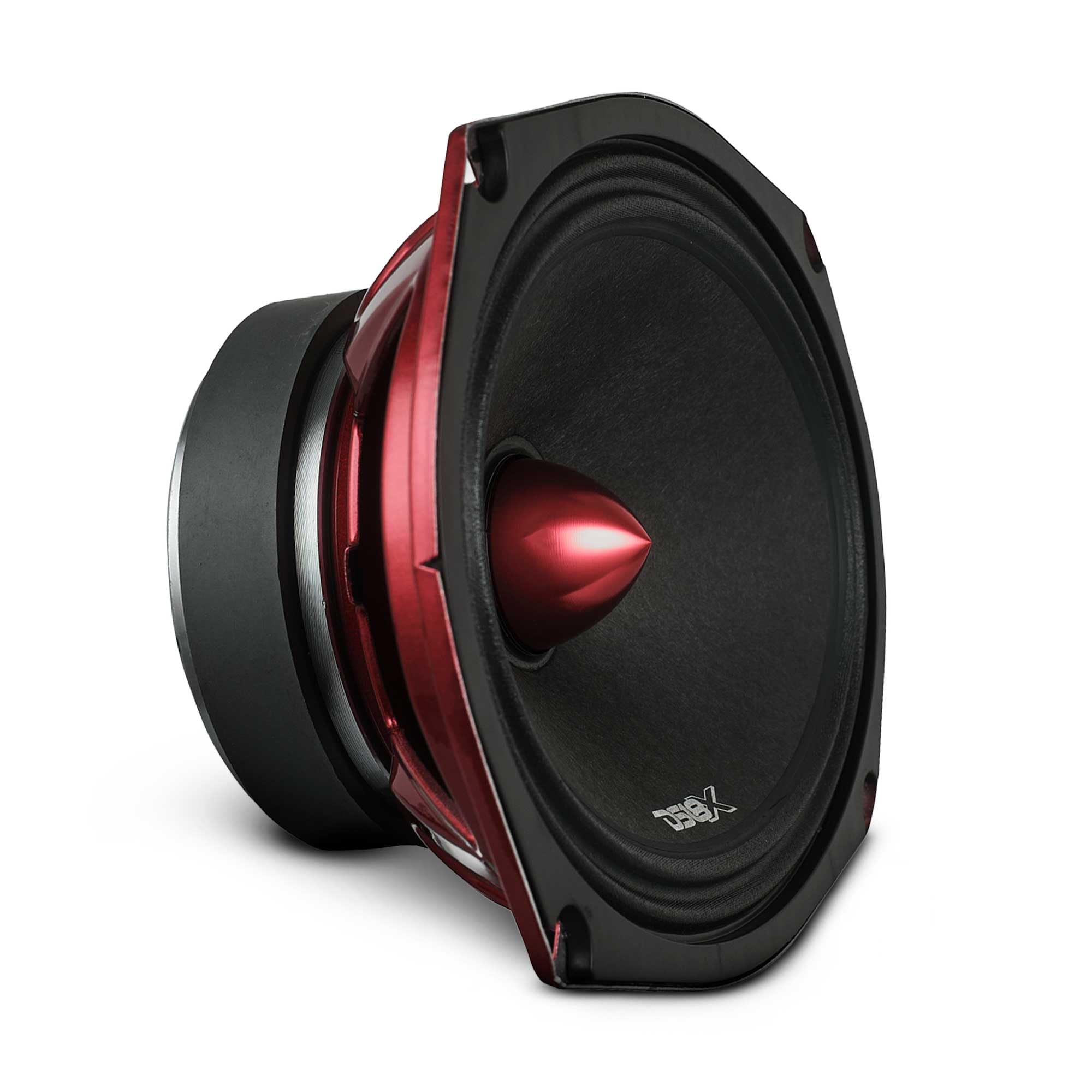
The dedicated mid-bass driver built to handle brutal power
This is not a full-range coax—it is a specialized midrange driver, and knowing that distinction is key. The DS18 PRO-X698 BM is engineered to cover the meaty part of the audio spectrum where vocals and instrumentals live, making it a fantastic addition to a system that already has tweeters and a subwoofer handling the extremes.
What makes it a bass weapon is its power handling: 200W RMS and 400W max at 8 Ohms, driven by a 1.5″ high-temperature CCAW voice coil. That coil is the engine room, and this one is built to withstand extreme heat and high volumes without failing. The high-strength ferrite magnet produces a wide range of tones while handling that tremendous power.
Owners praise sound quality and build quality nearly equally. The red aluminum bullet styling gives it a distinctive look, and the aluminum enclosure material adds to its sturdy feel. Just remember this is one speaker—not a pair—and it isn’t designed to be your only speaker; it is the muscle in a comprehensive build.
Perfect for: Building a serious component system where you need a dedicated mid-bass driver that can take serious wattage.
Not for: Anyone wanting a simple full-range drop-in replacement—this needs supporting speakers and an amp to shine.
7. ORION Cobalt CB693

The budget 6×9 that puts bass first and feels like a steal
ORION built the CB693 with one obvious priority: bass. The specs back it up—a dedicated 3-way design with a woofer tuned for low-frequency reproduction, backed by 320W of peak power and 80W RMS. Owners specifically call out the “strong midbass” and “bass-heavy” character, making it a great pick if low-end punch is your main obsession.
The build quality punches above the price point: a butyl rubber surround and polypropylene cone combine for crisp, powerful, distortion-free audio. As a drop-in for a 2006 Buick Lucerne rear deck, it was a perfect factory fit that “brings the rear stage to life” with clear highs and warm mids alongside that strong midbass.
Sound quality and value are the two things owners rave about. The honest feedback from a truck owner with a 2014 Ram 2500: the bass is heavy, but the mids and highs take a backseat, and you may want sound dampening to control vibration at high volume. If you like your music with extra thump and don’t need clinical detail, this fits the bill.
Reasons To Buy
- Delivers noticeably strong bass for a 6×9 in this class
- 80W RMS and 320W peak offer solid power handling
- Butyl rubber surround adds durability and deepens mid-bass
Keep In Mind
- Mids and highs take a back seat to the bass emphasis
- Some shoppers say needing sound dampening to stop vibration
Pick this for: a bass-forward upgrade on a budget where low-end impact matters more than perfect balance.
skip it if: you want a neutral, all-rounder speaker—the bass-heavy tuning means less detail up top.
8. Alpine SXE-6926S

The fuss-free Alpine that fits like a glove and bumps on deck power
You get a genuine upgrade that installs cleanly without adapters or head-scratching with the Alpine SXE-6926S. Owner reviews praise its fit—it goes into a 2007 Toyota Solara “like a glove” and drops into a 2006 Pathfinder front door with ease, saving you hassle when you’re working in a door panel.
For bass, this 2-way delivers a “nice bump” with a frequency response that reaches down to 40 Hz and a peak power rating of 280W. The magic is that it needs nothing extra to power them—owners emphasize they work beautifully straight off an aftermarket head unit. One reviewer running a 2007 Accord with a 180W radio found better highs, equal bass, and a great overall balance.
The 4-ohm impedance is a standard match for most factory and aftermarket systems, making it a true plug-and-play candidate. The long-fiber natural pulp woofer and mylar foam tweeter give it that classic Alpine clarity. The recurring concern across owner feedback is durability over the long haul, so it is best treated as a great-value speaker rather than an heirloom.
The appeal: Genuine plug-and-play simplicity with a solid bump in bass, ideal for a weekend DIY install.
Fair warning: Long-term durability is the one thing owners flag most, so manage expectations on lifespan.
9. MB Quart FKB169 Formula

The value pick that sounds like it costs twice the price
MB Quart’s Formula FKB169 is the budget pick that refuses to sound budget. The name brand carries serious audio heritage, and buyers report “Damm great bass n sound for less then 50 bucks”—punchy low end that defies the price tag. It is a 2-way coaxial, so it pairs nicely if you already run separate super tweeters for the high end.
The bass comes from butyl rubber surrounds, which provide durability and deeper mid-bass impact. The lightweight thermal-formed polypropylene cones enable faster midrange response, so it stays articulate even when the volume climbs. A high-temp adhesive keeps the cone and surround bonded in high-power use and extreme weather, adding to its longevity.
Available as a pair, this is an excellent rear-deck or door upgrade for someone wanting immediate bass improvement without a big spend. Owner feedback is strongly positive on both sound quality and value, with a mix of notes about size—some find them absolutely huge, so measure your mounting depth. An occasional unit may arrive with a hiss, which is the trade-off at this price point.
Why It’s A Steal
- Name-brand sound quality with genuine bass at a budget price
- Butyl rubber surrounds for durability and deeper mid-bass
- Comes as a full pair for a simple upgrade
Small Compromises
- Some owners find the physical size larger than expected
- Rare reports of a hiss or interference on one speaker
Best for: the value-focused buyer who wants a trusted brand and real bass without spending big.
Just note: it’s a 2-way, so you’ll want existing tweeters or a willingness to add them for the full frequency picture.
Understanding the Specs
Power Handling (RMS vs Peak)
RMS power is the amount of power a speaker can handle continuously—the number that actually matters for daily use. Peak (or max) power is a marketing figure that shows the brief burst a speaker can survive. A speaker with 100W RMS will sound clean and stay durable even when pushed, while its 600W peak rating just means it won’t blow the instant you hit a loud note.
Sensitivity (dB)
Sensitivity tells you how efficiently a speaker converts power into sound. A rating of 92 dB means it produces 92 decibels of volume with just 1 watt of power, measured from 1 meter away. Higher numbers are better for running on a stock head unit without an amp—each 3 dB increase is roughly a doubling of perceived loudness from the same power.
FAQ
Do 6×9 speakers really produce deep bass by themselves?
What is the difference between a 2-way and a 3-way 6×9 speaker?
Will 6×9 speakers fit in my car without modification?
Should I buy an amplifier to get good bass from 6×9 speakers?
What does frequency response tell me about bass performance?
Can I run 6×9 speakers without a subwoofer for bass?
Why do some 6×9 speakers handle bass better than others?
What does impedance (4-ohm vs 8-ohm) mean for my system?
Is it better to buy a midrange driver or a full-range 6×9 for bass?
Do 6×9 speakers need grilles for protection?
Final Thoughts: The Verdict
Across the board, the 6×9 speakers for bass winner is the Pioneer P.R.O. TS-6900PRO because it combines massive power handling and deep 31 Hz bass extension in a proven package. If you want the deepest reach of all without giving up clarity, grab the Pioneer A-Series MAX TS-A693FH. And for the strongest bass on stock power without an amp, the Kenwood KFC-6966R is the one to reach for. With the Kenwood being the crowd favorite among hundreds of owners for its un-amped punch, it is the safest bet for a simple, high-impact upgrade.
How We Picked
We do not accept paid placement. Every pick is matched to a real buyer and a real use-case; we do not hands-on test units.
Sources & Methodology
Specifications: manufacturer listings and product documentation. Review insights: verified customer reviews, as of August 2026. Pricing: not shown on this page (it changes often); check the current price via the retailer link.
As an Amazon Associate, Gadgets Feed earns from qualifying purchases. This does not affect which products we feature.