
Our readers keep the lights on and my morning glass full of iced black tea. As an Amazon Associate, I earn from qualifying purchases.
Specs are compiled from manufacturer listings and verified buyer reviews and can change over time — please confirm the key details on the product page before buying.
Upgrading your car’s 6×9 speakers is the fastest way to turn a dull factory audio system into something you actually want to listen to. The right pair brings out vocals, makes drums snap, and adds bass you can feel in your seat instead of just noise at high volume.
I’m Min — the founder and writer behind Gadgets Feed. This guide is built by comparing the manufacturers’ published specifications and the patterns across verified customer reviews, so you get each pick’s real strengths and trade-offs instead of marketing spin.
Upgrading your car’s sound starts with picking the right 6×9 speakers for sound quality—ones that match your vehicle’s fit, handle enough power, and cover the frequencies you actually hear. The picks below balance those three factors so you get a clear, loud upgrade without guesswork.
Our Picks at a Glance


How To Choose The Best 6X9 Speakers For Sound Quality
Picking 6×9 speakers is about matching the speaker to your power source and your listening habits. A speaker that needs an amp will sound weak on a stock stereo, while a high-efficiency model can shine without one if the specs line up.
Match Power To Your Setup
Check the RMS rating (the continuous power a speaker handles safely) against what your head unit or amp delivers. If you have a factory stereo, look for high sensitivity—around 90 dB or more—so the speaker produces clear volume from limited power without distortion.
Consider The Speaker Design
Coaxial speakers pack everything into one unit for an easy swap, while component systems separate the tweeter for better soundstage and off-axis response. Decide if you want simplicity or the best possible imaging based on your car’s layout.
Quick Comparison
| Model | Best For | Power | Sensitivity | Design | Amazon |
|---|---|---|---|---|---|
| Pioneer TS-6900PRO★ Best Overall | High-output mids | 600W max / 100W RMS | 88 dB | 2-Way Coaxial | Amazon |
| Kenwood KFC-6966SBudget Champion | Budget-friendly 3-way | 800W peak / 90W RMS | — | 3-Way Coaxial | Amazon |
| Rockville RV69.2CAmp-Ready Power | Amp-driven systems | 1000W peak / 220W RMS | — | 2-Way Component | Amazon |
| Pyle PLG69.8 | Creative box builds | 500W peak / 250W RMS | — | 8-Way Coaxial | Amazon |
| Kenwood KFC-6966R | Balanced all-rounder | 400W peak / 45W RMS | — | 3-Way Coaxial | Amazon |
| DS18 PRO-X698 | Midrange vocal clarity | 400W max / 200W RMS | — | Midrange Driver | Amazon |
| Infinity Reference 9632IX | Factory radio upgrade | — | — | 2-Way Coaxial | Amazon |
| CT Sounds Meso 6×9 | Silk tweeter smoothness | 400W max / 200W RMS | — | 2-Way Coaxial | Amazon |
| Pioneer TS-A693CH | Component soundstage | 460W max / 105W RMS | 92 dB | 2-Way Component | Amazon |
In-Depth Reviews
1. Pioneer P.R.O. Series TS-6900PRO
Our pick — over 4.5★ from 700+ verified ratings; the strongest balance of quality and price.
The high-output pioneer that makes mids the star of your sound stage.
If you want a speaker that treats vocals and guitars like they deserve center stage, this Pioneer is built for exactly that. Its frequency response stretches from 31 Hz to 16 kHz, meaning you get the low rumble and the crisp edge of a cymbal without losing the important middle range where most music actually lives.
Owners praise the sound quality most, and the specs explain why: a 600-watt max power rating with 100 watts of continuous RMS (the power it can handle steadily) gives you headroom to play loud without distortion. A sensitivity of 88 dB (how efficiently it converts power into sound) keeps it clear even on lower-power factory inputs. It’s a 2-way design, so separate drivers for highs and lows work together for balanced, accurate output instead of a muddy blend.
Versatility comes standard — buyers report these work well for both mid-bass and midrange applications, and the new installation is straightforward with the included grilles and mounting hardware. Just note the honest expectation: this is a midrange specialist, not a subwoofer replacement. For hard bass, you’ll want to add an amp and a dedicated sub, which is a fair trade for the vocal clarity it delivers.
Why It Wins
- Outstanding midrange clarity that reveals notes you missed before
- Handles 600W max power for serious volume without strain
- Easy install with all hardware included
Know Before You Buy
- Don’t expect hard bass without a subwoofer
- Some Chevy trucks need door panel trimming
Reach for these if you: value clear, powerful mids in a coaxial that fits most cars, trucks, and motorcycles.
Think twice if you: want earth-shaking bass from the speaker alone — pair these with a sub instead.
2. Kenwood KFC-6966S
The budget-friendly 3-way that surprises everyone with how well it fits and plays.
This is a 3-way coaxial design, meaning a dedicated mid-woofer, tweeter, and super-tweeter each handle their slice of the frequency range—from 35 Hz (deep bass) up to 20,000 Hz (high treble). That separation keeps highs and mids clean and distinct, so vocals and cymbals don’t blur together.
The polypropylene woofer cone and foam/rubber surround resist the wear that cheaper paper cones suffer over time in a hot car. Peak power hits 800 watts per pair with 90 watts RMS, which is plenty for a stock stereo and gives you room to grow if you add an amp later. The 4-ohm impedance and shallow 3-inch top-mount depth make it an easy fit for factory openings.
Sound quality is the top praise, with one buyer putting it plainly: buy these and “they fit amazingly.” The honest catch is fitment varies by vehicle—the mounting holes don’t always line up, so plan for a little drilling or spacers on models like a 2003 Camry. It’s a small adjustment for sound that owners call “good for the price.”
Smart budget bet: exceptional value with good highs and mids, plus a genuinely easy install for most vehicles.
Worth noting: not all cars drop-in perfectly — check your mounting pattern before you commit.
3. Rockville RV69.2C
The loud component system that’s meant to be fed by a real amplifier.
This is the speaker for people who already have an amp or plan to buy one. The Rockville RV69.2C is a component system — the tweeters mount separately from the woofers for better imaging — with a serious 1000-watt peak and 220 watts RMS per pair. That’s enough power handling to wake up a full build when driven by a high-powered amplifier.
The injection-molded polypropylene woofer cone and 1.2-inch PEI dome tweeter work to deliver deep bass, crisp mids, and smooth highs. A fine-tuned 2-way crossover splits frequencies at 3.5kHz, sending the highs and lows to the right drivers for precise separation rather than a confused mix. The Flex Motion butyl rubber surround and ferro-fluid cooled tweeter magnet are built to keep playing when you push the volume.
Owners are blunt that these exceed expectations for the money — “way better than I expected” is the recurring theme, especially when paired with a 4-channel amp. But the durability picture is honest and mixed: some report tweeters blowing out when pushed hard. The recurring caution is to match them with a clean, properly tuned amp signal rather than maxing out a cheap one.
Built to be heard: huge power handling and precise crossover separation for a loud, detailed system.
Handle with care: feed them clean amp power — the tweeters are the weak point if you clip the signal.
4. Pyle PLG69.8

The eight-way oddball that shines brightest in a custom box build.
Most 6x9s are 2-way or 3-way, but this Pyle packs an 8-way design with a 0.5-inch neodymium dome tweeter, a 2-inch polymer cone midrange, and five super film tweeters. That adds up to a speaker that can produce a very detailed, layered sound when it’s set up well, handling 500 watts peak with 250 watts RMS.
The 120-ounce magnet structure and yellow poly injected cone give it plenty of stiffness without the added weight, helping produce smooth, loud, and detailed sound across a 45-22kHz frequency range. The 3.55-inch mounting depth fits standard factory openings, and the included custom grilles, wires, and hardware make the initial install painless.
The creative crowd loves these — one detailed box build produced audible bass down to 9Hz with hi-fi mids and highs through wood horns. That’s the thing: these reward effort. On a basic door install they’re good, but reports of tweeters blowing and distortion on some factory systems mean they’re not the safest bet for a truly simple drop-in swap.
For the tinkerer: remarkable detail and extension when mounted in a custom enclosure, not just a door panel.
Be realistic: the recurring concerns are tweeter durability and fitment that varies wildly by vehicle.
5. Kenwood KFC-6966R

The Kenwood Road Series that balances bass, clarity, and easy install for daily drivers.
This is the sensible upgrade for someone who wants better sound without turning their trunk into a project. The KFC-6966R is a 3-way coaxial with a 400-watt peak and 45 watts RMS, and a frequency response of 35 Hz to 20 kHz. The 4-ohm impedance conducts power evenly, so it plays cleanly at appropriate levels whether you mount it in the front or rear.
The cloth woofer cones and electro-dynamic tweeters are built for durability, while the heavy-duty magnet design with lower tweeter heights and a shallow depth make it easier to fit behind tight factory panels. It comes with grilles for protection, and owners say the bass is genuinely surprising — with one reporting you can “feel the bass on your legs” even without an amp.
Versatility is a strong suit: it works as a front or rear speaker, and buyers have even used it in home speaker boxes with great results, handling 200W RMS per channel in that setting. The honest downsides are a fit that isn’t always drop-in (some trucks need door baffling trimmed) and a minority who find the power handling modest if you plan a big amp build later.
Dependable daily driver: a balanced 3-way that sounds great on stock power and still plays well with amps.
The catch: not every vehicle fits without minor trimming, and dedicated bass heads will still want a sub.
6. DS18 PRO-X698 BM
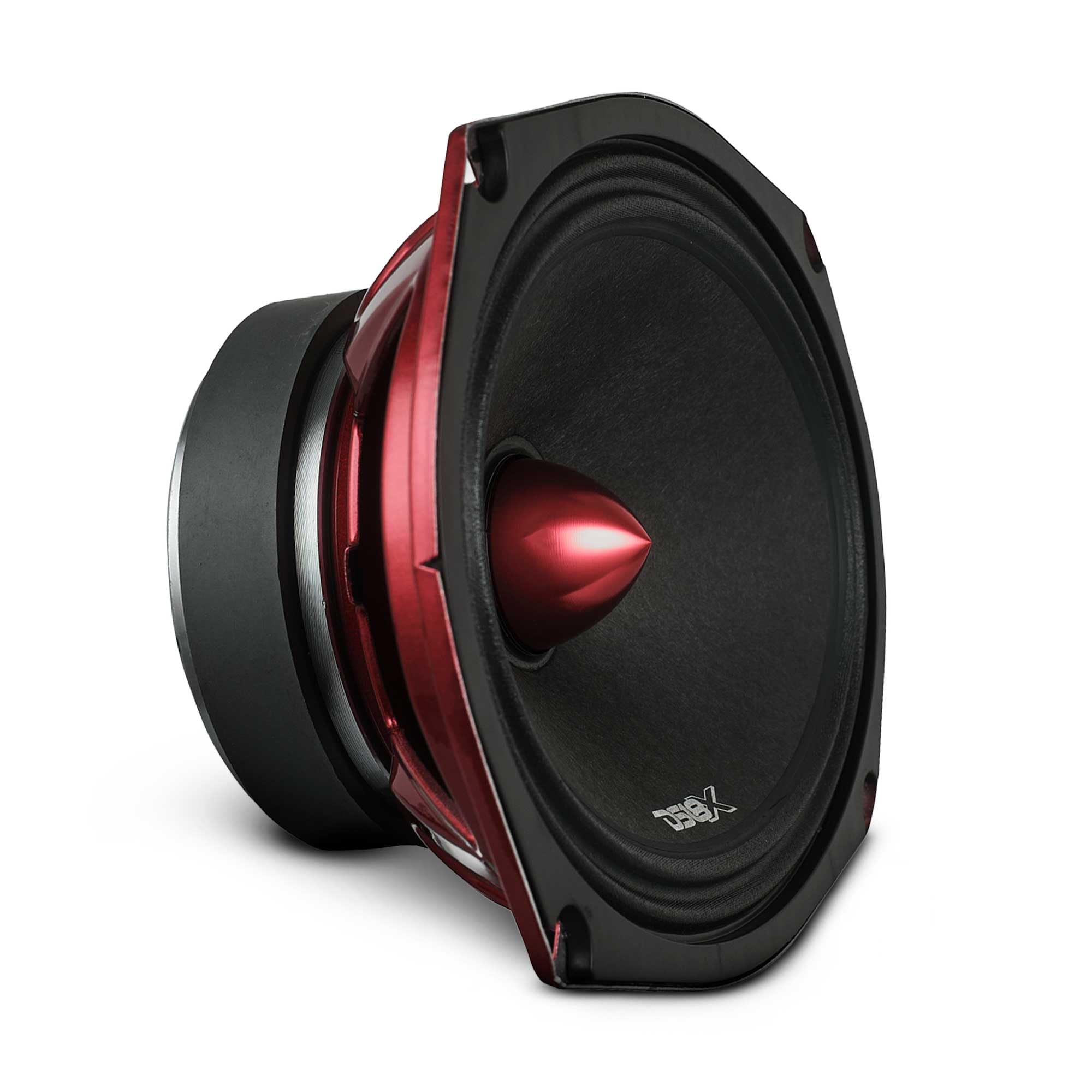
The red-bullet midrange that makes vocals cut through a full system.
If your system’s weak link is the vocals and instrumentals getting lost in the mix, this DS18 is the fix. It’s a dedicated midrange driver, not a full-range speaker, designed to handle the most significant part of the audible spectrum — the part where voices and guitars live. The eye-catching red aluminum bullet cone is built for the job.
Power handling is serious: 400 watts max with 200 watts RMS at 8 ohms. That’s enough to keep up with a loud build. The 1.5-inch high-temperature CCAW voice coil withstands extreme heat while holding its shape, which is what keeps the speaker alive when you drive it hard for hours. High-strength ferrite magnets produce a wide range of tones while handling big power at high volumes.
Owners describe the sound as crisp, and most are so pleased with the clarity and build quality that they call it great value for the money. Just understand what this is: it’s one speaker, built to be a midrange piece in a larger system — you’ll still need woofers and tweeters elsewhere to cover the full range. It excels in its lane rather than trying to do everything.
Vocal clarity weapon: a rugged 200W RMS midrange that brings instrumentals and voices to the front.
Know the role: this is one specialist driver — pair it with a fuller system, not a lone door swap.
7. Infinity Reference 9632IX
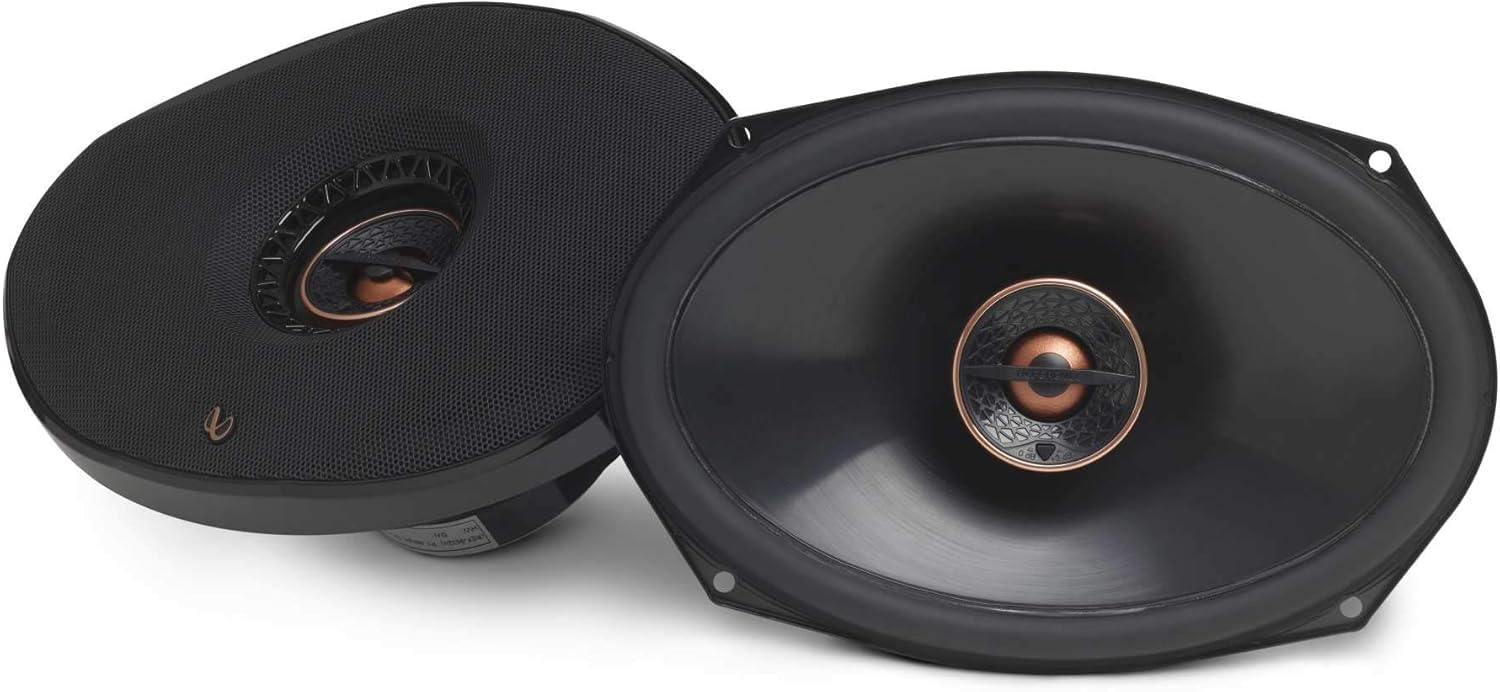
The reference-grade 2-way that turns a factory radio into a proper sound system.
Sometimes the best upgrade is the one that works with what you already have. The Infinity Reference 9632IX is a 2-way coaxial that owners consistently describe as a “great upgrade from factory setups,” delivering clear, crisp sound full of depth on a stock radio. The well-balanced tuning sits between bright and warm, so nothing sounds harsh or muddy.
Fit is a genuine highlight — owners mention it fits exactly as described, with one install being “plug-and-play, no cutting” in a 2002 Dodge Ram. The easy installation and good value for money round out a package that’s clearly designed for someone who wants high-quality sound without a major install project.
The sound quality is the top praise, and with the right amp these really open up — one owner notes the bass “hammers” when paired with a 400W Infinity K4 amp. The honest trade-off is that they need an amp for full power, and a separate sub is still needed for deep, thumping bass. On deck power alone, you get clean, clear sound rather than overwhelming low end.
Clean and balanced: superb clarity on factory power with an easy fit — the right choice for a simple, high-quality swap.
Plan for growth: owners agree an amp open up their full potential, and bass lovers will still want a sub.
8. CT Sounds Meso 6×9

The silk-tweeter CT Sounds set that delivers high fidelity without harshness.
If you hate that piercing, fatiguing treble that cheap speakers produce, the CT Sounds Meso is engineered with the opposite goal. The attached silk-dome tweeters use a CCAW voice coil and neo magnet to recreate vocals and high frequencies smoothly, so cymbals and voices sound natural rather than sharp. This is high-fidelity tuning for people who care about tonal accuracy.
Under the hood, a high-quality fiberglass cone and nitrile butadiene rubber surround deliver a crisp sound with powerful mid-bass. Power handling is solid at 200W RMS and 400W max per set, and owners say they’re loud and clear — with zero distortion at 80% volume even without an amp on some setups. The bass is deep enough that one owner notes it can “rattle the car.”
What wins people over is the balance: a well-tuned mix of mid-bass and snappy highs that’s “better than Skar” per one owner’s direct comparison. The honest notes are about fitment — Ram trucks need spacers to avoid window contact — and the huge magnet that takes up space behind the panel. It’s a premium-feeling speaker that asks for a little install patience in exchange for that smooth sound.
Smooth operator: silk tweeters (soft-dome drivers that reduce harshness) and a fiberglass cone make this among the most refined-sounding 6x9s here, so high notes stay sweet instead of piercing.
Install caveat: the big magnet and snug fit mean most installs need spacers and a bit of panel work.
9. Pioneer A-Series MAX TS-A693CH

The component Pioneer with 92 dB sensitivity that plays loud and clear on modest power.
Here’s the rare speaker that shines on a stock stereo but has the specs to grow with an amp. The Pioneer TS-A693CH is a 2-way component system — separate woofers and tweeters — with a frequency response from 30 Hz to 58 kHz, far beyond the range of human hearing so the top end never feels limited. Crucially, its 92 dB sensitivity means it produces clear, loud sound even with low power inputs, so you don’t need an amp to enjoy it right away.
The component design is the real story: the drivers deliver uniform off-axis response, which is ideal for cars where speakers are often aimed away from your ears. Owners praise tight, controlled bass that doesn’t sacrifice mid and high frequencies, with one noting it reaches into the 40-45 Hz range for real depth. Maximum power handling is 460 watts with 105 watts continuous, giving you serious headroom.
Installation is genuinely easy with the included 6×9 multi-fit adapters and angled tweeter mounts, though the adapters are designed for GM/Chevy fitment—other vehicles need the correct brackets. Owners say the bass quality and clarity “can not be beat for the money,” but that deep bass needs an amp on some decks; on factory power, it’s louder and clearer than stock but light on the low end.
Best of both worlds: high sensitivity for factory radios plus component-level staging and 460W of headroom for future amps.
Plan the bass: the included adapters only truly fit GM/Chevy, and deep bass really opens up with an amp.
Understanding the Specs
RMS vs. Peak Power
The RMS rating is the continuous power a speaker handles safely for long periods — this is the number that matters for everyday listening. Peak or max power is the brief burst a speaker can survive. Match the RMS of the speaker to what your amp or stereo actually delivers so you get clean output instead of distortion or damage.
Sensitivity and Frequency Response
Sensitivity (measured in dB) tells you how loud a speaker plays with a given amount of power — higher numbers like 92 dB are great for stock stereos that don’t have much wattage. Frequency response shows the range of sound a speaker reproduces, from deep bass in the 30-40 Hz range up to high treble beyond 20 kHz. Wider range means more of the music comes through.
FAQ
Will 6×9 speakers fit my car without modification?
What is the difference between 2-way and 3-way 6×9 speakers?
Do I need an amplifier for good sound quality from 6×9 speakers?
What does RMS power mean for a 6×9 speaker?
Can I run 6×9 speakers with my factory stereo?
What is a component speaker system vs a coaxial speaker?
What does the crossover do in a component 6×9 system?
What impedance should my 6×9 speakers be?
Final Thoughts: The Verdict
Across the board, the fastest route to a better-sounding car is the 6×9 speakers for sound quality winner: the Pioneer TS-6900PRO, because it nails the mids and highs that make music engaging while handling up to 600 watts of power. If you want an easy, balanced upgrade for a stock radio, grab the Infinity Reference for its clean, plug-and-play sound. And for a budget-first swap that still delivers impressive highs and mids, the Kenwood KFC-6966S is the one to reach for.
How We Picked
We do not accept paid placement. Every pick is matched to a real buyer and a real use-case; we do not hands-on test units.
Sources & Methodology
Specifications: manufacturer listings and product documentation. Review insights: verified customer reviews, as of August 2026. Pricing: not shown on this page (it changes often); check the current price via the retailer link.
As an Amazon Associate, Gadgets Feed earns from qualifying purchases. This does not affect which products we feature.