
A 7 1/4 miter saw might look small next to its 10- or 12-inch cousins, but that compact frame trades raw capacity for genuine advantages—lighter weight for hauling up stairs, tighter blade clearance for finer finish cuts, and a benchtop footprint that fits on a crowded job site or a garage workbench. For trim carpentry, baseboard installs, crown moulding, and framing lumber up to 2×6, this size class often delivers cleaner cuts with less fatigue because the smaller blade deflects less under load.
I’m Min — the co-founder and writer behind Gadgets Feed. I’ve spent dozens of hours analyzing cutting capacities, motor torque curves, bevel/miter detent precision, battery platform compatibility, and shadow-line vs. laser guide accuracy across the current crop of 7-1/4-inch sliding and compound models to find the saws that actually earn their spot in a pro’s van or a DIYer’s shop.
This guide breaks down seven distinctly different models to help you find the best 7 1/4 miter saw for your specific workflow and budget.
How To Choose The Best 7 1/4 Miter Saw
Seven-and-a-quarter-inch miter saws occupy a specific niche: they are portable enough for a service van, precise enough for finish carpentry, and powerful enough for dimensional lumber up to 2×8. The decision comes down to how you prioritize power source, cut capacity, and alignment accuracy.
Power Source: Corded vs. Cordless
Corded saws deliver consistent full-torque at the blade without battery anxiety, making them ideal for all-day trim jobs where an outlet is nearby. Cordless models free you from extension cords entirely, but you must evaluate the specific battery platform—ampere-hour rating, voltage sag under load, and compatibility with other tools in your kit. If you already own RYOBI, WORX, CRAFTSMAN, or Bosch 18V batteries, a bare-tool purchase saves significant cost.
Cutting Capacity: Crosscut vs. Crown
The two numbers that matter are crosscut capacity at 90° and nested crown capacity. A saw that can chew through a 2×10 flat (like the SKIL) or handle 3-5/8-inch nested crown (like the CRAFTSMAN) saves you from flipping boards or flipping the saw. Sliding rails extend reach, but check whether the system uses fixed rails (larger benchtop footprint) or a compact rail design (better for tight spaces).
Cutting Guide: Laser vs. Shadow Line
Laser guides cast a visible red line on the kerf, which helps beginners align their mark. Shadow line systems use the blade itself to cast an ultra-precise shadow of the tooth path, eliminating parallax error. In bright sunlight or on dark materials like walnut, shadow lines often win the accuracy battle, though lasers are perfectly adequate for standard trim work.
Quick Comparison
On smaller screens, swipe sideways to see the full table.
| Model | Category | Best For | Key Spec | Amazon |
|---|---|---|---|---|
| Bosch GCM18V-07SN | Cordless Premium | Pro portability | 8.25″ crosscut / 26 lbs | Amazon |
| CRAFTSMAN V20 CMCS714M1 | Cordless Kit | Kit value | 585 cuts per charge | Amazon |
| RYOBI ONE+ PBT01B | Cordless Value | Bare-tool flexibility | 800 cuts per charge | Amazon |
| WORX Nitro WX845L | Cordless Power | Shadow line accuracy | 4.0Ah PRO battery | Amazon |
| Evolution R185SMS+ | Corded Multi-Material | Steel & plastic cuts | 1500W motor / TCT blade | Amazon |
| SKIL MS6306-00 | Corded Compact | Compact rail footprint | 4800 RPM / 10A motor | Amazon |
| Hoteche P805219A | Corded Budget | Entry-level price | 7.5A motor / laser guide | Amazon |
In‑Depth Reviews
1. Bosch GCM18V-07SN PROFACTOR™

The Bosch PROFACTOR weighs just 26 pounds bare, which makes it the lightest pro-grade 7-1/4-inch sliding miter saw on the market. That number matters when you’re hauling it up three flights of stairs for a crown-molding install. The BITURBO brushless motor pulls full power from Bosch’s Core18V high-output batteries, delivering an 8-1/4-inch crosscut capacity that rivals many corded saws in this class.
The precisely centered sliding bars keep the head glide smooth and wobble-free, while the tall aluminum fence supports taller baseboards and nested crown up to 3-3/4 inches. The bevel detents at common angles click in with predictable firmness, and the dust extraction port connects directly to a vac without adapters. Several pros noted the stock 24-tooth carbide blade underperforms on finish cuts, so budget for a Diablo replacement if clean crosscuts are your priority.
Battery and charger are sold separately, which keeps the bare-tool price lower if you are already in the Bosch 18V ecosystem. For a professional who needs a go-anywhere, high-precision trim saw that disappears into a tool bag, this is the benchmark.
Why it’s great
- Ultralight 26-lb chassis for transport
- BITURBO motor delivers corded-class torque on high-output batteries
- Smooth axial-glide sliding bars
Good to know
- Bare tool—battery and charger sold separately
- Stock blade should be swapped for a finer-tooth model for finish work
- Single-bevel only (45° left)
2. CRAFTSMAN V20 CMCS714M1

The CRAFTSMAN V20 ships as a complete kit with two 4.0Ah batteries and a fast charger, so you can unbox it and start cutting dimensional lumber and baseboard immediately. The 3,800 RPM motor is slower than corded alternatives, but the sliding mechanism still delivers an 8-inch crosscut at 90° and a 5-1/2-inch crosscut at 45°—plenty for 2x4s, 2x6s, and most residential trim materials.
Craftsman claims up to 585 cuts in 3-1/4-inch MDF baseboard on a single charge, and user reviews confirm you can work a full day on one battery cycle for typical trim projects. The LED cut-line positioning system casts a bright shadow line that works well indoors, though it washes out slightly under direct sunlight. The nine casted miter detent stops click into common angles quickly, and the 21.8-pound weight makes it easy to move from truck to work area.
The included carbide blade is serviceable but not premium. The plastic bevel lock lever feels less durable than the aluminum parts on higher-end saws. For homeowners and light-contractors who want everything in one box without buying batteries separately, this is the strongest value proposition in the 7-1/4-inch cordless category.
Why it’s great
- Two 4.0Ah batteries & charger included
- Lightweight at 21.8 lbs
- LED shadow line for accurate positioning
Good to know
- 3800 RPM is slower than corded saws
- Shadow line visibility drops in direct sunlight
- Plastic bevel lock feels less robust
3. RYOBI ONE+ PBT01B

The RYOBI ONE+ PBT01B is sold as a bare tool, which is a deliberate advantage for the millions of users already invested in the 18V ONE+ ecosystem—over 260 tools share the same battery platform. The saw claims up to 800 cuts per charge when paired with a high-capacity battery, and user reports confirm you can work through a full day of baseboard and trim without swapping packs.
Best-in-class 2×10 crosscut capacity is the headline number here. That means you can rip through a pressure-treated 2×10 deck board in a single pass, something most 7-1/4-inch saws cannot do. The 40-tooth carbide blade delivers cleaner finish cuts out of the box than the 24-tooth blades found on cheaper models. The sliding rails extend smoothly, and the spindle lock makes blade swaps straightforward.
The saw is single-bevel only (45° left), so complex compound miters require flipping the workpiece. The plastic miter detents feel less precise than the metal stops on the premium Bosch and SKIL models. For RYOBI loyalists or anyone who prioritizes battery compatibility across a large tool fleet, this saw punches well above its price point.
Why it’s great
- 2×10 crosscut capacity best in class
- 40-tooth blade for cleaner finish cuts
- Runs on any RYOBI 18V ONE+ battery
Good to know
- Bare tool—no battery or charger included
- Plastic miter detents feel less crisp
- Single-bevel requires workpiece flipping
4. WORX Nitro WX845L

The WORX Nitro is the only cordless saw on this list that ships with a 4.0Ah Power Share PRO battery, a 2A charger, a 40-tooth TCT blade, and a built-in shadow line that eliminates the parallax error common to laser guides. The 7-1/4-inch blade housing delivers an 8-1/4-inch maximum cutting capacity, matching the performance threshold of corded saws in this size class.
The Nitro series engineering prioritizes power density—users consistently report this saw cuts as fast as their corded 10-inch units for common materials like 5/4 decking, 1×4, and 2×4. The fold-down work supports double as carrying handles, and the integrated work-holding clamp secures material on both sides of the blade. The depth-adjustment knob also allows dado cuts, a rarity in battery-powered miter saws.
The miter scale is a vinyl sticker rather than an etched metal plate, which can peel over time with heavy use. The plastic blade insert is wider than ideal, creating a slight gap that can catch small offcuts. For the DIYer who wants battery freedom without sacrificing cut quality, this saw delivers genuine corded-like muscle.
Why it’s great
- Includes 4.0Ah PRO battery and charger
- Shadow line is more accurate than lasers
- Depth-adjustment for dado cuts
Good to know
- Miter scale is a vinyl sticker, not etched
- Wide plastic blade insert can catch pieces
- Blade change mechanism can be finicky
5. Evolution Power Tools R185SMS+

The Evolution R185SMS+ is the only corded entry on this list that explicitly advertises multi-material cutting—steel, aluminum, wood with embedded nails, plastic—with virtually no sparks, heat, or burrs. The patented multi-material technology comes down to the supplied tungsten carbide tipped (TCT) blade and the optimized 1500W gearbox that keeps blade speed consistent under varying load.
The sliding mechanism offers 0–45° bevel capacity and 50° left/50° right miter range, covering all common cutting angles for both construction and metal fabrication. The laser guide is factory-calibrated and adjustable for fine-tuning. A 3-piece premium clamp, dust collection bag, and carry handle round out the package. The 3-year manufacturer warranty is best-in-class for this price bracket.
The build quality is tuned for finish and light framing work, not heavy commercial framing. The cord gauge is smaller than pro-grade saws, and the saw lacks a ground plug—a design choice that saves weight but limits some job-site compliance requirements. For a handyman who regularly cuts steel studs, aluminum trim coil, and pressure-treated lumber on the same job, this saw does it all without changing blades.
Why it’s great
- Cuts steel, aluminum, and wood with one blade
- 1500W motor maintains speed under load
- 3-year manufacturer warranty
Good to know
- Not built for heavy commercial framing
- No ground plug; smaller cord gauge
- Laser calibration needs initial adjustment
6. SKIL MS6306-00

The SKIL MS6306-00 stands out with its fixed compact rail system—the rails are nested inside the saw’s housing rather than protruding from the back, reducing the benchtop-to-wall depth dramatically. This matters when you are working in a cramped shed or flush against a wall. Despite the compact footprint, it delivers up to 2×10 crosscuts at 0° and up to 3-1/2 inches of nested crown.
The LED shadow line is brighter and more accurate than the laser guides found on cheaper saws in this class. The 10-amp motor spins at 4,800 RPM, giving you faster blade speed than most corded competitors. The quick miter lock allows fast angle changes, and the miter detents cover 0°, 15°, 22.5°, 31.6°, and 45° on both left and right sides.
The saw weighs under 25 pounds, making it one of the lightest corded options available. The single bevel only tilts left (0–45°), so you cannot tilt right without flipping the workpiece. The included work clamp is functional but basic, and the stand is sold separately (model SRS0001). For a pro who needs a corded saw that slides into a tight worksite without sacrificing reach, this is a strong contender.
Why it’s great
- Compact rail system saves benchtop depth
- 4800 RPM is fastest in this roundup
- LED shadow line superior to laser guides
Good to know
- Single bevel (left tilt only)
- Stand sold separately
- Basic work clamp included
7. Hoteche P805219A
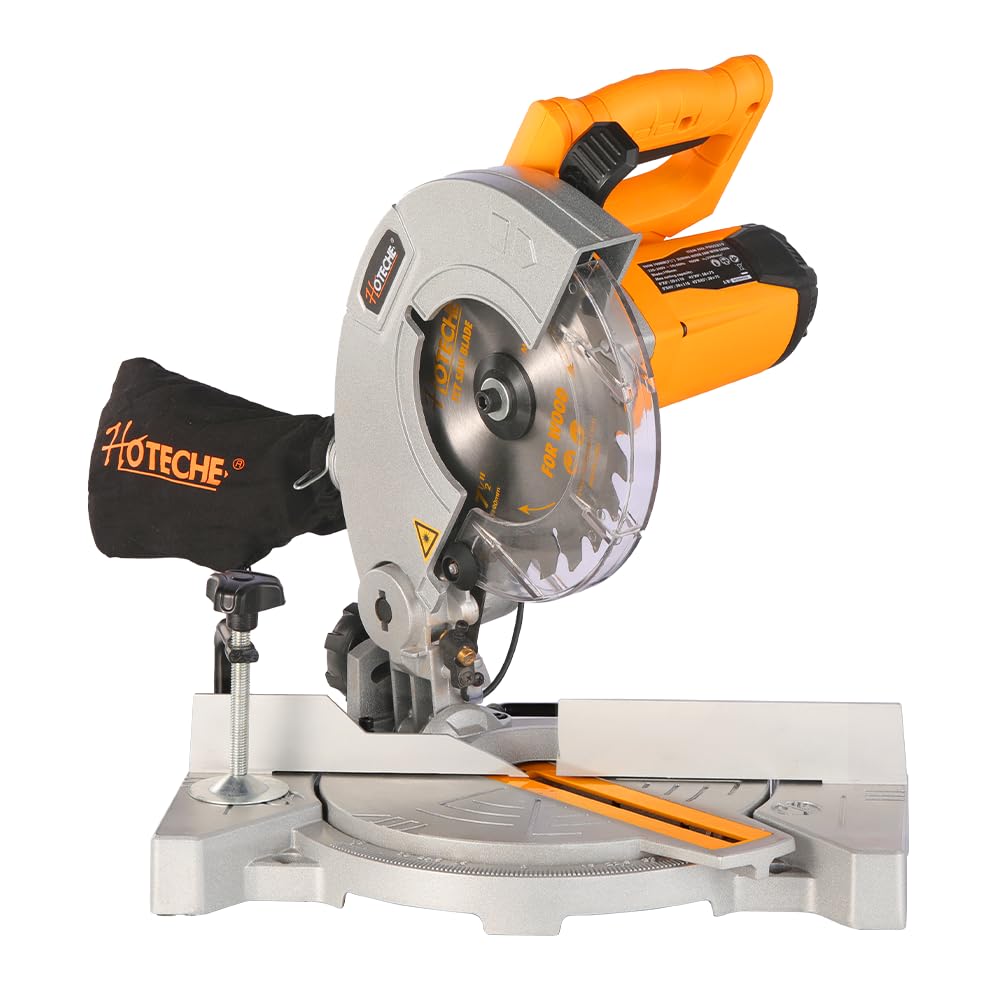
The Hoteche P805219A is the most affordable 7-1/4-inch miter saw in this guide, and it delivers exactly what the price suggests: a functional, laser-guided sliding saw for small DIY projects like window casing, picture frames, and light trim. The 7.5A copper motor spins at 5,000 RPM and includes positive miter stops at 0°, 15°, 22.5°, 30°, and 45°.
The kit includes a pair of extension bars for wider workpieces, a dust bag, two hex wrenches, and spare carbon brushes for motor maintenance—accessories that budget saws often skip. The laser guide is genuinely helpful for beginners, though users note the instruction manual is unclear about the transport lock release. Once that initial confusion is overcome, the saw cuts accurately through 1×2 strips and small hardwoods.
The fence is not set back far enough to accommodate wider cuts, and the plastic handle and base components feel less durable than the aluminum and metal builds on higher-end saws. For a homeowner who expects to make fewer than 200 cuts per year on small material, this saw offers genuine capability at an entry-level investment.
Why it’s great
- Lowest entry cost in the category
- Includes extension bars & spare carbon brushes
- Laser guide helps beginners align cuts
Good to know
- Fence not set back for wide material
- Plastic components feel less durable
- Transport lock release unclear for first-time users
FAQ
Can a 7 1/4 miter saw cut a 2×8?
Is a 7 1/4 miter saw good for crown molding?
What is the main advantage of a sliding miter saw over a non-sliding one?
Final Thoughts: The Verdict
For most users, the best 7 1/4 miter saw winner is the SKIL MS6306-00 because it combines the fastest 4,800 RPM motor, an accurate LED shadow line, and a compact rail system that works in tight spaces—all at a mid-range cost that outperforms its price class. If you want battery freedom with pro-grade portability, grab the Bosch GCM18V-07SN. And for budget-friendly entry into the category without sacrificing a laser guide and included accessories, nothing beats the Hoteche P805219A.