
A true 7.1.4 surround sound system is the difference between watching a movie and living inside it. With seven ear-level channels, one dedicated subwoofer, and four overhead or upward-firing speakers, the soundstage wraps around you completely — rain falls from above, footsteps creep from behind, and explosions have physical weight. Getting the configuration right, though, means balancing amplifier power, speaker sensitivity, and room acoustics, not just counting channels on a box.
I’m Rikta — the co-founder and writer behind Gadgets Feed. I spend my weeks dissecting frequency response curves, comparing THD ratings, and cross-referencing driver materials to make sure the spec sheet matches the real-world performance. (And Homer 🐱 claimed the center channel spot on the rug before I finished the first review.)
Building a home theater around a 7.1.4 layout demands careful choices across the entire signal chain. After comparing dozens of configurations, from soundbar bundles to discrete component setups, these seven systems represent the strongest options for buyers who want the full overhead immersion of 7.1.4 surround sound system performance without guesswork.
How To Choose The Best 7.1.4 Surround Sound System
Selecting a 7.1.4 system means committing to a specific architecture: a soundbar that uses DSP and up-firing drivers to simulate height channels, or a discrete passive-speaker system wired to a multi-channel AV receiver. The right choice depends on your room, your willingness to run speaker wire, and how much physical presence you want from each driver.
Amplifier Channels and Power Ratings
To drive a true 7.1.4 setup, your AV receiver must have at least 11 amplified channels — seven for the ear-level bed, four for the height layer, plus a pre-out for the subwoofer. Many mid-range receivers claim “9.2 channels” internally but assign two of those to Zone 2 or bi-amping, leaving you short. Look for receivers clearly labeled with 11-channel processing and at least 80 watts per channel into 8 ohms to handle dynamic peaks cleanly.
Speaker Configuration: Size, Sensitivity, and Impedance
Floorstanding towers with built-in up-firing Atmos drivers simplify wiring by removing the need for in-ceiling installs, but they rely on ceiling height and reflectivity for overhead effects. Bookshelf speakers paired with separate in-ceiling or on-ceiling modules offer more predictable height performance and better dispersion. Sensitivity ratings above 90 dB mean the receiver works less hard to produce the same volume, while impedance below 6 ohms demands a receiver rated for 4-ohm loads to avoid thermal shutdown during long listening sessions.
Room Acoustics and Calibration
Automatic room correction systems like Audyssey, Dirac Live, or Yamaha YPAO measure speaker distance, level, and EQ to compensate for reflective surfaces, furniture, and room modes. For 7.1.4 setups, the calibration must individually set delays and level trims for every channel including the height layer. Systems without per-channel EQ for Atmos modules can leave the overhead layer sounding thin or disconnected from the bed layer.
Quick Comparison
On smaller screens, swipe sideways to see the full table.
| Model | Category | Best For | Key Spec | Amazon |
|---|---|---|---|---|
| Sony BRAVIA Theater Quad | Wireless 4-Speaker Array | Discrete room-filling Atmos without wires | 16 speaker units, 360 Spatial Sound Mapping | Amazon |
| Klipsch + Yamaha Bundle | Passive Floorstanding | High-sensitivity towers with dedicated Atmos | R-625FA towers with up-firing Atmos drivers | Amazon |
| Samsung Q990D | All-in-One Soundbar | Full wireless 11.1.4 system out of the box | 11.1.4 ch, 4 up-firing drivers, rear speakers included | Amazon |
| Bose Smart Ultra + Bass 700 | Wireless Soundbar System | Clean living room setup with zero speaker wire | Dolby Atmos soundbar, Bass Module 700, surrounds | Amazon |
| Nakamichi Shockwafe Ultra | Soundbar + Dual Subs | Deep bass from dual 10-inch subwoofers | 9.2.4 ch, dual 10″ subs, 1300W max output | Amazon |
| Klipsch Cinema + Onkyo | Compact Passive System | Dedicated Atmos satellites with AVR bundle | 5.1.4 ch, 10″ sub, Onkyo TX-RZ30 9.2 ch receiver | Amazon |
| Sonos Arc Ultra | Expandable Soundbar | Scalable multi-room and whole-home audio | 9.1.4 spatial audio, AI Speech Enhancement | Amazon |
In‑Depth Reviews
1. Sony BRAVIA Theater Quad (HT-A9M2)

The Sony BRAVIA Theater Quad is the most convincing wireless implementation of a discrete multi-speaker Dolby Atmos system currently available. Four slim tower speakers, each housing four driver units for a total of 16, use Sony’s 360 Spatial Sound Mapping to generate phantom height and surround channels that rival hardwired 7.1.4 layouts. The system supports Dolby Atmos, DTS:X, and IMAX Enhanced natively, and the Sound Field Optimization auto-calibrates delay and EQ for each speaker’s position within minutes using the built-in microphones.
Each speaker connects wirelessly to the control box, which handles all HDMI 2.1 switching with 4K120, VRR, and ALLM passthrough for gaming. The phantom center channel is remarkably stable across a wide listening area, and the overhead layer feels physically present without a single in-ceiling driver. Music playback is equally impressive — stereo imaging is precise and the 36 mm full-range drivers produce a clean, non-fatiguing midrange that many soundbars cannot match.
The main compromise is bass extension below 30 Hz, which requires adding Sony’s optional SA-SW5 or SW3 subwoofer for LFE impact. The app-controlled setup is straightforward once connected via LAN, though initial WiFi pairing can be finicky in dense wireless environments. For buyers who want the closest thing to a fully wired Atmos system without cutting holes in their ceiling, this is the benchmark.
Why it’s great
- Phantom height and surround channels sound convincingly discrete
- HDMI 2.1 passthrough with full gaming feature support
- Wireless speaker placement offers total room flexibility
Good to know
- Subwoofer sold separately and only one can be paired
- Initial WiFi setup can be temperamental
- Premium price point that competes with high-end separates
2. Klipsch Reference Dolby Atmos + Yamaha RX-A2AB Bundle
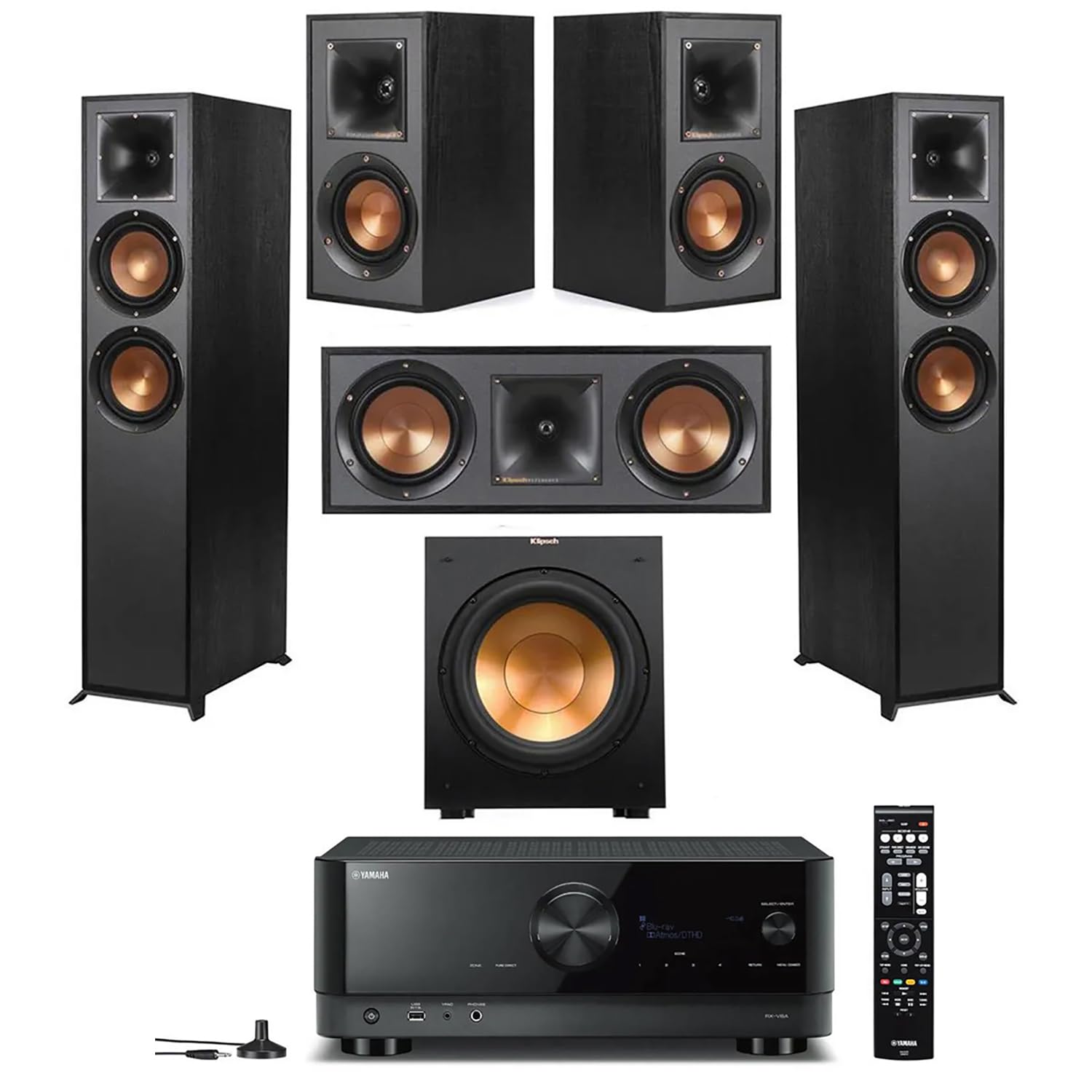
This bundle pairs two Klipsch R-625FA floorstanding towers — each with a built-in up-firing 6.5-inch Atmos driver — with the R-52C center, R-41M bookshelf surrounds, an R-12SW 12-inch subwoofer, and a Yamaha RX-A2AB 7.2-channel AV receiver. The result is a true passive 7.1.4 layout that leverages Klipsch’s 90 dB sensitivity and Tractrix horn tweeters, meaning the Yamaha’s 75 watts per channel drive the system to reference levels without strain.
The up-firing Atmos drivers bounce height information off the ceiling, and with standard 8-foot ceilings the effect is distinct and well-integrated. The 12-inch spun-copper IMG subwoofer delivers authoritative low-end down to around 28 Hz, and the Yamaha receiver includes YPAO room calibration plus HEOS wireless streaming. The total package provides a complete component ecosystem that can be upgraded piece by piece over time, unlike an integrated soundbar.
The main trade-offs are the physical footprint — the towers stand 40 inches tall and weigh nearly 50 pounds each — and the need to run speaker wire to the surround and height channels. The supplied tower feet screws are low quality and should be replaced with heavier-duty alternatives. For buyers who want traditional loudspeaker dynamics and the flexibility to upgrade individual components later, this system delivers exceptional value for its performance tier.
Why it’s great
- High sensitivity means effortless headroom with a modest receiver
- True passive speaker design allows future component upgrades
- 12-inch subwoofer provides deep, room-filling bass
Good to know
- Large floorstanding speakers require significant floor space
- Speaker wire must be run to surrounds and height modules
- Included tower feet screws are low quality
3. Samsung Q990D 11.1.4ch Soundbar

The Samsung Q990D delivers a complete 11.1.4 channel configuration — seven front-facing drivers, one subwoofer, four up-firing channels, plus a dedicated rear speaker kit — all connected wirelessly with no external AV receiver needed. The system supports Dolby Atmos and DTS:X natively, and Samsung’s Q-Symphony feature synchronizes the soundbar with compatible Samsung TVs to use the TV speakers as additional channels. Adaptive Sound analyzes content in real time and adjusts the EQ to prioritize dialogue during quiet scenes.
The included rear speakers feature both forward-firing and upward-firing drivers, creating a convincing height layer behind the listening position. SpaceFit Sound Pro uses the built-in microphone array to measure the room and automatically optimize the frequency response. The subwoofer uses a wireless connection and produces tight, controlled bass down to about 35 Hz without overwhelming the midrange. The included HDMI eARC connection handles Dolby Vision passthrough and simplifies the connection to a single cable from the TV.
Some users report intermittent audio dropouts over eARC with LG OLED TVs, and the automatic firmware updates can introduce bugs — manual USB updates are recommended. Dialogue clarity is strong for a soundbar, but the height channels rely heavily on ceiling reflection and lose distinctness with vaulted or textured ceilings. For buyers who want a complete, wire-free Atmos system with zero component matching, this is the most fully featured all-in-one option available.
Why it’s great
- Complete 11.1.4 system in one box with wireless rears
- Q-Symphony integrates seamlessly with Samsung TVs
- SpaceFit Sound Pro automatically tunes to room acoustics
Good to know
- HDMI eARC dropouts reported with certain TV brands
- Upward-firing Atmos relies on reflective ceiling surfaces
- Automatic firmware updates can cause issues
4. Bose Smart Ultra Soundbar + Bass Module 700 + Surround Speakers
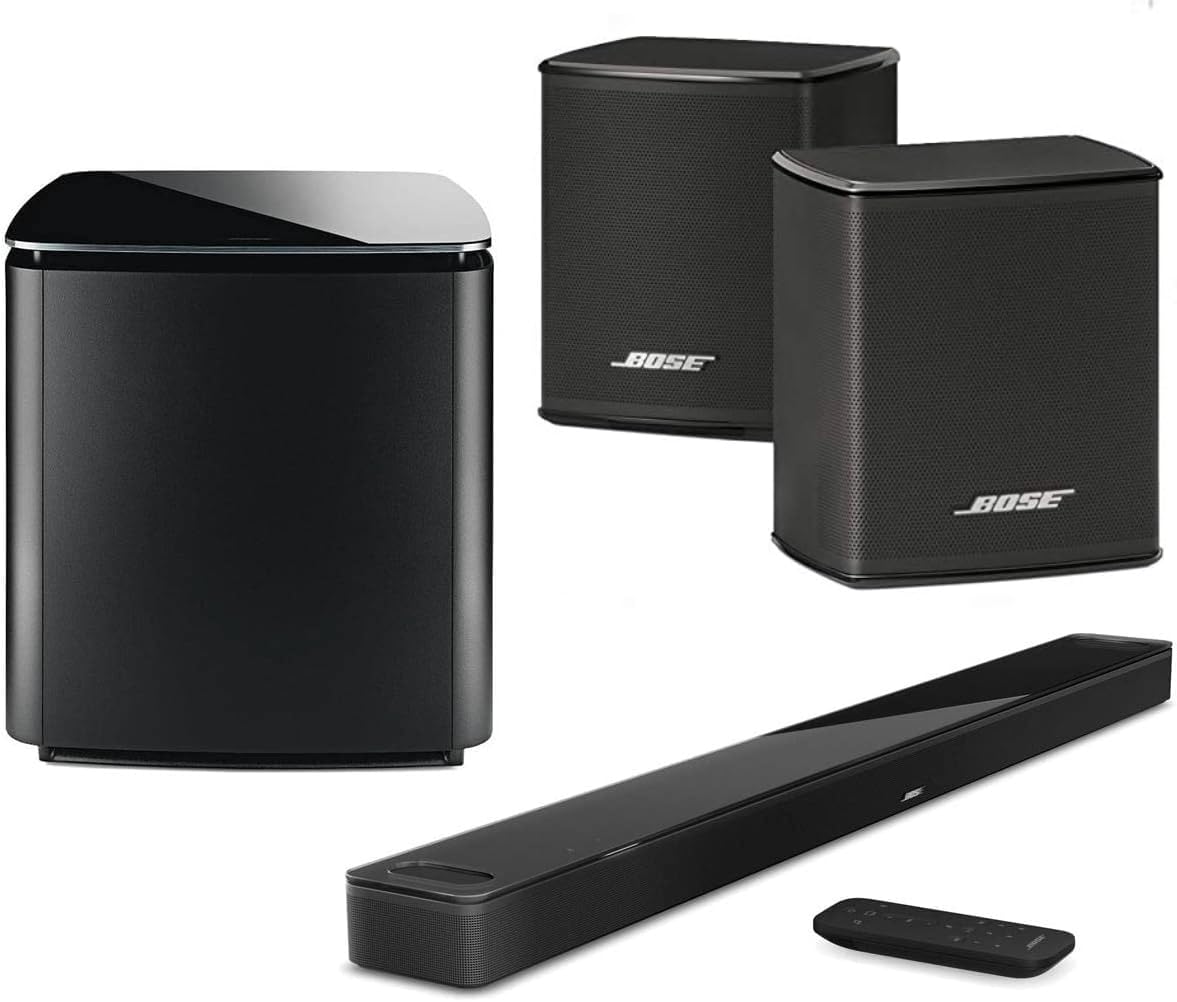
This Bose bundle combines the Smart Ultra Dolby Atmos soundbar with the Bass Module 700 and two wireless surround speakers to create a complete, cable-free 7.1.4-style system. The soundbar uses Bose’s PhaseGuide technology and upward-firing transducers to create a spacious soundstage with distinct overhead cues, while the Bass Module 700’s dual opposed drivers deliver deep, articulate low-end down to about 35 Hz with minimal cabinet resonance. The ADAPTiQ headset-based room calibration customizes the EQ and delay for the specific listening position.
The wireless surround speakers connect directly to the soundbar without a separate hub, and the system supports both Amazon Alexa and Google Assistant built-in. Dialogue clarity is excellent thanks to Voice4Video technology, which adjusts the center channel response to prioritize speech. The system also handles stereo music playback with impressive separation and low distortion at high volumes. The Bose Music app provides straightforward control over source switching, volume, and sound profiles.
The main compromise is the price point, which approaches that of a true passive speaker system with a dedicated AV receiver. The surround speakers require AC power, so they are not fully placement-agnostic. For buyers who prioritize a minimalist, furniture-friendly aesthetic and are willing to pay for the convenience of a fully integrated wireless ecosystem, this system delivers premium fit and finish with robust sound quality.
Why it’s great
- Fully wireless surround speakers with no hub required
- ADAPTiQ calibration tailors the sound to your room
- Bass Module 700 produces clean, deep sub-bass
Good to know
- Premium price that rivals some separates systems
- Surround speakers still need AC power nearby
- Phantom height channels less convincing than discrete in-ceiling drivers
5. Nakamichi Shockwafe Ultra 9.2.4
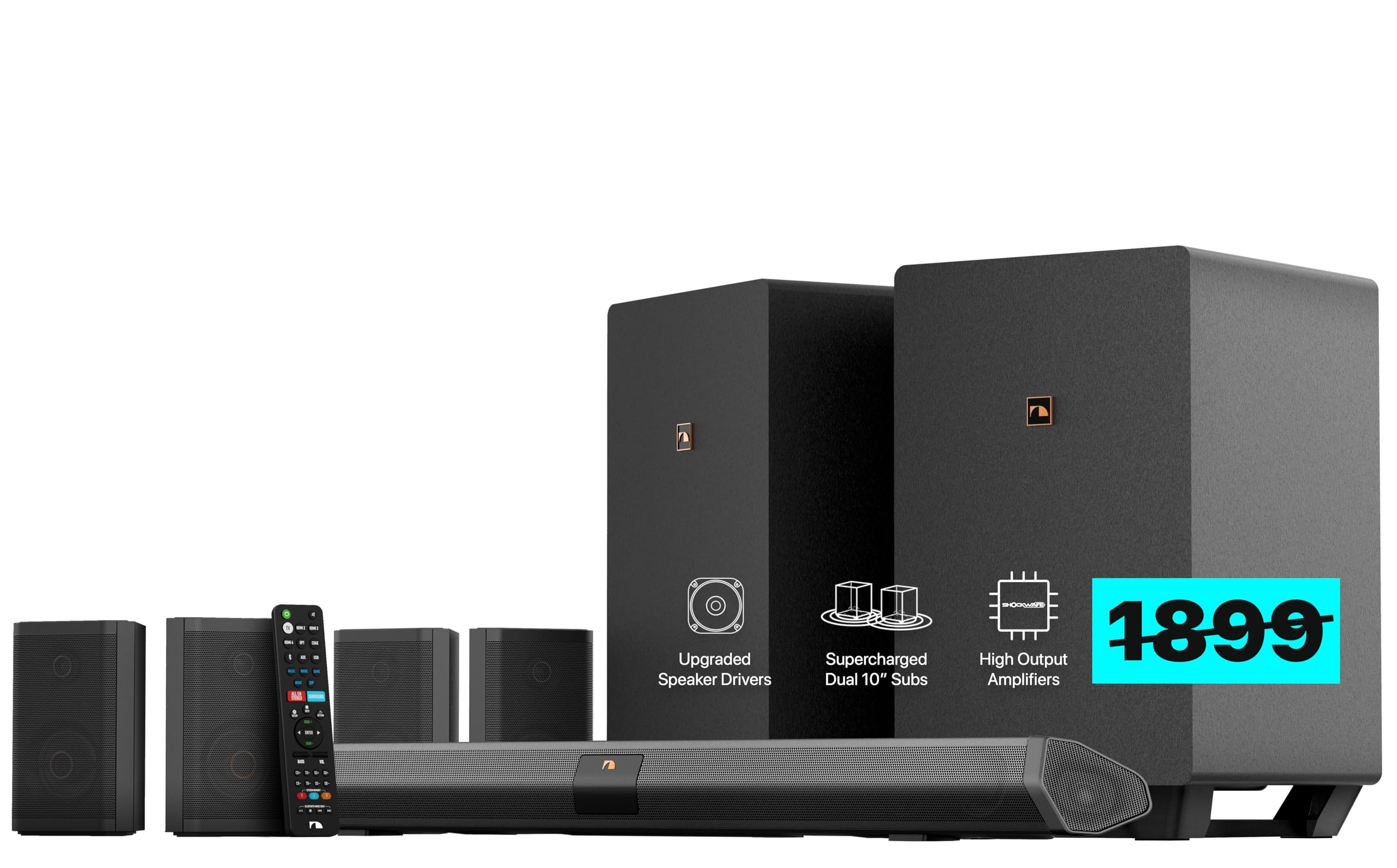
The Nakamichi Shockwafe Ultra is a soundbar-based system that relies on two massive 10-inch wireless subwoofers and four modular surround speakers to produce a 9.2.4 channel configuration. Each subwoofer houses its own high-output amplifier rated at up to 600 watts, delivering evenly distributed low-frequency energy that minimizes localization — you feel the bass as a room-filling pressure rather than a directional thump. The SSE MAX processing engine manages the Dolby Atmos and DTS:X decoding and creates convincing overhead effects from the soundbar’s upward-firing drivers combined with the four surround channels.
The four surround speakers can be used individually for expanded coverage or snapped together into dipole pairs to maintain a smaller footprint. The included 32-foot RCA cables allow flexible placement, though each surround must be wired directly to its respective subwoofer rather than being fully wireless. Connectivity includes HDMI eARC with Dolby Vision passthrough, three HDMI inputs, optical, coaxial, and 3.5mm aux-in. The backlit remote control is a welcome touch for darkened home theater rooms.
The dual-sub design eliminates the bumpy bass response typical of single-subwoofer setups in rectangular rooms. However, the system’s physical footprint is substantial — each subwoofer weighs nearly 24 pounds and stands over 20 inches tall. Some users report a low-level static hiss from the surround speakers at idle, and the power cable routing can be awkward due to the right-angle connector design. For buyers who prioritize tactile, chest-thumping bass over minimalist aesthetics, this system delivers the most low-end authority in the soundbar category.
Why it’s great
- Dual 10-inch subs provide even, low-distortion bass
- SSE MAX processing delivers convincing phantom height channels
- eARC and Dolby Vision passthrough for modern displays
Good to know
- Surround speakers connect to subs via included RCA cables
- Physical footprint is large for a soundbar system
- Some units exhibit idle static from surround channels
6. Klipsch Reference Cinema System + Onkyo TX-RZ30

This bundle pairs the Klipsch Reference Cinema System — four satellite speakers with integrated Dolby Atmos up-firing drivers, a center channel, and a 10-inch subwoofer — with the Onkyo TX-RZ30 9.2-channel AV receiver rated at 170 watts per channel. The configuration is technically 5.1.4: the four satellite speakers handle front left/right and surround left/right duties while their built-in up-firing drivers create the height layer, and the center channel anchors dialogue. The Onkyo receiver supports Dirac Live room correction with Bass Control, which significantly tightens the subwoofer’s integration with the satellites.
Klipsch’s Tractrix horn-loaded tweeters and Linear Travel Suspension aluminum tweeters deliver the bright, detailed high-frequency response that makes dialogue and effects cut through the mix without sounding harsh. The 10-inch subwoofer uses a dual-port design to improve low-frequency extension and output, producing clean bass down to about 32 Hz. The Onkyo receiver includes 8K HDMI 2.1 inputs, making this system fully future-proofed for the next generation of video sources and gaming consoles.
The satellite speakers are compact and easy to place, but achieving the full 5.1.4 effect requires the receiver to be configured correctly — the height channels must be assigned to the satellite speakers’ Atmos drivers, not to external ceiling speakers. Some users have reported reliability issues with the Onkyo receiver’s amplifier section, and the system does not include any speaker wire or HDMI cables in the box. For buyers who want the Klipsch horn sound signature in a smaller physical package than full floorstanding towers, this is a space-efficient entry point into discrete Atmos.
Why it’s great
- Compact satellite design with integrated Atmos up-firing drivers
- Onkyo receiver includes Dirac Live with Bass Control
- Klipsch horn tweeters deliver clear, efficient dialogue reproduction
Good to know
- Receiver reliability concerns reported by some owners
- Speaker wire and HDMI cables not included
- Configuration requires proper height channel assignment in the AVR menu
7. Sonos Arc Ultra Soundbar

The Sonos Arc Ultra represents the company’s latest acoustic architecture, using Sound Motion technology to generate a 9.1.4 spatial audio experience from a single soundbar. The system relies on advanced DSP and carefully angled driver arrays to create phantom height and surround channels that feel considerably wider than the soundbar’s physical footprint. The AI-powered Speech Enhancement mode detects dialogue frequencies and clarifies them in real time, making it one of the best soundbars for intelligibility during difficult scenes.
Setup is handled entirely through the Sonos app, and the HDMI eARC connection handles both TV audio and wireless music streaming via WiFi, Bluetooth, Apple AirPlay 2, and Spotify Connect. The Trueplay room calibration uses the microphone on a connected iOS or Android device to measure the room’s acoustics and adjust the EQ accordingly. The system can be expanded by adding the Sonos Sub for deeper bass and a pair of Era 300 speakers for dedicated rear surround channels, turning the 9.1.4 virtual configuration into a true multi-speaker setup with discrete overhead drivers.
The primary limitation is that the Arc Ultra alone cannot produce a convincing overhead layer without the Era 300 rears — the virtual height channels from the soundbar alone are subtle compared to systems with dedicated up-firing or in-ceiling drivers. The Sonos ecosystem is also closed, meaning third-party speakers cannot be integrated. For buyers who want a soundbar that can grow into a whole-home audio system over time and value the Sonos software experience above pure Dolby Atmos channel separation, this is the most polished single-box option available.
Why it’s great
- Sound Motion technology creates wide, immersive soundstage from one bar
- AI Speech Enhancement is best-in-class for dialogue clarity
- Expandable to a full multi-room system with Sub and Era 300
Good to know
- Virtual height channels need Era 300 rears for convincing Atmos
- Closed ecosystem does not support third-party speakers
- Premium price point for the soundbar alone before adding Sub and surrounds
FAQ
Can I use a 9-channel receiver to power a 7.1.4 system?
Do up-firing Atmos speakers work with vaulted or textured ceilings?
What is the difference between Dolby Atmos and DTS:X for a 7.1.4 system?
Do I need to run speaker wire for a 7.1.4 system, or can it be wireless?
Final Thoughts: The Verdict
For most users, the 7.1.4 surround sound system winner is the Sony BRAVIA Theater Quad because it delivers the most convincing discrete-channel Atmos experience in a wireless form factor that fits almost any room without construction. If you want the tactile, chest-pounding bass of dual subwoofers, grab the Nakamichi Shockwafe Ultra. And for a complete, one-box solution with zero component matching and wireless rear speakers, nothing beats the Samsung Q990D.