
A 7.1 receiver is the central nervous system of any serious home theater. It decodes the Dolby Atmos and DTS:X soundtracks that make movies feel real, routes 8K video signals from your gaming console, and powers each speaker with clean amplification. Choosing the wrong one means muddy dialogue, limited connectivity, or a system that can’t grow with your setup.
I’m Min — the co-founder and writer behind Gadgets Feed. I’ve spent hundreds of hours cross-referencing HDMI 2.1 chipset generations, room correction algorithms, and per-channel power output figures to build this guide.
After analyzing the technical specifications and real-world performance data for over a dozen current models, these recommendations represent the most reliable 7.1 receiver options available today for any budget and spatial audio setup.
How To Choose The Best 7.1 Receiver
Selecting a 7.1 channel receiver requires balancing HDMI 2.1 bandwidth, amplifier power, and room correction sophistication. The right choice depends on your speaker impedance, video source equipment, and whether you plan to add height channels for a 5.1.2 Atmos configuration.
HDMI 2.1 Bandwidth and Gaming Features
Not all HDMI 2.1 ports deliver the same throughput. Look for receivers with 40Gbps ports that support 4K/120Hz passthrough, Variable Refresh Rate (VRR), Auto Low Latency Mode (ALLM), and Quick Frame Transport (QFT). These features eliminate screen tearing and input lag when connected to a PlayStation 5 or Xbox Series X. Cheaper units may limit bandwidth to 24Gbps, which caps resolution and refresh rate.
Room Correction and Amplifier Power
Room correction software like Audyssey MultEQ XT32, YPAO R.S.C., or Dirac Live optimizes the frequency response for your specific room acoustics. A receiver with 80W per channel into 8 ohms (two channels driven) is sufficient for most medium-sized rooms, but budget models often rate power at 1kHz with one channel driven — a misleading figure that inflates the wattage. Compare FTC-rated continuous power across all channels for an accurate comparison.
Quick Comparison
On smaller screens, swipe sideways to see the full table.
| Model | Category | Best For | Key Spec | Amazon |
|---|---|---|---|---|
| Denon AVR-X1700H | Mid-Range | Best Overall Value | Audyssey MultEQ XT32 | Amazon |
| Yamaha RX-V6A | Mid-Range | Gaming & Reliability | 4K/120Hz + VRR | Amazon |
| Onkyo TX-NR6100 | Premium | THX Certified Power | THX Select Certification | Amazon |
| Yamaha RX-A2A | Premium | Build Quality | Surround:AI | Amazon |
| Denon AVR-S970H | Mid-Range | HEOS Multi-Room | 90W x 7 Channels | Amazon |
| Pioneer VSX-935 | Mid-Range | Value with HDMI 2.1 | 8K/60Hz Passthrough | Amazon |
| Onkyo TX–NR5100 | Mid-Range | Budget Gaming | 4K/120Hz + ALLM | Amazon |
| Sony STR-AN1000 | Premium | 360 Spatial Sound | Digital Cinema Calibration IX | Amazon |
| Marantz Cinema 70S | Premium | Compact Design | HDAM Discrete Circuitry | Amazon |
| Sony STRAZ1000ES | High-End | ES Series Reference | 100W x 7 (8 ohms) | Amazon |
| Klipsch/Onkyo Bundle | Bundle | All-in-One System | Dirac Live Room Correction | Amazon |
In‑Depth Reviews
1. Denon AVR-X1700H 7.2 Channel AV Receiver

The Denon AVR-X1700H delivers the best balance of room correction and HDMI 2.1 functionality in the mid-range tier. With three dedicated 8K inputs and one 8K output supporting 8K/60Hz and 4K/120Hz passthrough, it handles next-gen gaming and high-bitrate video sources without compromise. The Audyssey MultEQ XT32 calibration is a significant step up from the basic Audyssey found in the AVR-S series, measuring multiple listening positions for a more accurate soundstage.
At 80W per channel into 8 ohms (two channels driven), the amplifier section provides enough headroom for most bookshelf and floorstanding speakers in medium-sized rooms. Users report that the on-screen setup guide, combined with color-coded speaker terminals, simplifies the initial configuration significantly — the average install takes about one hour including Audyssey calibration. The inclusion of Dolby Atmos Height Virtualization is a nice bonus if you don’t plan to install physical height speakers immediately.
Some units have shipped with older firmware that requires a network update to enable full HDMI 2.1 stability, and a few users note that the calibration microphone cable is too short for large rooms. The HEOS multi-room platform works reliably for streaming Spotify and TIDAL, though the app interface is not as polished as MusicCast. For the price, the AVR-X1700H is the most feature-complete entry into proper 7.1 channel home theater.
Why it’s great
- Audyssey MultEQ XT32 room correction is best-in-class at this price point
- Three 8K HDMI 2.1 inputs for multiple next-gen consoles
- Phono input for turntable connectivity
Good to know
- Calibration microphone cable is short for large rooms
- Some units need a firmware update out of the box
2. Yamaha RX-V6A 7.2-Channel AV Receiver

The Yamaha RX-V6A is a 7.2 channel receiver that prioritizes gaming performance and long-term reliability. Three of its seven HDMI inputs support 8K/60Hz and 4K/120Hz passthrough with full VRR and ALLM support, making it a natural pairing for PC gamers and console enthusiasts who want zero screen tearing during high-frame-rate titles. Yamaha’s MusicCast platform is one of the most stable multi-room streaming ecosystems, supporting Spotify Connect, AirPlay 2, and TIDAL without connection drops.
The YPAO R.S.C. room correction with multipoint measurement does a respectable job taming room modes, though it lacks the precision of Audyssey MultEQ XT32. Users transitioning from older Yamaha receivers consistently note the improved dynamic range and dialogue clarity — the high slew rate amplifier design helps reproduce transient peaks in action scenes without distortion. The receiver powers 4 ohm speakers without issue, which is a differentiator against some competitors at this tier.
One recurring complaint involves the eARC implementation: the receiver does not always auto-wake with the TV, requiring a manual power-on to switch audio back from the TV speakers. The initial setup menu, while straightforward, does require a firmware update before enabling all HDMI 2.1 features. The remote design is improved over previous generations, but the learning curve for the multi-zone controls is steeper than Denon’s offerings.
Why it’s great
- Full HDMI 2.1 gaming feature set with VRR and ALLM
- MusicCast multi-room streaming is fast and stable
- Handles 4 ohm speakers without overheating
Good to know
- eARC auto-wake can be inconsistent
- Firmware update required for full HDMI 2.1 functionality
3. Onkyo TX-NR6100 7.2 Channel THX Certified Network AV Receiver
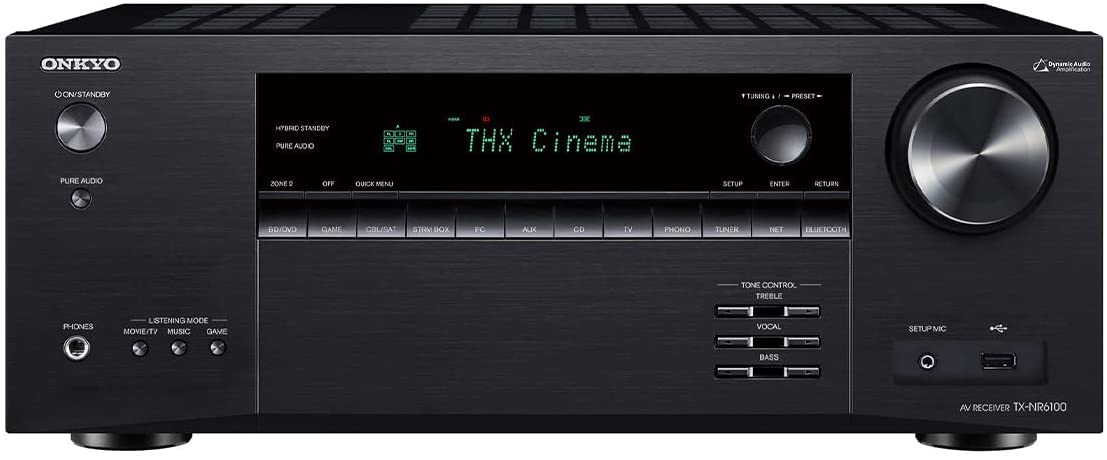
The Onkyo TX-NR6100 brings THX Select Certification to the 7.2 channel category, guaranteeing reference-level playback in rooms where the screen-to-seat distance is under 12 feet. The dynamic audio amplification system delivers 210W per channel into 6 ohms (1kHz, 1ch driven), providing substantial headroom for dynamic movie soundtracks. With three HDMI 2.1 inputs running at 40Gbps, it fully supports 8K/60Hz and 4K/120Hz passthrough for the PlayStation 5 and Xbox Series X.
The receiver supports both Dolby Atmos and DTS:X, and it includes IMAX Enhanced mode for compatible content. Users report excellent clarity when paired with Klipsch Reference speakers, with the auto-calibration correctly identifying speaker size and distance. The 8 HDMI inputs (including the 3 8K inputs) are generous for AV setups with multiple game consoles, a streaming box, and a Blu-ray player. The built-in app provides control over input assignment and sound modes without needing the remote.
There are two notable limitations. The non-backlit remote feels flimsy compared to the solid build of the chassis itself. More critically, some users report the unit runs hot during extended use, and a small number have experienced HDMI board failures after two years. Bi-amping the front speakers consumes the surround back channels, reducing the system to 5.1. On the whole, the TX-NR6100 offers exceptional power and video features for its price bracket.
Why it’s great
- THX Select Certification ensures reference-level performance
- Eight HDMI inputs with three supporting 8K/60Hz
- IMAX Enhanced mode for compatible content
Good to know
- Non-backlit remote feels cheap for the price
- Runs hot; requires good ventilation
4. Yamaha RX-A2A AVENTAGE 7.2-Channel AV Receiver

The Yamaha RX-A2A represents the AVENTAGE line, which Yamaha positions as their top-tier series with premium internal components and chassis construction. The unit features a fifth foot on the center of the chassis to reduce vibration, a lower THD amplifier design than the RX-V series, and a three-year warranty. The Surround:AI technology analyzes sound scenes in real time and automatically adjusts the balance between dialogue, effects, and surround channels for optimal immersion.
Three HDMI inputs support 8K/60Hz and 4K/120Hz passthrough, though early production units faced bandwidth limitations that later firmware updates resolved. Users upgrading from entry-level Yamaha receivers (like the RX-V373) consistently report a noticeably cleaner soundstage with better channel separation. The MusicCast platform integrates seamlessly with Yamaha’s wireless speakers for whole-home audio, and the unit is Roon Tested for high-resolution streaming.
The RX-A2A lacks analog video inputs (composite or component), which may be a barrier for anyone connecting older game consoles or VCRs. Some users have experienced intermittent HDMI handshake issues with newer TVs, requiring a power cycle to restore signal. At its normal price, it competes directly with the Denon AVR-X2700H and Onkyo TX-NR6100, but Yamaha’s build quality and three-year warranty make it a strong choice for buyers prioritizing long-term reliability.
Why it’s great
- Surround:AI real-time audio optimization
- AVENTAGE build quality with 5th foot stabilizer
- Three-year warranty coverage
Good to know
- No analog video inputs for legacy devices
- Intermittent HDMI handshake issues reported
5. Denon AVR-S970H 8K Ultra HD 7.2 Channel AV Receiver

The Denon AVR-S970H is a 90W-per-channel 7.2 receiver that slots just below the X series in Denon’s lineup, offering nearly identical HDMI 2.1 functionality at a lower price point. The HEOS multi-room platform is the star here — it supports streaming from Spotify, Amazon Music HD, TIDAL, and Pandora to any HEOS-enabled speaker in the house, all controlled from a single app. For users building a whole-home audio system, this level of integration is hard to beat at this price.
The receiver includes three 8K HDMI inputs with support for 8K/60Hz and 4K/120Hz passthrough, plus VRR, QFT, and ALLM for lag-free gaming. The on-screen setup guide and Audyssey MultEQ calibration make initial configuration straightforward, and users report that eARC works flawlessly with modern TVs. The phono input is a welcome inclusion for turntable owners, and the front-panel USB port accommodates convenient device charging.
The S970H uses the same amplifier stage as the previous generation, and some buyers note that the cooling fan is more audible than the X series models during extended high-volume sessions. The Powered Zone 2 feature uses the surround back channels, limiting the main room to 5.1 — an important caveat if you plan to run a full 7.1 setup simultaneously with outdoor speakers. The remote lacks a programmable TV power button, forcing you to use the TV remote for basic functions.
Why it’s great
- HEOS multi-room streaming is smooth and feature-rich
- Three 8K HDMI inputs with full gaming features
- Phono input for turntable connectivity
Good to know
- Powered Zone 2 reduces main room to 5.1 channels
- Cooling fan can be audible at high volumes
6. Pioneer VSX-935 7.2 Channel Surround Sound Network Receiver
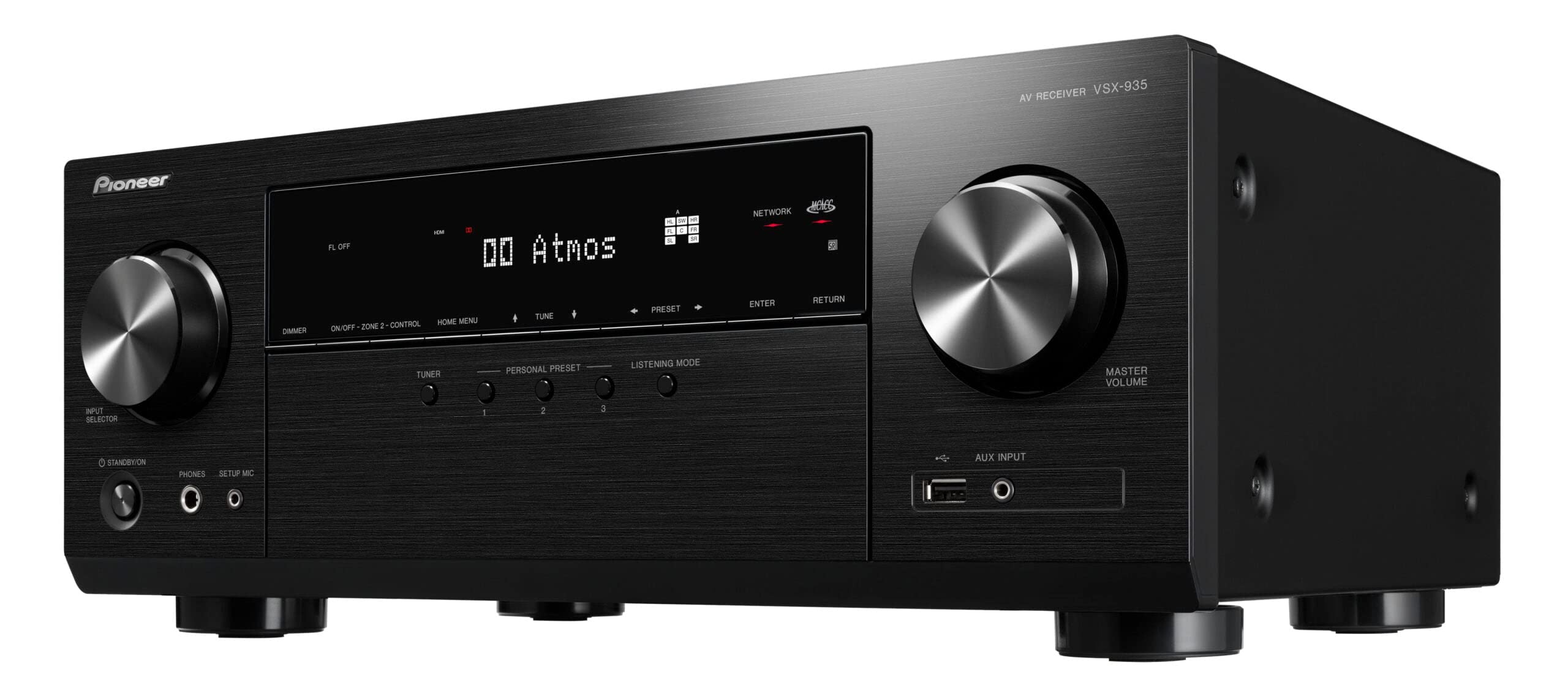
The Pioneer VSX-935 is a 7.2 channel receiver that punches above its weight class with HDMI 2.1 support at a price that undercuts most competitors. It features one 8K/60Hz input and supports Dolby Atmos Height Virtualization, which simulates overhead effects from traditional speaker layouts — a genuine cost saver for renters or anyone who cannot install ceiling speakers. The MCACC room calibration does a decent job of correcting basic frequency imbalances, though it lacks the precision of Audyssey or Dirac Live.
Owners praise the RF remote for its ability to control the receiver through cabinets and walls, and the dual-zone functionality works well for distributing audio to a second room. The front-panel display is dimmable, which is appreciated for dark home theater rooms. Audio quality is described as crisp and clear, with a slight brightness that pairs well with neutral-sounding speakers. The dual subwoofer pre-outs allow for more balanced low-frequency distribution in large rooms.
The Bluetooth implementation is a known weak point. It uses a two-way protocol that is buried in the setup menus and lacks a dedicated button, making it frustrating to switch between phone connections. The remote GUI feels dated compared to Denon and Yamaha’s offerings, and some users report that the volume ramps linearly up to 50, then jumps aggressively — requiring careful adjustment during the initial setup. The VSX-935 is a capable budget-conscious choice for those willing to work around its quirks.
Why it’s great
- Dolby Atmos Height Virtualization works without ceiling speakers
- RF remote controls through cabinets and walls
- Dual subwoofer pre-outs for balanced bass
Good to know
- Bluetooth implementation is cumbersome and unreliable
- Volume curve accelerates after 50%
7. Onkyo TX–NR5100 7.2-Channel 8K Smart AV Receiver

The Onkyo TX-NR5100 brings HDMI 2.1 gaming enhancements to the 7.2 channel category at a price that undercuts most premium options. With support for 4K/120Hz passthrough, VRR, ALLM, and QFT, it delivers the core gaming features that the PlayStation 5 and Xbox Series X demand. The eARC port simplifies connectivity with modern TVs, passing Dolby Atmos and DTS:X audio from native TV apps without an extra HDMI cable.
Users report that the setup process is straightforward, with an on-screen menu that is easy to navigate. The built-in Bluetooth supports two-way communication, though like the Pioneer VSX-935, the implementation has latency issues that make it less reliable for headphone use. The amplifier section produces good sound quality for movies and music, with clear dialogue reproduction and sufficient headroom for most bookshelf speakers.
There are two significant concerns. First, the speaker terminals use an unusual hybrid design — twisted front terminals with spring-loaded rear terminals — which makes cable management more difficult than standard binding posts. Second, there are multiple reports of units failing within two years, including total audio loss and HDMI board failure. While customer service from Onkyo has been responsive for some, the reliability data suggests this model carries higher risk than its competitors.
Why it’s great
- Supports 4K/120Hz passthrough with VRR and ALLM
- eARC simplifies TV audio connectivity
- Easy on-screen setup menu
Good to know
- Speaker terminal design complicates cable management
- Multiple reports of units failing after 18 months
8. Sony STR-AN1000 7.2 CH Surround Sound Home Theater 8K A/V Receiver

The Sony STR-AN1000 is a 7.2 channel receiver built around Sony’s 360 Spatial Sound Mapping technology, which creates phantom speakers in the soundfield to expand the surround experience beyond physical speaker positions. Digital Cinema Auto Calibration IX measures and optimizes the acoustic response across multiple seating positions, and the IMAX Enhanced mode ensures compatibility with IMAX-encoded Blu-ray discs and streaming content.
The receiver includes six HDMI inputs and two outputs, with three inputs supporting 8K/60Hz and 4K/120Hz passthrough. Sony’s S-Center synchronization feature pairs with specific Sony TVs to use the TV’s own speakers as a center channel, which significantly improves dialogue clarity without adding a physical center speaker. Users report that calibration results are superb for both movies and music, with the subwoofer distance measurement being one of the most accurate in this class.
The STR-AN1000 notably lacks a phono input, which rules out direct turntable connectivity without an external preamp. The front-panel display is small, and the sound field information is difficult to read from a normal seating distance. Some users have reported that Apple TV 4K Dolby Vision passthrough does not work reliably — the video must be routed directly to the TV with audio via eARC as a workaround. Despite these quirks, Sony’s 360 Spatial Sound Mapping creates a uniquely enveloping soundstage.
Why it’s great
- 360 Spatial Sound Mapping creates phantom surround speakers
- S-Center synch improves dialogue clarity with Sony TVs
- Accurate Digital Cinema Auto Calibration IX
Good to know
- No phono input for turntable connectivity
- Apple TV Dolby Vision passthrough requires a workaround
9. Marantz Cinema 70S 7.2-Ch Receiver (50W X 7)
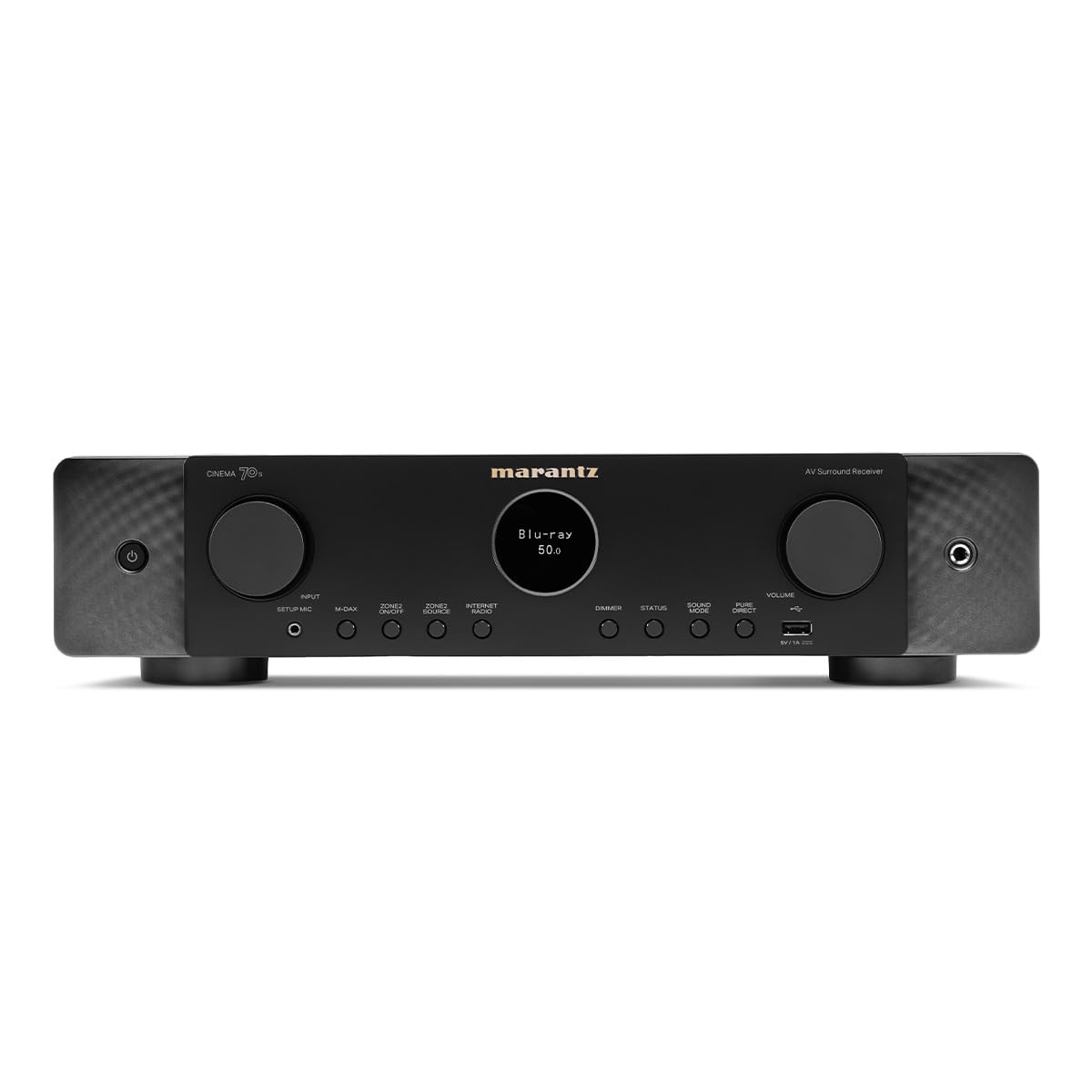
The Marantz Cinema 70S is a slim-profile 7.2 channel receiver that fits into AV cabinets where full-sized components won’t. Despite its compact dimensions, it houses Marantz’s proprietary HDAM (Hyper Dynamic Amplifier Module) discrete circuitry and current feedback amplification, delivering the brand’s signature warm, detailed sound signature. The included Audyssey MultEQ XT32 room correction — normally reserved for higher-tier Denon and Marantz models — is a major selling point for room optimization.
The receiver supports 8K/60Hz and 4K/120Hz passthrough across three HDMI inputs, with Dolby Vision, HDR10+, and HLG compatibility. It includes both Dolby Height Virtualization and DTS Virtual:X for simulating overhead effects without physical height speakers. Owners report that the setup process is smooth, the included cardboard microphone tripod is a thoughtful touch, and the overall build quality justifies the Marantz premium.
The 50W per channel power rating is lower than most competitors, which limits its ability to drive inefficient or low-impedance speakers to reference levels in large rooms — it’s best suited for sensitive speakers (90dB+ efficiency) in small to medium spaces. The network control app has stability issues, occasionally losing connection with the receiver and misreporting status. Some open-box units have been sold missing the calibration microphone or power cable, so verify packaging when purchasing.
Why it’s great
- HDAM discrete circuitry delivers warm, detailed sound
- Audyssey MultEQ XT32 for premium room correction
- Compact size fits shallow AV cabinets
Good to know
- 50W per channel limits speaker compatibility
- Network control app has stability issues
10. Sony STRAZ1000ES Premium ES 7.2 CH 8K A/V Receiver

The Sony STRAZ1000ES is the entry point into Sony’s elite ES (Evolved Standard) series, which is designed for custom integrators and serious home theater enthusiasts. It delivers 100W per channel into 8 ohms (two channels driven, 1kHz, THD 0.9%) — a significant step up from the STR-AN1000 — and includes the same 360 Spatial Sound Mapping and Digital Cinema Auto Calibration IX found in its lower-tier sibling, but with more robust internal components and a thicker chassis.
The receiver includes “Works with Sonos” integration for seamless blending with existing Sonos systems, plus Chromecast built-in, AirPlay 2, and Spotify Connect for universal streaming. The IP control capabilities are designed for professional installation, allowing integration with control systems like Crestron and Control4. Owners report that the 360 Spatial Sound Mapping with a 5.1.2 configuration convincingly simulates a full 7.1.4 system, creating an impressively wide and tall soundstage.
The STRAZ1000ES runs noticeably hot during operation — most users recommend active cooling with a product like the AC Infinity Aircom T10 for long listening sessions. It lacks support for HDR10+, QMS (Quick Media Switching), and QFT (Quick Frame Transport), which may be relevant for future-proofing. The subwoofer management could be more flexible, with no independent crossover settings per subwoofer output. For those who prioritize sound quality and build integrity over feature checklists, the ES series delivers.
Why it’s great
- 100W per channel handles demanding speakers
- 360 Spatial Sound Mapping creates expansive soundstage
- IP control for professional custom integration
Good to know
- Runs very hot; active cooling recommended
- No HDR10+ or QMS support
11. Klipsch Reference Cinema 5.1.4 System with Onkyo TX-RZ30 Bundle

This bundle pairs the Klipsch Reference Cinema 5.1.4 speaker system — featuring four Atmos-enabled satellite speakers with dual drivers, a center channel, and a 10-inch powered subwoofer — with the Onkyo TX-RZ30 9.2-channel receiver. The TX-RZ30 includes Dirac Live room correction, which is widely regarded as the best room correction software in the consumer AV receiver market. The combination delivers a true 5.1.4 Dolby Atmos experience out of the box, with no additional speaker purchases required.
The Klipsch satellite speakers use Tractrix horn-loaded aluminum tweeters and spun-copper IMG woofers, producing the brand’s signature high-efficiency, dynamic sound. The 10-inch subwoofer includes adjustable gain and low-pass crossover, and users report that it provides substantial low-end output for action movies and music. The Onkyo TX-RZ30 supports 8K/60Hz and 4K/120Hz passthrough with HDMI 2.1, THX performance certification, and IMAX Enhanced compatibility.
The bundle is physically large — the package weighs nearly 117 pounds — and requires significant shelving space. The Onkyo receiver uses 9 channels, which means you cannot add side surround speakers for a 7.1.4 configuration; the channel count maxes out at 5.1.4 (or 7.1.2 if you configure differently). Some users report that the Onkyo receiver can fail unexpectedly, with one user describing two separate amplifier failures at normal listening volumes. For buyers seeking a turnkey system, this bundle simplifies the selection process considerably.
Why it’s great
- Complete 5.1.4 Atmos system with no additional purchases needed
- Dirac Live room correction is best-in-class
- Klipsch Tractrix horn technology delivers dynamic, efficient sound
Good to know
- Extremely heavy package (117 lbs)
- Onkyo receiver has reliability concerns in some units
FAQ
What is the difference between a 7.1 and a 5.1.2 receiver?
Can I use a 7.1 receiver with only two speakers?
What wattage do I need for my speakers?
Final Thoughts: The Verdict
For most users, the 7.1 receiver winner is the Denon AVR-X1700H because it combines Audyssey MultEQ XT32 room correction, three 8K HDMI 2.1 inputs, and reliable multi-room streaming at a price that undercuts the competition. If you want the most immersive spatial audio, grab the Sony STRAZ1000ES for its 360 Spatial Sound Mapping and ES-series build quality. And for a complete turnkey experience, nothing beats the Klipsch Reference Cinema 5.1.4 System bundle with Dirac Live room correction.