
Our readers keep the lights on and my morning glass full of iced black tea. As an Amazon Associate, I earn from qualifying purchases.
Specs are compiled from manufacturer listings and verified buyer reviews and can change over time — please confirm the key details on the product page before buying.
If your gaming headset sounds flat and you can’t tell which direction a gunshot came from, the problem is your computer’s weak built-in sound chip. An external 7.1 sound card USB hands the audio work to a much better DAC (digital-to-analog converter, the chip that turns digital data into sound). That gives you surround-sound positioning that actually works. Here are the top seven models based on published specs and real buyer reviews, so you pick the one that fixes your specific audio problem.
I’m Min — the founder and writer behind Gadgets Feed. This guide is built by comparing the manufacturers’ published specifications and the patterns across verified customer reviews, so you get each pick’s real strengths and trade-offs instead of marketing spin.
A good 7.1 sound card usb can upgrade your entire audio chain through a single plug. That helps whether you are chasing footsteps in a competitive shooter, setting up a home cinema with SPDIF (a digital optical audio connection), or just want cleaner music from your laptop.
Our Picks at a Glance


How To Choose The Best 7.1 Sound Card USB
Not every 7.1 sound card USB works the same way. A cheap card creates an artificial surround effect. A premium one processes real multi-channel audio. Here are the three specs that separate a useful upgrade from a wasted USB port.
Sample Rate: 48KHz vs 192KHz vs 384KHz
The sample rate is how many times per second the card captures or plays back a slice of sound. A higher rate keeps more detail in high-frequency sounds like footsteps, gunfire cracks, or concert-hall reverb. so you hear more of the small sounds that tell you where enemies are. Entry-level cards max out at 48KHz (48,000 snapshots per second), fine for movies. Competitive gamers and music listeners benefit from 192KHz or 384KHz, where subtle spatial cues become clearly audible.
Signal-to-Noise Ratio (SNR): The Quiet Behind the Loud
SNR (Signal-to-Noise Ratio) measures how much hiss or electrical buzz you hear when no music plays. A rating of 90 dB is acceptable for casual use. At 117 dB to 120 dB, that background noise virtually disappears. so you hear only the audio you want. This matters most with sensitive headphones in a quiet room.
Connectivity and Platform Compatibility
Look at what output ports the card offers. If you have a home theater amplifier, you need SPDIF optical out. If your gaming headset uses a single 3.5mm jack, make sure the card has a combo TRRS port (tip-ring-ring-sleeve, the plug that carries audio and mic together). Also check whether the card supports your console — PS5 and Switch often require UAC 1.0 mode (a plug-and-play USB audio standard), while PC users can use UAC 2.0 for higher sample rates.
Quick Comparison
| Model | Best For | Max Sample Rate | SNR | Connectivity | Amazon |
|---|---|---|---|---|---|
| Creative Sound BlasterX G5★ Best Overall | Premium console & PC gaming | 192 KHz | — | USB + Mini TOSLINK | Amazon |
| Cubilux 7.1 USBBest Value | Hi-Res music + gaming hybrid | 384 KHz | — | USB A | Amazon |
| Fosi Audio C3 | Footstep-focused competitive FPS | 384 KHz | 117 dB | USB-C | Amazon |
| EPOS GSX 1000 2nd Ed | Desktop control and EQ presets | 48 KHz | — | USB-C | Amazon |
| Vantec NBA-200U | Multi-input recording & surround | 48 KHz | — | USB 2.0 + SPDIF | Amazon |
| HUANGENG SPDIF USB | Home theater SPDIF setups | 48 KHz | 120 dB | USB + SPDIF Optical | Amazon |
| Toeasor Virtual 7.1 | Budget plug-and-play headset | 48 KHz | — | USB A | Amazon |
In‑Depth Reviews
1. Creative Sound BlasterX G5 7.1 Headphone Surround HD Audio External Sound Card
Our pick — over 4★ from 800+ verified ratings; the strongest balance of quality and price.
The all-in-one gaming audiophile that connects to everything from PC to PS4 to Xbox.
If you play on both PC and a console, this card gives you a clear 3D soundfield across them all. The Sound BlasterX G5 supports PS4, Xbox One, and Mac alongside Windows 10 and 7. Its maximum sample rate of 192 KHz captures enough detail for competitive shooters. The built-in Blaster Acoustic Engine Pro processes positional audio in real time, so you hear footsteps and reloads with clear front-to-back separation. A Mini TOSLINK cable (a small optical audio connector) is included, making it a strong fit if you switch between a desktop and a console setup. Buyers report that the headphone amplifier inside drives higher-impedance headphones with more volume and clarity than a standard motherboard jack.
This model does not list a signal-to-noise ratio in the specs. Compared to the Fosi C3 and HUANGENG cards, which publish 117 dB and 120 dB, the noise floor here is an unknown. The trade-off is cost: it costs more than most external cards, but you get the broadest platform compatibility and the mature Sound Blaster software suite with granular EQ (equalizer) and surround tuning.
Platform-savvy build: For someone who games on a Windows PC and a PlayStation or Xbox, this is the rare card that works on all of them with the same drivers.
The visible gap: Anyone strictly on PC could spend less for the same or higher sample rate from the Fosi C3. That newer card runs at 384 KHz compared to the G5’s 192KHz, but you lose the console support.
Pick it for: Multi-platform gamers who need one card that spans PC, Mac, PS4, and Xbox without driver headaches.
Pass if: You only play on PC and want a lower price or a 384KHz DAC — the G5’s 192KHz cap is still excellent, but the Fosi C3 or Cubilux go higher.
2. Cubilux 7.1 USB Surround Sound Card
Hi-Res music-grade audio in a compact metal body that matches the top sample rate in this list.
The headphone output supports sample rates from 44.1kHz/16-bit up to 384kHz/24-bit — the same ceiling as the Fosi Audio C3. You get 7.1 and 5.1 surround through four separate 3.5mm ports, plus a dedicated line-in and a TRS mic-in (tip-ring-sleeve, a standard stereo microphone plug). The full aluminum alloy housing blocks electronic interference, which buyers confirm keeps the signal free of static. Unlike the Fosi C3, the Cubilux has no desktop volume knob or AI noise cancellation. You adjust volume through your operating system. Note the compatibility list: it does not support Windows XP, Windows 7, or Windows 8. For the price, it delivers 384KHz decoding and a sturdy all-metal build.
Why it stands out
- Matches the top 384KHz sample rate found on the Fosi C3
- Full aluminum alloy chassis eliminates electrical interference and ground noise
- Separate line-in, mic-in, and four surround outputs for flexible setups
One trade-off
- No on-device volume knob or sidetone — you control volume through software
- Incompatible with Windows XP, 7, and 8
Best for: Listeners who want a 384KHz-capable DAC for Hi-Res music streaming and also play games in 7.1, all for a mid-range price.
Otherwise: If you need a physical volume wheel or use Windows 7, this would be the wrong fit.
3. Fosi Audio C3 Gaming External Sound Card
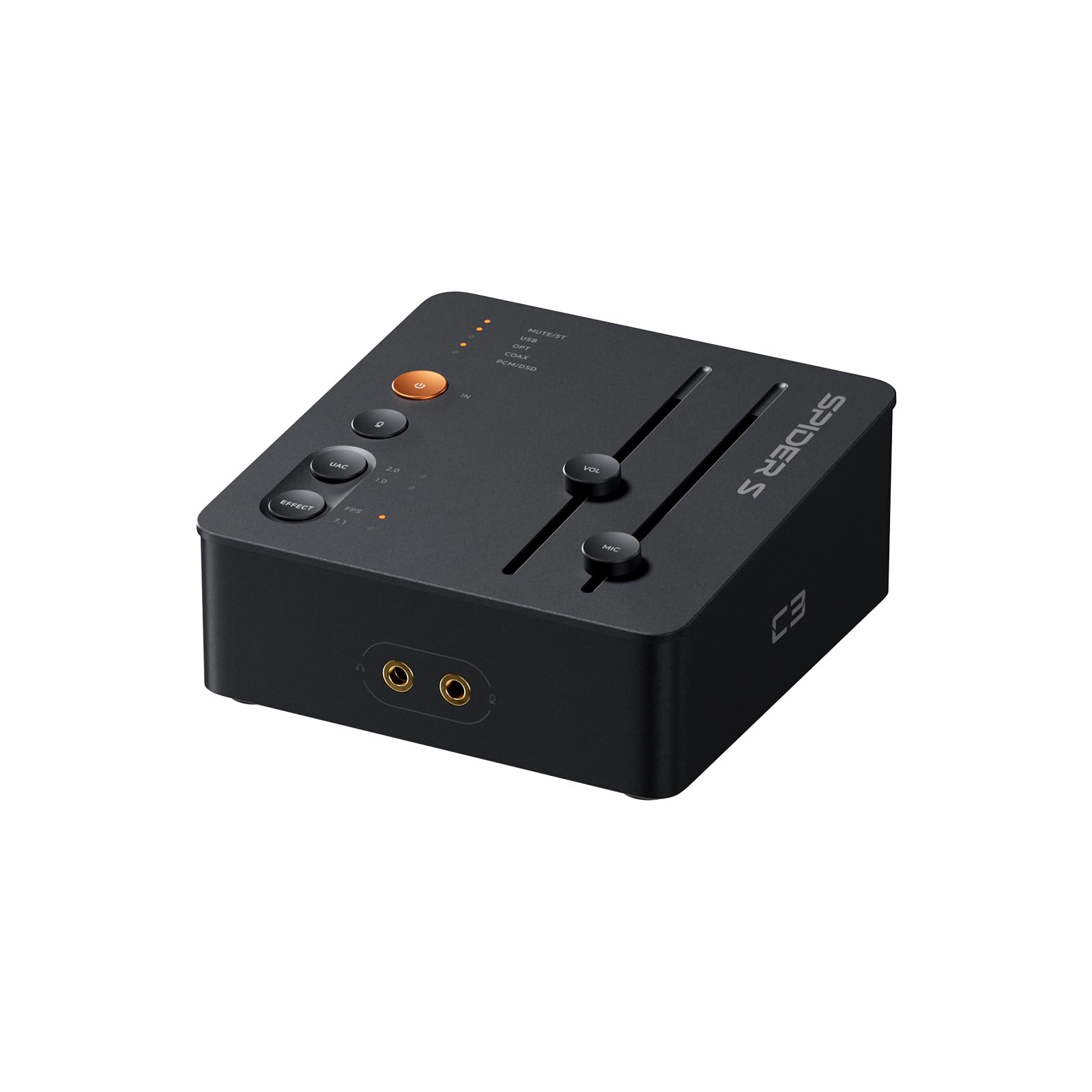
The first card that isolates footsteps algorithmically, pairing a flagship DAC with a desktop volume wheel.
Fosi Audio calls it StepSense Footstep Radar — a dedicated processing mode that amplifies in-game footsteps while keeping gunfire and explosions balanced. The hardware behind it is the CS43131 DAC, which handles 32-bit/384kHz PCM (pulse-code modulation, the standard digital audio format) and DSD256 (a high-resolution audio format). Total harmonic distortion plus noise (THD+N, a measure of signal purity) is only 0.0004%. The amplifier delivers 320mW × 2 at 32Ω, enough to cleanly drive 16Ω to 300Ω headsets. Its 384 KHz maximum sample rate puts it in the same class as the Cubilux. By comparison, the HUANGENG card maxes out at 48 KHz.
Fosi claims AI mic noise cancellation suppresses keyboard clicks and background buzz with only 50ms latency (the delay between sound and processing). Owners mention it keeps squad voice channels clear even during loud mechanical typing. The CNC-machined aluminum unibody tilts at a 5° angle. A single USB-C connection keeps the desk tidy. The UAC mode (USB Audio Class) switching is useful: UAC 1.0 (16-bit/48kHz) gives plug-and-play surround on PS5, Switch, and Xbox, while UAC 2.0 (32-bit/384kHz) open up full HiFi playback on PC and Mac. The signal-to-noise ratio of 117 dB is slightly below the HUANGENG’s 120 dB but the C3 compensates with more processing features and far more sample rate headroom.
Competitive edge
- StepSense footstep amplification gives a real directional advantage in FPS games
- AI microphone noise cancellation with 50ms latency keeps comms clean
- UAC 1.0 / UAC 2.0 switch works across PS5, Switch, Xbox, and PC
One limitation
- No SPDIF optical output for external amplifier or home theater setups
Grab this if: You play competitive shooters on PC and a console, and you want the most advanced footstep-detection engine and a desktop volume wheel.
skip it if: Your setup relies on an optical SPDIF connection to a receiver — this card is USB-only.
4. EPOS GSX 1000 2nd Edition Dac Amp

A desktop DAC with a physical volume wheel and adjustable sidetone that turns your desk into a studio.
The EPOS GSX 1000 2nd Edition focuses on ease of use. An aluminum volume wheel gives you precise control over headphone volume. A dedicated button lets you switch between headphone DAC sound and speaker output without unplugging cables. Adjustable sidetone lets you hear your own voice in real time at a level you set, so you stop shouting in voice chat. It includes a binaural rendering engine with EPOS-engineered 7.1 Surround Sound, plus EQ presets labeled for story, music, and more. The maximum sample rate is 48 KHz, matching the budget HUANGENG and Toeasor cards rather than the 192 KHz or 384 KHz of pricier competitors. If sample rate is your priority, the Cubilux or Fosi C3 deliver much more headroom for less money. Buyers praise the desktop control but note the 48KHz ceiling is disappointing at this price tier.
What it does well
- Aluminum volume wheel and speaker/headphone switch for instant source swapping
- Adjustable sidetone prevents you from yelling at teammates
- Binaural 7.1 rendering with dedicated EQ presets for story and music
What holds it back
- Maximum sample rate of 48 KHz is entry-level despite the premium price
- No published signal-to-noise ratio to judge noise floor
Choose this when: Desktop convenience and a physical volume knob matter more than the highest sample rate.
Look elsewhere if: You want 192KHz or 384KHz decoding — this card caps out at 48KHz.
5. VANTEC USB External 7.1 Channel Audio Adapter

The veteran external card with separate left and right microphone inputs for true stereo recordings.
Vantec’s NBA-200U is a longtime fixture in the USB sound card space. It uses a simple USB 2.0 connection that is backwards compatible with USB 1.1. It supports 48/44.1 KHz sampling rates for both playback and recording. Unlike most cards here, it includes SPDIF optical input and output, making it a good match for home theater receivers. It also provides separate left and right microphone inputs, so you can record true stereo audio rather than a mono mix. The adapter weighs 9.6 ounces and measures 3.94 x 2.28 x 1.02 inches, larger than the compact Cubilux or Fosi C3. Buyers with hundreds of reviews consistently mention its durability and stable driver support across many Windows versions. The sample rate stops at 48KHz, so it is not for 384KHz Hi-Res playback, but for surround playback and stereo recording with optical connectivity, it remains a solid workhorse.
Stereo-recording specialist: If you need true left-right mic separation for podcasting or ASMR, the Vantec is one of the few external cards that offers that without an expensive audio interface.
The age factor: At 48KHz max, any card in the 192KHz or 384KHz camp will out-resolve it for modern game audio.
Reach for this if: You need SPDIF optical connectivity to a receiver and separate left/right microphone recording from a single USB adapter.
Pass if: You prioritize high sample-rate gaming audio above recording features.
6. HUANGENG USB External Sound Card with SPDIF Digital Sound

The cheapest way to get a 120 dB signal-to-noise ratio plus SPDIF optical into your audio chain.
This HUANGENG card uses an aluminum alloy body and supports true 5.1 and 7.1 channel output. Its signal-to-noise ratio of 120 dB is the highest in this comparison, beating the Fosi Audio C3’s 117 dB. The maximum sample rate is 48 KHz, matching the budget Toeasor and Vantec cards rather than the 192KHz or 384KHz competitors. For the money, you get SPDIF optical input and output, allowing a clean digital pass-through to an external amplifier or home-theater receiver. Customers note it works with personal computers, speakers, headphones, laptops, gaming consoles, microphones, and amplifiers. The 48KHz ceiling is the bottleneck: while the 120dB SNR gives a black-silent background free of hiss, the card cannot decode high-resolution audio files above CD quality. It is a budget-friendly entry into surround sound with optical out, not a high-sample-rate audiophile device.
Cleanest background in the budget tier: With a 120 dB SNR, you get less electronic noise than many cards.
Where it falls short: The 48 KHz sample rate is the lowest notch — the Fosi C3 runs at 384 KHz, while the HUANGENG is at 48 KHz.
Best for: A buyer on a tight budget who needs SPDIF optical connectivity to feed a home theater amp and values the highest noise-floor rating.
Not for: Competitive gamers or music listeners who want 192KHz or 384KHz sample rate headroom.
7. Toeasor USB Sound Card Virtual 7.1 Surround Sound

A cable-style sound card with a control box that adds mute and volume sliders to any USB device.
Toeasor’s adapter is a simple plug-and-play cable with a small control box. It uses virtual 7.1 surround sound processing to enhance low frequencies (like footsteps) and high frequencies (like gunshots) through any 3.5mm gaming headset. The inline control box gives you a microphone mute button and separate volume sliders for headphones and mic. It is drive-free: plug it in, and Windows recognizes it immediately. Compatibility covers Windows 10/7/XP, Android, iOS, PS4, PC, and Mac. It works with TRS (tip-ring-sleeve) and TRRS (tip-ring-ring-sleeve) microphones. The maximum sample rate is not published but the form factor suggests 48 KHz, typical for this class. This is a pure entry-level solution — no SPDIF, no high sample rates, and no DAC as advanced as the CS43131 in the Fosi C3. One year of warranty is included. Reviewers point out it is perfect for laptops that lost their headphone jack or for adding quick mute control without software menus. Anyone expecting studio-grade audio resolution will find it lacks refinement.
Where it wins
- Inline mute button and volume sliders let you control audio without opening any software
- Plug-and-play with no driver installation across PC, Mac, PS4, and mobile
- Works with both TRS and TRRS 3.5mm headset connectors
What it lacks
- Sample rate and DAC chip are entry-level — no high-resolution audio support
- No SPDIF optical for external amplifier connectivity
Pick this for: The absolute lowest-cost way to get a mute button and headphone volume control on a laptop or console without drivers.
Look past it if: You want any form of high-resolution audio playback or optical output.
Understanding the Specs
Sample Rate (KHz)
What it does for you: Every second, a sound card takes a certain number of digital snapshots of your audio and converts them into the sound you hear. A rate of 48 KHz (48,000 snapshots per second) is enough for DVD-quality movies and standard music. Jumping to 192 KHz or 384 KHz adds more detail to the highest frequencies, like a sharp gunshot crack or the reverb tail of a piano note. In a game, that extra resolution can tell you an enemy is exactly six steps to your left, not just somewhere behind a wall.
Signal-to-Noise Ratio (SNR)
What it does for you: SNR tells you how much background hiss or electrical buzz exists when no sound plays. Measured in decibels (dB), a higher number means a quieter background. A card with 90 dB SNR lets you hear a faint whine in silence. A card with 117 dB or 120 dB, like the Fosi Audio C3 or the HUANGENG, drops that noise so low you cannot detect it. This matters most when you use sensitive headphones in a quiet room — the cleaner the SNR, the more you hear only the game or music.
FAQ
Will a 7.1 sound card USB work with my PS5 or Xbox?
What is the difference between virtual 7.1 and true 7.1?
Can I use a 7.1 sound card USB with a Mac?
Does a higher sample rate make music sound better?
What does SPDIF optical output let me do?
Why does my USB sound card sound worse than my motherboard audio?
Can I use a 7.1 sound card USB with a gaming headset that has one 3.5mm combo jack?
How long do external USB sound cards typically last?
Final Thoughts: The Verdict
For most people, the 7.1 sound card usb winner is the Fosi Audio C3. It has the highest sample rate (384KHz), Fosi’s StepSense footstep-enhancement algorithm, a desktop volume wheel, and AI mic noise cancellation — all in a compact aluminum body that works on PC and console. If you want a premium console-friendly all-rounder, grab the Creative Sound BlasterX G5. For budget-friendly SPDIF optical output with the quietest noise floor, the HUANGENG USB External Sound Card delivers 120 dB SNR while staying affordable.
How We Picked
We do not accept paid placement. Every pick is matched to a real buyer and a real use-case; we do not hands-on test units.
Sources & Methodology
Specifications: manufacturer listings and product documentation. Review insights: verified customer reviews, as of July 2026. Pricing: not shown on this page (it changes often); check the current price via the retailer link.
As an Amazon Associate, Gadgets Feed earns from qualifying purchases. This does not affect which products we feature.