
Our readers keep the lights on and my morning glass full of iced black tea. As an Amazon Associate, I earn from qualifying purchases.
Building a home theater means moving beyond simulated surround sound into true, object-based audio where helicopters fly overhead and rain falls in a precise three-dimensional space. A 7.2 channel receiver is the command center for this experience, decoding Dolby Atmos and DTS:X soundtracks while driving seven speakers and two independent subwoofers. The challenge is picking the right one from a sea of models that look identical but perform vastly differently at driving real speakers in a real room.
I’m Min — the co-founder and writer behind Gadgets Feed. I’ve logged hundreds of hours analyzing amplifier topology, HDMI chipset revisions, and room correction algorithms to cut through the marketing noise and identify which 7.2 channel receivers actually deliver on their specs.
This guide ranks the best options across every performance tier so you can confidently choose the best 7.2 channel receiver for your home theater, gaming setup, or music listening space.
How To Choose The Best 7.2 Channel Receiver
A 7.2 channel receiver must balance raw amplifier power, HDMI connectivity for modern sources, and room calibration that adapts the sound to your specific space. The wrong choice leaves speakers underpowered, gaming features missing, or bass uneven across the room.
Real Amplifier Power vs. Rated Wattage
Manufacturers often list peak power at a single channel driven into 6 ohms, which bears little resemblance to real-world performance with five or seven channels playing simultaneously. Look for power ratings measured with all channels driven into 8 ohms — a Denon AVR-S770H delivering 75W per channel this way will outperform a budget unit that claims 100W but sags to 40W under load. Higher sensitivity speakers (90dB and above) require less power, while low-sensitivity bookshelf speakers (86dB) demand more headroom.
HDMI 2.1 and Gaming Features
If you connect a PlayStation 5, Xbox Series X, or a PC with an RTX 30/40-series card, HDMI 2.1 support with 40Gbps bandwidth is critical. This enables 4K/120Hz and 8K/60Hz passthrough, but the real value is in Variable Refresh Rate (VRR) to eliminate screen tearing and Auto Low Latency Mode (ALLM) for lag-free responsiveness. Models like the Onkyo TX-NR6100 and Yamaha RX-A2A offer full HDMI 2.1 implementations, while older chipsets may restrict bandwidth or lack VRR entirely.
Room Correction and Calibration
Room acoustics dramatically alter sound quality, making automatic calibration systems essential. Basic Audyssey MultEQ (found on Denon AVR-S770H) measures multiple positions and applies filters to tame frequency peaks. Advanced systems like Audyssey MultEQ XT32 (Marantz Cinema 70S) use higher resolution filters for finer control. Yamaha’s YPAO R.S.C. with multipoint measures reflection control, and Sony’s Digital Cinema Auto Calibration IX on the STR-AN1000 uses 360 Spatial Sound Mapping to create phantom height channels. Skip receivers without any calibration system — they will sound significantly worse in untreated rooms.
Dual Subwoofer Output and Integration
The “.2” in 7.2 denotes two independent subwoofer outputs, but implementation varies. True dual-sub support with independent level and distance settings (common on mid-range and premium units) allows each sub to be calibrated separately, smoothing out room bass modes that plague single-sub setups. Budget receivers may simply split the signal from one output, providing no benefit beyond convenience. Models like the Denon AVR-S970H and Yamaha RX-A2A offer proper dual-sub management.
Quick Comparison
On smaller screens, swipe sideways to see the full table.
| Model | Category | Best For | Key Spec | Amazon |
|---|---|---|---|---|
| Denon AVR-S970H | Premium | Balanced home theater & music | 90W x 7 (8 ohms, 20Hz–20kHz) | Amazon |
| Yamaha RX-A2A | Premium | Serious audiophile build | 100W x 7 (8 ohms, THD 0.06%) | Amazon |
| Sony STR-AN1000 | Premium | 360 Spatial immersive sound | 165W x 1 (6 ohms, 1kHz) | Amazon |
| Marantz Cinema 70S | Premium | Compact high-end design | 50W x 7 (8 ohms, 20Hz–20kHz) | Amazon |
| Sony STR-AZ1000ES | Premium | High-end custom install | 100W x 7 (8 ohms, 1kHz) | Amazon |
| Denon AVR-S770H | Mid-Range | Best value modern features | 75W x 7 (8 ohms, 20Hz–20kHz) | Amazon |
| Onkyo TX-NR6100 | Mid-Range | Gaming with THX certification | 210W x 1 (6 ohms, 1kHz) | Amazon |
| JBL MA710 | Mid-Range | Turntable integration | 110W x 7 (6 ohms, 1kHz) | Amazon |
| Yamaha RX-V6A | Mid-Range | MusicCast multi-room | 100W x 7 (8 ohms, THD 0.06%) | Amazon |
| Pioneer VSX-935 | Budget | Entry-level 8K passthrough | 80W x 7 (8 ohms, 20Hz–20kHz) | Amazon |
| Onkyo TX-NR5100 | Budget | Budget gaming features | 80W x 7 (8 ohms, 20Hz–20kHz) | Amazon |
In‑Depth Reviews
1. Denon AVR-S970H

The Denon AVR-S970H hits the sweet spot between power, features, and price for a 7.2 channel receiver. Its 90 watts per channel into 8 ohms (all channels driven, 20Hz–20kHz) provides genuine headroom for medium to large rooms, driving floorstanding speakers like Klipsch Reference series with authority during action movie explosions. The Audyssey MultEQ calibration system measures six positions and applies 2,000+ filter points to tame room resonances, which makes a night-and-day difference compared to basic EQ setups.
HDMI 2.1 support includes three 8K/60Hz inputs and two outputs with VRR, ALLM, and QFT for PC and console gaming. The HEOS multi-room platform streams from Spotify, TIDAL, and Amazon Music HD to compatible speakers in other rooms, and the built-in phono input lets you connect a turntable directly without an external preamp. The onscreen setup guide walks through speaker configuration step-by-step, making it manageable even for first-time AVR buyers.
Zone 2 powered output uses the rear surround channels, dropping the main zone to 5.1 — check your wiring plan before committing to 7.1 in one room plus a second zone. The remote lacks a dedicated TV power button, a minor ergonomic annoyance, and the HEOS app has occasional network discovery delays. Overall, the S970H delivers premium features at a mid-range price point with reliable Denon build quality and a cooler chassis temperature than many competitors.
Why it’s great
- Full 90W x 7 real-world power for dynamic soundtracks
- Audyssey MultEQ calibration transforms uneven room acoustics
- Phono input and HEOS multi-room streaming included
- Runs cooler than Onkyo competitors (80°F vs 90°F+)
Good to know
- Zone 2 powered output reduces main zone to 5.1 channels
- Remote lacks programmable TV power button
- HEOS Bluetooth cannot stream sources from the app
2. Yamaha RX-A2A AVENTAGE

The Yamaha RX-A2A belongs to the AVENTAGE line, Yamaha’s top-tier series characterized by a fifth center foot for vibration dampening, thicker chassis panels, and a three-year warranty. Its 100 watts per channel (8 ohms, 20Hz–20kHz, 0.06% THD) drives low-sensitivity speakers cleanly, and the YPAO R.S.C. room correction with multipoint measurement analyzes reflection control to deliver precise soundstage imaging. Surround:AI analyzes the audio signal in real time and adjusts dialog, effects, and ambient sound parameters automatically — a feature unmatched in this price bracket.
Three HDMI 2.1 inputs support 8K/60B and 4K/120AB passthrough with ALLM and VRR, making it ideal for next-gen gaming. MusicCast streams to compatible Yamaha wireless speakers around the house, and the unit supports Roon Tested certification for high-resolution audio enthusiasts. The phono input handles turntable connections, and Zone 2 pre-outs allow adding a separate amplifier for a second listening area.
Some users report intermittent HDMI handshake issues with Sony TVs that require unplugging the receiver to resolve, and the MSRP is high for the power output when compared to direct competitors from Denon and Onkyo. The remote control is dense with small buttons, requiring a learning curve. On sale — often seen at – — the A2A justifies its AVENTAGE pedigree with noticeably refined sound quality over entry-level Yamaha models.
Why it’s great
- AVENTAGE build with vibration-dampening chassis and premium components
- Surround:AI real-time audio optimization adapts to content
- YPAO R.S.C. multipoint calibration for precise imaging
- Roon Tested and MusicCast multi-room streaming
Good to know
- HDMI handshake glitches reported with Sony TV models
- No analog video input conversion to HDMI
- Small, closely spaced remote buttons
3. Sony STR-AN1000

The Sony STR-AN1000 differentiates itself through 360 Spatial Sound Mapping, an advanced calibration system that uses Digital Cinema Auto Calibration IX to measure speaker positions and create phantom surround speakers. In a 5.1.2 configuration, it convincingly simulates a 7.1.4 setup, making it perfect for rooms where you cannot install real rear or height channels. The audio quality is crisp and detailed, with Dolby Atmos soundtracks feeling precisely placed in three-dimensional space.
Six HDMI 2.1 inputs and two outputs support 8K/60Hz and 4K/120Hz passthrough with VRR and ALLM, though some users report Dolby Vision passthrough issues with Apple TV 4K that require manual input switching to resolve. The calibration microphone setup is guided by a graphical interface, and the subwoofer distance measurement can be off by up to 12 feet — manual verification is recommended. The unit integrates with Sonos systems and supports Chromecast built-in, AirPlay 2, and Spotify Connect for flexible streaming.
The front display is small and difficult to read from a seating position, and there is no phono input for turntable users. Priced near the Yamaha RX-A2A, the STR-AN1000 delivers superior immersive sound processing for smaller rooms but requires careful manual tweaking to reach its full potential. Users pairing it with Sony SA-SW3 subwoofers report exceptionally smooth, room-filling bass thanks to the calibration integration.
Why it’s great
- 360 Spatial Sound Mapping creates convincing phantom height channels
- Digital Cinema Auto Calibration IX with 6+ position measurement
- Full HDMI 2.1 gaming support with VRR and ALLM
- Works with Sonos and Chromecast built-in
Good to know
- No phono input for turntable connection
- Dolby Vision passthrough requires manual workaround with Apple TV
- Small, hard-to-read front display
4. Marantz Cinema 70S
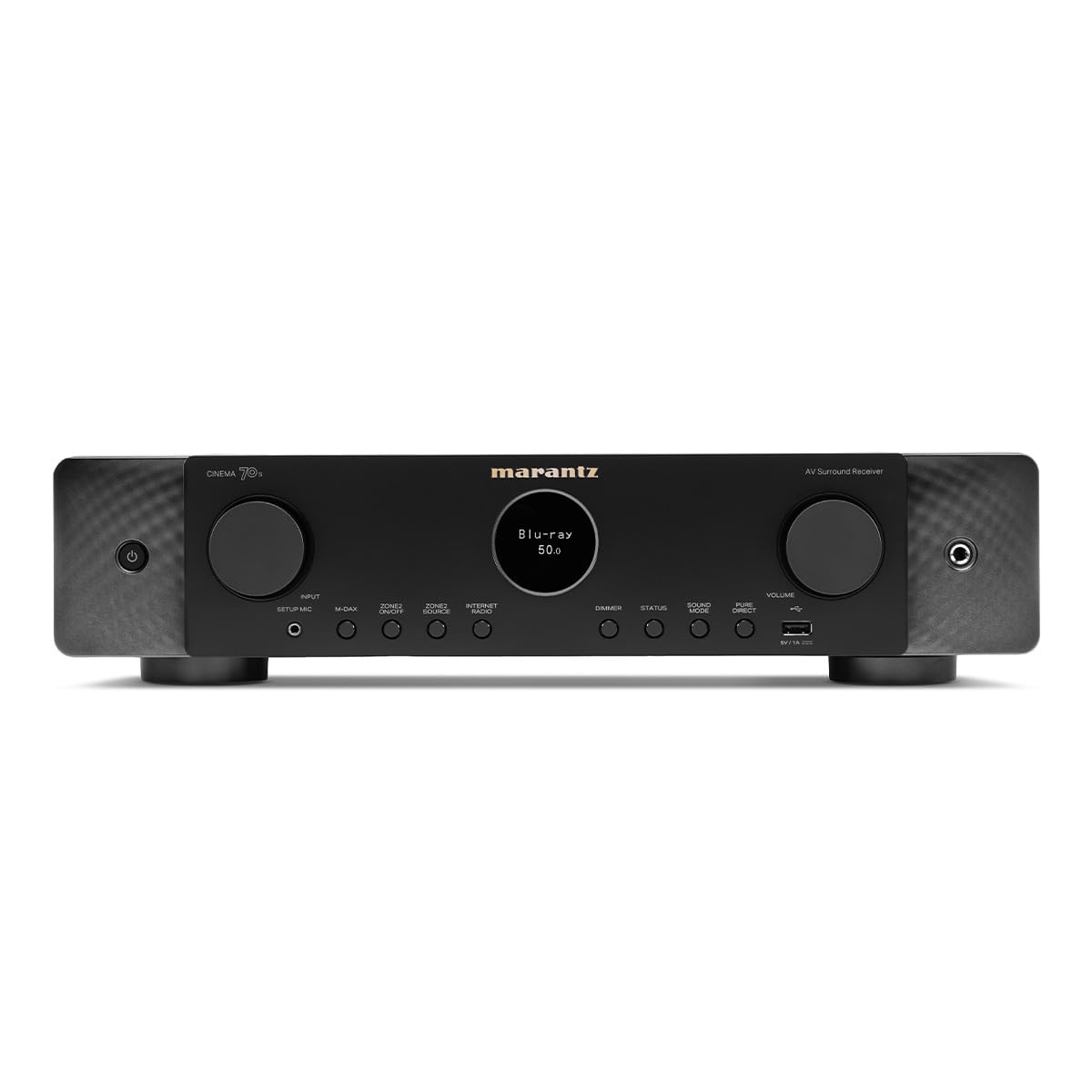
The Marantz Cinema 70S proves that size isn’t everything — its slim chassis, barely 4 inches tall, fits into tight media cabinets where full-size receivers won’t. The 50 watts per channel (8 ohms, 20Hz–20kHz, all channels driven) is sufficient for efficient speakers in small to medium rooms, and the legendary HDAM (Hyper Dynamic Amplifier Module) discrete circuitry delivers warm, rich tonality that music lovers appreciate. While 50W is less than competitors, the quality of the amplification produces higher current and lower distortion at listening levels.
Audyssey MultEQ XT32 is included, offering 32 times the filter resolution of standard MultEQ — this is the same advanced room correction found in Marantz’s flagship models. It measures eight positions and applies 512 filter points per channel, resolving deep bass nulls and harsh treble peaks that lesser systems leave untouched. Three 8K/60Hz HDMI 2.1 inputs and a phono input round out the connectivity, while HEOS provides multi-room streaming.
The low power output limits speaker choices — pairing with 4-ohm or low-sensitivity speakers will push the amplifier into distortion during dynamic peaks. The network control app sometimes misreports power status, and the slim profile means no Zone 2 powered speaker output. For a dedicated listening room with high-efficiency speakers, the Cinema 70S offers preamp/processor-level sound quality in a receiver package, justifying its premium price.
Why it’s great
- Slim 4-inch profile fits tight AV cabinets
- Audyssey MultEQ XT32 for premium room correction
- HDAM discrete circuitry for warm, detailed sound signature
- Phono input and HEOS streaming included
Good to know
- 50W per channel limits speaker and room size choices
- HEOS app network control occasionally unreliable
- No Zone 2 powered speaker output
5. Sony STR-AZ1000ES

The Sony STR-AZ1000ES is an ES-series (Elevated Standard) receiver built for custom integrators and serious home theater enthusiasts. Its 100 watts per channel (8 ohms, 1kHz, 0.9% THD) drives a 5.1.2 or 7.1 setup with authority, and the 360 Spatial Sound Mapping technology — the same processing found in the STR-AN1000 — creates expansive sound fields that extend beyond physical speaker positions. Users describe the 5.1.2 configuration sounding indistinguishable from a dedicated 7.1.4 system.
Digital Cinema Auto Calibration IX measures each speaker position and optimizes the spatial mapping, though manual distance verification with a tape measure is recommended for full accuracy. Six HDMI 2.1 inputs and two outputs support 8K and 4K/120Hz with VRR and ALLM. The ES series adds IP control integration for automation systems, a removable front cover plate for clean rack installation, and a backlit remote control — small details that matter in serious setups. The unit runs hot during extended use; third-party cooling fans are recommended.
The STR-AZ1000ES lacks HDR10+ and QMS support, which limits compatibility with some streaming devices. Its DAC quality is revealing enough to expose poor recordings, a double-edged sword for compressed music. At nearly , it competes with 9-channel receivers from other brands, so budget-minded buyers should confirm they need the ES-line reliability and integration features before committing. For those who do, the performance and build quality justify the investment.
Why it’s great
- 360 Spatial Sound Mapping creates convincing immersive audio
- ES-series build with IP control for custom installations
- Backlit remote and front cover plate for clean rack mounting
- Excellent DAC quality with revealing detail retrieval
Good to know
- No HDR10+ or QMS support
- Runs very hot; additional cooling recommended
- Premium price competes with 9-channel alternatives
6. Denon AVR-S770H

The Denon AVR-S770H represents the best modern feature set per dollar in the 7.2 channel receiver market. Its 75 watts per channel (8 ohms, 20Hz–20kHz, two channels driven) provides clean power for most home theater setups, and the Audyssey MultEQ calibration effectively addresses room acoustics. Users report clear, warm sound that makes dialog understandable and action scenes impactful — several long-time Denon owners say it sounds better than their previous + models.
HDMI 2.1 support includes one 8K/60Hz input and three 4K/120Hz inputs with VRR, ALLM, and QFT for gaming. The HEOS platform streams from every major service, and the setup wizard guides through speaker configuration in about 20 minutes. Dolby Height Virtualization and DTS Virtual:X create convincing overhead effects without ceiling speakers, making this a strong choice for rooms that cannot support in-ceiling installations. The unit integrates with Amazon Alexa, Google Assistant, and Siri for hands-free control.
Some units experience firmware instability — random volume drops to zero and infrequent startup picture failures have been reported. The remote requires a learning curve with its small buttons, and the Zone 2 output drops the main zone to 5.1 channels. For buyers who want genuine 7.2 channel support with Audyssey calibration and HDMI 2.1 gaming features without paying premium prices, the AVR-S770H delivers exceptional value.
Why it’s great
- Audyssey MultEQ calibration at an entry-level price point
- Full HDMI 2.1 gaming support with VRR and ALLM
- Dolby Height Virtualization for rooms without ceiling speakers
- HEOS multi-room streaming with voice control
Good to know
- Firmware updates can cause random volume drops
- No phono input for turntable connection
- Remote buttons are small and densely packed
7. Onkyo TX-NR6100
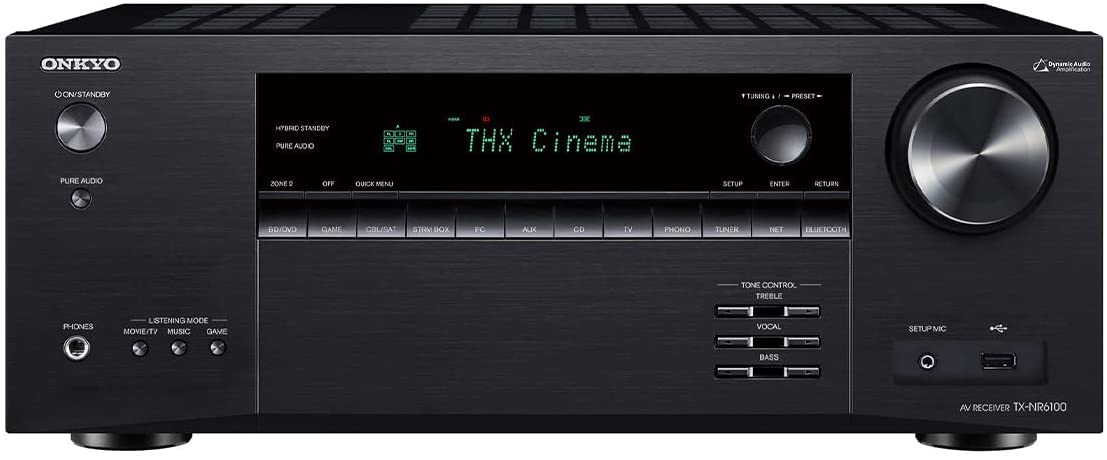
The Onkyo TX-NR6100 brings THX Select certification to the 7.2 channel receiver market, guaranteeing reference-level performance in rooms up to 2,000 cubic feet. Its discrete Dynamic Audio Amplification system delivers 210W per channel (6 ohms, 1kHz, 1ch driven), translating to high current output that drives demanding 4-ohm speakers cleanly. The three HDMI 2.1 inputs support full 40Gbps bandwidth with 4K/120Hz and VRR — critical for PS5 and Xbox Series X owners who want every frame rendered without tearing.
Dolby Atmos and DTS:X support enables 5.2.2 or 7.1 channel configurations, and IMAX Enhanced certification provides certified playback of IMAX-encoded content. The AccuEQ Advanced system calibrates speaker distances and levels automatically, though it lacks the filter resolution of Audyssey MultEQ. Dirac Live compatibility via an optional license would have elevated this receiver further, but the included calibration is sufficient for most rooms.
The HDMI 2.1 chipset has known failure issues in some units after extended use, with users reporting loss of 4K/120Hz output and audio dropouts. The remote feels flimsy compared to competitors, and inputs 4-6 are limited to 4K/60Hz rather than full 8K bandwidth. For pure gaming performance — low latency, variable refresh, and THX-tuned dynamics — the TX-NR6100 is outstanding, but long-term reliability and limited HDMI switching flexibility are real concerns.
Why it’s great
- THX Select certification ensures reference-level performance
- Full 40Gbps HDMI 2.1 for 4K/120Hz gaming
- High current output handles demanding 4-ohm speakers
- IMAX Enhanced certification for compatible content
Good to know
- HDMI 2.1 chipset reliability concerns in some units
- Inputs 4-6 limited to 4K/60Hz, not full 8K bandwidth
- Flimsy remote control feel
8. JBL MA710

The JBL MA710 stands out with its built-in moving magnet phono input, rare in the mid-range 7.2 channel receiver segment. It delivers 110 watts per channel (6 ohms, 1kHz, 1ch driven), enough to drive tower speakers like the JBL Stage or Polk ES series to satisfying volumes. The shallow 4.3-inch chassis depth fits into entertainment centers where deeper receivers won’t, and the clean front panel design blends into modern living spaces without looking like industrial audio gear.
Six HDMI inputs (one 8K, five 4K) with eARC support Dolby Vision, HDR10+, and HLG. The Dolby Atmos and DTS:X decoding works in 7.1 or 5.1.2 configurations, and wireless streaming includes AirPlay 2, Chromecast, and Bluetooth. The initial firmware update process can be confusing — users report unresponsive units until the update completes — and the remote lacks a backlight, making navigation difficult in dark theater rooms.
The DTS-HD Master Audio downmixing to 2.1 does not function as expected, limiting usability for stereo-only listening setups. JBL has not released firmware updates recently, so this issue may not be resolved. For vinyl enthusiasts building a hybrid music/home theater system, the MA710’s phono input and compact size make it a unique value proposition — just ensure your room uses DTS:X or Dolby TrueHD rather than relying on DTS-HD Master Audio stereo downmixing.
Why it’s great
- Built-in moving magnet phono input for turntable connection
- Shallow 4.3-inch depth fits compact entertainment centers
- AirPlay 2 and Chromecast built-in for streaming
- Clean, modern aesthetic design
Good to know
- DTS-HD Master Audio 2.1 downmixing does not work
- Remote is not backlit for dark room use
- Initial firmware update process is confusing
9. Yamaha RX-V6A

The Yamaha RX-V6A offers the MusicCast multi-room ecosystem at a mid-range price, along with genuine 100 watts per channel (8 ohms, 0.06% THD) that drives most bookshelf and tower speakers with ease. YPAO R.S.C. with multipoint measurement calibrates speaker distances and applies reflection control for improved imaging — a tier above the basic YPAO found in entry-level Yamahas. Users upgrading from 5- or 10-year-old receivers consistently report clearer dialog, better stereo separation, and more dynamic action scenes.
Three HDMI 2.1 inputs support 8K/60B and 4K/120AB passthrough with HDCP 2.3, though early firmware versions had bandwidth limitations that required updates. The RX-V6A supports Dolby Atmos and DTS:X, plus Dolby Height Virtualization for simulated overhead effects. The clean front panel and improved remote design represent a significant ergonomic upgrade from previous generations. Setup takes about 20–25 minutes using the onscreen menu, and Bluetooth/WiFi connectivity is reliable.
eARC setup can be complex — users report that the receiver does not auto-power on with the TV, requiring manual power cycling. The HDMI-CEC behavior with NVIDIA Shield and LG TVs can cause conflicts that require disabling certain control options. For MusicCast users who want Yamaha’s proven reliability and good sound quality at a mid-range price, the RX-V6A is a strong contender, though the setup friction with eARC/HDMI-CEC is worth noting.
Why it’s great
- MusicCast multi-room streaming ecosystem integration
- YPAO R.S.C. calibration with multipoint measurement
- 8K/60B and 4K/120AB HDMI 2.1 passthrough
- Excellent sound quality for both music and movies
Good to know
- eARC setup and HDMI-CEC integration can be problematic
- Does not auto-power on with TV
- Early HDMI 2.1 firmware required updates for full bandwidth
10. Pioneer VSX-935
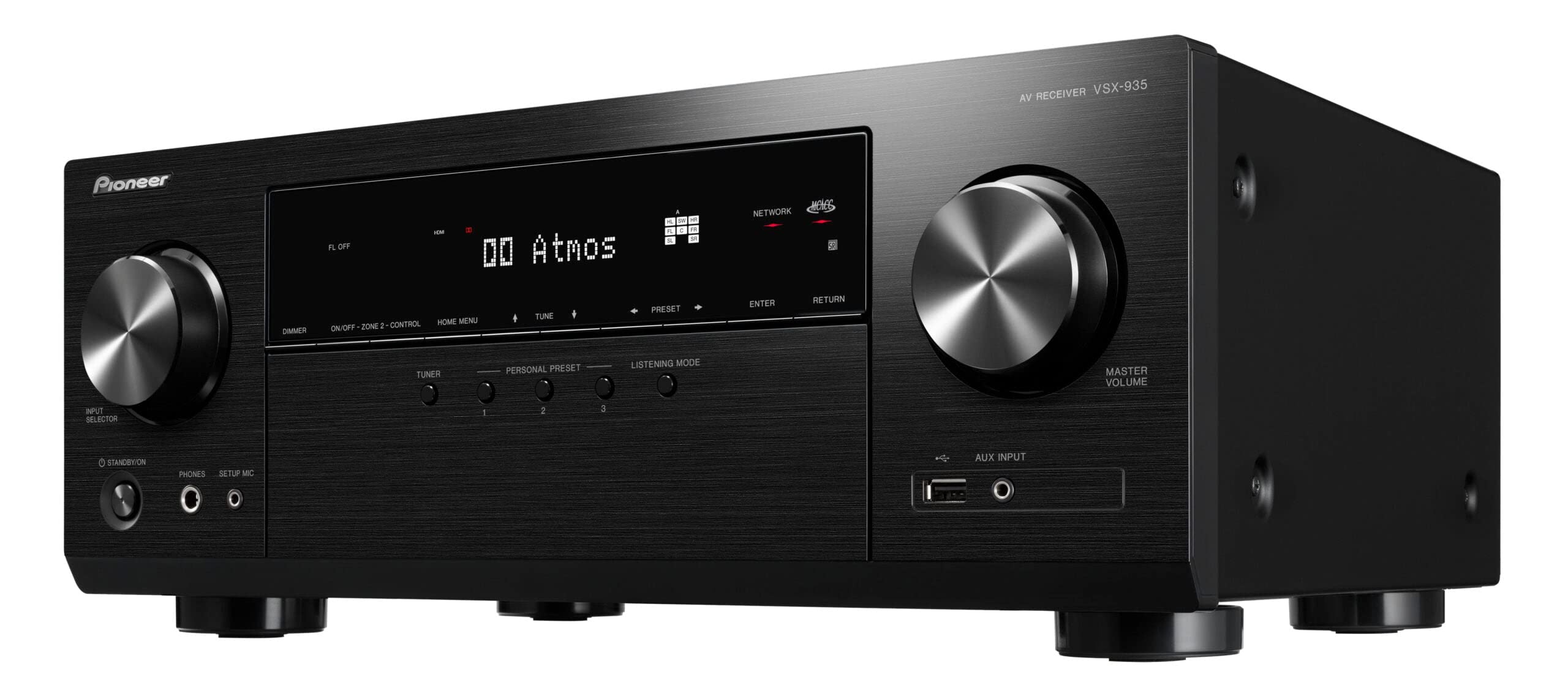
The Pioneer VSX-935 provides genuine 8K/60Hz HDMI 2.1 passthrough at an entry-level price point, making it the most affordable route to future-proofed video connectivity. Its 80 watts per channel (8 ohms, 20Hz–20kHz, two channels driven) is sufficient for efficient speakers in small-to-medium rooms, and the Dolby Atmos Height Virtualization creates phantom overhead effects without requiring ceiling speakers — a valuable feature for renters or those without in-ceiling wiring options.
The RF remote provides non-line-of-sight control through cabinets, and the dual-zone output allows a second speaker pair in another room. The clear front display with dimmer settings adjusts brightness for dark theater environments. Users praise the crisp, clear audio quality and the gradual-to-50-then-fast volume curve that provides fine control at low levels. The unit works with Audirvana and DSD128 for computer-based high-resolution audio playback.
The two-way Bluetooth feature is unreliable — pairing is difficult and there is no dedicated button, making it frustrating to use. Some units arrive with defects: dead displays or no sound output requiring toggling unused Zone 2 settings. The onscreen interface looks dated, without the polished graphics of Denon or Yamaha competition. For buyers who prioritize budget-friendly 8K passthrough and simple surround sound over advanced room correction and streaming features, the VSX-935 delivers the basics effectively.
Why it’s great
- Lowest-cost 8K/60Hz HDMI 2.1 passthrough available
- RF remote works through cabinets without line-of-sight
- Dolby Atmos Height Virtualization for phantom overhead sound
- Dual-zone output flexibility
Good to know
- Two-way Bluetooth implementation is unreliable
- QC issues: some units arrive with dead displays or no sound
- Dated onscreen interface compared to competitors
11. Onkyo TX-NR5100

The Onkyo TX-NR5100 brings HDMI 2.1 gaming enhancements — VRR, ALLM, and QFT — to the budget tier, making it the most affordable way to get variable refresh rate support for smooth PC and console gaming. Its 80 watts per channel (8 ohms, 20Hz–20kHz) provides adequate power for budget speaker packages, and the eARC support simplifies connection to TVs for high-bitrate Dolby Atmos streaming from built-in apps. The menu system is easy to navigate, and the larger front display is more readable than many competitors at this price.
The speaker terminals combine twist-lock connectors for the front pair with spring clips for the remaining channels — an odd design choice that makes replacing budget wiring easier for the main speakers. Users report that the sound quality is good for its price, with clear dialog and decent dynamics. The unit powers two 4-ohm front speakers via eARC when receivers twice the price cannot, a testament to its stable amplification design.
The TX-NR5100 has been advertised as 7.2 but is actually a 7.1 receiver — one subwoofer output is disabled, meaning true dual-sub support is absent. Bluetooth connectivity is hit-or-miss, with an 80% success rate and sync issues with low-latency headphones. Multiple users report complete failure after 18–24 months, with the HDMI board or main processor dying. For budget gamers who need VRR and are willing to accept single-sub limitations and potential reliability risks, the TX-NR5100 delivers the key gaming features at the lowest cost.
Why it’s great
- Lowest-cost HDMI 2.1 with VRR, ALLM, QFT for gaming
- Stable amplification drives 4-ohm speakers via eARC
- Easy setup with clear onscreen menu
- Larger, readable front display
Good to know
- Actually a 7.1 receiver — second subwoofer output disabled
- Reported reliability issues after 18–24 months
- Bluetooth connection inconsistent (80% success rate)
- Mixed speaker terminal design (twist + spring clip)
FAQ
Can I use a 7.2 receiver with a 5.1 speaker setup?
What is the difference between 7.1 and 7.2 channel receivers?
Do I need a 7.2 receiver for Dolby Atmos?
Why does my 7.2 receiver get so hot?
Can I use banana plugs with any 7.2 receiver?
Final Thoughts: The Verdict
For most users, the 7.2 channel receiver winner is the Denon AVR-S970H because it balances 90W of real-world amplifier power, Audyssey MultEQ room calibration, full HDMI 2.1 gaming support, and a phono input at a mid-range price — a rare combination of features that covers every use case from movies to music to gaming without forcing major compromises. If you want the highest-quality sound processing and the ability to simulate a 7.1.4 system from just 5.1.2 speakers, grab the Sony STR-AN1000 for its 360 Spatial Sound Mapping. And for budget-conscious shoppers who need 8K HDMI 2.1 passthrough and simple surround sound, nothing beats the Pioneer VSX-935.