
That check engine light has been on for weeks, and you know the fix: swap the oxygen sensor. But reaching into the exhaust manifold with a regular socket is a gamble — standard 22mm sockets are too thick to fit past the wiring, and a box-end wrench can slip, rounding off the sensor hex and turning a thirty-minute job into a nightmare. You need a tool designed specifically for the job: a dedicated 7/8″ oxygen sensor socket with a wire slot, thin walls, and a deep enough bore to clear the sensor body.
I’m Min — the co-founder and writer behind Gadgets Feed. I’ve dug through hundreds of customer reports, spec sheets, and real-world battle stories to separate the tools that actually grip a seized sensor from those that flex and fail under load.
Whether you’re tackling a downstream sensor on a Toyota or an upstream bank on a Honda, choosing the right 7/8 oxygen sensor socket means the difference between a clean swap and a rounded-off hex that requires extraction tools.
How To Choose The Best 7/8 Oxygen Sensor Socket
Picking the wrong socket can cost you an afternoon and a bloody knuckle. Focus on these four factors to ensure you buy a tool that actually removes the sensor rather than rounding it off.
Wall Thickness and Clearance
The biggest mistake beginners make is grabbing a standard 22mm deep socket. Most O2 sensor housings are surrounded by a sheet-metal shield that leaves only millimeters of clearance. A thin-wall socket—typically with an outer diameter of 29–30mm—is the only way to slip past. If the socket walls are too thick, you simply cannot seat the tool over the sensor hex.
Drive Size and Leverage
Most oxygen sensor sockets come in either 3/8″ or 1/2″ square drive. The 1/2″ drive gives you a stouter connection to a breaker bar, which is critical when you’re fighting rust and carbon-fused threads. The 3/8″ drive is more common and pairs with standard ratchets, but under extreme torque it can twist or snap. Some premium sockets offer both drive sizes on the same tool, giving you maximum leverage without needing extra adapters.
Wire Slot or Side Cutout
A dedicated O2 socket includes a longitudinal slot or side cutout that lets the sensor’s wiring pigtail pass through the socket wall. Without it, you’d have to cut the wires first—which ruins the old sensor and prevents you from backing it out manually. The slot should be wide enough for most OEM connectors (roughly 0.3″ wide by 2.2″ long) and positioned so the socket still maintains structural strength.
Material and Heat Treatment
Chrome vanadium steel (Cr-V) and chromium molybdenum steel (Cr-Mo) are the two common choices. Cr-V is harder and more corrosion-resistant, making it ideal for sockets. Cr-Mo is tougher under sudden impact loads but can be softer. Look for heat-treated alloy steel with a black oxide or phosphated finish for rust resistance. Cheap steel can flex and expand under high torque, causing the 6-point hex to lose its grip and slip.
Quick Comparison
On smaller screens, swipe sideways to see the full table.
| Model | Category | Best For | Key Spec | Amazon |
|---|---|---|---|---|
| CTA Tools 2064 | Premium | Tight engine bays | 29.80mm O.D. thin wall | Amazon |
| Lisle 12390 | Premium | Seized, rusted sensors | Dual 3/8″ & 1/2″ drive | Amazon |
| bylikeho O2 Socket Set | Mid-Range | Complete sensor kit | 5-pc set w/ thread chasers | Amazon |
| HTOMT 5PCS Set | Mid-Range | Versatility & storage | Cr-V steel, ABS case | Amazon |
| VCT Flex Head | Mid-Range | Hard-to-reach positions | Dual 6/12-point flex head | Amazon |
| Powerbuilt 648442 | Budget | Basic 1/2″ drive users | Chrome vanadium steel | Amazon |
| Acymner 5PCS Set | Budget | Entry-level full set | Cr-Mo steel, thread chasers | Amazon |
In‑Depth Reviews
1. CTA Tools 2064 Thin Wall Oxygen Sensor Socket

The defining problem with standard 22mm sockets is that they are too fat to drop into the recessed cavity surrounding most O2 sensors. CTA solves this with a thin-wall body that measures just 29.80mm at its tapered end — narrow enough to fit inside the wire cavity on a 2006 Toyota Matrix or a 2011 Kia Optima where other sockets physically cannot seat. The socket is 90mm (3.5″) long, giving you a deep bore of 72.7mm that clears even extended sensor bodies.
Dual drive configuration is another serious advantage. The top uses a standard 1/2″ square drive for a breaker bar or ratchet, while the external hex at the base accepts a 1″ wrench — useful when you need extra leverage in a spot where a ratchet head won’t fit. This is the tool to reach the top bank O2 sensors on Korean and Japanese vehicles where tight exhaust manifold clearance is a known issue.
It is worth noting that the thin walls trade some material strength. CTA explicitly warns this socket is designed for accessible sensors, not for hammering on a breaker bar with a cheater pipe. For rusted-in sensors, pre-soak with penetrating fluid and apply heat before attempting removal. The metal construction is solid, but the thin profile means it can flex if you over-torque on a fully seized unit.
Why it’s great
- Thin wall clears tight sensor cavities that standard sockets cannot reach
- Dual 1/2″ square and 1″ hex drive offers flexibility in cramped spaces
- 90mm length fits over longer-style oxygen sensors
Good to know
- Not designed for heavy torque on fully seized sensors
- No wire slot — you must disconnect the pigtail before seating the socket
2. Lisle 12390 Dual Drive Oxygen Sensor Wrench

If you have ever rounded an O2 sensor because your socket flexed open under load, the Lisle 12390 is the upgrade you need. This is a forged, heat-treated alloy steel tool with a thick six-point broach that simply does not expand or deform, even when you lean into a breaker bar on a sensor that has been baking in the exhaust stream for ten years. Multiple verified reviews confirm that this is the socket that removed stuck sensors after cheaper sockets had already failed.
The dual-drive design is genuinely useful. The tool accepts both 1/2″ and 3/8″ drive ratchets or breaker bars, which means you can start with a 1/2″ breaker bar for initial break-loose torque and then switch to a 3/8″ ratchet for faster spinning once the sensor is free. The detent ball holds the drive firmly so the ratchet does not pop off mid-pull — a small detail that saves frustration when you’re working blind under the car.
The trade-off is that the Lisle is a dedicated sensor socket without a wire slot. You must unplug the sensor connector before you can slip the socket over the hex. That is standard procedure for most mechanics, but if you prefer a tool that fits over an attached wire harness, this is not that tool. The thick walls also mean it may not fit into the tightest recessed cavities where a thin-wall design is required.
Why it’s great
- Forged steel with zero flex — removes sensors that other sockets cannot budge
- Dual 3/8″ and 1/2″ drive eliminates the need for adapters
- Heat-treated six-point design grips the hex without rounding
Good to know
- No side slot for sensor wire — connector must be unplugged first
- Thicker walls may not fit in the tightest shielded sensor cavities
3. bylikeho O2 Sensor Socket Set

The bylikeho set packs three different 22mm socket configurations plus two thread chasers into a single compact kit, giving you coverage for almost every sensor location without buying individual tools. The kit includes a deep 3/8″ drive socket (3-1/8″ long), a low-profile crowfoot-style wrench for tight spaces, and an offset 1/2″ drive socket for additional leverage. The thread chasers — M18 x 1.5mm and M12 x 1.25mm — let you clean up damaged bung threads before installing the new sensor, preventing cross-threading that can ruin the exhaust pipe.
The steel is forged with a black oxide finish that resists surface rust, and the 6-point broach on all sockets ensures a tight grip on the sensor hex. The side cutout design on the deeper sockets allows the wiring pigtail to pass through, so you can back the sensor out without first disconnecting the plug — a real time-saver when the connector is buried in the engine bay. Customers report successful swaps on Honda Pilots and Chevy Avalanches with no issues.
This is not the heavy-duty option for a fully seized sensor. The sockets are built from quality steel, but the thin walls and lighter construction mean you should still use penetrating fluid and heat on stubborn fasteners. The storage case is standard ABS plastic that protects the tools during transport, though some units arrived with minor case damage in shipping.
Why it’s great
- Five-piece set covers deep, shallow, and offset positions in one purchase
- Includes M18 and M12 thread chasers for cleaning damaged bungs
- Side cutouts allow wiring pigtail to pass through during removal
Good to know
- Not recommended for extreme torque on rust-seized sensors
- Storage case can arrive with cracks from shipping
4. HTOMT 5PCS Oxygen Sensor Socket Removal Tool Set
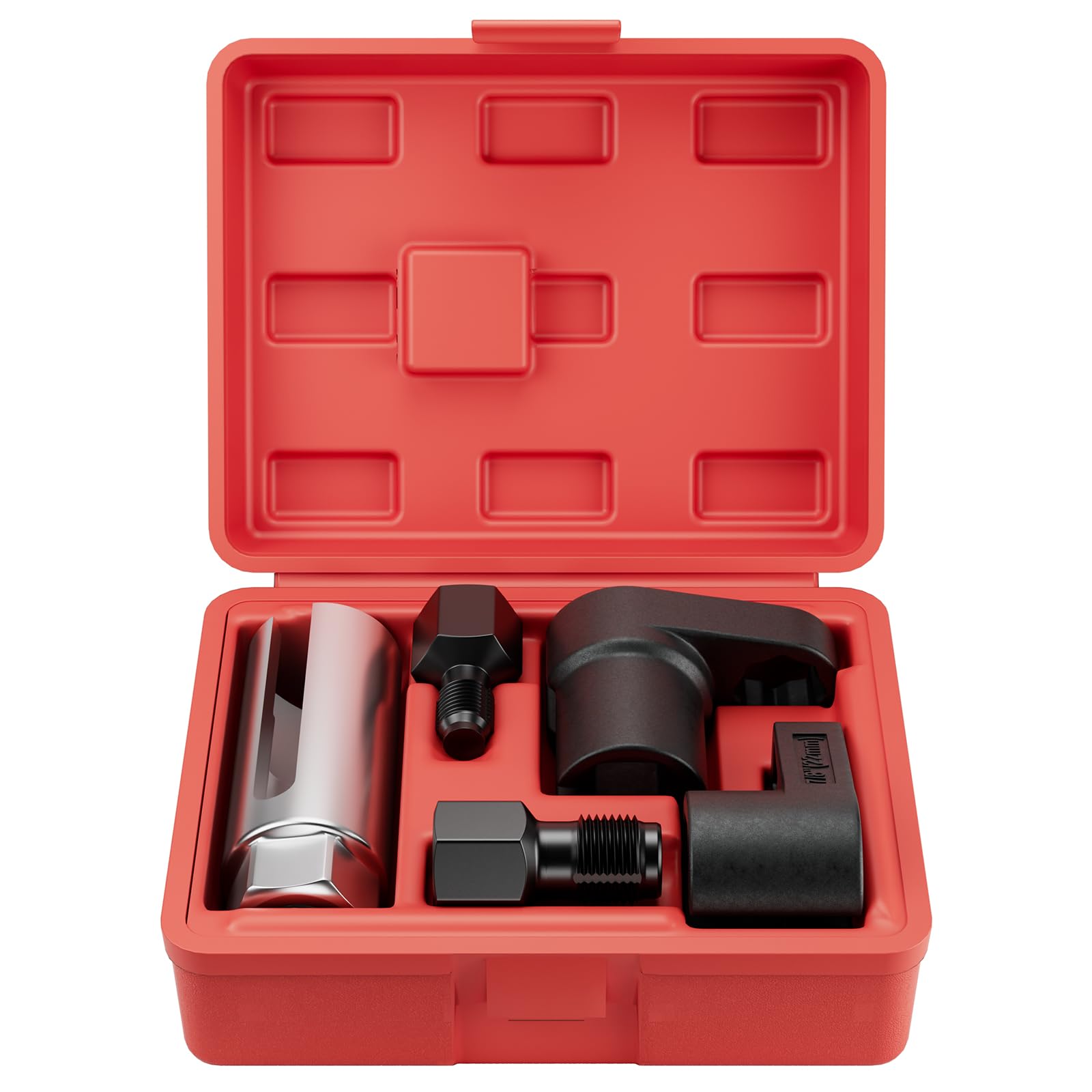
The HTOMT 5PCS set mirrors the bylikeho kit in concept but uses chrome vanadium steel with a phosphated and electroplated finish for superior corrosion resistance. The three socket types — extra deep broach (3-1/8″ long), low-profile crowfoot (1-1/4″ long), and offset crowfoot (1-15/16″ long) — cover the same range of sensor positions, with the offset design giving you extra clearance around the exhaust pipe flange. The 6-point 7/8″ opening fits standard 22mm oxygen sensor hexes precisely.
One specific advantage is the extra deep broach socket. At 3-1/8″ long, it provides the necessary depth for sensors that sit deep inside a recessed bung, such as those found on certain Subaru and Ford applications. The side cutout on the deep socket is positioned to let the wiring harness exit without binding, and the 3/8″ drive end works with most standard ratchets without needing a reducer.
The included M12 x 1.25mm and M18 x 1.5mm thread chasers are carbon steel with sharp cutting edges for cleaning light corrosion from bung threads. The set stores in a red high-impact ABS case that keeps all pieces organized. Some users noted that the case could be more robust, but the tools themselves held up without deformation during multiple sensor swaps.
Why it’s great
- Chrome vanadium steel with anti-corrosion phosphating finish
- Extra deep broach socket fits sensors in recessed bungs
- Thread chasers included for cleaning and repairing damaged threads
Good to know
- Case quality is basic and may not survive heavy shop use
- Offset wrench provides limited leverage compared to a breaker bar setup
5. VCT O2 Oxygen Sensor Flexible Double Sided Head Wrench

The VCT wrench takes a different approach from the traditional socket design. Instead of a fixed square drive, it uses a double-sided head with a 12-point configuration on one side and a 6-point on the opposite side, attached to a pivoting handle. The 12-point side gives you twice the number of engagement positions per rotation — a major advantage when the sensor sits at an angle where a standard ratchet swing is blocked by the chassis or steering components.
The pivoting handle locks at multiple angles, letting you apply torque from an offset position. This is ideal for sensors located on the back of the engine or near the firewall where you cannot get a straight pull on a breaker bar. Users on a Lexus IS300 reported that this tool removed all four sensors in fifteen minutes after months of struggling with conventional sockets.
The main downside is at the pivot joint itself. Several customers reported that the metal at the hinge point is relatively thin and can bend or snap if you apply heavy torque on a rust-welded sensor. This is a finesse tool for moderately stuck sensors — if you are dealing with heavy corrosion, pre-treat with heat and penetrating fluid, and consider switching to the Lisle or a breaker-bar setup for the initial break-away torque.
Why it’s great
- Pivoting head provides access in tight, awkward engine bay positions
- Dual 6-point and 12-point sides maximize engagement options
- Removed all four sensors on a Lexus in 15 minutes, per verified reports
Good to know
- Pivot joint is the weak point — can bend under extreme torque
- Not ideal for initial break-loose on heavily rusted sensors
6. Powerbuilt 1/2-Inch Drive x 7/8-Inch (22mm) Oxygen Sensor Socket
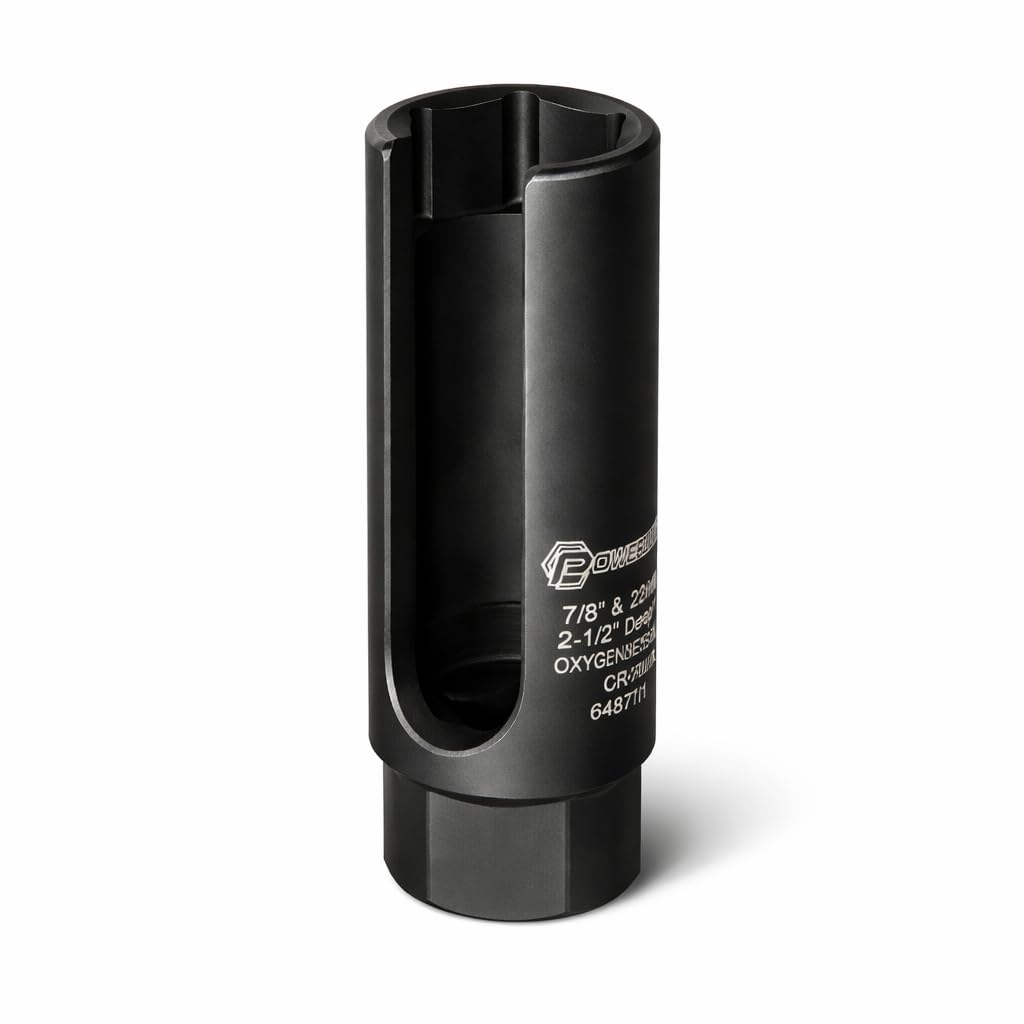
The Powerbuilt 648442 is the classic entry-level O2 socket that has been on the market for years. It is a 1/2″ drive, 7/8″ (22mm) 6-point socket built from chrome vanadium steel with a heat-treated and phosphated finish. The side wire gate — a 0.3″ wide by 2.2″ long slot — allows the sensor pigtail to exit the socket during removal and installation, which is exactly what you need for sensors with attached connectors.
At 2.5 inches deep, the socket is long enough to fit over most standard oxygen sensors, and the 1/2″ drive interface pairs well with a breaker bar for initial torque. Users on a 2006 Honda Accord successfully replaced sensor #2 in 30 minutes using this tool. The Cr-V construction offers reasonable strength for the price point, and the phosphating helps prevent surface rust during storage.
Accuracy of the 22mm hex has been inconsistent. Some users reported that the socket was stamped 7/8″ but fit loosely on the sensor, causing it to slip and round the hex — and in at least one case, resulting in a physical injury to the user’s hand when the socket slipped off a stubborn sensor. The socket can also flex slightly under high torque, which compounds the fit issue. For lightly seized sensors, it works fine; for rusted-in units, proceed with caution and keep a backup method handy.
Why it’s great
- Affordable price point for a dedicated 22mm O2 sensor socket
- Side wire gate accommodates sensor pigtails without cutting wires
- 2.5-inch depth clears most standard-length oxygen sensors
Good to know
- Sizing tolerance can be loose, leading to slippage on some sensors
- Steel flexes under high torque — not ideal for heavily seized fasteners
7. Acymner 5PCS O2 Sensor Removal & Thread Chaser Tool Set
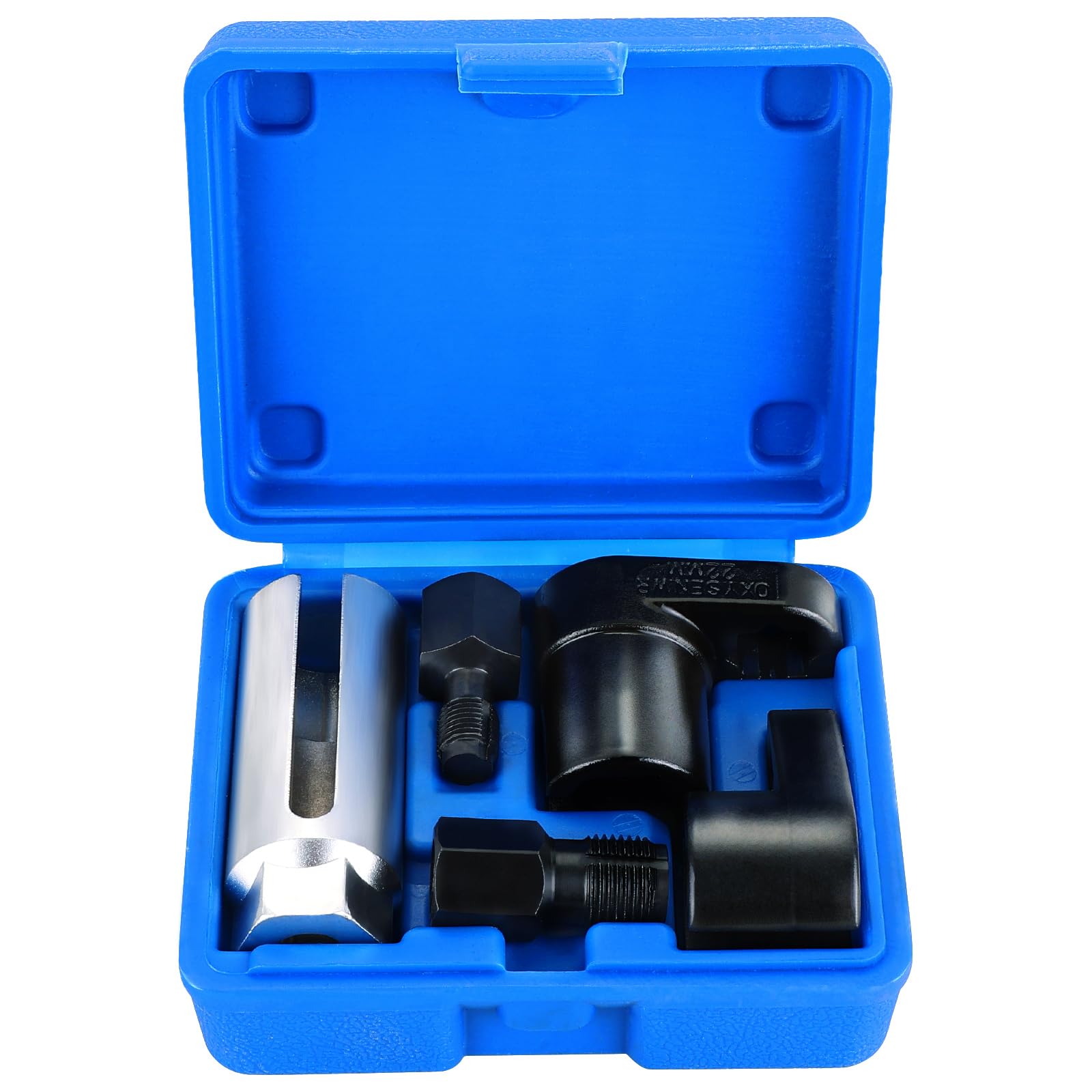
The Acymner kit offers a similar five-tool configuration to the mid-range sets but at a budget-friendly price. It includes the three socket types — deep, low-profile crowfoot, and offset crowfoot — plus the M12 x 1.25mm and M18 x 1.5mm thread chasers. The material is chromium molybdenum steel with a black oxide coating, which gives it better toughness under impact than chrome vanadium, though it is slightly softer in terms of surface hardness.
The offset and crowfoot designs are particularly useful for sensors that are recessed into the exhaust pipe or positioned at an angle. The side cutouts on the sockets allow wiring to pass through, and the 3/8″ and 1/2″ drive compatibility means you can use them with most ratchet sets. At 1.76 pounds, the set has a solid feel, and the thread chasers feature sharp cutting edges that clean bung threads effectively.
The primary caveat is quality control on the packaging and finish. Some units arrived with the box damaged, and a few users noted the black oxide coating was uneven in places. The sockets themselves test at functional quality levels — they removed sensors without stripping — but they lack the precision fit and heat treatment of the premium options. This is best suited for a weekend DIYer who needs a one-time-use kit or a backup set for the garage.
Why it’s great
- Five-piece set covers deep, offset, and low-profile positions
- Chromium molybdenum steel offers good toughness for the price
- Thread chasers included for cleaning bung threads before installation
Good to know
- Packaging can arrive damaged; finish quality may be inconsistent
- Not as precise or durable as premium forged steel sockets
FAQ
Can I use a standard 22mm deep socket instead of a dedicated O2 sensor socket?
What size is a standard oxygen sensor nut in millimeters?
Is a 6-point or 12-point socket better for removing an O2 sensor?
Final Thoughts: The Verdict
For most users, the best 7/8 oxygen sensor socket winner is the Lisle 12390 because its forged steel construction and dual-drive design reliably remove stuck sensors without flexing or rounding the hex. If you need a thin-wall design for tight engine bays where clearance is the main obstacle, grab the CTA Tools 2064. And for a complete kit that covers every sensor position plus thread chasers, nothing beats the value of the bylikeho 5-piece set.