
Our readers keep the lights on and my morning glass full of iced black tea. As an Amazon Associate, I earn from qualifying purchases.
Specs are compiled from manufacturer listings and verified buyer reviews and can change over time — please confirm the key details on the product page before buying.
You need a cooler that keeps food and drinks cold for a full week-long trip — not a standard picnic chest that leaves everything swimming in lukewarm water by day two. The difference between a 7-day cooler and a basic one is all in the construction: rotomolded shells, thick polyurethane foam, and freezer-grade gaskets that seal out heat. This guide breaks down the six best performers, from a 70-quart workhorse built in the USA to a 125-quart monster that edges past the 10-day mark, so you can pick the one that fits your adventures without overpaying.
I’m Min — the founder and writer behind Gadgets Feed. This guide is built by comparing the manufacturers’ published specifications and the patterns across verified customer reviews, so you get each pick’s real strengths and trade-offs instead of marketing spin.
Whether you are outfitting a hunting camp, prepping for hurricane season, or planning a long road trip, the right high-performance cooler saves you money on ice and keeps your perishables safe. Keep reading to find the best 7 day cooler that matches both your capacity needs and your budget.
Our Picks at a Glance


How To Choose The Best 7 Day Cooler
A standard picnic cooler uses thin foam that lets heat seep in fast. A true long-weekend cooler uses rotomolded construction (a single-piece plastic shell made by spinning powder in a heated mold) with thick polyurethane insulation and a freezer-grade gasket — that is what buys you seven days of frozen drinks. Beyond that, you need to balance size, weight, and the real-world conditions you will face.
Capacity and Group Size
The quoted quart number tells you interior volume, but you lose about a third of that to ice. A 60-quart cooler holds roughly 40 cans with a recommended 2:1 ice-to-contents ratio. For a weekend for two, 60 quarts is plenty. For a week-long family campout or group tailgate, look at 100 quarts and above — just remember that a larger cooler is much heavier and harder to move when full.
Ice Retention is About Insulation, Not Brand
The two things that matter most are the type of insulation and the lid seal. Rotomolded coolers with 2 to 3 inches of polyurethane foam, plus a freezer-grade gasket that creates an airtight seal, will hold ice for days. A pressure relief valve (sometimes called a purge valve) lets you release trapped air so the seal stays tight. Pre-chilling the cooler with frozen water bottles or a bag of ice for 24 hours before your trip can add a full day or two of ice life.
Weight and Portability
Rotomolded coolers are heavy — a 60-quart model can weigh over 30 pounds empty. If you are loading and unloading the cooler from a truck bed or hauling it across a campsite, look for one with wheels or molded tie-down slots to strap it in place. A lightweight injection-molded cooler (made by injecting plastic into a two-part mold) trades a few pounds of insulation for easier carrying, but may not hold ice quite as long in extreme heat.
Quick Comparison
| Model | Best For | Capacity | Weight | Insulation | Amazon |
|---|---|---|---|---|---|
| Pelican 70 Quart Elite★ Best Overall | Overall durability | 70 quarts | 33.29 lbs | 2 in. polyurethane, freezer gasket | Amazon |
| Xspec 60 Qt Roto MoldedBest Value | Budget performance | 60 quarts | 31 lbs | 3 in. polyurethane, freezer gasket | Amazon |
| ENGEL 60 QT Ultra-Light | Lightweight 7-day use | 60 quarts | 21 lbs | 2 in. closed-cell foam | Amazon |
| Hogg 110QT Rotomolded | Large capacity on wheels | 110 quarts | — | Polyurethane double wall | Amazon |
| Blue Coolers Ark 100-110 Qt | Extended 10-day trips | 100 quarts | 38 lbs | 2 in. polyurethane foam | Amazon |
| Coastland Delta 125 Qt | Maximum volume | 125 quarts | 29 lbs | Polyethylene, freezer gasket | Amazon |
In‑Depth Reviews
1. Pelican 70 Quart Elite Cooler
Our pick — over 4.5★ from 850+ verified ratings; the strongest balance of quality and price.
The American-built beast that blends military-grade durability with a no-questions-asked lifetime warranty.
You want a cooler you buy once and never worry about again. Pelican packs 2 inches of polyurethane insulation (the dense type that keeps cold in) with a 360-degree freezer-grade gasket (a flexible seal that stops warm air from sneaking in) into a 70-quart box. Owners describe it as “overbuilt” and “built like a tank.” The design is the most-praised aspect among buyers, with 136 people calling it out. The ice retention score is close behind at 107 mentions. You get 3-inch locking latches, a reinforced lockable hasp for security, a stainless steel bottle opener, molded tie-down slots, and four self-draining cup holders. The non-skid rubber feet keep it planted on a boat deck or truck bed. At 33.29 pounds empty, it is not light. But the integrated overmolded carry handle and anti-shear hinge system (hinges designed not to tear apart under stress) make it manageable for two people. The maker claims “you break it, we replace it. Forever.” That lifetime guarantee, combined with the US manufacture, gives you a level of assurance that budget options cannot match.
A buyer who used this for 4 years in tough conditions reports it still holds ice for days. Another owner in his 60s calls it “the most awesome ice chest” he has seen. The catch, as some note: at 70 quarts it is too large for park bear boxes. A few find the interior smaller than the exterior suggests. The handle design and latches get consistent praise for staying secure even after years of abuse. It is not a cooler you carry far — it is a cooler you fill, strap down, and rely on.
The lid is taller than most, so you get extra headroom for tall bottles. The attached drain plug means you never lose it. Compared to the Xspec below, this one costs more and weighs about the same for a slightly larger capacity. The lifetime guarantee and proven track record make it the pick for buyers who value certainty over savings.
The tank you trust: 136 owners single out the design and 107 praise the ice retention — this cooler earns its status as the crowd favorite with a huge margin.
The honest weight caveat: At 33.29 pounds, this is a two-person job when full; skip it if you need something you can toss in the car solo.
Reach for this if: you want a US-made, lifetime-guaranteed cooler that will outlast your truck and hold ice for days in 100°F heat.
Look elsewhere if: you need a lighter carry or a compact size that fits inside bear-proof food storage lockers at campgrounds.
2. Xspec 60 Qt XL Roto Molded Cooler
3 inches of polyurethane foam in a rotomolded shell that delivers Yeti-grade performance for a fraction of the price.
Xspec packs a thicker insulation wall than most coolers at this price point — 3 inches of polyurethane foam with a freezer-grade gasket (the same airtight seal used in household freezers). The 60-quart capacity holds up to 40 cans with the recommended 2:1 ice-to-contents ratio, or up to 50 pounds of ice alone. Owners are emphatic about the cooling performance: the top positive aspect is cooling performance with 48 mentions, followed closely by ice retention at 46. One buyer reports that 30 pounds of ice lasted 3 days half-melted and then another 5 days with water bottles in 70-80°F weather. Another describes using it for 6-day hunting trips, keeping crushed ice and blocks frozen with leftover ice that was refreezable. The roto-molded construction includes UV protection, a leakproof drain plug with a tether, low-profile snap-tight latches, heavy-duty grab handles, a molded ruler, a built-in compass, and built-in bottle openers. Non-slip feet and molded tie-down slots round out the package.
Dry ice compatibility is a genuine bonus for extended trips — add dry ice and one owner says it “stayed frozen for days.” The pressure relief valve (a feature usually found on more expensive coolers) lets you release trapped air for a tighter seal. The main trade-off is weight: at 31 pounds, it is noticeably heavier than the 21.5-pound ENGEL below. Multiple owners call it heavy even when empty. The camo color option is polarizing, but the cooler itself earns a 4.7 average from 390 ratings. If you want the insulation thickness of a premium rotomolded cooler without the premium price tag, this is the smart buy. It has a thicker wall than the Pelican above (3 inches vs 2 inches), but it weighs 31 pounds versus the Pelican’s 33.29 pounds and costs significantly less.
What wins people over
- Thicker 3-inch insulation beats most competitors at this price
- Dry ice compatible for multi-day freeze
- Pressure relief valve helps maintain the airtight seal
- Buyers report 6+ days of ice in real-world use
The trade-off to know
- 31 lbs empty — the weight is the most-discussed drawback
- Camo pattern won’t suit every buyer’s taste
Best value pick: You get 3-inch rotomolded insulation and all the premium features for hundreds less than the big names — ideal for the budget-conscious adventurer.
Who should skip it: Anyone who needs a lighter cooler for carrying long distances; the 31-pound empty weight is a real load.
3. ENGEL 60 QT Ultra-Light Injection Molded Cooler

The injection-molded cooler that weighs just 21 pounds but still claims 7-day ice retention — it weighs 21 pounds, while rotomolded rivals often weigh 31 pounds or more.
ENGEL uses an injection-molded construction with 2 inches of advanced, ultra-light, closed-cell foam insulation (a lightweight foam that traps air in sealed pockets). At 21 pounds, it is 10 pounds lighter than the Xspec’s 31 pounds and 12.29 pounds lighter than the Pelican’s 33.29 pounds. According to the maker, it still keeps ice up to 7 days. The quality score is the top aspect at 73 mentions, with ice retention following at 65. Owners who own both this and a Yeti say it is just as good, if not better. One long New England trip report notes that 35 pounds of ice started it off, with only 30 pounds added over 10 days of use in 75-80°F weather. The included removable wire basket and cooler divider are called out 30 times as a major plus — they keep food dry and organized (something harder to do in a rotomolded cooler that tends to pool water). The built-in bottle opener, tie-down slots, and patent-pending level floor with precision tapered drainage channels add to the thoughtful design. The quarter-turn drain plugs seal well after tightening, owners confirm.
This cooler delivers rotomolded-level performance in a package you can actually carry one-handed when empty. The integrated rope handles and molded hand-holds make beach or boat loading genuinely easy. The honest trade-off: in extreme heat — Florida summer with a heat index around 100°F — one owner reports ice lasting only a couple of days. For day outings or moderate conditions, it is superb. For desert or deep-summer trips, a thicker rotomolded cooler, like the Xspec with its 3-inch walls, will hold ice longer. The 60-quart capacity (measures 29.5 inches wide x 18 inches deep x 17 inches high) fits a generous haul for a family weekend. The divider lets you separate drinks from food so you do not have to open the whole chest for a soda.
The lightweight advantage: At 21.5 lbs, it is the clear pick for boating, beach trips, and anyone who wrestles their cooler in and out of a car — the weight is the third most-praised aspect at 57 mentions.
The heat limit: In 100°F+ conditions, ice retention drops; this is an excellent 3-5 day cooler in moderate climates, not a desert workhorse.
Best for: boat owners, kayakers, and families who need a 60-quart cooler they can actually lift — the 21-pound weight is a standout for portability.
Not ideal for: extended trips in extreme heat (100°F+) or anyone who needs thick rotomolded walls for bear-country camping.
4. Hogg 110QT Rotomolded Cooler with Wheels
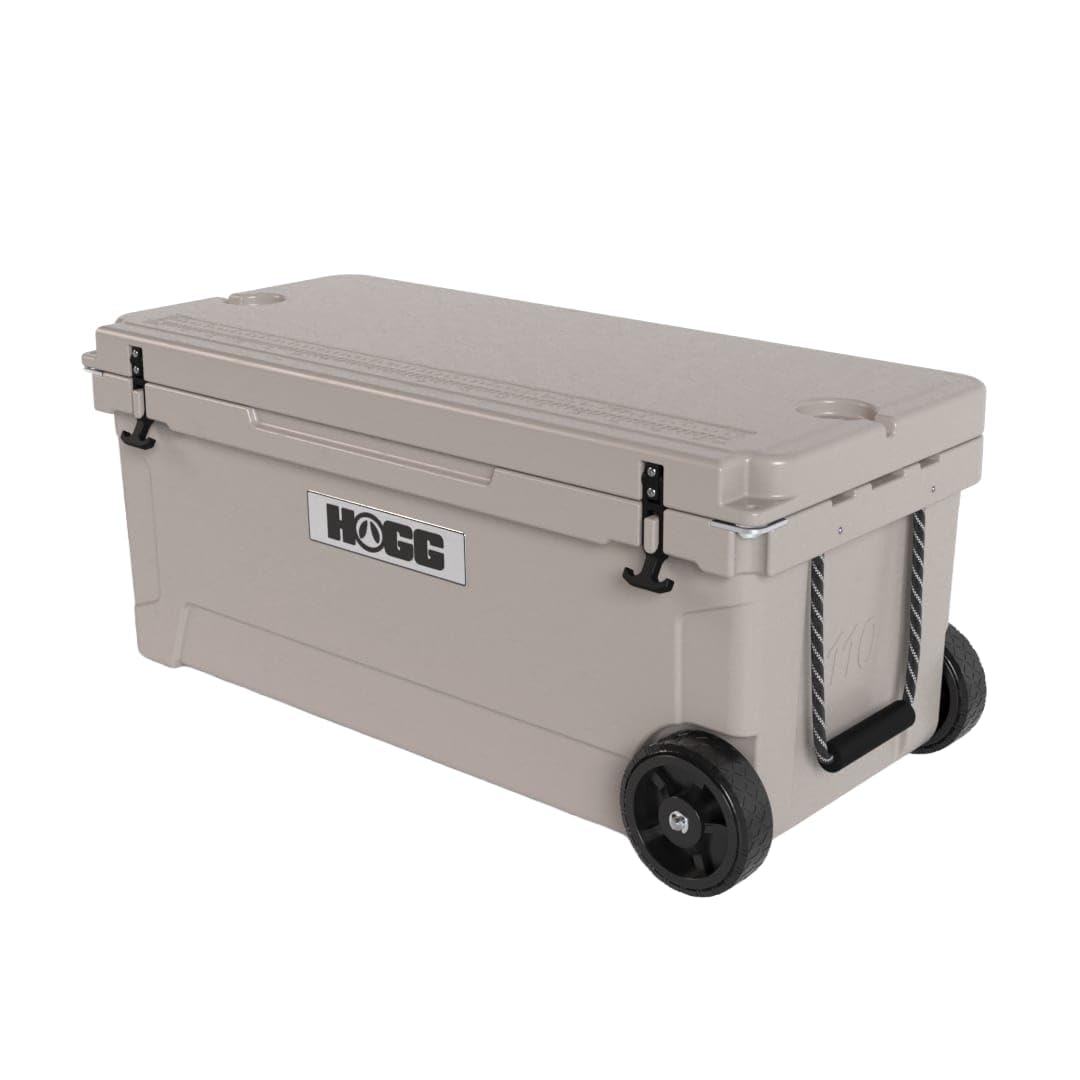
The 110-quart roller built for serious group hauls — fishing trips, hunting camps, and big tailgates where you need capacity without breaking your back.
Hogg’s rotomolded cooler uses pressure-injected commercial-grade polyurethane double-wall insulation and a durable Low Density Polyethylene shell. The cooling quality is the top aspect at 33 mentions, with ice capacity at 24. At 110 quarts, it is the first cooler on this list that truly needs wheels — and it has them. The wheeled design, built-in cup holders, drain hole, and included dry storage basket, divider, and bottle openers make it a complete package for large groups. Owners say it keeps items cold for “a couple of days” during camping trips and praise the compartments and cutting board divider for keeping food separated. One owner compares it directly to a Yukon 110 cooler, noting that this one adds the divider and basket that the Yukon lacked. The Dune Kiss color option is more stylish than the usual camo or gray.
The honest catch: durability is the most mixed aspect (15 mentions), with some owners reporting broken wheels on arrival or after limited use. One negative review states the wheel was broken when it arrived and the seller did not respond for two weeks. The ice retention is also not as extreme as the Blue Coolers or Pelican above — most owners mention “a couple of days” rather than a full week, though pre-cooling improves it significantly. At 4.2 stars with 149 ratings, it has the lowest score and fewest reviews in this lineup, so it carries slightly more uncertainty. For the right buyer — someone who prioritizes size and wheels over absolute ice longevity — it is a solid value for a 110-quart rotomolded cooler.
Why it stands out
- 110-quart capacity with wheels — the largest wheeled option here
- Comes with dry storage basket, divider, and cutting board
- Built-in cup holders and bottle openers
Heads-up
- Some customers note wheel durability issues
- Ice retention is good, not great — expect a few days, not a full week in extreme heat
Who it serves: Large groups, fishermen, and tailgaters who need 110 quarts on wheels and appreciate the included organizing accessories.
Who should think twice: Anyone who needs guaranteed 7-day ice retention in hot weather or wants a cooler with a proven long-term track record.
5. Blue Coolers Ark Series 100-110 Quart Cooler

The big box that edges past a week with 2 inches of insulation and a 10-day ice retention promise — the closest thing to a 10-day cooler at a non-Yeti price.
Blue Coolers positions the Ark Series for the “professional high volume user.” At 100 quarts (or 110 with wheels), this is a stationary cooler — the manufacturer explicitly says not to try moving it without emptying it first. The quality and ice retention are the top aspects at 28 and 25 mentions each. The maker claims up to 10 days of ice retention. One owner in 80-90°F sun confirms ice lasted 6 days, with drinks staying cold for 7. Another reports 4 days in 100°F+ Texas sun. The rotomolded construction with High Density Polyethylene (HDPE) includes non-skid feet, a lockable lid, a freezer-style gasket, sure-grip handles, a rapid drain system, and high-quality wheels on the wheeled version. Included accessories are a cooler, drain cap, and utility port. The lid doubles as a ruler for measuring catches up to 20 inches — a thoughtful touch for anglers. At 38 pounds, it is the heaviest cooler on this list, and owners repeatedly describe it as a beast. Compared to the 70-quart Pelican, this has 30 quarts more capacity but weighs 4.71 pounds more and costs slightly less.
The key trade-off: one owner in extreme Texas heat (100°F+) reported the lid warped after 3 days in direct sun, which could compromise the seal over time. Another said the handle made a one-time crunching sound. Despite these isolated reports, the overall positive sentiment is strong — 4.6 stars across 208 ratings. The Blue Coolers Ark is the pick for anyone who needs to keep a huge amount of food and drink cold for a full week-plus, and who has a vehicle (or a buddy) to help move it.
The ice vault: 25 owners praise ice retention, with real-world reports of 6-7 days in summer heat — this is the closest you will get to a 10-day cooler at a non-Yeti price.
The weight reality: At 38 lbs, this is a strap-it-down cooler, not a carry-it-around cooler; the manufacturer tells you flat out not to move it full.
Who needs this: Large families, hunting camps, and serious fishermen who need 100 quarts of capacity that stays cold for a full week or more, and can be left in place.
Not for: anyone who needs a portable cooler they can lift solo or who regularly parks their cooler in direct desert sun for days.
6. Coastland Delta Series 125 Quart Rotomolded Cooler

The 125-quart rotomolded mammoth that gives you the most cubic feet per dollar — 125 quarts at only 29 pounds, the best capacity-to-weight ratio here.
Coastland’s Delta Series is the largest cooler in this roundup at 125 quarts, holding 31 gallons. The manufacturer rates it for 7-10+ days of ice retention. It has insulated walls, heavy-duty rubber latches, a freezer-grade lid gasket, a rope and molded handle system, a high-flow drain, and a thick no-skid rubber foot pad. Quality and durability are the top aspects at 22 and 18 mentions each. Owners who pre-chill and use a 60/40 block-ice ratio report 6+ days of ice. The lid has a built-in ruler for measuring fish up to 20 inches. At 29 pounds, it is surprisingly light for a 125-quart rotomolded cooler — that is 9 pounds lighter than the 100-quart Blue Coolers. The delta in weight comes from the polyethylene insulation material rather than the heavier polyurethane foam, which may also explain the mixed ice retention feedback. That makes it easier to lift than the Blue Coolers, but harder to fill with confidence for a week-long trip.
This is the cooler where you should set expectations honestly: ice retention is the most mixed aspect (15 mentions), with some owners reporting only 2 days of ice in 70°F weather when accessed 2-3 times a day. The sealing mechanism also gets mixed feedback. One owner praises the excellent construction and seal, saying it matches pricier roto-molded coolers. Another says it “didn’t hold ice in 70 degree weather as long as advertised.” The difference depends on pre-chilling, block ice vs crushed ice, and how often the lid is opened. If you follow best practices — pre-chill the cooler, use block ice, keep it in the shade — this 125-quart beast is incredible value. If you want a cooler that tolerates careless use, the Pelican is a safer bet.
Why it stands out
- 125-quart capacity at only 29 lbs — the best capacity-to-weight ratio on this list
- Lifetime warranty support from the manufacturer
- Owners who pre-chill and use block ice get 6+ days of ice retention
The catch
- Ice retention is variable — some owners get only 2 days in 70°F weather
- No included divider or basket (unlike the Hogg or ENGEL)
Best for: large-volume buyers who are willing to learn proper pre-chilling and ice management to boost performance.
pass on it if: you want guaranteed 7-day ice retention without any special preparation or if you need the included organizing accessories.
Understanding the Specs
Rotomolded vs Injection-Molded
Rotomolded coolers are made by spinning plastic powder in a heated mold, creating a thick, single-piece wall with no seams. That smooth construction is why they hold ice for days — there is no path for warm air to sneak in. Injection-molded coolers are made by injecting plastic into a two-part mold and then welding the pieces together. The ENGEL cooler on this list uses injection molding but still claims 7-day retention through its advanced closed-cell foam insulation, while being much lighter. Rotomolded is generally more durable and better for extreme conditions; injection-molded wins on portability and price.
Quart Capacity and Real-World Space
A 60-quart cooler holds about 40 cans with a 2:1 ice-to-contents ratio, or roughly 50 pounds of ice alone. The stated volume is the interior space, but you will fill a third of it with ice. For a weekend trip for two, 60 quarts is comfortable. For a family of four on a week-long trip, you want 100 quarts or more. Keep in mind that a larger cooler is exponentially harder to move when full — a 100-quart cooler filled with ice and food can easily exceed 100 pounds.
Insulation Thickness and Material
The two types of insulation you will see are polyurethane foam and polyurethane (PE) foam. Polyurethane foam is denser and heavier, with better insulating properties per inch — that is what the Pelican and Blue Coolers use. PE foam is lighter but less effective, which is why the Coastland cooler has mixed ice retention despite its large size. A 2-inch layer of polyurethane foam is the standard for 7-day coolers; the Xspec goes to 3 inches for extra margin.
Freezer-Grade Gasket and Latches
The lid gasket is what actually stops warm air from entering. A freezer-grade gasket is flexible, magnetic or compression-based, and designed to seal even if the lid is slightly uneven. Heavy-duty latches — either rubber or metal — hold the lid tight against the gasket. Rubber latches are quieter and less prone to rust; metal latches are stronger but can corrode in saltwater environments. A pressure relief valve (found on the Xspec) is a nice addition: it lets you release trapped air so the lid seals tighter as the cooler cools down.
FAQ
What makes a cooler hold ice for 7 days?
How many quarts do I need for a week-long camping trip?
Are cheaper rotomolded coolers as good as Yeti?
Will a 7-day cooler work in 100°F weather?
Can I use dry ice in these coolers?
How do I clean and maintain a rotomolded cooler?
Are these coolers bear-resistant?
Does a white or light-colored cooler help with ice retention?
What is the difference between a 60-quart and a 100-quart cooler for a family trip?
Which cooler on this list is the easiest to carry?
Final Thoughts: The Verdict
If you want one dependable pick, the best 7 day cooler is the Pelican 70 Quart Elite because it combines proven 4-7 day ice retention with a US-made lifetime guarantee and the strongest owner consensus on the list. If you want better portability without sacrificing ice life, grab the ENGEL 60 QT Ultra-Light — it weighs about 10 pounds less than any rotomolded competitor while still delivering 7-day performance in moderate conditions. And for maximum capacity on a budget, the Xspec 60 Qt Roto Molded gives you 3 inches of insulation and dry-ice compatibility at a price that undercuts the premium brands by hundreds of dollars. Whichever you