
Our readers keep the lights on and my morning glass full of iced black tea. As an Amazon Associate, I earn from qualifying purchases.
Specs are compiled from manufacturer listings and verified buyer reviews and can change over time — please confirm the key details on the product page before buying.
Cutting a 7-inch circle is one of the more stressful jobs you can hand a drill, and the wrong saw turns a clean ceiling cut into a torn, splintered mess that takes hours to patch. This guide breaks down five very different ways to make that big hole, from diamond-coated glass cutters to carbide-tipped metal eaters, so you can match the tool to the material you actually drill.
I’m Min — the founder and writer behind Gadgets Feed. This guide is built by comparing the manufacturers’ published specifications and the patterns across verified customer reviews, so you get each pick’s real strengths and trade-offs instead of marketing spin.
Whether you are chasing a 7 inch hole for recessed lights or a plumbing flange, these five approaches cover wood, steel, tile, and drywall with honest trade-offs.
Our Picks at a Glance


How To Choose The Best 7 Hole Saw
Before you buy, figure out what you are actually cutting. A saw that chews through steel will destroy a porcelain tile, and a diamond-coated cutter meant for glass will not last a second on a steel plate. Match the blade chemistry to the material, then worry about the drill.
Match the cutting edge to your material
Diamond-coated saws are for hard, brittle surfaces like glass, marble, tile, and granite — they grind rather than cut. Carbide-tipped teeth handle hard metals, stainless steel, iron, and aluminum. Bi-metal blades are the generalists, slicing through wood, plywood, plastic, and soft metal sheets. Pick the wrong family and you will burn out the teeth in one hole.
Check your drill’s power and speed
A 7-inch saw is a lot of circumference for a drill to spin. Several owners note that heavy cutting can burn out cheap battery drills, so a corded or plug-in drill with a 1/2-inch chuck is the safer bet for thick material. On brittle surfaces, slow speed with water cooling is the standard technique to keep the edge alive.
Quick Comparison
| Model | Best For | Cutting Edge | Teeth | Best Material | Amazon |
|---|---|---|---|---|---|
| JINGLING★ Best Overall | Tile, glass & granite | Diamond coated | — | Ceramic, Glass, Marble | Amazon |
| AcekitBest Value | Wood, plywood & plastic | Bi-metal HSS | 12 | Wood, Plastic, Soft Metal | Amazon |
| cenyb | Hard metal & stainless | Tungsten carbide | 40 | Steel, Iron, Aluminum | Amazon |
| GUICGOC | Thick steel plate | Carbide steel | — | Stainless, Iron, Wood | Amazon |
| Jonard Tools | Drywall & speakers | Adjustable cutter | — | Plywood, Sheetrock, Acrylic | Amazon |
In-Depth Reviews
1. JINGLING 175mm Diamond Hole Saw
Our pick — over 4.5★ from 500+ verified ratings; the strongest balance of quality and price.
The diamond-coated specialist that makes clean holes in glass and granite without burn marks.
This saw grinds through the hardest household surfaces — glass, marble, tile, and granite — thanks to its diamond coating on high carbon steel. The 175mm (7 inch) outer diameter pairs with an inner diameter of 171mm and a 25mm drill depth, so it takes on the brittle materials that wreck standard toothed blades.
There is no center pilot drill on this one, so the technique matters — you start at a 45-degree angle to the surface, then straighten to 90 degrees as the hole forms. Buyers report it cuts granite countertops “like butter” and delivers a clean, smooth result that needs no further finishing work. Use water as a lubricant and slow the drill speed right down.
The durability question is the honest trade-off here. Some owners see no wear after repeated cuts, while others are unsure it will hold up to constant daily use. It is a tool built for a job or a handful of holes, not a production line. When it works, the results are striking — owners mention drilling 1/2″ glass at 60rpm for 49 minutes to produce the cleanest hole they had ever cut, saving a tank replacement.
What owners rave about
- Cuts through granite countertops and ceramic floor tiles cleanly
- Smooth, clean results that need no further finishing
- The bit enters cleanly with no wobble and no back-side blowout
What to know before buying
- Long-term durability for constant daily use is unproven
- No center pilot drill, so you need a careful start at 45 degrees
- The blade size is not a standard size, drawing mixed feedback
The crowd favorite: If your project is tile, glass, marble, or granite, this diamond-coated saw delivers the cleanest cut of the group.
The honest limit: Treat it as a precision tool for a few key holes, not an everyday workhorse.
2. Acekit 7 inch Bi-Metal Hole Saw
The budget-friendly generalist that surprises owners with its appetite for big clean holes.
Built from M42 high speed steel with a bi-metal construction, this saw carries 12 teeth on a variable tooth pitch that keeps cutting fast and precise through wood, plywood, laminated boards, PVC, plastic pipe, and ceiling board. The four slots along the side quickly clear the chipped material so you are not fighting a clogged blade on every rotation.
The 7/16 inch hex shank arbor uses pins to lock the saw in place, which stops the threads from stripping under heavy load, and it fits 1/2 inch drills. It ships with an Allen wrench plus two extra strengthened drill bits so you have spares ready for long jobs. Customers note two clean holes in 3/4″ plywood with the second as easy as the first, which is the mark of a blade that is not single-use.
Quality is what wins people over here, with durability and sharpness drawing mixed notes. Some find it very strong and sharp; others say it gets dull easily, and one owner saw the blade dull and burn through soft wood on a long run. The weight is the other consideration — at 1.58 kg it is heavy, so it performs best in a drill press, and a hand drill needs real power behind it. One owner put it bluntly: heavy material can burn out cheap battery drills, so use a plug-in drill for the tough stuff.
Where it shines
- Better quality than expected for the price point
- Two clean holes in 3/4″ plywood, second as easy as first
- Cuts through metal as well as thick wood
Where to be careful
- Best used in a drill press due to the weight
- Durability and sharpness get mixed feedback over time
- Heavy cutting can burn out cheap battery drills
Reach for this if: You need a reliable big-hole saw for wood, plywood, and plastic without spending premium money.
Look elsewhere if: Your daily work is hard metal — the carbide specialist above holds an edge longer.
3. cenyb 178mm Tungsten Carbide Hole Saw
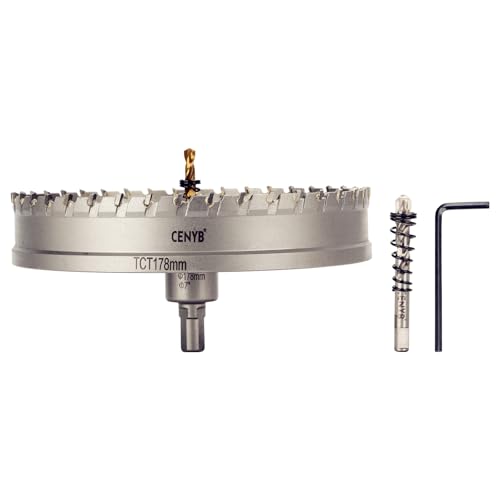
The metal eater with 40 teeth that slices through steel plate faster than its rivals.
This saw brings 40 carbide teeth to the fight — over three times the tooth count of the bi-metal Acekit above, which carries just 12. That density is why owners describe it cutting through mild steel “like butter” while creating clean holes at speed. The 178mm (7″) cutting diameter pairs with a 25mm (1″) hole saw depth, so it handles steel plates and square tubes with authority.
The tungsten carbide tipped construction uses a unique three-blade design — outer, middle, and inner blades working together for sharper, more efficient cutting on hard metals, stainless steel plates, iron, cast iron, and aluminum alloy. It works with bench drills, magnetic drills, and gun drills, and ships with two titanium-plated pilot drill bits plus a hex wrench in a plastic box.
The critical spec to remember: this saw cannot touch concrete, tiles, or stone — that is the diamond-coated JINGLING’s job. Durability is the main mixed note here, with some owners saying it lasts a long time while others report tips breaking off on contact with material. Reviewers point out the 1-3/8 bit cut a nice clean and true hole in aluminum, and one owner praised the thick, sharp carbide for lasting much longer than a steel tooth version.
Why it leads on metal
- 40 teeth for fast, clean cuts through hard metal
- Three-blade design adds sharpness and efficiency
- Works with bench, magnetic, and gun drills
The limits
- Cannot be used on concrete, tiles, or stone
- Durability is mixed — some report tips breaking on contact
The standout spec: 40 teeth versus the bi-metal’s 12 — that is the gap that makes hard metal cutting feel easy.
The caveat: Keep it away from masonry and tile, or the carbide tips will pay the price.
4. GUICGOC 185mm Metal Steel Hole Saw
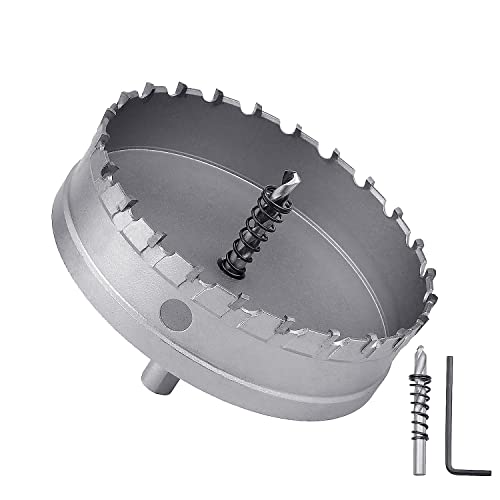
A slight size up at 185mm that cuts through 1/2 inch steel with surprising speed.
At 185mm (7.3 inch), this saw’s cutting diameter is 7.3 inches, not 7 inches, and it is aimed squarely at thick metal — stainless steel, aluminum alloy, iron, and wood. The carbide steel and alloy steel construction suits a hand-held electric drill or a CNC drilling machine, giving it flexibility across job sites.
Sharpness is a clear strength, with buyers reporting it cut through 1/2 inch steel in about 20 seconds, and one tiny home builder described it as working on steel like a knife through butter. It also earns praise for clean, accurate holes on FRP and GRP boxes with minimal fine dust and near-perfect circles, avoiding the shattering and rough breakouts common with wood hole saws.
The honest catch is durability. Several shoppers say the carbide tips breaking off after the second hole, even while the main cutting part stays sharp — one builder noted the pilot bits broke but the cutting ring remained as sharp as day one. The fit can also be finicky, with some chatter and binding on a drill press until you get past 75 percent of the hole depth. It is a tool that rewards slow, oiled, deliberate cutting.
The strengths
- Cuts through 1/2 inch steel in about 20 seconds
- Clean, accurate holes on FRP and GRP boxes
- Sharp and well-suited to the task at hand
The trade-offs
- Several buyers report carbide tips breaking off after the second hole
- Chatter and binding on a drill press below 250 rpm
Best if: You need a handful of clean holes in thick steel or fiberglass boxes and can cut slowly with oil.
Think twice if: You plan on daily production cutting — the tip breakage reports make that a gamble.
5. Jonard Tools AHC-10 Adjustable Hole Cutter
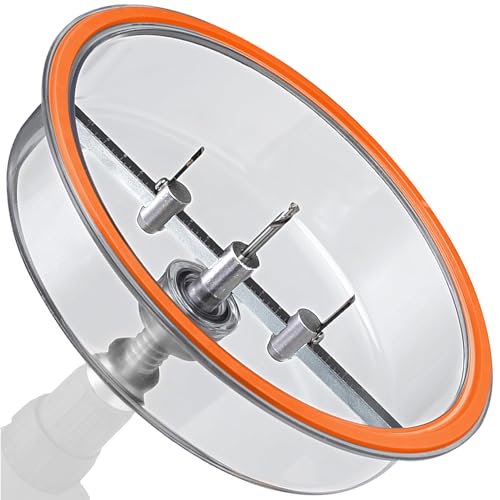
The drywall specialist that adjusts from 2.2 to 10 inches and catches every bit of dust.
This is a different animal from the fixed-size saws above — the AHC-10 adjusts to cut holes from 2.2″ up to 10″, and it cuts through plywood, sheetrock, plasterboard, and acrylic sheet up to 1 1/16″ thick. The adjustable hex locknut and compression spring let you dial in any size in that range, so one tool replaces a whole drawer of fixed saws for ceiling lights and speakers.
The defining feature is the polycarbonate transparent dust shield, which collects dust and stops chips flying into your eyes while cutting. Owners mention cutting 50+ holes for lights and speakers with the mess kept to a minimum, and one installer cut four ceiling holes in about five minutes for 8-1/4″ speakers with no tarp needed afterward. The rubber gasket seals tight against flat surfaces and protects the surface from damage.
It works with any variable speed drill, including a Dewalt 20V cordless, and ships with a rugged case plus two extra blades. Durability draws some mixed notes, and a few owners feel the price runs high for a tool likely made in China. But for anyone placing multiple recessed lights or speakers in drywall, the time saved is the real story — owners describe saving roughly 14 minutes per speaker and a whole lot of cleanup.
What makes it worth it
- Adjustable from 2.2″ to 10″ covers nearly any ceiling job
- Dust shield keeps drywall mess to a minimum
- Cuts through everything including lath and plaster
The honest notes
- Durability feedback is mixed over time
- Some owners feel the price runs high
The premium play: If you are installing multiple lights or speakers, the dust containment alone pays for the time saved.
The hesitation: For a single hole in drywall, a fixed-size saw gets the job done for a fraction of the cost.
Understanding the Specs
Tooth count and cutting speed
More teeth mean faster cutting and a smoother finish, but they also mean more friction and heat. The carbide cenyb packs 40 teeth versus the bi-metal Acekit’s 12, which is why the carbide saw slices through steel quickly while the bi-metal needs a slower, more deliberate pace. For hard metals, higher tooth count wins; for wood and plastic, fewer teeth clear chips better.
Cutting edge material
The blade chemistry decides what you can cut. Diamond coating grinds through glass, marble, tile, and granite — the hardest, most brittle surfaces. Tungsten carbide teeth bite into hard metals, stainless steel, iron, and aluminum. Bi-metal blades are the generalists that handle wood, plywood, plastic, and soft metal sheets. Match the coating to your material or you will burn out the edge fast.
FAQ
Can a 7 inch hole saw cut through tile and glass?
What is the difference between carbide and bi-metal hole saw blades?
Do I need a pilot bit for a 7 inch hole saw?
Will a cordless drill handle a 7 inch hole saw?
How fast should I spin a 7 inch diamond hole saw?
Can a 7 inch hole saw cut through stainless steel?
Why does a 7 inch hole saw have mixed durability reviews?
Is an adjustable hole cutter better than a fixed 7 inch saw?
Final Thoughts: The Verdict
For most buyers, the best 7 hole saw is the JINGLING diamond saw because it handles the hardest materials — tile, glass, marble, and granite — that no toothed blade can touch. If you want fast clean cuts through wood and plywood on a budget, grab the Acekit bi-metal. And for serious metal work on steel plate, the cenyb with 40 carbide teeth is the one to reach for.
How We Picked
We do not accept paid placement. Every pick is matched to a real buyer and a real use-case; we do not hands-on test units.
Sources & Methodology
Specifications: manufacturer listings and product documentation. Review insights: verified customer reviews, as of August 2026. Pricing: not shown on this page (it changes often); check the current price via the retailer link.
As an Amazon Associate, Gadgets Feed earns from qualifying purchases. This does not affect which products we feature.