
Our readers keep the lights on and my morning glass full of iced black tea. As an Amazon Associate, I earn from qualifying purchases.
Specs are compiled from manufacturer listings and verified buyer reviews and can change over time — please confirm the key details on the product page before buying.
A chipped porcelain edge can ruin a whole day of tiling. The right 7-inch wet saw blade separates a clean, factory-looking cut from a jagged edge that needs filing. This guide covers blades that deliver smooth, fast, chip-free cuts on porcelain, granite, and glass.
I’m Min — the founder and writer behind Gadgets Feed. This guide is built by comparing the manufacturers’ published specifications and the patterns across verified customer reviews, so you get each pick’s real strengths and trade-offs instead of marketing spin.
We break down the best performers by material, rim type, and value, so you can confidently choose the right 7 inch wet tile saw blade for your next project without wasting money on the wrong one.
Our Picks at a Glance


How To Choose The Best 7 Inch Wet Tile Saw Blade
Match the blade to the material you cut most. A blade that excels on soft ceramic may chip on dense porcelain, so let your primary material drive the choice.
Match the Rim to the Material
Continuous rim blades have a smooth, unbroken edge and are the go-to for porcelain, ceramic, and glass because they produce the cleanest, most chip-free cuts. Turbo rims add a serrated or mesh pattern for faster cutting, but they prioritize speed over the absolute smoothest edge.
Prioritize Blade Thickness and Stability
A thinner blade removes less material, which means less resistance and a cleaner cut, but it can also be more prone to flexing. A laminated center hub or a thicker core adds stability, helping the blade run straight and true for precise cuts without wobble.
Check Your Arbor Size
The arbor is the hole in the center of the blade that fits onto your saw’s spindle. Most 7-inch wet saws use a standard 5/8-inch arbor, but some blades come with a removable bushing to fit other sizes like 7/8-inch. Always verify your saw’s arbor size before buying.
Quick Comparison
| Model | Best For | Rim Type | Rim Height | Weight | Amazon |
|---|---|---|---|---|---|
| PEARL P4 Thin Mesh Turbo★ Best Overall | Fast, clean cuts on hard porcelain | Thin Mesh Turbo | 10 mm | 13.12 oz | Amazon |
| OSTEK Super Thin DiamondBest Value | Budget-friendly precision cuts | Super Thin | — | 0.39 kg | Amazon |
| OSTEK 7″ Diamond Wet SawBudget Champion | Value pick for thick porcelain | Thin Turbo-Mesh | 10 mm | 0.39 kg | Amazon |
| Delta Diamond Piranha | Versatile dry or wet cutting | Continuous Rim | — | — | Amazon |
| Casaverde Turbo Diamond | Heavy-duty granite fabrication | Turbo | 8 mm | 0.54 kg | Amazon |
| QEP Continuous Glass Tile | Clean cuts on glass tile | Continuous Hi-Rim | 7 mm | 9.6 oz | Amazon |
| QEP Black Widow | Smooth cuts on porcelain | Thin Continuous | 7 mm | 11.04 oz | Amazon |
| Diablo Continuous Rim | Smooth, burn-free cuts on tile | Continuous Turbo | — | 2.4 oz | Amazon |
| MK Diamond Hot Dog | Thin, precise cuts on hard tile | Thin Rim | — | 7.2 oz | Amazon |
In‑Depth Reviews
1. PEARL Abrasive P4 Thin Mesh Turbo Porcelain Blade
Our pick — over 4.5★ from 950+ verified ratings; the strongest balance of quality and price.
The professional-grade favorite that powers through dense porcelain with minimal chipping.
If you are a contractor or a serious DIYer dealing with hard, brittle porcelain, this is the blade that wins people over. Its defining feature is a full 10mm tall diamond rim, which delivers a long tool life by giving you more diamond to wear through before the blade gives up. The thin blade kerf (the width of the cut) is engineered to cut fast with little to no chipping, making it perfect for materials that are prone to breaking off at the edge.
The thin kerf and mesh rim reduce heat buildup, easing stress on blade and tile. The thin kerf and mesh pattern rim reduce heat buildup, which lessens stress on both the blade and the tile you are cutting. A laminated center hub reinforces the blade core for straighter, more precise cuts, so you are not fighting the blade to keep a line true. Owners praise its cut quality, reporting it slices tile “like butter” and navigates curves around fixtures with ease.
Longevity is debated: some report wear after 80% of life, others after eight full bathroom remodels. Some buyers report the blade degrades after about 80% of its life, while others have used it for eight full bathroom remodels and thousands of square feet and say it is still going strong. The value is also a point of disagreement — some call it the best for the price, others find it overpriced. Weigh the premium cost against the speed and finish it delivers.
thin mesh turbo
- 10mm diamond rim for extended blade life
- Extra thin kerf reduces chipping on brittle tile
- Laminated hub keeps cuts straight and stable
pricey option
- Premium price that not everyone agrees is justified
- Some owners mention wear after heavy use
best for porcelain: you need fast, clean, reliable cuts on hard porcelain and stone for professional or large-scale work.
look elsewhere if: you are a casual DIYer on a tight budget and can accept slightly more chipping for a fraction of the cost.
2. OSTEK Super Thin Diamond Saw Blade for Porcelain Tile
An ultra-thin blade that slips onto a Ridgid saw and cuts porcelain straight and fast for a low price.
This OSTEK blade proves you do not need to spend a fortune for a clean cut. Its super-thin profile is just 1.6 millimeters thick, which is dramatically slimmer than the 10-millimeter-thick Pearl blade, meaning it removes less material and cuts with less resistance. This makes it an excellent match for hand-held machines and angle grinders where you want speed without bogging down the motor.
You can cut dry or wet across porcelain, ceramic tile, granite, sandstone, and quartz with this blade. The X-teeth design (a tooth pattern that bites into hard materials) is meant to deliver fast, smooth cuts, and owners confirm it handles daily wet-saw use well—one notes it cuts “porcelain super straight and super fast.” At 0.39 kg, it is light enough to keep your tool easy to handle without adding extra strain.
The trade-off is the cut finish. It is fast, but at 8500 rpm (revolutions per minute, or how fast the blade spins) it can be “fast but not clean cut”—not as smooth as a continuous rim blade on a wet saw. Durability gets mixed feedback: some find it very durable, others report chipping after a while. For the price, it is a solid entry-level option that delivers more than you might expect.
super thin value: You get a performance-focused, ultra-thin blade that rivals pricier models for a fraction of the cost, making it the smart pick for budget-conscious DIYers and pros alike.
3. OSTEK 7″ Diamond Blade Wet Saw Tile Cutting
A bargain blade that cuts through thick porcelain like a hot knife through butter.
This OSTEK offering is the budget champion that delivers surprising performance on the toughest materials. It features a 10mm rim height — the same tall diamond rim as the premium Pearl blade — which means you get a long cutting life and increased contact with the material for faster cutting. The thin turbo-mesh rim and core are designed for fast cutting with minimal chipping.
Owners have used it in a skill saw for tiles too large for their tile saw, and the results were impressive: thick porcelain gets cut “like a hot knife through butter” with beautiful edges that barely need filing. It fits most tile saws and angle grinders with a 7/8-inch or 5/8-inch arbor. At just 0.39 kg, it is lightweight and easy to maneuver. The blade quality and cutting performance are the most praised aspects.
The honest catch is durability. While some customers note it lasts long, others note it starts to chip after extended freestyle use in an angle grinder. The thin rim can flex if you don’t use a saw guide. For the price, one owner tiled an entire shower with a single blade and said it cost half of what a brand-name blade would — that’s the value proposition in a nutshell.
wet saw workhorse: For a fraction of the cost of premium blades, you get professional-grade cut quality on porcelain that makes this the clear budget pick for value hunters.
4. Delta Diamond Piranha Premium 7 Inch Tile Blade
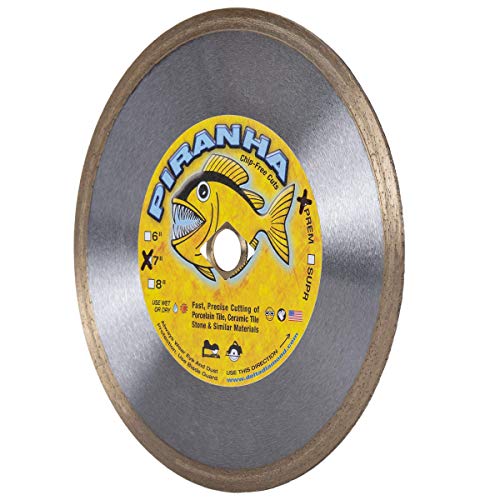
A continuous rim blade that handles wet or dry cutting across a huge range of materials.
Delta’s Piranha is the flexible all-rounder of this list. It is engineered with higher levels of diamond for professional use and a continuous rim design that promotes smooth, chip-free cutting on porcelain, ceramic, marble, and granite. Unlike many specialist blades, it is rated for both wet and dry cutting, so you can move it between a wet tile saw and an angle grinder without hesitation.
It comes with a 5/8-inch preinstalled bushing and a 7/8-inch option, and fits basically any hand-held angle grinder, circular saw, tile saw, or trim saw. The max safe speed is 8,730 RPM. Quality and cutting performance are what owners praise most, with the blade cutting through hard agate and petrified wood “like it would cut through anybody else’s saw” and handling a 48-inch marble countertop cut with minimal dust.
The trade-offs are real. Some reviewers point out the blade wobbling and the mounting insert falling out, so check the bushing is seated firmly. Chipping on porcelain can be an issue, especially at 45-degree miters, but for straight cuts it is generally clean. Durability is a mixed bag — some say it lasts through about 40 cuts, others report it breaking on first use. The lifetime warranty against warping and cracking is a nice safety net.
premium choice: the multi-material user who wants one blade that can do dry and wet cutting across porcelain, granite, and even rocks.
skip on budget: the mounting bushing needs a firm seat, and heavy miter cuts on porcelain may chip more than a dedicated continuous rim blade.
5. Casaverde 7″ Turbo Diamond Blade with 5/8-11 Thread
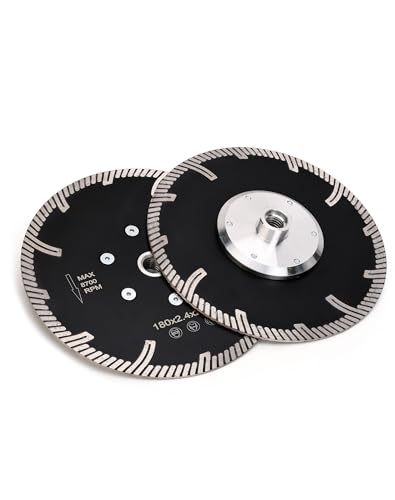
A turbo blade built for granite fabrication, with protective teeth to prevent undercutting.
This Casaverde blade is a real time saver for professional stone fabrication, specifically engineered with a high diamond concentration for extra long life on hard stone. It has an 8mm rim height and protective teeth designed to prevent undercutting — that’s the unwanted chipping at the bottom edge of the cut. It works for dry and wet use, though it performs better with water.
Cutting performance is the standout here. Shoppers say slicing through up to 9 feet of 1-inch thick granite with clean results, and one user enlarged a hole in a 3-centimeter-thick black granite countertop for a new cooktop with excellent results. At 0.54 kg, it is heavier than the PEARL P4 Thin Mesh Turbo (0.39 kg), reflecting the sturdy alloy steel construction and larger diamond concentration built for demanding work.
The honest downside is that it is a specialist tool. One owner noted it is great for fine material removal and polish prep but “not for heavy material removal.” Some owners also expected two blades based on the pictures but received only one. Durability gets mixed feedback, though the blade still looked new after cutting 2 feet of 1-1/4 inch granite. This is the pick for stone counters, not general tile work.
threaded mounts: your daily work involves cutting granite tops, vanity tops, and other hard stone where a dedicated turbo blade shines.
skip for arbors: you mainly cut soft ceramic wall tile and want a smoother, less aggressive cut finish.
6. QEP 7-Inch Continuous Rim Glass Tile Diamond Blade

The must-have blade for glass mosaic tile that delivers clean, smooth cuts without chipping.
Cutting glass is a different beast, and this QEP blade is designed specifically for it. It features a 7mm diamond-coated cutting edge and a continuous hi-rim design that produces clean, smooth cuts with no chipping on glass tiles. It’s rated for wet cutting at speeds up to 8,730 RPM, and the 5/8-inch arbor fits most brands of wet tile saws.
The performance is what owners praise most, with one user cutting through 100+ beer bottles and 20+ wine bottles without the blade stalling, producing clean, chip-free cuts. It’s a huge improvement over a regular tile blade on 1-inch glass tiles, and it handles thin trim pieces effectively. The blade also sprays more water than other blades, which helps keep the cut cool and clear.
The trade-off is that it’s slower than cutting regular ceramic tile, and the edges of glass cuts may need sanding with a few grits to finish. There’s also a recurring note about centering — several buyers report the arbor hole is not perfectly centered, which can cause vibration. For glass, mosaic, and bottle-cutting projects, this is the specialist to grab.
glass tile specialist: If your project involves glass mosaic or decorative glass tile, this blade is the clear choice for clean edges, even if it means slower cuts and some edge finishing.
7. QEP 7″ Black Widow Premium-Grade Thin Rim Diamond Blade

A thin-rim blade with laser cutouts that prevent wobble and keep the blade cool for a longer life.
QEP’s Black Widow is a premium-grade, thin-rim blade built for fast wet cutting of porcelain, ceramic, granite, and marble tile. Its unique diamond-shaped laser cutouts serve a dual purpose: they prevent blade wobble and keep the blade cooler, which directly translates to a longer life and straighter cuts. The 7mm rim height provides increased cutting contact with the material.
Blade quality and cutting performance are what owners rave about. It cuts porcelain “like going thru butter” and leaves smooth edges, even making a cheap tile saw cut great. The thin continuous rim reduces chipping, and owners mention it compares favorably to blades costing significantly more, with one noting it “outperforms expensive brands” while lasting through more than one bathroom remodel.
The recurring gripe is durability — some customers note it wears out quickly and can chip tiles after extended use, while others report it lasts and doesn’t damage tiles. For the price, it is a strong performer that delivers professional results without the professional price tag.
thin cuts: you want a premium thin-rim blade that prevents wobble and delivers fast, chip-free cuts on porcelain and ceramic.
skip for thick: durability is a mixed bag, so treat it gently and keep it wet to boost its life.
8. Diablo Diamond Continuous Rim Masonry Cut-Off Disc
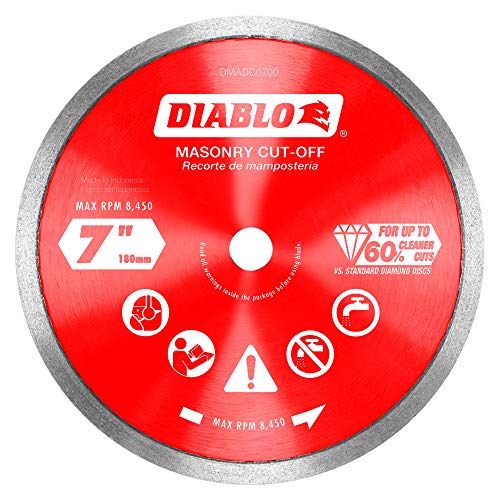
A Diablo disc that lives up to the brand name with smooth, burn-free cuts on tile and stone.
Diablo’s reputation for quality shows in this continuous rim masonry disc. The manufacturer claims up to 60 percent smoother cuts with chip-free edges on tile, granite, marble, and porcelain. The industrial-grade diamond rim with a hardened disc body delivers lasting durability even in extreme applications.
This blade’s ultra-thin constant contact continuous turbo rim (a rim that stays in touch with the material for smooth, fast cuts) is designed for precise, high-speed work. It supports a maximum RPM of 8,450 and works for both dry and wet cutting. Owners praise its performance: one notes it “cuts brick like butter” on a patio project with about 1000 brick pavers, and another reports it sliced through porcelain tile “like butter” with clean cuts and minimal chipping on a big bathroom job.
The main caveat is durability — some reviewers point out it doesn’t last quite as long as expected, though they still consider it a good value. It is light at just 2.4 ounces, which is easy on your grinder’s motor. If you want a trusted brand with a smooth cut, this Diablo is a safe bet, but it doesn’t quite match the longevity of the Pearl or MK Diamond blades.
smooth edges: the buyer who trusts the Diablo brand and wants a smooth, chip-free cut across tile, brick, and stone with a lightweight disc.
skip for speed: expect good performance but not class-leading longevity — it may wear faster than thicker premium blades.
9. MK Diamond 7″ MK-225 Hot Dog Premium Thin-Rim Blade

A thin-rim blade with stiffening slots that guarantees straight cuts on dense porcelain.
The MK Diamond Hot Dog is the precision pick, designed explicitly for porcelain and hard vitreous tile while also handling slate, limestone, granite, marble, blue stone, and hard quartz. Its defining feature is the thin rim to prevent chipping, combined with stiffening and cooling slots that guarantee straight cutting on dense, hard materials like porcelain. It’s lightweight at just 7.2 ounces, reducing strain on your saw.
Cutting performance is what owners praise most. On a wet saw cutting rocks, it cut the time from 15 minutes to about 2 minutes per piece — a dramatic improvement. It excels on large-format Spanish porcelain, enabling thin 1/8-inch and angle cuts on a QEP 7-inch wet saw. It is flatter than the QEP Black Widow with a thinner kerf, meaning less wobble and finer cuts, making it better for thin cuts and weaker saws.
The honest downside is that it may wear faster than thicker blades, especially on heavy bevel cuts — one owner went through 3 blades on a single project. It can also wander on 45-degree cuts if your saw alignment isn’t perfect. For those who want the cleanest, most precise cut on hard porcelain, this is the blade to reach for.
pro reliability: precision is your priority — you want the flattest, thinnest cut possible on hard porcelain and even rocks.
skip for novices: you have a heavy production workload with lots of bevel cuts—this thin blade may wear faster than a thicker, more sturdy option.
Understanding the Specs
Rim Height and Blade Life
Rim height is the height of the diamond band on the edge of the blade. A taller rim, like 10mm or 7mm, provides more diamond to wear through, which extends the blade’s life. It also increases the cutting contact with the material, allowing for faster cuts. The Pearl P4 and OSTEK 7″ both feature a 10mm rim, while the QEP blades use a 7mm rim.
Blade Thickness (Kerf)
The kerf is the width of the cut the blade makes. A thinner blade, like the OSTEK Super Thin at 1.6mm, removes less material, which means less resistance and a cleaner, faster cut. However, thinner blades can flex more easily, so a stable core or hub is important. Compare that to the Pearl at 10mm thick, which is a much wider, sturdier cut.
Continuous vs. Turbo Rim
A continuous rim has a smooth, unbroken edge and is best for clean, chip-free cuts on brittle materials like porcelain and glass. A turbo rim has a serrated or mesh pattern for faster cutting, but it may leave a slightly rougher edge. Some blades, like the Pearl P4, use a thin mesh turbo design to balance speed and finish.
Arbor Size and RPM
The arbor is the hole in the center of the blade that mounts to your saw. Most 7-inch wet saws use a 5/8-inch arbor, but some blades include a bushing to fit a 7/8-inch arbor. Always check your saw’s specs. Max RPM is the fastest speed the blade is rated for — exceeding it is dangerous. Most blades here are rated around 8,450 to 8,730 RPM.
FAQ
Will a 7-inch blade fit my wet tile saw?
What is the difference between a continuous rim and a turbo rim blade?
Can I use the same blade for wet and dry cutting?
How long should a 7-inch wet tile saw blade last?
What does rim height mean for cutting?
Why does my blade cause chipping on porcelain tile?
Can I cut glass tile with a regular tile blade?
What is the maximum RPM for these blades?
Final Thoughts: The Verdict
For most people, the 7 inch wet tile saw blade winner is the PEARL P4 Thin Mesh Turbo because its 10mm diamond rim and thin kerf (the width of the cut) deliver the best mix of speed, cut quality, and blade life for hard porcelain. If you want clean cuts on glass mosaic, grab the QEP Continuous Rim Glass Tile. And for granite countertop fabrication, the Casaverde Turbo Diamond is the one to reach for.
How We Picked
We do not accept paid placement. Every pick is matched to a real buyer and a real use-case; we do not hands-on test units.
Sources & Methodology
Specifications: manufacturer listings and product documentation. Review insights: verified customer reviews, as of August 2026. Pricing: not shown on this page (it changes often); check the current price via the retailer link.
As an Amazon Associate, Gadgets Feed earns from qualifying purchases. This does not affect which products we feature.